Paul Laurence Dunbar is most often introduced as the first successful Afro-American poet, and I guess I’ve just followed form by starting this post that way. That statement is more-or-less true. I’d suppose a case could be made for the primacy of Phillis Wheatley who published a book of poems with some notice in the 18th century even before American Independence. And then too, there’s the question of success levels. Dunbar was able to publish more than a dozen books, got praised by some white literary critics and established poets. Figures in Afro-American culture put him forward as a leading Black poetic voice: Frederic Douglass, James Weldon Johnson, pioneering Black orchestral composers William Grant Still and Samuel Coleridge-Taylor.
As noted in Anne Spencer’s elegant short eulogy poem linking him with other died-young poets, Dunbar was only 33 when he died. Carl Sandburg was just 6 years younger than Dunbar, Robert Frost was but two years younger — both of those poets survived into the 1960s. Dunbar died in 1906 after being debilitated by illness and a series of personal crises. By the time the Harlem Renaissance came around to start making Afro-American artists chic, Dunbar was more than a decade dead. How much more growth and new circumstances could have accrued for Dunbar!
That we still remember him, that a couple of his poems, “We Wear the Mask” and “Sympathy (I know why the caged bird sings),” survive to be widely read and considered, should be counted as a success.* “The Sparrow” is not as well-known, but I’d note that it both comments on the Afro-American experience and a more generalized human experience.**
“The Sparrow” is a poem about being sent joy, being sent song, being offered the peace of fellowship, being offered something — and being too callous, or too ignorant, or too busied with the things that aren’t joy and song. In the course of this poem, it may be simply drudgery that is keeping the poem’s singer from noting the bird. Even non-unpleasant rote life can obscure those offered gifts. And oh yes, oh yes, it can be fear and prejudice that shuts them out too.
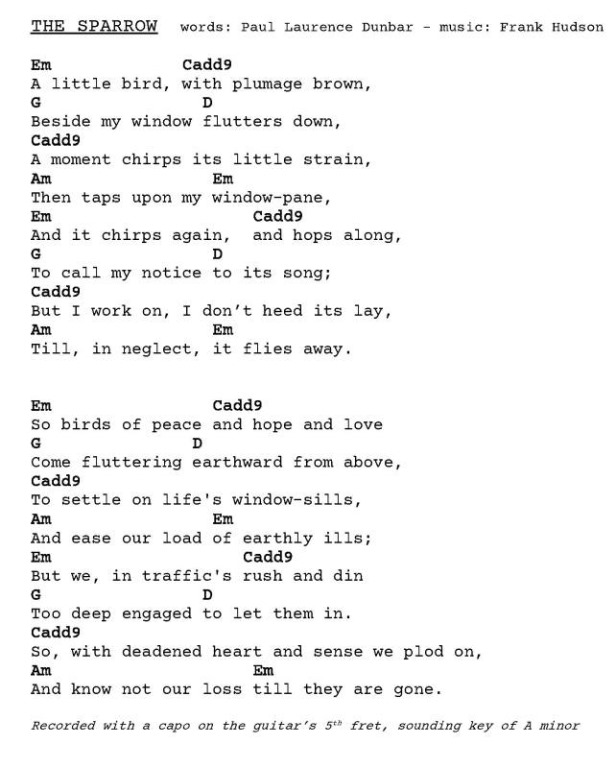
Guitar chord sheet for those that want that want to perform my song setting of Dunbar’s poem.
.
Beyond his remembered poems, I think often of Dunbar’s own life as a sheaf of strong metaphors. His mother was born enslaved. Sensing somehow that her son had a talent as a child, she herself learned to read to help him along, so that eventually that son wrote of that caged bird and of today’s offering sparrow. After publishing his first poetry collection, Dunbar sold it while working at his job as an elevator operator in his hometown of Dayton Ohio. He would offer it to his passengers migrating a few floors up or down inside his elevator cage.*** He grew up in Dayton with a couple of bicycle mechanics, Orville and Wilbur Wright. Orville was his school classmate and helped Dunbar find a publisher for that poetry collection. After eventually attaining some notice for his poetry and public readings of it, Dunbar got a job in the Library of Congress. Around that time his mortal illness was diagnosed as tuberculosis. I read today that he thought the dust of the books in the library made him — the man who could once charm musicians with the way his poetry sung off the page — choke and cough. He descended into his illness and depression for the foreshortened rest of his life. Three years before he succumbed, those bike mechanics made and flew the first airplane, and some of mankind slipped the surly bonds.
Someone had to be the first men to compose flight — but flying or caged, we need to sing, need to hear the singer, even after they’ve flown away. As Dunbar’s “The Sparrow” has it in its ending line we often “Know not our loss till they are gone.”
I composed the music for Dunbar’s poem earlier this week, and dedicated much of today to completing the arrangement you can hear below with the audio player you may see below. No player? This highlighted link will open a new page with its own player so that you can hear it. You may notice that I changed a few words in Dunbar’s poem while singing it. Some of the longer sentences didn’t give the song (or at least this singer) enough space for breath — and where rhyme didn’t demand it, I unconsciously changed a couple bits of the 19th century poetic diction as I strove to bring out the poems meaning as I sung it. That’s generally considered a fault in classical song settings, but I come from a looser folk songwriting tradition where that sort of thing is allowed. Here’s a link to the poem as Dunbar published it with all his words and syntax intact.
.
*To be known for a single poem, to have that carried by others, even in part, in reader’s memory, is an achievement I’d say. I can remember having a discussion with Kevin FitzPatrick some years back when he put forward that Dylan Thomas should be weighed by only being known for one poem — or maybe just that one poem’s refrain. That’s an arguable assessment, but even accepting that, that’s more than many poets, including prize winning-poets, achieve years after their death.
**In dealing with Autism Spectrum Disorder I often think of Dunbar’s poem of Black code-switching to seek acceptance or protection from mainstream white culture, and apply it to the ASD tactic of “masking” to seem more neurotypical. Dunbar’s caged bird never has to say it’s a metaphor for Afro-American experience to Black folks, but caged hopes are not an exclusive experience. I’ll split hairs on thin ice to mix those metaphors re: cultural appropriation vs. cross-over impact.
***Further risking flippancy on my part, it could be argued that the Wright Brothers invented the airplane, but the enterprising Paul Laurence Dunbar invented the elevator pitch.
 Frank Hudson