October November

By title this would be the perfect piece for today, though it does not describe the axis of these months this year in the upper Midwest, which is cold, gray, blustery, and threatening sleet or snow. So, this is not the day or night for sitting on arbor-seats in some garden, and the blazon leaves have already succumbed to a snow storm last week.

But never mind the weather, it’s an early enough poem from Hart Crane to have fallen into public domain, so that I can use it here. “October-November”  shows only a little of Crane’s eventual poetic style, but that means it might be a good way to introduce him.

Hart Crane and the Bridge

Would you like to buy a poem about this bridge? Crane in Brooklyn.

Crane’s just a bit younger than the other early 20th Century modernists, but you can see similarities to some of the branches of modernism we’ve already climbed out on. Like Tzara or the Surrealists he loves extravagant images; but though he is utterly romantic, there’s a certain classicism to many of the images he uses, just as H.D. or Eliot would. On the other hand, like the Futurists, he loves to touch on what was then modern technology. Like Edna St. Vincent Millay or Yeats his music can sound older than his subjects. Crane is a master of Elizabethan-style iambic meter and he doesn’t avoid the old habits of poetic diction. You can even see links in Crane to the original American Modernists: the ecstatic pronouncement of a new world and a new version of humanity like unto Walt Whitman and the concisely packed and puzzling lines of conclusion that Emily Dickinson could use.

But what you see most in Hart Crane, although it’s only hinted at in this early poem written when he was a teenager, is extraordinary, stunning, eloquence at the phrase level, lines with heart-stopping lyricism. Like Shakespeare, Dickinson or the writer of Ecclesiastes, a Crane poem may hold gnomic and gorgeous sounding lines, even if they are as inexplicable as what they sum up. One could write dozens of books or poems with titles taken from lines in Crane poems, though few have done so.

There’s more to say about Hart Crane, perhaps another post that tells about how the Modernists he lived and worked among never fully accepted him, but let me leave that for another day.

“October-November”  is simpler than later Crane, just a pair of images of sun dappling a garden as if it’s still summer followed by a fully delirious autumn night. I sense a growing intensity as this short poem proceeds, and tried to reflect that in the music I composed and played for this one, extending that ecstatic line in the instrumental section at the end.

One last ironic Halloween tie-in: Crane’s father invented Life-Savers, a candy that are now available in a rainbow diversity of sugared flavors that one might find in a ghost’s or skeleton’s bag at the end of tonight; but when invented, Life Savers was more of a breath mint line, successfully sold to cover up the vices of drink and tobacco on the breath. The thing that remains its essence? The round shape, the hole in the center, like the floating ring made to be tossed to a drowning person.

1917_Life_Savers_ad

Like a kid in a candy store. The Crane family business.

In 1932, a 32 year-old Hart Crane vaulted over the railing of the ocean liner carrying him back to New York City. One witness says they looked after, and “saw Crane, swimming strongly, but never again.” Perhaps his leap was too far and his swimming direction away from them, but there is no account of a round, perforated life preserver being tossed in after him before he disappeared and died.

To hear my performance of “October-November,”  use the player below.

From Sunset to Star Rise

Today was the Autumn Equinox, which some use to mark the beginning Fall. Where I live it was very hot and muggy, hardly autumn-like at all, and even the reasonable breeze could not budge the heat. I went bicycling with my son, promising him ice-cream, which he accepted as adequate exchange, and picked up cold sandwiches for our supper, but in-between I worked on the setting for this piece, yet another by Christina Rossetti.

I wasn’t intending to return to Rossetti so soon, and I’m not sure how I ran into this poem, but it meshes so well with some others I featured here this month about summer and attitudes to love. I just couldn’t deny it.

Going beyond the last Rossetti poem of longing we featured here, or William Carlos Williams with his observation of nature’s dispassionate summer, or Edna St. Vincent Millay’s notice of a missing summer muse of comfort in herself, this one is more distressed. The speaker is depressed and is showing her friends away—it’s a fairly pure piece of Victorian melancholia. Will her friends notice she’s not keeping her garden up and bring her round some tea and biscuits? One hopes so.

Christina Rossetti charcol

Christina Rossetti: sadness that none-the-less sings in a lovely way

I know little of Christina Rossetti’s life, if she suffered from depression, or if this reflects a more temporary mood; but in whatever case, she fashioned a finely crafted lyric to present the experience. I find this sort of thing often in English poetry, sadness that none-the-less sings in a lovely way. Here is America we grew up some Blues, and we tend more to bargain with despair, or call it names and begin to insult its absurdity.

The title is a bit of puzzle to me, though. “From Sunset to Star Rise”  has something of a “It’ll get better” connotation. Was she trying to remind herself of some wisdom that could come from this, or that there is some mystery yet to work out?

Musically I wrote this on acoustic guitar and the full arrangement retains the acoustic guitar part with some disconsolate drums and slowly building synth parts. To hear it, use the player gadget below.

I Know a Place Where Summer Strives

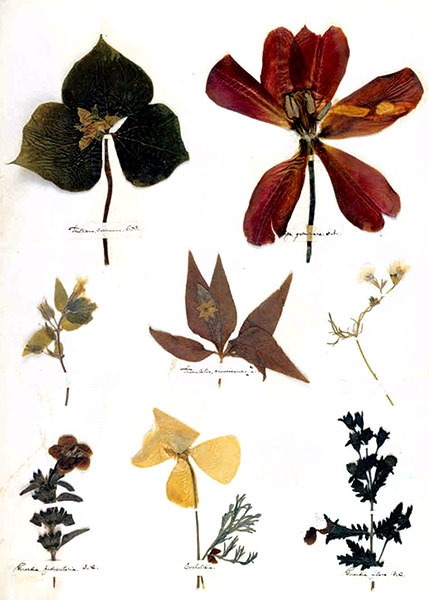
It would seem odd to us now, but when Emily Dickinson died, her most noted accomplishment was not her poems, but her plants. She was a serious gardener, known to her family, neighbors, and town for cultivating her plants even at night (which was also her customary writing time).

Emily Dickinson Herbarium page

Emily Dickinson created a 66 page herbarium with pressed flowers,
and often included flowers with her letters and privately distributed poems

There’s a lot of comparisons to be made there, that her poems are like flowers, pretty at first sight, but with their own alien structures, but I’ll leave that for now so that I can move on to today’s piece “I Know a Place Where Summer Strives.”

This is a poem that fits well with the Parlando Project’s tactics of combining poems with music, because it’s a poem that uses puzzles to tell its story. When you combine a puzzling lyric with music you can let those words ride along without requiring them to be immediately meaningful, as otherwise poems that go out of their way to be puzzling can frustrate readers not in the mood for non-straightforward speech.

I enjoyed “I Know a Place Where Summer Strives”  before I had solved its puzzles. As usual, Dickinson doesn’t belabor her subject, just three stanzas and 12 lines, a nice dosage for puzzlement. The poem’s internal music flows nicely, and Dickinson’s use of unusual word choices in the final stanza adds decoration to the mysteries. After reading it a few times, writing the music for it, performing it with the LYL Band, and then mixing the recording available below,  I have finally gotten around to trying to solve the riddles.
 
The first verse/riddle is a particularly cold spring, with “practiced frost” taking casualties among early blooming flowers. The second verse/riddle is a description of a building storm, which turns out not to be destructive, it brings “soft (ref)rains.” The third verse/riddle is more obscure yet, but the rain falls onto the hardened, adamant, ground. The last two lines of this verse are lovely to read and hear, but I couldn’t make any sense from them. At first thought I, like blogger Susan Kornfeld, wondered if this was a late-fall time image, and the quartz was ice forming on amber leaves—but then I noticed that the third verse clearly appears to be carrying forward the sentence and thought from the second verse, so it can’t be winter’s arrival: south wind, rain—that doesn’t sound like winter arriving.

Blogger Linda Sue Grimes suggests a solution, that the amber is mud on the shoe. This makes sense, and it could logically follow the rain on adamant hard ground, which could even be light yellowish, amber-colored, clay and not good dark garden soil, but I still am puzzled by the quartz. The line here is especially lovely: “That stiffens quietly to quartz” resonating with the “qu” “zee” and at “t” sounds, but I don’t think Dickinson cheated just to get the sound. Quartz can be brown like mud, though that’s not how I think of it, but its name and the modifier “stiffens” indicates this is something crystalline—not gooey, caked mud.

In performance I decided, intuitively, to repeat the first verse; and in so doing, I bring back the cyclical end of summer to close things.

young Stipe

Michael Stipe when he was Gardening at Night.
Coincidentally, both he and the Parlando Project are in some part inspired by Patti Smith

When I read that Dickinson’s gardening extended even to nighttime work, I recalled the song from R.E.M.’s first EP, “Gardening at Night.”  Michael Stipe’s early lyrics, are far more abstract than riddles, reading to me like abbreviated captions to blurry photos. A set of lines like:

We ankled up the garbage sound,
but they were busy in the rows.
We fell up not to see the sun,
gardening at night just didn’t grow.

Are as obscure as any poem, but I could, and still can, enjoy R.E.M. songs like that one. Stipe sincerely sang his own meanings, and he had a great band around him that supplied the music that lets the meaning ride.

To hear the LYL Band performance of “I Know a Place Where Summer Strives”  you can use  the player that appears below. Musically, you might find it to be vaguely R.E.M.-like too.