I ask AI to write a protest song, and…

A funny thing happened on my way to winding-up my Summer diversion series of thoughts on Artificial Intelligence. I’d concluded last time: since current AI was capable of producing musical pieces in popular styles that could pass for human works in casual listening – or plausibly even more exacting listening – those who’d prefer music expressed by humans might need to change the things they look for and value in music. What kind of things? Accept more imperfections in the music, cultivate an appreciation for the humanness inherent in live performance, and increase their consideration of the intent and motivations of the musical organizations they support.

That last point, about more significantly honoring intent, had hardly inscribed itself as a blog post here when a mischievous thought came over me: while AI is created by businesses with commercial intent, human-made music doesn’t have to be. As difficult as it is to refine authentic intent from music made by strangers distributed in a marketplace, could we be fooled about intent by entirely software-generated music? So, what if I asked AI music generating software to produce a protest song? What if I went further and presented it in a misleading context?

Disregarding my environmental footprint for the duration of the experiment, I created a free account on an AI music generating site, and I set about creating a new protest song. Out of the many outrages of 2025 so far, I picked the authoritarian assaults on academic independence which have sought fines/bribes/tribute from some of the U.S.’s most prestigious universities (known in America as “the Ivy League”) while demanding oversight into their operations and academic programs on flimsy pretexts.

Like a lot of AI, the one I used for this works on a “freemium” structure, with limited features for non-paying users. To make a song I only needed to enter in a text prompt (length-limited for free users) describing it. I asked another AI engine to suggest a prompt and asked it to create lyrics for a song (though the song-creating AI site would be glad to generate its own lyrics). The more general AI answer-bot suggested including artists whose style the music generating AI site should seek to emulate. I picked Phil Ochs and the Fugs. I wanted something with real anger and satiric bite.*

I created around six songs. None of them gave me that, even when I tweaked my prompt. What came out was sweet-voiced singers with an attitude of pop-music yearning, or acceptably sorrowful disappointment in their delivery. The AI lyrics did come up with a few phrases that had some charge to them, but the lyrics generally suffered from what I personally call “Horse With No Name” defects.** My prompt specified “gruff,” “angry,” rough” or even “sloppy” to describe the vocal delivery I was looking for, and out came the singers with an air of polished regret, and lyrics that groaned under their attempt at machine-constructed sincerity. The best I could say for the lyrics on the songs? They might pass as modern recording-production-style versions of the parodies created for the Spinal Tap acting company’s folk-music parody It’s a Mighty Wind.***

These results fed into the context I chose to present them in. I wrote a script for a podcast, supposedly devoted to American folk and Americana music. I decided the podcast presenter would be earnest, but a bit removed from the less-commercial segments of American folk music, and so I made her British. She would be portrayed by the machine speech that I use on my writing computer as a proofreading aid.**** As the token human in this enterprise, I’d appear as a hype-man for the Parlando Project.***** Over the next day I wrote the podcast script and recorded it folding in sections of the machine-generated protest songs. I slightly degraded the audio quality for the British host’s dialog, though after I finished I now think I should have done that for my own dialog instead, as I’d be more likely the guest relying on a remote overseas link for the imaginary podcast.

I had fun doing this, trying to gauge how many tells that this wasn’t on the up-and-up I should drop before revealing the near total AI nature of the content in the last minute. For the names of the Americana acts that were purported to be performing the AI songs, I decided to burlesque the names of U.S. 19th century Fireside Poets. I think “Greenleaf-Whittier” is a great name for a band in that genre – failing that, Jeff Tweedy if you’re reading here, you’re welcome to it for the next Wilco album title.

Greenleaf Whittier

Featuring the exciting new song “University Surrender” you heard on the “Kit That Sounds So Real” podcast.

.

The audio player below will let you hear the 18-minute program. The program opens with a snippet of an AI generated folk instrumental whose prompt I supplied was its title: “Obey in Advance.”   Though only a small selection, I think it demonstrates that AI generated music without vocals is particularly “real” sounding. The program continues with parts of three versions of a song called “University Surrender”  where the AI program supplied the words, music, and fully produced recording in three slightly different Americana styles it thought appropriate. The three versions resulted as I tried tweaking my text prompt – and while distinct, on repeated listening they seem somewhat “samey” to me. More smooth than I was asking for, “Ralph Waldo Bryant’s” version rising to falsetto delivery almost works for the material despite the pitch control artifacts I can detect in the computer-generated performance – but remember, as I said earlier in this series, the same artifacts are now common with recorded human vocalists in current pop. “Greenleaf-Whittier’s” cover did add one, nice, out-of-leftfield, touch: the flagrantly computer-voiced autotuned opening refrain of the title before continuing into its bouncy two-step country groove. And then there’s “Oliver and the Rolling Homes’” version of “University Surrender”  whose arrangement serves up a country-music playlist/station format sound. I was laughing hard as I heard the small-town-worshiping-my truck-my girl -I may get a little drunk sometimes-but I’m a hardworkin’ man-like my daddy sonic approach, but this time holding forth on tenure and syllabus issues. And then there’s “Ivy Towers Bow”  that is said to be written and performed by “J. R. Lowell.” The lyrics here were written by an AI chatbot and then those lyrics were given to the AI music generating program to make this song. Musically this one doesn’t give me anything – so generic. I almost didn’t include it, but I decided it was an example that a generate-songs-AI was on par with a text-focused AI when writing lyrics. The final song on the fake podcast might be the one of the group that does the best emulation. If I was listening casually and “E. E. Peterbuilt and the International Harvesters ““The Emperor’s New Chains”  came on, I’d think it better than many songs in its style. Oddly enough, the AI program produced it when I goofed and clicked generate when I’d only partly written the prompt “Folk or Americana protest song, gruff voice…” and by not having to lyrically add the academic details that made Oliver and the Rolling Homes version of “University Surrender”  so unintentionally hilarious, its Horse-with-No-Name lyric faults are not as exposed. If I wanted to pick one AI song from the ones I generated to fool a careful listener, I’d pick this one. You know you’re in the Uncanny Valley when the guitars have faded out and the robot vocalist gives us a little aside into the still open mic. Spooky.

If you don’t see the audio player gadget to play this imaginary podcast, this highlighted link was human supplied to let you hear it, and will open a new tab with its own audio player.

If my courage and energy hold out, I still want to write one more post about what I call “the guild issues” that concern some artists engendered by plausible AI results.

.

*The AI program didn’t object to those two 20th century folk-rock artists of outrage and cutting satire being supplied for models – but it completely ignored trying to emulate them. When I tried “Bob Dylan” – suggested by the separate AI that’d given me a prompt I could use elsewhere – the song AI immediately refused to do so, presumably due to a specific concern about IP.

**”A Horse With No Name” was a 1971 song, recorded in England by a band led by expatriate Americans. The recording, done by humans, not AI, sounded like someone had anachronistically entered our future and asked AI to “Create a song that sounds exactly like a Neil Young record.” The lyrics went forth despite including some awkward lines like “There were plants and birds and rocks and things,” “the heat was hot,” “’Cause there ain’t no one for to give you pain,” and “Under the cities lies a heart made of ground, but the humans will give no love.” To spare us from more lyrical howlers, the song also featured a lot of repeated “la la la’s” in its chorus, well-performed in a CSN&Y style of harmony.

The song was a substantial hit in both the U.S. and Britain, indicating that it worked as a song for its audience none-the-less.

***Hey, I’m a fan of Spinal Tap. Everyone is! And rating art is a fool’s game – but “It’s a Mighty Wind” is every bit as good, maybe better.

****The “read aloud” feature in the current versions of Microsoft Word is a huge aid to my self-proofreading. With my neuro-wiring, it lets me catch a great many errors I’d otherwise miss, and using the female British voice enhances the “hearing this anew, as if I didn’t write it” factor that makes it so effective.

*****The stuff I say in the middle of the satiric podcast concerning the Parlando Project is how I actually feel about the nine-plus years of stuff I’ve put out here.

AI music may be telling us something about how music works for listeners – and we might want to change that

I had to catch myself editing the last post – as I discussed my use of virtual instruments in place of the actual instruments and the new plausibility of thoroughly AI music, I was tempted to overuse the word “verisimilitude.” Is that really something essential to the art of music? I like the cranky not-quite-real sound of the Mellotron after all. If musical art should be imagination, music itself certainly doesn’t care if the instruments are real – though musicians might, from legitimate guild concerns. Then we moved to having the computer play the instrument, and that too asks about human-displacement – and now we have AI creating songs outright from very generalized prompts. If you’re a composer, a musician, or a listener, this raises questions.

Let’s start by being honest with ourselves as listeners in avid or casual modes: as we pass through life, music becomes a sort of sonic homeplace – a location where something sounds similar to what we’ve heard before, with just enough difference to stave off boredom, just enough new to add the spice of novelty. Some musical ears live in homogenous towns, others in more diverse ones, but we go to music for the effects we’ve learned to appreciate.

Current entirely-AI music exploits this: taking what we know of form and sounds, following its predictability in a way listeners have been known to appreciate, and serving our aural expectations back to us. When they do that, the robots are telling us something about ourselves. As I ended my last post, if we object to AI music, it may be from the romantic feelings we retain for human artists. We want fellow humans to make these sounds with and for us, and our response may rise to disgust when we are tricked. And here’s a problem: it’s getting harder to say you won’t be tricked.

If this is so, what hopes do we have? One: imperfection, at least of a kind. Let me interject here that I’m not talking about the imperfections of boredom, of which there are many. I’m talking about music that may be a bit more haphazard and unpolished. If machines can precision-target our musical comfort-center receptors, then let us distrust that response at least in part.

Commenting reader rmichaelroman has already guessed that might be part of it, mentioning the performance, rough in recording quality and musical finesse, from the LYL Band at an Alternative Prom in someone’s basement years ago.  Even stored on honest recordings – live music, particularly live music that is truly live, with unplanned-out moments, with instruments reveling in their specific bodies, breaths, and vibrations – offers vivid imperfection.

Or too: voices with less talent than intent. I try to not over-burden my listeners with self-made excuses for my singing voice – but for all its limitations, it remains the one I have handy to realize the songs. Would AI be able to duplicate those imperfections? Perhaps, but it’s unlikely to want to.

When music practices and equipment reached points of greater mastery in the 20th century, reaction in the form of purposely avoiding those felicities arose. Midcentury pop music was opposed by the rising Folk revival and by early Rock’n’Roll. Then later, perfected Rock recording technology and improved musicianship found themselves met with Punk and Hip-Hop premised on the idea that a minimum of tech or muso-chops can still make an effective statement. By the way, I believe those technical hierarchies produced worthwhile music, but those that dispensed with them did so too.*

And when I wrote about voices with more intent than talent: for all the romantic imprecision of assigning internal motivation from a separated artistic product, what we believe we understand about why a piece of music was produced has importance. AI-music, however good it is at mimicking the technology and sound of music we like, presently offers only the weakest and least admirable answers to the question of why it was called into existence. To make some money? To make inoffensive sonic décor? To sell drinks to dancers? To show it can be done, as if that “verisimilitude” was the most significant thing about art? Some music I have liked was made for such mundane reasons, but in the future we may find intent more necessary to weigh.

I’ll leave with one more brief metaphor as AI-music reaches a level of musicological competence: we may have come to something analogous to painting’s role as photography entered the realm of visual representation. AI music in artistic hands may eventually seek out flagrantly subjective use of the technology – and music made by humans holding physical objects in real time will increasingly began to value qualities beyond sounding customary and “correct.”

If my energy holds out, there’s at least one more post in this AI series before I return to our regular combinations of literary poetry with original music, this one will address in more detail some of those music things I call “guild concerns.” If you miss the usual Parlando Project fare, there are over 800 examples of that here, so feel free to look around.


I wouldn’t want to call this performance imperfect, but there’s a human unexpectedness to it that satisfies me

.

*The 1950’s-early ‘60s folk music revival had elements that I found closely mimicked by the Punk/Indie movement of following years: the DIY convictions, the gumption to form or transform venues and record labels, the opportunities for out-of-the mainstream ideas and sounds to sneak in between the more polished and “professional” acts. Similarly, Hip Hop followed the folk process: use what instruments were at hand, assertion before sounding “correct,” recombining shared culture materials (floating verses and borrowed tunes for the banjo brigades; turntables, cheap drum machines, and samples for Hip-Hop, contemporary social comment for either). Musicologist Ethan Hein said in a BlueSky post that helped spur me to write this series, “You can get across the essential elements of hip-hop and house with buckets (Hein here is referring to overturned buckets used as drums –FH)  and voices. Computers and sound systems are nice to have but inessential. Long after Spotify is gone, people rapping over beats will still be with us.”

The Unquiet Grave

August brings me this triple obligation: it’s the anniversary of the public launch of the Parlando Project, of my late wife’s death, and of the atomic bombings — three things varying in nearness, scope, and heart-weight. Two of them plainly have to do with grief — and poetry’s connection to matters of death and survival is there to be examined too.

Today’s musical piece isn’t exactly literary poetry, as its survival can largely be laid to singing, not printing and the murmuring eye.*  “The Unquiet Grave”  is one of those works from that prolific author Anonymous. Their publisher? The memories of people who wanted something to sing. The version of “The Unquiet Grave”  that you can hear below was collected by Cecil Sharpe in Great Britain from the singing of a “Mrs. Lucy White at Hambridge, Somerset, 6 August 1904.” This is a portentous coincidence: I just went to the book where I saw that version to gather the note on its collection, and that date of the year is the very day my late wife died; the year of collection, the same that the house my late wife and I bought and I still live in was first occupied; and the place it was sung “Somerset,” says August in its sound.

The Unquiet Grave

With all the words flowing through the Internet, you still might want to pause and listen when the ghost begins to speak.

.

The story in the ballad is compressed, but it opens with a lover’s mourning. The next event, the dead partner becoming present and speaking is not just supernatural, it’s also an empirical report of what many of those in grief experience.

Just last week I was listening to Fresh Air’s Terry Gross interviewing podcaster/comic Marc Maron.  As they talked, ostensibly about Maron’s career, the two bonded over their own recent partner’s deaths — Maron’s a couple of years ago, Gross’ earlier this year. They each shared that their dead spouse’s presence and voice had vividly returned to them, and each averred that this experience was not horror-show scary — rather it was, while remaining strange, comforting. I can remember one of my own experiences around a year after my wife’s death. I was becoming involved with my present wife around this time, and I felt it awkward that here was the presence of my dead wife returning. I don’t know if I spoke to my dead wife’s presence out loud, but then in such a spirit world our conversations likely needed no sound or syntax, only the sense, and that sense was a common realization between us that it was  awkward, but that this new complexity was fine. More than speaking — do ghosts laugh? Do we laugh in their presence? I think we both might have that night.

I’ve always felt that “The Unquiet Grave”  has a practical, darkly humorous, intent. If ghosts have additional knowledge, extra-existential wisdom, what the ghost in the song shares is that one can cherish the dead, even hear them speak, but that they are changed forever — and the living can, should, change too. When the ghost says that you wouldn’t want to kiss the corpse’s lips, the gothic joke on deadly “mourning breath” almost writes itself.

The words in Lucy White’s version, which I remained faithful to, somewhat fumble the lyric’s closing statement. What the final exchange the lovers share means to say is “When the autumn leaves fall from the trees/and (then) spring up green again.” I just sang what was on the page, but that fumble is, I now think, also exemplary of grief, it’s misdirection. Grief’s disruption, like a slight-of-hand magician: something is here (like what you meant to say), and then it’s, poof, gone.

Today’s musical performance of “The Unquiet Grave”  is a tribute to Fairport Convention, the pioneering British folk-rock group — a choice of mine inspired by recently listening to Andrew Hickey’s 500songs.com history on how that group formed its own Cecil Sharpe revival-with-Stratocasters after their own encounter with death and grief. You can hear my performance with the audio player below. Has any such player failed to materialize? If so — mourn but organize — and click this highlighted link which will open a new tab with its own audio player.

.

*It’s hard to date the ur-versions of folk songs, though many were printed in the 18th and 19th centuries, first by commercial broadsheet publishers and then by collectors and song-catchers like Cecil Sharpe and Francis James Child. Child collected “The Unquiet Grave”  in America in the late 19th century and numbered it 78 in his ballad collection. It’s always seemed to me that “The Unquiet Grave”  (also known in versions as “Cold Blows the Wind”)  is an extended variation of one of the oldest fragments of English language poetry “Westron Wynde,” which has been dated to the Middle Ages, plausibly to quite early in that era.

The House of Ghosts

It’s been a busy week at the Parlando Project studio as I record more Halloween-themed songs freshly made by combining other people’s words (usually literary poetry in the public domain) with original music in differing styles. Let us go to the lab and see what’s on the slab.

Last dark-and-stormy-night-time we had a poem that started with someone at a household’s door asking to be let in. Waif or wraith? Therein lies that tale. Today we again have a piece that starts at a doorway — but the tale-teller here lets themselves in. What do they find there? Well, that’s the song.

The words I used today originated with a poem by early 20th century American writer Margaret Widdemer. While Widdemer is little remembered now, she was a successful presence in the literature of her day. And while the Parlando Project does the everlasting Greatest Hits of Poetry sometimes, I also like digging through old poetry collections and anthologies looking for overlooked poems and poets. Such “many a quaint and curious volume of forgotten lore” reading let me find Widdemer, and one thing that drew me to her was that she seemed to have absorbed some stuff from the folk-music collectors of her time — for example, this eerie poem of hers that builds on the “Lyke Wake Dirge”  presented here six years ago.

One thing that folk-music tradition teaches us: the singer is free to change and adapt the song that was handed down to them. Entirely new words or new music may be applied. Verse order, much less exact wording is not sacrosanct. Instead, a good fit for the singer and the audience (these being the folk in folk-music) is the guiding force. Most composers who work in the Art-Song form are compelled to keep the text unaltered, and while I’m not of that tradition, I most often present the poet’s words as they published them for the silent page. But, for today’s piece I substantially altered Widdemer’s poem to make what I hope is a more effective song.

House of Ghosts

Widdemer’s poem is linked here if you’d like to see the “before” to my substantial revision.

.

I started with a simple change: I created a refrain based on the initial verse of Widdemer’s original text when I found it ineffective for audience grabbing. In other revisions and additions, I sought to sharpen the “build” of the story’s details, and I excised antique words and diction that added no charm.

Musically I recorded a late-night laid-back Rock combo of two electric guitars, electric piano, bass, and drums for my resulting song. Here’s the chord sheet in case you’d like to play your own rendition. That’s also the in the folk-music tradition: the song shouldn’t belong to only one voice.

To hear the way I played and sang it you can use the audio player below. What? Has no audio player gadget materialized on your screen?  This highlighted link will open a new tab with its own audio player then.

I plan to be back soon with an entirely different, more orchestral ensemble for the next piece in our 2024 Halloween series. Should I act like a YouTubber or Substack author and urge you to subscribe for this upcoming content?*

No, I’ll leave you as a free agent on that decision. This Project goes beyond non-profit — it is by design no-profit. I just love diverse music and poetry and get a kick out of exploring what’s possible. I have nothing to sell and would avoid anything that is paid by the click, because I have no makeup to be a small-businessman.** But my self-regard (or desire to promote a range of poetry) likes seeing viewers and listeners. Sharing this stuff on social media, or just telling a friend, will help keep this going.

.

*The Parlando Project started as a short-form podcast, one sans the usual blather, paid-for-promotions, and between-host jocularity — presenting instead our typically 2-5 minute musical pieces unadorned. It turns out that podcast audiences prefer one-to-two hours of gab — but if you want a break between the talkers in your podcast app, you can still subscribe to the Parlando Project on Apple Podcasts or most other popular ways to get podcasts.

I don’t believe I misunderstand those who appreciate the typical podcast format. I sometimes listen to podcasts while cleaning or fixing something with my hands. Alas, as a person who spends much of their time reading, composing, playing, recording, and mixing music, my own ears are usually occupied, and so I lack time to partake.

**I admire small-business people in general — and yes, I appreciate how hard it is for musicians, composers, and writers to make even a meagre living these days. While I work at this Project like someone with a small-business enterprise, I’m just not suited to bookkeeping, form-filling, and tax-law lane-keeping.

Paying the Piper chapter 4: “I heard my mother sing this ca. 1876”

Today is Juneteenth, a holiday coming into greater recognition as a celebration of the ending of America’s race-based chattel slavery. Why this date? I repeatedly warned you that I can’t tell a story simply and briefly, but for this holiday I have an excuse.

Slavery began in the American British colonies somewhat haphazardly, but by the time we became an independent country we had lots of laws, customs, and beliefs to entrench it. As it often is with the mechanics of oppression, the structures to hold it up took work to maintain, and by the 1850s there was great worry between slaveholders that it would collapse. In the 1860 election, Lincoln won, and even though he’d stated a politician’s compromise middle ground on the slavery issue, his party included enough abolitionists that most powerful slave-holders were ready to press their states to rebel and set up their own government. Civil war ensued.

Which didn’t free the slaves — at least not yet.

Of course the enslaved had been freeing themselves, when they could, all along. Armed rebellions hadn’t worked for more than moments, but the brave, lucky, and skilled might successfully flee at least from the slave-holding states if not to Canada where US law couldn’t touch them.*  But it wasn’t easy traveling all that far.

Once the war started in 1861, some enslaved people recognized they could try a shorter route: just make it to the Union troop’s camps, and a good many did just that, which created an awkward situation. You see: nothing had ended slavery’s legal framework, Lincoln still maintained he wasn’t doing that (if only because a few slave-holding states and slaveholders remained on the Union side). He just wanted to put down the rebellion.**  Law still said the slaves were property.

Someone on the Union side came up with a peculiar idea. If the enslaved were legally property, they could be confiscated during wartime like a cannon, horse, ship or other enemy property could be. Dehumanizing language? Sure, but escaping past the Union lines meant an increasing chance that they wouldn’t be taken back.

Eventually, Lincoln supersized that freedom, by declaring that all the enslaved in the states in rebellion were free. This, the Emancipation Proclamation was issued at the beginning of 1863. American slaves elsewhere? Nope, not in the Proclamation. Slave owners in places under Confederate rebel control? Not gonna listen to Lincoln’s order. In April of 1865 Robert E. Lee surrendered the bulk of Confederate troops, but that still didn’t mean all enslaved were free, and the legal matter wasn’t consolidated until December of that year with the adaptation of the 13th Amendment.

A couple chapters back I talked about how slow by modern standards communication could be in the mid-19th and early 20th century. Well, it was slower yet when not everyone was on-board with the news. Juneteenth, with an absurdity that is so often a part of America’s racial history, celebrates when Union troops got over to Texas in June of 1865 to announce that the war had been over for over a month and the enslaved in Confederate Texas were no longer legally slaves.

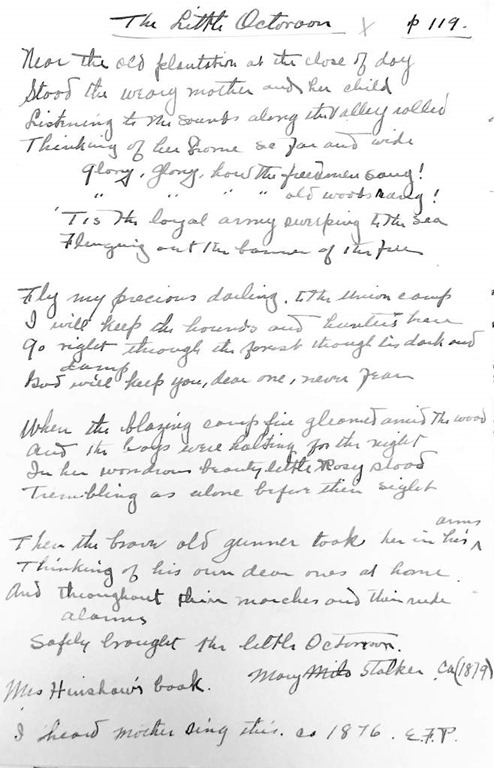
When I left off I was (more or less) talking about folk songs and the songs collected in the American Midwest before WWI by poet Edwin Ford Piper. I’ve also already mentioned that folk songs aren’t unchanging, and aren’t pure. While going through the yellowing paper in Piper’s archives, I came upon this song, handwritten in his own handwriting. He has the title as “The Little Octoroon.”   Things aren’t going to get simple here readers. I can’t be simple.

The Little Octoroon 1024

The song as Edwin Ford Piper heard it from his mother

.

Octoroon is a largely obsolete word, derived from a lot of rigmarole regarding how Black someone was. It means 1/8th (octo=8) Afro-American. In general, the mumbo-jumbo legal biochemistry in American history regularly said it didn’t make much difference. Half, quarter, sixteenth — hell, for those who had trouble with fractions it was sometimes written down as: 1% Black, you’re legally Black.

An octoroon may not look  Black. I can still recall when I was 14 or so, and having grown up in a tiny rural Iowa town. An Afro-American man who was a civil-rights activist was to visit my church camp. He arrives. Wait — that man’s Black? I remember in my naivete looking at his summer hands and forearms. The man had freckles people!

So why does this song, which is clearly a song from the Union and Abolitionist side make some point about the child being an octoroon? This will get weird: it was possible to be an abolitionist and  a white supremacist thinking Afro-American’s inferior. Yes, you could be smart and ignorant at the same time! If you’re trying to end chattel slavery, and you’re counting votes or troops, you might not care to make a sticking point about this, ugly as it is. Those with pseudo-scientific beliefs such as an octoroon is “nearly a white person” might have stirrings of respect. (Ugh!) And then at the unconscious, illogical level, there’s the factor of that person looking much like me, so maybe they  should have rights like me. Even if it’s a song (something with no visual element) those factors may have entered into its composition.***

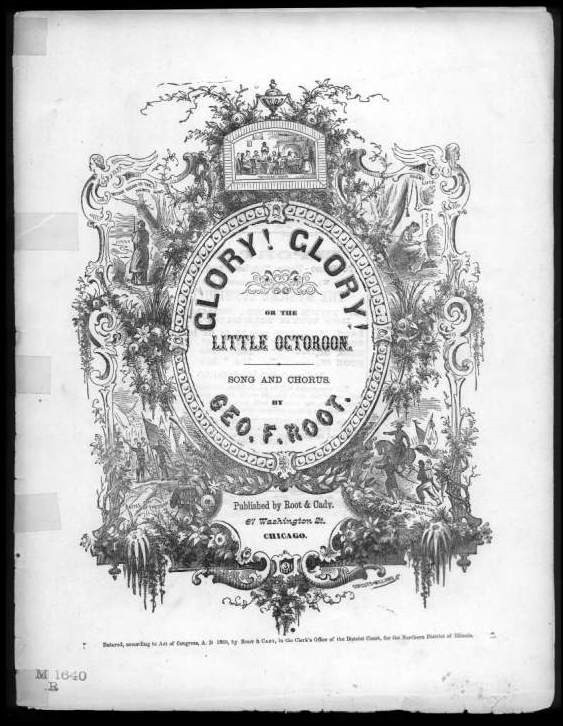
While there are no notes I saw in the archive that Piper knew this, this song does have a composer: George F. Root.  Root didn’t quite reach Stephen Foster or Dan Emmett level of 19th century American songwriter fame, but he had his “hits” such as they were in the pre-recording era. During the Civil War period and based out of Chicago, he specialized in songs for the Union side.

The Little Octoroon song sheet cover 800

The sheet music from George F. Root’s music publishing firm. When Piper remembers his mother singing this tune, it would have been only 10-years-old.

.

Did Piper’s mother learn this from someone else? Was there sheet music in a piano bench for this, unknown to the 5-year-old Piper? In the quiet library archive, I visualized two white people, a mother and child, in rural frontier Nebraska sharing this song. The differences in the printed song from the one Piper wrote down from his mother’s singing say this isn’t likely a handwritten copy from sheet music.****

Here’s my conclusion, which I hope I’ve demonstrated even though I’ve trimmed parts of this piece back: Juneteenth is the most complicated American legal holiday.  The only simple thing about the holiday is that it stands for freedom and the lifting of oppression. Taken at its whole, though messy and with calculated delay, that makes it a favorite of a person like me, who still cries and wonders at how simple truths and rights take so long to be established. The song I’m performing today, its path and turning into a folk song, isn’t that complicated — but yes, the path of American freedom is.

You can hear my performance of Root’s “The Little Octoroon”  with the audio player below. No player? This highlighted link is an alternate.

.

*In 1850 a Fugitive Slave Act was passed that required northern state governments, not just the federal government to return enslaved people who reached northern states. Some cities and states wouldn’t comply (there’s this Minnesota case for one example).

Piper’s mother was in Canada near the US border in this era. It’s possible that fugitive slaves might have crossed over into her region. I also note that Piper says she was singing it in 1876, perhaps because that’s the border of Edwin Ford Piper’s memory, but I read the date and think about it being the year Reconstruction largely ended and new de-jure laws and customs greatly restricted Afro-American citizenship.

**No, Nicki Haley, slavery was the cause of the Civil War, even though many liked to parse Lincoln’s compromise and coalition statements of this time to make it sound like it wasn’t. The flaw in that framing? Lincoln didn’t start the war, the South did, and they were explicit in proclaiming why they did it.

***There’s another song using this terminology that this Project has already presented: Longfellow’s scathing pre-Civil War poem “The Quadroon Girl.”   In Longfellow’s poem the situation leading to that poem’s mixed-race child is laid out: feudal concubinage and/or rape by slaveholders. For making a speech implying the same, Longfellow’s friend, US Senator Charles Sumner was beaten to within an inch of his life on the floor of congress.

****The biggest difference: the printed song’s title calls out the chorus — it’s officially “Glory, Glory, The Little Octoroon.”   I only sang the martial chorus twice in my performance because I was more drawn to the bravery and sacrifice told in the verses. We have two holidays that say soldiers made us free, but it’s not only soldiers.

I followed Piper’s transcription for the words, not the printed lyrics, honoring the chain of transmission to me rather than accuracy. I also modified Root’s tune and chords to suit my tastes and tendencies. I could not help but think of these things as I sang this: first, the mother, her family heritage caught in that sexual exploitation making the choice to stay and face the slave hunters and their dogs to assure her child’s escape. We never find out if she and the daughter will be reunited, or even if she survives. Then next I think of those pursuers who to the degree they are portrayed in the song would be gaslight villains — but in history they would be real people doing great evil, who could be thinking they were serving justice. And then lastly, the final-verse gunner who cares for the child, though he’s more the Horatio of the story, with the mother being the tragic hero. I ask you not to skip over the villain characters. It’s fine if you empathize with the gunner, but some great dangers in one’s life (and often to other lives) are those middle souls, like the slavecatcher pursuers, who have a system that tells them they are arduously, justly, doing right.

Paying the Piper chapter two: time travel, wagon trains in space, & folk song

The walk across town to the University of Iowa main library turned out to be no problem, even in the heat. I walked into the modern lobby of the facility decked out with LCD screen-signage, a set of computer carrels, and airy windows. I used handy lockers with touch-screen set-your-own-combination lock panels there to store my bag and hat.*  The library is one of those amended buildings, representing different eras in décor as it was added to over time or remodeled — so it was almost a theme-park-ride effect as I walked further into the main entryway to reach an old elevator with a flickering florescent fixture that took me up to the third floor with dark wood trim that reminded me of the libraries of my mid-century youth.

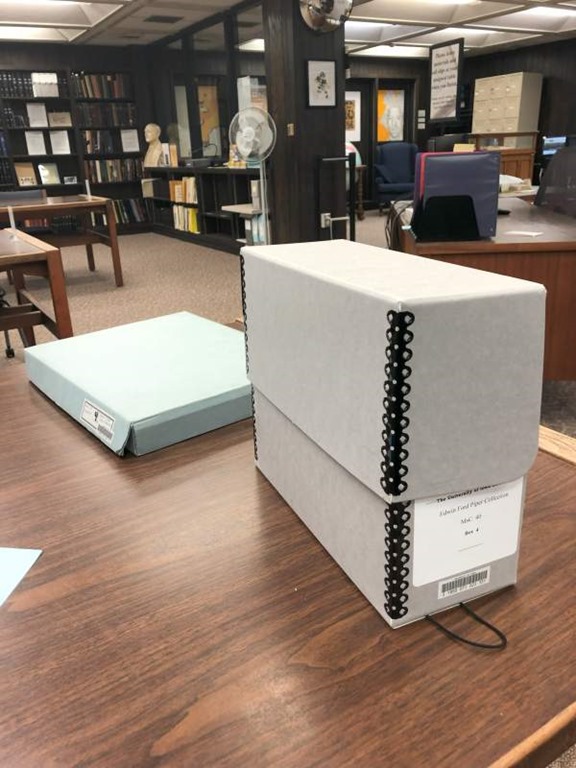
The special collections staff set me up on a placard-numbered plain table in the reading room. It took only a few minutes for my selected boxes from the Edwin Ford Piper collection to be delivered by cart. Looking around the reading room as I waited, there were filled bookshelves, a globe, a couple of busts,** and a few framed posters. Curiously, there were life-sized carboard standups of 20th Century Star Trek actors in their character costumes in a couple of corners. Why? Generalized nerd culture? LaVar Burton’s following enlistment in Reading Rainbow? I momentarily thought, at the commencement of my time-travel by library collections, that the original Roddenberry Star Trek concept was travel to “seek out new life and new civilizations.” They called it Star Trek,  not the second-word choice of the later movie franchise Star Wars,  nor something referencing a technology-based science fiction premise. Pitching to SF resistant TV programmers, Roddenberry famously described his show it “Wagon Train in space.”

The U of Iowa Special Collectons Reading Room 800

Transporter or time machine: archive boxes in the University of Iowa Special Collections Reading Room.

.

I don’t know how Piper’s parents came to rural Nebraska. His mother’s family (Ford) emigrated from Ireland first to Canada around 1810. The Ford brothers who emigrated were stone masons. His father’s line had settled in Massachusetts from 17th century, near-Pilgrim times. Piper’s mother was born in rural south-west Ontario and his parents were married there in Zorra township in 1848. The parents moved to Auburn Nebraska in 1869 where Piper was born in 1871. The 1869 date means it was likely by wagon, as that date predates railroads there.

I know no particulars about why the Ford brothers emigrated to Canada. 1810 preceded the infamous Irish famine years a generation later. My guess (by inference) is that the Fords were Anglo-Irish protestants. I don’t know why Piper’s father was in a non-descript rural area of Canada either.***

It’s hard for me to judge his parent’s economic status. Piper speaks briefly in papers in the archive about his father being a rancher who raised livestock and that the barb wire that titled Edwin’s poetry collection came to Nebraska with homesteading post-Civil War farmers who tended crop-fields cordoned off with that fencing, causing his father to move his livestock grazing farther west to Alma Nebraska (southwest of Kearney) and then Box Elder, which is more than halfway to Colorado. In a short biographic note Piper prepared and found in the archives he says he “rode in the movers wagon.” In the same note he says he had “broken sod and raised corn to sell at ten cents a bushel; I have paid three percent a month interest.” Since he went to Omaha and university there when he came of age and was an academic the rest of his life, this would indicate that his family wasn’t exclusively a cattleman or other livestock operation.

In talking about places and names I found in the archives, I get ahead of myself, it’s just clear that the young Piper was a traveling man coming from a traveling heritage. When we speak nowadays about the Midwest as “the heartland” or casually assign it as a homogenous place in stasis we miss that it was (even its rural areas) just as much an immigration site as the tenements of New York City — there was just more space between farms or towns.

In effect I was another immigrant in the library archives. I was eagerly opening the contents brought to the table from first box and on, lifting out folders from inside them and examining the mix of handwritten letters and notes, typewritten pages, fragile yellow newsprint clippings, and occasional whole publications. The libraries abstract of the contents, and the Piper collection’s mixed filing, meant that I never knew what I’d find “over the next hill.” I had been concerned if I could keep my focus on this task for a full workday. I could. Easily. I was back in the era which The Parlando Project so often refers to, the first quarter of the 20th century when Modernism emerged. I’ll look at Modernism later in this series, but the folk songs are things the travelers carried with them from the past. Same quarter-century, Janus like, looking forward and backward.

As the collection abstract promised, the folk music collection materials were considerable. Many of them have marginal notes or material showing either they came from other collectors or that they had appeared in versions in other contemporary published collections. Some of these notes are from a 1934 run through of Piper’s folk song materials by a graduate student who cataloged and categorized the material while Piper was still alive, though his organization is not reflected in the current filing in the archive boxes. That student, Harold Daniel Peterson, no doubt using Piper as an informant, says that Piper first collected the songs to sing himself, that WWI interrupted Piper’s personal collecting, and that post-WWI, his students at Iowa contributed songs their families and locals knew. Correspondence and marginal notes with associated names show that Piper seems to have assembled or participated in an informal network of other folk song collectors. Piper also mentions the Journal of American Folklore multiple times, and that publication and society started in 1888.

There’s a number of files dealing with hobo songs (some with notes presumably by Piper about the particular hobo who shared the song) and articles about hobo culture, Hobos were migratory workers who often hopped trains to move from place to place.

Coincidences can move me, even if I realize I’m the one making chance meaningful. The very last folder in the last box I went through in my days examining the Piper archive folk song collection contained a version of “Jack of Diamonds”  a traditional song with a variant that also goes by the name of a commonly included verse: “Rye Whiskey.”  Long-time readers here may recall that I was told by uncles that “Rye Whiskey”  was a favorite song of my great-grandfather, after whom I am named. In my time travel during this June trip I wasn’t just traveling to the time of Modernism’s emergence, I remembered at that moment opening that folder that I was traveling back to that man’s, a common laborer’s, time too. When investigating something else years back, I was taught that folk culture isn’t uncomplicatedly pure, always the result of children learning songs from the old folks on the porch of an isolated cabin. I recorded a performance with music of a plausible theory of how my great-grandfather might have come to fancy and appreciate that song. You can hear that performance with the audio player below, or with this highlighted link if that player isn’t visible to you.

To be continued…

.

*As is now common in special collections, there are rules about what you can bring into the reading rooms. Alas, theft has been a problem in such places, so bags (much less spill-risk food or drink) are not allowed. I noted the University’s rules also restricted paper notebooks and outside writing instruments.

**Of who? I never left my focus to find out, but the human form amputated to a head and shoulders is already concentrating on the life of the mind. The Piper Archive papers mesmerized me, time passed rapidly as I tried to take in as much as I could. The first day I had packed a bagel in my shoulder bag, necessarily left in the downstairs library locker in case I needed to take a lunch break outside of the Special Collections Reading Room. I ate that bagel in the evening back at my room.

***This basic genealogical detail is from a typewritten sheet titled “Notes on Family History” with some pencil annotations in Piper’s handwriting in the archives. It also says that he was “the tenth child in a family of eleven children” and gives the date of Edwin Ford Piper’s own later marriage to Janet Pressley in Iowa City as 1927.

Reading Carl Sandburg’s American Songbag

I spent much of today reading through Carl Sandburg’s landmark 1927 folk song collection American Songbag,  all 500-plus-pages of it. It’s not the first time I’ve looked into the book, and indeed I’ve paged through it or jumped to songs I was interested in before. But next month I’m planning a trip to Sandburg’s boyhood home in Illinois and to Iowa City where I will be taking a look at some papers relating to early 20th century poet and professor Edwin Ford Piper who was one of the sources of folk song material used in Sanburg’s anthology.*  So, looking at the book in full seemed a good grounding for this trip.

I’ve made the case before here, such as this post from a year ago, that besides being a somewhat deemphasized Modernist poet these days, Sandburg is a primary model for the American Folk Music Revival, which eventually produced in the second half of the 20th century several genres of popular and semi-popular music.**  Here’s the matrix that Sandburg built in the 1920s, a hundred years ago:

  • American folk music can be appreciated like art music
  • It will be associated with literary poetry
  • It expresses, or can be adapted to express or accompany, progressive/left-wing causes
  • It’s multi-ethnic, and the contribution of Afro-Americans will be substantially acknowledged
  • Humor and funny stories will be part of its presentation

Sandburg was including segments of folk music performance as part of poetry readings before American Songbag.  AFAIK we don’t have any transcripts or recordings from that era, but all these things are demonstrated for the record in the 1927 book. Sandburg is not the only American doing any of these things a hundred years ago, but he’s doing all of them at once,  and he’s doing it with a degree of fame and cultural acclaim that was significant.

I was aided in my rapid march through American Songbag  by already knowing many of the songs it contains, and as I encountered them I remembered hearing them in my half of the 20th century performed by Woody Guthrie, Pete Seeger, Bob Dylan and many of those other “folk singers” that surrounded them.***  The Sing Out magazine and Jerry Silverman folk songbooks of the Sixties that are my foundation, are successors to Sandburg’s work, right down to the touch of  using vintage B&W line drawings as interspersed decorations.

Sandburg often includes little stories about the collector (Piper was one of a group who collected the songs “in the field” for Songbag)  and for those he collected himself he says a few words about how, where, and with whom he first heard the song. Here’s one of the most engaging of those stories I came upon today in the book:

Once when the night was wild without and the wintry winds piled snowdrifts around the traffic signals on Cottage Grove Avenue, Chicago, we sat with Robert Frost and Padraic Colum. The Gael had favored with Irish ballads of murder, robbery, passion. And Frost offered a sailorman song he learned as a boy on the wharves of San Francisco.

The song Frost sang for Colum and Sandburg? A subtle wry ballad of farming? A nuanced lyric of nature cooly observed? No, it was this one. Some will know it from its latter association with the Assassin’s Creed video game franchise:

.

*Besides the folks songs Piper contributes, Sandburg even quotes a part of a poem from his contemporary Piper’s Barb Wire  poetry collection in Songbag.

**Besides the Folk Scare of the 50s and 60s, the American “Rock Music” that extended Rock’n’Roll to FM radio, college campuses, and rock critics was generally formed from folks who had connections with the just preceding folk revival. Modern Americana and roots music links to the same strains and connections that Sandburg was personifying 100 years ago.

***Guthrie composed music for Sanburg poems later. Ruth Crawford Seeger (Pete’s step-mom, Mike and Peggy Seeger’s birth mother) was one of the composers who created harmonized music for the folk songs in Songbag,  and she also set Sandburg’s page poems to music. When the young Bob Dylan started to expand the poeticism of his song lyrics, he decided to pay a visit to Sandburg, briefly meeting him unannounced in North Carolina at Sandburg’s farm. Other folk luminaries connected? At least a couple songs collected from Leadbelly by John Lomax are included in Songbag.  Lomax is credited, but Leadbelly isn’t, though Leadbelly’s more general public career hadn’t yet started. Let me just say that Lomax’s relationship with Leadbelly is complicated. Just this month I was reading a recollection of a performance by Spider John Koerner (who first performed in the mid-century Minneapolis folk music scene along with Dylan) where he told a humorous story about a farmer who fed his pig by lifting him up to the branches of an apple tree. That’s a story Sandburg also told. I’ll also note that when I came upon several songs in Songbag,  the rendition I recalled from the Folk Scare of the mid-century was by Dave Van Ronk, a wonderful performer and a mentor to Dylan when he arrived in New York.

The Last Antelope

Nothing excites me more while doing this project than coming across a little-known poet that I had never heard of. Some of these poets have perhaps a single poem worthy of interest; others, whole bodies of work which have slipped off the page, fallen to the floor, and have then been lost in the cracks.

Just how interesting is Edwin Ford Piper? I don’t know yet — and that’s fascinating! I’ve picked up a few things about him. He grew up during the closing act of the American frontier in the vicinity of the small town of Auburn Nebraska near where Nebraska’s southeastern border meets up with Missouri and Iowa. Despite a typical rural childhood of his era, with schooltime being “Sometimes two months a year, sometimes none,” he largely educated himself as a child by reading, graduated from the University of Nebraska, and he then became a long-time college professor of English Literature at the University of Iowa until he died in 1939.*

But here’s what’s intriguing me so far: unlike a great many of his contemporaries, it appears he takes as his subject the local culture of the Midwest in his time, including the ordinary working-class and underclass. At least at first glance he’s a Modernist of a sort. Some of the first poems I’ve read look like a melding of Sandburg** and a Midwestern, not New England, Frost — but with his own vision and sound.

I’ve been long-winded lately trying to share as much as I’ve been able to find out about another lesser-known Midwestern poet of this time, Fenton Johnson. So, let me rest your eyes from the historical matters of Piper so far, and share a performance of the first poem of his I came across: “The Last Antelope.”

In its deep cross-species empathy the poem reminds me of Kenneth Rexroth, who’s a generation later. Piper tells its story using some Modernist tactics, including abrupt time-shifts and changes in point of view, always chasing the most vivid perspective. It’s in an unfussy iambic pentameter, but like Frost, the language and word-music seem so natural you don’t hear the pentameter, just feel the rhythm without noting it. If  you’d like to read the poem along with my performance of it available below, you can find the text of it here.

Edwin Ford Piper

Like Fenton Johnson, there’s not a lot of pictures of Piper to be found online. How little-known is Piper? Not even a stub Wikipedia page!

.

A few pieces of detail about the pronghorn antelope that might serve as background for this poem: it’s the fastest land animal in North America (55 mph top speed!), and unlike some other speedsters world-wide, it can keep up significant speed over a long time and distance. The method of hunting implied in Piper’s poem is similar to what Indigenous tribes used, but with guns improving on bow and arrow: large groups of hunters driving the antelope into a natural or constructed dead-end pen where it can’t use its speed to escape.

Why did it become extinct in the Iowa/Nebraska area in Piper’s childhood era? He concisely notes the reasons in the midst of the chase the poem takes us on: they are skittish prairie creatures who want the lookouts of high ground and long free spaces to run. Early attempts to conserve them in fenced ranges failed, they refused to thrive where they couldn’t run. Barb-wire, a famous marker of the closing of the American frontier, was particularly dangerous: the pronghorn generally don’t leap over fences, they prefer to kneel and crawl under them. The barb-wire then tore at them, their crown of thorns.

Simple music for this closing of the frontier story — just acoustic guitar — but I hope I can tell well the story Edwin Ford Piper wrote. You can hear it with the audio player below this. No player? This highlighted link is an alternative way to get an audio player for it.

.

*Coincidences: for a few years late in the 20th century the University of Iowa’s Iowa Poetry Prize was named the Edwin Ford Piper Poetry Award, but for whatever reason, this name was abandoned. While it had this name, Missouri-to-Minnesota poet Phil Dacey, who I treasure for his early kind words and influence to me, won that prize.

**Like Sandburg (actually “with,” as he submitted collected songs to Sandburg’s landmark American Songbag  that helped kick off the American Folksong Revival) Piper was known to break into song when reciting poetry. He got called “The Singing Professor” for this, and that makes him a natural Parlando Project interest.

700

I released the 700th Parlando Project audio piece earlier this month. I consider this an extraordinary achievement. I’m unaware that anyone has ever done anything like this* at this scale.

Sometime around 2015 I had an idea: that while poetry and music had long been combined, the ways you could do that hadn’t been fully exploited. I thought of the strains of Modernist poetry that were presumed to be obscure and non-musical, and believed that they had musical elements that would allow those poems to seep into one’s consciousness under the decoration and repetition of music. And I thought too of dusty words safe in their paper alabaster chambers — obsolete poetry, or lesser-known poets — could some of them be asked to come out and sing and dance?

If one would combine these words with music, how could the music illuminate or vivify them? I knew there were answers that’d already been given, so I wanted to try some of the other answers and maybe even find new ones. I knew the traditions of Art Song a bit, admired much of that; but I sometimes felt that Art Song settings and performance styles, while beautiful, didn’t always communicate all a poem’s possible environments and emotions. I knew the old-fashioned mid-century traditions of Jazz and Beatnik poetry pretty well, and despite Rap owing something to those things ancestrally, Rap’s insistent flow of words sometimes seemed more demonstrative than denotative to my ear. Indeed those two traditions, Art Song and Rap, poles apart in cultural associations, often suffered from a similar flaw: they needed to demonstrate talent and skill in the singer or rapper to execute tricky stuff, vocal feats. I’m not against that per se, I just thought there could be more than that.

Musically I was more aligned with two movements, also closer than superficialities might lead one to suspect: “folk music” and what was called variously punk rock, alternative, and indie music. These two musical movements could allow virtuosity, but they didn’t require it. They knew that simple could be as effective as complex, that one could be both simple and distinctive, that expensive equipment and recording perfection wasn’t essential.

I originally thought that the Parlando Project could best be done by other people. I even pitched it as an adlib series of collaborations between various musicians, bands and ensembles with words that might not be overly familiar to them. Sensible radio network people listened and wisely chose not to try this. They were wise because such an effort has opportunity costs, and the results could fail embarrassingly. My idea was not a good bet and would take resources from safer bets.

So, I decided to try another route, one most consistent with my alignments: Do It Yourself. Like hootenannies, sing out, kick out the jams, get in the van, DIY is a way to bypass the might-have-been, the we’re-not-ready, we-haven’t-been-given-permission obstacles. My singing voice didn’t suit Art Song, my less than agile speaking voice didn’t suit Rap.**

Who’d write the music? Mostly, I would. Who’d perform the music? I planned to pitch-in on what I could play as things started out, but later it was often myself playing all the instruments. Who’d select the words and present them? I would. Who’d record the music? Me. Who’d promote this and call proper attention to it? Alas, mostly me.

The result? It got done, however imperfectly. Things that hadn’t even been imagined had realizations that now exist, that others could hear. What was beyond my imagination? How many writers work I’d have meaningful encounters with. Those writers are almost always long dead, yet the work of composing, performing, and recording these combinations with music means I have hours of collaboration with them. The poem I start out with is often not the understood poem I’d write about at the end — and frankly, my understanding sometimes changes after I finish presenting the audio piece to you. We understand poems, if we understand them, with our whole lives.

I’ve learned new things musically out of necessity. I’ve become a somewhat better vocalist. As a recordist, I’ve figured out some things that work well enough. Would the pieces be better if someone more talented in each of these fields did these things? In most cases, yes. But that didn’t seem the choice. The choice seemed to be: nothing, silence, possibilities that remained “how about/what if…” thoughts and nothing else.

Then there’s that last part of the DIY bargain, promoting this Project and bringing it to attention, something that was done badly. I’m a lousy self-promoter. Many artists are. When I get up the courage to do it — which I consistently fail to do — I often do it badly with insufficient skill at figuring out the hook that draws interest. It’s also quite possible that the general idea here: a variety of words (not always “poetry’s greatest hits”) combined with a variety of musical styles has a very narrow appeal. That musical eclecticism, a choice that suits me, I suspect reduces appeal. The listener who might like my simple folk music style examples will not care for the electronic pieces will not like the let’s give it a go live small rock combo stuff, will not care for the “Punk Orchestral” pieces, will not care for the weird drone and minimalist stuff, and so on. I fear it may only take one or two examples someone doesn’t like to end their engagement with the Project. Yet, I can’t help myself, all different kinds of music are always in contrasting discussions in my head.

In summary, as I look over the more than seven years I’ve been doing this, I’m left with pride at what I’ve done. The self-questioning and pitying part of my emotions whispers to me “No one else is astonished. Are you the fool for thinking it astonishing, or are they the fool for not?” The sensible me judges those self-whispers. Replies that a few hundred read or listen on the best days to things that would not exist otherwise. I’ve received kind words from some of you, and if I haven’t replied enough to those messages it’s because I’m so grateful for them I can’t think of adequate words to respond. Some readers and listeners have gone even further and re-blogged or re-posted some of the things from the Parlando Project on your own blogs or on social media, something that’s been important in growing the audience for this.

But still the question sits in my mind on my doubting days: literary poetry and approximately realized indie music are both smallish groups. The combination of the two may not be additive as in my initial hopes, but subtractive. It’s possible I’ve done the most substantial job ever toward a goal inherently of not-much-interest. Or that I’m not good enough at it. Sobeit, it’s what my soul wants to do, and if such doubts try to stay me from doing this, I’ll listen to them and try to continue.

Earlier this month, as this post sat in drafts as I wondered how embarrassing, needy, or self-aggrandizing it was, I saw this quote in a column by someone who I never really knew, though she was technically a co-worker.*** In a final column in a local arts and entertainment paper, The Dispatch,  that was itself folding its tents, long-time local radio host Mary Lucia wrote:

“Ultimately the world owes you nothing, but it’s OK to secretly believe it does.”

How can I tell if that’s true or not? I can’t even tell how I could tell. It’s one of those things that might take more than one lifetime to know. I remember that quote and  I remember the trio of things I wrote above examining myself: “embarrassing, needy, self-aggrandizing.” I may not have enough time in my aging lifetime to find out what is most true in the balance — and any younger person reading this, even you may not have enough time for whatever you bill out to the world. Doubt has value, doubt may keep you from doing something foolish, but as of now, doubt doesn’t tell me what else to do. If I’m a fool, I must do what fools do, or nothing.

The 700th Parlando Project Piece bw

I can’t draw for beans, but I’ve had fun generating illustrations this year using Adobe’s new AI technology that claims it doesn’t use uncompensated work of artists.

.

* New here? What’s this?   Words, usually literary poetry from a range of eras, combined with a variety of original music, with posts here discussing my impressions of the poets and poetry as I encountered them in the making of those pieces.

**More than 50 years ago, in my naïve solitude, I imagined a type of music that would use a chorus of rhythmically spoken words to represent music. I even composed a couple of short pieces that I imagined could be performed that way, and eventually a script for a short play that expanded on these ideas. A year or so later, I heard The Last Poets recording and heard something partway like what I had imagined. I looked with admiration at the beginning of Rap, but I honestly have to say that I haven’t kept up with it. Besides my lack of speedy vocal chops, and generational distance from the modern masters of this form, the word-music I hear in my head sounds more like Carl Sandburg and Langston Hughes. I’m just as generationally removed from that latter pair as from today’s rappers, only in another direction. I guess I’m just weird that way.

***She would come to work about the time I was leaving my shift at a radio network, so I knew her more the way ordinary listeners did, as an on-air host.

Four people doing something like what the Parlando Project does

You might know this pedant’s complaint: something can’t be “more unique” — because the word unique means the only, singular. If so, what the Parlando Project does then is quasi-unique. I well know that setting literary poems to music isn’t unprecedented, but the way I do it is  a smaller grouping. For reasons (some practical) I’ve taken to using my rough and not always reliable singing voice more often,* and more pieces have simpler arrangements featuring acoustic guitar. In the past couple of months I’ve become aware of four other people, singers and guitarists not totally unlike myself, who have being doing things related to this presentation of music combined with literary poetry.

I ran into Evan Gordon on a guitar-related online forum this year where he introduced himself as working on combining poems with acoustic guitar-centered music, including his version of a passage from Jack Kerouac that I too admire, and which supplied the name to his collection “The Long Long Skies Over New Jersey,”  a short album released this year. Kerouac’s words are there along with Houseman and Yeats and a couple of covers of well-known songs. I rather like Gordon’s poetry settings, and though there’s only three songs taken from literature, the range of the poetic sources he chose to set echoes what this Project does. So, you might well like this too. My favorite in this collection is his setting of Yeats’ “When You Are Old,”  a poem which I too have done.  I (and some other listeners) like my expression of that poem, but Gordon’s is exquisite. You can find Evan Gordon’s “The Long Long Skies Over New Jersey”  on streaming services such as Spotify or Apple Music.

Andrew Merritt introduced himself to me via a comment here at this blog regarding my versions of the classical Chinese Tang Dynasty poets, telling us he’s looked to them for inspiration too. Merritt has a collection that he calls “Twang Dynasty”  where he combines influences from Tang poems with classic American country music. Does that seem far-fetched to you? Well, I can imagine a translated scroll stroked in traditional Chinese calligraphy of Hank Williams lyrics sitting beside those of the Tang classical masters, so I like Merritt’s imagination. His lead-off cut, “Drinking with the Moon”  is Merritt’s version of a Li Bai poem I performed here.  You can hear his work at this link.

In a recent post on Carl Sandburg I tried to make the case that this somewhat deemphasized Modernist poet’s footpaths can be seen all over music in folk and Americana genres. I wrote that Sandburg blazed a path and model for Woody Guthrie, Pete Seeger, and Bob Dylan; and as an early American folk music revivalist, he personally allowed a connection between folk songs presented in the raw (not as motifs in fuller orchestrations) with progressive/populist politics and high poetic culture. Sandburg did this not only by performing those songs publicly at his free-verse poetry readings (with a voice and level of guitar skills roughly like my own, not as a concert artiste) but by publishing a pioneering general anthology of American folk song purposely mashed together from around our whole immigrant country and its various sub-cultures with his 1927 The American Songbag.

One problem with The American Songbag  as published is that it appears to be aimed at the musically literate owners of parlor pianos more than guitarists, many of whom are allergic to sheet music.**  So it was with great joy that I heard just this month of a project undertaken during the heights of the Covid pandemic by Stephen Griffith. He sought to record the entire Songbag,  all 315 songs, and to present them, as Sandburg might have sung them himself with just simple voice and acoustic guitar. I eagerly went to his web site to thank him last week, only to find that it had fallen off the web. Given his apparent age in the videos, I hope Griffith is well and still with us, that he’s perhaps just engaged with other things. Luckily, his performances are still available on YouTube at this link — and their unadorned presentation is a treasure chest. Some of the songs in Sandburg’s Songbag  became folk music “standards,” but the versions Sandburg and his collaborators collected ending in 1927 sometimes differ, not just in the folk-process of a few floating or varied verses and lines, but occasionally in entire melodies. I’ve listened to a lot of folk revivalist music over the years, but even though I haven’t made it through all of Griffith’s Songbag  versions, some of the songs I’ve heard there, taken from Sanburg’s anthology, seem new to me. Anyone interested in The Old Weird America owes Stephen Griffith a debt of thanks (well, and Sandburg too).

There’s a fourth example I want to draw your attention to: Joseph Fasano, a man who is doing some other things while also being a poetry-aware person wielding an acoustic guitar. Because of that range of things he’s doing, I’m going to leave him for an additional post to follow.

Here’s one of Giffith’s Songbag performances, a variation of a song I discussed here that my great-grandfather liked in this post.

.

*Earlier in the Project I was more likely to use spoken or chanted vocals. I still do this sometimes, depending on the text and what I feel is most effective.

**There are piano lead-sheets for the songs in The American Songbag, but no guitar chords or parts. Many/most folk music associated guitarists and singers learned their repertoire “by ear” from hearing others sing the songs, and those who wanted to notate guitar parts beyond chord sheets were likely to use guitar tablature not treble staff notation. There’s an old joke regarding guitarists as musicians: “Q: How do you make an electric guitarist turn down? A: Put sheet music in front of them.”

While technically possible in a narrow sense, it would have been an impractical task to try to present all 315 American Songbag songs as recordings in 1927. Decades later, after WWII, record collectors created anthology record albums such as the Folkways, Library of Congress, or Harry Smith’s LPs which “taught” old folk songs to new, young players. Sandburg’s existing work helped make this later work interesting — but those recording anthologies relied on dubs from 78 RPM records made a decade or so later than the era Sandburg and his collaborators were working in collecting songs from unrecorded singers.