Sonnet 73 “Bare Ruined Choirs”

Here’s one of the best-known of Shakespeare’s sonnets, which means it’s clearly one of “Poetry’s Greatest Hits.”

Since I’m not a real scholar or expert in such things, let’s take a look at it as if it was another of our presentations of lesser-known poems by little-known poets. You may want to follow along with the text, which can be found here. What might we see if we encounter it this way, without preconceptions?

The first thing one might notice is the antique language. In this case it’s not so much a case of “need to look that one up” words so much as it’s the olden-days tenses, pronouns and word forms: “mayst, ”thou,” “see’st,” “fadeth,” “doth,” “perceiv’st,” and “ere.” Given that the sonnet is a compressed form (this one uses 121 words) that might put one off. The syntax too, is not modern-day natural speech, but then when undertaking a sonnet even modern-day poets will sacrifice some of that for sound and compression of expression reasons.

If one is able to overlook those two things, or simply accept them as artifacts of the form and the time it was written, the next thing I notice is how much is stuffed into those 121 words. Tonight I’ll go to a meeting with three other poets, two of which are more accomplished than I am, with several published collections under their names. If I was to present to this group a poem with as many ideas and loosely linked tropes as Sonnet 73 (albeit with whatever level of skill I otherwise possess) they would likely be puzzled and displeased with it. Modern poetry is full of a great many styles, but many of them don’t try to push so much into so short a poem.

Let’s briefly look at those thoughts and the images by which we are to experience them. The first two lines open with a common autumn poem touchstone: the turning, falling, and fallen leaves. There are approximately 127 billion English language poems using autumn leaves by now, though there might have been only a few dozen in Shakespeare’s time. I think his image here is dual though, the left-leaves are compared to a balding head.

Chandos Portrait of Shakespeare

He’s not balding, he just has a large forehead. This disputed portrait has not been used to argue that Shakespeare was actually written by Larry Fine or translated from Klingon.

This image is further developed or morphed in the next two lines, including the image by which I always remember this poem: the now bare or near-bare branches bereft of the migratory and mate seeking/singing birds of earlier in the year liked to a ruined choir loft. Since choir lofts are elevated, and we’ve started with leaves equaling the now spare hair on a head, they are also the mind and voice which engenders such poetry and song.

Starting in the 20th Century some Shakespeare scholarship relates that ruined choirs image to the destruction and abandonment of Catholic abbeys and churches during his century. If so, Shakespeare has brought an undercurrent of the dangerous social change of his century into his short poem.*

Shakespeare doesn’t linger on that image, though it is so sharp it may have made his point. He next moves on to another image we now find common, the ending of a day related to the later parts of one’s life. His take is the variation (also used in some autumn poems) that there is extra beauty in the endingness, by implication it’s preciousness of limits, and from the luminous colors of sunset. He develops this a bit with an image that would have once seemed common, but has since fallen into disuse: that sleep is a model of death.

The final quatrain before the concluding couplet develops yet another image, one steeped in fire as one of the classical four elements. It’s antique physics, but observationally still rich for anyone that has ever dealt with burning wood: the speaker is the hot coals, hotter than the kindling fire of youth, or the early lapping flames. Since this is ostensibly a love poem, one can take this as another commonplace: fire equaling desire. My reading is that the love poem aspect is yet another layer of image, present, but not the only element, as it’s also about the artistic spirit that could create such a sonnet. The final line in the final quatrain is nearly the equal of the “bare ruined choirs” one. “Consumed by that which it was nourished by” is both a statement about the scientific nature of combustion; about desire, love, and it’s ending; and about the artistic impulse: that we must burn, fill and empty ourselves as if by weightless flame; that we will consume our time, our life-time.

The final couplet, as with many an English “Shakespearean” sonnet, jumps on to something else. In its guise as a love poem, it says that the lover must be extra passionate and devoted, because the poem’s speaker has limited time left and yet they still love them. What should we make of that? As a devotional interpersonal love-note, the thing the poem presents itself to be, it has emotional heft.** As a statement about the artistic drive, likewise. Every time one sets out to make something, we truly don’t know if it’s the last work we will do. As we age (I’m old, this is eminently personal with me) this becomes less and less a moot philosophical point. Treat the work as a lover, treat your lover as a work of art.

So, there’s a lot of territory in this poem. Even doing my best to present it with my performance there’s too much here to absorb in one listening, one reading, in one moment in one’s life. This is a reason why other kinds of poems may be better received. Many modern short poems seek to make one point, or tell a story with a plot rather than a complex instant that has no plot yet, or several plots happening at once. Those poems can work too, and work quickly.

Shakespeare seeks to lure us with his word-music, even now centuries later, even though he’s going to try to put a gallon of thought into a pint-sized poem, and even if he’s going to use a form of English we strain to hear as natural. “Bare ruined choirs where late the sweet birds sang” isn’t just an image, and an allusion to a piece of history that may be unfamiliar to us, it’s a lovely piece of sound. I could go on with other lines that have their compelling worth as sound: “When yellow leaves, or none, or few, do hang” or “Death’s second self, that seals up all in rest.” Can that word-music let us live with the 121 words long enough to get over the things which make us either hear this as “Shakespeare” the brand name or as an example of obsolescence?

I tried in my performance to illuminate the text and its sound as best I could. You can hear it with the player below. See no player? This alternate highlighted link will play it too.

*I’ve always loved the way Michael Wood presented the beginning of his series of TV programs on Shakespeare by saying he was born into what was a police state due to the whipsawing religious and geopolitical changes/wars/disputes England went through in the 16th century.

**By pointing out that this poem in my mind is expressing something about the experience of making art, I’m not prudishly seeking to eliminate the erotic reading. Many of the best images are bilateral. They aren’t just some thrown-off thing meant to decorate the poem with some cleverness or allusion. The thing used to represent the thing is real, maybe even more real than the thing it signifies. The thing signified enriches the image just as vice versa.

For an example of the erotic use of some similar imagery in a complex emotional landscape see this Edna St. Vincent Millay sonnet, a favorite of listeners here.

One piece of evidence that Shakespeare intends this as a complex set of images is that it was likely written when Shakespeare was in his 30s. Sure it reads “true” for this old man, but it’s not memoir as poetry. Memoir as poetry can work too, but I often feel that we’ve over-emphasized that mode.
Dunbar’s October

We’ve had Edward Thomas and Henry Vaughn waxing medicinal about autumn and affliction, and now it’s time to head back across the Atlantic to see what metaphor American poet Paul Laurence Dunbar brings to the season.

By coming to prominence in the 19th century, decades before James Weldon Johnson’s 1922 Book of American Negro Poetry  signaled the tip-off of what became known as the Harlem Renaissance, Dunbar proved to Afro-American poets of the 20th century that it was possible to get over to the culture at large.

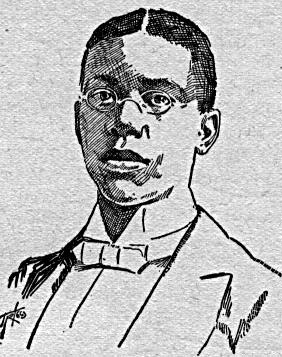
Paul_Laurence_Dunbar by Norman Wood

Paul Laurence Dunbar “Let the world dream otherwise…”


Like many cross-over artists, he did this by doing the established forms as well or better than the incumbents. One way he did this was by writing in regional black dialect, in poetry that is frankly hard for me to decode from my 21st century location. On one hand, regional dialect was all the rage in 19th century America across various regions and ethnic heritages, and there’s no reason that Afro-American dialect couldn’t be part of this—Oh, wait, there is a reason: white supremacy.*

Dunbar was born near the end of Reconstruction, right as the reaction to the possibility of full Afro-American humanity and citizenship was snapping much of his country back to a feudal system based on presumed, and if not presumed, enforced, inferiority. One can’t avoid the problematic nature of trying to portray a range of comic to simple-wisdom-dispensing Afro-American characters speaking a non-standard version of English in a context of a society that was fairly sure that was the extent of their intellect.**

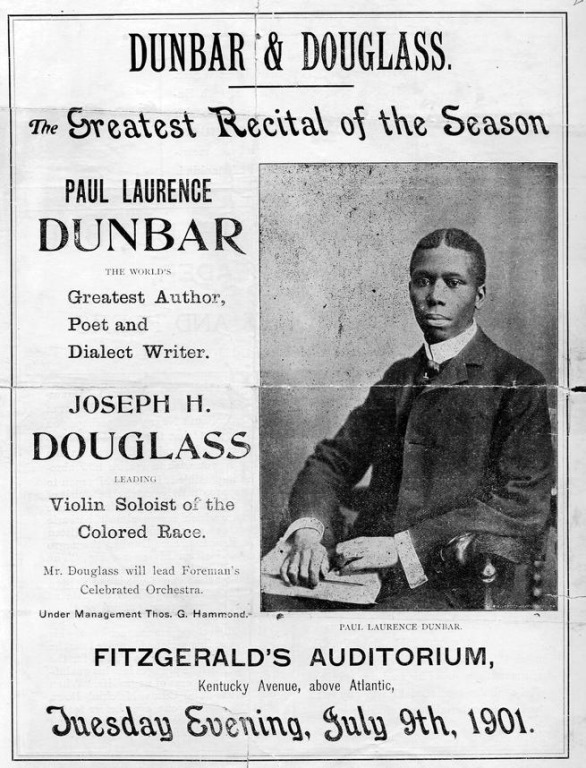
Dunbar Live!

Fitzgerald’s Auditorium later became Atlantic City’s “Club Harlem” and hosted jazz and R&B acts.


But that was only part of what Dunbar wrote. He also wrote supple 19th century lyric poetry in standard English, as good or better than the “Fireside School” of  East-Coast poets that were the standard for American poetry at the time. And it’s that side of Dunbar’s work that I present today with his poem “October.”

“October”  is an extended metaphor nicely developed over 24 lines of rhymed and metrical verse. Dunbar alternates his rhyme scheme of ABAB to AABB to add some delightful variety. The autumn notes of harvest bounty and oncoming winter are struck and sounded cleanly.

It was only after enjoying it as a good poem in this style that I began to notice another context, an undertone. This had happened to me earlier this year when presenting a Dunbar love poem, “Kidnapped.”   After performing that one, I moved on to ask: did the child of two formerly enslaved people write a poem about being captured like a butterfly and being taken far away from some home landscape? Yes, he did. Was he consciously encoding that undertone into a popular poetry form that could have been printed on a genteel valentine? I don’t know. It seemed a stretch as a conscious choice, if only because the undertone/metaphor wasn’t developed as fully as it might have been.

This time, with “October,”  Dunbar does develop his metaphor, and I know of no document where he comments on his thoughts on this poem. Autumn’s harvest is presented as if it were an economic system, and dare I say it: as a feudal/sharecropper system. October is wealthy and in charge, and harvest makes her wealthier. She is presented as foolish with this collected wealth. The poet observer’s persona is not outraged by this however—indeed he portrays her as happy, carefree, joyous, beautiful. And the poem is also unambiguously beautiful. Is this personified red-headed October, collector of the treasure and bounty, deserving of unstated disgust or even envy? Is this an idealized Daisy Buchanan-like character?

Your eye (like mine) as you first encounter this poem may be on the signified season. We can’t be expected to see the fall of the year as a real person, with an actual role and privilege in a system, can we? Is it only unconscious sub-text?

Ambiguous as this is, this is part of the wealth of poetry. It can be enjoyed as word-music. Its metaphors can be admired for cleverness and their own silent music of thought. But it’s also the way for the moving minds and experience of others to be shared. It is the concise literature of the oversoul.

I performed my solemn version of Dunbar with acoustic guitar, piano and electric bass. If you’d like to check out the text of Dunbar’s poem, or follow along as I perform it, it can be found here. The player for my musical performance is below.


*I expect a percentage of this blog’s treasured audience just clicked off when I typed that phrase. If you, indignant, at least followed to this footnote, thank you, I appreciate it. I know that some of you come to poetry and music to escape the turmoil of politics and social problems.

**It’s hard to do, but some Afro-Americans managed to do it. I can trace the musical line of it anyway, from Charlie Patton to George Clinton to the hip-hop movement.

Edward Thomas’ October

Moving from 17th century Welsh poet Henry Vaughn we’ll jump forward to a favorite of this blog: 20th century Welsh poet Edward Thomas. Thomas is less well-known in the U.S. than he is in the U.K., perhaps because he’s sometimes classed as a “Georgian poet,” a loose classification given to early 20th century British poets who weren’t Modernists.

As far as America was concerned, not being a Modernist wasn’t a good thing as the 20th century continued, particularly given that two Americans (Ezra Pound and T. S. Eliot) were instrumental in the Modernist revolution in English-language poetry. Georgian poets were soon seen as those that hadn’t gotten the news about what sort of topics, outlooks, and word-music was appropriate for the new century. Societal and cultural failures were prime topics, skepticism and a multivalent posture toward agreed-upon premises were expected, and the tight starched collar of strict accentual-syllabic verse music was loosened.

Thomas’ other problem was that he was killed during WWI, and wasn’t published to any degree until after that war was over. In Great Britain, those war poets who held to the pre-war verse forms were given some license because of their service and sacrifice. In the U. S., this was largely a non-factor.

But of course, what kind of word-music a poet uses has little to do with his subjects or outlook. Thomas, like his American friend Robert Frost, was roughly as Modernist as any of his contemporaries, he just didn’t sound like one if you muffled his words so that only the sound and rhythms remained. Like Frost, he never developed a Cubist or Dadaist kaleidoscopic vision, but within the monocular vision by which they squinted at modern problems, their analysis was fully of the new century.

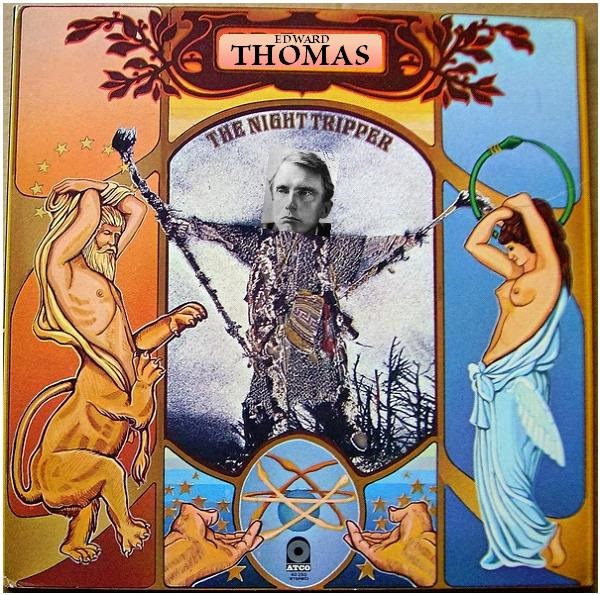
Edward Thomas The Night Tripper

Sun,  Moon, and Herbs; scabious and tormentil, Edward Thomas knows ‘em!

Case in point: today’s piece, Thomas’ autumn poem “October.”  The subject of “October”  is depression. Thomas gives it an old name “melancholy,” but depression and existential isolation is its matter. Many of Thomas’ other poems (including most of those we’ve featured here) have him focusing on the decision whether he as an over-draft-age man would volunteer to serve in WWI, a war whose cause he didn’t really believe in. In the end he decided that he would not exempt himself from the human suffering of the war.*  But in those poems, like this one, the other marker that lets one know that we are in an Edward Thomas poem is an almost encyclopedic knowledge of nature. “October”  shows this: the fall plants are specifically named, and the names he chooses for two of them: scabious and tormentil, specifically reference their palliative properties.** And so from the start “October”  features a prime Modernist tactic: the use of specific things to surround the actual, ineffable, topic of the poem. The October day described is altogether pleasant. He remarks it could just as well be spring, and the late fall flowers of the harebell are just as beautiful as the early spring flowers of the snowdrop.

He even muses that at some future time he may be able to see his depression clearly as a finished, or at least understood, thing. Notice: there’s close to nothing in this poem (other than that single “melancholy” that comes in the penultimate line, or that say-what’s-not, not what-is “I might as happy be” statement) that tries to say “I’m depressed and can’t presently find my way out of this mood, to decide my life.” He doesn’t even say “And now it’s fall, and I’ve got a damn winter to live through.” Instead, in “October”  Thomas leaves us in a Buddhist or Taoist moment, able to see the beauty and the sadness, equal reflections of each other. His opening couplet seems to me like it could be a poem by Du Fu or Li Bai, not the poem of an early 20th century Brit, and so I refrain those lines at the end of today’s performance.***

Elsewise in my performance I worked with the new orchestral virtual instruments which have given me more usable staccato articulations, which I’ve put in service of my simple “punk rock orchestration.” My finger strength has returned to a level that I felt comfortable playing the featured fretless bass motif for this.

The full text of Thomas’ poem his here. The player to hear my performance is below for some of you. Don’t see a player gadget? This highlighted hyperlink is another way to play my performance of it.

.

*Thomas’ outlook, his feeling that personal decisions even in the face of doubt and lack of information were critical, were gently chided by Robert Frost in Frost’s famous poem “The Road Not Taken.”  Frost was the stoic, Thomas the existentialist.

**Henry Vaughn, the practicing physician, was more overt about the pharmacology metaphors in his poem about “Affliction,”  but think of Thomas as an herb-doctor as he assembles the formulary of his nature scene here.

***Has anyone tried to translate Edward Thomas into Chinese? Although “October”  is written in English blank verse, so much of it seems like it would sit naturally as a poem in the classical Chinese manner.

To Autumn

October 4th is National Poetry Day in the U.K. this year, an event similar, though more condensed, to the National Poetry Month in April promoted out of the U.S.

No one’s revealed why April for the Poetry Month, though Chaucer and T. S. Eliot may have put in their votes, and the reasons for the fall date for Poetry Day could be arbitrary too. But autumn would have an emotional claim. Fall is changeable in weather, an underrated Spring of warm days and cold shuffling themselves. It has its long-established events: school years underway, harvests and harvest festivals, the closing of summer venues, Halloween, Veterans Day/Remembrance Day. Fall can also be an easy metaphor for approaching death, but poetry is one buffer we use to handle that subject anyway.

John Keats wrote one of his last and finest poems to the season almost 200 years ago in the autumn of 1819. It’s full of the strengths of Keats’ writing. Even in his time Keats was both praised and dismissed for the sensuousness of his poetry, and not a line goes by without some sensation of taste, touch, color and sound, and all that is contained in beautiful word music and an off-balance rhyme scheme that may couplet-rhyme two lines together, or tantalizingly wait two or four lines for the rhyme.

John Keats listening to the Nightingale on Hampstead Heath c1845 by Joseph Severn.

Look at that great single-track behind you John. In only 160 years someone will invent the mountain bike


Even if some of his words are 200-years-old antique, or for us Americans, peculiarly English, he crams all these sensations in his poem without them seeming forced, as if they were special or unnatural “poetic” things. Many of the sense words in this poem are of ordinary manual labor: load, bend, fill, set, reap’d, laden, press, and borne.

Where he is outrageously poetic is that this poem is an apostrophe. The entire poem is addressed, just as the title says, as if the season was a person: “To Autumn.”  A poet doing that today would, intentionally or otherwise, produce a humorous effect. Still, if we allow it, the second stanza gives us a leisurely fall, a farmer taking a break on a warm autumn day from rural labor, hiding in a barn, or taking a nap in a half-harvested field, but yet also returning to pressing cider from apples down to the last drop, and bearing away hand-gathered food on his head “like a gleaner.”

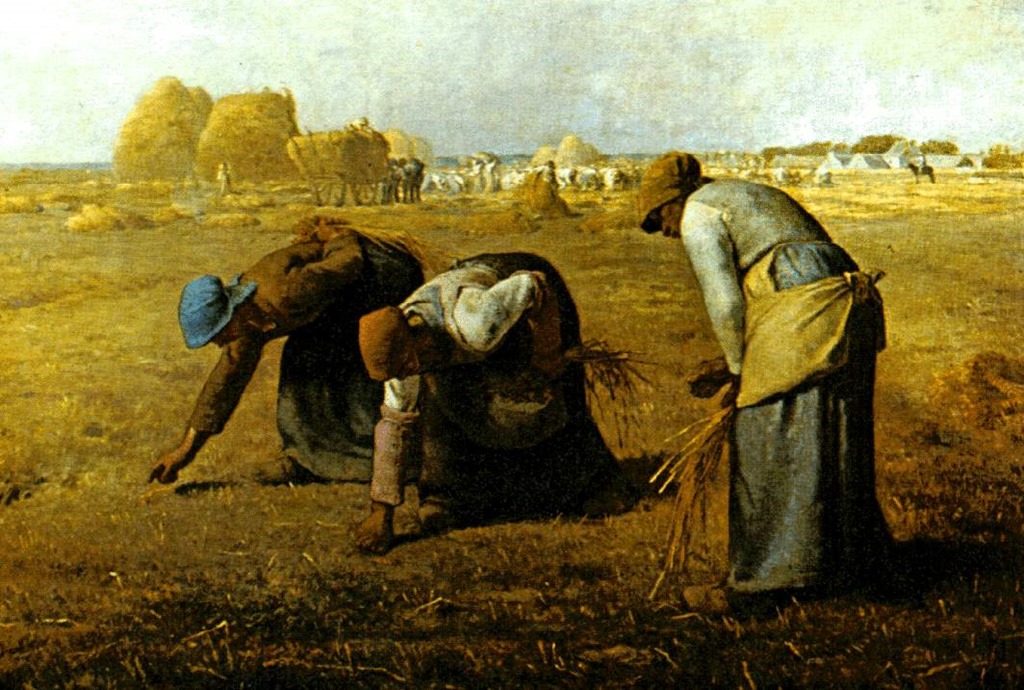
Gleaner is one of those antique words. It was a practice in some places to allow the poor and those without land to gather what leftover grain might be left in the fields after harvest. Just this week I was reading on the always Interesting Literature blog that Keats may have had this practice on his mind as gleaning had just been outlawed in England, and that other images in the poem may have had social resonances with Keats at the time.

The Gleaners by Francios Millet

Painters whose names suggest a subject for their painting: “The Gleaners” by François Millet


The poem’s final stanza retreats with distant banners flying, a symphony of extreme audio dynamic range. The infinitesimal sound of gnats flying is a choir. The wind crescendos and decrescendos. Lambs bleat loudly and then there is silence. Crickets arpeggiate for time. Birds whistle, twitter and leave in the sky, migrating away, and the poem ends.

Keats himself ends as a poet, this being one of his last works. He leaves for Italy in hopes it will help his tuberculosis, which it won’t. He’s dead in about a year.

My music for this today is acoustic guitar with bass and some orchestral parts: winds, a couple of cellos, a pair of violins. The player to hear it is just below.


Here’s a #nationalpoetryday bonus, featuring a very different British poetry from about a century later, T. E. Hulme’s “Autumn.”  Hulme was a too-little-known instigator of Modernist poetry in English, and like a lot of instigators he moved by opposition to previous schools. In particular, he disliked the English Romantic tradition of Keats, viewing it as too flowery, to full of images that were no longer real and which had become only conventional symbols.

Interestingly, in his “Autumn,”  Hulme’s central image is similar to Keats: instead of a farmer taking a break in his granary or napping in a field, he has a harvest moon looking over a hedge like “a red-faced farmer.”

Here’s my performance of Hulme’s “Autumn,”  which you can also listen to with the player gadget below. If you like this sort of thing, be sure to spread the word about what we do here at the Parlando Project.


Merry Autumn

Over the years I’ve developed a tough-enough way to be cheerful and productive, my own “grant heart” to myself. Though on the face of it, it sounds glum, I’ve learned it by reading about artists or from artists talking about their work, and it goes by this cheerful motto: “All artists fail.”

All artists fail more than they succeed. Every. One. No artist is so broadly popular that everyone likes their work. Even those that might gain a plurality of some kind, for some time, that likes their work, will find most of that group “ignoring” them most of their lives, because our attention is so precious and limited as audiences. One’s privilege as an artist is to get to fail again. If you don’t like how you’re failing, fail better, or fail differently, fail more often.

And even those artists we think of as succeeding sometimes, sometime find themselves succeeding in misunderstanding or misapprehension.

How can this knowledge help us, grant us heart, and not crush us? Anyone who makes things should carry in themselves the conviction that the world needs more of what they do, even if they or the world don’t know it yet. We are making more of what needs to exist, though that may fail when the world doesn’t know what to make of it. It may fail because we are wrong about its necessity. And it can fail because of how we choose to manifest our art.

Are we good enough to manifest our art so that it will not fail all the time? If our desire, our artistic conviction, is somewhere around helping heal the world and cleanse it’s perceptions, you may take that as beside the point. Decades ago, in the early days of the modern emergency medical system, I once helped receive a patient in cardiac arrest as they arrived at an ER, delivered by a volunteer ambulance corps. The man in the back of the rig, still in the human heat and confusion of the moment, said that he would have performed CPR, but that his certification for CPR had expired.

Well, you have to try, even though CPR then, as I suspect it does now, mostly fails. Art, even good art, usually changes our perceptions for only moments, leaving us nearly as deaf, blind and numb afterward. If art can heal the world, it’s a long course of treatment, and its healing is imperceptibly slow.

So, if you want to make art, want to write or make music, take heart and make sure your goal is to cleanse perception or heal the world. Add to your goals one more precept, to try to not bore the audience when it grants you it’s precious attention. If you want to create art because you want to succeed, consider a lottery ticket instead.

What a roundabout way to get to Paul Laurence Dunbar’s Thanksgiving poem “Merry Autumn.”  How did the poet Dunbar “fail?” The child of two enslaved African-Americans, raised by a mother who learned to read to help educate her son, Dunbar was able by the age of 21 to gather some appreciation for his poetry, which spoke in three voices. Voice one was that of an accomplished 19th century poet who spoke like the East Coast “Fireside Poets” such as Longfellow, using a middle-Atlantic diction that may sound slightly old fashioned to us, but was the established voice of poetry in America at the time. We in the 21st Century may hear the peculiarities of that voice from our vantage point in time, but it would probably have not seemed like a dialect at all to his contemporaries. He also wrote in two other American dialects, and dialects were a great American literary fad of the late 19th Century. We might rarely encounter the remnants of this fad in Mark Twain or some other regionalist writers nowadays, but the idea of using written English to represent the different pronunciation and syntax of a big country before broadcast media was an artistic and commercial success of the time. Dunbar’s poems, then, also “spoke” in an informal, less-educated Midwestern dialect, and in what was considered as the southern black dialect of the time.

Dunbar Live!

Ich bin nur einer meiner vielen Munde und jener, welcher sich am frühesten schliesst.”


It’s hard to say how accurate this black dialect was. Dunbar’s mother likely would have spoken in it. Even though we’re speaking about speaking of just a bit more than a century ago, it may come down to the same informed guessing that allows actors to perform Shakespeare in “original pronunciation” productions. And Dunbar’s transcribed accuracy aside, how it would be read by fellow African-Americans and how it would be read by Americans of European extraction would likely have differed greatly. On the page, his Afro-American dialect poems can look/sound like the black-face makeup minstrel-show dialect performed by successful white entertainers who perfected cultural appropriation for laughing audiences. The humble-brag of the Afro-American dialect poems may be abstractly similar to the tropes of the his Midwestern regionalist dialect language, but in the end, it was not “read” as similar by the predominate culture.

What did a young Dunbar think of all this as he wrote his poems in either of these languages? I do not know, but his dialect pieces were something he was praised for by the cultural critics of the time, and they no doubt aided his marketability. He eventually expressed despair at the concentration of the attention on the Afro-American dialect poems. Perhaps he had wanted to say that he’s all of these things: a black man, a Midwesterner, and a man who could sing a middle-Atlantic song as sweet as Longfellow or Whittier, and instead he was seen as the man to represent only the borough of his race in the eyes of those who did not share his experience. He had to try. He “failed.” Today we may be grateful for his failure.

Today’s piece “Merry Autumn,”  doesn’t show Dunbar’s later despair. It’s largely in the “Fireside Poets” mode, though he drops into informal Midwestern idiom once or twice. And following the precept to not bore the listener who lends their attention, he takes a contrarian stance toward the old poetic trope of Autumn symbolizing death and a fall to winter.

I sing it here with a folk-music type melody, an acoustic guitar, and some strings for accompaniment. Use the player below to hear it. Thanks for taking the time to listen!


Autumn Movement

I’ve been a bit long-winded in the past few posts, so a short-winded post about today’s piece. The words are another poem from Carl Sandburg, this time from his 1919 collection “Cornhuskers.”  There’s not very many words to it, a warning that there are not many leaves left here in the upper Midwest.

Cornhuskers cover

They were listening in London, and Sandburg’s “Cornhuskers” won him the Pulitzer prize.

I can compress talking about those words because I’ve already talked about Sandburg on the previous occasions when I’ve used his words here. In his poems of this era, he’s as perfect an imagist as any of the expatriates mixing up modernism in London and Paris around the same time.

Many of the Sandburg poems I’ve used previously have been from his landmark “Chicago Poems”  collection, but Sandburg, a child of middle, rural Illinois, spent time across the Midwest in his youth, from urban centers to the farms and small towns. The poem I use today, “Autumn Movement,”  is from that rural setting.

Images for autumn and fall foliage have been mined forever, which makes Sandburg’s key image here as unusual, even a century later, as T. E. Hulme’s red-faced farmer appearing as the harvest moon in his British autumn poem. Sandburg has the red and yellow of autumn leaves in a farm field vista as a yellow scarf with the copper color of a literally red-necked woman. So nearly has this skin color become an epithet, that few would think of using it today, as honest an image as it is.

Today’s audio piece is musically ars longa to the vita brevis of the words. I’ve been telling myself to allow space compositionally, and then going ahead anyway and filling things up like a compulsive cluttered room with only paths between piles of old newspapers. So, for this one, the drums (which are often quiet and spare) are the densest element. I added a simple bass line played on my fretless bass, a theme played on a Telecaster, and a digital synthesizer part that is a mix of four different patches played together rather than filling up the space with multiple synth parts. Give it a listen with the player  below. Or if you don’t see the player, you can use this highlighted hyperlink to play it.

Autumn

100 years ago, a WWI German artillery shell ended the life of T. E. Hulme, the man who sparked off what we now know as modern English poetry. I was going to say “invented,” but that’s a dodgy word in art as much as in science. Hulme borrowed ideas from several places, and adapted poetic tactics the French and some Americans had already made use of. But we can still say he started things off because he collected the tinder and cordwood in the Poet’s Club in London in the first years of the 20th Century, and the spark was applied by suggesting that everything he thought poets were doing since, well, just about the Renaissance, was wrongheaded. Too flowery. Too ornamented. Too “romantic,” an error he believed made them think of mankind as exalted and godlike.

Hulme, interested in visual art as much as he was in literature, thought the new literary direction should be visual. Cold hard images, direct and vivid, not abstract, were to be the new order, but these images could even be homey and simple (as long as they retained that vividness), not the sort of thing that signaled high culture in the British poems of the past couple of centuries. He was very certain of this, and he either made a convincing case in person or provided the theoretical underpinnings through first or second-order influence to the soon to be mighty modernists: Pound, Eliot, Yeats, H.D., and Frost.

Bust of Hulme
Bust of T. E. Hulme by Jacob Epstein, another member of the early 20th Century artistic “American Invasion” to England

Hulme illustrated his ideas with short poems. I’m not altogether sure how seriously he took these writings, but I find they have three attractive attributes. First, for all the bluster and pugnaciousness that he propounded his theories, the poems are very unassuming. In subject, they often seem to follow one of the principles I try to follow in the Parlando Project: “Other people’s stories.” Second, they are short, and I am attracted to the variety of expression that can succeed in short poetry. And lastly, they are the first. They have that charm, the same charm I might apprehend looking at a Chuck Statler music video, an Apple I or MITS Altair personal computer, an early horseless carriage, or the pictograms on a cave wall. The other beginners looked at this, and said “why not?” Ezra Pound related to Hulme’s ideas in formulating “Imagism.” T. S. Eliot either saw or was reinforced in his ideas for a new classicism in poetry in Hulme’s work.

What would be striking about today’s piece, Hulme’s “Autumn,”  in 1908 when it was published?

It’s “free verse.” No rhyme, no regular metrical scheme. Besides some French poets, American Walt Whitman had done this, but this was still rare, and rarer still in England. The last part of Hulme’s “Autumn”  is still musical however, essentially iambic, and sound echoes, if not rhyme, are present in “wistful stars with white faces.”

Hulme’s two substantial images in “Autumn”  are extraordinarily unpretentious, particularly the first one: “the ruddy moon” at sunset leaning “over a hedge/Like a red-faced farmer.” Compare this to Shelley’s “To the Moon” where the moon is “of climbing heaven” and is addressed as “Thou chosen sister of the Spirit” or Wordsworth’s “With How Sad Steps, O Moon” which is “running among the clouds a Wood-nymph’s race”—and these are examples from good poems of the 19th Century, not the more forgettable lot.

Over at the Interesting Literature blog, where I discovered Hulme, it is pointed out that Hulme, who was from a rural district, also had a ruddy complexion. Perhaps Hulme is looking at himself when he sees the ruddy moon, or his hometown in the moon, but we don’t need to know this subtext to sense the nostalgic comfort in this scene. Except for “cold” near the beginning, which is a sensation as well as an emotion, the only other emotion that is “told” rather than “shown” in the poem is the adjective “wistful” applied to the stars.

Did Hulme toss this off, just to say “Look! You can write a poem like this.” I don’t know, but that’s beside the point. As a person myself who has emigrated from a small rural town, Hulme’s “Autumn”  works as well or better than a grander poem in a more florid manner.

What would Hulme have done if he hadn’t insisted in serving his country in WWI, or if that shell had landed on some other poor soul? That, no one can tell.

Ascenseur pour l'échafaud cover

Like Pound, Eliot,  H. D., Frost, and Epstein, Miles Davis was another American making new art abroad.


For today’s performance, I was struck by rehearing a portion of Miles Davis’ soundtrack to “Ascenseur pour l’échafaud”  earlier this week when a piece of it, “L’ Assassinat de Carala,”  appeared unexpectedly in Ken Burns and Lynn Novick’s “Vietnam”  documentary series.. Performed by Davis with a mostly French pickup band over a couple of days during a short stay in France, it’s something of a radically simple first of it’s own, as Davis essays a spare style with less harmonic movement, a style that he was soon to use with a company of more experienced and exceptional improvisers in his epochal “Kind of Blue” recording. Other than Davis’ own trumpet, the featured instrument on “Ascenseur pour l’échafaud”  is Pierre Michelot’s bass. In my music for “Autumn”  I made more use of the drums as well as the bass, as the only “trumpet” I could use was a synthesized approximation of the timbre of the real thing. There’s another first here: the first drum solo on a Parlando Project piece. To hear T. E. Hulme’s “Autumn”  as I performed it, use the gadget below.


Frost’s October

Early on here I mentioned that I didn’t care for Robert Frost when I was young. When I first was introduced to him he was still alive, but the very image of an old man. I think of him on a cold, windy and monochrome day reading at John Kennedy’s inauguration ceremony, more than 80 years old, more than 70 years older that I was then.

Teachers introduced him as moralist:

“What does this poem tell us?” “What does he mean by the ‘road not taken?” The teachers would ask.

And as a formalist:

“Free verse is like playing tennis without a net.” That was his most famous quote not taken from a poem. All that wild bohemian, beatnik stuff–that’s like cheating!

Meaning in poetry can be problematic. It’s not that poets can’t express original observations or analysis of things, but poetry’s preference for brevity tends to make poems more like a hint than an instruction manual. I wonder how many students ended up hating poetry, thinking the poetry the teacher wanted them to interpret and “understand” was tricking them with irony and obscure metaphor. Frost, as he was taught when I was young, was “meaningful”—but worse than that, he seemed to be held up as someone whose poems were meant to teach good behavior and noble thoughts. As a teenager, I already felt I already had all I needed of that.

It was only a few years ago that I was looking for poems to set to music and sing, and to my surprise came upon the Frost of a hundred years before, the writer of short poems that just sang off the dry page. This sort of thing is very hard to do in English. I know, I’ve struggled to do it. What Frost could do wasn’t just tennis with the net strung up, this was playing grand slam tournament tennis while dancing classical ballet!

So here’s an example of Frost doing that: “October” written in 1913. Frost is a master here of singing vowels. This is less a poem than a singing mediation. Meaning? Well, yes this is one of many poems that look at October as the time of approaching Winter. That this is not a strikingly original thought is not really an issue, because the poem isn’t about the thought, it’s about the moment of that thought, common to many of us, and how to hold ourselves inside that thought. The real, valuable, “meaning” is in the sound and the way of saying it.

Musically I tried to serve that feeling of meditation, and once more I have a tambura drone grounding the melody lines. Dave Moore, who you may have heard reading other pieces here, is playing the keyboard part, which I call your attention to because I think it’s a fine performance on his part.

To hear that performance, click on the gadget below.

This Is the Darkness

This is a more difficult piece for me to put out for you to hear. Not because of the quality of the performance by the LYL Band, the performance is fine. Nor do I disagree with the performance, as it does what a performance should do: it represents a physical, working version of the feelings in the piece. The problem with it is, that taken in particular, it can be heard as out of balance.

I wrote this at a specific time in my life, for that matter at a specific time of year and even a specific time of day. When it was written and performed, I was exiting my middle ages, and elements of my life were out of balance. And it was written at this time of year, which in my upper Midwest US means that it is now dark when one awakens in the morning. At this time in September, there is no more promising summer sunlight tempting you to arise early, the sunlight that says the day has already started and you should go and catch up with it.

Perhaps you’ve had the thoughts I had on the day. You know you have things to do, many of them things you would not choose to do at that morning moment in time. How should one view this predicament?

Albert Camus wrote of this famously in his essay “The Myth of Sisyphus.” You can read the concluding section of that work here. It is not long, but if read thoughtfully it is arduous. Was I thinking of Camus when I wrote this? No, I was thinking of my own life; but other people’s stories, in effect, other people’s myths to explain this mystery, show that we hold these thoughts in human commonality.

I will not try to explain Camus thoughts on this, he does this better than I could. I have no quibble with his analysis of the situation, but as I’ve mentioned previously here, I currently suspect all myth of understanding more than it knows. Furthermore, the close association of myth and heroism makes me the more skeptical.

And that’s why I found this piece, one I myself wrote and performed, problematic. Inside it I come to the same consolation that Camus did, but Camus’ “Myth of Sisyphus,” and my piece “This Is the Darkness” can both be easily experienced in an unbalanced way: the absurd predicament is so strong an image that the consolation, our revolt and continuance of seeking right action in the face of that predicament, can seem all too vainglorious.

So let me suggest another myth. One plainer and less heroic. There is a plainspoken yet strange hymn associated with Christianity “Work for the Night Is Coming.” You can hear it sung here in this short video. As I said, this is a Christian hymn, still sung in Protestant Christian churches. Does it mention Jesus or any divinity? No. Does it elaborate any moral code? No, not really. Does it offer a sure explanation of any mystery or absurdity? No, not directly. It simply says “Work, because soon enough you will not work anymore”. In the context of Christian myth, this can be taken to mean heaven or the advent of heaven on earth, but this strange hymn decides not to say either.

Not so strange that this was written by a Canadian—the natural brethren of us upper Midwesterners, someone who would know intimately that the darkness beyond summer is long—but strange in that Anna Walker Coghill was 18 years old when she wrote it. I had to be much older to understand her words.

That’s a lot of context for this piece, but to hear “This Is the Darkness” performed by the LYL Band, use the gadget that appears below:

The School Year Begins

Tomorrow many US schools begin their school year, so here’s an audio piece about a child going through that first week back in school after what seemed to be an infinite summer.

The schools in Iowa, where I grew up, began a week earlier than the “day after Labor Day” start that is more common elsewhere in the US. I’m not sure why. Maybe farms needed kids more in the spring to summer transition weeks than in the summer to fall interval. Maybe it was an advance allowance for the inevitable “snow days” that would cancel school during the winter, days that if made up in the spring would move the end of the school year into June. Maybe it was, in some way, a gesture to say Iowans cared more about getting down to education than slacking neighbor states.

All I know is that as a kid I thought this terribly unfair. A whole week! My cousins in Minnesota got a whole week more of summer! That next week was always going to be the best week of summer, the one that you got to do whatever you hadn’t done, or done enough of, during the rest of the summer vacation.

Now my son goes to school, and the school yard the kids are walking across to get to the first day of school is like my schoolyard was. Maybe all schoolyards are like this. The grass is still a little beaten down from every independent path the kids have taken too and from, still worn from every recess outside last spring.

To hear the spoken word/music piece “The School Year Begins” as performed by the LYL Band, click on the gadget below this.