Frost Warnings: an appreciation of the poetry of Phillip Dacey

I mentioned earlier this month that my late wife took creative writing classes with poet Phillip Dacey in the mid-1970s. Later, through her, I met Phil and was able to talk to him a bit about poetry. Phil was generous about this, and I’ve never forgotten that.

It’s always hard to accurately, objectively, analyze where one is in in their writing craft. I knew I was only partway in craft, but I self-judged myself as better than average in the imagination aspect. Looking back at that young man I was then, I’d re-set my judgement now to say I was even less far along in craft than I thought, but I still think my imagination was as good or better than many. Those models that I looked to back then: Blake, Keats, Sandburg, Stevens, and the Surrealists were good enough for starters.

Of course, old men can be wrong when looking at themselves too – presently or retrospectively. I’ve come to consider self-judgment as so unreliable that I treat it as a traveler’s tale: something to listen to, but with a duty of skepticism. If I get time, I might extend this informal series engendered by finding old 1970’s manuscripts packed away in boxes with a few of my youthful poems. If I do, I’ll try to make it worthwhile for you rather than self-indulgence.

This Project takes author’s rights into strong consideration, and you may notice that we almost always perform works in the Public Domain.* As the Parlando Project was starting I learned that Phil Dacey had died. I hadn’t seen him in over a decade at that point, but I contacted his website on hearing the news, and got permission from one of his sons to perform a couple of his poems here. This autumn, while in a dusty boxes clean-out, I came upon a letter from Phil to my late wife dated November 1977, and within the handwritten letter was a typed copy of a poem of his about this time of year.**  I felt I had to perform it for you. Phil’s personal site is no more, and I retain no contact info for the family, but this not just a non-profit – non-revenue – Project would propose that the promotional/educational aspect far outweighs any abrogation of the rights holders. If one wants to seek out and read any of Phillip Dacey’s poetry collections, you’d be following my recommendation. I don’t know if today’s poem made it into a collection (I only have some of Dacey’s many books), but you will find poems like this in them.

This picture of Dacey is from the poetryfoundation.org site. There are some other poems of his linked to a short bio there.

.

The subject matter of Dacey’s poetry when I met him was spread out between memories of his childhood in St. Louis (a city that punches above its weight in modern American poetry), a Roman Catholic upbringing, erotic desire and its complications, and family and marriage. He came into a long-term teaching gig at a rural Minnesota college, and stayed in the state during his retirement; and as a result, the setting for many of his poems is distinctly Midwestern. In my early posts here where I wrote about Phil’s poetry, I stressed the humor in it and the unusually engaging way he presented his work to audiences. Both of those things might endear him to listeners and readers, but I fear they might blind the completely earnest (or the envious) to other strengths in his poetry.***  I don’t know how he taught the craft professorially, but he models for young writers a subtle kind of poetry, and the piece I perform today is an example of that strength.

“Frost Warnings”  begins – and with only casual attention might remain – an occasional poem about the present point in an Upper Midwest autumn. Afternoons remain warm, yet the hours before dawn drop lower and lower until they eventually sink below 0 degrees Centigrade – frost and freezing time for plants. Food gardeners must make their household harvests, flower gardeners, preserve their late bloomers. The poem’s bed sheets with rips and out-worn baby blankets start as reportorial items in a task to stave off frost-burn, but are, if we think again, stealthy deep images of desire and parenthood, the kisses from which we make mankind as Éluard had it our last post.

Then a third of the way in we meet the bedding again, cast as shabby Halloween ghosts. Dacey’s unshowy poetic compression of the worn-life of young parents “too much revelry and worry” is masterful, but might you overlook it on first reading? The modesty of how Dacey uses his craft pleases me – and then he playfully indulges himself by breaking into Wallace-Stevens-voice for the word-a-day-calendar delight of writing down the ridiculous sounding “tatterdemalion.”

On the page it’s also easy to miss the use of rhyme and near-rhyme in this poem: that “revelry” with “worry,” “find” and “vine,” and the comic “jalopy” and “credulity.” Finally, the poem sticks the ending with a rhyme: “Fall” and “mortal.” For at least a while, I think Dacey was associated with “New Formalism” in poetry. “Frost Warnings”  is Formalism unfettered.

I wish I’d spent more time on the music I made for this one. It’s been a busy week or so for me, getting vaccinations, some banking business, attending a large gathering against cruel and capricious authoritarianism, getting my own “garden” of bicycles and composing/recording equipment ready for the upcoming winter. As a result, the music I performed with Phil Dacey’s poem is quite short, and is just a trio. I wanted to add a melody instrument, and strip back or deemphasize the piano part for a guitar, or even a horn or wind instrument part, but that would delay things, and I have a half-a-dozen other pieces in WIP state that also want completion.

Phil was a great performer of his own work. He’d have done a great job presenting this, so I tried to use my memories of him to guide me. I attempted to memorize the poem for the performance (Phil often did poetry readings without “reading”) and I hope I brought out some of the elements in my recording that a quick reader of the page poem might miss. So, it’s done, and you can hear Phillip Dacey’s “Frost Warnings”  with the audio player below. Worried that someone’s taken the audio player away and spread it over last roses in the garden? Don’t wilt, I’ll provide this alternative: a highlighted link that will open a new tab with its own audio player.

.

*Yes, I have bent the rules a few times – and as the Project was beginning, I thought I’d get permission to use more recent poems by sending simple requests, only to find that would too often require prodigious effort and persistence.

**Here my late wife and Dacey were operating like 19th century Emily Dickinson and Thomas Wentworth Higginson well into the 1970s. By the end of the 20th century it’d be emails, and by now, social media or chat software. My dusty boxes and my late wife’s metal box held things for near 50 years, but who knows at what interval current inter-author correspondence-in-effect goes all Library of Alexandria.

***Often humor has a shorter shelf-life and lower canonical trajectory in literature. Using humor, or other approaches which seem to attract a wider audience, can attract a distrust of “mere entertainment.” The argument here, to be fair to detractors, is that such an audience is shallower even if broader, and that “fan-service” audience-pleasers keep an artist from growing and dealing with difficult subjects. My personal belief? Those most difficult subjects are absurd, incongruous, impossible mysteries and dichotomies to solve, and that humor can portray them as well as any other mode.

Phil read a few times with musical backing, as I present him today. One performance I attended was with his sons’ alt-rock band. His “readings,” even if acapella, could have performance elements. He’d weave well-told stories into the poems in such a way that you didn’t always know when the poem had started and explanatory introductory material had ended. He sometimes sang lines when he quoted a song inside a poem. Again, let me concede this sort of thing can be cloying. I’ve heard poetry readers down-rated for an “AmDram (amateur drama) style of presentation, and the “You are hereby sentenced to attend my one-man-show” jokes are easy to make – and that’s sometimes justified. My summary? This can be done badly. Just about all ways of presenting poetry can be done badly.  I thought Phil did it well. Other than talent and attention to his craft (including presentation) one reason it may have worked for Phil was the modest and subtle nature of his poetry that awaited and welcomed being presented more expressively than on the silent page. Still, and unlike some performance-oriented poets, Dacey’s poetry does stand up on the silent page – I just have had the pleasure of seeing it in that other framing.

Michaelmas Day, and a new short video

I’ve got things to do today, but I awoke, thought of this piece from the early days of the Parlando Project, and figured I could make a quick “lyric video” for it. I don’t know how many get introduced to the things the Parlando Project does via videos, but I’m always looking to find new listeners to these musical combinations with various words (mostly other people’s literary poetry).

This one is unusual in that I use one of my own poems for the text. Long time readers here will know that one of our mottos is “Other People’s Stories.” It pleases me to generally make these pieces with other poets’ words.

When the Year Grows Old

Here in Minnesota, the weather is turning, as it does at a time of its choosing in the Fall. Tomorrow morning the Fahrenheit temperature will be in the teens when I get up, and the forecast says single digits will greet me by Friday.

I began work on setting this poem by Edna St. Vincent Millay last week after seeing it at the Byron’s Muse blog. Two things grabbed me when I saw it: sitting there as silent words it begs to be sung, and it’s tantalizingly ambiguous.

This poem was from Millay’s first collection, published (1917) as Modernism was starting to find an audience in America. Americans in the last decade to be called The Twenties saw Millay as a Modern, though her prosody wasn’t like the free-versifiers, and her lyric’s narratives weren’t fragmented word-Cubism. So, a more comfortable Modernist to those whose expectations of poetry still flowed from the 19th century? Somewhat. Still, though not so much in her first book, but soon, Millay began to stand for The New Woman, a character that took up the prerogatives of independent thought, act, and agency in love and desire. A William Carlos Williams might have absorbed radical Modernist visions in Modern Art into prosody. A Carl Sandburg may have taken his Imagist eye and cast it toward workers and immigrants in his poems. But soon after this poem, Millay was using somewhat traditional verse to speak about female independence in life and desire. Cubism and Socialism were controversial, sure, but the kind of change Millay was covering in her poems was large in scope. Man Ray or Monet, Debs or Debussy, Pound or Reverdy — change was in the air — but as far as art such as poetry was concerned, the charge for change from women (and Afro-American artists) in the Last Twenties is a big deal, not something to shelve off as some sideline.

OK, so what does this early poem have to do with that? I’m not entirely certain. Yes, the overall scene of the poem is clear to any Northerner — but even as the poem starts the seemingly simple language has faceted surfaces. The poem is titled “When the Year Grows Old,”  but I’d suspect you might mistakenly remember it as “When the Year Grows Cold.”  It’s not just the rhyme, the poem is clearly about the weather getting colder, all the images intensify that. Intensities of anything old are not there directly at all. And then, I can’t say how idiomatic the opening statement (refrained at the end,) “I cannot but remember,” would be in 1917 — but it’s easy to read it (out loud, or in understanding) more than one way: “I will reflexively remember,” “I have only memory of this,” or even “I can’t do this, but I am forced to remember.”

And who’s the “she” in this poem? I had a thought in early-days with the poem it might be a pet, likely a housecat. Beside a generalized factor of love for warmth, cat owners might recognize the bird watching vocalizations — that, and a reference to “the warmth of fur” led me to that consideration. One reader’s reaction I read online this week thought “she” was a mother. I’m not sure of Millay’s mother’s (if that would be the mother here) characteristic feelings for tending a fire or even the specific kitchen task of making tea. My cursory non-scholarly thoughts are: not likely her happy place.*  Still, I could imagine that a general poetry reader in 1917 (like the Internet contemporary I came upon this week) could think that, or that the “she” is a friend of the poem’s speaker (which we might expect to be Millay), and so find this poem Millay’s predecessor to something like the young old Bob Dylan writing “Bob Dylan’s Dream”  about his remembering lost friends who’d once gather around a wood stove.

When the Year Grows Old

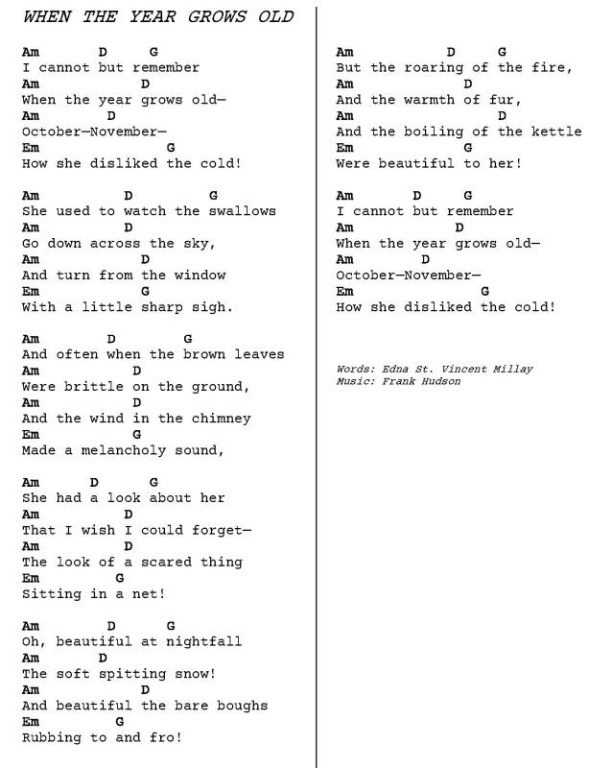
Simple chords for today’s piece, presented here as chord sheet  in case you’d like to sing it too.

.

Living with this poem as I set it to music and performed it, I came to think of it more at “Girl from the North Country” — a song about a lover who is longingly thought of lovingly, but who is now separated. By the time of the performance that you can hear below, that was how I was singing it. Why did I think that?

Partly from reading later Millay poetry, partly in biographic clues of Millay’s sexuality. There’s a definite undercurrent in the poem of the “she” feeling ambivalent: the sighing look at the flying birds, the melancholy chimney wind, and most directly in the abrupt “look of a scared thing/sitting in a net!” And what follows that line feels lustily sensual to me: those rubbing “bare boughs,” that fur by the fire verse.

That reading also answers the why the year being “old” is the title, not “cold,” other than just seeking variety. A once passionate attachment has been reconsidered by the other party, has grown old/cold.

Millay could have made other meanings (“cat lady,” “dear old mom.” etc,) clear with no commercial readership risks, but following my understanding, this presentation is coded so those who know will see that, and others will see a vaguer poem while recognizing late autumn weather. If I’ve misread it, or if Millay ever explained what she was intending — well, it wouldn’t be the first time — but it worked for me to find an experiential place to inhabit the poem.

You can hear my performance of Edna St. Vincent Millay’s “When the Year Grows Old”  with the audio player gadget below. No gadget? It’s nothing personal, just that some ways of viewing this blog suppress that. This highlighted link will open a new tab with its own audio player.

.

*As poetic testimony: tender as Robert Hayden’s well-loved poem “Those Winter Sundays”  is, it’s not a story of a parent finding happy beauty in loading up a household’s fire box.

Free to Fall

Allow me to be more internal than I usually am when presenting these pieces. Today’s piece uses my own words (we do that rarely here) and it’s here today for a peculiar reason — and peculiar is something I enjoy indulging in.

Early this autumn I was looking for a musical piece that represented the season, and I recalled this poem of mine that I had written music for. When? I probably wrote the poem early this century, and from a file I found, I was able to determine I wrote the music in 2007. Sometime after writing the music, I recorded what I recall was a pretty good version of it, likely with Dave Moore playing keys.

“Maybe I made this one of the early Parlando Project pieces” I thought. At the beginning of this Project as I was figuring out how to compose and record our combinations of original music with literary poetry, I had used several recordings of that vintage. Having some already completed pieces gave me time to get a handle on other tasks while getting this thing going.

But, what, I didn’t know? Well, I’ve put up over 700 publicly accessible pieces in this Project’s lifetime since 2016 — and that doesn’t count the ones that just didn’t work or didn’t fit the concept. One might like to think I keep my eye on every sparrow — but with that amount of catalog, it’s not fully accessible in my head. So, I looked. Here. For my own work.

Nope. I hadn’t presented it. It might not have made the cut because I wrote the words, and the Parlando Project is about other people’s words. Where else might it be? I looked in my somewhat disorganized collection of sessions and finished non-public pieces. Nope, not found there either.

My solution then was to re-record it. Recording time has been hard to come by lately, but I remembered this poem-which-became-song as being effective, so I tried to have it ready when I could open my microphone and record.

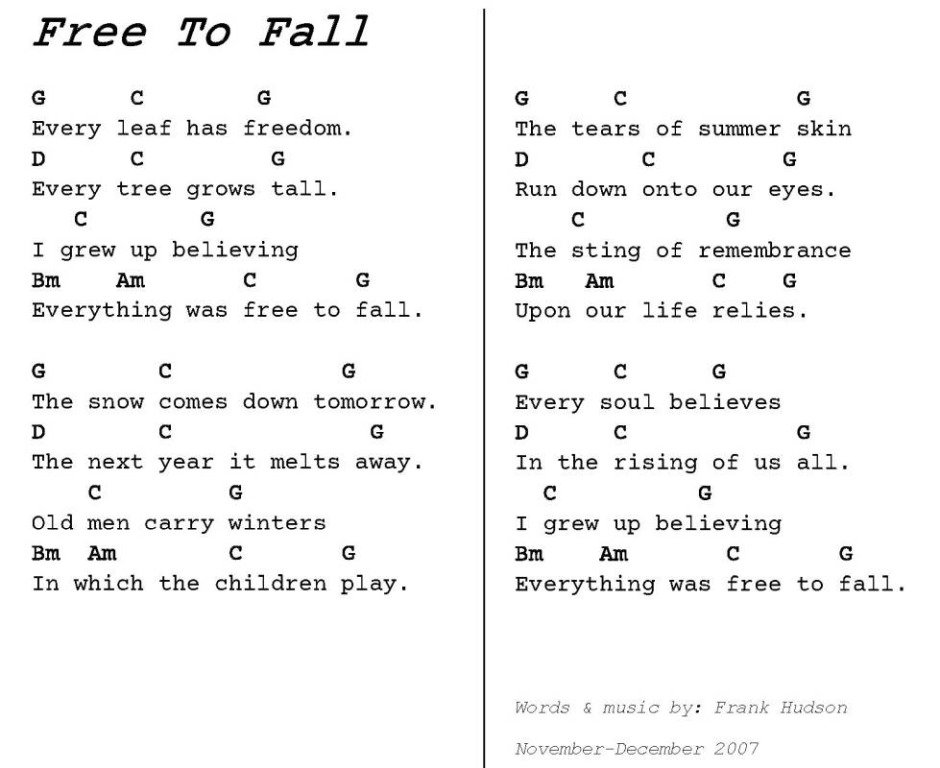
The piece is called “Free To Fall.”  As I wrote at the start of this inward story, I said I remembered it as being an interesting variation on the poetic perennial of autumn. In the first verse I already hit the falling leaves motif (can that one be escaped?) and I think the “every tree grows tall” was me referencing the British folk song “The Trees They Do Grow High.”   I continued to try to bring some longstanding tropes into this brief song: my own restatement of François Villon’s “Mais où sont les neiges d’antan*” starts off the second verse. I think the lines “Old men carry winters/in which the children play” are my own, but like my memory of where I put this song’s older recording, who knows if I just don’t recall some inspiration or reference.

The third verse’s reversion to summer memories and grief may be influenced by what I consider to be one of the great autumn songs, one found in every fakebook: Joseph Kosma/Jacques Prévert/Johnny Mercer’s “Autumn Leaves.**”  That song too begins with falling leaves, but references a summer lover now gone. Having lost my late wife in August might have made sure I made that step back in memory in the song.

Free to Fall Illustration 800

“Everything is free to fall”

.

The originality of this compressed catalog of autumn thought comes in the refrained pair of lines “I grew up believing/everything was free to fall.” What was my intent there? I’m not sure if I’m articulate enough to do as brief a job as the poet me did in writing the poem. Yes, I knew many readers/listeners would think of things like free will and predestination, shibboleths of theology — but in the lines’ first statement I wanted the connotation that autumn’s falling leaves are freed from their work in photosynthesis and now can flutter and drift. The fourth verse refrain may (or may not) put this in a different context. Is this a compressed statement of “free will,” the doctrine that humankind has the choice of choosing good or evil, which also carries a connected thought that this is what makes good, good, not just an inherent trait? I was likely aware of that when I wrote it, but in performing it this fall I took another plausible memory: that there are those who believe in an afterlife, or a rising or rebirth of the souls of the dead, but that the song’s singer believes that however temporary or final autumn’s dying off is, that there’s a freeing element in it, like that leaf that has been loosed at the start. That’s a bittersweet freedom I wanted to convey.

Free to Fall

Here’s a chord sheet so that other singers can extend or improve my performance

.

This poem/song works for me. Maybe it has some worth to you. In summary, the way I think it works is from the ability of compressed verse and song to collect things in a small memorable chunk of words, a portable experience. I’m glad I remembered this 16-year-old song and that I was able to record a new version to share with you. You can hear it with the audio player gadget below if you see that. No gadget? Some ways of viewing this blog won’t show them, but this highlighted link will open a new tab with its own audio player.

.

*“Where are the snows of yesteryear” is the concluding line of his “Ballade des dames du temps jadis”  published in 1533. Yup, those snows are definitely gone.

**One of the abandoned Parlando Project songs you won’t hear came from my idea to do a fresh translation of Surrealist-associated poet/lyricist Prévert’s French “Autumn Leaves” lyrics. I got a hold of those lyrics in French, and found that Johnny Mercer’s English lyrics are a freer, looser sort of translation. Prévert’s lyric is longer and more miserable, while Mercer’s cuts right to the nub of the situation without wasted elaboration. I found there was nothing I could do with Prévert’s French that would even approach the recasting that Mercer had already done.

My November Guest

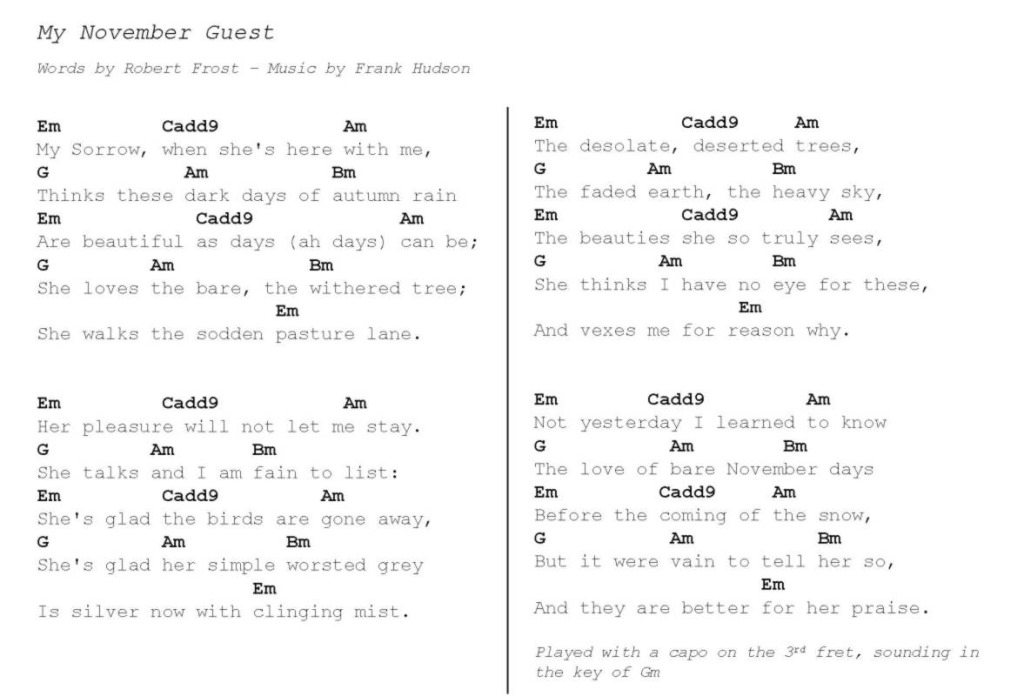
Back in 1916 American Poet Robert Frost published this short poem about what we’d today call Seasonal Affective Disorder (SAD). SAD is that syndrome where the increased darkness and other autumn changes set off depression in some individuals. Like many early Frost poems, it’s a beautiful, graceful poem with effective yet unaffected rhyme and meter — but when I saw it early today in a Twitter post by Cian McCarthy I was struck at the unusual way Frost treated this account of seasonal depression.

“My November Guest”  is set in the time of year we’re experiencing in my part of Minnesota this week. We’ve had two days of dark rain, even thunderstorms, the rain falling unbroken through the bald branches of the trees. It was around 60 degrees F. when I awoke this morning. I rode my bicycle to breakfast at a café wearing shorts as I might in spring, but when I rode past a small pond on my route I noted per the Keats of memory that “The sedge has withered from the lake/And no birds sing.” I returned home and spent an hour or so reading on our porch, but the forecast says it’ll be 26 F by midnight. Snow and ice will be falling north of us over the evening. “Robert Frost” is certainly the correct name for a poet to describe this.

Within the poem’s 20 lines Frost recounts a conversation between the poem’s narrator (we’ll say it’s Frost for simplicities sake as I paraphrase the poem) and his “Sorrow” (the poem’s name for depression.) Most of the conversation are points sorrow (simultaneously personified as external nature) is making to Frost. Sorrow/nature is stating that these dark days could be seen as beautiful. Frost says he is listening to this, feels what his sorrow is telling him has worth. The poem continues: the absent bird song, no colorful leaves on the trees, the cold mist — is it the dullness of grey or the burnish of silver? “You can’t see this as beautiful” nature concludes.

My November Guest

Here is the song I produced from Frost’s poem in songsheet format. I present these in hope that better singers than I might perform them.

.

Frost’s last stanza is his part of the conversation. “Yes, I know how to read the book of nature — or at least the calendar. I wasn’t born yesterday.” His day, the poem’s day, like my day today, may have been dark and damp, but it wasn’t yet the winter that is coming over the walls of the calendar’s date-boxes soon. I know I’ll miss sitting on the porch, biking without mitts, streets only wet not packed with snow or ice. The early and long November darkness may overwhelm us, set off mad clocks inside us, but that’s only dark, only hidden. Or so we tell ourselves and light our LUX lamps. Frost says it’d be vanity to tell his sorrow and this nature this, his mere knowledge, for nature knows the is  of this that surpasses knowledge.

Today’s music is a simple arrangement: me singing with acoustic guitar, as I quickly spent the middle of the day setting Frost’s poem to music and then recording it efficiently in my studio space before I need to hide my microphones from HVAC noises there. You can hear it with a player gadget where you can see that, or with this backup highlighted link for those who can’t.

.

Dusk in Autumn

I risked taking the charm and playfulness out of Emily Dickinson’s ghost poem last time by trying to puzzle out exactly what she saw. I won’t risk that today. This next poem in our Halloween series was written by a poet, Sara Teasdale, who wrote some complex adult love poems — but with this one she portrayed a child’s wonder. Well, a child with a little taste for tea parties with witches, but still.

Sara Teasdale Smiles

Sara Teasdale. Want to come to my tea party?

.

Teasdale was roughly a contemporary in her childhood in St. Louis with T. S. Eliot, but Eliot decamped for Harvard and then Europe — so as far as I’ve been able to find out, the two poets never met. I think Teasdale’s poem requires no further explanation, so I’ll just urge you to listen to it below. And here’s a link to the text of the poem if you’d like to read that.

Another simple musical accompaniment here, this time just some acoustic guitar. You can hear Sara Teasdale’s “Dusk in Autumn”  with a graphic audio player that many will see below. However, there are ways to read this blog that won’t show the player, and I also provide this highlighted link to click, which will allow those who don’t see the player to access the musical performance.

.

Fall 2021 Parlando Project Top Ten, numbers 10-8

It’s that time again when I present our quarterly countdown of the pieces most liked and listened to here at the Parlando Project during the past season. We’ll proceed from the 10th most popular and move up to number 1 in the next few posts. The bold-faced heading for each piece are links back to the original post that introduced the pieces here, in case you didn’t see them earlier this autumn.

10. Cobwebs, Steel, and Moonshine by Carl Sandburg.  Longtime readers here will know of my admiration for American poet Carl Sandburg, and so it may be no surprise that this is actually the second time I used parts of a single Carl Sandburg poem for a Parlando Project audio piece. The Sandburg poem is “Smoke and Steel,”  a poetic celebration of labor and laborers from a collection of the same name published in 1920. I used that whole poem’s title for the piece I created out of the beginning of it for May Day in 2019, but for this past American Labor Day I used the conclusion of “Smoke and Steel”  and gave the result this title. I dedicated it to another American poet, Kevin FitzPatrick, who was suffering from a serious and unexpected illness that killed him later this fall. This is the first of three poems in this fall’s Top Ten dedicated to poets Dave and I knew and exchanged work with who were suffering mortal illnesses.

I’m thankful that long-time reader of the blog rmichaelroman submitted a good guess as to what the steel might be in Sandburg’s short ode to workers and work: rebar.

Player gadget below for some of you, or this highlighted hyperlink will also play it.

.

9. Bond and Free by Robert Frost.  It’s been a while since I mentioned it, but Robert Frost bugged me when I was young. He was still alive, and omnipresent in anthologies one might find in school, which caused me to treat him like other 20th century poets and critics treated Longfellow: as a square preaching platitudes who stood in the way of younger and fresher voices who’d question all that with a more unruly poetry. I was misreading Frost of course, but through that error I did find others I thought in opposition to him that I found rewarding back then. Eventually I came around to love the word-music in his shorter lyric poems, and from that attraction found a starker and more divided meaning was there.

“Bond and Free”  is Frost in his more metaphysical and frankly philosophic mode, which isn’t my favorite Frost, setting out here a cosmic stage where Love and Free Thought conflict. He sounds more like Shelley or Keats in “Bond and Free”  than the more modern diction he was able to make sing in other poems, but sing the words do.

Player gadget below for some of you, or this highlighted hyperlink will also play it.

.

Frost-Moore-Sandburg

Three young poets at work. One played in the LYL Band.

.

8. They’re All Dead Now by Dave Moore. One of the most popular of my Halloween series this year, even though it’s a longer ballad form story that put my singing strength to the test. Longtime listeners here will know Dave as the most common alternate voice here at the Parlando Project as well as the keyboard player you’ve heard in the LYL Band.

He’s also a fine writer of poetry and songs. For reasons too complicated to deal with now, I fairly often sing Dave’s songs here rather than having him sing them himself. There’s a factor when someone sings another writers’ song. While they may bring a different kind of talent and musical craft, they may also somewhat misunderstand the song — or misunderstand (maybe more at “re-understand”) it in a valuable mutational way. Though I’m not a great singer, I do try to bring something to Dave’s songs when I present them here.

Every song stands to gain much more than one more life when sung by someone else. From time to time I’ve encouraged others to sing some of the Parlando Project songs. Anyone have their own cover of one of our Parlando Project pieces you’d like me to hear?

Yup, player gadget below for some of you, or this highlighted hyperlink will also play it.

.

Fall 2020 Parlando Project Top Ten, numbers 10-8

It’s time to count-down the audio pieces that you liked and listened to here most this past autumn. But before I get to the count-down I’ll mention that new pieces are getting harder for me to produce for a number of reasons. As of now, I still plan to produce some additional examples of what the Parlando Project does: combining various words (mostly poetry) with various original music (as varied as I can make it). Still, given the over 500 pieces already posted here, there will be a lot to explore while you’re waiting. What are those pieces like? Or unlike? Well, our quarterly top-tens are one way to see.

In each of the listings below and in the coming days, the bold-face titles are also links to the original posts where the pieces were presented in case you’d like to see what I wrote about them then.

10. The Poetry of the Root Crop  by Charles Kingsley.  I love coming across a remarkable poem I’d otherwise never come upon unless I was working on this project. “The Poetry of the Root Crop”  is largely unknown, and its author Charles Kingsley is too. No one seems to care much about his poetry, and even his lonely web biographic sketches barely mention it. I remember one I read saying his poetry was “competent.” Oh my. We poets are claimed to be a grandiose lot, and “competent” is a pen-knife between the ribs, not even a public execution. Kingsley the man is also lesser known, particularly here in the U.S., which might be unfair and yet favorable to us enjoying his poem. Considering Kingsley as a thinker and active force in his time has me going over this project’s many presented authors and recalling that while many had ideas I could agree with, they are often mixed with other prominent ideas and convictions that appalled me.

Poems can be about ideas, though they are not the ideal container for them as such I think. We are blessed that “The Poetry of the Root Crop”  isn’t a manifesto, though it uses some cultural markers as part of its scenery. What it is, what poetry is, is an apt container for communicating the experience of experience. Kingsley’s experience of a graveyard and/or garden can change how you see the thing yourself. To have that transference between minds isn’t merely “competent” I think. If you don’t see the player gadget to hear this piece, this link will also play it.

.

large tree stump 800

Snow started falling. I could hear the angel calling…He started to sing. He sang ‘Break it up, oh,  I don’t understand. Break it up, I can’t comprehend…”

.

9. No Common Ground  by Dave Moore.  Oh, how I miss having more of Dave Moore’s voice here. The pandemic has separated many artists, and performers most of all. How cruel this illness has been to have one of its earliest American super-spreading events to be through a group of people singing with each other!

So, it’s ironic that Dave’s piece that found so many listeners this Fall is about our chosen separations, one that I thought particularly apt for our current year when I reposted it on November 7th. The player gadget for “”No Common Ground”  is below, or as an alternative, this highlighted link for those that can’t see the gadget.

.

8. Back Yard  by Carl Sandburg.  I think it likely that Carl Sandburg had some ideas I don’t agree with, but I don’t look for them too hard, because I’m so grateful for the feeling of fellowship I often feel with him. “Back Yard”  too is not a manifesto, though it’s not hard to see its experience of the experience of an urban immigrant night as a statement by a son of a Swedish immigrant. Part of what I plan when I return to new pieces here is to talk a bit about our experience of the common ground of darkness as winter solstice approaches here in the Northern Hemisphere, and while Sandburg talks here of summer, his night somehow holds more than broad daylight can.

“Back Yard”  has continued to draw listens since it was first posted here two summers ago, and this September, as summer was leaving us, there was another strong spike in listens. My stats tell me I have listeners here who are approaching summer solstice below the equator, so this one is right on time for you.

Oh, there are a few words you’ll hear in the background that aren’t Sandburg’s. Some other angel’s alchemy from the common ground graveyard/garden of Kingsley’s poem perhaps? You can use the player to hear those night voices, or this alternate, highlighted link.

.

In German November, or What? Nietzsche was a poet?

As a person educated in the mid-20th century this is what I knew about Fredrich Nietzsche: he was a philosopher who was all the rage in the late 19th and first half of the 20th century and he had this thing about achieving a more perfected human condition. Oh, I knew one more thing about him, something that discouraged all other curiosity: the Nazis liked him, saw him as an intellectual forerunner of their decidedly non-intellectual movement.

I know only a little more than that now. In the past few years it’s become accepted knowledge that the Nazi connection was to a large degree accidental. Nietzsche’s sister was his literary executor,* and she was a Nazi fan-girl who did a great deal to forge that linkage; and since the Nazis were nationalists, the available idea that there was a notable German cultural figure whose contradictory writings could dab some intellectual cologne onto their bully-boy stink was useful.

I vaguely knew that one of my childhood heroes George Bernard Shaw had admired him, but I had no idea how many leftist and anarchist figures rated Nietzsche. Remember Gustav Landauer, the German Anarchist theorist and grandfather of the famous director and improv comic pioneer Mike Nichols, brutally killed in the post WWI revolutionary activity in Germany? He was said to be influenced by Nietzsche too.

But this fall, while reading a blog I follow,** I learned another thing: that Nietzsche was also a poet. Which shouldn’t be news to me I guess, but it had never occurred to me, even though as a philosopher Nietzsche seemed to be something of a human quote machine who could turn out memorable phrases. And today’s text, “In German November,”  was the example that introduced me to that fact.

November Sadness by  Heidi Randen

Ah sunflower! Weary of cold and $%*@! snow.

.

I know only a little about German literary Romanticism, but what I know makes Nietzsche’s poem part of that tradition: worship of nature, doomed love—Damn! There’s even a prominent talking flower for Odin’s-sake! This can seem very twee in summary, but Nietzsche redeems it with his gift for language and characterization. Unlike other translations I’ve done here, this one’s poetic images and plot moved rather easily into English.

This is autumn: it — it just breaks your heart.”

After the poem establishes its “This is Autumn…” refrain by opening with it, the first full stanza has a graceful post-equinox image of a now lower sun against a mountain that would please Wang Wei. The poem’s second scene, set in a orchard with post-frost fruit starting to rot mixes sex and death tropes effectively. And then there’s that talking flower.

It takes some nerve to carry that scene off both as a writer and as a performer. I felt I had to push myself as a singer to portray the sunflower, and part of the reason I’ve started to put chord sheets up for some of my compositions here is to encourage better singers to improve on my attempts.

German November My Translation for song

Simple chords, but this one has opportunities for a singer.

.

Because Nietzsche’s German moves fairly easily to English my translation doesn’t differ that much from the one in this link, which also provides you with the original German. One choice/change I made: I wanted to emphasize the existential angst of the sunflower and to strengthen an image—and so the original German: “in ihrem Auge glänzet dann/Erinnerung auf” gains a repeated word “memorial” reflected in the dying flower/eye. I also thought the implied pause in Nietzsche’s refrain: “This is autumn: it—just breaks your heart.” could be emphasized further by repeating the “it” for a stutter effect.

As I mentioned above, I went for it in this performance, and given my limits as a singer it may not be to everyone’s taste, but it was the best I could do given the more limited recording opportunities I have these days. The player gadget to hear it is below. Thanks for reading and listening in whatever November wherever you are.

.

*Nietzsche died in 1900, late enough to give his ideas access to the early 20th century’s cultural ferment, but with the benefit that the proponent of those ideas wasn’t around to contradict the uses interpreters put them to.

**Byron’s Muse. I like to think I’ve outgrown youthful goth romanticism, which fits badly with my aged frame and less virginal connections to death, but Byron’s Muse sometimes reminds me that artistically there is still some attraction there.

The most popular Parlando piece for Fall 2019 is…

We’ve reached the top of our seasonal top 10 covering the pieces you most liked and listened to over the past three months, but before I reveal the top piece, let me cover one other area.

I know from growth in the audience that some of you are new to the Parlando Project. Because of that, every so often I should explain what this project does. We take words, mostly poetry, mostly other peoples’ words, not our own, and combine them with music we write and perform ourselves. Sometimes we sing the words, sometimes we don’t, sometimes we split the difference somehow.

By intent the poetry we use and the music we create for it varies. Most texts are used under public domain rules.*  What kind of music do we use? I try to make it a whole lot of different. I’ve never been able to answer the simple-sounding question “What kind of music do you like?” because the idea of liking one kind of music is just not in me. So be aware that you may run into music here that you don’t care for, either because of our limitations as musicians or your own tastes and expectations—and that may happen right after a piece you liked. The same applies to the words we use. There are over 400 examples of what we do here in our archives, so you can move on and look at another one anytime. If you wonder if we’ve presented a poem or author, search here and see.

OK, so who sits atop our Autumn 2019 hit parade? William Shakespeare that’s who. That’s no surprise considering that it’s his Sonnet 73 which begins “That time of year thou mayest in me behold” (but which I’ve always thought of as “Bare Ruined Choirs”  for its most famous image)—one of the longest-famed “autumn of one’s years” poems in English.

Shakespeare Sonnets1609 edition Title Page

Let England Shake-Speares. The title page of the first printing.


I wrote at some length about my experience of the poem in my original post here, but I’ll reiterate only one point: even though this poem resonates with many older people and older lovers in particular, it was written by a man in his early 30s. Consider all the exegesis of Shakespeare’s sonnets that seek to tweeze out his sexuality, incidents to fill out his biography, or the identity of the fair youth, the dark lady, or “who really wrote Shakespeare,” and consider that they were written after all by an actor and a famously prolific creator of opposite and varied characters. I too want to invest those sonnets with his experience, to believe that this great artist is letting me see his heart. How much is intentionally or unintentionally “real,” and how much is a good illusion? We may never know, but we have the art none-the-less.

Here’s the player to hear my performance of Shakespeare’s Sonnet 73 “Bare Ruined Choirs.”  And a sincere thank you for listening and reading this fall. I hope that some of the pieces we’ve presented have pleased you and illuminated some matter or another.


*This means that the poetry is usually from before 1924. I happen to like (and have grown to like even more via this project) a good deal of early 20th century Modernist poetry, but we’ll jump around to older stuff than that too. While we’ve done many of “Poetry’s Greatest Hits” over the years, I’ll use lesser-known poets and poems when they strike me as interesting.