Late last year I promised you’d get to hear some pieces based on the poetry of Ethna McKiernan. I thought about which one to start off with, and decided I’d perform this one for you first. Why? Because it may make you smile.
Regular readers here recently will have caught up with my connection with Ethna: how I heard her read work in progress in a small group of other writers who cycled through each other’s homes each month to do that. You’ll also know that the rest of the group was usually men in its later years.
When we met in Ethna’s our meeting would always start in her little kitchen. We’d stand near her sink and stove and brew up some tea and talk a bit about what happened since we last met, until our remaining writer’s group members accumulated. On one side of that room was the clipping and photo-decorated refrigerator door, a generalized cultural artifact, and on the other side a small table and chair. Her house was a modest South Minneapolis bungalow probably built in the last Twenties, a couple of blocks off of East Lake Street. Comfortable and reasonably roomy with the usual shelves of books in its main-floor rooms and a couple of wandering cats as one might find in a poet’s house. I never saw more than the main floor, but there was a second story up a wooden staircase, and as we shall shortly hear, a basement below. That all said, it seems Ethna wrote and revised mostly in that small kitchen.
Kitchens are a physical metaphor, the site of drudgery and giving, sustenance and routine. If I may gender a floorplan: the most female part of most houses.
Approximately how some of us feel on winter days. If only there was some help…
.
I remember hearing “The Men in the Basement” at one of those meetings. Everyone enjoyed it, got it, right off the bat, which was far from a universal reaction to the work we shared. I heard her read it at least once at a public reading, and since it was included in her New and Selected collection* published just before her death late last year, we can be sure that Ethna herself liked this poem and expected audiences to do so too.
Do women understand this poem more than men do? How the hell should I know, though I suppose some raise themselves to opinions on such matters. I myself found it easy enough for my anima to perform it, though maybe some listeners will find that strange. Again, how the hell should I know? Anyway, given that we all bruise, want, wonder, live together and alone — and sorry, buzzkill for this entertainingly arch poem, we all sicken and die — I don’t find it worthwhile to predict or expect right now.
Musically I made this one an assortment of sounds, and I even worried that I may have over-egged it with the variety, but I’ll limit my predictions to that you’ll enjoy meeting Ethna’s text today. There’s a player gadget below for many of you, but you can also use this highlighted hyperlink where the player isn’t shown to hear it.
I ran long the last time, let me be short today. Last week after Ethna McKiernan died, Dave Moore and I talked briefly, and I said that I was going to try to write something for Winter Solstice.
“Make it a happy one” Dave requested. I’ve written at length about the losses Dave and I have had with poetic colleagues in recent posts, so for those who want more details, I’ll refer you to the last couple of posts here instead.
How far did I get to that “happy?” Not all the way. The piece I wrote and you can hear my performance of today is more at bittersweet. I’ve talked to Dave about how I’m hearing Kevin FitzPatrick’s and Ethna’s voices, very distinctly at times when I’m quiet. And since I knew them largely as poets, I’m hearing them reading their poetry. I tell you honestly I don’t find this eerie at all. I find it comforting. I expect that those voices will fade with time, but right now to hear them keeps them with me.
I suspect grieving people have heard similar departed voices since we first began to speak, and that those voices would be more sure to come on a long dark winter night. But here’s my modern variation: due to the pandemic the last few meetings of the Lake Street Writer’s group happened over Zoom Internet videoconferencing. I became accustomed to seeing Ethna’s face after she began her cancer treatment on the same home screen I’m typing this on, and so now when I’m on a Zoom conference I sometimes expect to see her face again as one of the squares on my grid — and I will allow myself to visualize my expectation. You can read all 2916 lines of “In Memoriam,” and you won’t find Alfred Tennyson having that exact image to deal with.
Here’s my own text I performed from. Due to short recording opportunities, I worked out the drums and percussion, and then rapidly laid down a bass, piano, and then an arpeggiated 12-string guitar part to further establish a harmonic flavor. I had time to quickly improvise three passes of a lead electric 12-string part, and this was the best of them.
.
Then the last time I saw Ethna McKiernan, it was her book launch reading at Celtic Junction on August 6th. I recall she wore a brightly colored headwrap on those last Zoom conferences, and for the public reading she was all in bright red. I melded those two visual memories with our seasonal gift-wrapped packages in the poem.
So those are some of the consolations the poem’s title refers to. And too, one of the fine things in winter and on winter solstice is to be inside, in our lights, at home with our partners, family, house-pets, and welcome ghosts.
Here’s what I speak of in the final line: our lakes and ponds and the still parts of rivers have ice surfaces now. Whichever side of the ice you are on: under it and in the underwaters, or over precarious ice not thick enough to securely separate yourself from those cold underwaters — laugh with more than happiness, laugh with that knowledge that that ice is a fragile and temporary division.
I fear this is going to be one of those bad elegies, one where the writer goes on too much about themselves and not about the person who has died. I’ve already mentioned that I find myself unacceptable and self-absorbed when I talk about myself, and saying that again only digs the self-dug hole I’m going to speak from today deeper.
In the mid-1970s when I moved to Minnesota from New York I connected back up with Dave Moore who I knew from a year in my aborted attempt at college. Through Dave I fell in with a literary group that varied in size and was herd-of-cats led by Kevin FitzPatrick. The group had just started a little magazine they called the Lake Street Review, Lake Street being a long commercial and industrial street that ran east/west through the center of Minneapolis: bars, gendered barber and beauty shops, warehouses, grocery stores, used car lots, a high-towered Sears linked to a rail-freight line and distribution center behind it, neighborhood movie theaters and former such theaters now grinding porn, the recording studio where “Surfin’ Bird” was recorded, a small attempt at a non-suburban shopping mall built on the tract where tractors and tanks were once factory-built, a “hardly a foot we can’t fit” shoe store whose upstairs apartments housed Robert Pirsig when he wrote Zen and the Art of Motorcycle Maintenance. Literary magazines generally preferred foreign words, or landscape landmarks like rivers, lakes, or mountains for their names. Yes, there were lakes at the west end of Lake Street, a self-improvement plan for nature dredged out from what had been swampy wetlands as part of a series of landscaped urban parks that circled Minneapolis — but let me be clear to those who aren’t from around here: calling an artistic enterprise The Lake Street Review was something of a provocation. This was a group of working-class writers with a non-academic outlook toward poetry.
The groups earliest meetings were held at a bar, and Dave noted to me that a large portion of the informal membership was made up of bartenders. Let me also set one other demographic fact: this was a group of men moving from their 20s to their 30s. Eventually the membership thinned out, and the remainder continued meeting in rotation in the members homes and apartments.
As the clan leader, Kevin was generally gentle and accepting. A high-school graduate, working in an urban ER, the again’er in me was attracted to the outsider stance, but Kevin also wanted the magazine’s public work to be acceptable to the parents and grandparents of us young men. The 1970s had still extended the “generation gap” of the 60s, so the “Seven Dirty Words You Can’t Say on Television” you also couldn’t say on the pages of the Lake Street Review. Feminism was mysterious, like women generally were to these young men, but those women were talking about it which made the mystery unsettling. Anything gender-queer was probably beyond the pale.
I liked those folks, but some of this rankled me. Kevin’s desire to speak across the generation gap as a poet was more noble than I appreciated at the time, but I wanted to go much more radically into discussions of sexuality and sexual roles than Kevin did, and what work I shared with the group privately I thought was underappreciated and misunderstood. I skipped off to two other groups sometime in the 80s, only to return to the Lake Street Writers Group after more than a decade away.
By this time the group had become smaller and more fixed in membership and was no longer concerned with the discontinued magazine. Four or five others, interesting writers and persons in their own right, were regulars, and then not; until by the last few years it became a quartet that would meet every month to share and discuss work in progress.
So when that group ended, it was Kevin FitzPatrick, Dave Moore, Ethna McKiernan, and myself. I’m not sure exactly when Ethna became one of the group as it was likely during my sojourn away from it. At one point she was one of two women generally attending, but as we contracted into the quartet, she was the only woman. As we aged it’s possible that this was less of a filter or division, even if it didn’t disappear. Another thing that happened as we condensed: the group had become predominantly Irish-American. Ethna’s father had been a force in the Irish cultural renaissance, something I was almost entirely ignorant of,* and Ethna’s speaking voice retained a distinct Irish pronunciation undertone. Kevin and Ethna took it upon themselves to establish an annual Twin Cities St. Patrick’s Day poetry reading, a reminder that non-descript leprechauns, green plastic hats, sham-shamrocks, and ever-filled and spilled red cups and flushed faces were not the sum total of Irishness.
Will I ever get to Ethna in this post? To my shame, I will speak more in silhouette, about myself. In many ways I felt the junior member of this group. Kevin and Ethna has several collections published. Ethna got arts grants, had an MFA. Kevin and Dave had degrees from fine private colleges, I was a High School graduate. I gave up trying to publish shortly after my temporary leaving of the group, and it would have been understandable if it irked Kevin and Ethna sometimes that here was this opinionated yet apparently non-professionally serious person taking up their time. I retained a close friendship and collaboration with Dave outside of the group throughout the decades, and grew to understand and appreciate Kevin’s artistic goals, but no such closening happened with Ethna. I knew much less about the details of her life, and what bits I picked up second hand, sometimes from the poetry itself and not from her own conversation, indicated a life with more than it’s share of staggering life events. I also got a not-unexpected sense that men had been part of some of those staggerings, something that she didn’t express much directly in our group of three men and herself. Here’s a statement: I know more about the life-details of Emily Dickinson than I know about the life of a poet, my own contemporary, who I shared a few hours with every month.**
Kevin’s mature poetry never seemed to aim at beauty as such. It is a beautiful thing to find beauty were it isn’t. Ethna indeed aimed for beauty, sometimes comforting and sometimes fierce, and as the saying goes, if you don’t know where you’re going, you’ll never get there. Ethna got there some of the time, which is all we artists can do. Looking through her recently published Light Rolling Slowly Backwards, New and Selected Poems it is easy to find that she was the most skilled poet in our little group, which sounds like fish-in-small-pond praise — but if you (who don’t know us) were to read her, I think you might find similar achievement to whatever other poets you read. When I read Kevin and Ethna’s last books during my yurt retreat early this fall I observed that while I had heard almost every one of Kevin’s published pieces in Still Living in Town in early draft form, I hadn’t heard many of Ethna’s. I know she attended more than one group sharing works in progress, but the amount of work new to me was surprising. I do plan to share one of her striking poems with you soon, but let’s wrap this long introduction up and get to the final part of my countdown of the most listened to and liked Parlando pieces from this past fall.
Three Irish poets: Yeats, McKiernan, and Campbell.
.
2. The Folly of Being Comforted by William Butler Yeats. Ethna never simply said something like “Read Yeats!” but before I encountered her I didn’t think much about him one way or the other. Now over the five plus years of this project you’ll have heard the fruits of that influence from her in my many well-liked presentations of Yeats. As I said when I presented it, Yeats was making a very specific point in his poem relating to his own life. I chose in my performance to stubbornly ignore what Yeats intended his poem to be about, and to instead sing it remotely to her on her hospice bed with my own intent. If I snub Ethna in this eulogy, I’ll ignore Yeats too. No respect.
It’s a challenge for me to work out my approximations of Jazz when I’m playing all the parts one pass at a time while being far from a master of any instrument. When it succeeds, as some thought here, I try to combine my simplicities (unimpressive I’m sure to a skilled musician) into something that still pleases when heard together. The highlighted title above will link to my original post on this where I discuss Yeats’ intended meaning, but you can hear my performance dedicated to Ethna with a graphical player (if you see that) or this highlighted hyperlink.
.
1. Reynardine by Joseph Campbell. Before the depths of their illnesses, I asked Kevin and Ethna if they’d heard of this early 20th century Irish poet, and they both drew a blank, which I’ve now found is generally true about this overlooked and worthy of more study poet. If Ireland is thought known for exuberant and willing to risk excessiveness expression, Campbell is never more masterful than when he’s compressing things to a handful of words.
Reynardine is a supernatural story in three short verses. From what I’ve been able to determine (see the original post on this) the supernatural element may have been introduced by Campbell, who took an existing long-winded run-of-the-outlaw ballad, and boiled it down with a shapeshifter element. After he’d done that, the resulting folk revival song, one sung by many of the best revival singers of the British Isles, always includes at least hints of that element. My presentation uses Campbell’s original lyrics, which I think are superior to those usually sung.
As far as it’s popularity here this fall, this is an odd one. The blog post presenting it wasn’t read much at all, and the likes for my explanation there of how Campbell transformed the Reynardine story were low in number. But the listens to the song (as with all the audio pieces here, available via Apple Podcasts or most other podcast directories) were easily higher than any other recent piece. To hear it now you can use the player gadget if your blog reader shows it, or this highlighted hyperlink.
.
*I once joked, confessing my cultural ignorance there, that my idea of an Irish writer was Frank O’Hara. Joke or not, someone somewhere must have addressed what connections O’Hara’s poetry had with Irishness, but I haven’t found it.
** It was only a year or two ago, after my interest in Dickinson intensified that I found out that Ethna too had a deep appreciation for that genius. Of course, I have my portion of blame for this, just as with this inappropriate eulogy, but suspect she believed that I wouldn’t understand or have any sense of her experience or sensibility. I’d estimate she was wrong, but saying that only adds to my inappropriateness here today.
Today we continue to move up the countdown to the most popular and liked piece from this autumn. I mentioned earlier in the countdown and elsewhere that during this year two poets that Dave Moore and I had grouped ourselves with over the years fell seriously ill, and this autumn they both died. Dave himself has been through a health swerve since 2020, but given that he’s alive and could tell his own story, I’ll leave that to him. I’ll just summarize that these three people were a large part of my direct and living connection to poetry, and my circumferential part of the ripples from two of them dying has been to sharply feel that human poetic-creation connection become past-tense.
Two of the pieces left in this countdown are remainder connections to those two poets.
4. Timepiece by Kevin FitzPatrick. This is one of my favorite pieces that I heard Kevin read even before it reached its final draft for publication. I believe Dave liked it too, and shortly after we heard it, the LYL Band performed it and that’s the recording you can hear below.
Kevin, like our other departed poet, Ethna McKiernan, was a consistent reviser of his work. Poets in groups like ours sometimes present work soon after it reaches a completed draft, but Kevin’s early drafts nearly always seemed close to “ready to publish.” Despite his reliance until far into this century on a typewriter and carbon paper, his drafts’ punctuation and spelling was always correct and the suggested and taken revision ideas often revolved around clarifying narrative elements that would be in the forefront of his poems.* Kevin also paid attention to meter, and when we’d see later revisions that would be another area he’d have changed.** As a group we could sometimes be brutal with each other’s work, but it was rare that Kevin would present a stick-out sore-thumb.
“Time Piece” (the title may have been a single word in the draft I performed it from) had one issue that I recall: there was discussion of the “incorrigibles” that the poem concluded hadn’t stolen the dead father’s wristwatch. At least one of us didn’t like it, perhaps thinking it an archaic, obscure or somehow too formal a word. Kevin nodded and said little as was his usual response to suggested revisions. I think I may have argued for incorrigibles, and since it was there in the draft we performed from long before the poem’s publication in Kevin’s 2017 collection Still Living In Town, that was still the word in my performance.
Well, damn it, Kevin’s dead, and it’s his poem, and he was good at writing poetry, but “incorrigibles” is the right word, and his revision for publication: “those slick boys” doesn’t have enough flavor. That Dick Tracy word-aroma is just what’s called for! “Greatest Generation” father, and a wristwatch after all! He also made one other revision on the published version: from “That he wasn’t scheduled for a boxing match at six” to “That he wasn’t scheduled to box at six.” I suspect Kevin’s ear thought the later better meter-wise. However as boxing has become a more obscure sport the shorter “box” may miss some readers.*** “Did he work in an Amazon warehouse?” some moderns may think.
“Timepiece” or “Time Piece” is a poem well worth reading or listening to. The LYL performance of the earlier draft is what the graphical player below will play, and if you don’t see the player, slug this highlighted hyperlink.
.
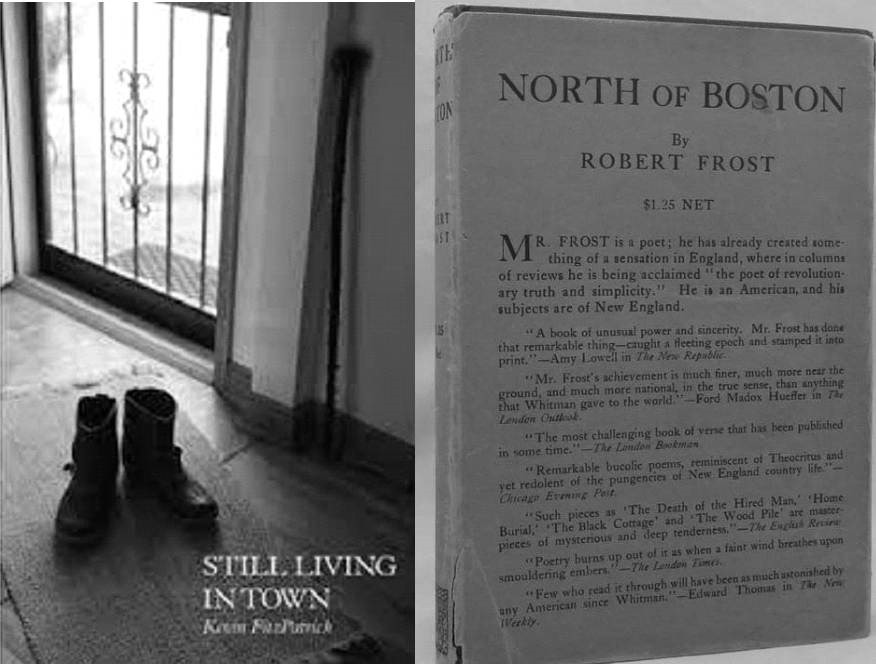
FitzPatrick’s publisher, Midwest Villages & Voices, doesn’t distribute online, but this link contains an ISBN and other info that may help you obtain a copy from your local book store or library. Then this other guy, Frost, has books available too.
.
3. After Apple Picking by Robert Frost. Unlike our other Frost poem in this autumn’s Top Ten, the metaphysical “Bond and Free,” you can feel this one. Particularly as Kevin began to spend his weekends working at his life-partner’s rural farm, I could see kinship between FitzPatrick and Frost. Both were drier than a Minnesota winter’s static humidity, both liked to observe human outlooks critically, and both of them could give you some of the tang of work tied to nature. I’m not sure if lifetime farmers are likely to write a poem like this, but someone coming to that work from something else, as Frost and FitzPatrick did, has the outsiders’ advantage of fresh observation.
When I presented this poem last month I thought about dedicating it straight out to Paul Deaton, who’s blog I’ve read for the past few years, in part to catch up on his accounts of small-format food farming, sometimes mentioning apple trees and orchards. But I wasn’t certain how well it fits anything Paul experiences. The apple trees of my youth were tall enough that ladders would be required, but the orchards I saw biking around Bayfield this fall have quite short trees, the kind where an adult would stand flat-footed to pick the fruit.
But maybe I should have gone ahead. Even though this poem has specifics, even to what aches after work, it’s about finishing a task. When another blogger I read: professor, editor, and author Lesley Wheeler wrote of getting to the final stage of a book-length manuscript, I thought of how I felt after finishing a manuscript decades ago. That same “Well, I probably missed a few, but I’m done with apple picking now.”
This post has gone long, though with things I wanted to say. Our next post will break from our usual Top Ten countdown, as it will deal with both the most popular piece, and the runner up, and I’ll talk more about poet Ethna McKiernan.
.
*More than once I’d say to Kevin “If I had had the idea to write something from this same material that you used, I’d have written a short story.” I remember once Ethna took me sharply to task for saying that, admonishing me that Kevin was writing a narrative poem. She misunderstood me, for I knew and admired that. Mixing into a short poem, with its almost unavoidable lyric immediacy and compression, with narrative elements sometimes even including a Joycean epiphany, is not easy. Once or twice, so taken with the story in one of Kevin’s poems I attempted to craft a short story from the same material, to demonstrate my point — and yet I could never complete one of those attempts. Kevin’s poetry may look unshowy, but it’s not easy to duplicate.
**Several years ago, Kevin and Minneapolis folk/blues revival pioneer Dave Ray of Koerner Ray and Glover engaged in a little side-bar about meter in Blues lyrics, with Kevin scanning their iambics. Kevin played a little blues harp, and Ray and Kevin’s dad were both in the insurance business.
***Kevin also boxed, and not in a warehouse way. He once wrote a poem which had as significant line “The boxer slugs!” Dave Moore’s punishing wit, after dealing with a lengthy group discussion about if that line would be misunderstood, was spurred to write an entire song about a garden beset by invasive…wait for it…”boxer slugs.”
Long time readers here will know that one of this Project’s ideas is “Other People’s Stories.” I’ve chosen to make that one of its principles for a couple of reasons. First, the Internet is full of folks telling their own stories, and this is fine (after all, to me those would all be “Other People’s Stories”). I wanted to do something different, to focus on how you and I experience a variety of words from a variety of writers with a variety of outlooks. The second is that I’m rather uncomfortable with promoting myself. That one’s complex.* Like most writers or composers or artists I think my own work has value at some percentage over half the time. Which then, mathematically, allows that I doubt its value, or my handling of its value, or the costs of declaiming its value to the universe a bunch of the time too.
No one creates without the first thought. It would be impossible. And no one who cares about what they create, about their audiences, or about how much craft and care can be devoted to any art; without seeing the faults, the missed communication, the needs for just one more revision or tomorrow for any work.
Many of us create instinctively, because we have to — but sharing that work is a choice. I’m nearing 600 Parlando Project audio pieces presented here. I could have presented at least half or two-thirds of that easily with things Dave or I wrote, but I made a different choice. It’s less conflicted for me to publicly look at, to be honestly surprised and delighted at Emily Dickinson, William Butler Yeats, Carl Sandburg, Langston Hughes, Sara Teasdale, or Du Fu; and then to share that with you.
But there’s a problem with “Other People’s Stories.” I’m likely not understanding everything those authors intended.** And they’re their stories, their visions. I’ve talked recently here about how when I translate a poet who wrote in another language how I want to honor their work and transfer accurately their particular powers, and yet then become tempted to break off into something their work makes me see through my own eyes.
A long prolog to presenting today’s piece, one I wrote and titled “Ethna’s Dream.” Ethna is Ethna McKiernan, a poet who I used to meet and talk about work with once a month or so, along with two to four others. Ethna cared and crafted her work over decades, and in her life did other useful work: running an Irish heritage book and art shop, working with the homeless. She’s currently in hospice, comforted by family, and the reports are that she’s now mostly in an out of what appears as sleep.
I couldn’t call Ethna a close friend. I always sensed a distance there. I think often of her none the less these days, and of every rudeness, awkwardness, or self-dealing on my part around her; and those or any number of things could have caused that. The very fact of writing a poem about her death, her dying, that mostest personal thing, seems problematic.
So, when you listen to my piece “Ethna’s Dream” you now know all that. This is not a poem about those things I’ve discussed in prolog, or at least I hope so. Instead, my intent is that it’s a poem about what we should treasure of that sharing of the unconscious that we have with artists (including those whose main art is just living). What I present in “Ethna’s Dream” is not a romantic, imaginary, sentimental metaphor in my own mind — though it may attract or repel you if you see it as such — it’s more at the essences of what we do, share, and take with art.
There’s references to Bottom’s speech in Shakespeare’s A Midsummer Night’s Dream. Am I prettifying myself up with pretentiousness, or comparing myself to the foolish play character? I wrote it, and yet I can’t tell.
*One problem, leading to one fear, is that when offered the chance to promote myself I see myself as overdoing it, and coming off as a self-absorbed narcissist that runs on too long about the arts I work in, prattling about the obvious and the obscure in equally embarrassing ways. If you’re still reading at the footnote stage, you may have forgiven me for that.
**Beside just plain embarrassment of ignorance, we now more often talk about cultural appropriation in regards to this. The travesties of cultural appropriation are real, but my belief is that they should, must, be risked.
Readers often hear different poems when reading the same text. It’s unavoidable, even though it causes some authors to despair at how they are misread. So, it should be no surprise that it is possible in performance to recast poetry considerably without changing a word.
Around 1902 Irish poet William Butler Yeats wrote a poem taking exception to a too-easy consolation meant to comfort. He cared for the poem enough that around 20 years later he revised it slightly, to emphasize his response to this well-meaning gesture, explicitly writing out the one word concise enough to underline his feelings at the offer of comfort: “No.”
Those who study Yeats’ life are pretty sure this poem is biographical and is based on his unrequited courtship of Maude Gonne. That’s a long story, and to say that these were two complicated individuals is to understate the matter. If one reads today’s text, that poem “The Folly of Being Comforted,” in that biographical way, it makes sense. Here’s a link to that text. That reading, coldly condensed, would have it that someone told Yeats, “Hey, that hottie that you are so enamored with — I’ve heard she’s getting older, grey hair, older skin around her eyes. Sure, they say with age comes wisdom, but never mind any of that, she’s no longer so attractive that others will be chasing her. So now, maybe your chance will come around.” And to this Yeats gives his “No,” explaining that as he sees it, she’s not lost a step beauty and attractiveness-wise.
There’s a perfectly good romantic love sonnet there, and that’s not what I performed today.
I’m mentioned this year that I have family and others I know going through infirmities and transitions. It’s not my nature to talk about them, or even to directly write of my own experience of those situations. Even though one of the principles of this project has been to seek out and to present “Other People’s Stories,” I’m hesitant to speak over their own voices* in the same way that I’m comfortable talking about those long dead and in some cases too little remembered.
As I was working today on finishing the mix of the audio performance you can hear below, Dave called me to tell me that our friend and poet Kevin FitzPatrick had died last night. We were planning to visit him in hospice tomorrow. Now we’ll visit him when we think of him. Visiting hours are now unlimited.
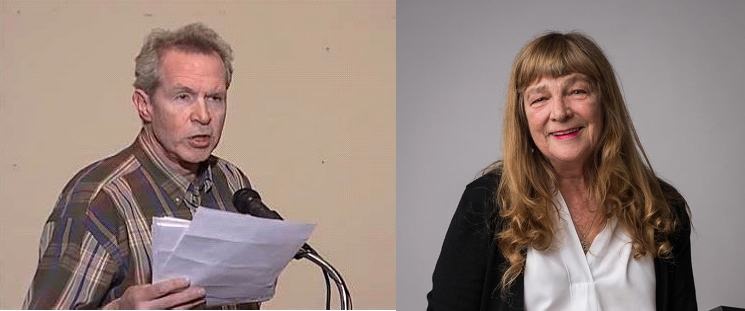
For many years Kevin and Ethna would celebrate poetry in a public reading on St. Patrick’s Day in Minnesota.
.
Another poet we both know, Ethna McKiernan, is also facing a serious illness this year. When I read and then performed Yeats’ poem, I was thinking of these things. I recognized it was a romantic love poem, yes, but I read all sorts of undertones in it. We are meant to pass over them in the “correct” reading. Maude Gonne was all of 35 when Yeats first published his poem, the grey hair and “shadows…about her eyes” were likely subtle things. We’re all more than double that. Age is not subtle at that volume. When I read Yeats’ simple elaborating line “I have not a crumb of comfort, not a grain.” I felt my own lack of useful care or comfort I’ve offered Kevin or Ethna, partly because I fear I’d be rather bad at it, and partly because I’m less close to either of them than even Dave is. That said I’ve been acquainted with Ethna for about 40 years. I may have not been close to her in her “wild summer,” but I knew her when. Yes, the fire “burns more clearly” with her even now as Yeats says. After all, when you get our age, there’s more fuel.
Yeats called his poem, “The Folly of Being Comforted” and he ended the poem with that title. He likely had real feelings in this matter, long ago when he was alive. When I think of these mortal matters, now, here, my feelings are different than a witty sonnet about someone’s crude mistake regarding his estimate of Maude Gonne. And so I performed my feelings, using Yeats words.
The player to hear that performance is below for many of you, but some ways of reading this won’t display that. So, I also offer this highlighted hyperlink that will open a new tab window and play it.
.
*I feel I must guard myself in that partly because I’d easily fall into it if I didn’t.
Before we continue with our count-down of the most liked and listened to audio pieces this past spring, let me remind newcomers what the Parlando Project does. We take words (mostly other people’s, usually poetry) and perform them along with original music in various styles and sounds.
I really try to honor that intent for variety. My musical and singing limitations cannot be overcome just by intention—but the idea is to test limitations to see what will bend or break, not to treat them as barriers to be looked at from a safe distance off.
7. Water. One of our post series this spring I called “The Roots of Emily Dickinson.” I had the obligatory exposure to Dickinson during my education in the mid-20th century. My impression then was that she was treated as an approachable poet of the second rank. I think the shortness of her poems was part of that presumption of approachability, and that contributed to her subsidiary ranking too. And yes, the filter of gender stereotypes and prejudice had to be a factor. Common anthology poems like “Because I could not stop for death” added a little gothic touch to our genteel high-school textbooks, and in my college life she got a place in American lit, though much less in more general literature or poetry courses.
But when you dive into Dickinson deeply you may find that the modest surface level of a Dickinson poem, which seems a homey back-lot pond, is rather a deep and mysterious well, and that you’ll run out of breath long before you touch the bottom of some of her little poems. If you’re curious like me, you can’t help but wonder: “What did Emily Dickinson think she was doing?”
So, this spring I looked at some of her models, confidants, and influences, and chief among them must be Transcendentalism, the hard to pin down American movement centered in Dickinson’s own region and time whose instigator and leading prophet was Ralph Waldo Emerson. I had fun in my original post on “Emerson’s Water” by comparing Emerson’s fame and influence to Oprah Winfrey—but really, you’d have to add to Winfrey, Malcom Gladwell and the Dali Lama to get the range of Emerson’s influence.* I was going to add some Robert Bly in there too, but though Emerson wrote poetry and influenced poets up to and including Robert Frost and Wallace Stevens, Emerson’s own poetry was not even wholly esteemed by other Transcendentalists.
Emerson’s poem “Water” is still worth hearing, as many of you must have found here this spring. Back in The Sixties, when I first encountered the Transcendentalists’ story, I could see connections to the Hippie culture, and now in a generally more practical and materialist time I still see linkages. The Midwest had exceptionally widespread flooding issues this spring, and Emerson could have written “Water” this year to address that. What’s Emerson got to say about water? The player is below.
6. He Wishes for the Cloths of Heaven. William Butler Yeats is another familiar word-musician who supplies words to the Parlando Project. Perhaps I came closer to Yeats because I’ve ended up hanging around some Irish-American poets** once I moved to Minnesota, but if one is interested in musical sounding poetry in English, with things to consider beyond the inviting sound, eventually you’ll turn the corner and Yeats will be there.
The poem’s romantic closing lines are among several of Yeats’ that are well remembered by readers—memorability being one of the great tests of poetry. Hear those closing lines, for the first time or again, with the gadget below.
It was a classic battle of wills. The cat would not get up until Yeats agreed to get the cat food, and Yeats wouldn’t get the food until the cat got off his lap. Both were found and rescued in an emaciated state.***
5. May-Flower. From the roots present in Emerson, to the flower as expressed by Emily Dickinson herself, here’s the fifth most liked and listened to piece this spring.
Let’s return to the question of Dickinson’s intent. There some thought that this was written as merely a riddle-puzzle, that the reader was to guess the genus of the bloom from the clues in the poem. If that so, if that’s all, then it seems to me that Dickinson failed as a riddle-maker, as the clues don’t seem to determine the exact flower (and Dickinson, the avid botanist, would have had the knowledge to have done that). I decided to take her text and drill down to the mystical essentials she wrote of instead.
This is not the first time I’ve written of the psychedelic aspects of Dickinson. I can’t quite do the differential diagnosis on her eye problems (for which we know she needed medical attention) or decide on the theories that she may have had epilepsy or another disorder that could have caused auras and visual disturbances, but Dickinson often seems to be asking us to see differently, more intensely, as I believe she does here.
What kind of singular mind can toss this off as a riddle?
Hear my performance of “May-Flower” with the player.
*All of these pop-culture comparisons understate the influence Emerson seems to have had in American academic life, also largely centered in New England at the time, but I don’t think they understate that Emerson’s readership in America’s 19th century extended deeply into the general literate class.
**Perhaps the most directly connected to Irish culture of them would be Ethna McKiernan. A footnote is not an adequate way to draw attention to the news that she has a new book, but she does.
***This is a joke, and only this footnote is serious. And don’t link to yesterday’s post for your homework as a cite that Carl Sandburg taught O’Hara, Baraka, and Wilbur about the building trades.
We now come to the top half of our count-down of the most listened to and liked pieces during the past three months. But what if you’re new here, and you wonder what this Parlando Project does?
In short, we take various words, mostly poetry, combine them with original music, and perform them. My intent at the start was not to do this the same way each time, to vary our approach as much as we could. We’ve been doing this for a couple of years, and there are now over 220 Parlando Project pieces available here if you search through our archives. From time to time, as I look at what we’ve done, I seem to notice a “style” developing, and while I have no objection to that arising organically from my predilections and limitations as a musician, performer or composer, when I hear that I usually ask myself “What can I try that’s different?”
The poems are not always the famous ones, I like to mix in some “deep cuts,” but it just so happens that these three recently popular ones are all pretty well-known, but maybe we can bring something new to them?
In position number four we have Emily Dickinson’s “We Grow Accustomed to the Dark.” Last time I talked about how I’m finding that Modernist poetry in English moved from a recognizable natural landscape freshly observed in it’s early poems to a more interior landscape, another darker country where new dialects of language and syntax seemed the natural tongue of that region. It may well be that WWI, with its unstoppable socially-accepted murders, was a cause for this change. The rise of Freud contributed too. But more than half-a-century before WWI, and decades before Freud published, Emily Dickinson, spurred by American Transcendentalism and her own individual genius, was exploring some of those same places.
When Dickinson gets furthest inside her own head and tries to use her mutation of mid-19th century language to describe it there, she can be inscrutable; but when she’s half-way there like in this little masterpiece, she’s exploring poetic areas that won’t be visited again until the 20th Century.
This is another of the pieces where I think my music works particularly well. Perhaps you’ll agree. Player below:
Funny how these count-downs seem to form a sequence. From Dickinson’s dark we move to the third place piece, by that little-known poet William Shakespeare, with one of his sonnets about The Dark Lady, “My Mistress’ Eyes are Nothing Like the Sun.” When we wasn’t supplying titles for late 20th Century Sting CDs, or writing a play here and there, Shakespeare wrote a collection of sonnets that are full of ideas woven of memorable phrases.
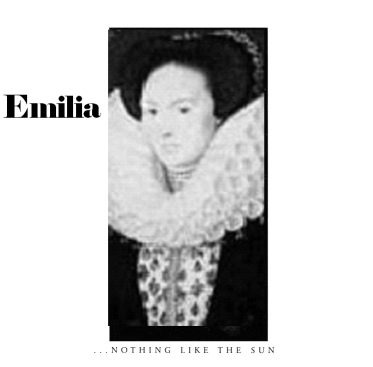
Emilia Lanier, musician, poet and possibly Shakespeare’s Dark Lady.
I’ve always loved the sonnet, even shared a few of mine here. It just seems the perfect length for a lyric poem, long enough to develop two or three ideas costumed as images, but not so long that one will find them frayed and soiled at the cuffs before it’s done.
Hear my performance of Shakespeare’s Sonnet 130, “My Mistress’ Eyes are Nothing Like the Sun” with the player gadget below.
And now we’re up to the second-most popular piece this past quarter, Marianne Moore’s “Poetry.” Shakespeare’s poem in slot number three declares his love by saying the things his beloved isn’t. Poet Moore’s poem about poetry starts off famously by saying she “too dislikes it,” and goes on to tell us what she feels works an doesn’t work as poetry, including the poem’s other famous line about poetry’s goal, to show “imaginary gardens with real toads in them.” I think here again of those early Imagist poems, with their unromantic and ordinary things made into central images: T. E. Hulme’s red-faced farmer standing for the moon or Aldington’s poplar tree as a young woman or F. S. Flint finding the moon taking on the terror of a WWI Zeppelin raid. Toads all, ordinary nature, not the battalions of classical gods or the obligations of sentiment.
This piece’s popularity on Spotify continues steadily, as with “Sky” from earlier in the count-down, I wonder if it’s the short, somewhat generic title that brings in curious listeners there.
My initial idea of the Parlando Project did not have my voice as the only reader, and the first voice you hear in this version of “Poetry” is Dave Moore who’s been the voice in a number of pieces over the past two years. The other voices in this performance are two fine poets who’ve spent a lifetime raising toads to see what works in their gardens: Kevin FitzPatrick and Ethna McKiernan. Hear them read Marianne Moore’s “Poetry” with the gadget below.
That leaves us only the number one to count-down, the most popular piece this past spring. It’s not a well-known poem, and it’s not by a well-known poet. See you back here soon for that.
Today’s audio piece marks the 200th published by the Parlando Project! Since presenting our first piece, Carl Sandburg’s “Stars Songs Faces” back in 2016, we’ve combined words (mostly poetry) with original music as varied as we can make it. Those who’ve followed along know that the words we use are generally written by others, because that lets me encounter them, as I hope you do too, freshly, to discover anew what charms they have.
Not only does the music vary, but how we present the words varies too. Sometimes we sing the words, sometimes we just speak them, sometimes we chant or intone them.
“Like a horse that feels a flea” Marianne Moore around the time she wrote “Poetry”
Through this past couple of years, Dave Moore has been the alternate reader here, and I expect that you enjoy the break from my voice once in awhile (as I do). For today’s 200th piece, and for April’s National Poetry Month, I’m pleased to present Marianne Moore’s “Poetry” read, not by me, but by the “Lake Street Writer’s Group,” a small group of usually poets who’ve met since the 1970s, which took it’s name from the inner-city commercial street near where they lived. The first voice you’ll hear is poet, musician, and comics artist Dave Moore again, the second is poet and writer EthnaMcKiernan and the third is poetKevin FitzPatrick, who has the honor of having the latest book published by a member of the group, “Still Living in Town”.
MM of another color. Minneapolis-Moline once built tractors in a Lake Street factory. Marianne Moore was once asked by a car company to suggest the name for a new model. One of her suggestions: Utopian Turtletop
It was my idea to ask them to read Marianne Moore’s poem, since Moore herself breaks her poem up into various voices, not only from abrupt changes in diction but with the use of quotes. My thought was the changing voices would emphasize the poem’s stance of speaking for poetry’s audience.
I broke this on the group of poets cold, and they are reading the poem off a page I gave them, which divided “Poetry” up in small beats and phrases of the poem. Remarkably—well, maybe not all that remarkably, Dave, Ethna, and Kevin are all excellent readers of their own poetry—what you hear is one take, just as they read it, just as they handed it off verbally from one to the other around a room. They had no musical backing to hold their cadence, only Marianne Moore’s words. I wrote, played, and recorded the music later: drums, bass, guitar, and piano.
What I hear coming out of this is the same thing I aim for often here. Just as you are encountering the poem’s words freshly, as they hit your ears, the performers are doing the same. Sure, we may have heard or read the poem before, but it’s another’s voice, happening now, that is conveying it to you. We use music with the words here, and with the other Parlando Project pieces, for several reasons: it reminds us that poetry is musical speech, that poetry works in its sounds, its rhetorical flow, and the harmony of imagery like music; and because it offers the option to relax the cause of the words meaning.
There’s not one missed word in the trio’s cold reading, which is more unusual than an accident. When I’m improvising melodic lines freely, I accept that I’ll need to deal with “wrong” notes, musically creating (to vary from Moore’s famous line) “imaginary gardens with real clams in them.” To hear the group read “Poetry,” use the player gadget below.







 Frank Hudson