When Lilacs Last in the Dooryard Bloom’d

We’re about to begin April’s National Poetry Month in the U. S., but I’m going to begin celebrating #NPM2018 today with a piece that’s a good way to start things off, the opening two sections of Walt Whitman’s “When Lilacs Last in the Dooryard Bloom’d.”

Large-Blue-RGB-National-Poetry-Month-Logo
We’re aiming to present even more audio pieces than usual this April
Use the Follow button to make sure you get a notice as they drop


National Poetry Month isn’t just for American poems or for American poets, but if it was, Whitman would be all the more inescapable. In the middle of the 19th Century, he and Emily Dickinson forged two original styles whose sounds and tactics can still be found in contemporary verse—Dickinson, with small lines in small poems that bind-up with puzzles immensities; Whitman with long lines and epic poems that offer a catalog of exultation. One sees a single, small thing and says it represents the universe, the other beholds the diversity of the world and says it’s really one thing. Complementary opposites.

Both were working at a prodigious pace during the 1860s, during America’s great Civil War. On April 14th of 1865 Abraham Lincoln, the US President during that war, was shot. The next day he died. Within weeks Whitman had produced the first published version of this poem along with other poems about Lincoln and the ending of the Civil War which he published as “Drum Taps.”  It would not be like Whitman to hold his thoughts on those great events inside. In contrast, Tennyson’s epic elegy on the death of a beloved friend, “In Memoriam”  took him more than 15 years before he published it.

At over 200 lines in its entirety, “When Lilacs Last in the Dooryard Bloom’d,”  taken as a whole, would exceed my usual mode here. I prefer my audio pieces more the length of the 45 RPM single records of my youth. So today, I present only the first two sections of Whitman’s poem. Whitman’s voice changes over the course of this long poem, but in these opening sections Whitman (albeit in free verse) is sounding somewhat like the poets his modernism would break from. Save for the absence of rhyme, his language here would not sound out of place in Tennyson (or even the earlier Romantics, like the Shelley of “Adonais.”)

Whitman's Parent's House

Is this the dooryard? Whitman was visiting his mother’s house when he heard Lincoln had died.
He stepped outside and saw the spring lilacs in bloom.


I did the same thing, presenting only the intro section, last April for the poem I believe is most responsible for April being National Poetry Month, T. S. Eliot’s The Wasteland,”  which begins memorably “April is the cruelest month…” Those that can finish that first sentence may recall it continues “Breeding lilacs out of the dead land.” So, Whitman’s elegy and Eliot’s poetic apotheosis of High-Modernism written over 50 years later, both begin in April, and with lilacs.

We’ll be revisiting territories in “The Wasteland”  later this April, but today you can start where Whitman started his poem, and from where Eliot got some of his inspiration for his. Musically, this one is fairly simple, but I hope effective: acoustic guitar and piano with a little low synthesizer groan eventually joining in. Use the player below to hear it.


March 2018 Parlando Top 10 Part 2

An artist named Linnea Hadaway made a book earlier this year. It had no words in it. She said it had no words because it was about listening.

Today is International Women’s Day, an arbitrary thing like all special days, months and years. I can hear some grumbling off in the distance as some read this: “Another one of those special-interest things. I go to poetry and music to get away from that faddish nonsense.” There’s consistency in that opinion: if one is upset at “identity politics,” dividing the world in halves is just as deplorable as dividing it into tenths or smaller.

Are there dangers in division? There certainly are. But I don’t see these sorts of things as division, but as requesting attention—and attention is what art, and this Parlando Project is about. You see, life is incarcerated in the ultimate special interest group, the ultimate identity, political and otherwise: our own selves. Breaking the cellular barrier to spill our selves, or enticing us into opening a tiny pore to stare across at the skin holding another self inside another world, the still unexplored world we share, is the whole of art.

There is no apportionment so small as to be smaller than that. There is no way out but the way of art, to pay attention. Our ears cannot see, they can only listen.

No planning in this, but the next three audio pieces in our Top 10 count-down of the most liked and listened to pieces this past winter use words written by women.

Carrington 3

Surrealist Leonora Carrington captures the Parlando Project recording another audio piece


7. We Grow Accustomed to the Dark

I think I’ve used more Emily Dickinson pieces for words here than any other writer. I didn’t plan it that way. I’m not sure that Dickinson planned it that way either. Obviously, she meant what she did, assiduously creating and collating the more than a thousand short and engagingly enigmatic poems that we now see as a cornerstone of American poetry.

But as a careerist she’s a mess. She showed some of her work to friends and family, but like most friends and family they probably saw them as artifacts of the ordinary Emily, that stubborn particular. Perhaps they understood or didn’t understand her poems better than we do; but we, her current readers, believe it’s the later.

She had a lucky break with Thomas Wentworth Higginson, the critic and social activist who answered her letter and saw something there. Even in the intellectual ferment of Transcendentalist New England, how many would have? The posthumous publication he shepherded, made possible the Dickinson we have today. But did he understand her art? We, as posterity, think otherwise.

So, like the woman in “We Grow Accustomed to the Dark”  Dickinson pressed on, walking, almost straight, and like the bravest, aware that the comedy of striding face-first into a tree was possible.


The Emily DIckinson Internal Difference

I was there! What a concert! The music was good too.

6. A Certain Slant of Light

I didn’t think about this while writing the music for and performing “A Certain Slant of Light”  and “We Grow Accustomed to the Dark,”  but these two Emily Dickinson poems are companion pieces. The Dark poem is more clear, even comedic, the Light poem more mysterious.

In my original post I decided to not talk about what I think the poem means. In some ways, I think that’s true to the poem’s “Where the Meanings, are.” I had fun with the mock psychedelic rock poster I created to illustrate it, but I think the core experience of the poem is the same that some were seduced into having by ingesting drugs, the insight that the universe’s meaning may be unknowable and its substitute only available by fiat.

Cure the cod-sitar sounds, and stereotyped sparkle-eyed hippie whooshing “Oh, Wow!” Of course, we must laugh. This is an insight available even to the young that can apparently be induced by mere intoxication.

But it’s true. It may be easier to see the borders of truth if one comes upon it without chemical aids; but even true, it’s an insight that’s hard to integrate into an active life and compassion. Dickinson integrated it with these little packets of poems. “None may teach it,” she says, but I can let you see my experience of it.


5. In the Bleak Midwinter

And one slot higher in the countdown, a woman who isn’t Dickinson, but is roughly her contemporary, English poet Christina Rossetti. Her’s is a Christmas and Christian poem, faith is her fiat; and a shaped and received story is her poems plot.

As this post talks about division, opposites—and how, if one distrusts them, one must cross them, sometimes listening, rather than shouting at them to come down—“In the Bleak Midwinter”  is all about divisions and opposites, and where they fail to hold.

In the moment of Rossetti’s beautiful song, even if earth is iron and water stone, heaven cannot contain God, nor can the earth sustain winter or meagre poverty.

I remember someone asking one of the earnest folk-singers of my generation (alas, I can’t remember who) if a song could change the world. Their reply was something like, “Of course not, but during the time the song is being sung the world is changed.” Perhaps an argument for longer songs, better memories, or us slowly learning how to integrate the experience of art into the rest of our lives.


I plan to return tomorrow with the next three in our Top 10 count-down of the most popular pieces over the past Winter.

There is another sunshine Part 3

OK, here are my Sunshine Blog nominations. I haven’t warned these bloggers (bad form?), and therefore, there’s no obligation—they’ve brought me much enjoyment and information anyway.

Tribrach

This is an aggregation site that gathers links from around the web about poetry or presenting poems online, with only occasional personal asides. Through Tribrach, I’ve been alerted to articles I agree with, to articles that tell me about something I don’t know, and to articles that I don’t agree with much at all—and those last two really can inspire new work! Also Tribrach beats Parlando in the “little-known word for blog title” contest.

On Books On Music

Doesn’t post as often as some blogs, but every single post is a sharply written, well thought out review of a book on a musician or musical topic, usually somewhere in the rock genre. It’s tipped me to some good books, and the writing is first rate and knowledgeable.

And here’s what I understand are the rules and such.

  • Thank the person who nominated you in a blog post and link back to their blog.
  • List the rules and display the Sunshine Blogger Award logo in your post.
  • Answer the questions sent by the person who nominated you.
  • Nominate new blogs to receive the award and ask them questions about their blog and/or themselves.

And here are my questions for the bloggers, tweaked from the ones that I received:

1. What inspired you to start blogging?

2. What is your favorite post on your blog?

3. If you know, what is the most popular post on your blog, and why do you think that happened?

4. What is your favorite book or poem about music?

5. You have a magical grant and can put one writer and one musician or band (living or dead, magical!) in a studio to produce a piece of work. You’re the producer, but you’ll have great audio engineers to assist you. Who’d you combine?

6. You can go back in time. When and where would you travel? Who’d you want to locate there to show you around? (Virgil’s been taken already, sorry).

The title I’ve been using for these three Sunshine Blogger posts comes from what may be the second poem Emily Dickinson wrote, before she had fully formed her voice, reminding us that before Emily Dickinson could give us Emily Dickinson, she was just Emily Dickinson.

Thanks again to Daze & Weekes, the bloggers I named, and all the bloggers out there reflecting, recalling, shining.

sunshine

There is another sky, ever serene and fair

There is another sunshine Part 2

As I warned everyone yesterday, I seem to like Daze & Weekes Sunshine Blogger questions a little too much. Longest post ever…

1. What inspired you to start blogging?

The Parlando Project started out as a podcast, which I wanted to be just the short audio pieces combining various words (mostly poetry) with as varied music as Dave and I could produce, presenting just the piece itself, without chit chat. The Parlando Project is available on all the leading podcast sources, it still can be consumed that way, even though it’s not a podcast as the form is now expected to be. In contrast, I loved how pop music radio operated in my youth, when bang bang you’d hear 3 minute records by Aretha Franklin, The Zombies, Slim Harpo, The Beatles, Sam the Sham and the Pharaohs, James Brown and Bob Dylan all jumbled together without any defenses of their value other than the glorious, various, numerous sound that came out of the speaker grill.

But, some folks will want to know something about the pieces, and rather than rambling on mic about them, the “show notes”/ blog entries began to get more elaborate as the project went on. Last summer I started to think of the blog as the main thing instead of the adjunct thing.

2. What is your favourite post on your blog?

My favorite (losing u, and crossing the ocean—which sounds like the germ of a might-be-too-half-clever song)? The blog post is one of my shortest, and the audio piece doesn’t even have my voice, but The Garden of Trust  is the Parlando Project piece that moves me the most. I’d tear up when I was mixing it.

By far the most popular piece has been George Washington’s teenage love poem, “Frances.”  Why? Illuminati web-bots boosting Washington’s hits? Angsty teenagers? Xerxes fans looking for a break from Purim?

3. Who are the top 3 bands/musicians that most inspire and influence you as a musician?

Oh, this is so painful. The list should be more like 300. Even though the blog is about “Where Music and Words Meet,” I must rein back from talking about music on the blog or I’d wear a reader out. Doesn’t everyone understand that the book and movie “High Fidelity”  is a documentary and has no funny parts whatsoever?

Artists—just as important in some regard to me—will be left off! You ask three, so I’ll focus on musicians associated with words that motivated me most generally, and not singer-songwriters.

Frank Zappa. I met him and talked with him for a bit more than an hour in 1970. Reformed me artistically from a romantic to something else in that short of a time. I don’t completely share Zappa’s Dadaist sensibility, which is something like Dave Moore’s, but I need that to buffer my tragicomedy, even when it offends me. Here was a guy who didn’t separate R&B, rock, jazz, and “classical”/serious composed music. There was nobody who did that before him, and there’s nobody that’s done it since, so I try to do it at a lower level.

The Patti Smith Group. I could fill a list somewhere between 50 and 100, of artists who combined music with spoken/chanted word and poetry, therefore influencing the Parlando Project in doing the same; but if I had to pick one, it’d be the PSG. I’d read Patti Smith on the page before the PSG, and so I was already primed, but their first single and LP galvanized me when they came out. Taken together they are predominately spoken/chanted word records with co-equal music that’s not just a background sound bed. Obviously, there’s a sensibility there that comes from Patti Smith, but I’m saying the Patti Smith Group not just Patti Smith. Lenny Kaye from the first poetry readings with just Smith and Kaye on electric guitar had to invent something new with whatever musical chops he had on hand. I still think “What would Lenny Kaye do?” when working with a poet, and the younger Smith’s ecstatic vocal style, along with the other modes she added since then, is something I still aspire to.

John Coltrane. In regard to musical chops on any instrument, I’m not John Coltrane’s left pinky. I even have trouble faking saxophone lines. I like his later free jazz recordings in small doses, and appreciate the concept, but I can’t listen to it for hours, but when I’m most troubled or down on myself, listening to prime era John Coltrane just sets me vibrating with him on a molecular level. If I had to suggest a syllabus for a course on being an artist (any field) I’d suggest a John Coltrane biography or two. To me they’re like reading the life and sermons of the Buddha must be to Buddhists. It’s this, and his uncanny ability to speak wordlessly on his instrument, that makes me include him as a music/words influence.

Apologetically, I’ve just realized that none of these are musicians who are invariably easy to listen to; that they all have more detractors and “does nothing for me” listeners than fans. Two out of the three even offend on purpose when they wish too. That’s not representative of the whole of my musical influences, or how I want art to always work—but these are three who moved me to do work. If you want to stream a musician you haven’t heard of until you read it on a blog, then I suggest Bill Frisell, Steve Tibbetts, or Dean Magraw, all of whom have a breadth and beauty to their work I try to emulate, both as a guitarist and in my use of percussion.
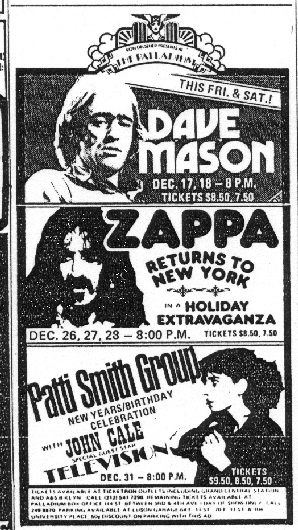
Mason Zappa Cale Patti Smith Television bill
That last show in particular sure looks worth $9.50


4. If you could have a drink with any poet (alive or dead), who would it be?

Once more my love of variety makes for a hard choice. Often if asked, it would be the poet I’m trying to interpret with performance and music on that day! That said, I’ll say Emily Dickinson. I’d so want to tell her “You’re going to win! You and the immoral Mr. Whitman are going to be the founders of American poetry. Every single day, people are going to read and be pleasantly puzzled by your little verses, and esteemed writers will look at what you did and wonder how you could invent such a new way to speak poetically.” I’d want her to answer all the Sunshine Blogger questions and more, and finally, though we’d be challenging bladder capacity by then, I’d want her to dish.

sunshine

Alas, Emily Dickinson has no blog and can’t  be nominated


5. If you could go back in time, when and where would you travel?

Easy first part. I’d target the first two decades of the 20th Century. I’ve always been drawn there for some reason, even though it’s not a period that gets much attention generally. That feeling has only intensified from my need to draw largely on works in the Public Domain (pre-1923) for the Parlando Project. Modernism in a lot of delicious flavors was breaking out all over, and in every art. Politically, a challenging time of vast inequality, but also a time of great hope that change was at hand. So, like time-travelers everywhere I’m going to expect to be reasonably well-off—but where to land?

If New York City, a chance to observe the melting pot at its most brimming. Visit the 1913 Armory Show to watch the onlookers’ new eyes seeing for the first time the paintings by the new eyes? Hobnob with the political, social and artistic radicals, some of them recently emigrated from my own family’s base in south-eastern Iowa like my “cousin” Susan Glaspell. Maybe fake a letter of introduction from my grandparents and ask Susan to show me around the Provincetown Playhouse and Greenwich Village? Meet Edna St. Vincent Millay.

Or Chicago? Meet Carl Sandburg and his young family. Swing by the offices of Poetry magazine and suggest to Harriet Monroe that she should read my blog (grin) for tips on hot new writers. Ride with Fenton Johnson in his electric motor car, and refrain from telling him he isn’t going to win and that there’s nothing I can tell him with my extra century of knowledge that can change the racial ignorance and prejudice of America between his time and now.

Or Paris. Meet Apollinaire, Reverdy, Picasso, Satie, and—oops! my French speaking skills are non-existent. OK, next.

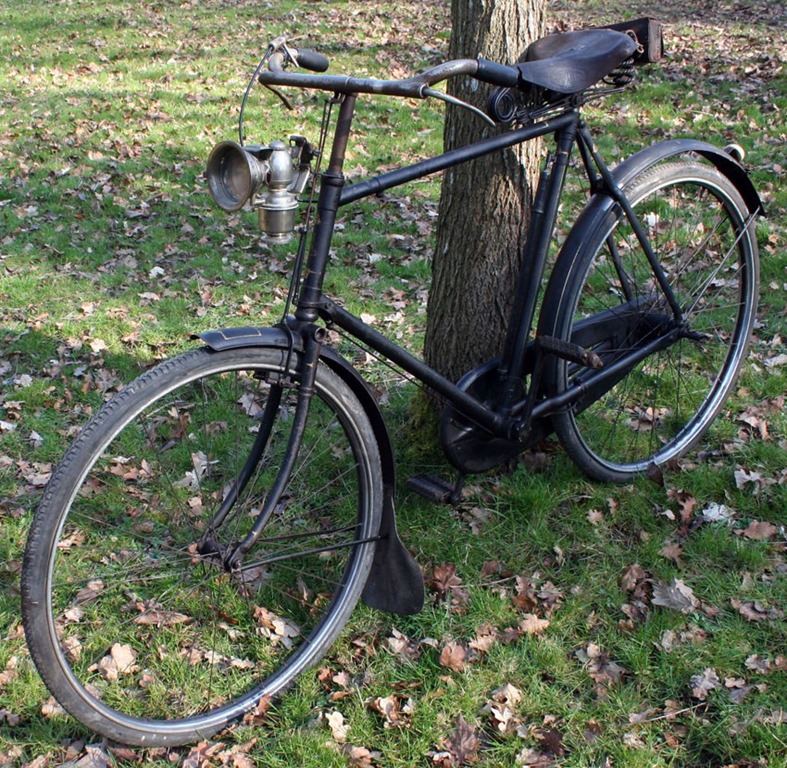
London. That’s it! Frost! Pound! Yeats! HD! Florence Farr! George Bernard Shaw! Crash the Poets Club to meet T. E. Hulme and hope I don’t get on his bad side. Sit close to F. S. Flint as a cover and act like I know him. Ask Flint about Herbert Read. Learn to play the Yeats’ psaltery and find out exactly what the Yeats-desired music “chanted, not sung” style sounded like. Slip Rupert Brooke a can of Deep Woods Off and suggest he look up Pound. Visit with Rabindranath Tagore in Hampstead. And the clincher for London? Buy a Raleigh bicycle with a Sturmey Archer 3 spd hub and a kerosene headlamp and ride around town. Why is that the clincher? I’m an introvert. Sadly, I might never make those social connections, even after traveling through time, but the bike ride would be worth it.

1910_Raleigh
Yeats, Pound, HD, Frost, & Flint…tally ho and toodle pip!

Next up, my Sunshine Blogger questions and nominations.

We Grow Accustomed to the Dark

It’s hard to escape the pull of Emily Dickinson here in the Parlando Project, and I keep finding that her poems ask for that unheard music in them to be made audible. So much is remarkable about Dickinson. She’s so original in poetic expression, and yet she’s kept a substantial audience of readers from the time of her first posthumously published collection in the late 19th Century.

Here’s yet another striking fact about her: she wrote over a thousand poems, the majority of her poetic work, roughly around the time of the American Civil War, in a burst of creativity less than a decade long. Can one even imagine what that might have been like? For this means that, on average, over twice a week a new Emily Dickinson poem, a new and unprecedented type of poetry, emerged from her pen.

Emily Dickinson's desk

Where she created a new way to write American poetry over a thousand times


She shared them somewhat, some of them anyway, with family and friends. She informally bound many of them into little booklets. But did she know what she was accomplishing? What faith drove her creativity?

Today’s words are drawn from a Dickinson poem she wrote halfway into that burst. Unlike some Dickinson poems, the “plot” of the poem is easy enough to follow, and it concludes with a moral, like a conventional poem of moral uplift might. However, like a lot of good art, the experience and meaning of it changes as you bring your own time and times to it.

“We Grow Accustomed to the Dark”  starts off in that pre-electric outdoors that we last talked about with Frost’s Stopping by a Wood on a Snowy Evening.”  On a new moon or overcast night, that old dark is darker than any we routinely experience in modern urban America. Yet, then or now, eyes indeed adjust, and make better use of what weak light may be present. Dickinson next changes the scene and speaks of “Evenings of the Brain” where even moon and starlight are extinguished. Other than Dickinson’s near, but not quite, “slant rhymes,” this is a conventional poem up to this point. But wait there’s a small warning that she’s not going to develop this conventionally. Those evenings inside the brain are a larger thing than the whole of the outdoor night.

Her next metaphor is not Victorian sentiment, but outright slapstick farce. Moving forward in the dark earnestly, the nobly brave—smack!  Faceplant themselves into a tree trunk.

This brings ambiguity to her concluding moral. Is becoming accustomed to the dark a good thing? We think we’ve adjusted. We think we’ve steeled ourselves to “Brave”—or maybe we’ve just added that outer darkness to our brain, and we agree to pretend it’s normal. “Life steps almost straight” she concludes. Somehow, at least this week, as I watch our dark world, I don’t think Dickinson intends this as a consolation.

For today’s music I tried to underscore that from the first note. I wrote this orchestral piece based around an F minor to D progression that should leave the listener unsettled from the start. I chose to experiment with this cadence after reading Alex Ross’ short piece about pioneering Afro-American composer Florence Price earlier this month. If you’re new to the Parlando Project, let me remind you that our goal is to present the words with music as varied as I can make it. If you like one kind of music that works one way, we may puzzle you with what we do in any single piece. If so, try another. We are fast approaching 200 audio pieces in our archives, so take a listen around a few of them.

To hear my performance of Dickinson’s “We Grow Accustomed to the Dark”,  use the player below. Please remember that this Project continues because listeners and readers pass the word around about it.  Mentioning us, tweeting about us, linking to us, telling a friend about us, helps grow the audience and encourages our efforts.


A Certain Slant of Light

The Parlando Project combines various words (usually poetry) with music as varied as I can make it. When I planned the Parlando Project I did not intend to post detailed examinations of the poems’ meanings.

After all, I thought, listening to music is a sensuous experience, and poetry, as it is musical speech, also has its impact when hearing it, independent of any final meaning one could extract from it. Of course, assuming the poetry is in one’s own language, it’s nearly impossible to escape meaning if one allows oneself to listen at all. Some words and phrases will mean something, even on first hearing, even with the most confusing and difficult poetry.

In the end, we may experience a difficult or elusive poem as if it was a set of flat-pack furniture, or a jigsaw puzzle, or as one of those plastic model kits that I bought and glued together in my youth. But in those cases, a wordless black and white sheet with numbers and pointed arrows inside the carton tells you this is to be assembled as a dresser or end table, and the puzzle or model kit has the beautiful color picture on the box top that tells you the pieces’ assembled meaning.

With a poem like Emily Dickinson’s “There’s a Certain Slant of Light”  there is no picture of it complete, there are no assembly instructions. If you try to put it together, you may feel there are pieces missing.

The pieces, though, are beautiful, even left unconnected, even if we don’t know what the whole is to be. Slanted light on a winter’s afternoon with a heft like music. Shadows holding their breath. Heavenly hurt without a scar.

The Emily DIckinson Internal Difference

See Emily play?

There’s no harm in going to the bottom of this post and using the player to hear my performance of “There’s A Certain Slant of Light”  without reading the rest of this. There will be no test. There’s no correct answer. You never need to put down your pencil and close your test booklet. Dickinson didn’t write about what she intended with this poem, and intelligent readers have differed in what they found there. Some found an end-table, others a fine art painting, others a plastic 1940 Ford sedan built one of three ways. Some listeners will just enjoy the pieces. There’s a little piano motif I play in it: A, B, C, E ascending and then back to A again. What does that mean? It’s an arpeggiated A minor (add 9) chord, or it’s just a series of notes that sound “meaningful” in sequence without knowing the harmony.

AMT 1940 Ford 3 in 1 model car kit

It could look like this after you put it together

Here’s that player to hear my performance of Emily Dickinson’s “A Certain Slant of Light.” No assembly required.

Solstice Featuring Dave Moore

Yesterday’s post and audio piece had Dave Moore combining the poetry of William Blake and Christina Rossetti, but today we have him singing the work of yet another English mystic as well as his setting of a lyric by Emily Dickinson.

For those readers and listeners in the Northern Hemisphere, tomorrow is Winter Solstice. I write from Minnesota, fairly far upward and north in latitude. Winter Solstice is the darkest day of the year, with the sun not rising until almost 8 AM and the sunset clocking out of work early at 4:20 PM. Despite our colder climate, that’s about the same as London’s solstice daylight and a hour longer than Edinburgh. Minnesota’s famous Scandinavian immigrants, as one comic once put it, traveled across the whole wide ocean just to find the one place as cold, dark and miserable as the place they’d left—well I checked—they picked up 2 to 4 hours more midwinter light.

Of course the new year is less than two weeks off, and solstice is the shortest  day—not the entry into a dark season, but the beginning of a gradual expansion of daylight, cold daylight though it may be. For this reason it’s been a fairly widespread feast day across cultures.

However, for writers and musicians, the cold and the dark is no great hindrance. Sure it may blunt our moods, and stunt some mitigating outdoor activities, but our products are part of the festive in the darkness, and they can be like the shared quilt or blanket on the coldest night. Yes, before indoor lighting technology, scholarly reading was curtailed, but the poets of that dark time could recite from memory, needing no light bulb on their lectern. The sounds of strings, the dunest drum and the golden cymbal, travel without light.

And our partners and families don’t need light either to be known to us. They don’t even need poetry or music, their plainest word in the darkness is song enough, if we can hear that as one note in the slowest song that is our life together.

So, for today and the Midwinter Solstice, here is Dave Moore singing Robyn Hitchcock’s “Winter Love.”

The LYL Band tackles the darkest time of year


And for the short passage of the daylight, here’s Emily Dickinson’s sublime lyric about the transit of a day, “I’ll Tell You How the Sun Rose,”  also sung by Dave.

And don’t forget, we have over 160 audio pieces here, available in the archives on the right. Why not check out some from before the time you first heard of us?

Because I Could Not Stop for Death

One of the harder things to do when performing a song or a poem—or in talking about what either means—is to tackle a well-known piece. As far as American poetry goes, Emily Dickinson’s “Because I Could Not Stop for Death” qualifies as such a case. It’s one of those “most anthologized” poems. I’m certain I ran into it in high school, and it is like a lot of great and popular poems: it can be about three-quarters understood by a schoolchild being introduced to poetry scholastically.

Is there anything new and fresh that can be brought to it? And what may still be there in that other quarter of the poem beyond what one first understood as a teenager?

When I write and play the music or perform the words here I need to make choices. One of the most important of those choices is what is the mood? What is the overall outlook of the poem’s speaker? You can use educated guesses to what the author intended, or you can just make a wild guess, even a perverse one. For example, you take most any song that was written as a party anthem, and then slow it down and sing it with some doubt in one’s voice, you will completely undercut the swagger and good times vibe (as Aztec Camera’s cover of Van Halen’s “Jump”  proved years ago).

With “Because I Could Not Stop for Death”  I decided the mode I would use is sardonic. This is a good ground choice for any Dickinson poem in my mind. This is a poem about death, sure, but it’s a poem mocking death, or rather our appreciation of that subject.

That starts from the start: like death is a social appointment we don’t have time to schedule, but then also, a slow passage of the entire trip of life at a fine and boring pace is appropriate too, as it’s a trip to the graveyard in the metaphor of the 3rd verse.

In the sublime 4th stanza, when the speaker has passed the days of her life (the slow carriage ride of life so stately that the sun transit of a day outraces it) she finds herself unprepared for the cold weather of death, dressed only in useless, ladylike garments that may reference a bridal dress, a burial shroud or a nightgown.

The afterlife presented in the last two stanzas is not any heaven, but an eternity of nothingness. As a final irony, the speaker says the centuries of eternity seem like less of an experience than even a day of a slow life.

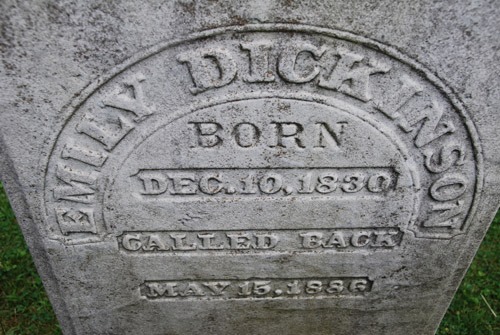
Emily Dickinson Gravestone
Emily’s family held more conventional views of heaven reflected on her gravestone

So, on one hand this is a mock solemn poem about death, spoken in a mode not that far from what Maila Nurmi/Vampira might have vamped on TV a century later. But it’s also a carpe diem poem, written this time by a woman, one whose artistic life is not giving her time to stop for death, nor the daily deaths of an unexamined, uncreative life. When Thomas Higginson was editing the first collection of Dickinson poems, he may have appreciated that aspect when he added the title “The Chariot”  to it. “The Chariot” as in “Time’s wingèd chariot” in Marvell’s poem.

At least that’s what I think is there. I could be wrong. You have to make choices.

Dickinson poems, which are largely written with her internalized Protestant hymn tune rhythms, can be set to music easily. And the basic track in my performance would have demonstrated that, as played on just a 12-string guitar, even though I undercut its simple three chord progression with some chord alterations. The piano part brings the strangeness in by playing simple arpeggiated chords, but in an insistent cross-rhythm.

So hop in the carriage, we’ve got the clip-clop of the hooves and the jangle of the harness to accompany us when you use the player below to listen to my performance of Emily Dickinson’s “Because I Could Not Stop for Death.”


Wild Nights Wild Nights

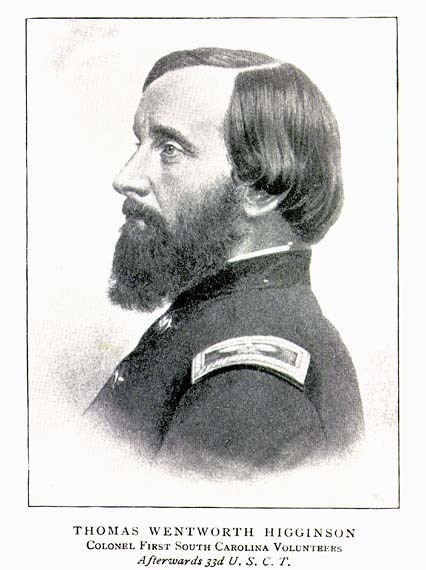
Thomas Wentworth Higginson may have exaggerated a bit, speaking then of “dread.” But it was 1891, and he had taken on editing the surprisingly vast literary legacy of Emily Dickinson for its first substantial publication. In this task, he was a lucky find, for though he had engaged in a lengthy correspondence with Dickinson when she was still alive—the real rarity was that he was a thoroughgoing radical, a Transcendentalist comfortable with heterodoxy, an uncompromising abolitionist who raised and lead a company of Afro-American soldiers in the Civil War; and rarer yet in his time, a stalwart feminist who knew and worked with pioneering American feminists Lucy Stone and Susan B. Anthony.

Thomas Wentworth Higginson in uniform

Abolition, Transcendentalism, Civil War, Women’s Suffrage and rights
Higginson wasn’t going to keep a little keep a poem about desire bottled up


So, fear of controversy was not in Higginson’s nature. Still “dread” was the word he used:

One poem only I dread a little to print—that wonderful ‘Wild Nights,’—lest the malignant read into it more than that virgin recluse ever dreamed of putting there. Has Miss Lavinia (Emily Dickinson’s surviving sister, and the one who found the large cache of poems at Emily’s death) any shrinking about it? You will understand & pardon my solicitude. Yet what a loss to omit it! Indeed it is not to be omitted.

What dread could a little 12-line poem cause? Dickinson’s “Wild Nights Wild Nights”  appears to be a poem about unembarrassed female desire. Even with suggested subtext supplied for for lines like “Rowing in Eden,” it probably seems less shocking today. Still, let’s give Higginson some credit. He not only didn’t want to censor it, he maintained it needed to be included for publication.

Even if we’re not shocked by an erotic element, let’s not forget: it is an Emily Dickinson poem. It’s terribly concise. It sings off the page, yet with such short lines, just three to five syllables long. It’s memorable. When I mentioned it to my wife as the next piece I was working on, she nearly knew it by heart.

But most strangely, though it starts like an ardent valentine, it finishes either in disconnected thoughts blurred by lust, or with something altogether less conventional. Setting humptastic subtext aside, why would one row in Eden? You’re in paradise! Where do you want to go? Do you need to stock your ship up with the fruit of knowledge against the scurvy of faith? And you’ve made it to port in the last stanza. Again, let’s leave the “made it past third base” metaphors behind for a moment. Why are you exclaiming the sea when you’re in port? I even wonder if Dickinson is slipping in a pun here: “Ah! the sea!” sounds like “Odyssey.” Is Emily’s wild-nighter an Odysseus looking to getting back on the boat and back to sea?

I don’t know exactly what Dickinson is getting at there. It’s her characteristic level of concision: pretty, but sharp pieces of glass, leaving lots of slant light to refract.

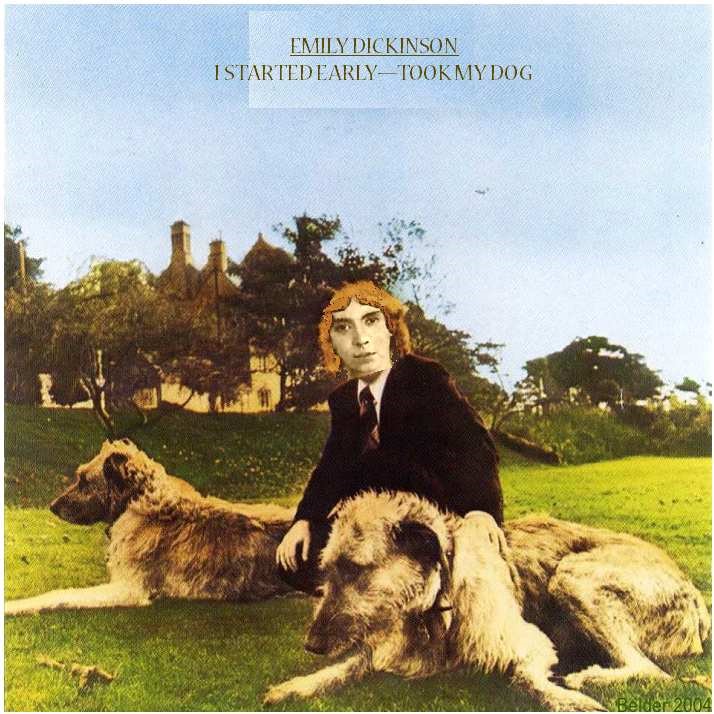
Veedon DIckinson

Poetic license. Yes, I know “Wild Night” is on Tupelo Honey


We’ve followed the Parlando Project goal of varying the music with Dickinson poems so far, even casting her as a classic blues singer. For “Wild Nights Wild Nights” I wrote a more rocking R&B thing this time. I relaxed a bit with the vocal this time too: tossing it off in one take while playing the acoustic rhythm guitar part. The opening lines of Dickinson’s poem reminded me of Van Morrison’s song, and so I slipped a few mutated lines near the end. Play the performance with the gadget below. You can dance if you want to…


I Know a Place Where Summer Strives

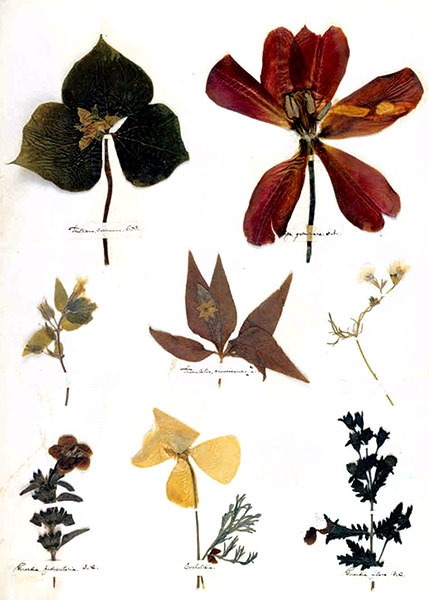
It would seem odd to us now, but when Emily Dickinson died, her most noted accomplishment was not her poems, but her plants. She was a serious gardener, known to her family, neighbors, and town for cultivating her plants even at night (which was also her customary writing time).

Emily Dickinson Herbarium page

Emily Dickinson created a 66 page herbarium with pressed flowers,
and often included flowers with her letters and privately distributed poems

There’s a lot of comparisons to be made there, that her poems are like flowers, pretty at first sight, but with their own alien structures, but I’ll leave that for now so that I can move on to today’s piece “I Know a Place Where Summer Strives.”

This is a poem that fits well with the Parlando Project’s tactics of combining poems with music, because it’s a poem that uses puzzles to tell its story. When you combine a puzzling lyric with music you can let those words ride along without requiring them to be immediately meaningful, as otherwise poems that go out of their way to be puzzling can frustrate readers not in the mood for non-straightforward speech.

I enjoyed “I Know a Place Where Summer Strives”  before I had solved its puzzles. As usual, Dickinson doesn’t belabor her subject, just three stanzas and 12 lines, a nice dosage for puzzlement. The poem’s internal music flows nicely, and Dickinson’s use of unusual word choices in the final stanza adds decoration to the mysteries. After reading it a few times, writing the music for it, performing it with the LYL Band, and then mixing the recording available below,  I have finally gotten around to trying to solve the riddles.
 
The first verse/riddle is a particularly cold spring, with “practiced frost” taking casualties among early blooming flowers. The second verse/riddle is a description of a building storm, which turns out not to be destructive, it brings “soft (ref)rains.” The third verse/riddle is more obscure yet, but the rain falls onto the hardened, adamant, ground. The last two lines of this verse are lovely to read and hear, but I couldn’t make any sense from them. At first thought I, like blogger Susan Kornfeld, wondered if this was a late-fall time image, and the quartz was ice forming on amber leaves—but then I noticed that the third verse clearly appears to be carrying forward the sentence and thought from the second verse, so it can’t be winter’s arrival: south wind, rain—that doesn’t sound like winter arriving.

Blogger Linda Sue Grimes suggests a solution, that the amber is mud on the shoe. This makes sense, and it could logically follow the rain on adamant hard ground, which could even be light yellowish, amber-colored, clay and not good dark garden soil, but I still am puzzled by the quartz. The line here is especially lovely: “That stiffens quietly to quartz” resonating with the “qu” “zee” and at “t” sounds, but I don’t think Dickinson cheated just to get the sound. Quartz can be brown like mud, though that’s not how I think of it, but its name and the modifier “stiffens” indicates this is something crystalline—not gooey, caked mud.

In performance I decided, intuitively, to repeat the first verse; and in so doing, I bring back the cyclical end of summer to close things.

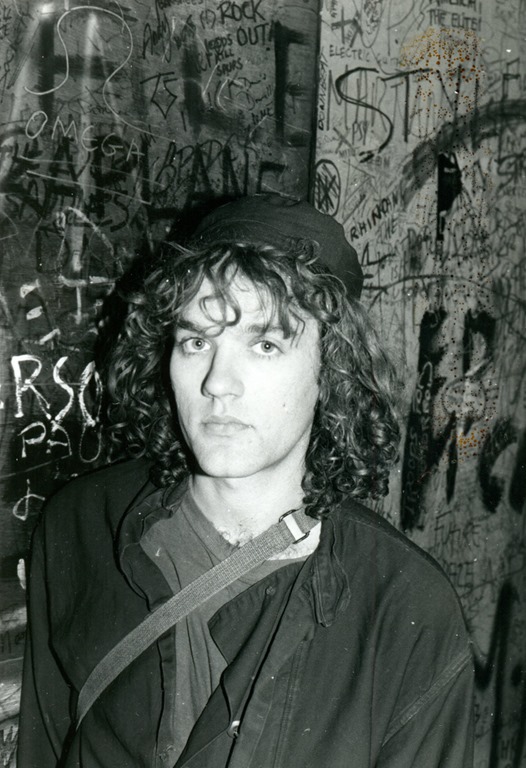
young Stipe

Michael Stipe when he was Gardening at Night.
Coincidentally, both he and the Parlando Project are in some part inspired by Patti Smith

When I read that Dickinson’s gardening extended even to nighttime work, I recalled the song from R.E.M.’s first EP, “Gardening at Night.”  Michael Stipe’s early lyrics, are far more abstract than riddles, reading to me like abbreviated captions to blurry photos. A set of lines like:

We ankled up the garbage sound,
but they were busy in the rows.
We fell up not to see the sun,
gardening at night just didn’t grow.

Are as obscure as any poem, but I could, and still can, enjoy R.E.M. songs like that one. Stipe sincerely sang his own meanings, and he had a great band around him that supplied the music that lets the meaning ride.

To hear the LYL Band performance of “I Know a Place Where Summer Strives”  you can use  the player that appears below. Musically, you might find it to be vaguely R.E.M.-like too.