Edmund Vance Cooke was a Canadian poet. At least I think he was. There’s not much on his life I can find, and sometimes his last name is rendered as “Cook.” His sparce Wikipedia entry says he was born in what was then known as West Canada in 1866, and back around the beginning of the 20th century he wrote a type of popular published poetry in a style that has largely died out. Wikipedia calls his genre “inspirational verse,” and some of it I’ve found is that: paeans to earnest striving and social virtues that now-a-days would be reduced to short easily-sharable quotes or the captions on “hang in there” motivational/affirmation posters. But there are indications that social criticism was also part of his repertoire, and this poem I perform today has some bite to it. Though written in 1917, I felt I should work up some music and sing it as a freshly-made song in 2025.
One of the things that irks me most this year is the outrageous lying by my country’s mad despot and his fawning courtiers. I can’t say for sure what drives all these fabulations and alibies across his administration. For some personalities a lie is a demented reflex, a neurological tic. Others spout the lies as a cold tactical choice of propaganda, with a sense that it will gain them some rewards. A more generous assumed motivation: that by saying this or that is so, when it’s not, may help manifest the thing not yet in existence – and this is akin to what affirmations invoke for personal improvement. Alas, most of the things not yet in existence that our current regime members are manifesting by statement are ugly, cruel things. We shudder – while considering the exaggerations, we fear they might not stay lies for long.
Today’s Cooke poem “Sedition” is a statement of the countervailing powers of truth. It reminds me of an anonymous poem about truth that was widely printed in the same era as Cooke was writing, “Truth Never Dies.” Five years ago in this Project, I presented that poem and wrote about what I found about who had republished it. This link will be of interest if you wonder about that. Though it’s a statement without evidence, it’s not impossible that Cooke was the author of the much reprinted “Truth Never Dies” poem – but “Truth Never Dies” is a more religious and spiritual poem than “Sedition.” I composed music for the former with acoustic guitar and strings presenting it as a firm, but gentle prayer. The latter, Cooke’s poem, is more sardonic, defiant, even militant – and so I decided to crank up some electric guitars for it.
Here’s a chord sheet for my version of Cooke’s poem. I won’t take responsibility if you decide to play and sing it yourself, – that might make you part of a conspiracy.
.
I played three guitars in the recording via multitracking. For the electric guitar nerds, the center channel has a Gretsch hollow-body playing the chords, the right channel’s a Jazzmaster solid-body with a pitch-shimmering wiggle stick, and the left side a Telecaster whose wide vibrato here was created by having enough personal frustration to expiate that my fingers directly wrung the strings sideways to way above their fretted pitch.* I associate this kind of guitar solo with Canadian Neil Young’s credo that sometimes your intent is to not sound like a “professional guitarist,” some master of tasteful licks and precise intonation.
You can hear the performance with the graphical audio player gadget below. No gadget? I’m not lying – some ways of viewing this blog suppress the player, so I offer this highlighted link that’ll open its own tab with an audio player.
.
*”Hey, posh-guy, you’ve got a lot of guitars there.” I accumulated cheap imported versions of these guitars over 30 years, using trades, hunting up second-hand examples, and waiting for sales. Coincidently, the current regime’s tariffs are threatening what has been a golden age of reasonable quality, good sounding instruments for musicians with limited funds.
If we think of poetry as more than a barren art, we might think of things we read in poems as things that occurred to another person, somewhere, sometime. Oh it may be a mistake to automatically read poems as memoir — invention has always been one of those occurrences — but the more universal the poem’s account, the more we may think: this decorated thing I’m reading came from the senses of someone feeling an experience.
If we do that, we can think today that somewhere in China, sometime in the 8th century, an adventurer turned poet in middle-age awoke at night. What kind of bed, what kind of bedroom? The poem tells us nothing posh, despite its brevity: the poet’s expectation in the shining he sees around his bed is that it’s frost. It might be a lean-to, or even a bedroll on some improvised pallet out in the open. At best it might be an unheated room.
But still he’s awakened to something shining. He soon re-adjusts. No, this brightness that has occurred is moonlight not the frost of a more northern climate. Commentaries I read on classic Chinese poetry note that “bright” is something of a favorite poetic ideogram in those poems. A good symbol for immanence and essence? That light from the now open eyes of our poet must be seen. Oh, it’s the moonlight, likely a full moon on a clear night, he figures out. But that realization says something about near and far. The moon is more than 200,000 miles away. Yes, the moonlight is near, he could touch it but feel nothing.
What can he touch? He can put his head back down on the bed and think, perhaps to think himself into dreams of his home. Feel that now with him as the side of face and scalp touch back down. How far, that home? Moon far?
The 8th century poet who wrote this, Li Bai (also known as Li Po), was an itinerant for much of his life. Choice? Consequences of other choices? Exile? The traditions seem to indicate a mixture of all that.
This is a well-known poem in Chinese, taught as an early lesson in poetry to children like Sandburg’s “Fog.” In my translation I did something I don’t normally do: imposing an English meter & some rhyme.
.
Now another man, in another bed. I can tell you with more exactness where and when: September 18th, 1970 comes in within a night in London, England. The man has been out to nightclubs, “sitting in,” playing music with others, something that consistently energizes him. For much of his life music has possessed him like that. He’s been blessed or cursed with the compulsion to make it. It’s just a couple days past the harvest moon in this room, the moon as far away as Li Bai’s moon.
He’s with a woman whose role is somewhere between girlfriend and convenient stranger, but this is not strange to him. He barely knew his mother, his father’s time was taken with drink, low wages, and a skin color that marked him as an outsider, and so he could rarely care for him. This had often been. As a child, taken in by other women, neighbors, and relations — and as he left home, others in the various valences between girlfriends and strangers.
Do non-performers understand how hard it can be to transition to sleep after the active interaction of live performance? Performers likely have tried it all: sex, boring TV, cannabis, food, and even more alcohol than they drank to take the edge off self-consciousness before performing — enough to move them from the level of self- to un-consciousness. And yes indeed, other drugs.
This man had moved from at least some of the above to the other drugs: his companion’s sleeping pills. A foreign formulary, they were much stronger than he anticipated.
September 18th, 1970, Jimi Hendrix, the man in London, quiet night thoughts. Did he awaken in that night as Li Bai did in his poem? Accounts differ from that London night. Let me think that at least his consciousness tried to return — in his head the sparkling currents like the magnetic waves when electric guitar strings are strummed. Did he think of home as the great Chinese poet did? If so, what would be home? Did he think of America? He was doubly American in a fierce way: some of his ancestors had been kidnapped and sold to enslavement there, and some of his ancestors had had their before-it-was-named-America taken too, a trail of tears. Did he think of his parents, even more so because of their relative absence in his life? Others who had episodically cared for him? He might have. Maybe too his night thoughts were of music, of songs. We can still hear him sing about dreaming on recordings, so he could have dreamt of singing a new and elusive verse. Did he open his mouth to say it, and there was nothing? No air. No breathing. No life.
You can hear my performance of Li Bai’s “Quiet Night Thoughts” (for Jimi Hendrix) with the audio player below. See just a pool of moonlight at the end here, no audio player? This bright link will open a new tab with its own audio player.
Here’s a little story, about a one-eyed man named Leonidas, who you might think at first is not worthy of telling here at a place that talks about poetry and music. Was Leonidas an artist? Well, he started off an accountant. That’s important. Alas, the Great Depression happened, and even accountants were made redundant. Next, he opened a radio repair shop, since he’d been handy with electric circuits since he was a teenager. Better to repair a radio in those days, so he was able to make a go of that.
So, when does the art come in? Patience. Perhaps you know how revisions, pentimento, second drafts work in art? Then too, do you know the old saying about the one-eyed man in the kingdom of the blind.? That’ll apply too. There’s musical elements coming up, and we’ll end up in the Museum of Modern Art.
It wasn’t just families’ home entertainment radios that came into Leonidas’ shop. Musicians would come in and ask him to repair or construct public address systems. Leonidas’ region was bustling. First with agriculture, and soon with manufacturing. Workers wanted music at dancehalls, bars, and roadhouses, and the small affordable music combos with growing and sometimes rowdy audiences needed to be heard. Leonidas could make things loud.
Some of these musicians played electric guitars, a newish invention. The big hollow reverberant wooden boxes that had formerly needed only to be loud enough to provide a discreet chop of propulsion to large brass and saxophone led bands were now equipped with magnetic pickups which drove amplifiers so that one or two guitarists could replace that horn section. Simple accounting — the venues wouldn’t necessarily increase pay for larger, more elaborate groups. Slim down, but get louder.
One catch. The louder noise these big hollow guitars now made with pickups mounted on their surfaces reacted with a hellish howl from their resonate bodies’ underground cavities when the volume got loud enough. Leonidas’ amplifiers could make them loud, but the guitars couldn’t operate well in that loud environment.
Leonidas was the one-eyed man who knew nothing about guitars, but he’d been wiring electric pickups for a particular kind of electric guitar that was going through a bit of a fad: the “steel guitar.” A steel guitar wasn’t a guitar made out of steel, it was a simple flat piece of wood, like a small, narrow end table, with some strings and an electric guitar pickup that was played with a steel bar slid by one hand up and down the strings while the musician’s other hand plucks the notes the bar’s position has stopped on the length of the strings.
Leonidas got the notion to make a guitar that could be played in the regular way, with fingers fretting the notes, but still with a solid wooden body. He made a very practical instrument out of this idea. It was cheap to make, using inexpensive wood with an ingenious neck that could be removed in a minute with a screwdriver. Some musicians loved it, while guitar makers thought it crude. The simple plank of wood that made up a steel guitar wasn’t all that visible, being played flat like a table. This unadorned plank guitar was hardly more sophisticated, yet it would be hung around the musician’s neck for all to see. A musical end table is one thing, but hanging one around your neck while you sang or performed on stage? That’s just not right thought the existing guitar makers.*
Turns out musicians cared less about that incongruity, because Leonidas’ guitar was so practical, affordable, and it sounded great.
Soon other guitar makers responded to this success — but with fancier, less spartan iterations. The competitor’s responses might have golden paint or hardware and the same graceful arched tops the hollow guitars had, though now on top of solid bodies. Others had metalflake sparkle or fancy sunburst two-tone paint.
Leonidas may have been a non-guitar-playing accountant turned radio repairman, but he and his associates figured out how to fancy up his next design. The guitar he came up with next was curved and wrapped like a flowing scarf, shaped like an abstract painter’s asymmetric amoeba in the moment of forming itself into or away from the classical shape of a guitar. It would come in a variety of new-car-show colors. It had not just one, not just two, but three whole electric pickups. And it had a whammy bar, a spring-loaded vibrato device that let one easily swoop whole chords up and down in pitch. It was named like a Strategic Air Command bomber or the upper atmosphere verging on outer space: the Stratocaster.
Telecaster: like hanging an end-table around your neck and calling it a guitar vs. the colors and curves of the Stratocaster. A big Super 400 guitar forcing an arm akimbo.
.
Leonidas “Leo” Fender was born on this date in 1909. He never learned how to play the guitar — but he helped a whole lot of other people make music with one, by making his guitars affordable and durable like an accountant watching the logistical details. And as a repairman and tinkerer, he made his guitars easy to repair and modify. By choosing a modular design with interchangeable parts he made it possible for infinite variations of his original design to flourish. One could fill a store’s walls with a hundred variations of his Stratocaster — and eventually that is what happened. It’s the most popular electric guitar ever.
In 2015 while visiting New York I got to see them introduce a Stratocaster guitar into the Museum of Modern Art’s permanent collection. Thinking of the radio repairman’s art-shaped art-tool in the midst of MOMA’s paintings and sculptures I wrote this short ode to Leo’s Stratocaster in that context, and then I performed it with the LYL Band the same year. You can hear it below with the player gadget (where that’s seen) — or if you don’t see the gadget, with is highlighted link.
.
*Leonidas named this guitar that superseded his radio repairman line of work after the entertainment device that was obsoleting his radios, the Telecaster. I make the Telecaster sound crude because just like an Imagist poem that Modernists suggested could replace more elaborate and sufficiently “poetic” poetry, it did seem incomplete to many then. As an instrument however it’s surprisingly versatile to those who know their way around it. Despite the greater and continued popularity of the Stratocaster, there’s a solid cadre of players who give the secret handshake and declare “Leo got it right the first time.”
Today let’s examine the place of hands and humor in poetry and music. Let’s start with hands, before we turn to the subject of humor and a poem about farming.*
You just heard alternate Parlando Project voice Dave Moore last time here, but besides letting you get a break from my vocals, Dave has played keyboards with me since the late 1970s as the core of The LYL Band. That’s a long piece of work, particularly in that I’ve needed him more than he’s needed me with this. Here are the basics of that: I’m a poor rhythm guitarist. I like to add color and decoration whether the song is fast and loud or quiet and moody. Groove, beat, a solid march of chords to carry you along? Not in my wheelhouse. The LYL Band has had other guitarists over the years to handle some of that, but most of the time it’s been down to Dave for the chords and groove. Back in the earliest days of recording us, when four tracks were a fresh luxury, I’d put Dave’s keys on the same track as a drum machine, sure that he’d be solid as the machine.
Now we’ve both got some mileage on our hands, and Dave has encountered some issues with both of his arms and hands. He tells me that the fingers just won’t do what he asks them to do some of the time. He’s become more like me now as a musician: able to do some things, some days, within limits. My own hands have had problems too, which currently are no worse, and many days a little better. Oddly, writing and composing can let my hands weaken. To wrangle a guitar as I often like to takes not just flexibility but also finger strength which is best approached by regular use with a gentle uptake, not a two-hour live session where I need them to work right off after weeks of musing on poetry and tapping out a sonnet. I’ve been trying to carve out more time to “just play” in order to keep my digits loose and strong.
So, when Dave and I got together this month to honor our friends who’ve recently died, I assessed that my hands were ready to rumble by current standards; but Dave, while game, wasn’t sure. During the session, he did all right, even if he wasn’t nearly as strong as he was in our little band for years.
Now on to humor. Kevin FitzPatrick was a poet we got together to honor. We both knew him for decades, and Kevin even played a little blues harmonica with us a few times in the early days. One thing that Kevin’s poetry often used was his dry sense of humor. If his poems “had other people in them” the interaction between those characters was often humorous. Humor is like that, isn’t it? With poetry one can easily fill a chapbook with solitary musings, singing philosophies, and hermit’s prayers, but humor generally requires other people, our rubs, our missed and kissed connections.
Kevin’s final collection Still Living in Town has several characters, but the central ones were his own persona, a city-living office employee and his life partner, Tina, a woman who had decided she wanted the rural life — and not a Walden cabin in the woods, but a farm growing a variety of produce and sheep.** Kevin was in his 60s, but he was a big fit guy (he boxed and taught martial arts in his youth) and however urban his life had been, his character pitched in with the farm labor.
Kevin’s farm poems are and aren’t like Robert Frost’s to compare them to a famous example. That Kevin could approach a blank verse feel in some poems would connect them — but Frost, urban-born and professionally an itinerant teacher, liked to cast his persona in his farming poems as knowledgeable and in place with farming, while Kevin portrayed himself with beginner’s mind on the farm. Given that fewer living readers have any connection with farm work, Still Living in Town invites us into that milieu wonderfully.
The poem of Kevin’s I used for today’s piece is looser metrically, but while it’s set in like weather to this current March (wheeling rain and snow and thaw) it most wants us to hear a little story about the two characters, the labor of farming, and yes, the humor in hands and their stubbornness.
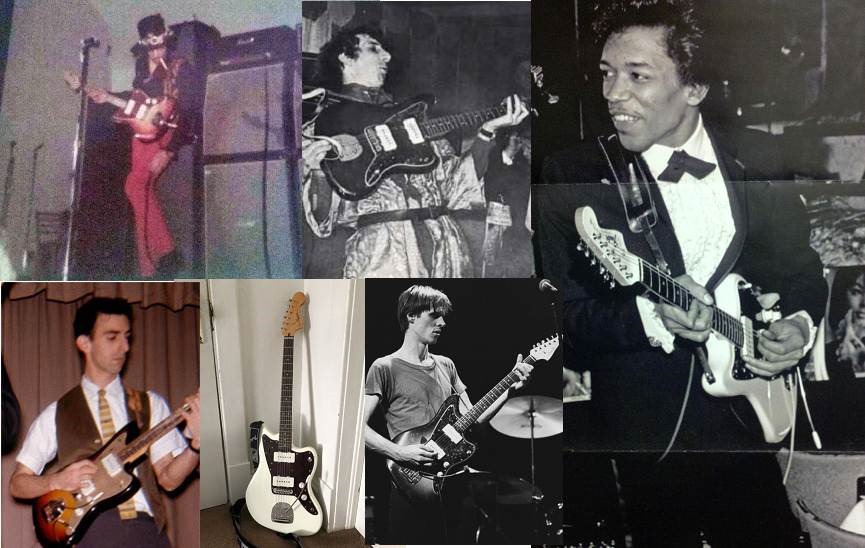
Jazzmasters! From the upper left: Jimi Hendrix without a Strat; Pete Townsend about to decrease the supply of used guitars; some guy named Jimmy James (wonder what became of him?); Frank Zappa, who didn’t say “The Jazzmaster isn’t dead, it just smells funny;” my Jazzmaster painted the homeopathic color Sonic Blue; Tom Verlaine, vanguard of the alternative nation which latched onto the bargain unwanted Jazzmaster in the 1970s.
.
A few notes on the music. I sometimes create the drum tracks for my compositions before the live session begins. And since I’m usually needed in the guitarist role, I sometimes lay down the bass parts with those tracks ahead of time too. That’s how this piece was. On the day of the session, I sang and played the wailing lead guitar*** and recorded the reading of Kevin’s words live with Dave playing a baaing/buzzing synth part live. Dave’s part, subject to his current hands, didn’t fulfill all the groove chop I thought the piece needed. So I added a second guitar part doing my best at rhythm guitar on my Telecaster, but a lot of the final groove you hear is an electric piano part that I laid down trying to imitate my friend and partner Dave’s playing as I recall it from the past.
By now I hope you’re ready to hear the musical story of Kevin FitzPatrick’s farm poem “Coyotes.” The player gadget is below for many of you. Don’t see that? This highlighted link is provided as an alternative so you can hear it that way too.
.
*I have to repeat this one, which I read in a comment thread this month regarding the upcoming Hollywood Oscar awards event: “The only Oscars I care about are Peterson and Wilde.” In the context of Dave Moore, even the young Dave wasn’t likely to stand toe to toe (finger to finger?) with Oscar Peterson on piano. On the other hand, I’ll hop on top of Oscar Wilde’s tea table in my slush-muddy Minnesota shoes and declare Dave’s poetic wit with Wilde’s.
**Other reoccurring characters weave in and out in the farm poems too — and while four-legged, the couple’s farm dog, the incongruous poodle named Katie, makes a cameo appearance in this one and others.
***The lead guitar part is played on a Jazzmaster, a famous failure in Fender’s otherwise wildly successful line of mid-century electric guitars. A couple of decades into its Edsel-hood of “what were they thinking” failure, unwanted used Jazzmasters became an affordable choice pragmatically chosen by some punk and alternative musicians. Even so, few think of a Jazzmaster for this kind of wailing lead guitar with a bit of funk flavor. As long as one is able to address the Jazzmaster’s bridge design issues, it can do that sort of thing.
Long time readers here will know that one of this Project’s ideas is “Other People’s Stories.” I’ve chosen to make that one of its principles for a couple of reasons. First, the Internet is full of folks telling their own stories, and this is fine (after all, to me those would all be “Other People’s Stories”). I wanted to do something different, to focus on how you and I experience a variety of words from a variety of writers with a variety of outlooks. The second is that I’m rather uncomfortable with promoting myself. That one’s complex.* Like most writers or composers or artists I think my own work has value at some percentage over half the time. Which then, mathematically, allows that I doubt its value, or my handling of its value, or the costs of declaiming its value to the universe a bunch of the time too.
No one creates without the first thought. It would be impossible. And no one who cares about what they create, about their audiences, or about how much craft and care can be devoted to any art; without seeing the faults, the missed communication, the needs for just one more revision or tomorrow for any work.
Many of us create instinctively, because we have to — but sharing that work is a choice. I’m nearing 600 Parlando Project audio pieces presented here. I could have presented at least half or two-thirds of that easily with things Dave or I wrote, but I made a different choice. It’s less conflicted for me to publicly look at, to be honestly surprised and delighted at Emily Dickinson, William Butler Yeats, Carl Sandburg, Langston Hughes, Sara Teasdale, or Du Fu; and then to share that with you.
But there’s a problem with “Other People’s Stories.” I’m likely not understanding everything those authors intended.** And they’re their stories, their visions. I’ve talked recently here about how when I translate a poet who wrote in another language how I want to honor their work and transfer accurately their particular powers, and yet then become tempted to break off into something their work makes me see through my own eyes.
A long prolog to presenting today’s piece, one I wrote and titled “Ethna’s Dream.” Ethna is Ethna McKiernan, a poet who I used to meet and talk about work with once a month or so, along with two to four others. Ethna cared and crafted her work over decades, and in her life did other useful work: running an Irish heritage book and art shop, working with the homeless. She’s currently in hospice, comforted by family, and the reports are that she’s now mostly in an out of what appears as sleep.
I couldn’t call Ethna a close friend. I always sensed a distance there. I think often of her none the less these days, and of every rudeness, awkwardness, or self-dealing on my part around her; and those or any number of things could have caused that. The very fact of writing a poem about her death, her dying, that mostest personal thing, seems problematic.
So, when you listen to my piece “Ethna’s Dream” you now know all that. This is not a poem about those things I’ve discussed in prolog, or at least I hope so. Instead, my intent is that it’s a poem about what we should treasure of that sharing of the unconscious that we have with artists (including those whose main art is just living). What I present in “Ethna’s Dream” is not a romantic, imaginary, sentimental metaphor in my own mind — though it may attract or repel you if you see it as such — it’s more at the essences of what we do, share, and take with art.
There’s references to Bottom’s speech in Shakespeare’s A Midsummer Night’s Dream. Am I prettifying myself up with pretentiousness, or comparing myself to the foolish play character? I wrote it, and yet I can’t tell.
*One problem, leading to one fear, is that when offered the chance to promote myself I see myself as overdoing it, and coming off as a self-absorbed narcissist that runs on too long about the arts I work in, prattling about the obvious and the obscure in equally embarrassing ways. If you’re still reading at the footnote stage, you may have forgiven me for that.
**Beside just plain embarrassment of ignorance, we now more often talk about cultural appropriation in regards to this. The travesties of cultural appropriation are real, but my belief is that they should, must, be risked.
I move back and forth with musical instruments and intent here, but since I started as a guitarist, there’s a lot of guitar playing in the Parlando Project pieces. When someone asks about my musical stuff, such as what I play, I often redirect, and make it a point to call myself “a composer” even though the poet in me knows that word’s connotations are fraught.
“Composer” risks putting the listener either in mind of some long past-tense powdered wig guy or a highly serious and educated modern theoretician. I’m neither. What I mean is that my intents with music are to invoke certain sonic combinations. I use various instruments to do that, and often that’s a struggle as I’m not as skilled as many players. Every note I play here comes after a committee meeting between the composer and the musician where the composer asks for things the musician can’t do and the musician suggests to the composer alternatives it can accomplish. Sometimes these are drawn-out affairs, and sometimes they are small latencies as I am asked to improvise then and there.
My poor guitars sit silently in the middle of this struggle, in days between pieces being finished, or in the moments between notes. These two sides win and lose and compromise. I’d certainly be a better composer if I could experiment in areas which my musicianship cannot empirically enter. I think I become a better musician in the times when the composer pushes me to think thematically or to not make the reflex choice.
If all that above seems dreary, it’s not. Yes, there’s friction, but each side enjoys it most of the time. And making music and hearing it are both sensuous acts. Thinking and scheming are involved, but what happens after that, when the next note is sounded, that just feels.
I mentioned last time that every September 18th I take some time to play an electric guitar and commemorate the date that Jimi Hendrix died after likely mistaking the dosage of some foreign sleeping pills. Think for a moment during this paragraph about the troubled history of musicians and drugs. Drugs to stay up, drugs to mellow out, drugs to excite creativity, drugs to sleep fast and deep. In terms of the life the composer asks so much, and the musician abuses the body’s instrument trying to extract those timbres and notes. It’s unavoidable for the composer and musician to struggle, but sometimes external and internal factors let this get out of control.
I played for a couple hours this Saturday, as much as I could spare. I had no ready words to include until I read on the same day an interview in Premier Guitar magazine with a band called Squid.* Squid is a British post-rock/math-rock kind of band, and that’s a genre I have some interest in, as bands that get those labels often are seeking new solutions to using conventional rock combo instruments. The band’s two guitarists had some interesting things to say about the electric guitar as it stands in 2021, more than 50 years after Jimi Hendrix helped redefine its parameters. So, I copied out a couple of quotes from the interview** and read them along with what occurred to me on the guitar in that hour and time.***
Today’s piece is what resulted. In the text, Squid guitarist Louis Borlase opens with an abstract theoretical statement, but soon offers a testimony affirming the expressiveness of the instrument, and for all of Squid’s make-it-new Modernism he ends by saying that that expressive voice allows you to aspire to “those people who came before you.”
Borlase implies a lot into what for someone of my age seems objectively a short amount of history for the electric guitar, which was only about 20 years old when I was born, and then whose extraordinary timbral variations were first exploited in my lifetime. But he’s not wrong, electric guitarists have stuffed a lot into that time since Hendrix’s. And electric guitar is also just another instrument, something to make music with, and we know we’ve done that since someone drilled some holes in a hollow bone or reed.
The second part quotes the other guitarist, Anton Pearson, who speaks theoretically again. Pearson says that the electric guitar is the “perfect marriage of technology and a gestural nature” which I believe at this time is true. Just as the invention of the modern drum set allowed for one drummer and their four limbs to command a combination of percussion voices and roles, the modern electric guitarist can use the fingers of both hands and foot-operated devices to create a large amount of playing instructions and sounds.
As beautiful and fundamental as wind instruments are to music, no one has extended them to that level. Keyboards come very close, including their modern use to control synthesizer timbral range and their ability to use all the fingers and limbs at once, but Pearson wisely restates his “gestural nature” of the guitar to include “visceral nature.” I have seen Keith Emerson stab knives into his keyboard and wrestle it to the ground. I have heard the groans and watched the creative agony on Keith Jarrett’s face while he played acoustic piano. Yet, they never touch the strings directly with either hand in various ways, they never move the instrument into the spot where the amp starts to possess the note.
“Is this a crime against the state? No! Someone controls electric guitar”
.
Are we past all that, is the electric guitar now a long-tail, trailing instrument tied to a passing era? The very thing I pedantically call myself, a composer, is now often modified to “beat maker” as folks think of new ways to order and modify sound, often without touching a conventional instrument. As listeners the instrumentation is immaterial after all. As I wrestle compositionally with my drum tracks, I know that rewards care, and succeeds or fails just as playing an instrument does.
But does anyone just power up and make beats for the sheer joy of it, not for recording or an audience, but just for the physical feel of the sounds being made, and made in real time, and for the ambiguity of the aches in my old finger joints after a session of fretting and neck wrangling? Does Jimi Hendrix, if and wherever his consciousness resides, miss that feel of that neck and the strings under his fingertips?
*If this sort of music sounds interesting to you, you can hear some of the actual sounds of Squid, touring dates, etc. at their web site at this link. Not your thing? I understand. It’s just one of the kinds of music that interests me personally.
**The full interview conducted by Tzvi Gluckin is available on Premier Guitar’s website at this hyperlink.
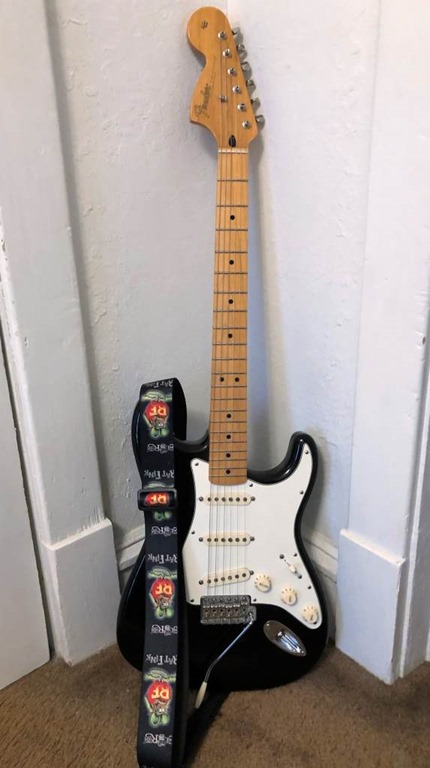
***Toolkit and process? Here’s details for guitar nerds. Everyone else is excused and can go home early. The drums are a software drum machine, which I intended to improve and then didn’t. I laid down the electric bass part with a Squier Jaguar bass. I did two passes and picked the best one. Last year I bought a set of TI flat-wound bass strings for this bass, which cost about a third of what the bass is worth, but I have old fingers and the soft feel of the TI strings are what they like. The guitar I naturally was drawn to on this day is my current Fender Stratocaster, a “reverse Strat” which emulates the pickup array and neck that lefty Hendrix would have on a regular right-handed Strat flipped upside down.
I tuned up and played for a couple of minutes to reacquaint my hands after playing bass, and then hit record and played for a bit over 16 minutes with the bass and drums. The lead guitar in the right channel is going through a reissue EH Triangle Big Muff fuzz pedal and a Cry Baby wah-wah pedal, though for some of what you’ll hear the wah pedal is left partway down for that Tallulah Bankhead “cocked wah” sound. Rather than emulating Hendrix (something I do sometimes on September 18th) I was aiming this time for the guitar to speak in different voices and over the 16 minutes it sort of does, but I decided to trim the piece down to mostly the parts where I read the Squid guys quotes about electric guitar. At over 6 minutes, even the edited piece is longer than I like to present for the Parlando Project.
The last track I laid down was the left channel rhythm guitar part. I used the same Stratocaster guitar, but it’s compressed with a Boss CS-3 compressor pedal and running through a Walrus Audio Lillian phaser, which even bought used is the most expensive guitar pedal I own. That track sounds almost like a modulated electric piano comping away, but it’s just electric guitar being versatile.
Both of the guitar parts are one pass, “live in the studio” parts. I didn’t have much time to do otherwise. The guitar amp for both electric guitar tracks is a Fender Hot Rod Deluxe.
My recording computer in my studio space is still an 11-year-old Mac Mini running an older version of Apple Logic Pro X.
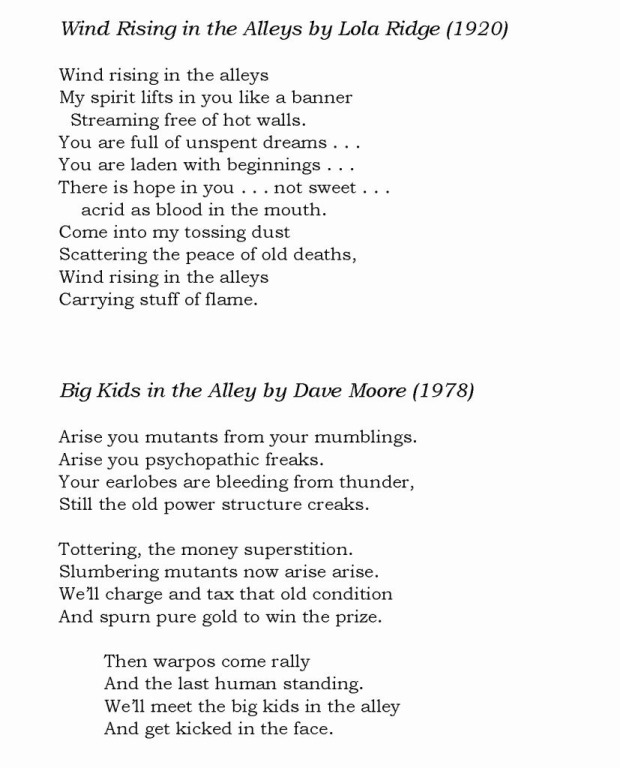
I thought I might get a second American Labor Day piece in from a few ideas I had last week, and this is the one that survived the cut. Well, maybe it’s more than one, as it’s a two-in-one, combining poems written 40 years apart: Lola Ridge’s “Wind Rising in the Alleys” and Dave Moore’s “Big Kids in the Alley.”
Ridge is a figure that could fascinate several different ways. She has a life story that would defy the most expansive novelist to invent. She was “on the scene” in both the literary avant garde of the NYC area of the first half of the 20th century and in touch with the political radicalism* of that era, and as woman who clearly saw the limitations of gender roles, she was allied with the wave of feminism arising then as well. A several-time immigrant herself,** she wrote with insight into the immigrant experience.
Having an interesting life isn’t the same as writing interesting poetry or poetry that compounds its interest over time, and I blow hot and cold myself as I once more start to read some of it. She has more than one style of poetic diction, occasionally sounding a little bit 19th century, and then sometimes flat and spare, to other times striking out with passionately with intense tropes of natural phenomena intending prophetic power. The first time I featured her work here I could easily see how that last kind of writing could link in with our era of Climate Change. In my second time into her work this summer I may be starting to “get” her, and Ridge may be one of those poets who one needs to get over the ways she seems “wrong” before understanding what she’s doing that’s uniquely “right.”
Accidents or coincidences, can sometimes help me do that. Reading her poem about a so red sky in contemporary times of widespread fire-smoke is one such connection. And my second time with Ridge happened when I saw this poem where nature in an urban alley is portrayed at a prophetic level. When I read this poem first published in 1920 I thought of a Dave Moore lyric used in the first Fine Art record in 1978. I made a note immediately to myself that they could be combined.
Are these Labor Day poems? Sandburg’s piece from “Smoke and Steel” I used last time is certainly one in the context of the larger poem it concludes. “Wind Rising in the Alleys” is the concluding poem in Ridge’s Sun Up, a collection of mostly short, sometimes Imagist style, poems and “Wind Rising in the Alleys” is the last one printed in the book’s final sub-section which also includes poem-portraits of famed Anarchists Emma Goldman and Alexander Berkman. The poem for which the section is named, “Reveille” starts “Come forth, you workers!” and ends “Let us meet the fire of their guns/With greater fire/Till the birds shall fly to the mountains/For one safe bough.” “Reveille’s” militant final lines compress parts of Ridge’s rhetoric: fervent radicalism combined with a “who would guess it would come next” poetic image.
As I mention here political beliefs and calls for direct action following from them, I’m thinking that some of you may not share those beliefs. So, let me stop for a moment and mention something important to poetry as an art. Poetry is not a very efficient method of communicating ideas, much less particulars of strategy and tactics. To say that it fails in these things (or to overstate what it may do in some part) is to find the obvious, for poetry fails as expository work or argument closer to the degree that music does. What poetry can do instead, is to tell you what having some idea or intent feels like. Do you recognize what it feels like the moment that someone you love or desire lets you know that they feel the same? That’s what poetry can do, and do intensely. Of course, it may happen that that lover turns out to be flawed, or an outright heal, just as much as they can turn out to be a partner for a lifetime and the treasured ancestor of ancestors.
That moment of love and connection is powerful to feel, and it’s not just romantic love poetry that can present that connection.
The optimistic winds in the alley Ridge speaks of have hope in them, hope for change. I can’t say exactly when it was written, but for publication in 1920 it may have been written in a time that was not at all hopeful for American labor and political radicalism. Berkman and Goldman were deported in 1919, and that year saw red-scare round ups and a particularly deadly year for anti-Black race riots. Whatever it is, “Wind Rising in the Alleys” is not a victory march.
I write about poetry and music on May Day or Labor Day, you can easily find others who will discuss political and economic matters. Let me just summarize a lot of complex history to say that workers and capital have both advanced their lot in the United States greatly since 1919. Hooray for Labor Day. Has justice advanced too? Yes, but the argument that that has been to a lesser and insufficient amount is strong. Hooray for Labor Day — and the days afterward.
Here are the texts of the two allied alleys that I’ve put together today.
.
Step forward to 1978. Dave Moore’s “Big Kids in the Alley” was written at the request from a rock band named Fine Art forming and making its debut album. I’ve written elsewhere a short history of that band, one of the earlier bands in the Twin Cities area to make and record original music in the Punk to New Wave transit station on the route-way of Indie music. Just as “Wind Rising in the Alleys” was the “album closer” for Ridge’s Sun Up,“Big Kids in the Alley” closed Fine Art’s record and was the encore or set closer for a lot of live sets I saw. At this time it remains one of two studio-recorded songs of theirs that can be found on the Internet, and it was even sampled and used in a hip hop record in our current century. Here’s the YouTube link to that cut from the vinyl record.
You may think that’s quite the intense showpiece. On stage it could be even more so, and it’s certainly not the kind of song you’d want to put in the middle of a set list with other songs immediately following. Rhythm guitarist Ken Carlson was always solid and tasty, and vocalist Terry Paul used a more aggressive style here than what was customary for her, but “Big Kids in the Alley” was also a feature for Fine Art’s lead guitarist Colin Mansfield. You can hear effects pedals sweep frequencies in the song, and Colin would usually play all or most of the parts using the edges of a Zippo lighter in his right hand as a string and pickup exciter as well as a pick. Colin had some understanding of avant garde and other orchestral instrument music under his belt before Fine Art, and while what he was doing here was unprecedented in punk and new wave bandstands in the Twin Cities in the 70s, unorthodox sound generation methods had some pedigrees there. Outside and Free Jazz players would also do similar things, though because those styles were usually wind instrument based, the precedents are less direct. A short-lived rock band movement in NYC at the same time (documented in the No New York LP also of 1978) used random noises and alternative guitar tunings often played by naïve players.*** Colin wasn’t a naïve player.
Lyrically, Dave Moore’s words for “Big Kids in the Alley” starts as a parody of “The Internationale” the 19th century labor anthem. If you read this Wikipedia article compiling the various versions of “The Internationale’s” lyrics over time and in many languages, you can see that they vary considerably, but the opening’s general thrust, retained with some intensifying language in Moore’s parody, is mostly honored. I sometimes wonder how many folks in pioneering venues that supported “punk” or “new-wave” bands in the Twin Cities 40 some years ago recognized the reference. You never ask such things when dancing.
The final chorus of Moore’s version adds an unexpected departure. This morning I realized I’d never asked Dave what his intent was in what he wrote there. I called him up, and he explained “That you’re going to have setbacks, that they are going to react violently. That you should realize that.” Note that the arrangement on Fine Art’s version ends on Dave’s final thought, which emphasizes its impact.
I didn’t use Fine Art’s music for this performance, and my musical setting is simpler while referencing a similar flavor. I did dig out an old Zippo lighter I keep in a drawer in my studio space, but I didn’t quite get Colin’s exact effect in my “get’er done” charge to record today’s piece.
You can hear this loud rock band combination of these two texts written 40 years apart with the player below, or if winds haven’t blown that up your alley, this highlighted hyperlink in an alternative way to play it.
.
*Early American Modernists, unlike an appreciable number of European or European-based Modernists, tended to be left-leaning, even radical. Many of the American publications that printed the work of Modernist poets or visual artists were equally if not more so concerned with social reform or outright restructuring.
**Though, I do not consider the elements in anyone’s background determinative, I enjoy on a superficial level the diversity of ethnic and regional variety in English language poetry. Ridge is a case where the hyphenation cannot cope. Born in Ireland, immigrated to New Zealand at 8, then to Australia where her career in the arts gained a foothold, then to the American West Coast were she at least touched bases with the contemporary arts there, and finally to New York City where she lived the majority of her life, including time in the teaming immigrant Lower East Side.
***A less-remembered pioneering American punk band Pere Ubu was working some of these ideas as early as 1975. Sonic Youth was connected to and arose after the NYC No-Wave scene was receding, becoming a successful band in the Indie Rock era. In the Twin Cities, The Wallets later presented a more song-oriented version of what some of the NYC No-Wave bands did.
1 A High-Toned Old Christian Woman and First Fig by Wallace Stevens and Edna St. Vincent Millay It seemed like an odd pairing. So much so that I wondered why I thought it might work. Wallace Stevens, who looked like what he was, an insurance executive; and Edna St. Vincent Millay, the beautiful bohemian New Woman of the 1920s. Stevens’ poem “A High-Toned Old Christian Woman” was awash in his characteristic play with esoteric words, luxuriating in its educated Modernism. Millay’s “First Fig” is epigramically brief and simply said. They were only about a dozen years apart in age a hundred years ago when these poems were written, but Stevens seemed older than his years, and Millay was famous as a distinctly young poet and as a poet who spoke for the new youth.
The subconscious forces that had me perform them together is still somewhat inexplicable. The rational connection I can see is that both of them are giving their Modernist defense against an older propriety, each in their own voices. Both are defiant in their ways, but they also somewhat reassure the older generation with an undercurrent in their poems. “A High-Toned Old Christian Woman” is telling the titular old Christian (which may be based on Stevens’ mother) that he too is a devout believer, but his belief is in pagan art. Millay’s “Fig” self-admits the likely unsustainability of her devotion to an artistic life, yet her short poem has enough room to say that she’s aware of that. Both poets accept that their stubborn individual Modernism may make widows wince.
Adding Modernist poets to your electric guitar pedalboard.
The unusual music in this spring’s most popular audio piece may have attracted some. Earlier this year I was able to find a used example of a guitar effects pedal that I’ve looked at for some time: the Electro-Harmonix Attack Decay pedal. Its prime trick is to make an electric guitar’s notes burn at both ends. Most other similar effects work only with single notes, but with proper settings and playing, the Attack Decay can latch on to and do the reverse delay thing on overlapping notes, letting the featured guitar in this piece sound like a hurdy-gurdy.
This is the piece that you, our flexible Parlando audience, listened to and liked the most last season, and you can hear or re-hear it with the player gadget below, or through this highlighted hyperlink which will play it in a new tab window.
During this project’s first April #NationalPoetryMonth back in 2017 I started what has become a 5-year serialized performance of the entirety of T. S. Eliot’s “The Waste Land.” And here we are today, finally completing that portion of our Parlando Project.
Why “The Waste Land?” for this lengthy each-April presentation?Several reasons.
Like a number of literary cultural artifacts, the single thing widely known and carried forth from it is only a single line. A certain significant ratio of us knows “The best of times, the worst of times,” or “Do not go gentle into that good night,” or “To be or not to be” — and so you may know “The Waste Land” from its opening line: “April is the cruelest month.” That small keepsake of a long poem is much brought forward for anything that occurs in any April, and as much or more than Chaucer’s April preface to his Canterbury Tales, it’s likely the reason April is National Poetry Month. As an opening line it’s not misleading. Much cruelty happens in Eliot’s poem. Is it cruel to be kind as Shakespeare and Nick Lowe might put it? Is it just cruelty for shock effect — or can it cure, however partially? Our long serialization explores that, covering all those parts that you may have forgotten even as you remember and repeat the first line only.
“The Waste Land” is also a landmark, a milepost, a line in the sand for a certain kind of Modernist English language poetry. While this project is not entirely about the rise of Modernism, the current rules of public domain make work from the first quarter of the 20th century the latest I can surely use for my project’s purposes without complications. If time permits me, I may follow up today’s post with a later one about what I’ve learned about Modernist poetry before and after “The Waste Land” while working on this project; but when I first encountered the unescapable “The Waste Land” in a schoolbook and classroom as a teenager one thing that I understood about it (perhaps the only thing I understood about it) was that it’s quite musical in most all of it’s movements.
“The Waste Land” is not, at least in America, a beloved poem from what I can tell. Even among college-education-exposed Americans it’s not commonly memorized, kept in a commonplace way, used for occasions, or re-read for pleasure or new insights. Consistent with that, for the most part, these every-April “Waste Land” segments have not been among the most popular here.* Even among poetry lovers there are some that actively dislike it, find it a pretentious mishmash overrated by those afraid to speak plainly. Eliot himself seemed to avoid speaking about it or reading sections of it at later public readings. He may have thought his later poetry more accomplished, but I also wonder if he didn’t care to revisit the more unbounded elements of his life reflected in The Waste Land.
Which brings me to the main reason you’re about to get a chance to hear this performance today: The Waste Land is not just one thing by design or execution, but it is significantly about someone in the throes of depression. Indeed, much of this year’s final section, “What the Thunder Said,” was first drafted while Eliot was hospitalized for this. This section is not “The Waste Land” of scholarly footnotes, bank officer work, gender blurring and questioning, or the knowledge of a night-class schoolteacher for working class women, or the lament of a man who has a personal sense of the intimate losses of a great war. This is the howl of personal despair of a consciousness who can portray those things — and it’s the howl of someone seeking to explode and break out of that state.
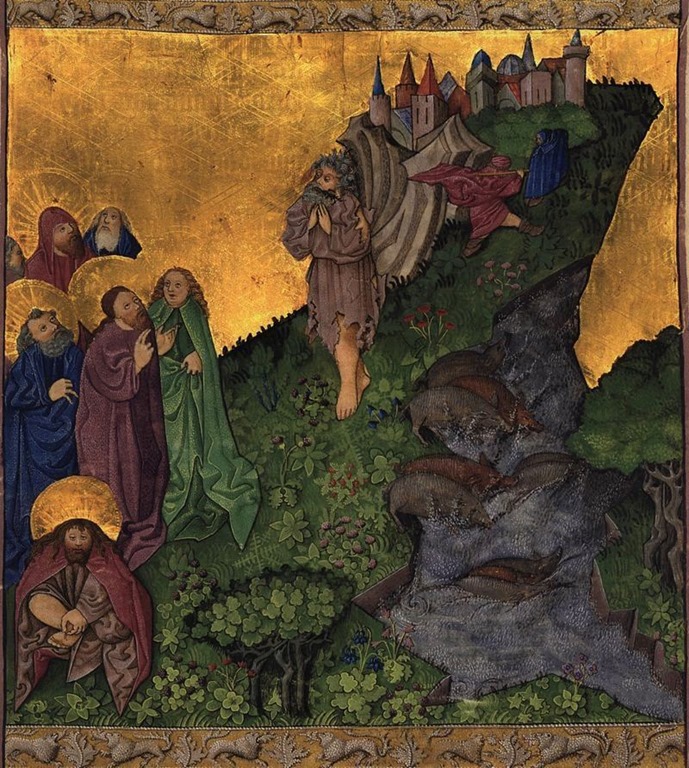
The LYL Band performance you’ll hear if you click on the player at the bottom of this post is a live performance from more than a decade ago, long predating the other sections I’ve presented here of “The Waste Land” over the past 5 years. At the time of that performance I myself was emerging then from an episode of depression, one of two I believe I have gone through in my life. Depression has a variety of feelings and absence of feelings, and if one reads good writers describing their own depression experience you may well get a sense of the blind men’s elephant of fable, but my own feelings on the day and hour this was recorded were largely feeling sick and tired of those depression feelings. At some level I felt this section of Eliot’s poem was similar to what I was seeking, feeling, finding: an expression of an expiation of that, of demons transferred into mad pigs being cast into the sea. This coincidence of my life, a performance, and the poem would make it dear to me.
As I said, this is a recording of a live performance. Besides my voice and electric guitar playing, you’ll also hear Dave Moore’s voice spontaneously following along as I unfurled mine. I was cold-reading Eliot’s text here, I had not rehearsed or prepared for this performance, other than printing out the text. Embarrassingly, as I reached many of the foreign words in the text and fully in high transport of the moment, I mangled their pronunciation or dropped them from the reading. I used a handful of short samples you’ll hear mixed in the background to restore some of the dropped text.
In later, calmer reflection I continue to think this element of expiation is part of Eliot’s design here. A line I recall feeling strongly and intimately as I came upon it in my reading and performance that day is:
We think of the key, each in his prison
Thinking of the key, each confirms a prison.”
Whatever part of the elephant of despair or depression you might jiggle, touch, or be crushed by, we think of the key. Can we also think, hope to think, expect to think, of the prison as invalidated, destroyed, or obsolete?
What you’ll hear if you click on the player or hyperlink is rough, it has some mistakes, and being recorded live there is little I can do to fix them — and by intent it’s not a very genteel and formal presentation of Eliot’s poem. If that was my intent on that day over a decade ago, I today renew that intent by concluding our long, serialized The Waste Land with this performance that predates all the other segments. In one of Eliot’s later poems (“The Little Gidding”) that he may have uprated over his 1922 landmark, he wrote:
We shall not cease from exploration
And the end of all our exploring
Will be to arrive where we started
And know the place for the first time.”
And so it is here too: every episode for this serialized presentation of “The Waste Land” has been informed by that beginning, performed and recorded long before, that is now being used at it’s conclusion.
We’re now nearing the top of our look back at the most liked and listened to audio pieces this past fall. Yesterday we used words from a trio of women writers, and today starts off the same way. If you missed the original posts on my encounter with these texts and creating the music for them, I’m including a link to them in each of their notices in this Top Ten series, and those linked posts also will show or link to the full texts. The player gadget to hear the audio performances with original music is after each listing below.
4. Autumn by Emily Dickinson. We start off again with Emily Dickinson. I can’t help it, every time I go looking for some additional texts I run into a short Dickinson poem that fascinates, and that’s just the sort of thing I like to use here.
Oddly, this one isn’t the weird, sly, or mystical Dickinson. It’s just a light piece of occasional verse. In my original post I noted that Dickinson’s classmate and friend Helen Hunt Jackson could have written and published this sort of poem, and it’s the sort of verse that would have fit well in the newspapers and periodicals of the time.
Of course, her times weren’t placidly occasional as this poem seems to be—they were less so than even ours are. She grew up in a time that the U.S. political system was falling apart, unable to solve the social and economic addiction to chattel slavery based along racial lines. Her own father was a local principal in one political faction trying to grapple with this.* The years of her greatest poetic output paralleled the bloody 4-year civil war that followed.
I can’t say for sure why Bob Dylan issued his Nashville Skyline album in 1969—another war-torn time. In that LP Dylan dared to write the simplest, even corny, statements; and the singer who had snarled and howled his words at the height of his fame sung them in a tenor croon. Is there some truth—or at least momentary respite—in those sentiments? Opinions differ. Dickinson’s “happy autumn” poem reads like that to me. My suspicions are that it was a part of her capacious mind (no one can be fierce all the time), that she wanted to show (in this early poem) that she could do those expected kinds of verse, and that maybe it was a resting place for her (as it could be for us) from the changeable world that refuses to change.
Brancusi’s Golden Bird by Mina Loy. It was a blockbuster trade. The United States sent Ezra Pound and T. S. Eliot, both powerhouse Modernists with a reverence for old school classicism to the European side in return for a scrappy English up-and-comer Mina Loy and a future draft pick which turned into W. H. Auden.
And as I noted in my original post, this poem of Loy’s was published in the same issue of The Dial that included a modest little contribution from Eliot: “The Waste Land.” You might have heard of that one.
It’s only lately that some have come to re-assess Loy. And talk about fierce, committed, and assertive writing by a woman—Loy could bring it.“Brancusi’s Golden Bird” is a high-energy hymn to Modernist art.
Separated at birth? Mina Loy and Patti Smith. Alas, Loy was more than a generation ahead of the electric guitar, a fault we’ve now remedied.
In the 21st century, Patti Smith, one of my heroes for demonstrating the uses of heroes, and a model for the value of guitars with poetry, has issued some below the radar explorations of various Modernist artists. Let her heart and mind go where it wants to go, but I do sometimes wonder if she’ll get around to Mina Loy, whose soul might resonate with hers.
Do Not Frighten the Garden by Frank Hudson. Yes, the Parlando Project continues to be about “Other People’s Stories.” That means it’s about how I react to others’ writing. There’s no lack of selfish pleasure in that. The thrill I get when I compose the right music for a text, or when I complete a translation of something from another language, or just perform a piece with some degree of satisfaction is more than enough.
And really, honoring other people’s work is important! If our poetry scene is only voices, however vivid and individual, speaking only their own words, then it risks being the silent forest for the trees.
In my defense, I offer that “Do Not Frighten the Garden,” is inspired by a phrase in one of poet Robert Okaji’s poems as I discussed in my original post on this. In all probability I wouldn’t have written my poem if I hadn’t read his poem. Writers in general are instructed to “Write what you know,” but like “Look before you leap” and “He who hesitates is lost,” opposites can be true. Particularly with the immediate lyric poem, there is another possible instruction: “Write what you didn’t even start to know until just now.”
And here’s my holiday wish to you, adventuresome reader and listener: that something we present here inspires you to see something differently or possible. Tomorrow we’ll be back with the reveal of the most popular piece this fall.






 Frank Hudson