Libertad! Igualdad! Fraternidad!

We’re going to have some William Carlos Williams poetry turned into a song below. If you’ve missed that sort of thing from me, I’ve returned with time to focus on what we do here.*

I think I’ve already mentioned that I’m disappointed in my country and its follies this past year after the national election. I could take your time and patience with some personal punditry on where to apportion blame for this. The electorate? The winning vassal party and it’s red duchies? The oligarchs and emperors ever-richer and more protective of prerogatives? And then too, the losing party, who gets apportioned blame for everything else on the list as well as bearing the sting of defeat?

I’m not going to do that. A complete list opens up the vulnerability of adding one’s own self to the blame. While many personalities have strong defenses against that self-indictment, I’m not sure if that’s a good or bad thing. By now, if you wanted any variety of that, you’ve already had your fill. Rather, if you’re on the side that lost, you might feel left alone. As we approach the new regency in a matter of hours, let me repeat something I said after the election: we can, we should, forgive ourselves for hope. It is a right-sure prediction that we’re going to need more not less hope in the next few years.

As we approach the new regency in a matter of hours, let me also repeat something I said after the election: we can, we should, forgive ourselves for hope. It is a right-sure prediction that we’re going to need more not less hope in the next few years.

Further in that feeling alone — except for the exchange of blame and shame — I’m not thinking this group are presently at risk of being visited by reporters seeking to understand their sorrow, fear, disappointment, despair. They’ve had over 60 days to file those “I must understand them” stories, but there’s a general silence on that front. Perhaps there will be some stories of the manifestations to come of what some of us fear — though if the worst fears come, those could be harder to find, and stories after injury may be less efficacious than the now-impossible to file stories that could have come beforehand.

Libertad!

I urge folks to sing these Parlando songs themselves, so here’s a chord sheet for today’s piece. Some will likely do a better job than I do, and additional voices strengthen a song.

.

So, I was happy to find, write music for, and sing this short William Carlos Williams poem this winter, even though it was written back in the last decade called The Twenties. I too feel forced into the mud, and so much now depends on the stink of the ash-cart rolling toward us. You can hear it with the graphical audio player gadget that should appear below. No player? No editor looking over his shoulder at their owner-baron has spiked it. No algorithm has ruled against it in court. The audio gadget has always been impartially suppressed by some ways to view this blog — but you can use this highlighted link to open a new tab with its own audio player.

.

*This isn’t the first holiday season that has caused a drop in new pieces or posts, but I’ve spent a good deal of time in this cold bilaterally looking January shopping for a replacement for my 20-year-old car. I had previously figured I’d wait until that car had reached its full majority this upcoming fall to shop for a replacement, but like some others I played the odds that new tariff taxes and repercussions would raise prices.

To Waken an Old Lady

It’s National Election Day in the United States, and it’s seen as an extraordinary consequential election. Amid that great matter, I fielded a clutch of social media queries on poetry and music in the last 24 hours or so. I think I understand this seeming paradox. Though I myself will likely stay up late tonight listening to returns — as it is after voting early in the morning, I’m expecting to have only the maelstrom of worrying and hoping to spend over the rest of this national event tonight.

But since I last left my listeners at the end of October with an atypical audio piece, I thought it’d be a good day to release this performance by the LYL Band of a poem by the American early Modernist poet William Carlos Williams. That’s what we usually do here: take other folk’s literary poetry never meant to be sung and combine it with original music in differing styles.

What’s my personal history with Williams? Oddly,* my introduction to Williams was in the guise of his printed introduction of Allen Ginsburg to me (and many) in the thin City Lights paperback Howl and Other Poems.  Williams’ name was printed right on the cover of Howl,  and while in a smaller font than Ginsberg’s, it’s not fine print either. They must have thought it would help.

Howl Cover

Published November 1st, 1956. Did the choice between Eisenhower and Stevenson seem quite so existential?

.

As a young man I don’t think I absorbed much of what Williams said in his short introduction. I didn’t have the experience of life to fully grasp it, and about all I knew of Williams was that he was an established, a somehow certified, real poet — and the man he was introducing, Ginsberg, was not. At that point, the younger poet had not been elected to such a post by the cultural electoral college, but WCW was vouching for him beyond the matter of a questionable Beatnik fad. As a teenager at the time, what did I know about what made a real poet? I can’t fully remember. I had some romantic ideas about vision, seeing intensely what others couldn’t sense, and some idea that that would likely put the poet in opposition to elements of society. This was not some structured critical philosophy on my part, it was more a gut feeling, a wish for something more. I look back at that kid I was and think: well, maybe I’m still no better a philosopher than he was, though I now know complications — but yeah kid-of-the-past, there’s still something to that.

Williams’ name on the Beat landmark paperback did not lead me to read Williams then. Rereading that introduction today that may have been because while it had words that Ginsberg took as validation, it was somewhat between hands-off and off-hand about Ginsberg’s poetry. He called Ginsberg “disturbed,” recalled that he didn’t think the young man would develop into a poet (or even survive). He characterizes the title poem of the collection, “Howl,”  as a howl of defeat. I adamantly heard it as a howl of survival. So, thanks old man. Glad you at least said we should pay attention, be “arrested” Williams wrote, by Ginsberg’s poetry.

It’s only been in this century that I read Williams early 20th century work. I found a lot to like in his clean spare early poems written as Modernism sought to clear out the tired excesses of decoration. Now as I re-read Williams mid-century introduction to Howl  I’m arrested by things I, an old man, resonate with. He did  see the poem’s survival testimony. He wrote this there about Ginsberg’s poetry:

He proves to us, in spite of the most debasing experiences that life can offer a man,
the spirit of love survives to ennoble our lives if we have the wit and the courage and the faith — and the art! to persist.”

And he continues in the introduction to Howl:

Poets are damned but they are not blind, they see with the eyes of the angels. This poet sees through and all around the horrors he partakes of in the very intimate details of his poem. He avoids nothing but experiences it to the hilt. He contains it. Claims it as his own — and, we believe, laughs at it and has the time and effrontery to love a fellow of his choice and record that love in a well-made poem.”

It seems to me now, from my old age, that to “see with the eyes of angels” may be its own curse, and thus the angels may howl.

Is today’s small William Carlos Williams poem, one turned into a little song sung with the LYL Band, too slight to serve on a night where we look as nations move? I don’t know. I already told you, I’m not much of a philosopher. Williams’ “To Waken an Old Lady”  is a poem that yokes old age and the descent into winter. Here’s a link to the text of the poem if you’d like to follow along.

I now can often feel like the small birds he puts in this poem. In the course of life, I’m here past the days of career or work harvest. In the summer, the summer of this political campaign, I felt the cold dark winds plenty of times. The poem doesn’t say, but I suppose the poem knows spring comes. I suppose also the poem knows that death comes and preempts spring too.

“But what?” Williams interjects as the poem turns. Look: there are these broken seed husks, the ones that didn’t bloom. So what if they are not to bloom, they are sustenance for survival.

You can hear the LYL Band performance of “To Waken an Old Lady”  with the audio player below. Are the returns of an audio player yet to come in?  This highlighted link will open a new tab with its own audio player.

.

*Well maybe not odd for me. If you’ve read many of these posts, you may have recognized that I love the odd connection.

O honey-bees, come build in the empty house of the stare

I have my partisan convictions, you may have them too. And yes, our particular governmental and economic  institutions are imperfect instruments. Natural forces only partially in our control and as small as a virus and as large as a changing atmosphere are still arrayed against not just our nation, but our planet. Proud racial and ethnic caste systems divide our forces against these things.

How to be humble and not loose heart? How to rejoice if there are things to do? Well, I believe that without joy we cannot achieve any needed changes or maintain any necessary things—but there’s much I don’t know, and as with all the things I think or say, my beliefs and actions are less important than yours, particularly if you are younger than I am. Laugh at all that clap-trap about named generations with variant but supposedly sharp an defended borders and a fixed list of characteristics like some crummy astrological sign summary. You are, or you need to be, The Greatest Generation.

White House and the US Capitol

William Butler Yeats said about his country a century ago: O honey-bees/Come build in the empty house of the stare.
.

I hope to have new audio pieces with posts  in the next week, and there are lots of them already posted here. Here’s one of those older pieces you may not have heard yet, featuring the words, voice, and keyboard playing of Dave Moore titled “No Common Ground.”  The player gadget to hear it is below.

.

As we wait….

A momentous week in the United States as election results are counted, and I’m frankly distracted from my normal creative routine. But as we wait, I can offer this piece by Henry Wadsworth Longfellow that I presented as part of a celebration of American Independence Day last July.

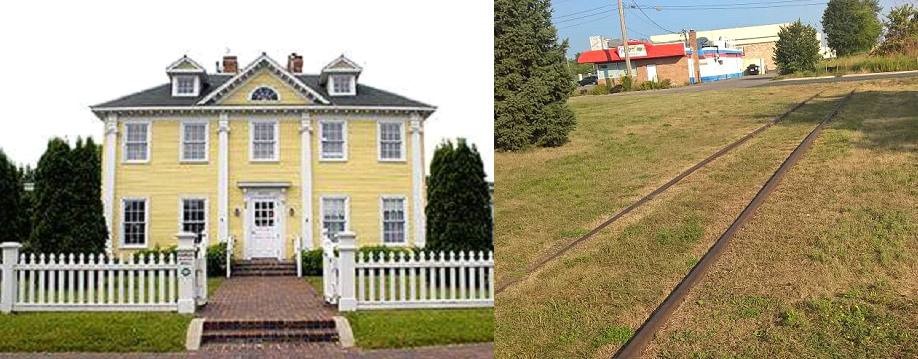
Longfellow House and remains of trolley tracks

Mixed metaphors: ships and trains. Minneapolis has a replica of Longfellow’s famous house, if you look closely outside it, you can find remnants of trolley tracks that now start and finish under the earth.

.

As we noted back then,  Longfellow’s 19th century American poem was sent by Franklin Roosevelt to Winston Churchill during the darkened days of WWII in the middle of the 20th. Maybe it speaks to Longfellow’s country here in our 21st century. The player to hear my performance of Longfellow’s “Sail On, Oh Ship of State”   is below.

.

.

Election Day

I recall being on the shores of Lake Superior, North America’s great internal sea, on the morning of the last U. S. Presidential election, a day very early in the run of this Project. The lake and wind were calm, and I was out alone at dawn at a place where you could hear the water-lapped gravel stones at one part of the shore clinking against others.

I arose this morning at dawn in my diverse urban neighborhood and rode and old bicycle down to a low creek near the border of the city. That waterway is running low, exposing the ragged banks it used to wear. On the way back I picked up a take-out breakfast and rode past my voting place where I saw some of my fellow citizens entering and exiting to do what I had already done a few weeks ago.

I am ill at ease for my country, my family, and myself, something that accelerated throughout this year. I’ve read all the information, added to it all my speculations, but I have no source or way of knowing if that helps. It seems likely that my country’s fate will be decided in varied places across a continent, by a group of people I don’t know, by rank strangers like and unlike me.

We call that system democracy. Our republic filters and strains that democracy, weighs us unequally. There are days that call to mind diverted poet Winston Churchill’s famous line “Democracy is the worst form of government except for all those other forms that have been tried from time to time….” and other days were my mind’s ear hears singing poet Leonard Cohen*  intoning that “Democracy is coming (slight, sly, pause…) to the U.S.A.

Our Books

Books and votes and viruses and a world that weighs them with a right thumb in your eye and a left thumb on the scales. And you? Close your fist to protest. Open your fist to read, to vote, to grasp each others hand.

.

I know some come to this blog to find something other than politics and self-assertion, and others as a break or supplement to earnest efforts at those things. Readership and listening stats here have never been higher, even as many of you have no-doubt been as troubled as I have been this year, so I feel the call to leave you with something today. I have picked a text from a writer that I often turn to in troubles: Carl Sandburg. When I first presented this audio piece, I said that Sandburg had seen every evil and injustice I had seen, would not deny what he had seen, but still retained an embrace of humanity. So, I’ll give you a selection again from his “The People, the Mob”  for this election day. The player gadget should appear below.

.

*That Cohen died on the eve of that last U. S. Presidential election still seems like an epitaphic metaphor.

.

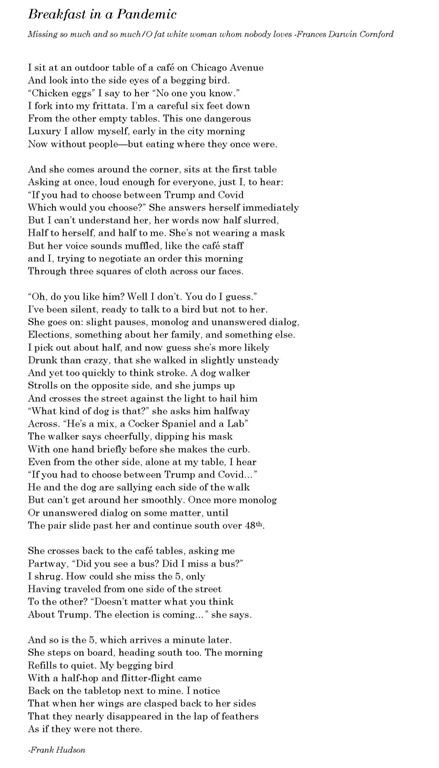
Breakfast in a Pandemic

Can we accept a little fall-off from Rilke last time to something I wrote?

As long-time readers here know, the Parlando Project is about “Other People’s Stories.” Dave and I both write words as well as music, but I find it interesting to examine how I experience other people’s words, other people’s outlooks and visions. This project’s focus for the past four years  has been an exploration—often into writers I didn’t know, or writers that I, and perhaps you as well, think we know because of what we have been told about them.

I was able to run this piece past a fine poet Kevin FitzPatrick,*  before it reached the form you’ll read/hear today. He noted that I was working in my Frank O’Hara mode, and he’s right. For me in my 20s, O’Hara helped me integrate the French Surrealists with the American mode of Carl Sandburg,**  with a Modernist touch of exoticism I’d retained from love of the English Romantics.

I had to remind Kevin that a big influence on this poem was his own poetry, about which a reviewer once said included so many “poems with other people in them.”  Why, oh why, is that so rare? How many poems are about the poet’s own head space or solitary meditation on nature? Of course, that landscape can’t be avoided. And yes, some very good poetry can be written in that less populated country. Readers here will know how much I’ve come to admire what Emily Dickinson did. Though we now know that her life was not entirely that cloistered myth that once was used to define her, does her extraordinary corpus of poetry ever include another human character speaking for themselves?

So, my poem starts out like a nature poem, albeit in an urban setting, and then another character breaks in and changes the poem. The music I composed and performed seeks to underline that. And a disease pandemic is, after all, a natural metaphor for our separation.***

Breakfast in a Pandemic

A long poem for me these days. Some thought it could be shorter and some thought it could include even more detail . They’re both right, but that’d be another poem I decided.


In the text of the poem I use an epigraph from Frances Darwin Cornford’s “To a Fat Lady Seen from the Train.”   Dave wondered if that might put off some readers. His concern has merit. Cornford’s poem (better known in Britain) is an earworm best known for being disliked. I have not seen anything from Cornford about what her intent was with the poem, and perhaps she had little conscious intent, thinking of it only as a catchy triolet. However, I think it’s a kind of pointed  failed encounter and is written as such.

As I said above, the music here tries for contrast, with acoustic guitar and then drums and bass with a smattering of woozy strings and distant woodwinds. The composer in me isn’t sure the composition or the performer achieved all of his intent. The middle section may be taken at too fast a tempo. My late father who hated poetry read too fast would certainly think so. But I remind myself that plenty of modern spoken/chanted word is taken at a rapid pace, so maybe not.

The player gadget is below, so you can listen and decide for yourself. Stay well, valued readers and listeners!


*Alternative Parlando voice and keyboardist, Dave Moore had some helpful suggestions on it too.

**I don’t know what O’Hara thought of Sandburg, but I wouldn’t be surprised if it wasn’t favorable. Sandburg might have seemed too straight, and too yokel. But Sandburg was working often in the mode of Whitman and Hart Crane which O’Hara also was (along with O’Hara’s French language influences).

And did you know that Whitman’s oh so American ‘barbaric yawp” was a formative influence on French Vers Libre? I didn’t either until this project’s exploration.

***At least the existence of this poem means that this pandemic of our age won’t be as little covered by poets as the big 1918-1919 flu pandemic that poetry ignored.

I Am the People, the Mob

Last week was a tough week to bear, from the guns of Louisville through Pittsburgh and the man with the bomb plan and his sheets of flag stamps. Evil should not surprise me, it should not baffle me—and yet it does baffle me. Should I also feel sad along with bafflement? A good question for lengthy political analysis, but that won’t change how I feel beholding this.

I’m not naïve. I’ve lived a long life, and I’ve met a fair cross-section of Americans in it. Ignorance, racism, clan and gender prejudice—humans are prone to this. If I had a great deal of experience outside of the U.S., I would expect to find these things elsewhere too. But now and here, we have a benighted charlatan—in over his head—who trashes around in these things, knowing in some simple, instinctual, skunk’s way that this cloud of stink will confuse us from considering him.

In a few days our imperfect democratic republic will have an election. I do not suppose to know what will happen. I’m a poet and musician, go elsewhere for predictions. Poetry and art allow us to see more vividly across our temporary borders of place and time, but that sort of perspective doesn’t necessarily make us better prognosticators. In poetry and music, like in history, everything is possible, and over the long time, a great deal of the possible will become.

So here I sat, in this mere and disturbing week, having trouble considering the attempted and achieved beauty of my arts—because, in this stink and sadness, what can be meaningfully beautiful?

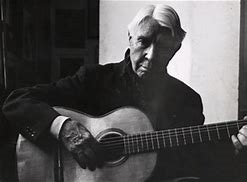
Carl Sandburg wth guitar

Carl Sandburg essays a look that Leonard Cohen would cop to sometime later

As I did earlier this fall feeling like this, I turned again to reading Carl Sandburg for my soul’s sake, for the early 20th Century Sandburg had seen every evil I have seen, and yet retained an embrace of humanity. Often here I focus in on the neglected Modernist Sandburg, the forgotten Imagist Sandburg of short poems that sing our overlooked, ordinary, humanity. Sometimes I fear the more expansive, Whitmanesque voice that Sandburg also used has drowned out the individuality of his shorter, less shouty poems.

But I needed him to shout some of his heart into me this week, so here’s Sandburg’s “I Am the People, the Mob.”  The player is below to hear it.

Frank Eli Hudson and Rye Whiskey

It’s election day in the United States, a day of great hope and fear. Yesterday I was on the shore of a great lake and the sunrise was a perfect unbroken horizon of a bright line with pink above that, and then graduations to blue rising up over our heads as high as we wished to look. At our feet, the lake waves came from wherever they come from and broke on the stone ballots cast on the beach.

We are riding a great wave of change sweeping from wherever it comes from to wherever it goes. I feel our country has become both more perceptive and more blind,  in what is too close to equal amounts. I do not know what part of that proportion of blindness is mine or yours. Perhaps until we see, if we ever see, we will not know.
 
We’ve talked about myths here before, our big stories that explain ourselves. When Homer sang his myths he was said to be blind, and myths are often blind. When John Keats read Homer in Chapman’s translation, he wrote about it in a fine sonnet almost exactly 200 years ago, but oops! he put the wrong explorer on that Pacific-viewing peak. So clearly a mistake that a friend pointed it out to Keats immediately, but in the end, it harms the poem in only that simple and clear “wrong guy, Johnny!” way. People who know about these things might note that Chapman’s translation of Homer, published 400 years ago this year, is a bit loose as well. Homer’s music is always very hard to translate, but they say that Chapman added some additional material dear to his own philosophy.

Let’s just leave it at this for now: little or big deviations from the truth make up many, perhaps all, myths, those explanations of ourselves. We grow blind and perceptive at the same time.This piece, Frank Eli Hudson and Rye Whiskey, is as much true as my proportion of blindness and perception can make it now.

My appreciation of what was called “folk music” in the US in the mid 20th Century was founded on an appreciation for “authenticity.” “Authenticity” is a particularly hard to define myth. If I can distill it briefly, “Authenticity” believes that certain emotions and feelings are more perceptive, closer to the truth of things. So, to portray those emotions and to share them through art allows one’s audience to see and share the truth of things. The 20th Century American folk music circles search for authenticity is not much different from hard-core punk later in the century (the two musical movements have many parallels).

I saw the folk song Rye Whiskey though that shared myth of authenticity, just as the piece recounts. On the page, and as performed by many folk-revival singers, Rye Whiskey seems to call on harrowing emotions. However, for a time this year it occurred to me to see what I could find out about my great-grandfather for whom I was named, A decade-old report from an uncle that he liked the song Rye Whiskey was one thing I knew.
 
Around this time a co-worker thought my son, who likes math, would be interested in some sets of numbers relating to a deck of playing cards. I told the co-worker that some of that material was used in a hit song of my youth, The Deck of Cards. Turns out The Deck of Cards was a hit not once, but several times, and that Tex Ritter had been one of the earliest to have a successful cover recording of it.

On the other side of Tex’s A Deck of Cards was Rye Whiskey, a  that song that was part of Tex’s repertoire for a long time, going back at least into the 1930s. I can’t say for sure where Frank Eli Hudson heard Rye Whiskey, but Tex Ritter would be an odds-on favorite.

The Deck of Cards was not “authentic” folk music. Robyn Hitchcock once did a parody of it that is hilarious. And Tex’s version of Rye Whiskey?  Well, listen to the piece as played by the LYL Band to hear what I found about how my great-grandfather, authentically living in that “Old Wierd America” that Greil Marcus writes about, might have experienced this song. The gadget to play Frank Eli Hudson and Rye Whiskey should appear below.


After you’ve heard my tale, here are some versions of Tex Ritter singing this authentic American folk song.