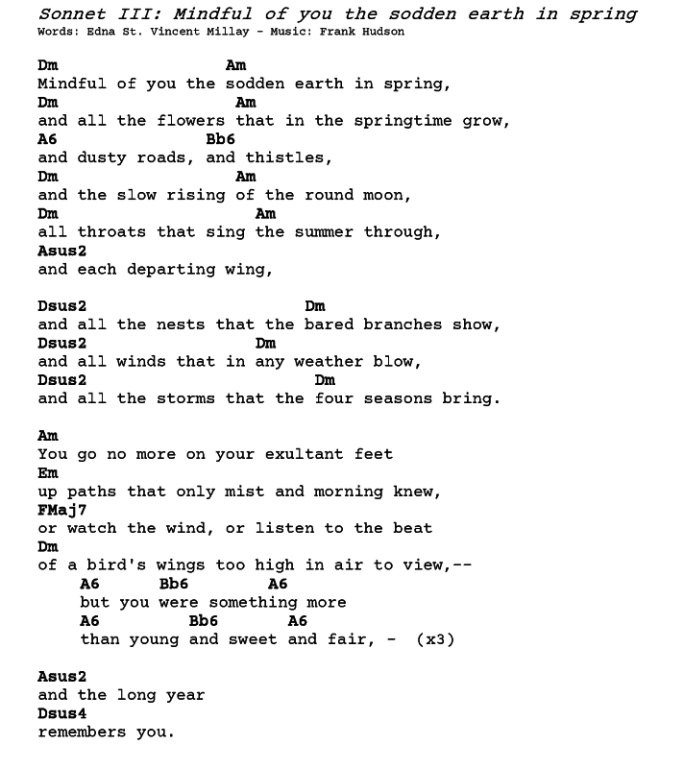
Dirge Without Music

I’ve worried a bit lately that I’ve been doing too many Parlando pieces presenting sad poems. It’s likely that mood is part of my nature despite living a life I’m grateful for — perhaps even more so because I live a life I’m grateful for, and I’m therefore aware of its temporary nature that I cannot keep. Because of this, I’ve kept a quote, a suggestion, from Kurt Vonnegut close to me:

I urge you to please notice when you are happy, and exclaim or murmur or think at some point, ‘If this isn’t nice, I don’t know what is.’”

Vonnegut wrote this in one of his last books, one that might again speak to my mood in this state of my nation and its ideals, A Man Without a Country.

At my age, it’s no longer morbid to think about death. This past weekend my wife and I went on a goth date, and visited one of the fancier local cemeteries. We mostly went for the 1910 main chapel building full of early 20th century William Morris/Pre-Raphaelite derivations which echo back to the start of the era I mine for a lot of the poetry here.*  The cemetery was taking part in a special open-house event held around the Twin Cities offering more access for the public to “behind the scenes” parts of the facilities.

We walked by famous early citizen’s gravesites, some elaborate with statues and such, and then too the many small vaults with names and dates on their file-cabinet sized faces. One room’s space was maximized with rows floor to ceiling across the room — so much like a library, even up to having a rolling metal staircase that would facilitate viewing the topmost. Instead of spines one views in those tall rows names, and partner’s names, and those bookend years. Every one of them, like every book I suppose, expects that there’s someone left to see and remember them, and I paused to consider that that wasn’t always so.

In another part of our tour, another portion of my nature was stoked. Walking by the cemetery’s crematorium, I noticed this homely implement hanging on the wall. As the old prayer book has it: ashes to ashes, dust to dust — and that passage now had a corollary: and dust to pan.

Dome and Dust Pan

Part of the main chapel: tiled mosaics, stained class, intricate motifs, capitol mottos. Crematorium: clean, professional, and an inexpensive hanging broom and plain white plastic dustpan, the same model as hangs in our home pantry.

.

Oh, it was a beautiful Spring day, full of decoration, full of evidence of grief, inscriptions of loss — and to the puritan, evidence of vanity. Life is so big, or so small, we must laugh at it.

Which brings us to today’s poem I’ve performed with music: Edna St. Vincent Millay’s “Dirge Without Music.”   I had finished this piece earlier this Spring, but at first held it back because I feared it was too much like some other musical pieces I was working on — and then after those coincident issues expired, I started to worry that it was too much-more sadness. Revisiting it this week, I now think no, it’s not just bleak — it’s a bald-faced statement of honest feelings about death and loss. Here’s a link to the full text of the poem.

In writing music and preforming this poem, am I disrespecting the author who titled her poem “…Without Music?”   I think Millay’s intent here was to speak against sentimentally decorating loss. Loss has patterns, resolutions, codas, and rests — and music too, even if it has repeat marks, has an ending measure — but music’s part of the equivalence is so often beautiful. In such ways fine poetic word-music, as well as that with express melodies, may speak over loss, interrupt it. Perhaps my rough-hewn voice with its limits and plainness, its lack of precise or elaborate lyricism, is apt for Millay’s mood here?

You can hear that musical performance of Millay’s poem with the audio player below. What if you see no player? That’s likely because some ways of reading this blog suppress showing it, but this alternative highlighted link will open a new tab with its own audio player.
.

*A few years back here I did a series on “before they were Modernists” with early poems by some Modernist figures. More than a few had roots in those retro-hipster movements of the late 19th century, and many a free-versifier had carried around a Swinburne volume in their youth.

Poem in Your Pocket: Counting Out Rhyme

I’ve been dealing out the civic poetry so far this American National Poetry Month, but for today’s Poem in Your Pocket Day here’s a charming poem by Edna St. Vincent Millay. If I understand Poem In Your Pocket correctly, its idea (as distinct from the entire Poetry Month) is to put emphasis on publicly sharing other people’s poetry. The rest of Poetry Month has a lot of examples of encouraging the writing of poetry oneself: poetry prompts, daily haiku writing pledges, poets putting forward their own work, and so on. That’s all fine—but this Project from its beginning has sought to go beyond the supply side to encourage the consumption of poetry. With the recorded musical versions we make here, there’s a modest hope of community in singing or speaking the poetry aloud. A song not heard is one of those trees-falling-in-an-uninhabited-forest things—whatever the result, it means to be a sound.  Now onto today’s poem, situated in a forest.

Counting-Out Rhyme

.

“Counting-Out Rhyme”  indicates with its title that it should be considered as that children’s game or process. As a game, a counting-out rhyme is a delineated incantation, each beat accompanied by a pointed indication around a group until the ending beat arrives and the final pointed-to individual is chosen. The most common folk poem in this manner in my childhood was “Eenie, Meanie, Miney, Moe.”*

I, having emigrated from the republic of childhood so long ago, have no idea if kids still use this process on playgrounds. From my more recent experience as a parent, modern younger children who would use it seem more supervised more often than my cohort, and responsible adults might be likely to select without rhymes. In my day, when the 20th century still had decades to run, kids just knew how this worked via the folk process.

Despite its title, as I worked with Millay’s poem I couldn’t really think she authored it for playground uses. Though not a long poem, it’s longer than it needs to be for selection, and the poem seems utterly beholden to its own, internal, incantatory powers. It picked up from the Imagists the flagrant naming of colors, decoration not needed for utility. I suspect Millay is remembering her own New England childhood here, much as E. E. Cumming was recalling his in his Spring poem, and the poem is rather more a magical spell, one meant to bring on Spring or bring one back to when the woodland sights of it were unprecedented and wonderous. It’s lovely word-music, and I heard it from off the page — and then played it in the musical version below — as a languid song, not the hurried rota of trying to make a quick, randomized choice.

In a week when chronological adults (whatever their maturity) are playing counting-out games with numbers that will empty or fill pockets and prisons, I share this poem from my pocket — not legal tender, but Spring tender. With the audio player below you can hear me perform this with 12-string guitar and sparse contributions from an ensemble of viola, violins, flute, clarinet, English horn, and silence. No player? You won’t need to find a wood-nymph to cast a spell, I provide this highlighted backup link that will open a new tab with its own audio player.

.

*In my experience from my times and place, the following line always included that dammed ethnic slur that makes the opening line of nonsense words almost offensive in anticipation. I noted in the Wikipedia article on that verse that the ethnic slur was an American variation, and there are multiple theories of the rhyme’s origin without it. I have no full accounting of the harm the slur brought by its childhood ubiquitousness — but I was somehow pleased to read as an aged adult that it was something the folk process added in America, and in order to form a more perfect playground republic, the same process can remove it.

The other similar selection process I recall from childhood was deciding which side would bat first in kids-run baseball games by alternating two kid’s hand-grasp up the length of the barrel of a bat until the final grasp topping the length was up first. Wouldn’t flipping a coin be faster? I’m not sure we had coins in our pockets back then.

Northern April

I wrote down this poem earlier in the year as a good fit for an April National Poetry Month piece. It’s author, Edna St. Vincent Millay, was from Maine, and I write from another northernmost American state, Minnesota. If a southern-born St. Louis boy like T. S. Eliot who went to live his life in temperate England wants to ironically write about April being the cruelest month, dryly riffing on the Middle English of a Chaucer’s pretty “Aprille with his shoures soote” — well, what with all the flowers and pleasant nourishing rain, that kind of puts a climatic brand on the month poetry-wise.

I rise with Millay to contradict: we have birdsong here, but it’s a more desperate, assertive song, not some celebratory strope — because it rained, sleeted, and concludingly snowed a sloppy wet mix all night and afternoon as I worked on completing today’s musical piece, and this morning everything — tree branches, overhead wires, yard fenceposts, garbage cans — had, to the very limits of toppling, piles of sticky snow as high as any booklover’s stack of unread books.

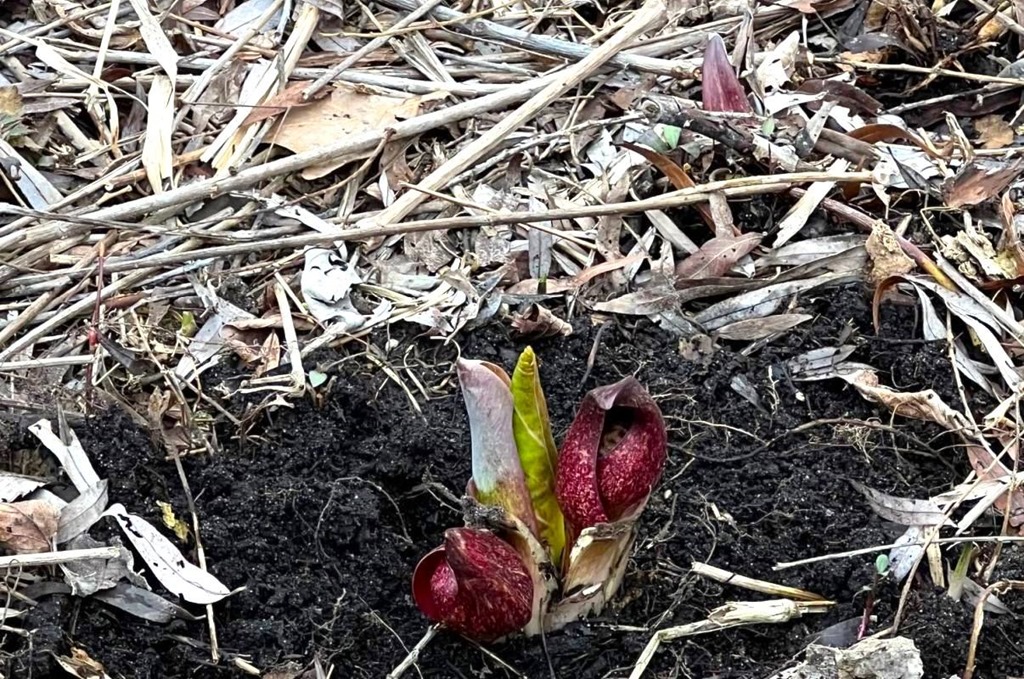
My nature loving wife took a European-born friend on a hike last week and showed the friend skunk-cabbage, a strange red, raw-meat looking early Spring plant that is exothermic — it creates its own heat like some huddled mammal so that it can bake through the snow cover. Nearer to home, indeed right next to the foundation, a small surviving clutch of tulips has sent up green leaves, but no buds yet. Their leaves course with some green antifreeze, as nighttime temps remain consistently below freezing.

Skunk Cabbage - Photo by Heidi Randen 800

“O April, full of blood, full of breath, have pity on us!”

.

My wife and I have varied memories of who planted the tulip bulbs. I remember it was my late father, long ago — while she thinks it was her mother more than a decade ago. There are only a few left. Brazen squirrels dig them up, or perhaps they are only perennial in the same sense that we are, bound to rise in many springs, but not forever.*

So, if the theme of this April’s Poetry Month is The Shared World, I certainly felt I was sharing the world within Millay’s poem “Northern April.”   The wind, the resonance of a creek with remaining ice, the just warm enough to be rain/rain. At least for me, in my northern clime, there’s a rich sensuousness in the poem, and enough word-music inherent in it to command me to sing it.

I’ve noticed that I haven’t used my 12-string guitars much this winter. They are a little more stout to play, and I think they show less forgiveness for my less-than-pristine technique, but I tried to plant today’s piece in the furrows dug between my limitations.

My music today makes use of a couple of instruments playing at the edge of their ranges. The bass guitar part is entirely played in the upper octave of the instrument, giving it an unusual sound I found I liked; and for a bit of melodic embellishment, I played an oboe line, again at the upper reaches of the instrument. Why an oboe? I thought of a 20th century band called Oregon who would mix 12-string guitar with reed/woodwind instruments, and I wanted to revisit that set of timbres from the composer/player side instead of from my listener’s memory.

You can hear my performance of Edna St. Vincent Millay’s “Northern April”  with the audio player gadget many will see below. Has no such gadget sprouted? I offer this alternative, a highlighted link that will open a new tab with its own audio player.

.

*I took leave from poetry and music to very briefly look at that issue from gardening knowledge. It appears that the bulbs shoot off other child bulbs, a process hidden in the dark underground in the later, non-flowering, part of the year. If so, appropriate for the idea that we think these spring flowers are from our parents.

Millay’s Thanksgiving

There’s a long tradition in poetry of civic poetry — poems not meant for an audience interested solely in the interior intimate experience of the poet, but speaking to larger, more public themes. I suspect modern poetry doesn’t do this mode directly much, even though some individualist poetry infers that purpose. American poetic Modernism began with an emphasis on the concrete, the thing specific: red wheelbarrow, ripples in a pool, a certain Chicago cat-fog, an exit on the Metro on a rainy day. Yet, a focused subject can still be an example that stands for more.

If the subject is small though, perhaps we poets expect our audience most often to be small too, compared to a variety of other, popular arts. But this was not always so. Longfellow and Whitman expected the nation to listen to their poems of democratic virtues. If the literary set eschew the mode, song-lyricists and non-literary poets will still assay it.

Just under four years ago, a poet Amanda Gorman who has written civic poetry, delivered a poem at the last U.S. Presidential inauguration, speaking of the nation’s fears, hopes, promises. The mode of the next Inauguration has changed. I’m not expecting poetry. Some will think, more-the-better — who wants a poet spouting off what I should think.

Why not, are they not citizens? What are the occupations that are allowed to speak?

Nearly 75 years ago. American poet Edna St. Vincent Millay wrote a long poem for the American holiday of Thanksgiving. She expected a good-sized audience: it was published in the Saturday Evening Post, a weekly general interest magazine, the one that often featured Norman Rockwell paintings on the cover, that claimed Ben Franklin as its founder.

Millay NFTG

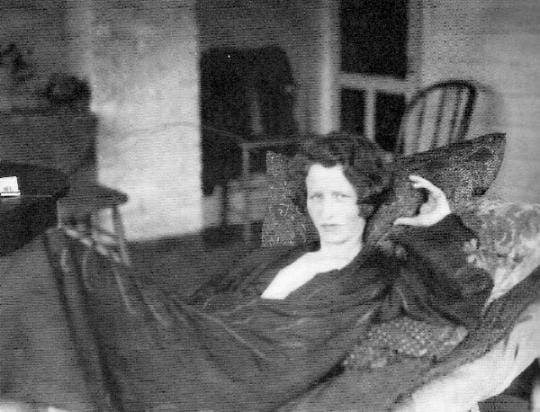
The most often used pictures of Millay show the young romantic adventurer. I’m also fond of this one that seems less all that. The poem which I perform excerpts from today was the last one she published before she died at age 58.

.

I’m sure there were specific things on Millay’s mind, geo-political, American issues. She writes five years after a war ended with two A-bombs. How long would be the peace? In 1950 there was another war going on overseas in Korea, there was a “Red Scare,” and to a large degree some deficiencies in American equality of opportunity were so far off to the side that too few even thought of them as political issues to address then. Millay didn’t cite any of that directly.

Instead, she wrote about how she thinks we, the citizenry, were feeling, assuming a general agreement that might be hard to gather today. Thanksgiving is a dual holiday occasion: it’s our harvest festival, a time to give thanks to what our work brought us, and it’s also a holiday to give thanks for what we’ve come through: it originated in a time of Civil War, and it commemorates the hardy survival of some early 17th century boat-people who landed without papers and survived on American shores. Millay’s Thanksgiving thoughts were more toward the latter than the former.

What will ring true in some American hearts this year will be her words of hopes dashed or at least deferred. Can one give thanks for having hopes that were unfulfilled? Can we at least forgive ourselves for hope? Her poem exists in that question. In the excerpts I performed today for this musically accompanied piece you can hear below, I focused on that sense, felt in my bones. “Cunning and guile persist; ferocity empowers” Millay writes. The lines that stand out for me as a Thanksgiving prayer this year are “Let us give thanks for the courage that was always ours; and pray for the wisdom which we never had.”

As civic prayer goes, that’s humble, but it has some bite in it.

You can hear my performance of portions from Millay’s “Thanksgiving…1950”  with the audio player below. The full poem’s text is at this link. No audio player gadget to be seen?  This highlighted link will open a new tab with its own audio player.

.

.

When the Year Grows Old

Here in Minnesota, the weather is turning, as it does at a time of its choosing in the Fall. Tomorrow morning the Fahrenheit temperature will be in the teens when I get up, and the forecast says single digits will greet me by Friday.

I began work on setting this poem by Edna St. Vincent Millay last week after seeing it at the Byron’s Muse blog. Two things grabbed me when I saw it: sitting there as silent words it begs to be sung, and it’s tantalizingly ambiguous.

This poem was from Millay’s first collection, published (1917) as Modernism was starting to find an audience in America. Americans in the last decade to be called The Twenties saw Millay as a Modern, though her prosody wasn’t like the free-versifiers, and her lyric’s narratives weren’t fragmented word-Cubism. So, a more comfortable Modernist to those whose expectations of poetry still flowed from the 19th century? Somewhat. Still, though not so much in her first book, but soon, Millay began to stand for The New Woman, a character that took up the prerogatives of independent thought, act, and agency in love and desire. A William Carlos Williams might have absorbed radical Modernist visions in Modern Art into prosody. A Carl Sandburg may have taken his Imagist eye and cast it toward workers and immigrants in his poems. But soon after this poem, Millay was using somewhat traditional verse to speak about female independence in life and desire. Cubism and Socialism were controversial, sure, but the kind of change Millay was covering in her poems was large in scope. Man Ray or Monet, Debs or Debussy, Pound or Reverdy — change was in the air — but as far as art such as poetry was concerned, the charge for change from women (and Afro-American artists) in the Last Twenties is a big deal, not something to shelve off as some sideline.

OK, so what does this early poem have to do with that? I’m not entirely certain. Yes, the overall scene of the poem is clear to any Northerner — but even as the poem starts the seemingly simple language has faceted surfaces. The poem is titled “When the Year Grows Old,”  but I’d suspect you might mistakenly remember it as “When the Year Grows Cold.”  It’s not just the rhyme, the poem is clearly about the weather getting colder, all the images intensify that. Intensities of anything old are not there directly at all. And then, I can’t say how idiomatic the opening statement (refrained at the end,) “I cannot but remember,” would be in 1917 — but it’s easy to read it (out loud, or in understanding) more than one way: “I will reflexively remember,” “I have only memory of this,” or even “I can’t do this, but I am forced to remember.”

And who’s the “she” in this poem? I had a thought in early-days with the poem it might be a pet, likely a housecat. Beside a generalized factor of love for warmth, cat owners might recognize the bird watching vocalizations — that, and a reference to “the warmth of fur” led me to that consideration. One reader’s reaction I read online this week thought “she” was a mother. I’m not sure of Millay’s mother’s (if that would be the mother here) characteristic feelings for tending a fire or even the specific kitchen task of making tea. My cursory non-scholarly thoughts are: not likely her happy place.*  Still, I could imagine that a general poetry reader in 1917 (like the Internet contemporary I came upon this week) could think that, or that the “she” is a friend of the poem’s speaker (which we might expect to be Millay), and so find this poem Millay’s predecessor to something like the young old Bob Dylan writing “Bob Dylan’s Dream”  about his remembering lost friends who’d once gather around a wood stove.

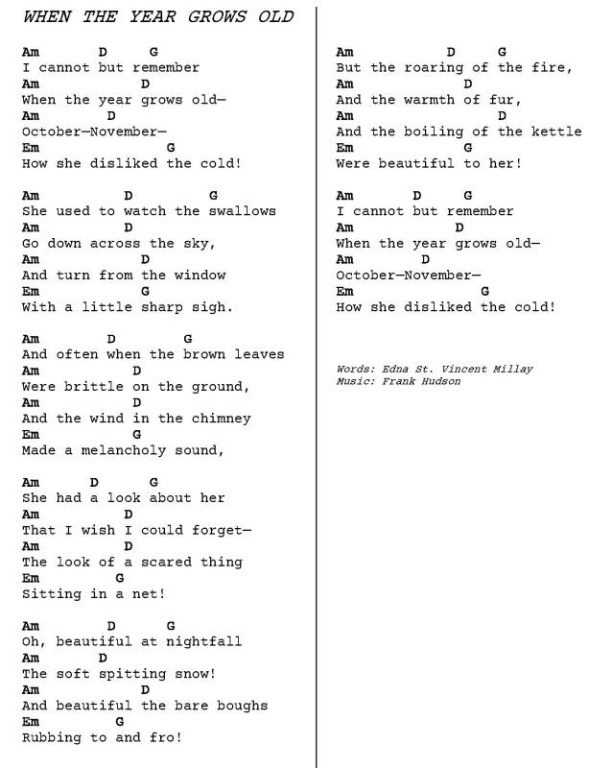
When the Year Grows Old

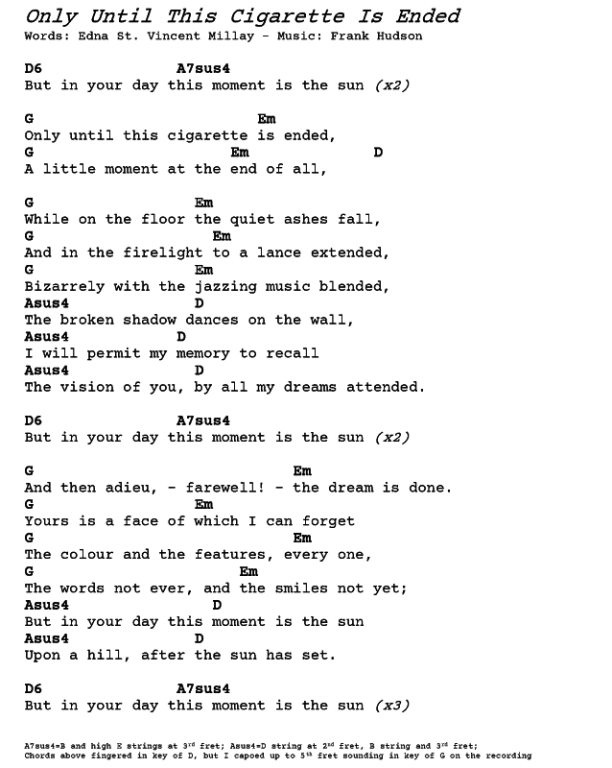
Simple chords for today’s piece, presented here as chord sheet  in case you’d like to sing it too.

.

Living with this poem as I set it to music and performed it, I came to think of it more at “Girl from the North Country” — a song about a lover who is longingly thought of lovingly, but who is now separated. By the time of the performance that you can hear below, that was how I was singing it. Why did I think that?

Partly from reading later Millay poetry, partly in biographic clues of Millay’s sexuality. There’s a definite undercurrent in the poem of the “she” feeling ambivalent: the sighing look at the flying birds, the melancholy chimney wind, and most directly in the abrupt “look of a scared thing/sitting in a net!” And what follows that line feels lustily sensual to me: those rubbing “bare boughs,” that fur by the fire verse.

That reading also answers the why the year being “old” is the title, not “cold,” other than just seeking variety. A once passionate attachment has been reconsidered by the other party, has grown old/cold.

Millay could have made other meanings (“cat lady,” “dear old mom.” etc,) clear with no commercial readership risks, but following my understanding, this presentation is coded so those who know will see that, and others will see a vaguer poem while recognizing late autumn weather. If I’ve misread it, or if Millay ever explained what she was intending — well, it wouldn’t be the first time — but it worked for me to find an experiential place to inhabit the poem.

You can hear my performance of Edna St. Vincent Millay’s “When the Year Grows Old”  with the audio player gadget below. No gadget? It’s nothing personal, just that some ways of viewing this blog suppress that. This highlighted link will open a new tab with its own audio player.
.

*As poetic testimony: tender as Robert Hayden’s well-loved poem “Those Winter Sundays”  is, it’s not a story of a parent finding happy beauty in loading up a household’s fire box.

Rejoicing Veins

Summer has event dates for me. Wedding anniversary for my living wife, death anniversary for my dead wife. In between, my birthday. A birthday has the same date on the calendar, but they change over the years in their nature. I can still recall the birthdays for singular digit ages, those massive markers toward becoming, achieving oneself. And then there are the rights-granting ages, 18 and 21; or certain decade mileposts, 30 and 50.

Now aged, the age number becomes hazy, defining less. A fair number of people who’d be my age aren’t, due to death. Most of my cohort have some collection of Marley’s Ghost chronic conditions, mild to significant. This is, after all, the portion of life that takes away things, slowly or all-at-once.

But it’s important to add to this calculation, life adds each day too. I’m celebrating my birthday today with my wife and a couple of friends. We’ll meet at an art museum’s restaurant. Everyone and I have not stopped breathing.

I celebrated my actual birthday by getting an ultrasound study of my aorta. My doctor suggested it since I had smoked in my twenties, and there’s some increased risk that this major artery can later swell and be at risk for a rupture, something that is in that all-at-once class of ageing events. Weird going through a test like the one when I first saw the shadow of my child, to know if I have a shadow of death inside me.*

To a degree not equaling my enjoyment of life right now with my little family and this Project, with still being able to hop on a bicycle and ride, with the ability to meet an instrument and come to an agreement on some music, I do have a sense of shadows. Multiple family members, all younger than me, have had some mild to more significant cognitive issues diagnosed this past year. Slowly or all-at-once — that’s birthdays, that’s aging. I’m enjoying the days slowly.

“Upon our couch we lay as lie the dead,/Sleeping away the unreturning time.” Go ahead Vincent, it’s OK to take a nap. It what you get done when you wake up that counts.

.

Today’s musical piece is my setting of a sonnet by Edna St. Vincent Millay. You can read the text of her poem here if you’d like at this link, and listen to my performance with the audio player below. I had a half-a-dozen beginnings/basic tracks of Parlando musical pieces sitting on my hard drive, and I selected this one mostly out of how near to being finished it seemed. Then as I set down to write today’s post — asking myself what I was thinking — I realized the poem expressed elements of my life this summer.

I remember when I presented my first Millay sonnet for this Project, years ago. I knocked her then for using too much archaic language and sentence order, an affliction her contemporary Modernists were seeking a cure for. “Rejoicing Veins”  is from later in Millay’s career, and by then the language in this one shows little of that fault. This is another poem that seems to me to speak accurately about old age, yet this was written by a 40-year-old poet. Vinny, that doesn’t seem so old to me, but you got it right!

There’s that graphical audio player now, or if you don’t see it, this highlighted link that will open a new tab with its own audio player.
.

*Test results? Everything looked fine. Rejoicing arteries?

Millay’s “The Little Ghost.” Does your garden have ghosts?

Last time in our Halloween Series, an A. E. Housman poem combined with music had death on a knife edge. Placed at the end of the growing year in northern places, Halloween comes at a time in a yearly cycle that suggests death. Note: that statement includes the word “cycle.” Humans have memory, and song, and eventually writing, so we know the turning round — the end of the growing comes before the white none of winter and before the regreening of spring.

Should it be so with death, that full nothing? Some hope and believe that so, though we can have no memory of that. But even one life has many turnings, places we pass through and leave. Today’s piece ends by portraying that we open and close gates of memory, gates that are no longer there.

Edna St. Vincent Millay wrote this poem of a non-threatening ghost. It’s an earlier work, and some see the ghost as a wisp of her not-long-departed girlhood. I’ll add that the choice of having the ghost appear in a garden speaks to the placement of Halloween in a harvest/leaving time of the year. Gardens have needs: nutritious soil, water, sun, and care. Perhaps they need ghosts from time to time as well?

The Little Ghost 1024

“She paused—then opened and passed through a gate that once was there.”

.

The music I composed and played for Millay’s “The Little Ghost”  shows South Asian influences, what with harmonium, tambura, and my vibrato note electric guitar playing. You can hear that combination of words and music with the audio player below. No player to be seen?  This highlighted link is an alternative, it’ll open a new tab with its own audio player.
Millay’s “Rosemary” for National Poetry Month

It’s my hope that some of you are newer people reading this as a result of my increased posting frequency and other activity during April’s National Poetry Month. If you’ve just found this: welcome! What we do here is combine words (usually poetry) with original music in varied styles, and then write about our encounters with those words and what we discover from performing them.

Since we’ve been doing this for 6 years and over 600 pieces, what we’ve been doing this Poetry Month has been to highlight some of my favorites from the first half of our Project. Since the composition, performing, and recording tasks are already done for these pieces, this has made the daily posts possible, but it has still been a lot of work at a time when life has made other calls on my time and concern. I’ll skip that story, but I want to take a moment to tell those other blog authors that I follow that I’ve been unable to read your posts for the past couple of weeks. I miss that, and I still intend to catch up.

Today’s piece is from a poem of love and respect lost by Edna St. Vincent Millay which is titled “Rosemary.”  As a lyric poem it’s somewhat mysterious in terms of time, place, and exact events. The opening verse’s rushes and bergamot have something of a house-cleaning feel to them. Rush stalks were used in place of rugs or other floor covering historically in homes as varied as Native American structures to European castles, and dried bergamot is fragrant and would be a nice way to make a place smell better, as is the herb rosemary, which may be the name of the speaker in the poem, and/or another way to freshen the smell of the house. Housekeeping is continued as a theme in the second verse. The final verse links back to the opening two lines, and I read it as a revelation that those tasks are being done out of duty and with a false-face of faithful servitude. After the final verse, those early fragrant herbs and fresh-straw-on-the-floor mentions now say something has gone off, is spoiled or rotten.

Millay on Chaise Lounge 3

I felt a contemporary link for dismay when I saw this picture of Millay “On a chaise lounge, on a chaise lounge, on a chaise lounge…”

.

Is the poem’s speaker a wife or partner in a cold relationship? Or possibly a servant? The poem’s “gentle sirs” in its next-to-last line indicates more than one master is being acknowledged, but I can’t eliminate the idea that it could be a spurned lover chiding a partner as if she’s now a servant.

I called this poem “mysterious” rather than “vague” largely because I find Millay’s word-music enticing. Another poem with the same matter, but without that extra factor, might merit that second term. In my performance I created a jaunty tune for this enigmatic but essentially sad story. That’s a common tactic in British Isles folk music, where you can have brisk tunes telling stories of unjust and sorrowful fates. The performance ensemble is a small acoustic band: drum set, bass, two acoustic guitars — but I’m a one-man band performing that in overdubs. Listening back on this several years later I admire that I was able to make it sound like a live take by an actual band. My musicianship has remained inconsistent throughout my life, but this one works, and is able to serve the composer (me), though I wish I was a better vocalist here and elsewhere.

The lyric video

.

Three ways to hear it: a player gadget below for some of you, and this backup highlighted link if you don’t see the player. And as I’ve done so far with all these re-releases of early Parlando Project performances, I’ve created a new lyric video that shows the full text of the poem above.

.

Summer 2021 Parlando Project Top Ten, numbers 7-5

Let’s continue or count-down to the most listened to and liked Parlando Project piece over the last summer. Today we move to the half-way point, numbers 7 through 5.

Wait, maybe you’re new here. Parlando Project — what’s that? Well, for a little over five years I’ve been presenting combinations of various words (mostly poetry) with original music. The words are mostly poetry not just because poetry has musical elements built into the form, but because I like compression of expression. Typical Parlando pieces are 2 to 5 minutes in length. You may notice that I’m generally not doing poetry written during your lifetime or even mine, and that’s not by choice. American copyright law puts up heavy barriers to reuse of copyrighted work; but on the good side I happen to like some of what went on in the first quarter of the 20th century, and so you’ll see a lot of work by the pioneering Modernists here. One of the benefits of this Project is that I’ve been rediscovering in public what they did to “make it new,” and finding some of their ideas worthy of being revived today.

What kind of music then? I like to think I vary that, composing and arranging for different instruments and sounds. Some pieces are just voice and acoustic guitar (my first instrument), some have fuller arrangements using orchestral instruments, and some pieces use an off-the-cuff rock band. And some pieces use instruments you don’t hear all that often in America, or synthesizer sounds created or modified for the composition.

7. Answer July by Emily Dickinson  We left off with Dickinson’s childhood classmate and “You should really publish your stuff Emily” friend Helen Hunt Jackson. So, it’s a natural segue to this piece that was a bit more popular last spring.

What was I saying about unusual instruments? The main motif in this one is played on a sitar, the South Asian instrument that had a short vogue in The Sixties. Some composers and musicians who encountered sitar took the rich musical heritage associated with it to heart and incorporated, and still incorporate, elements there into music played on other instruments, but unless one wants to invoke a “Don’t be late for the Human Be-In” soundtrack vibe, the sound of the sitar isn’t something Americans get to hear much now, but it’s still a beautiful sound.

I’ve never actually owned one of the complex and somewhat fiddly sitar instruments, though I’ve used more than one “electric sitar” approximation over the years. The practical compromise I’ve come to favor is to use MIDI “virtual instruments” where I can play my guitar with a MIDI pickup and the sounds that come out are decent approximations of the real acoustic instruments playing that note.

Dickinson’s poem I used here is one of my favorite expressions of the ineffability of the summer season, and it seems a lot of you agreed this summer. To hear it again, (or for the first time) you may see a player gadget below. No gadget? Then this highlighted hyperlink is another way to play it.

.

6. Over the Roofs the Honey-Coloured Moon by Bliss Carman.  I had fun last month riffing on some late 19th/early 20th century poets’ names, but Canadian poet Bliss Carman’s name easily equals Algernon Charles Swinburne in promising the most in Yellow Book Aestheticism of that period. His audaciousness in the collection that introduced this piece Sappho: One Hundred Lyrics  was to “Imagine each lost lyric [of ancient Greek poet Sappho] as [if] discovered, and then to translate it.”  The first part of that description, which hints at mediumship is outrageous enough, but even the second clause reminds me of my own audacity in avidly translating work from cultures and languages I’m not native or intimate with.

His synthetic results still have their attractions. Sappho — however real and in what particulars she was, thought, and created in her reality — hardly exists. We have but two or three mostly complete poems, and a scattered field of quotes and fragments. We have thick books binding up Shakespeare’s works, and facsimile editions of Emily Dickinson’s manuscripts with every alternative and scratched out word, and yet we reinvent those authors and their work every generation or so, using such ample literary evidence and fresh insight. Carman was more cavalier with Sappho, and the best historical studies and literary scholarship can point out what are likely errors or mere imagining in this man’s early 20th century Canadian Sappho — but Sappho was a lyric poet, and lyric poetry exists in charged moments that seem as present. Lyric love poets may lie, may often prove untrue even if they are sincere during their moments, but isn’t it also so that we may accept those momentary lies if they are beautiful enough?

The player below will let you listen to my performance of one of Bliss Carman’s imaginings of Sappho’s lyrics, or if you don’t see that player, imagine this highlighted hyperlink which will also play it.  Beautiful enough? You decide.

.

Dickinson-Carman-Millay Collars and Neckwear

Taken maybe 80 years apart, three poets, their collars and neckwear. Each have their mouths basically in a neutral state though Carman’s is somewhat downturned and Millay has just a hint of a knowing smile. Dickinson seems to be looking right into the colloidal silver on the plate and saying, “I know, I burn you.”

.

5. Recuerdo by Edna St. Vincent Millay  Speaking of lyric poets able to interrogate romance, let’s move on to Millay. Each of the bolded listings in this Top Ten is a hyperlink back to the original post when I discussed the work in somewhat greater length, and with this one I compared Millay’s impact in her time to Joni Mitchell 50 years later.

I also wrote about the ambiguity I sensed in the tale of the infatuated young couple and their interaction with the old woman on the ferry. In that reading the old woman is meant to stand, imagistically, for economic and social inequality coexisting in the romantic night within the last time we called a decade “The Twenties.”

Maybe I’m reading too much in this, but it’s as if a great portion of the whole of the novel The Great Gatsby  was condensed into this poem that I can sing in four minutes. Well perhaps the 20th century cared more for novelists than lyric poets, but both Fitzgerald and Millay went through a period before their deaths when they were down-rated and thought too tied to now irrelevant past decades. Fitzgerald got reassessed in the second half of the 20th century while Millay’s examination of society and literary value continued to languish. Now our own Twenties can find its own reading of that previous Twenties. Reading, or listening? Here’s my performance of Millay’s “Recuerdo”  available with the player gadget where present, or with this highlighted hyperlink where it isn’t.

Recuerdo, or we celebrate Joni Mitchell’s Blue with some Edna St. Vincent Millay

A longish one this time. I’ll try to make it worth your while.

In the places I go it has been hard to escape Joni Mitchell and the 50-year anniversary of her breakthrough record album Blue  this month. Mitchell is one of those artists like Emily Dickinson* or Thelonious Monk who people contemporaneously recognized as someone on the scene, someone whose work might appear at hand or gain mention — but then decades afterward the level of originality and importance of what they had done becomes more and more clear.

Mitchell’s Blue  wasn’t immediately recognized as a classic, successful statement. Musically it’s a bit odd, even by the eclectic field of 1971 recordings. Though “singer-songwriter”** was a growing genre at the time, most of them would present their songs in a full band context on record. Instead, Mitchell’s record is spare, often just her voice and one instrument — and sometimes the instrument is a mountain dulcimer at that! She often used her voice unusually, with quick almost yodeling leaps in service of the originality in her melodic contours, and this was off-putting to some. One thing I remember about listening to Joni Mitchell LPs back in my youth was that the amount of volume in her upper register would rattle the plastic frame and enclosures of my tiny portable stereo’s speakers, producing a very unpleasant buzzing distortion.

To the degree that she was noticed in 1971, that she could be a figure who’s fame might outreach her record sales or rock critic esteem — it wasn’t just that she was a successful songwriter for others who could round-off her corners just a bit to present “Clouds (Both Sides Now),” “Woodstock,”  or “The Circle Game”  to a wider audience than their author could — it was because she was known as (this gets complicated, stay with me here) as the “girlfriend” of a lot of male rock stars. This got joked about. The now infamous Rolling Stone “Old Lady*** of the Year Award” in 1971, or a joke picture of a purported Joni Mitchell LP with a song listing of: 1. Crosby, 2. Stills, 3. Nash, 4. And Young.

Do those of my generation remember that? Did you laugh? I did. That’s part of the complication, but then I believe sex is only funny when you’re risking doing it “wrong” — and it is best if it’s funny some of the time. Dead serious and entirely secret? We might as well sign up for Brave New World  industrial reproduction or efficient devices shipped in plain brown wrappers.

That said, now-a-days that 1971 behavior toward Mitchell is now viewed as belittling and a case-study in patriarchal attitudes in the “counter-culture.” Which it was. In the era’s defense I’ll say that the times were groping (should I revise that word?) toward an imperfect but different attitude toward sexual relationships. Just exactly what women would have to say about this wasn’t the first or second thing on the official list of speakers, alas.

It just so happens that Mitchell spoke up anyway, and mixed that with a kind of music which might have seemed just a bit odd or imperfect then, but now is seen as effective, important, and original.

And now it’s time to play Frank’s favorite history game. Folks are thinking about Joni Mitchell and 1971’s Blue  here in 2021, but what could we see if we rebound off that 1971 time and look back 50 years from then?

Millay-Mitchell

Well, they do tilt their berets the opposite way. Edna St. Vincent Millay and Joni Mitchell

.

The poetry fans who are still with this post were wondering when I’d get to Edna St. Vincent Millay. In 1921 Millay had broken out as a young poet to watch, partly by that “being on the scene” presence in New York City in the era around and just after WWI, and by famously losing a poetry contest with a poem that many (including the contest’s winner) thought was the best of the lot. That poem was then featured in her debut book-length collection, and now it was time for the “difficult second album.” She planned that second collection to be what was to eventually become her book: Second April,  a title that suggested that plan. But she was having trouble with her publisher, and eventually another collection came out ahead of it, just as the 1920’s began to roar: A Few Figs from Thistles.****   It’s a fair analogy: that book was Millay’s Blue. And like Mitchell’s Blue  people noticed the author’s public persona not just the poetry. Millay became the exemplar of “The New Woman” of the 1920s, who were sometimes finding patriarchal marriage a doubtful institution, and flaunting disregard for traditional arguments financial and domestic for that. Speaking openly about erotic feelings. Creating their own art rather than settling for standby muse duties.

I’m not sure if even an incomplete list of Millay’s lovers was known to a general poetry reading public 100 years ago, and one can’t quite imagine Poetry  magazine naming Millay “The Old Lady of 1921,” but the persona in A Few Figs from Thistles  gave us that adventurer in love character that makes Millay and Mitchell echoing artists. But the original edition was a thin volume, chapbook length, and from things I’ve read this week it seems that Millay worried that it wasn’t substantial enough while Second April’s  publication faced continued delays. A second version of A Few Figs from Thistles  was hurriedly planned and issued, and some of the additions were standout poems in the collection as we now know it, such as the one I use for today’s audio piece: “Recuerdo.”   Here’s a link to the full text of that poem if you’d like to follow along.

In her heyday of the 1920s Millay’s Modernist milieu and outlook wasn’t always reflected in her poetic diction. This may have helped her readership who were not yet used to, or appreciative of, free verse or other experiments in expression. Robert Frost or William Butler Yeats would also retain a poetry audience in this time with lovely metrical verse that expressed the modern condition, but Millay was (to my mind) not consistently as facile with metrical verse and more often fell back to fusty 19th century syntax and language,***** but she could also rise above those limitations. “Recuerdo” is an example of that. It has an effective refrain expressing two contradictory and relatable emotions: “tired” and “merry.” Those emotional words are contained solely within the refrain. The rest of the poem progresses in the Modernist/Imagist style: things and events are described out of order, and in a common Modernist trope in a mixture of tones and importance. How many love poems include a phrase like “smelled like a stable?” Yes, this is largely a love poem — why it even touches on the aubade formula of the pair’s night being interrupted by the dawn — but look again: love (or sexual desire) as a word or even as a direct description is not mentioned once! Yet many readers can sense and feel the limerence of erotic love all through the poem intensely. That is  there in this objective and fragmented depiction. Remarkable!

But that absence does allow for some ambiguity. Is there some level of inconsequential going-through-the-motions experience available in a reading of this poem? Or at least some sense of transience in the experience, which after all is framed by the title which means memory in Spanish? I think that’s accessible there too. Suppose I was to present this poem by inventing a frame that imagines it was written by two drug-addled addicts hooking up for one night and to say that that emotion word “merry” in the refrain has some archaic meanings that are congruent with “high.” Same words, different effect in that frame. Or if the same poem was written with a title like “How I Met your Father.”

We do have one clue to Millay’s intent. There is an extant recording of the author reading this poem, and though it’s not very dramatic, it hints at a bit of ironic distance on the events in the poem, a sense of noting the paradoxical koan of memorable inconsequence.

Perhaps I overthink things, but the last stanza with the donation of fruit to the older woman who responds with words of gratitude was rich in ambiguity to me as well. An act of Christian charity, mixed in Modernistically with other random events and sights? Seems likely, but if I’m traipsing around tired and tipsy with my night’s hot flame and somehow, someway we’re carrying two dozen minus two each of apples and pears, their value isn’t exactly gold, frankincense, and myrrh. Is the older woman’s “God bless you” a simple expression of thanks or an implied suggestion that maybe the two younger lovers might want to kick in some spare change, which they consequently provide? Given the push-pull of political radicalism and romance in Millay’s work, can we be sure she doesn’t intend to portray something of the limits of the gesture to the old woman?

How many are thinking then that I’m an unromantic old cynic who has misunderstood and harmed this poem? Is there another group that says I’m not straightforward in my social and political analysis of the situation? Well, my fate is to be doomed to be in both states alternately and sometimes at once. That’s why I like this poem.

One knock against Millay and other New Woman poets of her time once the peak of her fresh fame wore off was that she wrote love poems, not statements about the important, complex issues facing us. Fifty years later, one knock about Joni Mitchell was that she was writing songs about two little people who don’t amount to a hill of beans in this crazy world. Both of those summary beliefs are incorrect — but then, what is it you are saying: love songs are simple?

Maybe for you. Not for all of us.

The player gadget to hear my performance of Edna St Vincent Millay’s “Recuerdo”  will appear below for some of you. No player to be seen? Then this highlighted hyperlink will open a new tab window and play it. My music today isn’t very Joni Mitchell-ish (though later Mitchell, much past Blue,  was a bit into synths). The vocal turned out to be a “scratch track” I kept because it seemed usefully spontaneous, even though I omit a few words in the poem’s text inadvertently.

.

*Dickinson wrote much of her work in the 1860s, and a small group of people knew of some of it though almost nothing was published in her lifetime. I speak here of the Dickinson that existed at the turn of the century after several volumes of her poetry with regularizing edits had been issued. Today she’s taught as one of the great American poets. Back when I was in school she was a charming slight oddity that seemed to fit in with some of the small, short poems the Imagists/Modernists produced in Millay’s time.

**Years ago I wrote a humor piece where I called this 1970’s trend “Singer Sewing-Machine” artists because so much of their ethos had airs of “back to the land/rent a house in Laurel Canyon/sew hippy blouses and embroidered patches on your jeans.”

*** “Old lady” and “Old man” as in “My old lady” were usages borrowed from what were the old-fashioned/outdated terms for wedded partners. Used in the more fluid arrangements by young people in the mid-20th century counter-culture they were supposed to be ironic statements of: partnership at least for now. Mitchell’s song on Blue “My Old Man”  is an encapsulation of that moment.

****Back when I first presented a poem from that collection that so many of you liked this spring,“First Fig,” I was unaware of the origin of that book’s title. I wonder if my father who memorized Millay’s short poem but also studied to become a Christian minister in the Millay era would have known that Millay’s book title is from Jesus’ words in Matthew.

*****Her admirers can parse this as a Modernist use of older “ready-mades” which are being modified in the context of her 20th century verse.