At the Threshold: marvels with French on sky-blue waters

We’re going to travel to one of the best short poems that late 19th century American poet Richard Hovey ever wrote, a strange poem about approaching death, a place far or near, with no trusty mileposts. As I like to do, we’re going in a round-about way. Let’s start with a blue lake.

I can remember what a wonder it was. My father and his youngest brother loved to fish on lakes, and in search of ever more pure sport-fishing beyond the sky-blue waters of northern Minnesota, they took to traveling up further into Ontario Canada. I was maybe 10 or 11, still at an age when I was open to whatever my parents led me toward. We stayed at a family-owned fishing lodge at the end of a gravel road outside of Reddit. A few small, well-kept cabins, a couple of outhouses, and a lake-dock — which was all the two brothers needed, as the day was mostly spent out fishing.

As I said, I was accepting of this. I gamely came along, earnestly operating a rod and reel, waiting, sensing for any piscatorial tugs on the line, listening to the two men occasionally talking about what fishing tactics were most promising. My youngest uncle, maybe 18 or 19, had been about my age when their father died, and my father now served as his younger brother’s father-figure. I was unaware then that more than lures and casting targets was in their talk.

I was never bored. I had a vast imagination when young, and could sit quietly daydreaming stories and ideas in my head for hours. I suspect a good poet would have been more observing of the boundless nature around me; and while I watched and listened to my dad and uncle some, they were too commonplace for me to treasure.

Instead, here is what I recall being fascinated by: I was in another country, Canada, subject to its laws, and a Queen, a governmental oddity that seemed a little out of time to me. A gallon wasn’t even the same gallon there, nor a dollar exactly a dollar! The lodge owning family and everyone we met in Canada spoke English of course, but since my imaginative and book-minded mind lived in words, I was amazed that all the groceries we picked up in Kenora on our way up had bilingual labels including French.

I was as if I had found the Rosetta stone all by myself. As a native Iowan, I already had a passing place-name experience with French from my state’s then 160 year past life as a French possession, but here in Canada a box of Wheaties or a carton of milk could be held inside other words. So, later in high school and in my truncated college studies, I selected French as my foreign language.

I was terrible at it as a school subject. I did OK (not outstanding) in basic vocabulary. I was passable in recalling the tenses and such. I accepted the arbitrary gendering of nouns. But my mouth stumbled entirely in the speaking of French, so obtusely bad at speaking it that I strongly suspect it is something in my neurological wiring. That I persisted with French as I entered college was at least in part because I was learning that French poetry had been so interactive with English language poetry, particularly in the formation of Modernism.*

After my formal education ended, I continued translating French poetry, not by any right of fluency, as I’ve confessed above, but because I wanted to bask in the secret sauce that helped form Modernism.

Richard Hovey seems to have been greatly enamored of what was modern French poetry to him. His published work includes translations of Verlaine, Maeterlinck, and Mallarmé. While going through his published work this summer I came upon this sonnet “Au Seuil,”  in French, dated as having been written in 1898. When I translated it, I found this graceful consideration of dying and some possible judgement and afterlife which I present to you in English today. As an old person, dying no longer requires any heroic situation, acute illness, or grandiose gothic stance to make such consideration apt for me. It’s a matter of petty logistics now.**

At the Threshold as published in French

The poem as published posthumously in a collection by the Vagabondia co-author titled “To the End of the Trail.”

At the Threshold

My translation, presented here as a chord sheet for the musical performance you can hear below. In performance I refrained the final line of the sonnet as shown here.

.

Was today’s poem written by an old man, or a young man staring down a deadly disease? No, Hovey was 34 years old, likely in vigorous health. Still, in less than two years he’d be dead, dying during a routine operation for something as unromantic as a varicocele. One can only wonder how he would have coped with the upcoming English poetic Modernism that would be sparked in part by French writers he admired.

Though subject to my language limitations, today’s poem to song turned out to be a relatively straightforward and faithful translation — with one exception. My usual poetry translation tactic is to primarily find the images in the poem and work at carrying them over vividly to English. I strive to have a non-creaky, natural syntax and word choice in the target language, and to make from that a poem in modern English word-music rather than trying to mimic the prosody of the poem’s native language. What was that one exception? In the poem’s 13th line, “ Qui nous benira de ses grands yeux bleus,” there’s an image I think.***  It could be that Hovey intends a witty little aside about a Nordic male god-in-heaven sitting on a throne of judgement, the cliché being then his point. As I worked on this line I wanted the possibility, however unexpected and wishful, of something universally marvelous. I dropped the andromorphic gendered pronoun as more than unnecessary, and then perhaps unconsciously recalling the poetry of the first-nations name for my current home-state of Minnesota, made the apprehending eyes more than humanly large.****

You can hear my musical performance of what is now an English language poem with the audio player gadget below. No player seen?  This highlighted link is the alternative, and it’ll open a new tab with its own audio player.

*Oddly it wasn’t Spanish poetry. In England we can assign this to not forgiving the Armada and all that — but large portions of the United States had been Spanish possessions after all. And while Canada’s French is spoken regionally, Spanish is the predominate language across our equally large southern border and in the American commonwealth of Puerto Rico.

**For example: when I replaced two bicycles stolen early this summer, ones I’d ridden for 20 and 40 years, I wondered at the return-on-investment of spending like-amounts in current market prices to replace them. My favorite old-person’s joke is that when someone offers me a lifetime guarantee, I ask if there’s a better offer.

***Literal: “Who will bless us with his big blue eyes.”

****Lakota compound word for the place of sky-reflecting-waters. And there I have returned to that boat with my father and his youngest brother, as Hovey wrote in a different language: “we know this hidden way/as one knows the ghost of a dead friend.”

The Doomed regard the Sunrise

Here’s another example of a short Emily Dickinson poem that seems in some facets simple, and yet when examined more closely still shows her uniqueness. On first reading it reminded me of a saying attributed to Benjamin Franklin* “Nothing concentrates the mind like the prospect of being hanged at dawn.”

One might read this poem from the start as a restatement of that Franklin quote — except, Dickinson may be saying this isn’t someone’s last day, she wants to set down the situation someone’s next-to-last day. In the first stanza, it is sunrise, and the poem says that the doomed person has delight. Why? Because there is one more day before their death at the dawn.

Doomed regard the Sunrise

Chord sheet in case you’d like to sing this one yourself.

.

This idea is clearer in the second stanza, where again, death is clearly due — but tomorrow. There the doomed man is listening for the bird that will likely sing at the next dawn. Perhaps he’s listening to the Meadow bird in the day-before dawn more intently, knowing the next time he hears that song it will be his execution, and this is his last day to hear it in the more generally hopeful context of introducing a day, not an execution. He might choose this — after all, if he knows he’s to die tomorrow, he can be somewhat assured he will not die in that present day as the bird sings the day to begin.

The final stanza may be the oddest, but indicates that this is so. It twice tells us the mood is joyful, which would indicate that the condemned does feel assured of, and is in love with, this day — the full day before. There’s a somewhat ambiguous word-choice in the last line: “ought.” The word can be a stand-in for zero, for nothing, but it’s primary meaning is more at obligated. If we take the zero/ought meaning, or the obligated meaning, Dickinson’s poem is saying the poems doomed subject is joyful though the next-to-last morning Meadow bird has a duty to sing nothing but elegy, because the poem’s subject will accept the day with joy.

So, this is goth-mode Emily with death certain, but this is also certainly the day before  the last day.

Musically I had to throw this one together quickly, but it came out OK. Though in a minor key it’s somewhat jaunty. You can hear it with the graphical player below, or if the Meadow bird’s audio player isn’t visible, you can use this highlighted link that will open a new tab with its own audio player.

.

*There’s a similar quote attributed to Samuel Johnson, and there’s this later extension authored by Terry Pratchett “They say that the prospect of being hanged in the morning concentrates a man’s mind wonderfully; unfortunately, what the mind inevitably concentrates on is that, in the morning, it will be in a body that is going to be hanged.”

Lightly, from Aldus Huxley’s novel “Island”

Death is a funny thing, mainly because dying is treated so damn serious. Have you ever asked yourself this: are you afraid of death or are you afraid of dying? If you answer, “Well I’m afraid of death.” I ask you to further question yourself. Non-existence is easy, a gimmie, a non-task. Dying on the other hand? You can fear pain, suffering. You can fear what is left unremedied, unfinished, left undone. One can fear you will not do it well. That you will show too much or not enough emotion. You can fear you will do it too slow and draw out suffering — or have it happen too fast before one can set an agenda for the occasion.

This weekend is the anniversary of the official launch of the Parlando Project in 2016. This weekend is also the anniversary of my late wife’s death decades ago. Last weekend I learned that a poet/blogger who I’ve followed through much of the seven years of working on the Parlando Project has received one of those months-to-live diagnoses.*

In-between those weekends, someone posted the text I’m going to present today by Aldous Huxley. Here’s a link to where I saw it. The poster knew it as if it was a poem titled “Island.”   Instead, it’s a passage from Huxley’s last book, a novel called Island.  In using this as text I decided to call this short excerpt after a repeated invocation in the passage: “Lightly.”

I’m not very well-read when it comes to novels, but as a teenager I read Huxley’s best-known book Brave New World.  I loved the SF world-building of it even if I likely missed good portions of the satire at that young age. After that I tackled Island  as well, promoted on the paperback cover as an updated companion to Brave New World.  I don’t recall much about Island,  certainly not this passage. What could I remember? That Island  had a bunch of ideas to present, but since I read it so long ago and so young, I retained nothing else. Looking at synopsis’s online this week, it appears that Huxley was trying to synthesize a long fascination with Asian spirituality and philosophy and apply that to his contemporary mid-20th century Western world.

Island cover

I think this is the edition I read as a teenager

.

Today I was able to look at a copy of Huxley’s novel, and the passage, presented as I first saw it in broken lines as if it was free verse, is indeed a block of prose within it. I said Island  was Huxley’s last novel. He died of cancer a year after it was published.**   I don’t know if Huxley had received one of those “months left” estimates as he worked on Island,  but the passage spoken by a character in his final book could be the author speaking from, or to, himself —  a reminder of how he felt he should approach dying.

In the book it’s spoken to a woman who is dying, attended by her husband and family. As I read the larger section the excerpt was from, I thought of being beside my late wife as she was dying. Yes, in essence, the teenage me with my youthful experience, could not have read the same book.

I was only able to do that reading for context this afternoon, a day after I had already completed the new audio piece. Maybe that’s of little matter. After all, even shorn of context as I saw it online, it immediately resonated this week with my thoughts for my distant faintly-colleague. Perhaps you will find resonance as you hear it too.***

I made a couple small alterations to the excerpt to generalize it. Then I composed the music for it on acoustic guitar, playing that instrument in a somewhat pianistic style,**** and then combined the two in the performance you can hear using the graphical audio player below. No visible player? This highlighted link will open a new tab with its own audio player.

.

*This poet and blogger, Robert Okaji, has been mentioned elsewhere here in the Parlando Project blog. Besides being a fine poet in general, Okaji helped me by example and brief comment to continue developing my penchant for freely translating classical Chinese poetry, something he also did. Sometimes we would adapt the same poems from the same literal glosses, producing two facets, two impressions, of the Tang Dynasty masters. I never met Okaji, though I’m glad I got to see him read his work online once during the pandemic.

Here’s a link to his graceful announcement of his diagnosis.  Wishing you the best living Robert: lightly.

**A darkly comic touch to Huxley’s death. His fame from Brave New World  was still considerable in the Sixties. After all, in many ways, his book was more relevant to the US/British culture in that era than its quasi-competitor 1984.  Another late work of his, The Doors of Perception about the benefits of psychedelic drugs (also a subplot in Island)  was a pioneering examination of that idea — and the source for a Californian rock band’s name a few years later. But instead of Huxley getting the few days of reassessment that would normally have attended his death, he got bupkis. You see, he died on November 22nd, 1963, the day the American President was assassinated. The world’s news-hole was filled with non-literary matters.

***As it turns out, this excerpt has been shared numerous times that I found when I searched for information about the words this week. Sometimes the passage retains its prose layout, other times it’s presented as if it is a poem. A small point, but most of the online quotes have slight wording differences from what I saw in a 1975 edition of the book I looked at today.

****By using the whole neck of the guitar and alternate tunings, one can expand the pitch and timbral range of the acoustic guitar beyond that of the more folk-song style pieces I present here otherwise.

Oh, Maria

Here’s my performance of another poem from Irish-American poet Ethna McKiernan’s final collection Light Rolling Slowly Backwards.  In McKiernan’s later years of life she did social work with people who were homeless, and she dedicated Light Rolling Slowly Backwards  to “the hundreds of homeless clients I’ve worked with through the years — to their resilience, courage and care for each other.” Given that Ethna was somewhat frail even before her final illness, I marveled at her strength in taking that work on.

I recommend this collection, a fine summation of McKiernan’s poetry and its range. Here’s that link again to the Irish publisher of this book.

Why this one to start reading McKiernan? She herself created this “New & Selected Poems” book before she died late last year.

.

When I first encountered “Oh, Maria”  in draft form as a member of the Lake Street Writers’ Group I couldn’t help but flashback to my time working in Emergency Departments as a young man. As one side-point Ethna’s poem tries to convey the feeling of being next to someone experiencing a sudden, and unexpected death. I’d summarize those memories of mine as being full of intense experience, intent action, and if stabilization isn’t achieved, a solemn ceasing. Ethna’s account adds poignancy because it’s missing that middle part. I ached with her both as she feels guilt for not immediately recognizing the mortal nature of Maria’s incident — and then comes the line as she considers if she should have performed CPR: “If I remembered, God help me, how.”

I probably did my usual awkwardness in responding to that first hearing, perhaps mentioning how it reminded me of my experiences — something which was likely no help in her revision process. I think I did express that her missing the initial diagnosis of what was happening was not only forgivable, but par for the course. Could that have been worthwhile?

Indeed, my experience was that most people, even people who are otherwise medically trained, are likely to get this wrong in some way. Although my experience is now decades ago, I’ve seen CPR being performed on breathing people with a pulse — which is not a good thing. And effective CPR requires a degree of skill and frankly cold intent that is hard to practice outside of repeated actual events. Given that I last worked in an Emergency Department more than 30 years ago, and last went through the practice-with-dummies certification around a dozen years ago, I myself would likely not be the best person to be next to you if you were to experience a cardiac arrest.

If you ever take, or have taken CPR training, pay attention to that first step of assessment.   It’s important.*

So, besides the imperfectly empathic personal reaction I had, this poem’s core matter is Ethna’s continued sharing of the experience of those without homes, which exceeds even my old ER experience with our un or underhoused “regulars.” Notice the subtle point Ethna weaves into this poem: she expects that Maria is severely intoxicated when she collapses, and then she concludes her memories of this person dealing with complex problems imperfectly in the telling line “I laughed at your antics weekly.” What were the antics? Maria might have had a sense of humor, that could be part of it. It’s also possible, even probable, that Maria’s human attempts to deal with the difficult state of homelessness and its context were at times comically imperfect or ineffective.**   Ethna knows this from her intimacy with Maria, just as you know it with those you have in your lives. Intimacy isn’t just the experience of joyous connection, it’s the experience of our misapprehensions too.

Same with poetry. We write it imperfectly, read it imperfectly. That is part of our human experience of it.

To hear my performance of Ethna McKiernan’s “Oh, Maria”  you can use a player gadget if you see it below, or this highlighted hyperlink which will work if you don’t see the player.

.

*Several decades ago a book called The House of God  by Samuel Shem was written that was like unto a modern Machiavelli’s The Prince,  only about practical hospital medical training instead of statecraft. In Shem’s book there is a list of “laws,” one of which is “At a cardiac arrest, the first procedure is to take your own pulse.”

**Dealing with homelessness either as one who has reached that state or, as McKiernan did, as someone trying to mitigate it, is much more difficult than dealing with cardiac arrest. In my couple of decades in Emergency Rooms, I’ll admit that in the course of a shift or two dealing with intractable problems and complexly impossible situations, the “break” of dealing with a crash-cart severe trauma case or a cardiac arrest with their steps of immediate choose/act instants was, strange as it might seem, a relief.

The Final Minute

Patience appreciated reader. You know we sometimes start one place here and then teleport to somewhere else near the end.

The NBA finals concluded last night, settling for this year the championship of the world’s premier basketball league. Best as I can tell, there’s not a lot of sports-fan overlap here, and to be honest my sports interests atrophied by the time I reached middle age to the point that it’s mostly a skimming of the sports news.

Still while researching something else last night I noticed a live-updating article on a news site for the finals game in its last quarter. I opened a tab in my browser, and in between reading other links germane to my research, checked back on how it was going.

A tied and then two-point, one-possession game eventually entered its final minute, and around there the Milwaukee team, possession by possession, started to assure its win. Even though it is a business, and even though the losers will get paid too, these moments in sports still build into an Aristotelian Poetics agony. One side is partly hoping no one screws up the increasing likelihood; the other side increasingly knows hopelessness. Compounding this, the obligatory strategies of the game mean the endgame is prolonged with timeouts for court position and play caretaking, and desperate, clock-stopping intentional fouls.

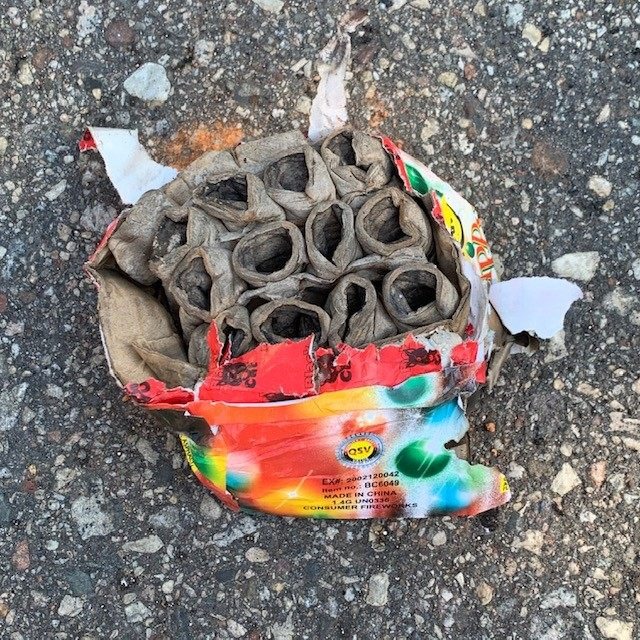
Fireworks spent

July remains of bang, light, spent.

.

And so, patient reader, it was then, as we continue our summer death, infirmities, and transformation tour here at the Parlando Project, that I thought of this song by Dave Moore that we had performed over a decade ago. Things sticking in memory is one test of artistic validity, and out of hundreds of different songs that Dave and I have performed since then, to recall this one seemed meaningful.

When I dug it out and listened to it this morning, I heard its infirmities: a simple rhythm-machine beat, Dave misses some intended notes in the vocal, my guitar part is not much. The combo organ sound that Dave uses is not hip or fashionable. But still, I think the piece did more than charm my memory. Near the end, Dave lets out a quatrain that still says something about our lives, about infirmities and death:

“You can’t make this up.
It makes up itself.
You can’t make it be
more than anything else.”

We all have our lies, our lives, our arts. We strive, and then someday, strived, to make them. Two out of the three are artificial, and yet from that we still try to discover truth. In the end, death makes up itself. Funny game.

A player gadget will appear for some of you to play this performance of Dave Moore’s “The Final Minute.”   If you don’t see it, this highlighted hyperlink is another way to hear it.

Winter Sleep

What age are we when we write poetry? What age should we be?

Poet Donald Hall while writing memoir in essay form after age 80 said that part of why he turned to prose was that after a certain age he no longer felt he had the urge to, or could, write poetry. I’m not that old yet, but after so many decades of writing poems I’m more likely to ask myself why this poem needs to exist.

This never occurred to me as a younger writer. It was enough that the urge was there, that the work of shaping it was rewarding, that the existence of some new set of words in some novel order representing a moment of experience had occurred. There are times when we may suppose this always is—at least approximately. We’re all our own first reader. For some of us, some of the time, our only readers. Even if we believe we’re writing a poem for someone else, that first audience is still inevitably connected with the poem’s creator.

I don’t know that there’s any pattern in that first audience disliking its own poem at times. Does one get better at crafting poems or observing experience with time? Does one get better at staying out of the way of the poem when that’s necessary? Does one get more preceptive at the ways the poem fails to meet, or cannot meet, some more perfect state? Does one just realize that some days you eat the bear, and other days the bear eats you?

A couple of years back I had some fun looking at a compiled list of the 20 most anthologized American poems of the modern era. Now of course such a list reflects any number of factors, some of which are extra-literary, such as prejudices, impact, and probably even some ivy-tower log-rolling. But still, these poems can safely be considered as successful with an experienced audience early in our century.

One thing surprised me. About half of these poems, the ones that are presumed to reflect the author’s masterpieces, were written in the author’s 40s. Six more were written in the author’s 30s. Just one was written by a writer past 50 (Elizabeth Bishop’s “One Art” published when the writer was 65). Only two were written by writer’s in their 20s (the list’s youngster was T. S. Eliot’s “Prufrock”,  completed when the author was 27.)

But how old were these poets in their souls of experience, the place from where they wrote these poems? It’s not unusual for younger poets to take on the air of more experienced people in their poems. This past fall we presented a couple of well-known and liked poems considered to be about old age: Rilke’s “Autumn Day”  and Shakespeare’s Sonnet 73 “Bare Ruined Choirs.”  Rilke wrote his autumn of one’s years poem in his 20s, Shakespeare’s was penned in his 30s.

Yet neither sounds false to this older reader.

Similarly, there are times when I’m writing that I feel younger than my years. It’s a commonplace that there’s a sense of play in the arts, something that past a certain age is increasingly rare to find in off-hand physical activity.

So perhaps you, like I, may feel unstuck in time when writing. Our writing may not be objectively timeless, but our mental flight seems so.

While thinking about these things this winter, I came upon this poem* that seemed to me to be a fine expression of the experience of old age experiencing the unsettledness of sense of age.

Edith M Thomas engraving

Edith Matilda Thomas. One thing I’ve found out: Emily Dickinson classmate Helen Hunt Jackson helped launch Thomas’ writing career.


There’s not much here today about the author, American Edith M. Thomas, who published “Winter Sleep”  in 1896, when she was just in her 40s. I don’t know that much about her yet. It’s strictly metrical and all rhymed up, but once or twice it seems to strain natural speech to make its rhyme and meter.

What’s impressive about it is that it strikingly presents not just old age, but the approach of death as an unstable state, the dream of life. This isn’t an “autumn of my years” poem—it’s a “winter of my years poem.” I immediately sought to set it to music for performance. To hear what I came up with, use the player gadget below.


*”Winter Sleep”  is another poem and poet I was introduced to by Poem-A-Day from the Academy of American Poets. Here’s a link to the text of the poem and you can sign up for Poem-A-Day there too.

Three More Cinquains

Once more, let’s travel back to 1914.

For several months, as summer 1913 turns to ’14 through autumn and winter, a 35-year-old woman is creating the manuscript for her first book-length collection of poetry. Creating a book-length manuscript is always a challenging task, and regardless of whatever realistic expectations the author might have for its reception, hope is normally the fuel for this. First collections are like that, as a poet figures out how to introduce themselves to strangers.

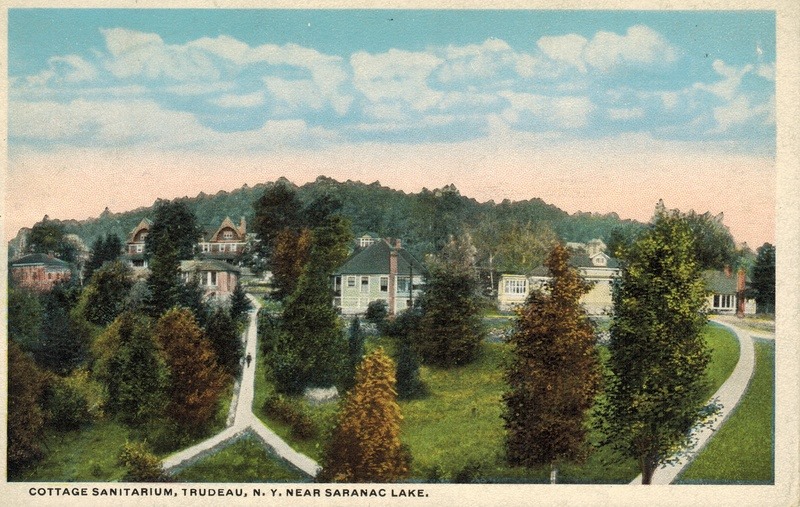
But this woman, Adelaide Crapsey, is also producing her final collection of poetry, and she likely knows that. She’s not working in her study or at some granted writer’s retreat, but at a sanitarium* where she’s suffering through the last stages of tuberculosis which has spread to her brain. If 1914 is The Year that Imagism Broke, it’s also the year that she will die.

Saranac Lake Cottage Sanitarium circa 1918

There are many paths away from here. How long are any of them?” Du Fu


The book that she is working on will be published in 1915, and it will be the place where she’ll introduce her own poetic form, the cinquain. The cinquain is a short five-line verse form, primarily iambic, that uses an increasing series of syllables: two in the first line, four in the second, six in the third, eight in the fourth, and then back to two in the final line. Some have noted that the increase creates an expectation of growth or expanding sense, only to have the ending come up short and terse. I’m not the first to see this as a symbol of Crapsey’s life and art itself.

Still it’s remarkable that Crapsey chose such a small, tight form into which to pour her thoughts on illness and approaching death. Some might choose a short but loose form to conserve energy; others might turn rangey trying to get all their last expressions in. Crapsey seems to find in the form’s limits the borders within to hold her place.

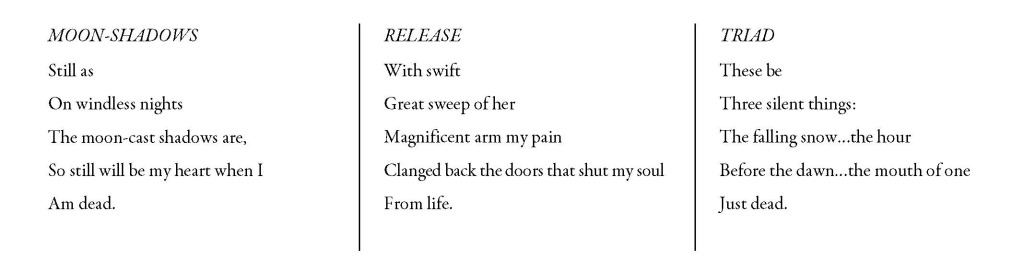
Three More Cinquains from Crapsey

Here are the three cinquains I used today. Illness and the eventual passage of dying is something we all share. Crapsey used tiny poems to bear vivid witness.


In the early 20th century world of Modernist American poetry, her tragic story lent a degree of publicity to the posthumously published book, but it was a small fire which soon burnt out. As I mentioned last time, extremely short poems and the direct lyric impulse is not where Modernism headed after the 1920s—but in the long run, we can still access these poems the only way that poetry can be reached: by directly taking them inside us. These cinquains don’t ask for a large place.

For my performance of three more of Crapsey’s cinquains of 1913-1914 I composed music for strings which sounds acoustic even though there is some spare, bell-like Rhodes electric piano and a cello line that is treated with a strong resonant echo that I think adds some poignance. I don’t know where this melody and counterpoint came from, but as I tried and played some string lines on my MIDI guitar it came to me quickly, as if out of the air. You can hear it with the player below.


*Looking to see what I could find about a Saranac Lake sanitarium I found a fascinating story about a small upstate N. Y. town that welcomed tuberculosis patients for palliative therapy in the early 20th century. Other literary residents after Crapsey included novelists Allan Seager and Walter Percy. On first reading “sanitarium” I had visualized a large dreary hospital building, but the setting appears to be surprisingly humane. Coincidentally, the remaining buildings were sold a few weeks ago.

The Dark Interval Version 1

How faithful should a translation be? I can hear your first answer even over the silence of the Internet: “As faithful as it can be, of course.”

And there are many times when I wish it could be so. One has to accept the translation loses when the devices of one language can’t make it over to the new one. Then, often there is the decay of time and the distances of cultures, and this can make meaning murky and less vibrant—but even between two people, of the same time and culture, native speakers of the same language, misunderstanding and misinterpretations of poetry occurs, as you can see with some pieces here where I perform words written by alternative reader and LYL Band keyboardist Dave Moore, which I didn’t fully grasp.

In the next two episodes of the Parlando Project, I’m going to demonstrate two different paths I’ve taken with the same poem, Rainer Maria Rilke’s “The Dark Interval.”  Today’s version is an attempt at a faithful translation.

rainer-maria-rilke

Looks like kind of the intense sort: Rainer Maria Rilke


Rilke, like Tristan Tzara or Apollinaire is another one of those WWI area European artists who exact nationality is hard to pin down. Is he Czech, Bohemian, Austrian, German, Swiss? It’s doesn’t help that the maps of Europe were being redrawn during his lifetime by the outcome of the WWI.

Nor does it help our translation task that he wrote “The Dark Interval”  in German, the language that one set of my grandparents spoke in their youth, and that even my mother was somewhat fluent in as a child, because I know even less German than French.

And Rilke is philosophically dense. His poems are full of compressed thoughts about the inexplicable, and he has a strong spiritualist bent. The former makes it hard for anyone to marshal his thoughts into another language while impressing on you the need to do so; the later makes it harder for me in particular, as I have come to believe that a philosophical spirituality is (at least for me) an impediment to approaching the mysteries.

It may help that I first encountered Rilke’s “The Dark Interval”  in a way deeply integrated into life. I, along with my friend John, was watching a band, The New Standards, perform in 2006, and during an interval in their show a man (who name I should remember, but can’t) read this poem. He did a good job of it, transmitting something of Rilke and himself in his reading. The translation he read was somewhat like the one I made later, and perform for today’s piece.

Just to give you a flavor of that concert, here’s the first piece they played. They did not pre-announce the song they were covering, leaving us in the audience to recognize it as their very different version unfolded:


I heard the Rilke poem immediately then as a meditation on the hurried mid-lives that John, I, and perhaps many of the audience were living at that time. Perhaps he—or the band performers, largely composed of veterans of locally famous indie rock bands of the 1980s and ‘90s—selected it for just that reason.

That’s not the version I perform here today. I did not change the words of this first translation, which sought to be faithful as I could understand it to be to the original German words, but circumstances changed how I hear it. John died, unexpectedly, way too young, a short time after we attended that concert. I learned later that Rilke composed it as he began to suffer from his final fatal illness. I can now see this not as a work about the busyness of middle age, but a work about the busyness of living nearer to dying. Different poem.

Here’s my performance of Rilke’s “The Dark Interval.” Just use the player that appears below to hear it. Tomorrow, my second translation of the same poem, with a different performance.


Her Final Summer Was It

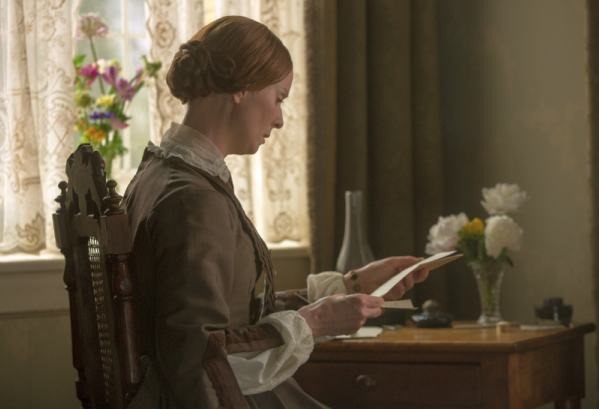
I got to see the Emily Dickenson biopic A Quiet Passion”  this month. I can recommend it with a warning: this is not a work that intends to be friendly or easy to digest. It does present a reasonable estimation of what may have made up Dickinson’s life experience, showing it with enough detail to be (for me) very moving. However, it also tries to show the intellectual ferment of Dickinson’s time in a very strange way, by spending a fair amount of the movie’s running time having people converse with each other in an extended series of Oscar Wildean epigrams.

A-Quiet-Passion

This movie has no car chases or flying magician CGI battles

 
Of course, I have no way of knowing how people spoke in 1860 Amherst Massachusetts, but I doubt they spoke like this: epigram after epigram, back and forth like a free-style 19th-Century rap battle. What I guess the director/screenwriter is trying to do is give us some sense of Dickinson’s mind and the minds of others she paid attention to—Dickinson’s poetry is full of epigrams and busted epigrams after all. What he does is artificial, but then having folks read Emerson or other Transcendentalists out loud would be artificial too.
 
Another part that is harrowing is the time spent on the routines of death and dying in her time. Given Dickinson’s own gothic tendencies, this is not only defensible, it may be indispensable in conveying her outlook. And Cynthia Nixon’s performance as Dickinson is very very good.

So go see “A Quiet Passion”  if you would be interested in a portrayal of a what Dickinson may have been like as a person and what drove her as an artist. But do not go to see it if you want a friendly, straightforward introductory film biography that would introduce you a writer you have not yet committed your interest to.
 
For once I’m happy that this is a long preamble to today’s piece, Emily Dickinson’s “Her Final Summer Was It,”  because I do not really want to talk much about the work itself, as I don’t think I can speak a well as Dickinson’s own sparse words. I found in it great resonance to my own experience, particularly a summer 16 years ago—but as with all things we present here, the intent is not to dwell on my own life, but to connect to and impact yours. I hope I do the work justice.

Her Final Summer was it MS

Dickinson’s own hand-written manuscript of “Her final Summer was it”

You can hear my performance of “Her Final Summer Was It”  by using the player below. If you’d like to hear other Emily Dickinson pieces interpreted by the Parlando Project, we have done four other Dickinson poems with music here.