A Sonnet of Two Letters

It happens to us alone, but it happens to so many it’s a trope we share. It goes like this: you have one of those bad dreams. Something terrible has gone wrong — and you, inside the dream, feeling it is real, try to fix it — but you can’t because the other people in the dream are oblivious to the terrible and are acting stubbornly in odd, irrational ways. While dreaming you’re trapped in this desperately unsolvable situation only you can clearly see and try to act rationally on, running in place, thinking in circles.

I had one of those dreams this week: felt so real, so heart-wrenching. Then the dawn comes, and you realize that experience was a dream — oh, that’s why you couldn’t fix it, that’s why everyone else in the dream was acting so wrongly!

OK, exiting satire mode, but let’s stay strange.

Early this Fall I was cleaning out something: a box, a drawer, a binder, a little used bag, I can’t remember exactly what. But in it was a clutch of papers. I glanced at the pages and recognized it was a mix of things: some works-in-progress looking for first reads from the old group of poets I used to meet with every month, and some initial drafts of a longer, multipart poem I was writing as my mother was going through her last hospitalization, the one from which she would ask to return to the home I grew up in with my father and sisters in order that she could die there. I set those sheets of paper aside.*  I figured I’d look them over later, maybe digitally scan them, or put them in my filing cabinet. At that later I’d also look to see if there were any drafts in the small stack that were unfinished pieces I could revisit.

Now here it is, we’re November and I finally got around to that sort-out. One of the pages was a college-ruled notebook sheet with a complete intermittent draft of an irregular (American) sonnet. What was this? While I remember well working on the longer poem around my mother’s last illness 20-some years ago, I had no memory of working on this sonnet. Complete blank. Moreover, the sonnet seemed to speak of someone’s story that I didn’t recognize as mine — nor anyone else’s I could recall either.** With the time-interval between discovery of the papers and my finally going over them, I can’t even be sure if this sonnet was found among the stuff from the time of my mother’s death or not. Trying to determine why I didn’t remember it, I wondered if it was even older. I recalled that scholars date Emily Dickinson manuscripts by looking at the changes in her handwriting over time, so I tried that assay. Looked to me more like my 20th century handwriting, so the poem could be older. Still, it was my handwriting, testifying I, however unremembering, wrote this poem — and “What was it about?” That intrigued me. The poem asks the reader to work obliquely, details are supplied but not all the details, something that can tantalize.

A Sonnet of Two Letters

The gardening stake metaphor used in the final section reminds the 2024-me of Robert Frosts “Pea Brush,”  a poem I didn’t know when the me I was back then wrote it

.

Why did the voice in the poem not mail their first letter? What was it about the recipient’s husband that was germane to that decision? Was there an affair or appearance of one? Clearer to me was the latter part, the stuff of the second letter, a recalling of youthful aspirations and a friend who by what they said helped make them more substantial than pretensions. What an interesting yoking, I thought. The imperfect, the not said, or the thing whose saying we keep hidden — combined with the things that were said that help us realize our lives.

As you might tell from the previous paragraph, I was experiencing this poem just as I would the general run of Parlando Project poems, ones written by others in a project which has as one of its mottos “Other People’s Stories.” Its mystery and ambiguity captivated me, and so I set about making it into a Parlando song.

I did a revision of the initial handwritten draft I had found and worked on combining it with the music you’ll hear with it below this week. The music today is played as a conventional LP-era rock ensemble: there’s the usual quartet: bass, drums, chordal and “lead” guitar. Added to that are two keyboards, piano and Hammond organ. You can hear the result with the audio player gadget you should see just below. No gadget? Wake up, this highlighted link opens a new tab with its own audio player.

.

*Two of those poets have since died, I re-handled those pages, ones they’d typed in and handed to me years ago, and thought tenderly of them. My part of the household is due for an austere “death cleaning,” the tossing of those things an old man keeps to extend something of the life of that-and-those who’ve passed on. I have no grave illness, but the keeper now must consider that they will pass on and that there’s no real keeping.

**I did write from personas in my writing life regularly, a bit more so in prose than poetry. I was likely imagining the “short-story” plot that I then went about expressing in the sonnet.
The Three Friends: an audio play adaptation of a Walter de la Mare short story

I indicated last time that I had another piece I wanted to present before Halloween by Walter de la Mare, that British master of the subtle supernatural. It took a bunch of concentrated effort to produce something of a realization of it, but it’s as ready as I can make it in time. How’d it come about, and why was I not sure I could promise it?

I use the Internet Archive often as part of this “not just non-profit — it’s non-revenue” Project. One of the things the IA has is a large library of scanned public domain literary works,* which affords me a handy way to look through “many a quaint and curious volume of forgotten lore.” In the run up to Halloween I made a note to see if there was some Walter de la Mare work I could use for my Parlando Project purposes.

This Project lets me not only explore the well-known writer’s and musical composer’s habit of procrastination, but also the reader’s and researcher’s branch of that foible too. I put that book search in my I’ll-do-that-tomorrow bin for about a week. “I’ll get around to it” I told myself.

And then in mid-October some numbskulls hacked the Internet Archive causing it to go largely offline for more than a week. When the scanned book section returned to availability, I was already into making other new work for this year’s Halloween series, but a few days ago I was finally able to access some additional collections of de la Mare’s work from the IA. In looking through those, I found that Walter de la Mare wasn’t only a poet. He also wrote short stories, which like his poetry, exhibit his dry sense of the strange. “The Three Friends”  is one of his shortest published stories — short enough to work into one of my short-format audio pieces.

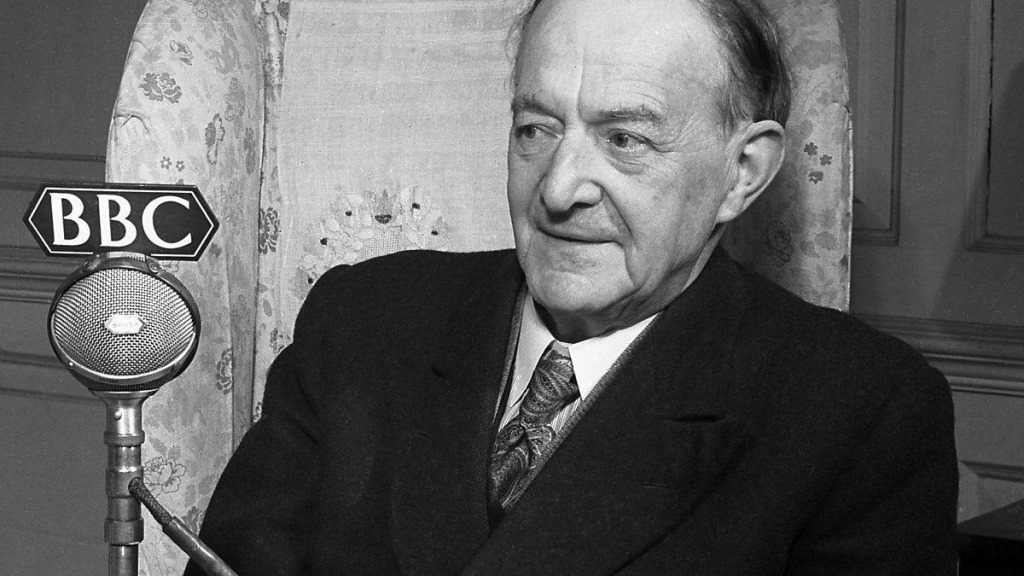
Walter de la Mare in front of a microphone

When Walter de la Mare worked the mic, he had a whole radio network to support him.

.

“The Three Friends”  is dialog-centric, and in less than a day I was able to jury-rig up a three-person play out of it — but who’d be my voice-acting ensemble? It was less than 72 hours until Halloween. I’d have loved to have used Dave Moore’s voice, but my production schedule is catch-as-catch-can, and I didn’t know if I could corral him in time. My wife agreed to play the part of Lacey, the tavern keeper member of the three friends, assuming she wasn’t completely worn-out from her work and the rest of her life. Last night she stepped up to the mic and recorded that part in a quick pass. I made a logistical compromise and recorded the other two parts with my own voice, also working quickly.**  By about 9 PM last night I had the dialog recorded.

Between then and about 3 PM this afternoon I worked on the audio production of the recordings, selecting a bit of instrumental music (from my last-weekend exploration of a new audio software feature) to serve as a plausible theme music for “The Parlando Project Theatre of the Air.” The 19 hours from first opening up the microphones to an audio play ready to upload weren’t all Project work: I did go to sleep after midnight, I got up at dawn and did a bicycle ride to breakfast, and early this afternoon I made another bike trip to the grocery store — but there was a lot of production work trying to meet the needs of this format that isn’t what the Project normally does. “Radio play” music production isn’t the same as recording and mixing a 3-minute song, and I had to learn how to apply my computer audio tools in a slightly different way. If you haven’t done audio production, it’s a heap of tasks even to get a half-way polished result: finding environmental sound effects, balancing levels, fixing the most egregious dialog glitches, deciding if any pauses are too long or too short, and so on. The result of this experiment is good enough to present, though I note things that I would have liked to do better.

So, what’s the story our actors are presenting for your ears today? Two friends are casually talking about a problem bedeviling one of them. That troubled man, Eaves, has been having reoccurring dreams or visions. His friend Sully tries to make light of it, but in the course of their evening they meet up with the third friend who works in a tavern, Miss Lacey. They talk over Eaves’ problem: you see Eaves thinks he has pierced the Samhain veil. Has Eaves seen, will he tell of, “the undiscovered country from whose bourn no traveler returns?”

Well, it’s de la Mare. Most writers would break out the purple pen to write such visions, de la Mare wants to make a more subtle (and human) observation. The orchestra (well, the piano trio) has started to sound. Take your seats and listen to the short, 10-minute world-premiere performance of the audio play “The Three Friends”  by using the audio player below. What, has someone tall with a large hat sat in front of your audio player gadget? I provide this alternative, a highlighted link that will open a new tab with its own audio player.

.

*The Internet Archive has also taken an aggressive stance to works that are not clearly in the Public Domain. That activity is controversial and has had some legal judgements handed down for rights-holders. I won’t take your time to go into all that, but its scanned PD literary archive is a treasure for readers and researchers.

**Oh, if only I was one of those skilled voice actors who can call up entirely different vocal timbres to create distinctive sounding character voices! I tried to mitigate the lack of distinction between Eaves’ and Sully’s voices both being portrayed by mine by using stereo separation on today’s audio

The House of Ghosts

It’s been a busy week at the Parlando Project studio as I record more Halloween-themed songs freshly made by combining other people’s words (usually literary poetry in the public domain) with original music in differing styles. Let us go to the lab and see what’s on the slab.

Last dark-and-stormy-night-time we had a poem that started with someone at a household’s door asking to be let in. Waif or wraith? Therein lies that tale. Today we again have a piece that starts at a doorway — but the tale-teller here lets themselves in. What do they find there? Well, that’s the song.

The words I used today originated with a poem by early 20th century American writer Margaret Widdemer. While Widdemer is little remembered now, she was a successful presence in the literature of her day. And while the Parlando Project does the everlasting Greatest Hits of Poetry sometimes, I also like digging through old poetry collections and anthologies looking for overlooked poems and poets. Such “many a quaint and curious volume of forgotten lore” reading let me find Widdemer, and one thing that drew me to her was that she seemed to have absorbed some stuff from the folk-music collectors of her time — for example, this eerie poem of hers that builds on the “Lyke Wake Dirge”  presented here six years ago.

One thing that folk-music tradition teaches us: the singer is free to change and adapt the song that was handed down to them. Entirely new words or new music may be applied. Verse order, much less exact wording is not sacrosanct. Instead, a good fit for the singer and the audience (these being the folk in folk-music) is the guiding force. Most composers who work in the Art-Song form are compelled to keep the text unaltered, and while I’m not of that tradition, I most often present the poet’s words as they published them for the silent page. But, for today’s piece I substantially altered Widdemer’s poem to make what I hope is a more effective song.

House of Ghosts

Widdemer’s poem is linked here if you’d like to see the “before” to my substantial revision.

.

I started with a simple change: I created a refrain based on the initial verse of Widdemer’s original text when I found it ineffective for audience grabbing. In other revisions and additions, I sought to sharpen the “build” of the story’s details, and I excised antique words and diction that added no charm.

Musically I recorded a late-night laid-back Rock combo of two electric guitars, electric piano, bass, and drums for my resulting song. Here’s the chord sheet in case you’d like to play your own rendition. That’s also the in the folk-music tradition: the song shouldn’t belong to only one voice.

To hear the way I played and sang it you can use the audio player below. What? Has no audio player gadget materialized on your screen?  This highlighted link will open a new tab with its own audio player then.

I plan to be back soon with an entirely different, more orchestral ensemble for the next piece in our 2024 Halloween series. Should I act like a YouTubber or Substack author and urge you to subscribe for this upcoming content?*

No, I’ll leave you as a free agent on that decision. This Project goes beyond non-profit — it is by design no-profit. I just love diverse music and poetry and get a kick out of exploring what’s possible. I have nothing to sell and would avoid anything that is paid by the click, because I have no makeup to be a small-businessman.** But my self-regard (or desire to promote a range of poetry) likes seeing viewers and listeners. Sharing this stuff on social media, or just telling a friend, will help keep this going.

.

*The Parlando Project started as a short-form podcast, one sans the usual blather, paid-for-promotions, and between-host jocularity — presenting instead our typically 2-5 minute musical pieces unadorned. It turns out that podcast audiences prefer one-to-two hours of gab — but if you want a break between the talkers in your podcast app, you can still subscribe to the Parlando Project on Apple Podcasts or most other popular ways to get podcasts.

I don’t believe I misunderstand those who appreciate the typical podcast format. I sometimes listen to podcasts while cleaning or fixing something with my hands. Alas, as a person who spends much of their time reading, composing, playing, recording, and mixing music, my own ears are usually occupied, and so I lack time to partake.

**I admire small-business people in general — and yes, I appreciate how hard it is for musicians, composers, and writers to make even a meagre living these days. While I work at this Project like someone with a small-business enterprise, I’m just not suited to bookkeeping, form-filling, and tax-law lane-keeping.

I Sing to use the Waiting — What Emily Dickinson does while waiting for that carriage

Is there a name for a poetic form made of two quatrains? Emily Dickinson wrote a good number of these 8-liners — brief, but a bit longer than one-stanza forms such as the haiku or the cinquain. One advantage of short forms is that they are easy to hold in memory, allowing them to be shaped and revised while one’s hands are busy with other daily tasks. We know Dickinson sometimes jotted down short pieces on household paper scraps, but maybe even those had earlier drafts before she could grab a pencil.

What can she put in such a container?

This one implies a short narrative. Someone (we’ll just say Dickinson for simplicity’s sake) is waiting at her house for something to arrive. She’s ready to tie on her bonnet (her outdoor hat) and on the waited arrival she’ll be going outside her home. In the second quatrain she says she’s awaiting “his…step.” The something is revealed as a male someone. Where are they going? Dickinson writes of a “journey to the Day.” Is this an odd way to say she expects a day-long journey? Perhaps, but she did capitalize “Day” as if it’s a particular concept rather than a 24-hour interval, and the poem ends with mention of a similarly capitalized “Dark.” Dickinson was fond of circular intervals standing for a lifetime, with a day’s sunset or nightfall standing for death. I suspect that’s what she’s getting at here.

I was captured by this poem, given my musical interests, by its citing of singing in each stanza. Examined carefully, the first line says something distinctive. “I sing to use  the Waiting.” What a striking statement to a musician — or to music’s sister art poetry and poets. Life is time, that’s its waiting. What counts its meter and shapes the air in-between? I think of composer Frank Zappa’s quote “Without music to decorate it, time is just a bunch of boring production deadlines or dates by which bills must be paid.” Poets and musicians sing to use that waiting.

In the ending sentence Dickinson says both she and the awaited are singing to “Keep the Dark away.” Does music — does poetry — hold off, or prevent, death? Well, it may not be that death=dark exactly. Dark may be the unknowable aspect of death, the frightening nature of the threshold we cannot see beyond.

A thought occurred to me as I was living with this poem over the past couple of days: it would seem to pair well with — as a prequel of sorts — to one of Emily Dickinson’s most famous poems: “Because I could not stop for Death.”   In “I sing to use the Waiting”  she’s awaiting that other poem’s he, Death, to bring around a carriage for her. If that’s so, we might expect that on the ensuing carriage ride the two, Death and Emily, are singing as they ride past the playground and the cemetery toward eternity.

The Phantom Carriage 1921 film still

I’m OK with all the night-time transparent carriage traffic, but I wish they’d stop singing so loud. Still from The Phantom Carriage (1921)

.

I had immediate ideas for the musical sounds for today’s Dickinson poem setting, which helped me get a rapid start of the process of composing and tracking it. I was aiming for mysterious, but when I went to mix the various tracks it began to sound odder than I had thought it would be. I explored different options at that point, but in the end I decided there was no going back from strange. I should more often remind listeners here that I go exploring a lot of different musical ideas, so don’t take any one piece you hear here as representative of what you might hear in the next piece, or the one after that.

You can hear my musical performance of Dickinson’s “I sing to use the Waiting”  with the audio player gadget below. Awaiting a gadget that never shows up?  This highlighted link is an alternative.

.

Quiet Night Thoughts under a harvest moon

If we think of poetry as more than a barren art, we might think of things we read in poems as things that occurred to another person, somewhere, sometime. Oh it may be a mistake to automatically read poems as memoir — invention has always been one of those occurrences — but the more universal the poem’s account, the more we may think: this decorated thing I’m reading came from the senses of someone feeling an experience.

If we do that, we can think today that somewhere in China, sometime in the 8th century, an adventurer turned poet in middle-age awoke at night. What kind of bed, what kind of bedroom? The poem tells us nothing posh, despite its brevity: the poet’s expectation in the shining he sees around his bed is that it’s frost. It might be a lean-to, or even a bedroll on some improvised pallet out in the open. At best it might be an unheated room.

But still he’s awakened to something shining. He soon re-adjusts. No, this brightness that has occurred is moonlight not the frost of a more northern climate. Commentaries I read on classic Chinese poetry note that “bright” is something of a favorite poetic ideogram in those poems. A good symbol for immanence and essence? That light from the now open eyes of our poet must be seen. Oh, it’s the moonlight, likely a full moon on a clear night, he figures out. But that realization says something about near and far. The moon is more than 200,000 miles away. Yes, the moonlight is near, he could touch it but feel nothing.

What can  he touch? He can put his head back down on the bed and think, perhaps to think himself into dreams of his home. Feel that now with him as the side of face and scalp touch back down. How far, that home? Moon far?

The 8th century poet who wrote this, Li Bai (also known as Li Po), was an itinerant for much of his life. Choice? Consequences of other choices? Exile? The traditions seem to indicate a mixture of all that.

Quiet Night Thoughs

This is a well-known poem in Chinese, taught as an early lesson in poetry to children like Sandburg’s “Fog.” In my translation I did something I don’t normally do: imposing an English meter & some rhyme.

.

Now another man, in another bed. I can tell you with more exactness where and when: September 18th, 1970 comes in within a night in London, England. The man has been out to nightclubs, “sitting in,” playing music with others, something that consistently energizes him. For much of his life music has possessed him like that. He’s been blessed or cursed with the compulsion to make it. It’s just a couple days past the harvest moon in this room, the moon as far away as Li Bai’s moon.

He’s with a woman whose role is somewhere between girlfriend and convenient stranger, but this is not strange to him. He barely knew his mother, his father’s time was taken with drink, low wages, and a skin color that marked him as an outsider, and so he could rarely care for him. This had often been. As a child, taken in by other women, neighbors, and relations — and as he left home, others in the various valences between girlfriends and strangers.

Do non-performers understand how hard it can be to transition to sleep after the active interaction of live performance? Performers likely have tried it all: sex, boring TV, cannabis, food, and even more alcohol than they drank to take the edge off self-consciousness before performing — enough to move them from the level of self- to un-consciousness. And yes indeed, other drugs.

This man had moved from at least some of the above to the other drugs: his companion’s sleeping pills. A foreign formulary, they were much stronger than he anticipated.

September 18th, 1970, Jimi Hendrix, the man in London, quiet night thoughts. Did he awaken in that night as Li Bai did in his poem? Accounts differ from that London night. Let me think that at least his consciousness tried to return — in his head the sparkling currents like the magnetic waves when electric guitar strings are strummed. Did he think of home as the great Chinese poet did? If so, what would be home? Did he think of America? He was doubly American in a fierce way: some of his ancestors had been kidnapped and sold to enslavement there, and some of his ancestors had had their before-it-was-named-America taken too, a trail of tears. Did he think of his parents, even more so because of their relative absence in his life? Others who had episodically cared for him? He might have. Maybe too his night thoughts were of music, of songs. We can still hear him sing about dreaming on recordings, so he could have dreamt of singing a new and elusive verse. Did he open his mouth to say it, and there was nothing? No air. No breathing. No life.

You can hear my performance of Li Bai’s “Quiet Night Thoughts” (for Jimi Hendrix)  with the audio player below. See just a pool of moonlight at the end here, no audio player? This bright link will open a new tab with its own audio player.

.

At the Threshold: marvels with French on sky-blue waters

We’re going to travel to one of the best short poems that late 19th century American poet Richard Hovey ever wrote, a strange poem about approaching death, a place far or near, with no trusty mileposts. As I like to do, we’re going in a round-about way. Let’s start with a blue lake.

I can remember what a wonder it was. My father and his youngest brother loved to fish on lakes, and in search of ever more pure sport-fishing beyond the sky-blue waters of northern Minnesota, they took to traveling up further into Ontario Canada. I was maybe 10 or 11, still at an age when I was open to whatever my parents led me toward. We stayed at a family-owned fishing lodge at the end of a gravel road outside of Reddit. A few small, well-kept cabins, a couple of outhouses, and a lake-dock — which was all the two brothers needed, as the day was mostly spent out fishing.

As I said, I was accepting of this. I gamely came along, earnestly operating a rod and reel, waiting, sensing for any piscatorial tugs on the line, listening to the two men occasionally talking about what fishing tactics were most promising. My youngest uncle, maybe 18 or 19, had been about my age when their father died, and my father now served as his younger brother’s father-figure. I was unaware then that more than lures and casting targets was in their talk.

I was never bored. I had a vast imagination when young, and could sit quietly daydreaming stories and ideas in my head for hours. I suspect a good poet would have been more observing of the boundless nature around me; and while I watched and listened to my dad and uncle some, they were too commonplace for me to treasure.

Instead, here is what I recall being fascinated by: I was in another country, Canada, subject to its laws, and a Queen, a governmental oddity that seemed a little out of time to me. A gallon wasn’t even the same gallon there, nor a dollar exactly a dollar! The lodge owning family and everyone we met in Canada spoke English of course, but since my imaginative and book-minded mind lived in words, I was amazed that all the groceries we picked up in Kenora on our way up had bilingual labels including French.

I was as if I had found the Rosetta stone all by myself. As a native Iowan, I already had a passing place-name experience with French from my state’s then 160 year past life as a French possession, but here in Canada a box of Wheaties or a carton of milk could be held inside other words. So, later in high school and in my truncated college studies, I selected French as my foreign language.

I was terrible at it as a school subject. I did OK (not outstanding) in basic vocabulary. I was passable in recalling the tenses and such. I accepted the arbitrary gendering of nouns. But my mouth stumbled entirely in the speaking of French, so obtusely bad at speaking it that I strongly suspect it is something in my neurological wiring. That I persisted with French as I entered college was at least in part because I was learning that French poetry had been so interactive with English language poetry, particularly in the formation of Modernism.*

After my formal education ended, I continued translating French poetry, not by any right of fluency, as I’ve confessed above, but because I wanted to bask in the secret sauce that helped form Modernism.

Richard Hovey seems to have been greatly enamored of what was modern French poetry to him. His published work includes translations of Verlaine, Maeterlinck, and Mallarmé. While going through his published work this summer I came upon this sonnet “Au Seuil,”  in French, dated as having been written in 1898. When I translated it, I found this graceful consideration of dying and some possible judgement and afterlife which I present to you in English today. As an old person, dying no longer requires any heroic situation, acute illness, or grandiose gothic stance to make such consideration apt for me. It’s a matter of petty logistics now.**

At the Threshold as published in French

The poem as published posthumously in a collection by the Vagabondia co-author titled “To the End of the Trail.”

At the Threshold

My translation, presented here as a chord sheet for the musical performance you can hear below. In performance I refrained the final line of the sonnet as shown here.

.

Was today’s poem written by an old man, or a young man staring down a deadly disease? No, Hovey was 34 years old, likely in vigorous health. Still, in less than two years he’d be dead, dying during a routine operation for something as unromantic as a varicocele. One can only wonder how he would have coped with the upcoming English poetic Modernism that would be sparked in part by French writers he admired.

Though subject to my language limitations, today’s poem to song turned out to be a relatively straightforward and faithful translation — with one exception. My usual poetry translation tactic is to primarily find the images in the poem and work at carrying them over vividly to English. I strive to have a non-creaky, natural syntax and word choice in the target language, and to make from that a poem in modern English word-music rather than trying to mimic the prosody of the poem’s native language. What was that one exception? In the poem’s 13th line, “ Qui nous benira de ses grands yeux bleus,” there’s an image I think.***  It could be that Hovey intends a witty little aside about a Nordic male god-in-heaven sitting on a throne of judgement, the cliché being then his point. As I worked on this line I wanted the possibility, however unexpected and wishful, of something universally marvelous. I dropped the andromorphic gendered pronoun as more than unnecessary, and then perhaps unconsciously recalling the poetry of the first-nations name for my current home-state of Minnesota, made the apprehending eyes more than humanly large.****

You can hear my musical performance of what is now an English language poem with the audio player gadget below. No player seen?  This highlighted link is the alternative, and it’ll open a new tab with its own audio player.

*Oddly it wasn’t Spanish poetry. In England we can assign this to not forgiving the Armada and all that — but large portions of the United States had been Spanish possessions after all. And while Canada’s French is spoken regionally, Spanish is the predominate language across our equally large southern border and in the American commonwealth of Puerto Rico.

**For example: when I replaced two bicycles stolen early this summer, ones I’d ridden for 20 and 40 years, I wondered at the return-on-investment of spending like-amounts in current market prices to replace them. My favorite old-person’s joke is that when someone offers me a lifetime guarantee, I ask if there’s a better offer.

***Literal: “Who will bless us with his big blue eyes.”

****Lakota compound word for the place of sky-reflecting-waters. And there I have returned to that boat with my father and his youngest brother, as Hovey wrote in a different language: “we know this hidden way/as one knows the ghost of a dead friend.”

As far from pity, as complaint

The great American poet Emily Dickinson writes about death a lot, so maybe I should pause for a moment to mention how inescapable the living’s experience of death was in her time and place, what with disease, injury, a deadly Civil War, graveyards within the city limits, and approaching death happening often at home.

West_Cemetery,_Amherst_Massachusetts

Because I lived across the street from death? When a child, Emily Dickinson’s family did not live in the Dickinson Homestead (now the Dickinson Museum), but at another house, located across the road from the town cemetery where she would later be buried. A child is born, plays, grows up, and crosses the fence.

.

The poem I’ll sing below today speaks to that. If you’d like to follow along, here’s a link to the text of “As far from pity, as complaint.”   This poem is more than its message —most good poems are — but let me write down here a sentence to summarize what I read this poem as saying: rather than pity, dread, or anger toward death, a result we cannot change, we should emulate the dead themselves who demonstrate that life is not everlasting — but the predicament of dying, and the predicament of living, are everlasting.

That’s a worthwhile thought, and poems in Dickinson’s time and place were often expected to deliver a lesson. But why is this a poem, why is this an Emily Dickinson poem? An essay, a sermon, a sympathy card, a letter, a conversation all could deliver this message as well or better as 12 lines not even pentameter-long and broken with the skeleton spaces of the pervasive Dickinson dashes (as if her “trade was bone.”)

Because it sings this situation, even silently on the page. There’s a dancer’s force, a singer’s force, an instrument’s augmented force in this way of telling. If death is inevitable — as is also meter, repetition, rhyme, the flow of sound into shapes — might we be comforted by these shapes? We live. We die. The shape of life continues. Quod Erat Demonstrandum, thus it is demonstrated.

When encountering this poem earlier this summer I sensed an intra-poem image-rhyme in this poems 7th and 8th lines. A better-known Dickinson poem which attracts us with what seems like mundane charm, “I’ll tell you how the Sun rose,*”  has summer children playing from dawn — and at the end, disappearing over the horizon’s fence-line at sunset. That’s the continuing shape of our lives.

You can hear my musical performance of “As far from pity, as complaint”  with the audio player below. If your way of reading this blog is numb to that revelation, don’t complain, I offer this highlighted link as a way to open a new tab that will have its own audio player so you can hear it.

.

*I love the version of that Dickinson poem sung by alternate Parlando voice Dave Moore. The LYL Band was performing the poem live, and Dave had selected a key that exceeded his vocal range — but I think the creaky breaking of his voice brings poignance to the recording.

The Doomed regard the Sunrise

Here’s another example of a short Emily Dickinson poem that seems in some facets simple, and yet when examined more closely still shows her uniqueness. On first reading it reminded me of a saying attributed to Benjamin Franklin* “Nothing concentrates the mind like the prospect of being hanged at dawn.”

One might read this poem from the start as a restatement of that Franklin quote — except, Dickinson may be saying this isn’t someone’s last day, she wants to set down the situation someone’s next-to-last day. In the first stanza, it is sunrise, and the poem says that the doomed person has delight. Why? Because there is one more day before their death at the dawn.

Doomed regard the Sunrise

Chord sheet in case you’d like to sing this one yourself.

.

This idea is clearer in the second stanza, where again, death is clearly due — but tomorrow. There the doomed man is listening for the bird that will likely sing at the next dawn. Perhaps he’s listening to the Meadow bird in the day-before dawn more intently, knowing the next time he hears that song it will be his execution, and this is his last day to hear it in the more generally hopeful context of introducing a day, not an execution. He might choose this — after all, if he knows he’s to die tomorrow, he can be somewhat assured he will not die in that present day as the bird sings the day to begin.

The final stanza may be the oddest, but indicates that this is so. It twice tells us the mood is joyful, which would indicate that the condemned does feel assured of, and is in love with, this day — the full day before. There’s a somewhat ambiguous word-choice in the last line: “ought.” The word can be a stand-in for zero, for nothing, but it’s primary meaning is more at obligated. If we take the zero/ought meaning, or the obligated meaning, Dickinson’s poem is saying the poems doomed subject is joyful though the next-to-last morning Meadow bird has a duty to sing nothing but elegy, because the poem’s subject will accept the day with joy.

So, this is goth-mode Emily with death certain, but this is also certainly the day before  the last day.

Musically I had to throw this one together quickly, but it came out OK. Though in a minor key it’s somewhat jaunty. You can hear it with the graphical player below, or if the Meadow bird’s audio player isn’t visible, you can use this highlighted link that will open a new tab with its own audio player.

.

*There’s a similar quote attributed to Samuel Johnson, and there’s this later extension authored by Terry Pratchett “They say that the prospect of being hanged in the morning concentrates a man’s mind wonderfully; unfortunately, what the mind inevitably concentrates on is that, in the morning, it will be in a body that is going to be hanged.”

The Highwayman

I’m continuing with my examination of a pair of 1920s poetry anthologies aimed at children: 1922’s The Girls Book of Verse  and the following 1923 The Boys Book of Verse.   Since you’re getting so much of me this month, you may welcome a short break from my singing voice today. In its place, you’ll get the voice and guitar of a singer-songwriter from The Sixties: Phil Ochs.

Despite its 18th century setting, Alfred Noyes’ “The Highwayman”  wasn’t all that old a poem when the anthologist chose it for one of our pair of books. It was first published in 1906. As I write a bit more about the poem, and give you this link to the full text of it, you may choose to play along with the little game I’ve been suggesting as we look at this set of gendered poetry books: was this poem in the girls or the boys volume? The answer is below.

The poem is a highly romantic though tragic tale of a mysterious but altogether gentlemanly armed robber and his devoted landlord’s-daughter sweetheart. I’m unread in modern romance fiction for young adults, but the general characterization there strikes me as surviving into the present day in such genre novels. I’ll also say that I don’t know how many current young adult novels deal in deaths of the main characters, particularly violent deaths with a strong overtone of chosen death. I knew this poem as a mid-century child, and loved its rush of alliterative language, but I’d suspect that modern American sensibilities might find it’s death-wish problematic for younger readers. “The Highwayman”  seems to have retained some general esteem in Great Britain at least through the end of the 20th century when it placed 15th in a 1995 survey of that nation’s favorite poems. One other late 20th century piece of evidence: a favorite singer-songwriter of mine, Richard Thompson, wrote a somewhat analogous death-of-a-romantic-robber narrative into one of his best-loved songs: “1952 Vincent Black Lightning”  which was released in 1991 and is an obligatory part of his performances to this day.*

Speaking of death wishes, guitarists who hear Thompson play may be tempted to self-harm.

.

Roughly midway between our anthology of children’s verse and Thompson’s song, American Phil Ochs set Noyes’ poem as a song he’d accompany with only his acoustic guitar. Ochs had made his way to the East Coast scene during the Cold War “Folk Scare” where he made his specialty the topical song. As one of the “sons of Pete Seeger” then, Ochs’ songs often commented on social issues and expressed left-wing viewpoints, and a good case can be made that Ochs was the purest expression of that. Yet, it was just such a summary that eventually would stunt his continuing reputation. His compatriot Bob Dylan could write songs like “Oxford Town”  or “Let Me Die in My Footsteps” that overlap with the kind of songs that Ochs was writing at the same time — but alongside his advantages of untouchable charisma, Dylan had a knack for writing more abstract songs with a longer shelf-life, even early on.

Ochs did work on developing other modes of his songwriting. Near the end of his active recording career he demonstrated some achievements there — but The Seventies, that decade that took Americans from Nixon to Reagan, troubled Ochs greatly and made is New Frontier persona seem yesterday’s papers. The endgame of Phil Ochs is as tragic a story as “The Highwayman,”  but the details aren’t ballad material, and they are everything but romantic.

But if I step back to 1964, I’d guess that Ochs recording Noyes poem was a way for him to buffer his branding as just a topical lefty songwriter. The rest of the LP it appeared on, “I Ain’t Marching Any More,”  otherwise showcases those strengths that would be seen as limitations later.** I remember hearing that record in The Sixties, and I’m sure I filed the tactic it demonstrated — that you could set literary poems to music with only an acoustic guitar — away to later become an influence on this Project.

.

OK, you’ve either heard Ochs sing Noyes or read the poem — maybe both, and it’s time to finalize your guesses: girls or boys book? Today’s answer: boys. I think this shows one marked difference between Noyes’ 1906, the anthologists’ 1923, and even Ochs’ 1964, Are young American boys or teens connected with anything like this level of romantic outlook today? That’s a honest question — I can’t say I’d know — but I suspect the answer is almost never. I can’t assay what’s good or bad about that change, it that’s so, without adding a thousand words to this post. Consider it amongst yourselves.

.

*This is of course a side-point regarding a cracking good song, but has Thompson ever said (or has anyone ever asked) about Noyes’ poem (or Ochs setting of Noyes’ poem) as an inspiration for this song? As a mid-century-born British songwriter, Noyes might have been known to Thompson — and his original UK band’s USP was (at first) performing works by the North American singer-songwriters of Ochs generation.

**Other reasons Ochs might have chosen Noyes’ poem? Noyes was a life-long antiwar man, and in 1940 he even wrote a science fiction book with a prescient trope of a weapon that could — and did in the story — wipe out nearly all humankind, leaving only a handful who were under the surface to survive.

Cool Tombs

It’s been too long since I’ve presented a poem by Carl Sandburg here, and awhile since I had the time to make one of my “punk orchestral” pieces accompanying one of the poems.

Carl first.  Unlike Frost (birthday boy today, happy birthday Robert!) I appreciated Carl Sandburg as a young person. A poem like today’s “Cool Tombs”  doesn’t appear to truck with irony or express its perceptions subtly. It appears to say what it means to say. Those schoolchildren sure that poets and their literature teacher accomplices are seeking to make fools of us dense and under-lived students can rest easy with what this poem seems to be. Here’s a link to the full text of the poem, if you’d like to follow along.

I’ve made my point elsewhere in this Project that Sandburg, likely with intent, had other poetic modes. Like Frost (which Sandburg was once considered a peer to in literary merit) he’s always plain enough speaking that one can be fooled into thinking his thoughts are always straightforward. Read quickly enough, seeing only the plain-talking, “Cool Tombs”  has just one thing to establish: that our selves lose and are left-loose from our deaths. Great accomplishments, great enemies, great failures — eventually, nothing.

Where’s the ambiguity? Where’s the deep reading that great poems reward?

My answer, my reading of Sandburg here, is that is to be found in American history — that history a denser poem full of every Empsonian ambiguity — and Sandburg clearly is roping in American history here.   Are his choices incidental/accidental? Well, they do include things that disappear, even if like love they remain inescapable, returning things.

Other than American historians, few readers today will understand what a “copperhead” is referring to when Sandburg speaks of Lincoln, other than perhaps knowing it as a species of poisonous snake. That it was, and is — but in the American Civil War those in the North opposed to fighting the secessionist slave-holding rebels took to using an incised liberty head carved out of the mid-19th century American penny coin as an emblem of their sentiments. If you reach into your pocket now and note who’s on the current copper penny, you’ll see the head of Lincoln.*  Did history write some irony there?

Civil War hero and post-war President Grant suffered from corruption among businessmen in and surrounding his administration, details now lesser-known outside of historians today. The Sandburg that wrote this poem, ex-political operative and then still daily newspaperman, knew that government corruption hadn’t disappeared conceptually. Perhaps he also knew that Grant intended to — to some degree did — try to set up a fairer settlement to those newly emancipated from slavery. In the cool tombs of history, perhaps we remember Lincoln and Grant for those efforts, even if imperfect and eventually abandoned, they were.

Pocahontas’ story, as much as can be deduced from records and oral histories, is complex, and subject from the beginning to substantial romanticization by English settlers.**  An indigenous American, she married an early English-American settler, and legends of this marriage and other friendliness of Pocahontas to the English settlers are the prime reason she became a historical character to the eventual conquerors. From the First Nations standpoint, one can easily see this story rests on a vibrating matrix of love, coercion, or treason. As her story leads into Sandburg’s voice claiming for the lovers in the concluding section, perhaps Sandburg holds primarily for the first of that trio — but he and I were not there, we cannot really tell. I also don’t know Sandburg’s intent, but the previous two situations are suffused with crimes and evil: slavery, murder, corruption, and greed. Is Pocahontas’ story contrast or continuance? The poem’s text allows either reading. Perhaps the fairest reading, the one that was in my sense as I read it, is that Pocahontas’ love was tragic given how the conquest continued with so much killing and subjugation. Note too that Sandburg says a hail-the-conquering-hero parade (perhaps to the tomb?) should be examined as a vainglorious exercise.

Lincoln, Grant, Pocahontas cool tombs

Lincoln’s tomb in Illinois, Grant’s tomb in New York, and Pocahontas’ burial site in England.

.

Is all this external exegesis based on unintended things that I’m artificially assigning to a simple or at least single-minded poem? Most modern academic readers of Frost understand him to be a poet comfortable with intentionally invoking subtext. Certainly, if this were a set of incidents in a T. S. Eliot poem with reference to metaphysical poetry, with passages in Latin and Greek referencing classical history and legend, we’d know he wanted us to consider those connections.***

But Sandburg? I’d caricaturize my sense of how Sandburg’s viewed today like this: he’s written off as a superficial popularizer of unremarkable intellect and talents. He fooled some folks earlier in the 20th century into thinking there was something there, but now we have a better vantage point.

I obviously don’t see it that way. I could be mistaken — in which case it’ll be forgotten in the cool tombs.

Carl Sandburg's grave

Carl Sandburg’s grave in Illinois. Not so grand, but it also asks us to add history to the grave. There’s a little plaque on the footing bearing the legend “For it could be a place to come and remember.”

.

Alas, now again I spent more time spent writing on the words, leaving less time for the music. I recently had enough energy and assured time to try to do something with a larger group of orchestral instruments. Let me be brief. I wrote this originally as a non-harmonized melody, but transformed it into a harmonized piano part via some software that extracts harmonic ideas from a monophonic line, choosing the one that interested me the most, and tweaking it from there. The piano part then became the orchestration by another translational process of placing the piano’s range of notes with various other instruments.

If I had the focused energy or assured time, this could be a movement of a larger piece with other themes, variations, contrasts in color — but that doesn’t fit my life. I’ve come to call these short pieces, often expressing a simple musical idea by whatever means I can bring to hand “punk orchestral.” You can hear the recording of my performance of Sandburg’s words with this orchestral music using the audio player gadget you see below. No player?  This highlighted link will open a new tab with its own audio player.

..

*That liberty head cent had been replaced with a new design just as Lincoln was elected, though still in circulation. The new 1859 design replaced the classical liberty head profile with what? An American Indian in native feathered headdress. The current Lincoln profile penny was adopted in 1909, less than a decade before Sandburg wrote his poem.

**A couple of obscure horticultural details occur in the Pocahontas section. “red haw” is a tree that produces a crab-apple in Autumn. So too is the pawpaw, a fruit widely raised and eaten by native Americans. Sandburg oddly refers to the “pawpaw in May” which would not be a sweet, edible fruiting time for the plant in North America. Is there intentional metaphor there, or a mistake?

***I don’t know if Sandburg had this poem by Thomas Campion, which in turn was a loose translation of Catullus — but the lovers getting as much as they can while tomb-wise element was brought to mind as I newly considered Sandburg’s tomb poem.