It Happened Here

Last post I spoke of Mina Loy and her pre-WWI adventure in Italy with the Futurists who would eventually become Italian Fascists. Loy utilized Modernist tactics in her own art and writing, but she was apparently wise enough to see the violence and totalitarianism in that Italian strain for what it was and extracted herself to less authoritarian circles. I’m unaware that Loy ever presented herself as a politically engaged artist, but the various Modernists she associated with after the end of her Italian adventure tended to the unaffiliated or left-wing side of Modernism.

Another woman, and American this time, had encounters with the early German Fascists in the era between the two World Wars. Her name was Dorothy Thompson. Thompson is another example of fleeting fame: she had a substantial mid-century multimedia presence through her books, journalism, and work in broadcasting. One of her roles was as a Foreign Correspondent, something of an antique designation now, but one that required that individual to live overseas and to report wisely what was happening in that country’s culture and politics. In Germany she was savvy enough to cover the rising profile of a fringe politician, Adolf Hitler. In 1931 she was able to wrangle an interview with him. This is some of what she wrote:

When I walked into Adolph Hitler’s salon in the Kaiserhof hotel, I was convinced that I was meeting the future dictator of Germany….In something like fifty seconds I was quite sure that I was not. It took just about that time to measure the startling insignificance of this man.”

Thompson was nobody’s fool. She wasn’t alone in underestimating the possible impact of Hitler, this “little man,” based on his personality flaws. The canny observer in her was able to figure that he might be able to achieve titular leadership of the German government as part of a coalition with other minority parties, as Hitler indeed did little more than a year later. When asked what his program would be, Hitler was forthcoming: “I will found an authority-state, from the lowest cell to the highest instance; everywhere there will be responsibility and authority above, discipline and obedience below.” Hitler was generally not a secretive, conspiratorial revolutionary. This was his electoral platform. In evaluating that statement, Thompson compounded her error. Thompson concluded:

Imagine a would-be dictator setting out to persuade a sovereign people to vote away their rights?”

That wasn’t a prediction, that was a rhetorical question. She didn’t think it could happen.

She published her article that year, and many thought her view the informed opinion that it was. If TL;DNR existed in 1931 you would summarize: Hitler is a clown car short of a few clowns.

Thompson shortly realized she had been wrong. Less than three years after she had disparaged him in her widely read article, Hitler made Thompson the first foreign journalist formally expelled from his new Germany. Had she helped or hurt Hitler by underestimating him? It didn’t matter, she had belittled him. Soon enough the world would be at war due to this insubstantial and insignificant man, this laughingstock.

She had a dark-humored quip on the matter. “Some got sent to prison. I got sent to Paris.”

sinclair-lewis-dorothy-thompson

Sinclair Lewis goes for the Johnny Cash long black frock coat look
while Dorothy Thompson essays  Patti Smith’s “Horses” cover idea


Thompson was married to another writer who was extraordinarily famous between the wars, Sinclair Lewis. In America, another politician was drawing from some a mixture of scoffing scorn and fear as he moved to run for President in 1936, Huey Long. It’s thought that Lewis availed himself of Thompson’s experience, as he began to furiously write a novel about how an American Fascist in all but name could unexpectedly be elected President. For his novel’s title, Lewis created an unforgettable phrase: “It Can’t Happen Here.”

The novel’s main character is a journalist, one who clearly knows that the forces which rise throughout the novel are evil, while underestimating their danger; but like Thompson he is able to recognize his error and take action.
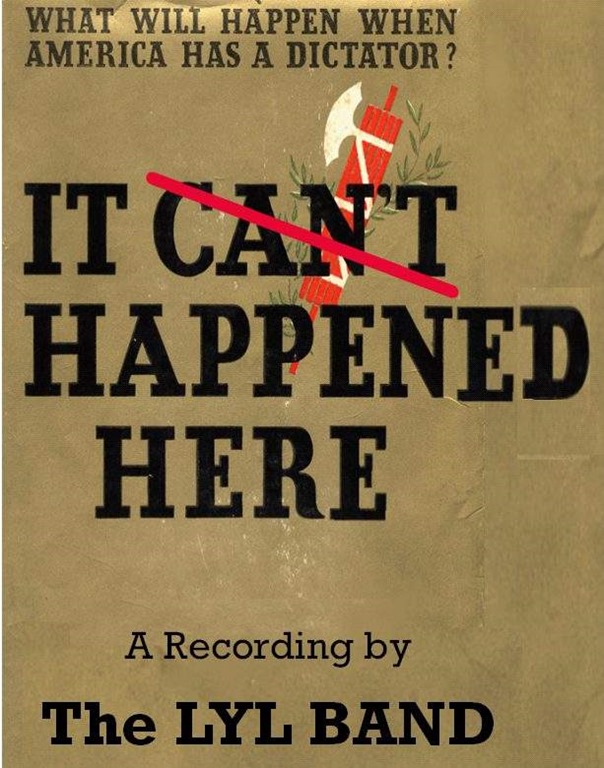
It Happened Here jacket

Listen to your first edition here. Slight wear on dust jacket.


We are now living in a time when that phrase that Lewis used for his title may seem more present than memorable. The alternative voice of this project, Dave Moore, has changed Lewis’ tense and described—what—that 1935 novel, or something else? You decide if he changed the story.

The LYL Band’s performance of “It Happened Here” plays with the gadget below.
 

The Apotheosis of Harlan Ellison

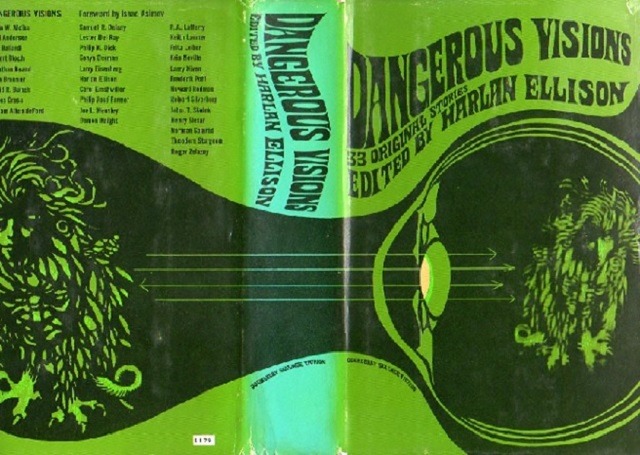
I’m not a fully-qualified Science/Speculative Fiction fan, though I did read it when I ran into it as a young man. Dave Moore, whose voice, songs and keyboard playing you’ll hear from time to time here, read more of it. I’m not sure if Dave introduced me to Harlan Ellison’s work, but my memory is that he did loan me a copy of Dangerous Visions  back in the Sixties. In that 1967 anthology, Ellison made the case that SF was the heir to a Modernist tradition of fiction using outrageous and unique situations—he was claiming SF could be more Kafka than L. Sprague de Camp.

It’s unlikely he was the only person thinking along those lines, but he certainly helped to popularize the idea at a time when an aging generation of SF writers, steeped in pulp magazines and cents-per-word paychecks were in danger of losing touch with the younger post-WWII generation who were more likely to be college educated and experienced in some chemically enhanced inner-space traveling.

Dangerous Visions cover

Used copies may have slight foxing (or are they cannabis stains?)


Ellison was an any-world-class curmudgeon. His non-fiction writing is full of enthusiasms and invective, with almost no middle ground. At times he reminds me of another late 20th Century artist/social critic: Frank Zappa. Both of them liked to remark that “The two most common elements in the universe are hydrogen and stupidity.” Over the course of his career Ellison seemed to transform from a US-born angry young man punching mostly up to a more generalized misanthropy, where at appearances he would sometimes riff like an insult comic. He once called my late wife who he had just met at an event, “Cathy Carbohydrate.”

These two things worked together. SF had always had a darker side, and the border between it and the gothic strain of fantasy or noir-ish mystery was crossed back and forth often. I believe a utopian, Transcendentalist wing of SF remains, but the terms SF and dystopia now seem to follow one another almost automatically.

Is this the artists’ fault or ours? A large question that.

Thursday night I read that Harlan Ellison had died. Friday I was booked to record with Dave. Friday morning, as I slept, I dreamed that Dave was showing me a binder full of typed manuscripts of stories he had written. As he flipped the pages I read parts of the stories. In style, they were the sort of thing a teenager just starting out would have written, so in the dream’s timeline they would have been written in the Sixties. In the dream, Dave, after learning of Ellison’s death, was telling me that Harlan Ellison had looked over these stories, and that Ellison didn’t like them very much, though he thought the last one had some promise. There was a short, encouraging note from Ellison scrawled in the margin on a page in the story. As I glanced up toward the middle of the page, I saw some dialog in which a character in the story was saying something. The character in this non-existent dream-story was named Octavia Butler.

Now I remind you: this is a dream. Dave never had Ellison critique any early stories he wrote. In the dream, these stories existed, in the waking world they don’t. But here’s the funny thing. I told you at the start that I’m not a fully-qualified SF fan. If you had mentioned Octavia Butler to me on Friday, the only impression I would have was that she was a writer. I wouldn’t have been able to name any of her work or have been able to place her in a genre. In the dream, I just thought it odd that Dave was using a writer’s name as a character in a story that the dream had had him writing 50 years ago. I was about to ask him why, when I woke up.

octavia-butler

Octavia Butler, before or after she was in my dream


I biked off for breakfast and hurriedly came back to write the piece you can listen to below.  Looking for info I might use in my song, I searched on Octavia Butler. In the Sixties, Butler was a young, unsure author, fearing that she was too “ugly and stupid, clumsy, and socially hopeless.” While she was still in school, Harlan Ellison, this man with a reputation as a scouring critic, had told her she had promise and should go to the Clarion Conference and present her work there, a suggestion that lead to her first publication in 1971.

Nothing there I could use in the song as it turns out, but strangely this was also nothing I knew when I had dreamed that dream early in the morning. I did use one bit I found in my searching: an interview with my former co-worker John Rabe that revealed that Ellison was still using a typewriter as his writing machine in the 21st Century. I thought of those older generation pulp writers and their per-word paychecks.

That afternoon, Dave and I recorded “The Apotheosis of Harlan Ellison.”  It turned out that in the waking world, Dave had not heard yet that Ellison had died. The player gadget below will let you hear it—though not on your typewriter.

A Visit from the Angels

Back more than 200 years ago, poet, painter, engraver and mystic William Blake was reported to be conversing with angels in English trees. Last episode we had William Carlos Williams celebrating celebrity scientist Einstein in a blooming New Jersey night early in the 20th Century. Today we have Dave Moore in his backyard garden in Minnesota in our present century.

Blake Angels on spiral

William Blake illustration of Dave’s Minneapolis garden night, sort of.

Is this poetry, song, or story-telling? It might be a little bit of all of them, but then labels are just sticky paper. Let me refrain this time from talking so much about the piece, but I encourage you to just listen to the LYL Band and Dave Moore tell the story. Use the player gadget below to hear it, or this highlighted hyperlink.

Parlando Spring 2018 Top 10-Part Three

We now come to the top half of our count-down of the most listened to and liked pieces during the past three months. But what if you’re new here, and you wonder what this Parlando Project does?

In short, we take various words, mostly poetry, combine them with original music, and perform them. My intent at the start was not to do this the same way each time, to vary our approach as much as we could. We’ve been doing this for a couple of years, and there are now over 220 Parlando Project pieces available here if you search through our archives. From time to time, as I look at what we’ve done, I seem to notice a “style” developing, and while I have no objection to that arising organically from my predilections and limitations as a musician, performer or composer, when I hear that I usually ask myself “What can I try that’s different?”

The poems are not always the famous ones, I like to mix in some “deep cuts,” but it just so happens that these three recently popular ones are all pretty well-known, but maybe we can bring something new to them?

In position number four we have Emily Dickinson’s “We Grow Accustomed to the Dark.”  Last time I talked about how I’m finding that Modernist poetry in English moved from a recognizable natural landscape freshly observed in it’s early poems to a more interior landscape, another darker country where new dialects of language and syntax seemed the natural tongue of that region. It may well be that WWI, with its unstoppable socially-accepted murders, was a cause for this change. The rise of Freud contributed too. But more than half-a-century before WWI, and decades before Freud published, Emily Dickinson, spurred by American Transcendentalism and her own individual genius, was exploring some of those same places.

When Dickinson gets furthest inside her own head and tries to use her mutation of mid-19th century language to describe it there, she can be inscrutable; but when she’s half-way there like in this little masterpiece, she’s exploring poetic areas that won’t be visited again until the 20th Century.

This is another of the pieces where I think my music works particularly well. Perhaps you’ll agree. Player below:


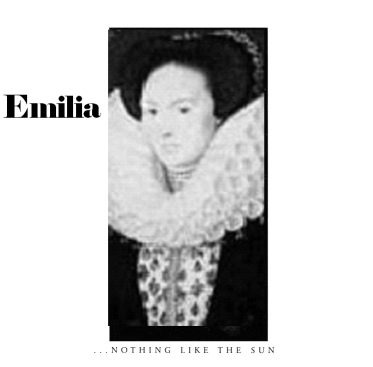
Funny how these count-downs seem to form a sequence. From Dickinson’s dark we move to the  third place piece, by that little-known poet William Shakespeare, with one of his sonnets about The Dark Lady, “My Mistress’ Eyes are Nothing Like the Sun.”  When we wasn’t supplying titles for late 20th Century Sting CDs, or writing a play here and there, Shakespeare wrote a collection of sonnets that are full of ideas woven of memorable phrases.

Emilia Lanier Nothing Like the Sun

Emilia Lanier, musician, poet and possibly Shakespeare’s Dark Lady.


I’ve always loved the sonnet, even shared a few of mine here. It just seems the perfect length for a lyric poem, long enough to develop two or three ideas costumed as images, but not so long that one will find them frayed and soiled at the cuffs before it’s done.

Hear my performance of Shakespeare’s Sonnet 130, “My Mistress’ Eyes are Nothing Like the Sun”  with the player gadget below.


And now we’re up to the second-most popular piece this past quarter, Marianne Moore’s “Poetry.”  Shakespeare’s poem in slot number three declares his love by saying the things his beloved isn’t. Poet Moore’s poem about poetry starts off famously by saying she “too dislikes it,” and goes on to tell us what she feels works an doesn’t work as poetry, including the poem’s other famous line about poetry’s goal, to show “imaginary gardens with real toads in them.” I think here again of those early Imagist poems, with their unromantic and ordinary things made into central images: T. E. Hulme’s red-faced farmer standing for the moon or Aldington’s poplar tree as a young woman or F. S. Flint finding the moon taking on the terror of a WWI Zeppelin raid. Toads all, ordinary nature, not the battalions of classical gods or the obligations of sentiment.

This piece’s popularity on Spotify continues steadily, as with “Sky”  from earlier in the count-down, I wonder if it’s the short, somewhat generic title that brings in curious listeners there.

My initial idea of the Parlando Project did not have my voice as the only reader, and the first voice you hear in this version of “Poetry”  is Dave Moore who’s been the voice in a number of pieces over the past two years. The other voices in this performance are two fine poets who’ve spent a lifetime raising toads to see what works in their gardens: Kevin FitzPatrick and Ethna McKiernan. Hear them read Marianne Moore’s “Poetry”  with the gadget below.


That leaves us only the number one to count-down, the most popular piece this past spring. It’s not a well-known poem, and it’s not by a well-known poet. See you back here soon for that.

I Thought It Mattered

Today is May Day, a day that combines many things. Neo-Pagans can point to it as Beltane or the morning that follows Walpurgis Night. Since the late 19th Century it’s been “International Worker Day” associated with labor and Socialist movements. It’s about midway between Spring Solstice and Summer Equinox.

It was also once a more or less secular holiday celebrated because by now it’s likely Spring in essence, not just Spring in some calendar’s notion in northern climes. A long time ago, in my childhood, in my little Iowa town settled by Swedes, May baskets were still exchanged—this before Easter had become one of the commercial candy holidays paired with Halloween. In Britain May Day still a bank holiday, celebrated next Monday with sundry celebrations.

In Minneapolis, this Sunday is the date of an annual parade organized by a local urban puppet theater. We will sit on the curbsides as Indigenous dance crews, drum bands, anarchists, political candidates, stilt dancers, decorated bicycles, giant papier-mache puppets, and various cause marchers pass by to music by flat-bed truck rockers and strolling brass bands. The Minneapolis May Day parade combines all those May Days into one thing, a Whitmanesque democratic cultural event, a container of multitudes spilled open on a city street.

I used to take pictures and film it, but now I just go and watch it. It may be just me, but in the past couple of years the level of invention in the costumes/puppets seems to have fallen off, but that may just be me and nostalgia filters. Ah, for the good old days of 2010! I’m holding that this is just random variation—but in the end it’s the gathering of South Minneapolis people, parading and watching who make me most appreciate it.

The 2010 theme incorporated William Blake, and my soundtrack to this slideshow features Blake’s “The Tyger.”


Today’s audio piece, “I Thought It Mattered,”  has words and music by Dave Moore, and is sung by him along with our more spontaneous incarnation, the LYL Band. Dave’s song speaks of lifetimes, marchers and causes. I think it’s one of his best songs, so give it a listen using the player below.

Poetry

Today’s audio piece marks the 200th published by the Parlando Project! Since presenting our first piece, Carl Sandburg’s “Stars Songs Faces”  back in 2016, we’ve combined words (mostly poetry) with original music as varied as we can make it. Those who’ve followed along know that the words we use are generally written by others, because that lets me encounter them, as I hope you do too, freshly, to discover anew what charms they have.

Not only does the music vary, but how we present the words varies too. Sometimes we sing the words, sometimes we just speak them, sometimes we chant or intone them.

Marianne Moore with pony

“Like a horse that feels a flea” Marianne Moore around the time she wrote “Poetry”


Through this past couple of years, Dave Moore has been the alternate reader here, and I expect that you enjoy the break from my voice once in awhile (as I do). For today’s 200th piece, and for April’s National Poetry Month, I’m pleased to present Marianne Moore’s “Poetry”  read, not by me, but by the “Lake Street Writer’s Group,” a small group of usually poets who’ve met since the 1970s, which took it’s name from the inner-city commercial street near where they lived. The first voice you’ll hear is poet, musician, and comics artist Dave Moore again, the second is poet and writer Ethna McKiernan and the third is poet Kevin FitzPatrick, who has the honor of having the latest book published by a member of the group, Still Living in Town”.

Minneapols Moline Tractor

MM of another color. Minneapolis-Moline once built tractors in a Lake Street factory. Marianne Moore was once asked by a car company to suggest the name for a new model. One of her suggestions: Utopian Turtletop


It was my idea to ask them to read Marianne Moore’s poem, since Moore herself breaks her poem up into various voices, not only from abrupt changes in diction but with the use of quotes. My thought was the changing voices would emphasize the poem’s stance of speaking for poetry’s audience.

I broke this on the group of poets cold, and they are reading the poem off a page I gave them, which divided “Poetry”  up in small beats and phrases of the poem. Remarkably—well, maybe not all that remarkably, Dave, Ethna, and Kevin are all excellent readers of their own poetry—what you hear is one take, just as they read it, just as they handed it off verbally from one to the other around a room. They had no musical backing to hold their cadence, only Marianne Moore’s words. I wrote, played, and recorded the music later: drums, bass, guitar, and piano.

What I hear coming out of this is the same thing I aim for often here. Just as you are encountering the poem’s words freshly, as they hit your ears, the performers are doing the same. Sure, we may have heard or read the poem before, but it’s another’s voice, happening now, that is conveying it to you. We use music with the words here, and with the other Parlando Project pieces, for several reasons: it reminds us that poetry is musical speech, that poetry works in its sounds, its rhetorical flow, and the harmony of imagery like music; and because it offers the option to relax the cause of the words meaning.

There’s not one missed word in the trio’s cold reading, which is more unusual than an accident.  When I’m improvising melodic lines freely, I accept that I’ll need to deal with “wrong” notes, musically creating (to vary from Moore’s famous line) “imaginary gardens with real clams in them.”  To hear the group read “Poetry,”  use the player gadget below.


Vegetables dream of responding to you

OK, let’s reveal where the words from the last post, Poetry in Translation,  came from and what I know about their context—but stick around, as this is going to relate back to those 20th Century theories about how poetry works. If you haven’t listened yet read and listened to Poetry in Translation,  this would be a good time to scroll down and do so.

Earlier this month I was making some tea and talking to my son in the kitchen. He asked about what kind of tea I was making. I picked up the box to show him, Tazo Peachy Green tea. I noticed there was something more than an ingredients list and those filled-circle graphs of how much caffeine was stuck inside the individually bagged dried leaves. So, I broke into my Parlando Voice, improvising line break pauses as the early 20th Century Modernists have ingrained in me, and read it to him:

Poetry in Translation from Tazo Peach Tea

Modernist verse in the supermarket?

My son, now a teenager, is making sure that he’s nobody’s fool. “They must be smoking that tea, not drinking it.”

We both laughed.

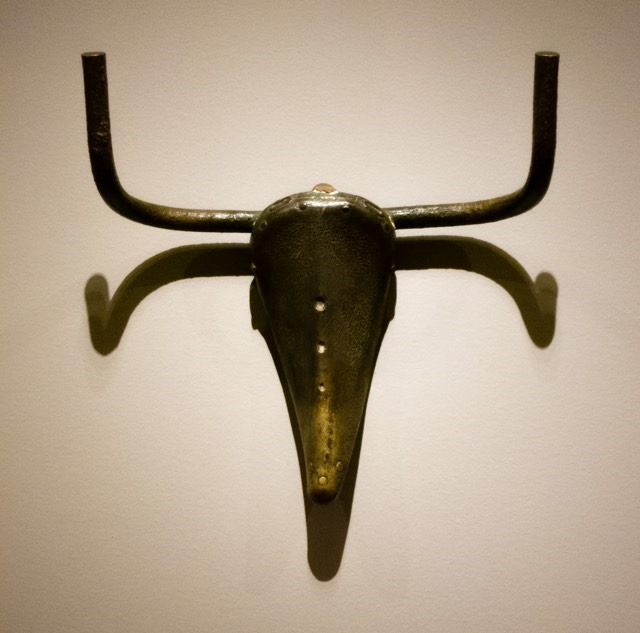
Modernists a century ago would have liked this. “Found Objects” and use of commercial ready-mades in art and Dada japes were ingrained in Modernism during its avant garde phase. I’d have fit right in at the Cabaret Voltaire in 1916 if I was to have read this wacky and rapturous advertising copy from the tea box while Hugo Ball played piano.

picasso-bulls-head
Some will see a Picasso sculpture, others will wonder if a bicyclist won’t be able to ride home

But as Modernism moved to the universities, and I. A. Richards’ and John Crowe Ransom’s “New Criticism” solution to the problem of unreliable interpretation became predominate by mid-century, things would change.

Simplifying wildly, the New Criticism suggested that the reader, not just poets and writers, needed to get under the hood and figure out what made poetry run. Inside every poem was the ideal poem, an expression of complex ideas or states of being placed there by it’s writer. The poems surface, though it may have some interest itself, was only the wrapper surrounding this more sublime poem. This bridged over the revolutions in poetic language, by making less important changes in the way poetry spoke, such as the widespread use of rhyme and free verse. John Donne, John Keats, Gerard Manley Hopkins, T. S. Eliot, Wallace Stevens—the different music of the words made no difference, the rich images portraying important thoughts could be studied side-by-side.

Imagery became poetry, more or less (yes, meter and sound were still attended to, but they dropped in importance). The original Modernists, including the Imagists, sought to kill off centuries of ingrained and tired imagery that had become merely decorative, and replace it with more integral and concrete images, palpable things. But just as when one finally cleans out a closet, time passing will clutter it again. If images contain the soul of poetry, and if deep reading is the best and proper way to encounter a poem, then complex and hermetic images will offer more of the poetic experience.

There’d been something of a cult of great poetry before, often based on important subject matter or the extent of readership, but as the New Criticism ascended to orthodoxy, the ideal of great poetry became stronger and used new criteria. Poems with densely jammed complex imagery requiring close reading and educational training to comprehend were great. Poems that didn’t do this were highly suspect—and likely harmful, in that they did not reinforce this new critical understanding of the soul of poetry.

As I said last time, this is how I was taught to understand poetry in the midcentury.

How can we return to the box of tea with its peach singing to the cucumber of its deathless desire? The midcentury New Critics presumed the supremacy of the poem and the poet’s intent. Later in the 20th Century new literary theorists arose, and the subjective experience of the reader became the place where the poem existed. The poem means what you think it means, which may be different from what another reader thinks it means. Meanings extracted from even the merest of texts could still be complex and valid. The intent of the author is not important, they could well be mistaken.

Now our singing peach isn’t a joke at the expense of exalted literature, it’s an expression of the woo of consumer culture signifying exotic essence through the appropriation of an ancient amphitheater dramatizing barely sublimated vegetable desires. Or it may be something a tired copywriter churned out on Friday afternoon before leaving work and picking up takeout on the way home to feed the kids.

As I said, I’m simplifying, but for the mid-century New Critics the poem existed objectively deep inside the poem where the poet put it. For the late 20th Century Deconstructionists and their contemporaries, the poem existed subjectively in its readers experience of it and the structures around that.

Coming up, is there a reconciliation between those two views? How will the 21st Century view what poetry is and where the poem lives? Will the cucumber and the peach find a meaningful relationship before they are dried and bagged?

Don’t worry if you’re missing the usual music and words meeting up here, we’ll return to that soon enough too. I promise variety, not predictability. To tide you over, here’s Dave Moore and the LYL Band running through his song, set in the late 19th Century, called “The Green Fairy.” 

Solstice Featuring Dave Moore

Yesterday’s post and audio piece had Dave Moore combining the poetry of William Blake and Christina Rossetti, but today we have him singing the work of yet another English mystic as well as his setting of a lyric by Emily Dickinson.

For those readers and listeners in the Northern Hemisphere, tomorrow is Winter Solstice. I write from Minnesota, fairly far upward and north in latitude. Winter Solstice is the darkest day of the year, with the sun not rising until almost 8 AM and the sunset clocking out of work early at 4:20 PM. Despite our colder climate, that’s about the same as London’s solstice daylight and a hour longer than Edinburgh. Minnesota’s famous Scandinavian immigrants, as one comic once put it, traveled across the whole wide ocean just to find the one place as cold, dark and miserable as the place they’d left—well I checked—they picked up 2 to 4 hours more midwinter light.

Of course the new year is less than two weeks off, and solstice is the shortest  day—not the entry into a dark season, but the beginning of a gradual expansion of daylight, cold daylight though it may be. For this reason it’s been a fairly widespread feast day across cultures.

However, for writers and musicians, the cold and the dark is no great hindrance. Sure it may blunt our moods, and stunt some mitigating outdoor activities, but our products are part of the festive in the darkness, and they can be like the shared quilt or blanket on the coldest night. Yes, before indoor lighting technology, scholarly reading was curtailed, but the poets of that dark time could recite from memory, needing no light bulb on their lectern. The sounds of strings, the dunest drum and the golden cymbal, travel without light.

And our partners and families don’t need light either to be known to us. They don’t even need poetry or music, their plainest word in the darkness is song enough, if we can hear that as one note in the slowest song that is our life together.

So, for today and the Midwinter Solstice, here is Dave Moore singing Robyn Hitchcock’s “Winter Love.”

The LYL Band tackles the darkest time of year


And for the short passage of the daylight, here’s Emily Dickinson’s sublime lyric about the transit of a day, “I’ll Tell You How the Sun Rose,”  also sung by Dave.

And don’t forget, we have over 160 audio pieces here, available in the archives on the right. Why not check out some from before the time you first heard of us?

A Song in the Garden of Love

Today we offer a respite from my voice and the return of alternate Parlando Project presenter Dave Moore. And since it’s been a few days since the last new audio piece, today’s piece combines a lyric written by William Blake with one by Christina Rossetti. Two great poets in one piece! Ladies and gentlemen, there is no greater value you can find today in the poetic words mixed with music marketplace!

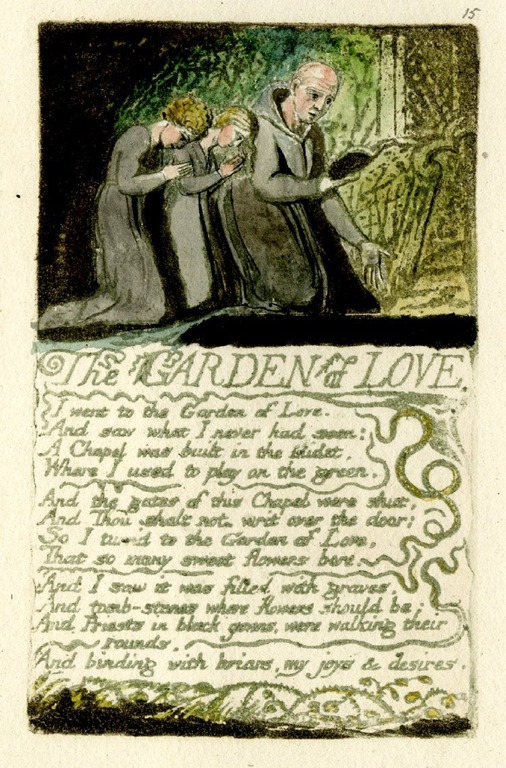
Both pieces are stated by their authors to be songs, either in the name of Blake’s collection where “The Garden of Love”  first appeared, “Songs of Experience,”  or in the title itself for Rossetti’s piece, which she called just “Song.”

So of course, both pieces have been set to music and sung before this, but it was Dave Moore’s idea to combine the two pieces; and one can immediately see once he did this, how tightly they fit, with Blake sorrowfully reporting the graves in the garden, and Rossetti musing on the grave and its landscape.

Rossetti wrote her “Song”  while still a teenager. Unlike Blake who was born in a religious dissenter family and grew increasingly distrustful of the corruptions of organized religion, Rossetti would become one of the most graceful and modest of the poets of the Victorian Christian revival. Strange, isn’t it, that the two poems mesh together.

Christina Rossette on staircase

“If you listen very hard, the tune will come to you at last”
Christina Rossetti listens for inspiration, or puzzles over her holiday gift list


Speaking from my poet/musician duality, the version of “The Garden of Love”  that I most recall is the one recorded by Allen Ginsberg in December of 1969. Ginsberg’s recording is played, followed by a 20-minute discussion of the poem and performance here. The four speakers in this discussion mull on the country music waltz feel Ginsberg performed the Blake too. If I were in that room, I could have replied from the musician side of that duality, that in 1969 there was a bloomlet of counter-cultural figures essaying country-music tropes to the puzzlement from the hippie audience as to what level of irony was intended. Two musical figures close to Allen Ginsberg had taken part in that move earlier that same year: Bob Dylan with “Nashville Skyline”  and Ed Sanders with “Sanders’ Truckstop.”

Wm Blake The Garden of Love

“A dominie in gray…led the flock away.” Blake’s self-illuminated song.


Our performance of this mixes Dave’s somewhat church-hymn organ (Ginsberg often used a hand-pumped harmonium organ in his live performances) with my country-ish Telecaster electric guitar, so perhaps Ginsberg’s country move was stuck in my memory as we performed this. Here’s what Dave Moore said about his performance:

“Wayback Machine time.

This song goes back to the early days of the Reagan years, which he ended up forgetting but we can’t.

Probably this is my first attempt to put music to classic poetry, I just thought they fit together so well & expressed both despair and hope so well. This one is my favorite vocal of all attempts at this piece. My introductory verses for each poet are new & I wish I’d separated them from the two little poems better, but that’s what you get with one-takes. Ah, sweet death, we can still sing.”

Dave points out a contrasting benefit of the pieces here performed as the LYL Band, which are not only “one-takes,” but are often pieces that only the composer-vocalist has any sense of the structure of, leaving the rest of us to follow and create parts on the fly. This leads to a certain roughness, and yes, at times, tentativeness too—but I believe there is a corresponding sense of the undiscovered and its discovery that may come across to the listener.

To listen to the LYL Band perform Dave Moore’s pairing of these two beautiful, yet sad, English lyrics, use the player below.


Thanks Owing

A holiday for it, so this is due.

yard turkeys

Have you changed out your summer flamingos for autumn yard turkeys yet?

“The Parlando Project,” my 2015 dream to present over a hundred audio pieces combining various words (mostly poetry) with various music, has now reached 155 officially published pieces. For those who’ve taken some of your attention and spent it listening to me present my take on the words of others, primary thanks is due to you. Despite the amount and variety of material I present here, I respect that your attention is precious. Thank you!

Thanks even to the unintended. The strange movements of technology and trade have allowed highly flexible musical instruments to become available at low prices. Most of what I use to make this did not exist one hundred years ago, and in the past few decades, the cost of these instruments, software and recording technology has declined into broad affordability.

Similarly, the Internet, so easy to dismiss for its mundane temptations, has made the availability of artistic materials “ubiquitous everywhere” that tautologies are sold.

Both of these things, the music technology and the Internet, are so enabling of creative work that it seems almost sinful to me to not apply my human imagination to them. But, as with many things, avoiding one sin leads to the commission of others. So, thanks also to my family for the forbearance that has allowed this project to get the amount of time and attention it asks for.

Thanks to Dave Moore, who lets me take a break from presenting my voice uninterrupted , and whose words are presented in some of the most listened-to pieces presented here.

Thanks to the Modernists of  100 to 150 years ago, who showed us fresh ways to use language, and shared their complicated hearts, heart’s beats, and apprehending eyes. Thanks also to their foresight to publish their work before 1924, so that we’re free to demonstrate to the still living what they did. Alas, the leading sadness in this project for me has been the large number of works by no longer living writers whose work you and I cannot speak publicly, because our copyright laws forbid it.

No new audio piece today, instead, here’s one of the first officially released pieces of the Parlando Project, words adapted from Dave Moore. I view it as being about the people left even farther behind than the signed artists of famous paintings. It’s called “Netherlands.”

I’ll let it be a reminder that there is a whole lot of material available here now, so using the Search… box or just click-wandering through the Archives months on the right will allow you to listen to more of the variety that Dave and I do.

Subscribing to the blog either through the “Follow” button near the top, or on the WordPress Reader, will let you know about new posts as they occur, or if you just want an easy way to get the new audio pieces for listening to them off-line, you can do that by subscribing to the “Parlando – Where Music and Words Meet”  podcast on  iTunes, Google Play Music, Player.FM, Stitcher, or wherever you get podcasts. The “Parlando – Where Music and Words Meet”   podcast is free of course. [note: I’d previously mentioned using the little orange RSS buttons to subscribe to the blog, and for those who have an RSS-aware app they will  still work, but the Follow button I’ve just added today makes this easier for most.]

Here’s the player to listen to “Netherlands”