Bavarian Gentians

One of the things I’ve loved about doing this Project is the varied ways that poems come into consideration for performance within it. I’m not even sure after reaching 850 of them today, that I could catalog all the ways the words have come forward. Here’s an example: last week my wife was visiting a wildflower area — something she does often enough that I kid her that she’s a nature nymph with all the powers and duties thereof. She’d taken some pictures. One she showed me was of gentian flowers.

“Do you know D. H. Lawrence has a poem about blue gentians?” I asked

“The flower or the dye?”

“Mostly the flower as I recall.”

In actuality, I couldn’t recall much about Lawrence’s poem, only that it had once impressed me around the age of 19 or 20 when I had started to read poetry more widely. Now the old man-me did a quick web search before going to sleep that night and found Lawrence’s “Bavarian Gentians,”  likely the Gentian poem I’d barely remembered. I copied it and saved it for further exploration around a Parlando Project performance.

This week I began to work on that. The first thing I noted was the poem’s odd word-music. There is enormous use of repetition: words “blue,” “black”, “dark” and “darkness” reoccur constantly, and the flow of the poem seems less that of normal prose or poetry and more like a stuck-record ostinato.*  In performance I couldn’t see how to treat this as an elegant set of refrains, so I based my eventual performance on my first impression of obsession.

But there are twin narratives inside the poem’s babbling: observation of the gentian flower itself in the Imagist manner, and a retelling of the Persephone in Hades myth. What I feel links them (other than the obsessive refraining about the dark blue color of the flower and the coincident darkness of Hades’ underworld domain) is that flowers are the reproductive organs of plants, and the Hades and Persephone, daughter of Demeter, myth is about a male/female couple in the context of Demeter’s goddess of fertility.

bottle gentians by Heidi Randen

The bottle gentians that led to today’s piece. Like the Bavarian gentians in Lawrence’s poem, dark blue and autumn-blooming. This genus’ flowers stay in this closed budded shape, which hampers pollination, while the Bavarian gentians open into the vase or torch shape described in the poem.

.

And then, as I was fairly far along in my work with the musical performance you can hear below of “Bavarian Gentians,”  I made a discovery. There are two candidates for the official, presumed final text of this poem. It just so happens, the one I found in my quick bedtime search was the lesser-known one. The version that instead will be found in most cites and collections treats the Hades/Persephone/Demeter material at a more abstract level, while the one I’d been working with is much more raw and troubling. Note: I’m not a strict adherent to content warnings, but the account in the version I was performing likely deserves one: it’s an incident of sexual violence. Here are links to the two versions of the poem: the smoother one, and the rawer one I used. Keith Sagar and some other scholars question the predominance given to the smooth version and argue that the more explicit take was Lawrence’s final revision.

I can see how the more often reprinted version of this poem was chosen. It’s more graceful I think, and one could read that kind of change as the path of an author’s revision where later, more-removed, artistic judgement polishes the rough-hewn inspirations — but it could also be the kind of revision made to make something more marketable. Now knowing of the other version, I briefly thought I should redo my performance using it — it might communicate better to a listener who might only hear it once —  and another reason I considered a redo: the sexual violence depicted in the version I had first found presented problems.

I’ll briefly outline that problem. Let me summarize the Hades/Persephone/Demeter myth. Hades, the god of death and the underworld, abducts the young Persephone to be his bride against her will and she is unable to escape from this situation. Her mother, Demeter, a more senior and powerful goddess, intercedes and a compromise is reached. Persephone will be able to rejoin the above-ground world of the living, but she must return every winter back to Hades and his underworld of the dead. The myth here is transparently an explanation of the growing season in non-tropical regions. Told at an abstract PG level, and particularly in the expectations and context of classical non-equalitarian and clearly patriarchal society, it’s a “just-so-story.” We are not to experience horror with it.

But in Lawrence’s lesser-known version, this scene is portrayed: the poet’s speaker, using the gentian flower as if it could be a lamp, follows an abducted Persephone and Demeter, this child’s mother pursuing in rescue. They enter Hades, a place of complete darkness, Persephone and everything else for that matter cannot be seen, but sound remains — and this is heard: Hades (called by his Roman name, Pluto*) is raping Persephone.

Did Laurence mean for this account to make us recoil in horror, as I did when I needed to confront the text for performance? Shouldn’t the text call for that? Or was it intended as just some ancient fantastic myth given a bit of specific detail for which the author had and expected no overwhelming empathetic reaction? There are readings of this poem’ that see a metaphoric synthesis which is only on some surface level horrible, and something else on a metaphysical level.

I don’t know enough to say for sure, if there’s a “sure” in this case. Like the sexual violence and exploitation that was woven into Eliot’s “The Waste Land”  without drawing significant emotional weight from most (and mostly male-oriented) readers for decades, it could go either way in authorial intent — but I’m not the author, I have to perform this, I feel that horror, and I expect some listeners will feel the same. Frankly, this makes me a little dissatisfied with my performance of this piece, though I tried not to shirk its implications, however imperfect the result.

What could have driven Lawrence to use this myth in such a way, and in this version, to keep in the horror? He was working on this poem knowing he was facing a mortal illness. Like poets John Keats and Adelaide Crapsey, he was dying of tuberculosis. I have no knowledge of his experience of sexual violence, but Lawrence was undergoing viscerally an abduction against his will into the underworld of the dead. He might have felt that his poem, starting and ending on the consideration of the (by natural fact) bisexual flower justifies that element of considering Demeter and Persephone, and his anima will be taken away to die along with the rest of him by the disease. Make your own judgements on these issues; they may be wiser than mine.

The final line of this version has a contrasting power to what precedes it. The erect yet open gentian flower — which despite its shape was after all useless as a torch in Hades’ dark —  spreads in dark welcome at the draught of the light of a day.

If you’ve progressed this far past the trigger warning, you can hear my performance of one version of D. H. Lawrence’s “Bavarian Gentians”  with the audio player below. No audio player to be seen? Some ways of viewing this blog suppress showing it, so I offer this highlighted link that will open a new tab with its own audio player for those situations.

.

*I figure much of my audience is old enough to grasp that metaphor, but a footnote for the rest: the vinyl record with a deleterious wound to its groove which won’t let the needle progress beyond one stuttering spiral revolution.

**Lawrence’s use in the poem of the Anglicized Greek names for Persephone and Demeter, but the Roman name for Hades, Pluto, puzzles some readers. I suppose it could just be a Cortez-on-a-peak-in-Darien kind of poetic error, but I wondered if this poem, written in 1929 might have been recently soaked in the Pluto name from the discovery of the then considered 9th planet. Close, but no cigar: Pluto was discovered in February 1930 at an observatory created by the poet-related astronomer Percival Lowell in the American Southwest region that had recently been Lawrence’s home.

My remaining theory on why Pluto? Having the underworld and its god-king both using the same name Hades makes it harder to distinguish between the two.

A Winter’s Tale: A cold mystery for Halloween

Having done over 700 audio pieces in the more than 7 years of the Parlando Project, I take pride in the variety of the original musical settings I’ve supplied for them. Oh, there are more than a few of the performances over the years that embarrass me: stuff were my problematic vocals don’t deserve parole, or arrangements where I can’t now tell how I ever thought they worked, or those where it would have been better if I’d had access to better musicians than my overdubbing, but many of them still sound good to me.

None sounds better than this one as we near the end of my Halloween Series presenting some of the listener favorites from those 700-plus pieces. “A Winter’s Tale”  sets a should-be-better known poem by D. H. Lawrence. For some of you that poem’s climate is going to seem premature — and you may even wonder why it fits a Halloween theme. I assure you in Minnesota, in the northern parts of North America, this poem is not out of season. We’ve had no snow yet, but my morning bike ride was –5 Celsius. And tomorrow? Those thin polyester costumes sold at stores for trick or treating are not right for many a Minnesota Halloween. And any creativity in making one’s own costume is suppressed by the eventual need for an overcoat which will cover it. And what of Lawrence’s poem — here’s a link to the text of the poem — what’s Halloween about it?

Winters Tale 1080

A long way between houses just for some candy.

.

Well, it’s quite mysterious. This is the third time I’ve presented it, and I’m still not sure what the specifics of the described wintery mystery are. At times it seems like a breakup or strained love poem. Other times it seems like a hunting poem, metaphorical or not. It may have some connection I’ve not fathomed to Shakespeare’s play concerned with virulent mistrust. If it’s a hunt, I can’t even say who the speaker/singer and the hunted are. One or the other may even be Winter itself. That mystery and the air of danger are enough to make it a Halloween poem, and after my musical work, a Halloween song.

You can hear it with the audio player gadget you should see below. No player to be seen? This highlighted link is a backup that will open a new window with its own audio player.

.

The Most Popular Parlando Project audio piece this past spring is…

Here’s something I’ve noted in the years I’ve been doing this: these quarterly Top 10 lists advantage pieces posted earlier in the season since they have more weeks to accumulate listens and likes. So it was quite an achievement for D. H. Lawrence’s “A Winter’s Tale”  posted near the end of February to make it to number 4 in our last-winter countdown, but it happens. After all, this time, “They Say Life is Precious”  released in the middle of May this year, made it to that 4th position in our spring’s list.

Still, past the earliest days after posting there’s a predictable drop off slope. Listens are “front-loaded” as people notice it as a new post or podcast, and after that it’s mainly the explorers and those who find things from a web search. I am gratified that many of you check out our archives and listen to the nearly 350 audio pieces we’ve already presented, but the sheer number of pieces means that the long-tail listenership tends to be spread between those hundreds of pieces, making repeat appearances in the Top Ten rare—but we have one this time, one all the way at the top.

And it’s that D. H. Lawrence piece, “A Winter’s Tale.”  I can see how: a large number of folks were still discovering and listening to it in March, and after the expected dip in April, more people actually listened to it in May than April. But I don’t really know the why.

D. H. Lawrence’s poetry* is not exactly forgotten, but he’s still better known as a novelist—but that could help if the interest in novelists is greater than that for poets.

Was it the music I wrote and played for it? My music for “A Winter’s Tale”  was rather explicitly ‘80s related, what with the piece’s arpeggiating synths and big reverbed drums. I do rather like what I accomplished there, both the recording and the ideas of the musical arrangement still sound good to me, and so perhaps they did to you. One memory I have of doing the piece was wanting to remember to make use of silence. I always need to remind myself to do that, and too often I don’t obey. Listening to Mark Hollis’ music as I wrote and arranged this piece may have made that reminder stronger this time.

Shakespeare-Hollils-Hendrix-Lawrence quadrent

OK, some of you guys must have helped make this spring’s Number One.


Was it the title? Shakespeare** seems to be a reliable boost to interest over the years (sort of like putting Jimi Hendrix on the cover of a guitarist magazine), and Lawrence’s title is shared with a Shakespeare play. Was it Lawrence or Shakespeare drawing those later listens, or the combined power of both?

Like I said, I don’t know why, but thanks for listening and reading this spring! There’s still a fair amount of In Real Life and studio re-organization putting pressure on the amount of new music I can put together, but I still hope to be dropping new audio pieces this summer and writing about my experience with the words.

So here it is, as we approach summer, the enigmatic story of D. H. Lawrence’s “A Winter’s Tale” that’s just a click on the player below away.


*I’ve called Carl Sandburg “The Forgotten Imagist.” His early poetry uses the Imagist rules, but despite the way he wrote, Sandburg as a person doesn’t “read” as an Imagist: an immigrant’s child who wasn’t seen in Paris and London, and who wrote often about the world of work and those who sought and were bound to it, he doesn’t seem the aesthete (even though he was, in part, that). D. H. Lawrence too doesn’t inevitably get called an Imagist, even though his verse shared some Imagist characteristics and he was published in the movement’s anthologies. Lawrence was never viewed as a theoretician or leader in Imagism, and socially he mixed with poets like Edward Thomas and Witter Bynner who were outside the movement. Is he too a forgotten Imagist, or just “Imagist-Adjacent?”

**One measure of Shakespeare’s strength to draw listeners is a piece I did taken from Shakespeare’s play “Twelfth Night”  which I still find embarrassing. After seeing what friend of the blog Weekesgaehl could do with her actual acting chops I figured I’d give it a go with a short scene from the play to frame a song found in it. The song turned out just OK, but my “acting” lead-in makes me cringe. Tragic fate and the draw of Shakespeare made sure a whole lot of people listened to that one—and continue to listen to that one—sustaining my embarrassment.

The Parlando Winter 2018-19 Top Ten part 3

Should I stop for a moment in our count-down of the most liked and listened to pieces this past winter to describe briefly what the Parlando Project is? After all, there are always new people coming upon this stuff.

What we do is take various people’s words, mostly poetry, and we combine them in various ways with original music. The music too is not one style. Sometimes we sing the words, but not always, or even usually. Sometimes we read them or chant them or talk-sing them. Singing gives a particular effect to the words, and though I admire many examples of art-song, including some examples that use the same texts that I’ve used, I think there are other facets of the poetry that can be shown with other performance styles.

I wish we had more modern or semi-modern poetry here, but very soon in this project I determined that the effort to obtain the rights to creatively engage with work still in copyright protection would reduce the amount of encounters we could produce.

Limits and restrictions often engender creativity though. I’ve found that being largely restricted to the pre-1923 public domain world still allows me centuries of material to pour over, and there seem to be a great many under-appreciated and forgotten writers to discover. A lot of what I end up using is work from the first part of the 20th century, the Modernists that established the world of literature we are still continuing and reacting to. It’s been fascinating to experience this early formative time of Modernism by adapting and performing their words.

Now let’s return to our countdown with numbers 4, 3, and 2 in popularity this winter. Yes, they’re all early-20th century Modernists. And one poet takes two slots in the countdown today.

4. A Winter’s Tale.  D. H. Lawrence is another novelist who was also a poet. In my youth he was probably better known for his novels, and their spicy rep in the mid-century world no doubt helped his youthful readership. I recall reading some Lawrence poems in the sixties and I remember liking them then, but I have to say that my interest in them didn’t continue. Now in this project, in this century, I’ve run into him again. The Imagists who kicked off British literary Modernism considered him one of them.

I liked this poem of his, even though I still can’t say for sure what’s going on in it, but we often can forgive that in the context of music and words. My musical setting for an early 20th century poem kind of took some small inspiration from the late 20th century music of Mark Hollis (of Talk Talk) who died last month.


D H Lawrence in Mexico 1923

D. H. Lawrence asks “Is that a Mexican poncho, or is that a Sears poncho?”


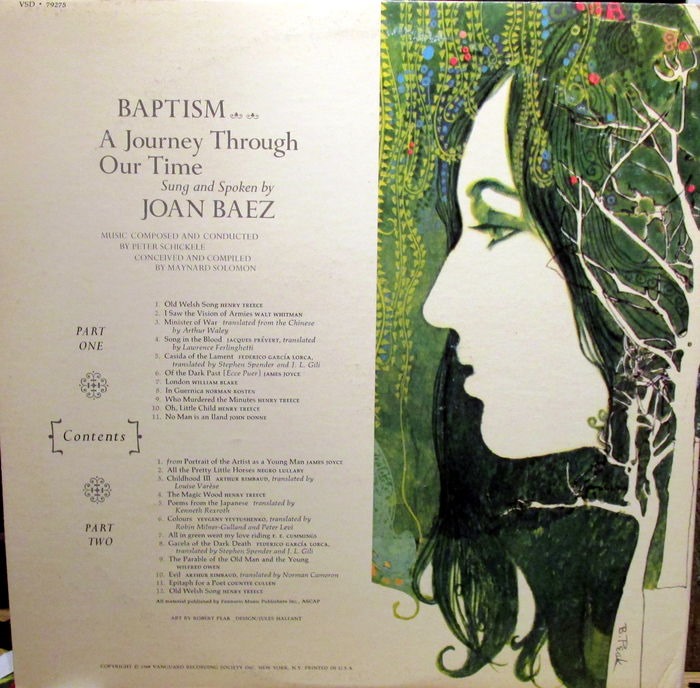
3. Gacela of the Dark Death.  Here’s another work that I translated into English myself for presentation here, a poem of passion and wit from Spanish poet Federico Garcia Lorca. I actually first heard this poem as part of a project that attempted to do something like what the Parlando Project does: Joan Baez and Peter Schickele’s 1968 LP Baptism.  Baez read Stephen Spender’s translation of Lorca’s poem earnestly there, and the poem’s title would lead one to read it as sorrowful. As I translated Lorca’s Spanish I sensed a more playful and mocking attitude in some of the images, and my performance tries to bring that out from my translation. As part of conveying the emotional range of the piece, I sang the opening and closing sections while speaking the middle of the poem—an example of how singing and speaking words changes the experience of them.


Baptism back cover

Baez and Schickele do Parlando 51 years ago


2. Self-Pity. D. H. Lawrence again, but a different kind of poem from “A Winter’s Tale.”  Shorter, and superficially an Imagist poem, it so clearly makes its “no whining” point that it was once used in a film by a drill sergeant. Poetry that makes straightforward self-improvement/empowerment points was not that common in early Modernism, and it’s not the usual way to literary cred these days either. I’m not sure why that would have to be. There’s an audience that likes it, and the 19th Century revered some poets who plied lessons like this poem does, although usually with many more words and stanzas. My best guess is that artists, particularly now in an era when literary poetry is something of an outsider art, like novelty and rebelliousness too much to settle for earnest self-improvement.

Well, this poem isn’t one of my favorites, but you know something: I need its message some days as much as anyone. I may have worked extra hard on the music I wrote and performed for it to compensate for that.


So what will be the most popular piece from last winter? I’ll be back soon to reveal that.

A Winter’s Tale

When I first conceived of the Parlando Project several years ago I did not plan to analyze the poems I presented. My original vision was to present the combinations of music and words directly, unmediated.

I had several reasons, including that I didn’t think I was particularly good at that, but the chief reason was that I was worried that was too easily associated with the idea that poetry was some kind of tricky riddle meant to lock out it’s meaning from the unworthy, rather than a different way to approach how things are.

For every person who is satisfied by “solving” a poem, there are twenty-times more that find the effort not worth their time or attention, and a not unsubstantial number that have been found-out for bad readings, wrong guesses, and are shamed from ever making another attempt with poetry. Or for safety and comfort,  some readers will restrict themselves only to poetry that seems to reveal itself at first sight.

The experience of poetry as rote code-breaking or writing of it like a video game cheat solution, even if you find that sort of thing engaging and fun, reduces it. Constraining your poetry experience to easily-grasp aphorisms and reassuring sentiments also limits it.

Once in operation the Parlando Project didn’t follow my plan. If you’ve been reading the more than 300 posts here accompanying the audio presentations of poetry, you’ll have seen that most of the time I present some kind of explanation of what I think the poem means. How’d that happen? Mostly because I ask questions as I experience the poems, and then I think “Why not try to find an answer?” Those answers often delight me, and I can’t help but share them.

And maybe that’s just as well. Get the puzzle part, the explain part, out of the way and we can get on with the enjoyment of the word-music, the music-music, and the innumerable costumes, persons, and ways of speaking by which the poems come walking up to us.

Why introduce today’s piece, D. H. Lawrence’s “A Winter’s Tale”  like this? Because I can’t tell you what this poem of his means to me, at least not yet. For a moment I stopped myself and asked how I could perform or present this without knowing that.

If you’d like to see the whole text of the poem, you can view it here.

Lawrence, better known as a novelist, was also a poet published in the early Imagist anthologies, and this poem fits well into that new Imagist idea of how poetry should present things. Minnesota is covered by a couple of feet of snow at this point in our particular winter this February. The winter landscape Lawrence presents is vivid and rhymes with my experience.

English planter in early spring

Early spring in England, daffodils in the grass, flowers in planters…and then snow.


It’s the other character besides the poet/speaker/singer and the landscape that puzzles me. It’s only a pronoun, “she.” And what do we know of “she?” Female. Walks out in the deep snow, no mention that there is any accompanying her. “She’s waiting.” For what? We aren’t told directly, though the lovely line that describes her waiting “Impatient and cold, half sobs struggling into her frosty sigh” is both vivid and mysterious. England isn’t as cold in winter as Minnesota, but no sane and competent person goes standing out in the rural snow alone without some good reason. Well except for hunters, and my sane statement still stands. I did give some thought about the poem being a hunting story, but I can’t think of any English game that would be large enough to sob and sigh.

The last stanza only compounds the mystery for me. She’s “come so promptly.” Huh? Sounds like there’s more than a common-sense supposition that there must be a reason for her to be there. The poet/speaker/singer steps to her, and the poem concludes before it tells us, saying only the question “Why does she come, when she knows what I have to tell?”

I read one attempt to explicate this as the story of a woman who has come to meet her lover who is about to break up with her, keying partly off the line that says she’s come promptly though she knows that “she’s only nearer to the inevitable farewell.” I don’t have anything better myself, but I’m not buying that. Another says she’s death. I could go part-way for that, although then what’s she/death doing knowing about and being constrained by farewell? Death breaks up with us, we don’t break up with death!

Could she be winter? The poem’s opening says winter has just arrived or returned overnight, so there’s a link to the “promptly” remark. That gorgeous sobs and sighs line could be winter winds. If this is so, then what the poet/speaker/singer has to tell winter is that they know spring will inevitably come.

And so my appreciation for the mystery continues, it isn’t solved now, and it was far from solved when I performed this earlier this week, singing only the question, and thinking of Mark Hollis. It was intriguing to forget certainty as I sang lines of uncertain meaning, but I could grab onto their beauty and find emotional hooks in threads even if I couldn’t view the tapestry. My earlier experiences of this poem, particularly when heard aloud and formed in my voice, are no lesser than my experiences after questions and possible answers.

It’s my hope, as it has been since I started this Project, that you can do the same, and listen to the audio pieces (perhaps several times if you are intrigued) and let meaning and the emotions that surround it accrue in its own time, for your own self. The player gadget for D. H. Lawrence’s “A Winter’s Tale”  is below, and thanks for listening, it means so much to me.


Self-Pity

Like Thomas Hardy or James Joyce, D. H. Lawrence is another writer remembered more as a novelist than a poet, though he published multiple books of poetry in a variety of forms in the early 20th Century.

He’s hard to place in the various “schools” of poetry of his time. He was published in Imagist anthologies, but he is also sometimes grouped with the Georgian Poets who eschewed free verse, though he often wrote free verse. He sometimes wrote compressed epigrams like the one I present today. “Self-Pity”  looks like a Modernist short poem on the page, but it doesn’t aim to work like most of those poems on the reader or listener.

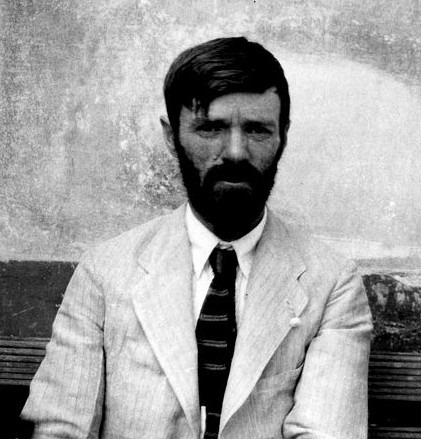
DH Lawrence  by Bynner

1923 photo of D. H. Lawrence by Witter Bynner


Oh “Self-Pity”  uses all the devices of poetry, save for rhyme. It’s loosely iambic with anapestic moments in meter, though the line lengths are uneven. This is consistent with much free verse, which still wants the beats of the words to be felt, without lock-step marching drills. It has a vivid image (the frozen, falling bird). It has a repetition (“sorry for itself”).

Why then does it seem different from other Modernist poems? Contrast Lawrence’s “Self-Pity”  to two other contemporary-to-it very short poems: William Carlos Williams’ The Red Wheelbarrow  and Carl Sandburg’s Fog”.  “The Red Wheelbarrow”  puzzles readers to this day about its message, other than it wants the wheelbarrow to be clearly real. I think it’s about the beauty and dignity of work and its tools, but perhaps I’m wrong. You may not draw any meaning at all when you first hear or read “The Red Wheelbarrow.” “Fog”  attracts immediately with its metaphor of silent fog and haunches-poised cat. It may seem to you at first a show of how metaphor cleverly works. “Wow, fog and a cat, I never thought of them together. Cool.” It’s only if you hold the poem longer in your mind and heart that you may ask why the fog/cat is at the harbor, that it’s not a pampered pet, but a feral or work animal.

“Self-pity”  is more directive. Many who hear or read it will get the point the first time. Yes, that frozen dropping bird is a vivid image, but it doesn’t lead off the poem, it comes after half-way, and it’s meant to work not as something the poet saw, but as an imagined image to illustrate his point.

Which way is the right way to go about it? That’s for you the reader/listener/writer/performer to decide. The Internet tells us some folks find the direct and pointed message of “Self-Pity”  helpful to them. I myself could stand to be reminded of it sometimes. Literary poetry of the 20th Century gradually made the decision to go with the non-directive imagery way, not with the more frankly didactic aims of Lawrence’s poem. Current writers and readers will get to re-decide this issue for our maturing, teen-aged, century.

“Self-Pity” was used in a Hollywood depiction of military training.  I imagine a Pythonesque skit where John Cleese or Graham Chapman submits other poetry to raw recruits. “I saw the best minds of my generation destroyed by madness, starving hysterical naked!” “Suppose an opponent comes at you armed with plums. So sweet. So cold. What would you do?” or “You are a pair of ragged claws scuttling across the floors of silent seas.”


What do I think? After all, this is the Internet. I must  have an opinion!

I’m eclectic. I don’t want poetry, or any art, to always work in the same way, to stop surprising me. If I could send myself back and offer advice to Lawrence on his poem, I’d tell him to spend more time on that bird before he tells us what the bird means. By not giving me the sense that a real human stood cold or bundled up or on the warm side of a window and watched that instant, that small bird, ruffling their feathers to hold what warmth was still there before the perch became its last, the poem loses potential power for me.

Thomas Hardy may have imagined his winter darkling thrush entirely as a useful image, but I feel that encounter with his bird. I’m convinced Rilke actually looked at an amputated and archaic torso of Apollo and wanted to see its present state fully before he delivered his reaction. I think Lawrence wanted to make a point, and that bird was a useful slide in his deck.

But that may be sentimentality on my part, and too much of that can be stifling and predictable. And perhaps the poem would loose some of it’s epigrammatic power. How often we see by opposition.

Musically, I spent a good deal of time on the drums/percussion for this track, trying to pull out the vibe of “Self-Pity’s”  meter. With the rest of the music I tried to balance my reaction to Lawrence’s resolution while transmitting the assertion of the epigram itself. To hear it, use the player below.