It’s usually of little use for an artist to apologize for their work, and this is so even though most have self-doubts. Perhaps more so, women artists will speak about “imposter syndrome,” but I’d guess that many/most male artists have the same feelings, they just don’t talk about it. The plain fact is that we’re all pretending to be what we want to be, to go to the place we want to go to. We maybe get there, we maybe don’t — but we’re all traveling, and we all get lost sometimes.
I even have trouble with the word “pretentious.” I say that, though I know the problem that word is describing: the embarrassing failure where something doesn’t achieve what it clearly wants to achieve. It’s just that most good, and nearly all great art, starts out with exactly that urge: to make something better, to make it new, to stretch and extend the maker’s talents, to make something over the horizon from what the artist knows. Since the same urge produces success and failure, it’s not the urge or the hubris that’s the problem. Don’t beat yourself up over that urge, don’t beat your breast over the failures. Reflexive humble-brag is exceedingly boring. If you must, get through any of that quickly. One of my animating maxims is “All Artists Fail.” As I’ve written about that maxim extensively here, that paradoxically comforts me.
I’m not an expert on Kenneth Patchen, but the general impression I get from him is like a 20th century American William Blake, that he self-invented himself and his credentials, and that’s easy for me to admire. I spent much of this week looking for a poem, a text, that would inspire me, and shake me out of some creative doldrums; and after striking out both swinging and looking during several at bats inside several books, I came upon this one. Since the text of this Kenneth Patchen poem doesn’t appear to be available to link, here it is:
One can think on the statement that “death is something which poems must be about.” That’s sort of true, and I laugh at it.
.
It doesn’t appear to have a title in the early Selected Poems volume I found it in, but the first line was used as such when Patchen was recorded reading it. The poem is read unaccompanied, but Patchen predated the Beats in doing the mid-century poetry with music thing that’s an inspiration to me. He reads it slowly, precisely. I hear it silent on the page as more anguished in its effect, and in trying to record a performance of it this week I first tried almost shouting out parts of it. After trying that I decided that wasn’t working, and tried a more understated take — only to find that my voice was horse from the earlier takes. I did my best in the time I had, and that’s the performance you can hear today.
“She had concealed him” seems to be using something of a collage of voices. Not so directly as a Patchen favorite of mine “Do the Dead Know What Time It Is,”but the opening seems like the start of a fairy tale, then there are bits of realistic daily speech, and then the fantastic metaphor of the poems final lines. As so often in Patchen poems, there’s a sense not so much that God is love, but that Love is god.
The music today makes use of some concepts of mine that are, to convention and many listeners, wrong. I like the rub of outside notes and grotesque melodic contours.* Rather than having a straightforward harmonic foundation below a singular or a mathematically related set of melody notes, I’m fond of twined melodic lines that respond or contrast in turns with each other. And as an electric guitar player accompanying singers or poetic readers, I clearly don’t know when to shut up and not play my guitar. This last one I might change, perhaps should change, but in the immediacy of the playing moment I’m believing that strong words, read with force, are able to stand toe-to-toe with electric guitar.
Frankly, I worry that the resulting musical performance may have too much of all of the above. Is that from a failure of nerve, or a failure of execution? Am I reflexively using old habits, not stretching out to something else? Well, I meant what I played, meant my reading performance of Patchen** — but meaning and intent didn’t allay my doubts. Yesterday I made four completed attempts to mix this. With my self-expected release schedule and time conflicts, it’s rare to go beyond two alternate mixes. I still decided to let the music continue for a bit more than an extra minute past the reading, because I liked the echoing musical conversation in the deep dark cave.
And there’s this perspective: all that is just one musical mode here. I have other pieces that are less cluttered, more accessible, and less contrary to expectations.
Returning to the thoughts of the opening of this post: the middle parts of what I write today are parenthetical and not something I want to take more of your time with. Non-paralyzing self-analysis is likely uninteresting to readers or listeners, but it can be effective as part of the journey of making art. I’m done trying to make this piece any better. I think the best moments that I hear in it and what Patchen wrote may be worth your time. My job with this Project is to move onto the next piece, to see what I can find and do with that. Thank you for reading and listening. The player gadget to hear the musical performance of Kenneth Patchen’s “She had concealed him” is below for many, and this highlighted link is there for the others.
.
*More than once, what I play has been characterized as out of tune or dissonant. Some of that is timbral, and some of it is wide vibrato, but often it is note choice and sequence. I don’t always hear it that way. I think harmony has rules, that can be broken or bent, but there’s propriety there. But melody? Melody is free. Yes, I’ll acknowledge that certain melodic contours generally cause admirable effects, but I myself am easily bored with stock moves. Two bands I admire, Television and the Velvet Underground, were each said to have banned playing Blues riffs that were part of the expected electric guitar vocabulary. I on the other hand, and in today’s piece for example, am playing Blues expression (stinky, funky notes and wide vibrato) without the expected sequence.
I think the opening electric guitar chord today was likely a subconscious attempt to refer to the chord at the opening of Peter Green’s Fleetwood Mac version of his “Black Magic Woman,” and Green’s Fleetwood Mac was another band like the combo I constructed for today’s piece that tried to find room for an overplus three-electric-guitar frontline. That band’s Live at the Boston Tea Party set is foundational to me.
**I felt my earlier more histrionic reading was less effective and my more resigned reading better and more true to the poem, not a retreat.
I’m taking a break today from telling some stories of discovering my own influences, and through them the possibility of this project combining words (mostly poetry) with original music. Instead, let’s return to one of this Project’s themes “Other People’s Stories.” Today’s piece is by William Carlos Williams, and it tells a story of a morning for a 30-something young father. The mood this poem is coming from is ambiguous on the page: it could be read as joyful, even if gently self-mocking, or it could be seen as an earnest Whitmanesque celebration. Since the poems here are performed — and more so, performed in the emotional environment of music — I had to make a choice of mood. I think it’s wistful, and I took that choice largely from the short song the poem tells us the poem’s speaker sings in the midst of it.
Parenthood, particularly first parenthood, is often a very significant life event. The urge to have a child, to reproduce in the emotionless language of biology, can be partly an expression of the parents seeking to extend and duplicate themselves. The reality of the child and child-rearing, conversely, is to reign in one’s autonomous self. Depending on one’s personality and role in the household, it may mean to act as a caretaker to the helpless and needy infant, or to find much of the home’s attention is now on the newcomer. The romance of the ideal baby can be immanently real some moments, and the endless labor and new roles just as real other times.
If the mood is ambiguous, the story Williams’ “Danse Russe” tells is told directly. It’s morning, the rest of the household is still asleep. Three others are mentioned as the sleepers: “my” wife, “the” baby, and someone named Kathleen, who has been identified biographically as a nanny the Williams’ family employed. Let’s be honest about the slight tells of the “my” and “the.” My is possessive, the isn’t. Kathleen’s named presence means there’s one other caretaker here. However privileged* we may view what was, in biographic fact, the presence of child-care, I’ll note that the speaker, the father, is plausibly then even more separated from the child. He is obligated and estranged in mixed degrees.
As the poem opens, he’s inside, physically in the household, but not with the others, and the house in his image has a sense of the outside world in morning mists and a cosmic sun. What does he do in this quiet early-morning time?
“To dance beneath the diamond sky, with one hand waving free.” Yes Bob ‘n’ Bill, but then the baby wakes up.**
.
He dances and sings, though one hopes it is a large house and he’s sotto voice and light on his feet. We’re told he’s naked and before a mirror. He indulges in a short Whitman’s sampler catalog of his unencumbered body,*** fully himself, able to bask in himself. Is he having a full-on Robert Bly drum circle moment here? Maybe. Let’s give Bly the poet his due here, he was often able to see a layer below the simple image — and Williams has chosen to show us this, even if we don’t know for sure why he makes this choice, and he doesn’t direct us to all his feelings, save for one, the one the dancer sings: loneliness. He concludes from the song that it’s best to be lonely, it’s his fate from birth (for being male?) From Williams’ own life I can assay he was certainly willing to be lonely, proudly stubborn in his self, but his story here, his image, is not without wistfulness mixed with self-justification. He, the poet, can help us see this. Who knows how much he, or we, can do with that knowledge? I tried to emphasize in performance that there’s a small refrained phrase in this short poem. Do you notice it when you read the text, linked here, or listen to the performance below? Three times the poem begins “If I….” What do we know of the I? What shall the I be?
Williams ends with his own “who knows?” Is he self-evidently, or by his own claim, “The happy genius of my household?” “Genius” here I think is meant in the mode of creator and progenitor, not in the IQ test sense.
I choose to think this is not a rhetorical question, that it’s truly at issue. He’s asking to cheer himself on: I’ve made the purchase of this house, I am the father of this child, I’m half the choice of its life — even if I’m also separated from this household and baby, and I feel that separation as loneliness. So many first-time parents feel in thought, bound and estranged, in all their variety of roles, partners, resources, and situations: “Am I happy?” And their best answers are “Halfway.” And then, “Shouldn’t it be all the way?” Who shall say? Well, William Carlos Williams dances and sings, and he says the distance from halfway is loneliness.
Today’s musical portion to go with Williams’ words I jokingly told my wife this morning is “shoegaze,” the genre named not just for the lack of audience eye-contact but for the number of floor-stationed effects pedals to be employed. You can hear that performance of “Danse Russe” while waving your shirt in the air with the graphical audio player below. What, there’s no player to be seen? Now you’ve got to rebutton that shirt? No, you can use this highlighted alternative link that will open a new tab with an audio player.
.
*Live-in childcare was more common at unexceptional levels of income in the early 20th century. A substantial number of young immigrant women worked in this role.
**I slightly modified this image generated from a text prompt using the test version of a new Adobe product, Firefly. Adobe promises that it uses only licensed art from it’s stock library to “train” the algorithm. Much controversy these days about AI, but of course poets have been using words to invoke images for some time.
***The contrast here between childbirth and breastfeeding roles and their intimate demonstration of bodily connectiveness strikes me. Did Williams intend this? I don’t know, but it’s there for me to sense. As a family physician, Williams would have certainly known intellectually of those differences.
A break in the influences as memoir series here, that theme that I’ve fallen into doing for National Poetry Month? Maybe. I’m going to present a new performance of a Carl Sandburg poem — but before that I’m going to talk about another writer, Rod Serling. Serling wrote a variety of things, but he’s best known for creating and hosting, often presenting his own scripts, the mid-century TV show The Twilight Zone.
I’m doubtful young people watch the old gray half-hour Twilight Zone episodes anymore, though they are still available in various ways — but people younger than me certainly did, and to some degree still do. That generation between today’s youth and my old age has sought to revive it under its original title or in spirit, and they still talk between themselves about the original episodes and their hard to reproduce sensibility. I remember being in a creative writing class back in The Seventies, with folks maybe five years younger than me, and I was surprised at how often they might refer to some TZ episode instead of a Greek myth or some piece of literary poetry. SF/Fantasy fandom has grown a hundredfold since, it’s the backbone of popular narrative culture now. The SF/Fantasy memory-hole village that was Twilight Zone’s once, has become a crowded inner-ring suburb, neither new-hot nor charmingly old-fashioned.
One episode of that series, one that came early in the show’s 156 episode run from 1959 to 1964, appears on some of the middle-generation’s “best of” lists, though I think there’s a strangeness that it does. Titled “Walking Distance” it’s tied very clearly to Serling’s own Greatest Generation memories, not as much to my generation who might have watched it on its first run, and I’d expect not-at-all to those younger than me. To summarize the plot without spoilers I’ll say the story is that an overworked and worried 1960 advertising man ends up walking in the countryside and enters his old hometown, the allegorically named “Homewood,” where he grew up before he left for New York City. He finds it not the present town in 1960, but the town of the 1920s.Given the number of time-fantasy stories written since then, not that unique a setup.*
Well, is a poem about a poet hearing a bird sing, or mourning a dead intimate, or finding themselves awash in desire all that unique? “Walking Distance” works, if it works, on performance and from the strength of the slightly wordy** but emotionally resonant script. A feeling of nostalgia — more than that, the feeling of wanting to be able to walk one’s childhood places in dimensions more palpable than memory is something easy to evoke in us. Serling’s script wants to draw a bit more than just all the feels in this situation — but let’s face it, all the feels, the range of edges soft and sharp of them, is the powerful engine here. That engine is strong and universal enough that I can feel the lost 1920s that Serling evokes, even if I never lived them.
Which brings me to Carl Sandburg and today’s poem for performance, “Band Concert.” Published in 1918, it presents itself in a poetic collection of contemporary portraits of American places and people that Sandburg has observed in his travels. The night of the band concert in this poem — while in Nebraska instead of upstate New York — is closely contemporary to Serling’s Homewood. Poet Sandburg is roughly 40, so while the scene in his poem is set in the now, the poem views the kids half his age re-enacting things that are already past for our storyteller.
If one knows the history of American music, Sandburg can be decoded as knowing that the Nebraska city is a few decades behind Chicago or New York. The band seems to be playing rags, the craze of the turn of the century, not of 1918. A small-town kid who had long left for the biggest cities in America, Sandburg can compare the giggles of the kids to the “Livery Stable Blues,” a landmark early Jazz recording where white musicians produced outrageous instrumental sounds imitating farm animals. “Livery Stable Blues” was released in 1917, and Sandburg was an early Jazz-bug — but he’s not knocking the Nebraskans for their music. He’s celebrating it, and them. And after all, cowboy rags and Negro*** rags, would be in the repertoire of Carl Sandburg the folk musician who would be including a set of guitar-accompanied songs in his poetry readings.
Homewood’s park and our 1960 visitor, dressed much as script writer & host Serling would be. Town square park and bandstand from my grandmother’s town. Bandstands in towns were common enough in my Midwest, so I forgot this elegant one, but I did remember the alligator.
.
In time-space, I’ve never visited Serling’s Homewood, nor the Nebraska place Sandburg is reporting from. Those are my grandparents’ times. In my own midcentury I’ve been to their outskirts close enough to see the band pavilion in the park or square, the full summer dresses, farm boys when that was a common occupation rather than employees of feed lots, and I’ve walked the sidewalks past the lattice shadows decorating porches. I can translate some from their writing. Serling, Sandburg, my grandparents, they know “more of the story.” Which is us — time, space, placental barriers away.
You can hear me perform Carl Sandburg’s “Band Concert” with a rock quintet which has no tubas nor cornets in this concert. Audio player gadget below, alternative link here for those who don’t see a graphical gadget.
.
*Twilight Zone itself did another well-loved episode later with a very similar setup: “Next Stop Willoughby.”
**As if poets have standing to complain about the use of words to portray things, rather than filming a chase, fight scenes, or calling in a CGI render farm.
***Those who go to the original text linked here will note that Sandburg uses the n-word in this poem as he does elsewhere in his early poetry. I’ve “translated” it. Sandburg also uses the general range of derogatory ethnic names of an era where “white” by the conventions of today wasn’t then a monolithic block, but instead was segmented into many othered creatures to be devalued with rude names and determinatory stereotypes. I’m not a Sandburg expert, nor am I the one to rule on what’s racist and what’s documentary, but what I’ve read of Sandburg says to me that he was intentionally anti-racist.
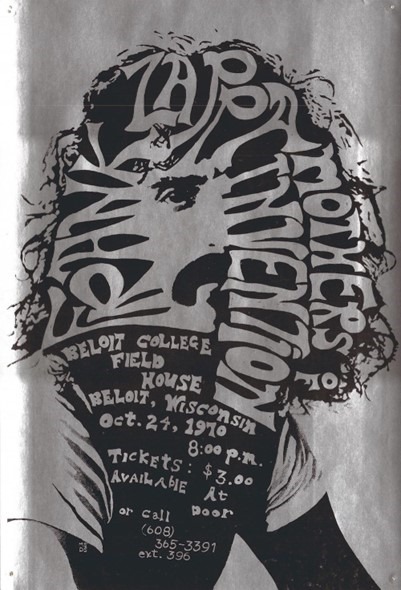
OK, it’s time for my Frank Zappa story. I’ve told this story a few times, but it’s appropriate that I tell it here as part of this series where I discuss the ways the Parlando Project’s meshing of poetry and music became an idea, and an idea I could implement. This post will be exactly as short as I can make it in order to move the story from Francis Poulenc to Frank Zappa.
Last time in this series you met Dave Moore and Jim Scanlon. During the year the three of us were all at this small college south of Des Moines in Iowa, we worked on an “underground newspaper” called The Gadfly that Dave and his partner ran. The content consisted of a mix of things, often with a strong satirical streak, commenting on politics, culture, and music. The capsule overview younger people of later generations get of The Sixties* is that every white young American was a hippie, everyone had long hair, and we all lived in bohemian haze coincidentally stoned and angry at political situations and injustices. The reality, as I saw it in Iowa then, was that 1968 was not that different from 1961. One common complaint reflected in The Gadfly was that the problem wasn’t just The Establishment, it was also our own cohort (at least the ones we were living among) who seemed mired in apathy. We thought new ideas and some ridicule of the old order might change that. Were we, and others like us elsewhere, slowly changing things? Observations differ.
Then came the spring of 1970, when for a brief moment the political activism spirit seemed to change in the matter of a couple of days.
My friends Dave Moore and Jim Scanlon had left for another college in the fall of 1969, Beloit in Wisconsin, where they hoped they would get a better education and find a more responsive group of students. I remained at the small college in Iowa where I had become the editor of the official school newspaper at a premature age. Over the school year, that responsibility slowly spiraled out of my control. I had no idea how to lead a group of people (still don’t). My working theory was to let them exercise their talents and see what happens.
Here’s what often happens under that scheme: many people will valorize what they think is their talent, then not actually exercise it. What will some conclude from that? That they must be restricted yet, somehow — that the actuality that they can’t deliver must be due to outside forces. For those, any extra degree of freedom doesn’t free them, it exposes them.
If you’re considering that carefully, you may wonder, is that what I was suffering from as well? I’d been given this opportunity/responsibility after all. Was I ducking it? Was I not taking advantage of it? I will say this: I wasn’t blaming outside forces, I was blaming myself. The romantic me wanted to see others blossom. The romantic me thought that blossoming was a natural process. Like an inconstant gardener, I was looking at a lot of failed plantings.
Then the spring of 1970 arrived, and with it the shootings at Kent State University, shortly followed by further deaths at Jackson State in the context of the now official expansion** of the Vietnam war into neighboring countries. This led to an extraordinary expansion of activism on college campuses around the country. I was frankly surprised at the speed and the rapid spread of the college student response, even after the shootings. There had been for at least a couple of years an eminent fear among the young men regarding the draft risk, which while it had helped fuel the anti-Vietnam War efforts, it hadn’t engendered this level of response. Tens of thousands of Americans, our generational contemporaries, had died in the combat, and that’s just considering “our side.” Activists being shot or killed wasn’t new either. Activists knew all this. I knew this. What had I discounted was that the Kent State shootings were at a very ordinary midwestern university, that dead included non-activists who just happened to be between classes, and that the dead included women.*** Across the country hundreds of colleges were shut down by a fast-rising wave of student activism, including my little Iowa college.
As quickly as the tide of activism rose up, the wave subsided. Our college-based headquarters and its plans for increasing political pressure to end the war depopulated as students returned to home or summer jobs. Eventually it was a few people in an apartment on the town square, lieutenants without any troops.**** I left for New York in an adventure I don’t have time to recount today.
Returning that fall, I was living in a sort-of-commune in the college town, without any funds to attend college, trying to figure out what I should do. Not only didn’t I know that, I didn’t have any idea how I would know that. That’s when I heard that Frank Zappa was going to play at Beloit, at the college my friends had left for over a year before.
I probably heard this news by reading it in a letter. Yes, younger readers today, there was no other way. There was no Internet. There wasn’t even timely press coverage of national tour dates, everything being done through local promoters and short-lived rock concert halls. Phone calls beyond your city were “long distance,” charged by the minute and too costly to use for entertainment gossip. I found out in 1970 the same way as someone would have exchanged this information in 1870.
My interest in Zappa had grown over the two years since I’d first heard Zappa’s Mothers of Invention on recordings. I didn’t realize it fully, but wider music listening and observing Don Williams’ ability to construct music on the fly was mixed with another rare thing my small college supplied me. This little college 20 miles south of Des Moines, with enrollment of barely a thousand students, had a burgeoning opera program. Opera of course is — what does it say up at the top of this blog? — a place where music and words meet. The opera curriculum would grow over the years, but at this time the program was still emerging. The theater used for performances (also the site of some of my classes) was a small old building, with seating for a few hundred. I’ll summarize one part of my experience in this: to see opera sung in a grand opera hall, with elaborate sets and pricey tickets, with a complete orchestra, is a very, well, operatic way to view the realization of that art. All art is artifice, sure, but the human connection to me in those situations is stilted. Not so, opera sitting a few yards away from another person singing it, perhaps even a person your own young age who you might see in your classes or on campus. That’s another experience, far rarer.
You have not likely seen that impact reflected on my adult life, or on the Parlando Project that you know here. For one thing, my voice is not operatic, it’s barely a singing voice. Yet I can write this today, that I remember seeing for one exact example, a performance of Poulenc’s Dialogues of the Carmelites, and being carried away about what performed music, voice, and words could do in that small space. It may have helped that this opera makes an extensive use of recitative.
Listening to Rock music in my daily life then in The Sixties, it occurred to me, who in Rock could bring something to opera? Besides the differences in the use of the voice, or the nature of projecting character as opposed to ones seemingly authentic personal voice, there was the problem of extending the instrumental colors. My thought-answers then? Jim Morrison, who had performed a bit of Brecht/Weill on the first Doors album, and Frank Zappa, who claimed the ability to be “a composer,” and was even allowed to demonstrate that he could compose for larger ensembles including orchestral instruments.*****
That I could consider that was consistent with Zappa’s brand then. In those early, heady days of Rock Criticism, it was a given that Zappa was a genius. He wasn’t the sort of musical act that many people listened to with addictive, ear-worm pleasure, sure, but still a genius. Well, there were those smutty lyrics, and an assumed swimming pool of contributory drugs, but still a genius. It was The Sixties, we assumed impossible things could happen, but we still felt genius was rare and worthy of note.
So, a chance to see this genius in a live concert, this artist whose recordings had opened up other considerations for me, couldn’t be missed. I drove there, 300 miles, with other share-the-gas people in a Fiat 1100D.
Cost of the concert? $3. An amount similar to my portion of the share-the-gas cost too.
.
The concert? Not life-changing. The acoustics in the fieldhouse hall were atrocious, and our seats were in the galleries far from the stage. The music was good, but with the sound bouncing around and the typical poor vocal PA of the time, the result was a mixed pleasure.
We got back in the little car to head back to Iowa. Finding our way through the unfamiliar streets we saw another car occupied with hair as long as ours inside. That car contained some young women. For some reason they wanted to share with the fellow freaky-looking folks that they knew the hotel where Frank Zappa was staying and that they’d been invited to visit him.
Of course we believed them. Of course we followed them. What did we assume was to happen there? Some sex, drugs, and rock’n’roll orgy? I’d just turned 20. I didn’t know what I was going to do with my life, or how I’d figure that out. So, why would I worry about might happen for the rest of some single night in October?
When we arrived, the bunch of us from the two cars, maybe 8 or 9 people, spread out around the non-descript motel room. A couple members of the band were checking in with Zappa. There was a short discussion at the doorway between Zappa and George Duke about what Duke had played at the concert, which got approval from Zappa. The band that night, though billed as the Mothers, was new, containing vocalists who had once been part of the pop band The Turtles, now billed as “Flo and Eddie.” One of the young women from the other car bounced on one of the beds. Most of us seemed like me, passive, waiting for something to happen. Zappa turned his attention to us, asked us what we’d thought about the concert. There was some short discussion. I think I may have mentioned that a lot of the material seemed new. Best as I can remember, that was accurate. Zappa replied that they were doing some of the old stuff too. Memories fail, but I believe “Concentration Moon” was replied as one of the veteran numbers. The male part of the room had some hard-core Zappa fans, who started to geekout on questions about the band’s history. I recall one asking about Doug Moon who had played with early versions of Captain Beefheart’s Magic Band. Were they trying to impress the genius with their knowledge, even in the midwest, of the places Zappa had come from? Zappa replied Doug was some guy who’d worked at a gas station. Zappa was patient about the questions, however trivial. At one point he took out a movie camera and filmed us in the room. I remember he moved in close to my face as I was missing one bow on my eyeglasses after that part had broken, and I had no funds to fix or replace the frames yet.
Here’s a few things Zappa conveyed to us in the roughly hour that I, and maybe others in the room, didn’t know before meeting him.
When asked about his doo-wop music parodies, including the Cruising with Rueben and the Jets LP, he corrected us that he liked that music. He spoke about Fifties R&B records he was inspired by. Since the lyrics in those songs were satiric, I’d assumed the music was also something he held in contempt. Far from it, he lit up talking about this. In The Sixties there was a widespread critical assumption that good music was “progressive,” meaning that we were to drive our plows over the bones of the dead, so this was news to us.
He nonchalantly corrected any impression that he was inspired by drugs. How he did this without sounding like a “Listen kids…” PSA I can’t exactly recall.
He seemed genuinely interested in us, and what we thought about the music — though at times, such as when he wielded the camera, the idea that we were natives and Zappa was an anthropologist occurred.
For me, the important thing happened near the end of our time in the room with this “…But, a genius” guy. I asked him how much of the show was improvised and how much was composed. He went over to the side of the room and picked up an oversized portfolio. Opening it, he showed it to me. Multiple staves of music, a rather full score as I recall. Dialogue written out, seemingly informal and back and forth, as if the band members were speaking off the cuff. In retrospect, I believe I was looking at scores for 200 Motels which would be filmed a few months later with a full orchestra. As he showed me this, he talked briefly about the effort he put into it, which the score showed. I was immediately impressed with the formality of the effort to achieve what seemed like chance informality. There must have been some serious seat-time in getting that done. The intent of it!
Imagine instead if I had somehow visited the hotel room of Jim Morrison in 1970. Perhaps my romantic notions of the creation of art would have gathered more poète maudit forces. Did something in my subconscious connect what Frank Zappa conveyed that night with William Blake, who when not out talking with the visions of angels, was innovating printmaking techniques and making books with his own skills?
After that significant side-trip, we left the room and returned to Iowa. If you’d asked me that day, I still didn’t know what I wanted to do with my life — not a whit more — but what I did have was a piece of information, and an outlook. From that night I could remember that doing was a large part of doing something with your life.
This is already a double-length post, so enough for today. To tip my hat to Mr. Zappa, here’s the LYL Band roughly approximating one of his later tunes in a we’ll-give-it-a-go live performance.
We flattened Zappa’s music and arrangement here, but as the video points out, if Zappa were performing this song today he’d be sure to include more screens than just TV.
.
*This oversimplification is more accurate about youth in The Seventies than the Sixties, even the final three years of The Sixties. In terms of clothes and hair, look at a range of contemporary photographs and film from the actual Sixties. Beards and long hair will be sparse on the young men, not movie wardrobe department common. Yes, use of marijuana and other drugs increased during the last half of The Sixties from a very in-group secrecy thing to a sizable minority, but in doing so it lost a bit of its bohemian rhapsodic connotations and became just another illegal high like drinking alcohol before the age of 21 had previously been. Real “counter-culture” bohemianism in an artistic sense had grown from the beatnik Fifties — maybe even doubled or tripled — but was still something a single digit percentage of people engaged in with any seriousness.
**In reality, this regional expansion of the conflict had been going on by proxy and by secrecy for a long time — but in the run up to the Kent State shootings it had become stated policy, driving hard-to-escape fears that there were now going to be additional para-Vietnam Wars.
***This is a complex point, one I need to leave off too briefly. Women of course were involved in anti-war activity before Kent State, but it occurs to me that this small factor may have been more important than recognized in adding to the explosion of activism in the spring of 1970. In case you’re wondering: yes, the anti-Vietnam war organizations, like the counter-culture, weren’t significantly less patriarchal than the rest of Sixties society — and though it may rankle some, I’ll add this as well: the victims at Kent State were also white.
****Any reading this who participated in Occupy Wall Street or the Black Lives Matter activism of this century may have a moment of recognition here. The emotional high of sensing that something is finally being said loud enough, that mass pressure is finally being brought by an unprecedented number of people is shared from this time. The emotions following, when such movements crest and seem to dissipate, need to be considered too. Here’s one piece of wisdom from someone else from this time worth listening to.
*****Will some Classic Rock oldster reading this think “Well, Rock Opera, what about the Who’s Tommy?” Tommy had yet to be released.
While continuing my observance of National Poetry Month, I must apologize for resorting to regular blogging form and writing about myself today. That sort of thing works for many, but I tend to run on a bit when I do it. It must take a long time to bore myself.
Why, when, did I decide to do the Parlando Project, this odd little idea to combine words, mostly literary poetry, with not-exactly commercial music? It wasn’t something I toddled off to grade school knowing I wanted to do. I had no great early childhood connection to poetry. I was exposed to the children’s poetry in my mid-west, mid-century tastes: Longfellow appeared, illustrated. The D. Seuss of my time then was Dr. Seuss, not Diane. My interest in music was greater, despite having no discernible musical talent or outlet. The wife of my little town’s school superintendent taught a music class, which was mostly music appreciation, little samplings from records of the orchestral repertoire. My peers found this impenetrable and boring. Since I was something of an outcast I decided to listen to what was so outré in their just-teenage world. Around the time I myself entered teenagerhood I got a gift of the mid-century handheld device, the transistor radio. I would bike around my town and outskirts with its faux leather case strap wrapped around my bicycle handle-grips, twisting the little plastic radio’s orientation with my fingers so that the stations from far-off towns aligned with its antenna. Was I listening to rock’n’roll, that mid-century strain? No. At first I was listening to an AM station that was one of the pioneers of what later became public radio, and this station programmed classical music.
Rock’n’roll was the music of those that distained that music appreciation teacher and distained me. If many then and now read the sneer or assertion in rock’n’roll as the music of when-in-the-course-of-human-events independence and freedom, I heard it as the music of those that didn’t care much for me. But I eventually relented. I wanted to look at the music the rest of the teenage world was hearing, thinking it might be a window into their interiors. Maybe it was a bit of survivor’s reconnaissance.
I found some of what the Top 40 station played interesting. This was in the era which the American pop music histories sum up as post-Elvis, pre-Beatles, describing it as dire and worthless. Were the teenagers of that Ike to Kennedy time, even if subconsciously, wanting more, wanting better? I dunno. For myself, I didn’t know any better. It was a mix of Brill Building girl groups, Black R&B, folk music/country and western* crossovers, late period crooners, and novelty records that would shame a modern TikTok sensation in their silly sensationalism.** Unlike my peers who were closed-off to me, there were voices there speaking secrets, their moods and moments.
Want to know why the Parlando Project musical pieces are all over the map in terms of musical flavor? This is the child-is-the-father-of-the-man reason.
Poetry? I admire the knowledge and deep interests of academics, while somehow worrying that poetry is seen as having an academic requirement for reading or writing it. You didn’t need to go to school to listen to the radio. There was no MFA for the Brill Building, Motown, or Slim Harpo, at least not then. Still, I have to be honest, like many who continue to read poetry that they won’t be graded on, it was a teacher again, Terry Brennan, a recent St. John’s of Collegeville grad, who taught an English literature class in my little 100-person high school who introduced me to poetry as possibility. Did I understand poetry? Does one need to understand what one is drawn too? I don’t think so — a little mystery may even help. Much of it was beautifully inarticulate to me, phrases that said with inevitability, descriptions that were exotic, situations that I hadn’t lived, or lived in any understanding whatsoever. I loved Keats and Blake. I found out Blake was the original DIY Indie, who wrote, illustrated, engraved, and published his work, mastering what technical, logistical, and creative work was needed to realize his art. I loved a capsule description of Blake I found in the back of one of my parents’ old textbooks that they had saved. It went something like this: “He wrote early charming lyrics showing real talent, but later descended into incomprehensible writing suggestive of madness.” Writing without limits! I was ready to sign up.
On the day after Christmas, riding in a Dodge station wagon filled with my sisters and parents, rolling between Minnesota and Iowa, I wrote my first poem. I was 16. I thought it rather marvelous that I could write such a magical thing. A year later, the last Christmas I was to spend in my childhood home, I got enough money to buy a cheap record player and three LPs. These inscribed, foot-square, vinyl circles were the adult music, the things that could contain the igneous something that was starting to get called “rock.” Rock as a name seemed solid, monumental, permanent. I suppose in much of my cohort it still is — childhood transition music sticks with you. These are the three LPs I bought with the leftover money: The Doors “The Doors,” Bob Dylan “John Wesley Harding,” and The Rolling Stones “Their Satanic Majesties Request.” In reverse order they imprinted me with love for Mellotron and ramshackle pretension, spare acoustic guitar arrangements and one-room songs without bridges or choruses, and poets who wanted to front a rock band that had listened to some Jazz and Blues records.
Of those 3 LPs, maybe only the Dylan retains current esteem, yet all were considered significant in their time. Blake & Keats? Well, it’s poetry, so the answer is complicated, particularly in the United States.
.
Music, various, and words, mostly poetry, exploring other people’s stories — yes, I can still see the damage there. While we’re not to the Parlando Project yet, this is enough for one post. Let me leave you with a Parlando Project audio piece, words from another poet recalling that era, Ethna McKeirnan’s poem of “Stones” that seemed permanent as she moved through her life. Player below for most, backup link for the others. McKiernan’s final new & selected collection including this poem is available here.
.
*Little known fact: C&W and folk music were often thought of as the same or aligned genres then. The 21st century Americana thing was how things were considered circa 1960 as well.
**Look up “Ahab the Arab” for one such example. Can I call it transgressive? Can you call it cultural appropriation? Fatima has less agency in this tale than Clyde (the girl-group Brill Building songwriters might have made her the main character.) If you’re on the borderline of acceptance, I’ll tell you that Jimmy Saville had the UK cover-version hit with this.
In the nearing 7 years since the Parlando Project launched we’ve normally celebrated the US National Poetry Month with increased activity. This year that celebration is conflicting with some other factors which are keeping me from a focused plan for NPM. That said, one goal of the #NationalPoetryMonth activity here has been to draw new readers and listeners to what we do. So, it’s probably a good idea to let new eyeballs and ears onto what to expect if they visit our archives of over 650 audio pieces released, pieces featured and expanded on with the nearly 900 posts since we kicked things off in 2016.
You see one motto up in the header of this blog and elsewhere: “The Place Where Music and Words Meet.” I take words — usually not my words, but words their authors likely intended as literary poetry — and combine them with various original music — music that I generally compose, and increasingly often play myself in one-man-band ways.
Sometimes what we mean takes time to discover. How do we relate to something else, the differences, the things similar? That’s a metaphor. Make the metaphor musical, however you do it, and that’s poetry.
.
A few readers may figure — perhaps even a listener of a stray Parlando piece they see linked somewhere — that there’s a convention, a style I follow when I do this. I hope they’re mistaken. I’ve always intended to not do that. The people that have influenced, or unintentionally given me permission to do what I do, made music and word combinations in different ways.* I try to use all those ways, and hope to stumble on some others. I will sing the words, but just as often chant them, talk-sing them, or resort to a freer, spoken word cadence — thus the origin of my Project’s name.
I try to keep the audio pieces short, almost always less than 5 minutes. I try to keep these blog posts shortish too, less than 1,000 words — and though I sometime fail in keeping those goals, I try to keep my failures in check. And not all the realizations of the words with my music and performance work for everyone, or most, or perhaps anyone. Some of them are even embarrassing to me, but I leave them up in our archives you can see separated into months to the right of this post.
Why do I do this? Manyfold reasons. Some of them? I like the challenge, the variety of verse, the variety of music. I think poetry is musical speech, and making even more of the musical component offers a different way to enter the words for the listener. Consider how you might enter into a song you grow close to, over listens, over time. At first it might be a phrase, riff, or refrain that catches you, or a general tone you feel, but then some new nuance may come to the fore. Or how a song you thought an abstract construction of words can from new experiences, experiences inside or outside of the song, somehow become more realized and concrete.**
This is how poetry lives, it’s the only poetry. Poetry does not live on reputations or silent copies printed, it lives inside you, a single reader or listener, as sound that may eventually saunter up closer in sense. This is what I celebrate all year, and some more so during National Poetry Month.
.
*Perhaps I’ll write more about, and thank more, those possibility creators this month? To name some of the models for Parlando: Beat poets and their immediate predecessors Rexroth and Patchen reading to music, Patti Smith, Bob Dylan, Joni Mitchell, Leonard Cohen, The Fugs, those English lute composers like Campion and Dowland, Tom Rapp, whatever William Butler Yeats planned to do with his bespoke psaltery, Rabindranath Tagore, what alternative hymnal Emily Dickinson was internalizing when she played her Homestead piano, Frank Zappa, Carl Sandburg, Langston Hughes, the American blues poets from Charlie Patton to Gil Scott Heron, Anne Sexton and her rock band, Laurie Anderson and her expansion of Ken Nordine and his “word jazz.” I’m also aware of “art song” — and appreciate both the achievements and the limitations for my purposes of that long established form of combining literary poetry with complex musical settings and melodies using orchestral instruments.
**One of the reasons I trust that you may find these experiences when the poem is carried to you inside a musical environment, and buffered there, is that I very often have had that experience composing and recording the Parlando musical pieces. I start out not sure what a lyric means or thinking I know something of what it means, only to find that there’s an entire other something or somethings there the 5th, 10th, or 20th time through it. The very act of putting the poems words into my mouth illuminates things, the exact question of how to utter them throws light from out of my dark throat.
I’ll admit I rushed to complete today’s audio piece because I wanted to make note of a birthday anniversary of an important contributor to the American wing of the Modernist movement of the early 20th century. I’m going to get to it in a roundabout way. Have patience, valued reader, I think this abbreviated story is worth your time if you care about the everyday accidents and personal connections that you might find scattered about behind what become large changes.
This story starts with two 19th century American immigrant families. I know a few details, and though I probably don’t know a lot more, but I think I know enough for a story. One family’s breadwinner was a laborer from Sweden. I read today he signed his name with an X, and he worked at various jobs including blacksmith’s assistant in Illinois after arriving. His wife was resourceful and was able to keep the underfunded household going. The other was described as a “peasant family” from the tiny country of Luxembourg. “Peasant” sounds so Bruegel, I don’t know if things were that feudal in Luxembourg in the middle of the 19th century, but that second family emigrated to the midwestern United States like the first one. The husband started out working in a mine until ill health forced him out. Luckily his wife found some income working as a milliner.
What’s important about these two families? Well, so far, nothing — though they raised families, that’s something. The second family already had kids when they arrived, the first one soon had seven kids. We’re going to concentrate on some of the kids. Our first family was the Sandburgs, the second the Steichens. One of the Sandburg children in Illinois called himself Charlie, and over at the Steichens in Wisconsin we had Edward and Lillian who were born in Luxembourg but were now growing up in the US. Charlie, the son of the man who signed his name with an X was passionate about writing. Edward, the son of the miner, was interested in art.
Charlie, our writer, had to leave school to help earn money for the struggling family at age 13. Eventually he volunteered for the army and served in the Spanish American War. Edward worked at the commercial end of art while having ambitions to move into the fine art world. Given those ambitions he took a wild chance by moving over to photography, which in the late 19th century wasn’t yet considered a fine art. How could that acceptance happen?
Edward started taking pictures and working on various ways the composition, lighting and film developing process could alter the images in artistic ways. One of his models for the photographs as he worked on his craft was his younger sister Lillian (see below).
Charlie got a break after the short-run war he was in. A local college gave him a scholarship* as a returning war veteran, and one of his sisters, Mary, was big on education and helped support him. Charlie rushed into doing everything writing he could do there — and while he didn’t graduate, when he left it was to pursue writing and to give talks on the midwestern Chautauqua circuit. Looking to network, he found himself in Wisconsin attending a Socialist party meeting.** It’s there that he met Lillian Steichen. Bam! Charlie fell hard and fast for Lillian. Lillian was perhaps a bit more careful. Charlie told her he was a poet, an artist, and he asked for her address (she was visiting her family, but was teaching in another state). She obliged. That was it, one accidental meeting.
For the next six months Charlie Sandburg wooed Lillian Steichen with letters. Lots of letters. Letters with poetry. Lillian’s letters easily showed her intelligence and wide interests, and she may have felt freer to discuss those things with native-born Charlie in writing because English was her second language and she may not have been as fluent in it speaking casually. And despite Charlie not being a good provider catch, the two fell deeply in sealed-with-a-kiss love. How much did Lillian rev Charlie Sandburg’s poetry engine? We’ll see at the end of this story today.
What about Lillian’s big brother Edward? His art photographs were getting some interest, and he had crossed paths with Alfred Stieglitz, another man who was interested in the Modernist movement to make photography into art. In 1905 the two go in to showing not just their fine art photographs but all kinds of Modernist art in New York City. Edward’s photographs filled Stieglitz’s journal Camera Work. A gallery they set up, the 291 Gallery, shows much new modern art work — not just photographs— and this work is often shown there publicly for the first time in America. How important and primary were Stieglitz and Edward Steichen in Modern art? Even a person who’s not primarily interested in visual arts like me has heard of the famous 1913 Armory Show in NYC, often considered the pioneering event in America’s exposure to Modernism. Well, Stieglitz and Steichen were showing that kind of work and laying the groundwork for that show for a decade before.
Back to Lillian Steichen and Charlie Sandburg. They married in 1908, job prospects for free-verse poets not overly concerning them. Charlie started to go by his birth name Carl, which he’d previously ditched because it seemed too ethnic. He worked for awhile as the PR/Press Secretary for the Socialist mayor of Milwaukee.*** And then he moves on to daily journalism as his day gig in Chicago. Carl, Lillian, and the brother-in-law exchange Modernisms. Carl’s poetry becomes more tightly visual, more show not tell. Later, if by extension photography can be an art, how about movies? Carl Sandburg’s daily journalism includes becoming an early movie critic.
Edward & Lillian Steichen. “My Younger Sister with a Rose Covered Hat.” Carl and Lillian Sandburg. “My Little Sister.” All photos by Edward Steichen. Check out the hats. Was it another happy accident that Steichen’s mom was a milliner?
On the anniversary of Edward Steichen’s birth, here’s one of Carl Sandburg’s poems wooing Lillian Steichen, “A Dream Girl,” performed as a song. You can think of it as Sandburg’s “Love Minus Zero/No Limit.” But knowing the art-photography Steichen side, consider the poems final line when you listen below, or read it here. I recorded the song quickly, with just my voice and an acoustic guitar, something that Carl Sandburg would have had handy to him, because Carl Sandburg was also a pioneering folksong revivalist, often dropping a set of acoustic guitar songs into his readings at a time when Pete Seeger wasn’t out of diapers. Oh, and Bob Dylan? Did you know that when Dylan’s poetic songwriting was just taking off that he took it upon himself to seek out Carl Sandburg? Oh, so many stories, let’s get onto the song. Graphical player below, and an alternative highlighted link for those that can’t see that player.
.
*Charlie, Mary, or someone must have talked Charlie up a bit. Colleges, even then, didn’t usually admit folks who hadn’t attended high school.
**By the turn of the century, democratic socialism was an emergent movement in the US. Despite its suppression in the WWI years there was some chance that it could have developed into a European style mass political party. Even with the Palmer raids and fears of a Soviet style revolution after WWI, US Socialists were able to win governorships, congressional seats, and mayoral races in places in the American Midwest in the first half of the 20th century.
****My own dedication: I found out about the 291 Gallery in a book Strange Bedfellows about the intertangled networks of American Modernism that was given to me by Dave Moore and Linnea Hadaway. Thanks!
Poetry, musical speech, is so associated with symbols that it may be impossible to imagine it without metaphor as a rhetorical device. This both bugs and pleases readers and listeners. Symbols can add richness, a sense of novel connections, or they may vex the reader, taunting them with needs for esoteric knowledge or psychic investigations of the author’s mind.
For me at least, poems can work when they are clear as any condensed speech would be on first reading — and when they are nearly incomprehensible as anything other than collections of energetic words. So, along that continuum, a poem may succeed (or fail) — but it must compel. After all, we have so many other words that waft over us written, spoken, recorded, some enriched with music, video, some from those already near and dear to us. As a young person I was drawn more to the richness of images and cared less for the clarity of expression. Other poets tried to convince me that clarity showed respect for the readers busy lives, that incomprehensibility wasn’t a requirement for good poetry. I eventually listened to them and somewhat changed what I wrote and admired. In my newer but still ambiguous stance toward poetic obscurity, I believed that a poem needs to be no more complex that it has to be, and no fancier in its conceits than it needs to be to draw a reader’s or listener’s attention. I may have a bit more to say on these issues in another post, but let’s move on to a new musical piece today.
I’m largely unfamiliar with the poet whose words I’ll use for today’s audio piece, Anna Akhmatova.* She became known to me several years back when the unique American roots singer-songwriter Iris DeMent recorded an album of heartfelt intuitive settings of Akhmatova’s poems, “The Trackless Woods.” This record was released in 2015, around the time that I was formulating some ideas of how to do what became this Parlando Project. Many of my ideas were already set down, even some of the pieces you’ve heard here had already been recorded, but I felt then that DeMent’s record reinforced my intents to do this Project at a time of decision.
Now this month I saw Akhmatova’s poem “Like a White Stone” featured in poets.org’s Poem A Day — and it did that “compel” thing with me as I read it in the middle of an otherwise occupied day. I eventually set upon creating a musical setting for it, one which you’ll be able to hear below.
This whole project is so mysterious to me…. It’s just this weird thing that happened instantaneously upon the first reading of the very first poem of hers I ever read which was “Like a White Stone”. In that period of time, within an hour or so I’d set three or four of them to music.”
I also found out, after composing and recording my performance of “Like a White Stone,” that Akhmatova was associated with a movement called Acmeism which reacted against the French Symbolists, a group of French poets that attracted me in my youth. The Symbolists were all about the effusive, exotic and elusive image. The Acmeists, in reaction, all about precision and clarity. The Symbolists were admired by Dada, Surrealism, and the hermetic strains of modern poetry in English. Acmeism could easily be related to other modern poets who want clarity and the power of easily discerned emotional messages.
“Someone looking closely into my eyes would see it” Anna Akhmatova
..
Knowing that, how does “Like a White Stone” stack up on the continuum from clear and direct to wild and elusive? Here’s a link to the poem’s text. I’m working from this translation (by Babette Deutsch and Avaham Yarmolinsky) and I know, as one who’s translated poems myself, that there are risks that I may be grabbing onto details that are the translator’s solution not the author’s own design in the original language. My judgement overall is that this poem is in the middle somewhere, even if closer to the clear and direct pole. The opening image, the one that first grabs the reader, is both clear and elusive for me, a combination that often works to compel. A “white stone**” deep in a well, yet it’s also “hard and clear.” It somehow doesn’t put us off that this is contradictory. How much might we be able to see anything clearly, even a light-colored stone, deep in a well? Yet the poem says we know it’s there, we know its hardness sensuously — it’s not only some indistinct imagination. Is it likely we know the stone, its color, its feel in the hand, because we’ve tossed it there? And the poem then launches into an extended consideration of memory, its dichotomy, how it’s both present and by definition, absent. It’s easy to explicate this poem as something addressed to a false, absent, exiled, or discarded lover, yet it refuses to choose details or say that directly. In the poem’s conclusion, the white stone deep in the well is an image like unto a human turned into a rock or statue, unable to move from or toward exile, as permanent as ended — a memory.
Would this poem be more powerful if it just straightforwardly told us the details? Would it be more artful if it was more elaborate and fanciful in its images? Well, some poem otherwise might be — but this poem compelled both Iris DeMent and me, and maybe it’ll compel you to listen too.
My performance isn’t like DeMent’s at all. I hadn’t even recalled that this poem was one that she had performed when I worked on it this month. Although DeMent uses the same translation as I used, she phrases it differently, and while I’m no stranger to some American roots style musical flavors my choice today was more toward electronic synth sounds. Hers has a Protestant hymn flavor, mine aims at the surging dance of the floating memory mind. You can hear my performance of Anna Akhmatova’s “Like a White Stone” with the player gadget below, or if you don’t see that player, with this alternative highlighted link.
.
*My ignorance isn’t Akhmatova’s fault. Although her work was suppressed by the Soviet Union’s cultural czars, and some of her associates killed, exiled, or imprisoned, she’s now generally recognized as an important 20th century Russian language poet.
**The white stone image, the specificity of which depends on translators’ choice, might possibly connect with another translator’s choice, in the Bible’s Revelations verse about a white stone. But remember, these are two translators, one going from Russian and the other from Greek to our English, each deciding exact words that we put in with our own connotations. Did this white stone have some connotation of translucency, perhaps even a diamond? Intuitively to me it’s a lover’s token, but I could be wrong.
Something in me says there should be more new pieces here since the last post, as I have several partially completed things, but the distress of folks around me pulls me several ways away from that. The distress hints that this music and poetry stuff should yield to more pressing problems, and then the unpredictability of the distress primes a sense of anxious alertness mixed with weariness. Though I’m at home, I feel like I’m in a medical waiting room, perhaps outside an Emergency Department, waiting for what it is that will be, in some not predictable soon, be said. As waiting people do, I read and do random things, anything having nothing to do with the matters at hand. Nothing too absorbing, for I don’t know when I will need to put it down.
But I’ll also say this, poetry has managed to stick itself into this state nonetheless. Poems can be as small as house mice, there’s always some place they can sift or scrunch their way in. And so it was early this morning when I saw this poem by Frank O’Hara “Now that I am in Madrid and I can think.” I found it could be fit to an already composed musical piece I had done late last month, and so I put them together this afternoon. If you’d like to read the text of this poem, here’s a link to that.
This is a love poem, and more specifically a poem about separation from the beloved, and O’Hara’s language is as beautifully askew and full of charming scatteration as any of his more well-known poems. If I had time and an inclined mood, I could write at length about his musical language here and his turns of phrase: “The slender heart you are sharing my share of, “See (sea) a vast bridge stretching,” and “The lungs I have felt sonorously, subside, slowly.” There’s this intimacy interrupted, the separation of bodies and their encased lives. The title says the speaker in the poem can now think. Well, they have constructed a fine thing, something that takes some smarts, some wit, but what they have constructed is a set of feelings outweighing any thoughtful aesthetic pleasures of travel.
The exciting places in Madrid Frank O’Hara is ignoring to think of his beloved. Oh— this is Madrid, Iowa! Iowans can tell out-of-staters by how they can’t get the French pronunciation of Des Moines right, and then they’ll see if they’ll correctly say this town’s name as “Mad-Rid.”
.
Perhaps this is why this poem snuck in between the trivia and my nervous time-passers. Here the illustrious culture of Spain is obscured by the distress and longing of separation. The poem finishes with one of O’Hara’s fine last lines. Do I want the empty world, the world without art? Yes, sometimes, but only by the choices of joined desire.
From the times I’ve listened to recordings of Frank O’Hara reading, I suspect he’d be more off-hand and playful in reading his poem than I was, but my reading reflects my current mood. The music for today’s performance is dense and urgent, I will not dance much about its architecture right now, but you can hear it with the player gadget below — or if that’s not visible as you read this, with this alternative highlighted link.
I just spent a half-hour watching this video recommended to me by a stranger elsewhere online. I knew. and still know nothing, about the man who talks here, despite a documentary being made about him a few years back.
Why did it hold my attention, even though it’s partly about that documentary and a career I don’t know? Well, he’s an engaging talker, and the interviewer here too is excellent, but that wouldn’t be determinative. One of this project’s mottos is “Other People’s Stories,” but obviously in a world of current billions and more than a millennium of poetry to consider, I’m going to ignore or pass by most people’s stories. Maybe it’s his age and his obvious engagement with art, while being old enough to be my father? I’m old. I’m still engaged in this Project. Old people still facing that situation may be the link that connected me.
As someone who currently rarely performs live in a room of listeners, the subject of “stage fright” isn’t a pressing issue for me. The early parts of this interview do speak to that issue, reminding us that it is not a unique, shameful, issue — but one that is rather common among performers. No, it’s not so much stage fright that I myself am most interested in. Rather, I’ve been increasingly promotional with the more than 650 audio pieces and accompanying posts that have accumulated here over the past six years. I frankly feel a mix of unseemly self-interest and objective self-delusion as I do that. These acts of promotion are still novel enough for me that I can, for now, press on past those feelings. And since it’s been harder to create more pieces, or as complete a realization in them of what this Project tries to do, this task — which embarrasses me — allows me to think I’d doing something in place of that.
.
What I find is the deeper message then of this man’s account is that there is an element in art — subject, yes, to the clouding of our egos and neurotic urges — that is beyond ourselves. More than 20 minutes in, in what becomes the conclusion of the interview’s story arc — the thing everything before has been building to — Seymour Bernstein articulates that place.*
Can we visit that place consciously, acknowledge that we want to abide there at least a little while?
For an audio piece, here’s one of the early pieces of this project I’m most proud of, another older man of music speaking about that art. Weston Noble, spoke this about music at his retirement, and I wove his words into some original music. You can hear it with the player gadget below, or with this highlighted link.
.
*So, should I give it to you in pull quote form, a TL:DNR assistance to the harried reader who doesn’t have time for the half-hour interview? I debated this, but decided that no, it would lack impact without the build of the story telling itself by the method of it’s telling. I decided, you might be too likely to shrug, and the precept would roll off your consciousness. And earlier in the interview Bernstein makes another recommendation that may be valuable to writers and composers: that a balance of re-creation and creation is helpful.




 Frank Hudson