There are more things than well-made that a poem can be — but as someone who’s worked to make their own poems work, I can use that experience to admire what Robert Frost does in today’s piece.
“Pea Brush” is a rhymed iambic poem, based on four-foot lines, but it throws in enough variation that it never seems like it’s limping along in its gait. The rhymes aren’t fancy, and at least for me, they quietly chime along in the background without calling attention to themselves. This is prosody that isn’t bragging or showing off. It was easy to sing in my rough-hewn manner for the most part,* but if I was to reformat it into blocks as if it was prose, it wouldn’t seem all that strange either. Indeed, as I performed it, I wanted to stress its conversational quality.
I myself haven’t had a garden in decades, but one friend of the blog Paul Deaton covers their kitchen garden regularly at his blog, and alternative Parlando voice and keyboardist Dave Moore has a garden that we talk about sometimes. I could imagine reading the first-layer plot of this poem as a post Paul might make. “I’ve arranged with a neighbor to use the small limbs from some birch trees he’s clearing as poles for some of my climbing garden plants. When I went to pick them up on Sunday, I noticed bent-over wildflowers** blooming under the brush pile. My reuse of the felled branches will help my pea vines and give the wildflowers room to grow.”
Besides this clear plot line, there are fine clear images in the poem’s story: the smell of sap still in the air from the just-cut trees, the pause in the frog’s song, the near-like to a baby’s grip of an adult’s finger to the tendrils of a climbing plant on garden stakes.
Wishing good luck to all the gardeners reading this.
.
Below this surface, what is the poem trying to convey? The poem’s speaker (as a character perhaps a more prosaic farmer than the poet and indifferent farmer that Frost was) just notes the practicality of the arrangement — free garden stakes — while letting us in on the blooming of May flowers and the promise of harvest aided by this arrangement. Frost the poet has written this well-made play, painted this scenery, blocked and directed its performance. The play portrays the give and take of humankind in nature. We’ll grow (and consume) the peas with their infant tendrils. Neighbor John has amputated the treescape for his own agricultural designs. These are planned acts of life and death. The episode of the frogs has them portraying those things outside our plans, their Sunday-service silence to hide from a two-footed demigod that might come to capture them to a final silence.
I’ll note too the poem’s ending “had to come” interjection breaking the meter to make a final statement of the budding wildflowers that couldn’t wait for humans to make their plans.
I had to make do with a single hour to get this musical performance down today, and I chose to grab an acoustic guitar to get this accomplished. The results felt right enough to produce this new piece that you can hear with the graphical audio player below. No player? This highlighted link is an alternative that will open a new tab with its own audio player.
.
*The line “The same as you seize cat’s-cradle strings” is a bit of a tongue-twister. And while I get Frost’s image clearly in that line’s stanza, the syntax is a little disordered I think.
**Frost names his wildflowers as trillium. I don’t know if Frost was the exact botanist that his friend Edward Thomas or his great New England predecessor Emily Dickinson were. Neither am I, but I’m often open to researching specifics like this in poems. I find that one of the species of trillium that grows in Frost’s New England is the Nodding Trillium, a variation that grows crooked stems naturally, not because a brush pile has altered its growth.
It was quite the April for me, and I’m resting up today before getting on with a bunch of tasks I’ve put off while working on the accelerated posting schedule for National Poetry Month. Readership was up substantially, busiest month ever for visitors at this blog, and page views blew past the old record by over a thousand. I should be better at replying to your comments and encouragement, but besides being focused on the work I have a mental Catch 22 where I often can’t decide the best way to respond, and in that indecision put off responding.
.
I didn’t put anything new for International Workers Day today, but I’ll repost this piece with Carl Sandburg’s words from his longer poem “The Windy City” that I created for last autumn’s U. S. Labor Day. In posting it last year I suggested something I had bounced off my old compatriots in The Lake Street Writer’s Group, something I call “The Sandburg Test.”
Let me suggest a rough analog of the Bechtel Test. Let me call it The Sandburg Test. To be clear, it’s not my suggestion that every poem has to be about work, about the things we do for our daily bread. But, if we are viewing an anthology or substantial poetry collection from a poet, to pass The Sandburg Test it has to have poems that deal with work in some substantial way. How does the speaker or characters in the poem relate to work? What are they doing that work for? What is it in presenting them that portrays something about life? What are the mysteries, sensations, and systems of that work?
Here’s that musical performance of Sandburg’s words from “The Windy City” accessible with the graphical audio player you should see below. No player to been seen? This highlighted link is an alternative.
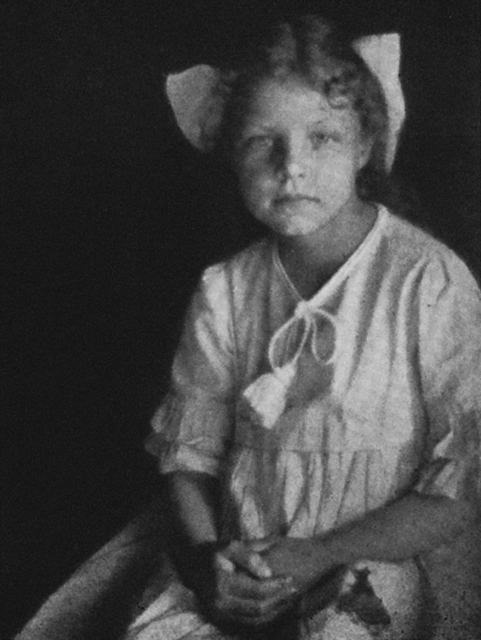
It’s 1914. A single mother is listening to her 4-year-old talk to her imaginary playmate. Has this always happened? Did children in pharaonic Egypt or ancient Ur exercise their fresh language skills and nascent social skills with such fancies while being buckled into their camel child-seats? There was no Mesopotamian Facebook — the only way we’d know this would be if someone wrote it down. No such accounts survive.
This mother was a professor of English at Smith College, associated with artists: visual artists, writers, musicians. She wrote poetry, and I’ve read she knew Robert Frost and Walter De La Mare. She chose, as an artist might do, as a mother might do, to write down some of the things that her child was saying.
At some later point, the daughter was asked if she knew what her mother was doing. “No, she was always scribbling” the daughter replied, she made nothing of it. Eventually, her mother revealed that she was writing down what the child was saying as poetry. What the child invented and spoke — at first to her imaginary friend, and now to her mother — was transcribed by the mother into lines and stanzas. The mother’s name was Grace Conkling, her child/poet was Hilda Conkling.
Short, compressed, Modernist free-verse was becoming a thing in America. Ezra Pound’s first Imagist anthology and Carl Sandburg’s Chicago Poems were published in 1914. Edgar Lee Masters’ The Spoon River Anthology was released on New Years Day in 1915. The child’s mother was savvy enough to know that a few lines with fresh, direct imagery could be a poem even without strict meter or rhyme.
Over the next few years the mother and child produced poetry this way: the child speaking it, the mother writing it down. Some of the poems were sent to magazines by the mother, and they were published.* In 1920, a book-length volume of the poetry, Poems of a Little Girl, was published. It was successful enough that two other Hilda Conkling collections soon followed. Amy Lowell wrote a preface to the first Conkling book. I read this week that Louis Untermeyer called Hilda “the most gifted of all” child geniuses. Rimbaud, dead for 30 years, couldn’t complain. When the editors of our pair of 1922/1923 poetry anthologies for kids made their choices, they included four of Hilda Conkling’s poems, an unusually high number. Only Wordsworth and De La Mare had five selections in the volume that included Conkling — Shakespeare or Robert Louis Stevenson only warranted 3 each.
As I revealed earlier this month, Conkling’s poems are the only Modernist poetry in the Girls and Boys Book of Verse.** That may somewhat account for that level of representation. The first two sentences in that book’s foreword say:
“Because real lovers of poetry know that time and place are of little importance, the poems in this book are brought together with no sense of the period in which they were written. From “The Song of Solomon” to Hilda Conkling’s “Spring Song” they are here because they are beautiful, with a beauty that neither years nor events can change.”
So, Conkling is there to represent the here and now, a representative not only for being the most recently published, but because she still hadn’t reached the age of 12 when those words were written — she wasn’t just content for an audience of boys or girls, she was still a young girl, plausibly a future as much as a present.
Verse for children? I’m children, and a Modernist too!
.
Those who’ve been reading along this month know that since our anthologists decided to produce a gendered pair of books, The Girls Book of Verse and The Boys Book of Verse, I’m asking readers here this National Poetry Month to guess which book included the poem of this little girl. Answer below.
Hilda Conkling is now largely forgotten. When one looks at the published poems today, they still have their charms. When I’ve tired of reading so much derivative and rote late 19th century poetry and those 20th century poets who didn’t even try to “make it new” Conkling’s poems can be refreshingly free of the dead hand of influence or fears of being scored on exacting verse-craft. There are still effective lines in many of them. Unpretentious but striking images pop out. Professor/mother Grace Conkling was adamant that she didn’t edit the poems, that as their process developed she would read the transcribed poems to Hilda and that she would always obey Hilda’s corrections of anything she got wrong. What’s unsaid is how much selection or excision Grace did, what poems never were transcribed as unremarkable or if any lines were never transferred from scribbled notes to manuscript. Young Hilda Conkling wouldn’t be the first artist whose work was magnified by a sharp blue pencil and a shortening scissor wielded by a skilled editor.
As far as anyone knows, Hilda stopped creating poems just as she became a teenager. If there were any later-life discarded drafts from adult revisiting of her childhood inspirations, they are unknown. She lived with her mother Grace until Grace died, and made her living working in bookstores in Boston, two things indicating that Hilda could have continued to connect with literary culture if she’d wanted to. Hilda’s story, her poetry, once held as so remarkable, became a literary curiosity that only attracts folks like me who want to think about art and Modernism thoroughly.****
.
I haven’t read anyone claiming that Hilda wrote her poems because she remembered past lives, because she was an “old soul” — but then or now, that sort of woo thing might have come up. Today, as I was finishing this post, days after completing the musical arrangement I used for her poem “Hills” that you can hear below, I wondered how to explain the musical choices I made for that original music. The music is sorta-kinda South Asian, based slightly on my appreciation for those World Pacific Ravi Shankar LPs that entranced me as a young man and the Indian physicians I worked with in New York in the 70s. Specifically though, it’s more at the cod-raga experiments that many Western folk/rock musicians took to in the 60s. I always liked that stuff, and it’s more approachable with my musicianship than the real thing. Was something asking me to musically express a reincarnation theory?
To hear my musical performance of the 8-year-old Hilda Conkling’s poem “Hills” use the graphical audio player below. No player manifesting? The skepticism of your way of reading this post may be blocking the ectoplasm! Knocking on this highlighted spirit-table link will open a new tab with its own audio player.
.
*Poetry Magazine published Conkling’s poems alongside a great many of the formative Modernist poets. But she also appeared in Good Housekeeping.
**As a fan of early Modernist poetry, I tell myself that I could have easily found a dozen or more suitable Modernist poems published before 1922 to include in their books.
****I think of the work of New York School poet Kenneth Koch, who in the 1970’s started teaching poetry and creative writing to grade school children by reading them Modernist poetry (including poems that our 1920s anthologist overlooked) and then prompting them to create their own poems. A short web search revealed nothing so far, but the brief phenomenon of Hilda Conkling might easily have come up alongside Koch’s teaching ideas.
I have some hopes of finding the energy and audacity to write about a new attempt this year by a contemporary poet to inspire children to write poetry, but only time will tell on that one. Girls or boys book of verse for this poem of genderless camel-hills bearing the world on their backs? Girls.
It’s Poem in Your Pocket Day in the midst of U. S. National Poetry Month. This lily gilding observance aims to integrate poetry more completely with ordinary life. A great way to do that would be to bring poetry and our workdays together, something we rarely do.
For National Poetry Month I have been selecting and performing poems from a pair of poetry anthologies published in the 1920s for children: The Boys and The Girls Book of Verse. There’s little in the two books about ordinary work life. You might explain that as “Well, those books were for kids after all” — but the same could be said about many a poetry collection or anthology, then or now.
Our last piece, a famous poem by Wordsworth, touches on the weariness of work, speaking of the getting and spending part of life. Other than military service, there is little else in these children’s books about working for a living, so today’s piece stands out. “The Coromandel Fishers” sounds, even on the page, like a folk song, a work song, something that might be sung in the tedium and effort of daily labor. It’s author, Sarojini Naidu, published it in a section of her poetry that she called “Folk Songs,” so it really does ask to be sung, which you’ll see below I’ve done.
A reminder of the casual game I’m playing here with this pair of gendered anthologies: was this in the girls or boys book of verse? Answer below.
.
Naidu is little known in America but led a fascinating and significant life. She was born in an India ruled by Great Britain as a colonial possession, was educated in England, and during that education touched bases with literary figures there. William Butler Yeats’ father, an artist, sketched her as a young student, and while a young poet she was called “The Yeats of India.” Despite that start, she more-or-less left poetry for a life of political activism. Upon her return to India she became a key lieutenant of Gandhi, marched and strategized with him, was imprisoned twice by the British for her activism, and after Indian independence served in the new Indian government.
The young Naidu while studying in England as sketched by W. B. Yeats’ father, and during the famous Salt March with Gandhi. Gandhi thought the Salt March would be to arduous for women, Naidu thought otherwise.
.
I happen to have had a few more hours to work on music this past week as my teenager has started their first job. I, an old man, think often about my decades of paid labor. I recall the dailiness — yes, sometimes the weariness — of that. But here’s what I think of more often: the coworkers — A fair feld, ful of folk, fond I there bytwene, of alle manere of men, the mene and the pore, worchyng and wandryng as this world asketh.* I recall the thereness of these, my colleagues for the majority of my life’s waking hours, working in common cause. I’d often have a poem in my pocket in those years, a draft of my own, or a song of another on those days after days. Another thought: not often enough was the poem in my pocket about them, about the world of work we shared. Wordsworth said in his poem I sang last time that “The world is too much with us” — and we poets too often, too completely, stop at that phrase. I tried to outline in response: Wordsworth’s poem is more complex than we think it is, that his poem says everything is out of tune. Naidu’s fishermen, like the political activism she joined after writing this poem, says that we may sing to align us with the world.
Here’s an anecdote I read about Naidu. At the end of her life, she was weary from the wear-and-tear of political administration. Doctors said she must stop at whatever place she found herself, but she was restless, she could not rest. Finally, she asked a nurse to sing to her, and she fell asleep. In that night she died.
A couple unrelated last notes, and then you’ll have the opportunity to hear my performance of the song I made from Sarojini Naidu’s poem. She seems to have been the only person of color to have a poem in the two 1920s children’s anthologies,** and just as Wordsworth’s from last time, her poem of a world that’s with us, late and soon, ends up invoking the god of the sea. The audio player to hear me sing Naidu is below. No player? It’s not washed overboard, some ways of reading this blog hide it, so you can use this link as an alternative.
.
*Autocorrect didn’t have a stroke — can’t you read English? It’s a passage from the medieval poem Piers Plowman:
A fair field full of folk · found I in between,
Of all manner of men · the rich and the poor,
Working and wandering · as the world asketh.
**A fault I wouldn’t expect in any modern anthology for children, there are just too many good choices that are well-known and published now. It wouldn’t have hurt them to include a poem by American Paul Laurence Dunbar, or one of the translations from Chinese or Japanese by Arthur Walley — though the latter were new on the bookshelves at the time. I’ll allow them an excuse on a case near enough to the one for these 1922-1923 anthologies’ almost complete exclusion of Modernist poetry.
Are you taking part in this month’s quiz on which gendered book of verse Naidu’s poem appeared in. It was in The Boys Book of Verse.
Social media likes controversy, so it’s no surprise that two things have recently mingled there in provocative assertion: poet Mary Oliver and the dread “middlebrow” epithet.* It’s not a long bridge between the two: Oliver’s poems are put forward as all too middlebrow in this charge, and middlebrow is a sign of significant lack of ambition or achievement. I’m not a fan of the term “middlebrow,” for a hierarchy is implied and I don’t care for hierarchies much — but to speak of this I should define middlebrow poetry. A definition that works for me is: poems that remind us of something we already sorta-kinda know, but maybe couldn’t quite put into words. These poems are usually immediately understandable on first reading by a significantly literate reader.
Why’s this bad or lacking? If this is a singular mode it rules out poems that tell us multivalent things, or mysterious things that require more thought to comprehend, thought perhaps taken in stages. It rules out shocking, utterly surprising poems. And such poetry doesn’t feed our playful desire to puzzle-solve with clues we are proud to have acquired.**
My view? I think various modes of poetry (even differing modes of reading the same poem) have diverse values, and I’m more than OK with that. Poetry’s eye should be the insect’s compound eye, containing a hundred, a thousand, ommatidia. And so, if it was up to me, the best cultures wouldn’t be restricted to, or rewarding of, one poetic mode. This may be a visceral thing with me: I get bored with all one type of thing quickly. Building towers of hierarchies might be fun, and illustrative of what one can stably hold long enough to build such a tower, but in the end, the domain one will look out on will have a lot of scenery that isn’t in your tower. In the right mood, I can get pleasure out of looking at the commonplace apprehension poem and a “difficult” avant-garde one — and in the wrong mood on my part, or insufficient achievement in the poet, not a touch of pleasure in either mode. And beyond all this meaning and metaphor, there’s the oldest part of poetry, the part even young children understand, that poetry also has abstract pleasures like music has — poetry is the instrument on which the meaning plays.
A great many of the poems in our pair of 1920s children’s poetry anthologies are as middlebrow as any Mary Oliver poem brought up on charges in this controversy. This shouldn’t surprise us. A modern children’s anthologist looking to duplicate the task of those in the previous decade called The Twenties would, I think, do likewise. Some of those pressures would be commercial: what will sell to parents, libraries, teachers. Some would be practical: these children aren’t yet bored with the lessons of the world — those lessons are new and useful building-blocks for their youthful towers — and maybe a lesson of my old age (and a lesson of Mary Oliver) is that I shouldn’t have been bored with the lessons of the world either.
I think too of what happened as the first childhood readers of these poems in the 1920s progressed into the economic distress of the Great Depression, the rise of nationalist dictators, the Second World War, and the Damoclean Cold War. All through the middle of their lives how much time would they have for poetry that offered them the highbrow pleasure of gnostic meaning, of shocking new combinations and collisions?
The answer is: some would find the time, some went on and made their own verses in those modes — and many others would not. Some kept food on the table, kept bolts tightened on airplanes, tended the sick, kept fuel in NATO tanks facing east. Some had their yet young lives ended sans poetic envoi. Others desired, birthed, and raised my generation.
Highbrow, middlebrow, it is neither sophistication nor no-nonsense populism to forget either part of that cohort.
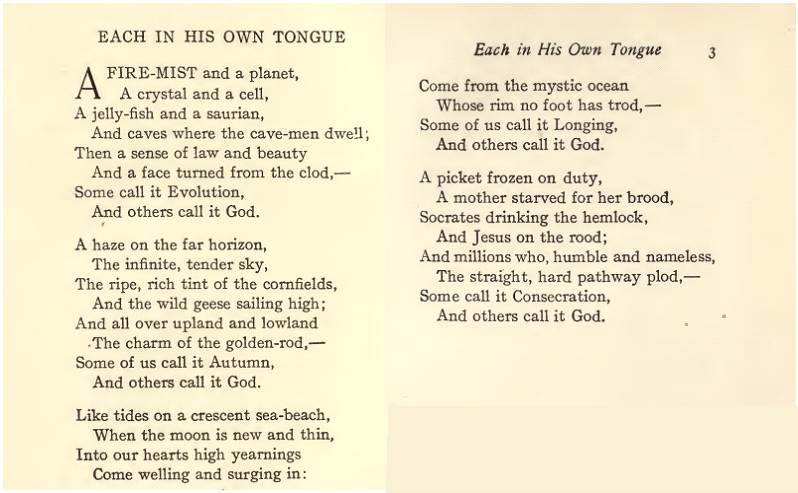
On to today’s poem, an example of a poem that earnestly intends to be a lesson: “Each in His Own Tongue” by William Herbert Carruth. Look! Mary-Oliver-approved wild geese make their appearance in it, decades too early! I also offer this month’s puzzle challenge: the pair of 1920’s anthologies I’m drawing from were gendered: one for boys, one for girls. So as with each post this month, you’re asked to guess in which volume did the poem appear. Answer lower down.
Here’s today’s poem as it appeared as the title poem in a book-length poetry collection by Carruth.. Marginalia picked up in the scan of a copy of that poetry collection. Wonder who Ina Coolbrith is? Here’s a link.
.
The brief Wikipedia stub for Carruth tells me he was “president of the Pacific Coast Conference of the Unitarian Church.” One of my preacher relatives once said of an Unitarian school he’d attended “The only time anyone would speak of ‘God’ is when someone stubbed their toe.” I read this morning a brief poetic knot of a summary of Oliver’s earnest lessons delivered by A. M. Juster who wrote that he’s “Not a big fan or a big detractor of Mary Oliver” but then sums up his impressions of her work by saying “I also think her spirit wanted to write religious poetry, but her mind wouldn’t let her.” Each in their own tongue I’d say, ungendering Carruth. Carruth wrote “His,” and his poem appeared in the Boys Book of Verse. You can hear my musical performance with the audio player gadget below. No gadget to be seen? This highlighted link is a backup which will open a new tab with an audio player.
*This last factor is less-often laid out as I just did, perhaps because it doesn’t seem serious when complex poetry is discussed. But let’s admit it: great portions of humanity loves puzzles and challenges in which they feel rewarded if they can progress farther than some other human.
From my Parlando outlook, this is a fine choice to start off a look at our twin girls and boys 1920’s poetry anthologies for National Poetry Month. Today it’s a poem by William Blake, a poet still known and rated today, and a poem that includes a child and praise for music inside of it. It’ll make a natural beginning I figured.
After I made that decision, I started to notice a couple of things. The poem began to seem stranger than it somewhat straightforward first reading might suggest. The odd thing I noticed first was the amount of insistent repetition in it. Lyric poetry, and even more so poetry meant to be sung. will often refrain lines, repeat entire verses or sections — look at many a modern charting pop song and you’ll see hooks as repetitious as today’s poem — but it still struck me as odd. The child continues to ask for song. The piper plays it. Immediately, the child asks for the song again. Parents experienced with young children may relate here — insert your own bête noire kids-song ear worm and insatiable toddler — those requests can be cute and dulling at the same time. Blake’s child is laughing at the time of the first request, weeping at the second, Why? Best guess: because the song is over, and they must hear it again. But then the child asks for a third song — perhaps the same one, perhaps not — and they are asking for it without the piper playing the pipe. Since most pipes are wind instruments it’s likely the piper in the poem hasn’t been singing the first two times.*
Combining the child’s responses after the first two requests which the piper has immediately fulfilled (laughing, weeping) the child “wept with joy” after the third go-round.
The picture I get here is joy in repetition, and woe at ending. The child makes one more request: the piper should cease the singing and write this music down. The piper MacGyvers up a pen and ink and gets to scoring.
Simple guitar chords on the chord sheet this time.
.
Then we’re told the child vanishes. This shouldn’t surprise us. If we were paying attention, this child appeared to the piper “on a cloud.” This child wasn’t a flesh and blood child — wasn’t one of the potential readers or listeners to the anthology’s contents — it’s a spiritual emanation of childhood.
OK, that’s a little weird, but Blake was a self-confessed visionary, and literary inspiration stories can be peculiar. Just another day at the poetic office for Blake. And as the piper makes his own pen and ink, I thought of one of the things that I found most inspirational in Blake’s life: that despite literary poverty he mastered the means of creating his own poetry, art, and engraved books.
Just after completing my musical version of this, another area of concern came to me. Just how strange did this seem to the children in the 1920s or to their parents who might read this to them if they were younger children?
I was a young child in post-WWII America, and in my time and place, I would have been puzzled. About the only piper I’d have any reference to was The Pied Piper, a page-bound storybook character. Yes, various kinds of musical pipes were extant then, as there would have been in the 1920s, but nothing I would expect in my time to see being played in wild valleys. Blake’s poem was over a century old when the 1920s anthology was made— maybe late 18th century England had itinerant rural pipers?
As they grew up, the child reader, then or now, would likely understand this is fantasy, even if exactly what Blake was getting at with his fable might be missed. Its value would remain as a set of word-music that speaks to the joy found in music and the arts.
Is anyone trying to guess if this was in the girls’ or boys’ anthology? Male author. The cloud/child is male, the piper is not gendered. Is joy in music a gender role thing? Not really.
Wilderness cumulous-carried spirit children are not a reliable compositional prompt.
.
It’s from the introductory section of the “for girls” book. My music is a simple folk music setting: acoustic guitar and bass, and eventually an Irish tin-whistle for piping. The tin-whistle is a played VI.** Two other instruments make a subtle entry in this recording. There’s a quiet electric piano in the piece, played and mixed so low it almost sounds like an overtone of the guitar, and another VI of a small obscure 1940s keyboard instrument, the Solovox that comes in for the next-to-last verse.
The Solovox was an FDR-era monophonic analog keyboard synthesizer, with glowing tubes and a wood-veneer case like a large table radio of the time. I used it for two reasons. If this song floats in fairy-tale time with children appearing and disappearing out of clouds, I thought the piper’s sound could change from the tin whistle to something more mid-20th century as a marker of how the children the anthologies were written for grew and changed. But also, I’ve seen, even briefly played, a particular real Solovox. The mother of alternative voice and keyboard player in this Project Dave Moore had one, and when he was young his mother would play piano and deftly slip one hand over to play melody lines on a Solovox. Dave now has his mother’s example of this old instrument, and has had it fixed so it plays, though with some glitches.
To hear “Piping Down the Valley’s Wild” you can use the graphical audio player you should see below. Player vanished? This highlighted link will open a new tab with an audio player. I plan more poems, adapted musical pieces, and observations from The Girls/The Boys Book of Verse coming up soon.
.
*There are methods to do that, where a singer alternates using their breath to sound the instrument and to sing lines of song. And there are bagpipes and the like where the wind comes from a bellows. But the child has asked the piper to drop their pipe and sing, so it stands to reason this is a request for the piper to sing a song with words after playing instrumentally for two renditions. The song then progresses from melody, to sung words, to finally written words — a plausible metaphor for the writing of a poem.
**I explained VI/Virtual Instrument technology last time, but in short it’s playable software that tries to contain all the sounds an actual instrument makes, often by capturing all conceivable notes and many articulations of those notes with a microphone it makers placed on the real instrument.
Despite my inveterate bicycling and my wife’s love of nature walks, I’ve never been much of a hiker, and I’m very much not so in my old age. None-the-less I was charmed this winter when I saw this short poem because it appealed to my mental wandering. Walk with me: it’s not all that long a hike to a short audio piece.
When I saw today’s poem, I immediately noted that its translator from Goethe’s original German was the American poet Henry Wadsworth Longfellow. Let me reassure the poetry hardcore who might be reading this post that Longfellow was far from my interests when I started this project. While 19th century worthies Whitman and Dickinson remain staples of American poetry, Longfellow was to me only a schoolchild’s memory — and at that, not even a literary anthology schoolbook memory. My Midcentury-Modern anthologies of poetry in English didn’t concern themselves much with him, so I recalled only the Longfellow of illustrated poems for children that predated Dr. Seuss’ ascendency, Midnight rides, patriots at the bridge, culturally appropriated native Americans epics in stalwart meters. Longfellow’s Wikipedia page, reflecting critical consensus, still makes the case to downgrade him — and that’s hard to do, to downgrade someone who is now largely overlooked. The judgement handed down can be summarized: you don’t know him, and it’s probably best to keep it that way.
How did Longfellow come to me then? Part way into this Project I visited Massachusetts, planning to see the historic sites in Boston. While in Boston I decided to add a visit to the Washington/Longfellow house in Cambridge. This was a toss-in, yet it was while I was there that I heard about Longfellow’s life and I started to pay a bit more attention to the range of poetry he wrote.
While on that tour, our group was walked through Longfellow’s study where he wrote. I noticed right away that he had something that 21st century Americans would recognize immediately as a modern adaptation for intellectual work: a standing desk. If you must be deskbound, current theories hold, it’s best for your body to spend some of it on your feet during its mental wanderings.
The other thing that stood out was a statue on the desk. It’s not a small little desktop trinket that some of us keep on our own desks,* but something you could easily see across the room from behind the tour ropes. “Who’s the statue on the desk of?” I asked our guide.
“Goethe.” They replied.
If Longfellow has some incontrovertible objective value remaining, it’s that he established the idea of a preeminent American national poet. Those children’s books were thinly veiled citizenship lessons, direct appeals to America’s nationhood after all. So, what’s up with this German poet?
Longfellow, born of a generation where many living adults knew the American Revolution firsthand, was tasking himself with finding what could be an American poetry. What materials did he gather for this?
It’s likely he knew British literature of his time well, but he was officially a professor of Modern European Languages, and while still a young man he taught himself French, Spanish, Italian, Portuguese and German. He read literature in those languages, translated works from them into English. Whitman and Dickinson largely looked inward (within national and mental borders) for their remarkable American poetry, Longfellow was (as far as influences) a proper internationalist.
He could have decorated his desk with former householder: George Washington I suppose, or that other Washington who was a pioneering American literary figure, Washington Irving. Nope. The man he wanted staring at him when he stood and wrote was this formidable German poet and polymath.
Longfellow’s desk, and Goethe is right up in his grill when he wrote there.
.
Johann Wolfgang von Goethe was not a model for a faint-hearted writer, but perhaps one of the things from Goethe’s overstuffed portfolio might have interested Longfellow: Volkspoesie, “Folk poetry.” The idea here was that shared history, mythic tales, and interests of ordinary people experiencing their landscape was a nation-forming cultural foundation. Here’s a connection Longfellow might have felt: France, England, Spain, and Portugal had been nations for centuries by Goethe and Longfellow’s time: but Germany was not yet a nation in the modern sense, and Longfellow’s United States was only freshly one.**
“Wanderers Nightsong” is not a grand, nation-building poem however. It’s a tiny little lyric, really only concerned with an internationally-known experience of being outside under one’s own power, perhaps by choice recreationally, perhaps in some outside-directed travel or need to escape, but anyway alone enough in one’s landscape that all things are silent. You can hear your own breath, feel your own accumulation of footsteps, and the landscape says: rest with us.
This means that Longfellow has a delicate task. The thoughts contained in Goethe’s German are not unique — indeed, they wish to speak of a shared experience. Nor are there striking images or clever language effects in the poem. No strange worlds or visions are portrayed. The song-sense here, even on the silent page, is the poem’s substance. Like Hank Williams’ American country song standard “I’m so Lonesome I Could Cry,” the point here is not that the singer has seen something you haven’t seen, the point is that he sees what you’ve seen, felt what you’ve felt, and you, even reading silently, can sing it with them. Therefore, Longfellow chose to keep Goethe’s German rhyme scheme in his translation to English so that it continues to sing on the page in its new language.
Schubert fans will tell you, I’m a follower not a lieder.
.
Longfellow’s choice here is the right one, and I’ve honored it while slightly modifying his syntax and usage. You can read Longfellow’s original text and Goethe’s German at this link. Coincidentally, the poem’s original germ was written on a wall, a fact shared by “Smells Like Teen Spirit”and this poem presented here a few years back. My performance is not complicated — it’s folk-song like — though the chord structure uses some less-common chord extensions. I do use one of my standbys, the simple sustain-pedal piano notes which testify to my absolute non-mastery of that instrument while wanting to make use of its sonorities. Like some other poems I’ve presented here, an accomplished composer has set this before me. You can hear my simple version with English lyrics using the audio player gadget you should see below. No gadget? This highlighted link is an alternative way that will open a new tab with its own audio player.
.
*I used to keep a sentimental ceramic rabbit that was a gift from my late wife on my writing desk. More recently, a Lego figure of Shakespeare my child assembled and gave to me.
**Yes, nationalism, and in particular German or American nationalism, has its downsides — but the case that it’s foundational to establishing a civic bond can be mooted without denying it’s plausible faults. I should also note for students: my knowledge of German literature is scant, despite my mother having been bilingual in her childhood, and her grandparents speaking German in their home and church. This is a blog written by a “layman” explorer of poetry and music, my scholarship is spotty, though my interests are broad.
I’m going to start off the new year 2024 with something I do less often, presenting a new piece that uses my own words. I give myself permission in part because it was engendered by thoughts of another poet, Robert Okaji, who I’ve considered as something of a kindred spirit to my efforts here since this Project began 8 years ago. Like most every blogger I can’t help but talk about myself, but when I do that I fear I become a spendthrift of boredom, so one of this Project’s mottos has been “Other Peoples’ Stories.” Yet, for all that, this isn’t Robert Okaji’s story in any summary — he’s his own poet, his own writer. I’m presumptuous, but I won’t go there. I don’t know him, though I’ve read his blog, his poetry, seen him read online once. Is that like knowing him in some way?
Many of us poets could admit that we see ourselves in a timeless guild. Homer, Sappho, Shakespeare, Emily Dickinson, Du Fu, Yeats — they’re our co-workers. We flatter ourselves at times that we now occupy their offices. By the same conceit, I could think of Okaji as a compatriot. We live in the same country at the same time, we’ve exchanged the customary short notes over the Internet. At least once before today, something he wrote caused me to write something myself. I think I started writing translations/adaptations of classic Chinese poetry before reading his, but his approach (we both need to start from literal English glosses) ratified mine in effect.
So we poets, at the moments our heads swell up so that poetry can burst forth,* may think it’s as if we know each other, because we think we know each other in poetry. To say then that it’s like companionship, that it’s as if, is to do that thing that’s called in poetry a simile.
Every simile when examined harshly knows it’s pathetic. Every poem is not the thing it represents — even the great poems that change how we look at the thing they represent. Let all in the poetry guild admit this to each other within the walls of the guild hall.
I started writing today’s words on one of my more-or-less daily bicycle rides. In spring there may be many kinds of birdsong in my well-forested city, but in winter it may be only crows — which, as the poem describes, are quite vocal about a solitary early morning bicyclist in their midst.
Crows, ravens, big dark birds, are a death symbol of long repute. And it struck me that while we might chide ourselves for not having sufficient knowledge or understanding about death, we could just as well say that death doesn’t understand us. Living in our consciousness as if the present continues indefinitely, we don’t understand death, but death doesn’t understand that moment either. And then, we poets think we can capture the flow of consciousness and preserve it in poems. Today’s poem carries on in a series of similes and then makes a final summation of the series.
Okaji has written a group of poems over the years featuring the character of a scarecrow. Perhaps he too is riffing on crows as the death symbol, but his scarecrow is at times a comic figure too. A scarecrow is just another simile, a sort of, an as if symbol for us — and so I speak of Okaji’s scarecrow in my poem.
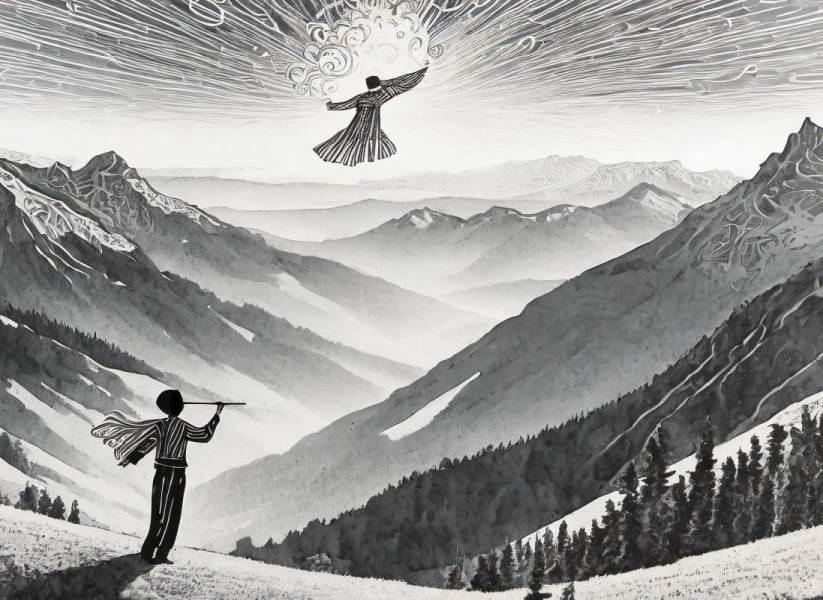
Scarecrow rides a bicycle in early winter mornings, and the crows object. (a note: I begat these AI illustrations with Adobe Firefly, which claims it doesn’t use uncompensated artists’ work to train itself)
.
I said my poem isn’t Okaji’s story — it’s more mine partway — but if you’re like me in some ways, particularly if you want to consider those of us aged to where a compatriot’s death seems next door, then it might be as if it’s partway yours too. The admonition in the poem’s title is therefore not addressed impertinently to Robert, but to myself and perhaps others who might read or listen to this.
Woody Allen wrote a great line: “I don’t want to be immortal from my work. I want to be immortal by not dying.” We write poems, we make those “like a” statements by writing poetry. As if: in our minds we walk into those poetic offices, write our metaphors, our similes. And some day, we must clean out our offices, leaving on our desks a few sheets of paper, maybe enough to stuff a scarecrow.
Today’s performance started with two electric guitar lines I recorded early on New Year’s Day, following the tradition of trying to do things on that day that one would like to continue to do regularly the rest of the year. The two somewhat irregular riffs were spontaneous,** thinking that promise to myself required doing as much as planning. The bass line was laid down almost a day later to try to hold things together, and the decoration of the keyboard parts arpeggiating the spontaneous chord changes which had started things off, were the final tracks. Those things done, I had my rock band to declaim my sonnet “To not be scared of death that doesn’t understand us” over.
You can hear that with the audio player you should see below. No player? This highlighted link is a back-up method, as it will open a new tab with its own audio player.
.
*A metaphor that sounds more like a sneeze than Athena’s birth when I re-read this.
**I fancy the right channel line played on my Telecaster has some crow-call-like moments.
Of all the English language poets who have achieved a general readership, it’s likely that Robert Frost is the most misunderstood. I don’t say that to shame that broad audience — after all, in my youth, when asked to read Frost, he seemed too full of tired maxims and quaint commonplace situations. Sure he comforts folks I ignorantly thought, and maybe I undervalued comfort, but that wasn’t what I was looking for.*
I won’t blame that youth I was then too much. I was onto other things — but as far as Frost goes, I was carelessly understanding his best work too quickly. Decades later, partly as a result of this Project, I came to his short lyrical poems, beginning to appreciate their supple word-music — and then once beguiled, I began to see what he’d put in these concise pieces.
Maybe it’s its concision, or the careful way Frost uses incremental details, but this poem was first published in 1915 and yet the horror it contains seems to have passed most readers by. As I read it this month, now more attuned to how Frost can work, my first thought was this is as harrowing as Bob Dylan’s “Hollis Brown” or as stark as Bruce Springsteen’s Nebraska album.
My first reminder as you read this poem is that it’s set in a circa 1900 rural America that was more isolated than you might imagine today. Farm families didn’t always have daily connections with others, and those institutions that offered connections: churches, shopping towns, exchanged labor, and rural schools were episodic. Long winter nights and snowstorms restricted what travel there was. Frost himself went through a brief attempt at living that farm life in this era. Perhaps he had a writer’s lighthouse-keeper fantasy of splendid, thoughtful isolation. His poetry testifies that he learned the reality.
Frost’s poem opens with a snowstorm in progress in the nighttime. How many poems, stories, blog posts, other accounts portray such a scene? Frost wants to let us know this isn’t a greeting card picture. The wind is a “beast” and it’s curiously imploring “Come out!” How many readers will miss this odd inclusion and take it as so much filler merely indicating that there’s a wind?**
The poem’s speaker, who we’ll find out is a young husband in the house with a wife and child, responds that it doesn’t take much interior debate to not obey what the beast outside is requesting. He’s thinking: there’s a storm, I’m staying in.
Then we get a different calculation. He tells us about the wife and child. They’re asleep, there’s no awake partner to bounce ideas off of. Suddenly he’s worried about the isolated farmhouse’s sole source of heat, a wooden fire. I think the implication here is that at the very least he thinks he needs to visit an outside woodpile. Or perhaps the winter has been hard enough that he’s short on fuel.
In the poem’s concluding scene, he’s now set on going outside. In the snowhills and blowing snow, even the barn looks “far away.” Is he even considering trying to make it to a neighbors for fuel? Is he making a difficult but sane decision, or is his isolation and “cabin fever” such that he’s thinking of making a risky trip for less than necessity?
I thought too of the deadly rural winter isolation of Susan Glaspell’s “Trifles” reading today’s Frost poem.
.
Let me note one other thing about the poem. For Frost, the famous formalist, this poem’s form is very irregular. Poetic feet, meter, rhyme scheme? It’s all over the place, though periodic iambs are there in the confusion. Formalists who teach Frost would likely skip over this example for lessons. Workshopping this poem with a formalist? I can imagine the markup.
In setting “Storm Fear” for performance I was able to deal with the irregularities in Frost’s design, but then I’ve worked in this Project with a lot of outright free verse and have found it not as difficult to sing or mesh with music as some might guess. But when you’re performing (rather than writing a page poem) there are a couple of things you might want to add stress to: a sense of repetitive or choral structure and some additional guidance to the listener to intrigue understanding on one listening.
My choice here was to make the poem’s 7th and 8th lines into a refrain that repeats twice more, the last with a variation. The first time we hear “It costs no inward struggle not to go,/Ah no!” we hear it as the easy rejection of the beast-storm’s call. The second time, as the singer thinks of his wife and child, it seems more as a statement of the imperative for him to take action and leave into the storm. And in the final statement at the end of the song, he’s about to enter the storm thinking he must seek aid.
Would Frost have approved of my changes? Who knows. He was a man of strong opinions and an often brusque manner. Many poets or their rights-holders would forbid changing even a word. But this old poem is in the public domain now, I need no permission, and I hope my setting honors the intent of Robert Frost.***
You can hear my musical performance of “Storm Fear” with the audio player gadget you may see below. Is that player snowed out? This highlighted link will open a new tab with its own audio player in those cases.
.
*So yes, I was a dolt about Frost, but not singular in that ignorance. Frost’s first two poetry collections were published in England after he left America for there. One reason for that hejira: American publishers were not in the least interested in his poetry. Frost was nearing 40 when A Boy’s Will was published. So at least in 1915, the experts were also misreading Frost.
**Some Faustian readings of this poem take that beast as The Beast — that the poem’s speaker is a sinner being stalked by his sins’ debt collector. Frost may have been aware of that implication, though it doesn’t strike me as consistent with what I understand of Frost’s own theology. Making the wind “howl” or “growl” is a commonplace, and calling it outright a beast may be stronger — but if enough readers miss the eminent dread in this poem, maybe it wasn’t strong enough.
***Generalizing, poets who feel they’ve worked their words with a fine touch are often resistant to editing by collaborative outsiders. Since Faust has entered the chat, I think of the collaboration between Bob Dylan and Archibald MacLeish who were slated to do an adaptation of Steven Vincent Benét’s “The Devil and Daniel Webster” for Broadway. MacLeish knew Benét, and likely thought he could do right by his late friend’s work. Dylan has his ways, and MacLeish had his — so the two fell out, and Dylan’s songs in progress for the play were not used. The eventual Broadway production bombed. Dylan used some of the songs later on his own. His “Father of Night” is often attributed as one of those rejected songs.
I left a comment on the Fourteen Lines blog last month when I saw he’d posted this Kenneth Slessor poem. I didn’t know the poem, but I wrote that blog’s host that he and I may be the only Americans who appreciate Kenneth Slessor.
Slessor is an Australian poet, and Australia is a long way off, but then over in our hemisphere we’re not obligated to keep all the poets of the first half of the 20th century in mind either. I know little about his life other than the short-ish Wikipedia article. I did a more elaborate search a few years back, and I recall he was considered by some as a pioneering Modernist in his country.*
Some of his poems I’ve read don’t move me on encounter. There are elements in his verse at times that vaguely remind me of a troop of other British poets contemporary to Slessor in the U. K. What is that that leaves me cold in that field of first half-century British poets? Stilted, too formal language, non-vital metaphors, musicality that can only barely contest those first two failures. This could be my failing, my taste may not be yours, and another apprehension (mis or otherwise) of mine is that there’s a whiff of posh-boy entitlement and clubishness in too many. I’m a Midwestern American, I could be wildly misjudging this. I make no claim of authority.
But no matter that, because his best poems move me like few other pieces of verse can. They have Modernism’s Classicism streak, that idea that the poet doesn’t always presume to tell you what the characters in the poem think, nor does he directly tell you what to think about what goes on, even though the selection of what he portrays intends an effect.
I know nothing of Slessor’s poetic influences.** In the Wikipedia article someone says he was compared by someone favorably to Yeats. I’d have to squint to see that one. Someone else said Baudelaire, and I can see that somewhat, though Slessor avoids the bad-boy-boast persona. Indeed, in my favorite Slessor poems, he’s not in them at all, he’s just the observer, and we only know him by his senses — which as we read those poems, become our senses.
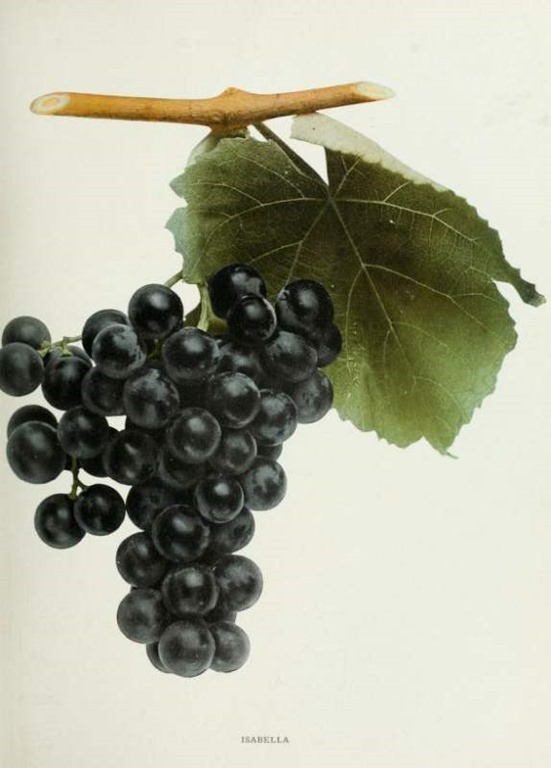
Such a poem is “Wild Grapes.” I can see and smell the marshy landscape, the broken orchard, and the sight, the shape, the texture, the musky taste of a wild black grape.
Then as the poem reaches its penultimate stanza, a bit of mystery arrives. There is a sense there of a ghost, a “dead girl” named the same as the grape variety — and as the poem moves to its conclusion, seen as a union of the two, before we move to a final disturbing line.
Ending poems is hard — at least I find it so. I could generate a hundred good starting lines, and yet with the same effort still not come up with a single good last one. Slessor’s last line grabs me. There’s a reason the ghost’s spirit stays in the deserted place. Maybe it’s her similarity to that wild black grape. Or maybe it’s some emblazoned event, before the orchard was abandoned, its sweet fruits of apple and cherry still tastable and ripe. The poem’s voice only suggests: kissed or killed there. Is there a dichotomy, a distance between those two suggestions? Perhaps Slessor intended that — but here’s what I think: I read that line, implying an “and” not the written “or,” as a vivid allusion of sexual violence.***
You can hear my performance of Kenneth Slessor’s “Wild Grapes” with an audio player many will see below. No player? This highlighted linkwill open a new tab with it’s own audio player.
.
*He wrote poetry between the end of WWI and the end of WWII, so not in the very first wave of Modernism elsewhere, but Australian culture might have lagged a bit from Britain, France, and the U. S.
**I can see Rilke and Robert Frost in his poetry, and there’s nothing outlandish to think he might be familiar with their work. A prominent object in this poem are grapes, and I thought of this poem by Rilke, and this one by Frost, which also feature that fruit — but I don’t know. Though my favorite Slessor poems are more sensuous, there’s an epitaph character sometimes that reminds me of a somewhat forgotten early American Modernist, Edgar Lee Masters.
***I suspect more women, from more experience of violence chained with sexuality, would see that reading. Slessor wrote “or,” and his typewriter had other keys if he wanted to use them. He could just be musing on a range of things and the unknowability of the lives on what sounds like a plot once occupied by lower-class settlers or convict exiles from Ireland.








 Frank Hudson