I was ready to post this new piece, Carl Sandburg’s “At A Window,” early yesterday when I had one of those days that come to challenge artists. Artists less fortunate than I can perhaps point to a single thing that holds them back, but with myself it’s often several smaller things.
I’m a habitual early morning reader of the news, a rhythm that may have started in my earliest teens when I delivered newspapers before school and continued through night-shifts in hospitals where I’d read the papers as they came out in the predawn hours. Nowadays, it’s not the papers I turn to for news, but Internet newsfeeds, and the pre-dawn hour was filled with the reports of another mass shooting profaning music, this time in Las Vegas. These events hurt me because I often spend as spend as much of my day as I can carve out making the music here in combination with the words that I combine with it. One of art’s purposes in my mind is to allow us to set aside momentarily the real consequences and strictures of life. Not necessarily to escape them—in fact, many times art allows us to examine them so that we can treat them as the reality of what they really are, because those strictures, even things we fear most, have their limitations, just as we do. And art can be the “R&D Department” of the soul and the repair of the world.
Thus, the hurt when those borders are crossed. Thus, the feelings of one’s work in an inadequate field.
Of course, my feelings on this matter are a small and abstract hurt, compared to the suffering of those more directly impacted. Small things closer to my heart feel larger than great things farther away. This is one of the limitations of our perception. Then my day continued with another unrelated hurt, closer yet to my heart, and I was reminded again of my limitations and imperfections.
Real hurt seems so large, art seems so small, and I feel like a poor worker in a field of playful trivia.
Which may be so, the limits of my perception may not be able to tell. However, I believe this is a common feeling for artists to have, and so if you create art, you may also have felt this. We try to do so much, and all we can see is so little. This is part of why the Parlando Project principle: “Other People’s Stories” has value. Speaking the words of others helps me by adding what their eyes and hearts have seen.
“He is an observer with sympathy but without fear”
This morning, it turns out that Carl Sandburg, in the very piece I was working on this previous weekend, “At a Window,” was speaking to this experience, though in my down-heartedness, I couldn’t hear him for a while. This short poem, appearing first in 1914 in Poetry magazine alongside his “Chicago, hog butcher for the world…” poem which will overshadow it, waited patiently to speak into my ear. What good could a more than a 100-year-old poem have for me?
Eight poems of Sandburg’s Chicago Poems debuted in this issue.
“At a Window” says that even in shame and failure you must hunger for even more of the same. In the context of the sampling of Sandburg’s Chicago poems, which spoke so frankly about the situation of poor and working-class Americans, I think that window in the title means so many things. Yes, it means there is an imperative to look outside oneself as an artist. The dusk and shadows out the window lets one see little, but one must still look.
Will there be any consolation? Sandburg apparently had such consolation in his spouse, who championed his work, who he speaks of in the “Leave me a little love…” section. Perhaps you have such a champion in your life, perhaps you don’t. We are called in “At a Window’s” conclusion to look out the window anyway. Perhaps the one who comes walking out of the dusk is yourself, to champion someone else?
To hear the performance of Sandburg’s “At a Window” use the player below, and thank you for listening.
The subtitle of the Parlando Project is “The Place Where Music and Words Meet”. As I mentioned last night, this project, which combines words sourced from a variety of sources with a variety of music, has now reached 100 available audio pieces since it’s official launch 11 months ago. Note that stress on variety. In terms of writers, I have my favorites, and the short format of our audio pieces strongly favors poetry, but the Parlando Project has featured words taken from other sources as well, and some of the poets featured were unknown to me until I ran across them looking for material, and I’m trying to vary the music as much as I can. Sometimes our pieces are as simple as acoustic guitar and voice, as in our most recent post The Oven Bird. Some pieces have full arrangements with multiple instruments, and some feature spontaneous performances by the LYL Band, a folk-rock band that’s been playing a rough and ready mix of electric instruments and literate lyrics since the early days of Minneapolis punk rock.
We’ve gotten thousands of downloads and streams so far, and though I don’t have the time to thank everyone personally for the likes and the shares, it’s been your passing on the existence of our audio pieces that has grown our audience from a few hundred downloads to thousands. I don’t have time for a social media presence myself. Researching, writing the majority of the music, as well as arranging, producing and recording these 100 pieces has taken an untold number of fascinating hours, but it leaves me little time to promote this work myself. So I’m very grateful for you, the readers/listeners who have done so.
Since we last did did a Top 10 in the spring, that growth in listenership has meant that there is only one returning piece since that list a few months ago. Which piece has the staying power? Lets start off the countdown in the traditional order, with #10.
10. Adlestrop – a late surge brought this piece with words by fateful British poet Edward Thomas into the top 10, just beating out Zalka Peetruza and Spring Grass as the final slot shifted back and forth this week. Adlestop’s download rate is noteworthy too in that its the newest post to make this list. Listening to this hazy slide guitar piece I still recall my own muggy summer unscheduled lay-over in Kingham a year ago, but that’s a private moment, though I feel somehow I’ve shared it with Thomas thanks to his words. In a more public way, this poem gains resonance from it’s connection to Robert Frost’s The Road Not Taken and to the Centenary of WWI.
9. Grass – speaking of WWI, here’s the first of two placings of a Carl Sandburg piece on this Summer’s Top 10. My private memory is performing this with the LYL Band, spontaneously as usual, with no rehearsal or warning as I read Sandburg’s words, and having us stop on a dime for line that starts “What place is this…” as Grass approaches Sandburg’s ending. For other listeners, particularly those with friends, families, and even ancestors lost to war, Sandburg’s piece asks a powerful question of forgetfulness.
8. Intro to The Waste Land – One could say this continues our WWI Centenary theme, as T.S. Eliot deals with his personal depression in the context of the aftermath of The Great War in this poem, but it was instead intended as part of our April “National Poetry Month” celebration, which I will always link to the poem’s famous opening line “April is the cruelest month.” This is one of my composed pieces musically, were I get to write and perform all the parts myself, which means I get to fully realize my personal “vision” of the music (something the listener needs to care not a bit about) and to therefore be responsible for all my own mistakes. My personal memories of The Waste Land are two-fold, one a memory of reading it for the first time in college, and though mystified, feeling an intense musical thrust in what Eliot wrote, and then to a time more than a decade ago when I felt just past my lowest ebb emotionally and then performed the last sections of The Waste Land spontaneously with the LYL Band, and found it as musical as I expected it would be, but also was surprised at how it expiational performing it was. Publically, the downloads of this have been steady, and have continued long past #NPM in April, so it’s either due to your sharing of it, or the poem’s continued fame.
7. To A Friend Whose Work Has Come To Nothing – Irish poet William Butler Yeats is another writer whose work we’ve mined for more than one piece here. One thing I learned while looking at material for this blog was that Yeats too believed that poetry performed with music was a necessary combination. Another investigation, brought on specifically by this piece, was to find out just who the friend was whose work had been thwarted, and what that work was. This has been another piece with a steady listening rate since posted. My guess is that the experience Yeats was telling us about is common to many, and whenever it is encountered it is not easily forgotten. Weeks after this was posted, I watched the former FBI director James Comey testify before Congress, and thought if Yeats was his friend, he would have said the same things in verse to him.
6. Clark Street Bridge – Carl Sandburg gets his second appearance on this Top 10 with this wistful story of day and night on this busy downtown Chicago river bridge. As a personal experience I got to see the Clark Street Bridge this spring on a visit to Chicago, and though the current bridge is almost 100 years old, it’s not the one Sandburg watched and wrote of. Another thing I learned during my trip: his night scene with silver singing stars equal in number to all the broken hearts in Chicago contained a larger number than I would have estimated from modern urban nights, as the poem was written before the widespread adoption of all-night electric lights. What are, or could, the listeners be attracted to? Well, broken hearts remain as numerous as the stars in a dark sky for sure, and Chicago has taken Sandburg to it’s heart; despite, or because, he says that that heart is broken.
5. The Death of Col. Bruce Hampton – I’ve written a number of direct tributes to musicians that I’ve featured here, but this is the most popular. Particularly now as the main lot of musicians fall back into the lower levels of the “gig economy” they gave their name to without additional payment, I see them as retaining the heroism of artists in general, who do what they do to general indifference, but now with a much lower chance of professional earnings. This is the only piece in this Top 10 where I wrote the words and the music, but that’s about the right amount, as the Parlando Project is about appreciating “Other People’s Stories” after all. The defensive shells and double-ended poison stingers that artists grow don’t always lead to happy lives, but those who knew Bruce Hampton have grateful things to say about him as a person and collaborator. And by chance, he got to come to the end his life with some of those folks thanking him, while he encouraged the creation of even more spontaneous art. I assume that’s the reason for so many people listening to this piece.
4. These Fought – Here’s one I’m a little surprised about. Ezra Pound may have done more than any other person to create modern poetry, but he’s less read today than many he influenced and championed. And though other modernists dabbled in between-the-wars nationalism and racial theories, Pound became America’s most notorious fascist apologist. And this piece, posted around Memorial Day is an uncompromising denial of the honor in the sacrifices of WWI. If you like your poetry feel-good and inspirational, if you like your poets cuddly and full of civic pride, this piece is not your choice. The LYL Band tries to equal Pound’s fierceness in this performance.
3. Love and Money – Unlike many other poetry and spoken word blogs, we feature other people’s words almost all the time in the Parlando Project. Of course, there’s nothing wrong with self-expression, but in following the Project’s dictum “Other People’s Stories,” we don’t do that often. Perhaps in consolidating that stated aim with the catalog of thought-provoking words that Dave has written over the years, many of the Dave Moore pieces I’ve posted so far have been performances where I perform Dave’s words–a mixed blessing that–because, to steal an old Columbia Records ad from the 1960s “No one sings Dave Moore like Dave Moore.” I was sold on this one the moment I heard Dave sing the first line of this piece as we spontaneously performed it, and there’s no way I could do it justice. The popularity of “Love and Money” probably has the same private and public reasons, it’s just a good song. Oh, and Dave’s pounding electric clavichord performance might have something to do with it too.
2. Up-Hill – Here’s an example of a poet I knew close to nothing about before looking for material in the public domain to adopt for Parlando performance. Having a long time love of the Pre-Raphaelite painters and knowing that poetry and poets were part of their artistic circle, I went looking for Pre-Raphaelite poems that I could relate to musically. I kept striking out. I really wanted to find something by Algernon Charles Swinburne, because, well, “Algernon Charles Swinburne”. Is there any name that says more clearly that you don’t give a damn about sounding cleanly modern and approachable? Only Ezra Pound’s invented persona “Hugh Selwyn Mauberley” comes close. Alas, I could find nothing I felt I could inhabit–and then I came upon some of Christina Rossetti’s shorter poems. Read this on the page just once, and you know it’s crying out to be sung. Perhaps Up-Hill draws listeners because it’s a Christian religious poem, but Rossetti’s writing personally connects with me because it’s imagery and expression is so non-abstract and modest.
1. Frances – Here’s the only repeat from last Spring, and it’s still on top, with almost double the total listens since released of the any of the others on this list. I released Frances on a lark to mark US President’s Day last February. I suspect it got picked up and linked somewhere more popular than other pieces that have been linked from here, but I haven’t been able to find out where. Here’s an example of how relatively popular it’s remained, long after it’s author’s, the first US President George Washington’s, birthday this winter: it was the 8th most listened to piece from the Parlando Project in May, still 19th in June, and currently it’s the 13th most listened to song in July, with a hundred alternatives competing with it. What accounts for this? Well it’s a love song for one thing. Maybe it’s the pared back Pixies soft/loud arrangement? It’s a mystery.
So that completes the Summer 2017 Top 10. I plan to do another one next Fall. If you’ve got a favorite you’ve found here, do what someone must have done with Frances, and go ahead a link to it to see if it can get more listeners.
In the last post, I presented Ezra Pound’s rant about the society that lead so many to their deaths in WWI, deaths that included several of his own modernist artistic circle. Taking it personally, Pound exclaims that their “fortitude as never before” for change and their “frankness as never before,” lead only to equally great “disillusions”. He sees lies and liars leading others into the war and their sacrifices, and only liars as triumphing.
Speaking repeatedly about liars and lies and illusions, Pound’s “These Fought” would not be a very popular choice for a Memorial Day speech then, just as it probably would not be one now. If you agreed with him, you might enjoy his precise inventory of folly. If you didn’t, you’d say he was unappreciative of his friends (and so many others) sacrifice, and that his disbelief in the stated high motives for the war could be mere cynicism. I can hear what some voices must have said then (and would say now): “You can complain about what is imperfect, perhaps even foolish, but what’s your solution, other than to stand to the side and write poems?”
Alas for Pound, he did propose a solution. It was a solution chosen by many others disappointed after WWI, a fresh modernist conflation of race hate, nationalism, technology and authoritarianism, the fascism that lead to WWII.
What place is this? Where are we know?
Today’s episode: “Grass” by Carl Sandburg is just as pure a modernist, imagist poem as any by Pound, but it’s statement about the sacrifices of war is more indirect.
Sandburg has a reputation as a clear-spoken poet who makes his points straightforwardly, as if plain words mean simple thought. I believe this is mistaken. Sandburg’s mind was not a simple, unicameral mind. Sandburg was leading multiple lives at once during the WWI era. He was writing, sometimes under a pseudonym, for radical leftist/labor IWW publications, while writing for the mainstream Chicago dailies, while writing modernist poems. When Sandburg was protesting the jailing of IWW antiwar activists, and writing today’s compressed, Imagist, “Grass,” Sandburg had also published a long, Whitmanesque populist and blood-thirsty poem “Four Brothers” lauding the urge of Americans to go overseas and put the German Kaiser’s head on a pike. “Grass” too has its echoes of Whitman—not the martial revolutionary Whitman, but the Whitman who wrote of grass as “the beautiful, uncut hair of graves.”
So, this is a complicated and perhaps self-conflicted man who is writing this, and when we move in “Grass” from the catalog of history’s deadly battles, ending with two great battles of WWI, Sandburg’s poem takes a turn.
In two years or ten years, what is this sacrifice? In“Grass” the places of these battles become nowhere. Is this a hopeful statement, that after this “War to End All Wars,” we will now be able to forget war? Is this an anti-war statement that would say, as the radical Sandburg or Ezra Pound would have said: that after all such strife, the liars and those that run things will continue to run things anyway, as if the war settled nothing? Is it a statement of reconciliation to come, when elderly soldiers from opposing sides meet and speak of their common experience and equally lost comrades? Is this a statement of the democratic socialist Sandburg, that the forces of inevitable Marxist proletarian revolution will come and obsolete all that was before? Or is it a cool and detached statement that all human efforts are transient?
I don’t think it’s an accident that this divided man wrote a poem about the sacrifice of war that lets it be all those things.
To hear the LYL Band present Carl Sandburg’s “Grass,” use the player below.
Returning now to our discussion of Modernism, that early 20th Century artistic movement that gave the artistic environment we are still grappling with. While it was a world-wide movement, reacting to world-wide changes in technology and society—for the first time, Americans were at its forefront.
But not all the Americans were residing in America.
Back in 2014, when there was a brief 50-year anniversary flurry of coverage of the Beatles “British Invasion” of the US, I played one of favorite games. So, if we were to think in 2014 of the way things have changed since 1964, what would a person in 1964 be looking back at from the same 50 year interval from their time?
Turns out they could have been looking at not a “British Invasion” of musical groups, the Beatles et al—but an “American Invasion” as Ezra Pound, T.S. Eliot, H.D., Gertrude Stein, Robert Frost, and Ernest Hemmingway all were residing in England or Europe around this time. Pound in particular, was busy making alliances and promoting his vision of Modernism, which he called “Imagist.”
Imagists, at least at the start, put a high value on concision. Pound was just as concise in Imagism’s manifesto, reducing it to three rules:
Direct treatment of the “thing”, whether subjective or objective.
To use absolutely no word that does not contribute to the presentation.
As regarding rhythm: to compose in sequence of the musical phrase, not in sequence of the metronome.
Images of Imagists: Sandburg on the left, Pound on the right. You can say that again.
Not all the Imagists were residing overseas however. Back in the specifically American city of Chicago, Carl Sandburg was to combine these Modernist/Imagist precepts with Socialist politics and activist journalism. He worked so hard at this that he essentially split himself into different people. There was Carl Sandburg the Imagist poet who hung out at the then new Poetry Magazine offices, where the poetry discovered by their European Editor, Pound, was funneled into America. But he was also a journalist working for the legendary Chicago daily press portrayed in “The Front Page”. At the same time, he was also associating with equally legendary American IWW radicals and anarchists, writing for their publications, sometimes under a pseudonym. Was he hiding his identity, or just saying that the agitator was a different personality?
Visualize that American comic-book secret-identify hero, say Superman. By day the “mild-mannered reporter for a great metropolitan newspaper…” by night fighting for “Truth, Justice, and the American Way…” as a crusading radical Socialist—but wait, there’s something more—he’s not just those two, he’s trying to create Modernist poetry as well. And pay the rent. Which is his true secret identity?
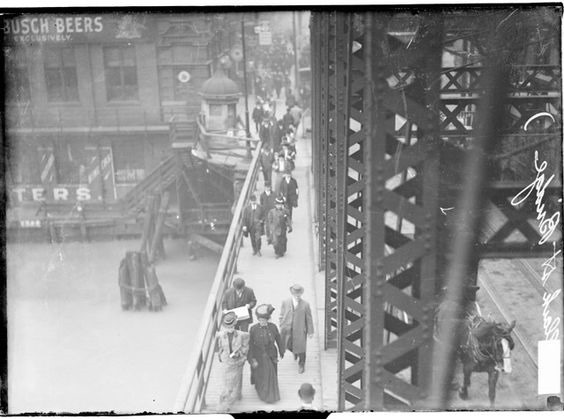
Chicago’s Clark Street Bridge, then and now: “No more dust and wagons.” Are the voices still unheard?
Today’s audio piece, Carl Sandburg’s “Clark Street Bridge” is an orthodox Imagist poem by this un-orthodox, tripartite man. The subject “thing” is definite as the downtown Chicago river bridge in its title. Its rhythm is as legato and singing as the absent voices singing at it’s end. It starts with its busy turn-of-the century black’n’white newsreel footage of crammed wagons and walkers, then takes us to the dog-watch night: only three scattered people interrupt the foggy mist and the brightest stars above the urban river. In this mist and shadows, reporter Sandburg takes off his double-breasted suit, but then, stay-at-home Imagist poet Sandburg takes off also his poets’ tights and doublet, and now, naked as a radical above the dark Chicago river he hears the “voices of dollars” in the city’s heartless commerce, the “drops of blood” from the men and women who animate it, and the gigantic chorus of the resulting “broken hearts,” as many as all the stars, as heavily present as the mist, and as unheard as either.
As I’ve often found with Sandburg, others have set his poetry to music, but no matter, I press on. My music for “Clark Street Bridge” started with an un-relenting long-measure typewriter-like drum part which I hoped would stand for hoof and foot beats. I tried to pair the guitar part and the reading of the words, and finally, I laid a legato bass part underneath it all to stand for those voices softer than the stars and mist. To hear it, use the player below.
Did I just say it’s been awhile since I featured a piece with words by Carl Sandburg? I started this Sandburg piece early this month thinking it would appropriate for the onset of spring and National Poetry Month. It fairly short order, I came up with the general chord progression I wanted to use, one which is somewhat ambiguous as to key-center (D, A, F# minor, E, with the cadence generally descending from D, but resolving either the A, the E, or the F# minor, and with a single B minor thrown in).
I liked this musically when I laid down the initial acoustic guitar track of the chords; but I intended to add additional parts to fill out the arrangement, and when I started that, I found I had given myself more of a challenge than I had anticipated. A better orchestrator than myself would have had less trouble I suspect, but I finally came up with something I felt I could accept yesterday.
Carl Sandburg rocks out, no fancy arrangement needed.
If you search for other Carl Sandburg pieces that have been part of the Parlando project, you can see how fond I am of Sandburg as a writer of short poems. For someone who writes generally in free verse, Sandburg’s work has been set to music more often that one might expect. As I worked on “Spring Grass” I assumed someone else had taken a crack at it, but I put off looking at that to concentrate on my own musical problems. This morning I did some searching and found that there are at least twoother settings besides mine, one done by the young Phillip Glass, a composer I very much admire.
This guy probably had less trouble with his orchestration.
I find one word Sandburg used here intriguing: “spiffed,” which is obscure enough in his poem that I’m not sure what it means. At first I thought it was a nice onomatopoeic sound for the wind horse in the poem snorting gently near the poet’s face—and perhaps it is—but if I read Sandburg’s sentence right, it’s the spring grass smell riding on the wind that “spiffed” the author. Does he mean “spiffed up,” the only idiom I know that uses that word? I’ve never heard “spiffed” without the “up” myself.
Well, the word-mystery doesn’t stop the poem, there’s enough mystery in Spring itself. Enjoy the rest of #npm17 and keep telling folks about the Parlando Project and our combining of various music and various words in various ways. To hear my version of “Spring Grass” use the player that appears at the end.
Earlier this month I posted the Parlando Project audio pieces that were the most listened to as of the start of this Spring. Turns out it’s a pretty good mix of what Dave and I are trying to do with this combination of music and words. However, in looking at the stats for the Parlando pieces, it looks as if a lot of readers and listeners are coming in partway into the project, starting around the beginning of this year. That’s fine. I think I’m getting a little better as I work intensively on the goal of 100 Parlando Project pieces by August of this year, but I think some of the early pieces are missing the listenership they otherwise might have gotten if I’d posted them later.
Since we’re still in National Poetry Month (#npm17), it stuck me that this might be a good time for some of our audience to catch up. So here are a few of the 2016 Parlando Project “deep cuts” from last year that you might want to check out:
Stars Songs Faces. I wrote the music for this Carl Sandburg poem as my tribute to David Bowie in January of 2016, and it was the piece I choose to kick-off Parlando. Although I’m not the first to write music for these Sandburg words, I still like what I did, and the LYL Band performance realizes my intention well. This piece also reminds me that it’s been awhile since I posted a Carl Sandburg-based piece here. I’m working on one this week, but the orchestration is not going as well as I’d like it to yet.
The Prairie. One of things I enjoy most about coming up with material for the Parlando Project is finding things in the public domain poetry cannon that I’d never read or even heard of. This is one of them. William Cullen Bryant was not on my radar until Dave Moore visited the Mississippi river valley mounds last year and began to write about them himself. This audio piece is on the longer side, which may account for the lower number of listens.
The Green Fairy. Here’s a good piece written and performed by Dave Moore that hasn’t been listened to as much as some other pieces he’s written here. My notes in the accompanying post were written in mystery about the actual intent of Dave’s words. I’ve probably got some other poets’ intent wrong too, but remember that’s one of the points of the Parlando Project: you can appreciate poems when they are accompanied with music just as one appreciates song lyrics (or even music without words at all), as bits and pieces of language that sound good, or as lines or phrases that attach themselves to you with little pieces of meaning without any requirement that you understand the whole thing.
This is the Darkness. I ascribe the lower listenership on this one to the dark tone. And indeed it might be an odd piece to listen too in the late Spring as days get longer and eventually warmer here in the upper Midwest. None-the-less, living around the 45th Parallel Minnesotans and Canadians should understand this.
Christ and the Soldier. When I was my son’s age, I was following a day-to-day summary in the newspaper, a series called “100 Years Ago in the Civil War” which covered the events just out of memory of the living in the American Civil War. And now, since 2014, I’ve been informally following the centenary of World War I, which has similarly passed out of the memory of the living. Siegfried Sassoon’s poem is a biting comment on WWI from a veteran of that war’s trenches. You know that old saying “There are no atheists in a foxhole?” Sassoon has a more complex view.
Early in 1964 the then 22-year-old Bob Dylan and some friends decided to go on a road trip, and so they all piled into a new Ford station wagon. The group had (or developed along the way) some objectives. Some sight-seeing. Dropping off some donated clothes for mine workers. A couple of scheduled concerts (one sold-out, the other had to be re-sited to a smaller venue due to lack of ticket sales). They probably had some generalized youthful expectations of adventure, the “whatever comes our way” feeling. Bob Dylan was also expressly trying to change his songwriting.
Bob Dylan, the performer, was not yet widely known, but Bob Dylan, the songwriter, was a going concern. That summer his song “Blowin’ in the Wind” had sailed up the pop charts when sung by another group, and other performers lined up to record the song.
Bob Dylan was writing a lot of songs; in quantity alone, amazing to those in the know at the time, and yet “Blowin’ the in the Wind” seemed to be a different kind of song. What was its difference? It was clearly a song about social issues, the sort of topic that never challenges the dominance of desire and partying as popular song subjects–but also it dealt with those issues in a metaphoric way. That was not unprecedented. For example: Pete Seeger and Lee Hayes “If I Had A Hammer” was written in 1949 and had also been a hit that summer for Trini Lopez, and that song used verse by verse metaphors in a similar way—but still this poetic approach was not common for topical songs.
Around the same time Bob Dylan wrote “Blowin’ in the Wind,” he wrote another song, one with even more uniqueness: “A Hard Rain’s A-Gonna Fall.” How unique? Nearly seven minutes long for starters. Instead of the neat metaphors of “Blowin’ in the Wind” or “If I Had a Hammer” marching in ordered procession, the images come rushing out as if they are escaping for their lives rather than being marshalled for presentation. Social issues aren’t being addressed in “A Hard Rain’s A-Gonna Fall,” they’re being hit with a fragmentation bomb. It doesn’t aim to be another polemic so much as to convey the experience of the polemic forming. It doesn’t try to convince you of its opinion so much as to entice you into having a passionate opinion.
There was no song like “A Hard Rain’s A-Gonna Fall” before Bob Dylan wrote it, and afterwards you can see holes from its shrapnel everywhere. The man who could write “Blowin’ in the Wind” could be a successful songwriter. The man who could write “A Hard Rain Is A-Gonna Fall” could win the Nobel Prize for Literature, even if that would take a while.
That previous summer, poet Allen Ginsberg was at a party. Someone puts on Bob Dylan’s LP, the first side. The side begins with “Blowin’ In the Wind” and ends and “A Hard Rain’s A-Gonna Fall,” and as that last song plays Ginsberg says he wept, because “It seemed that the torch had been passed to another generation. From earlier bohemian, or Beat illumination. And self-empowerment.”
But back to our 1964 car trip. How much of this does this 22-year-old Dylan know? Who can tell. The best supposition is that he knew he was onto something and he wanted to do more of it. So in the back seat of the car he has a portable typewriter—the mechanical, steam-punk laptop of the day—and throughout the trip he’s writing songs. Principally he’s writing “Chimes of Freedom.” Again, who can tell, but I think a lot of creatives would empathically suspect he was feeling a heady mix of excited and relieved that he could do it again.
Their car trip gets to North Carolina. Dylan says they must visit a poet who lives around there somewhere. Not only does Dylan’s era and car lack laptop computers, they lack smartphone apps and GPS. So they stop and ask a local. This is how Dylan biographer Anthony Scaduto tells the story:
“Where’s Carl Sandburg’s place?” (Dylan) asked the tall gangling mountain man in coveralls. “You know, the poet.” The mountain man considered that for a while. “You mean Sandburg the goat farmer?” he asked.
“No, I mean Sandburg the poet.”
“Don’t know about no poet. There’s a Sandburg has a goat farm. Wrote a book on Lincoln. Little guy. Littler than you, even. If that’s the one, take this road two miles up there, turn left after the little bridge, can’t miss it.”
So here’s the 22-year-old Bob Dylan, the man who is about to take his own jangled and re-mixed reception of modernist poetry and societal criticism and collide it with guitars and transistor radios in an unprecedented way, and who does he want to see? The 85-year-old Carl Sandburg.
Accounts of what happened next differ, and may not matter if we consider only that one thing, that Dylan wanted to see Sandburg.
I’ve talked about this before here. Everyone who influenced us had an influence. It’s a great long chain across time. Dylan was influenced by Woody Guthrie, Woody was influenced by Carl Sandburg. Sandburg was influenced by Walt Whitman. Whitman was influenced by William Cullen Bryant. Bryant was influenced by Homer. And now going forward from 1964: Every rapper’s flow that jumps from one thought and observation to the next without catching its breath, every indie-rock song that decides to show the oblique confusion and emotion of confronting experience without boiling it down to conclusions, every self-penned ballad where the singer insists we hear how specifically she or he saw things comes (however indirectly) through Bob Dylan’s lyrical revolution.
So after all that introduction, here’s a short autumn-themed piece with words written by Carl Sandburg with music I did myself. Like Dylan’s later work, Sandburg’s “Under the Harvest Moon” unflinchingly addresses issues of love and death.
A small anecdote about the process of recording this piece.. As I set up to do the basic track for “Under the Harvest Moon” the power went out, and stayed out most of the afternoon. I so wanted to “try out” the composition, as much as I could, so I dug out and old hand-held digital recorder and a 12 string guitar and recorded the vocal and acoustic guitar track in a dimly lit room. As happens fairly often with musician’s demo tracks, I liked the demo well enough to keep it. Later when power came back on I added bass, an electric guitar part and the string –section part of the final track. To hear the resulting “Under the Harvest Moon” click on the gadget below.
Previous Parlando readers and listeners will know that a few years ago I renewed my appreciation for the poetry of Carl Sandburg. Here’s another Sandburg selection from his powerful Smoke and Steel collection of 1920.
Sandburg excelled in portraying his modern age, the early 20th century in the United States. His best known poem is the title piece of his Chicago Poems, the “Hog butcher to the world/city of the big shoulders” paean to Chicago, and Sandburg remains associated with Illinois in many minds because of that poem and his birth and youth spent in Galesburg, but even before that Chicago poem Sandburg had traveled widely around the US observing closely the work and lives he crossed. This poem is not set in Chicago, but instead in the fabled Lower East Side of New York City where generations of American immigrants first settled. Immigrants who often came from rural and village backgrounds to the most intensely urban section of America.
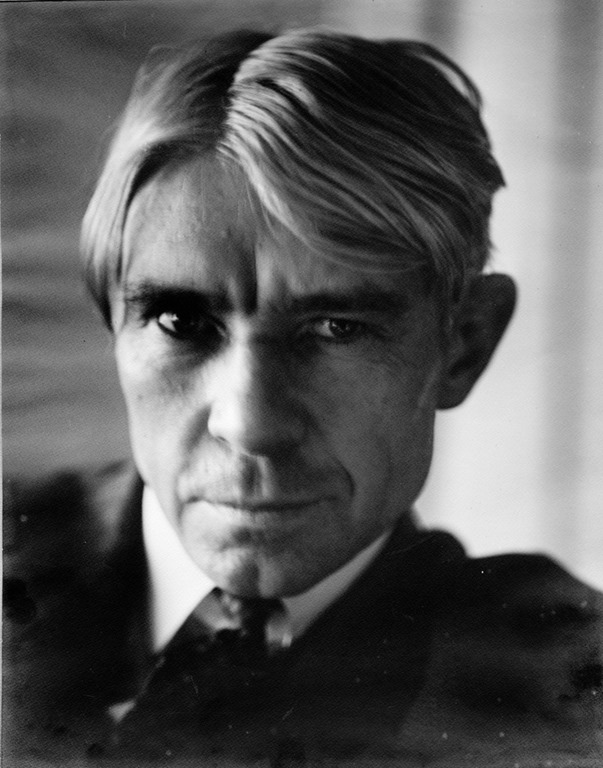
Sandburg can compress so much into a tiny portrait such as this. I’ll let you look at Sandburg’s picture without further explanation as you listen to the piece.
Two coincidences interesting to me are attached to “Home Fires.” A few years back I was able to visit the Tenement Museum in New York City and took a walking tour that leaves from there and crossed the Rivington Street mentioned in the poem. I highly recommend the Tenement Museum to anyone who visits New York. Coincidence number two: when another childhood hero of mine, Harry Golden, first visited with Carl Sandburg in the 1950s, he reported that Sandburg read this poem to him.
Musically this is fairly rich setting for me. The core tracks are the LYL Band with Dave Moore supplying one keyboard part (that’s the breathy flute sounding part in the right channel) and I am playing bass guitar and electric guitar. After the initial tracking I added some orchestration using a swelling synth patch, some clarinets, and (of all things) a bassoon. The clarinets and bassoon are synthesizer approximations of the real instruments, but I liked how those colors worked out.
To hear “Home Fires,” use the gadget below to play the audio piece.





 Frank Hudson