Sitting on Top of the World: three songs and one poem lead to a new song

I woke up to economic tumult around the world this morning after finishing a mix of this song I made from a poem by Carl Sandburg last night. I’d gone back and forth on mixing this simple piece of music. At one point I thought it needed piano. I tried an arpeggiated part. Hmmm….no. I tried a coda with underlying low-register sustained intervals. Nope too. So, no piano. I was going to post the remainder yesterday when I began to wonder if the bass line was mixed too high. I told myself I’d reconsider in the morning and went to sleep.

Awaking, I found the news of international economic fears overlaying the world of our current sustained carelessness and cruelties. Well, I thought, maybe it’s not all that important how perfectly the song is recorded or mixed. It’s time to get this little bit of Carl Sandburg out to our modern world for National Poetry Month.

This Project spends a lot of time in the previous decade to be called The Twenties, a time when all the arts and poetry had to deal with a changing culture that ended with a great falling of commerce. For much of the decade it was written up as a time of fashionable Modernism, easily pilloried as a faddish, brainless rush. The label “The Jazz Age” wasn’t meant as cultured praise. Even Afro-American intellectuals were worried that Jazz was just some fast-tempo frivolity, a soundtrack for licentiousness. Luckily for us, some Black composers and songwriters kept on making their form of Modernism.

From our time, we know the plot arc of that last Twenties. A great worldwide depression began in 1929. Fascism rose in multiple countries. Poets may have started the decade engaged with new, freer verse modes, but by The Thirties they’d be charged with dealing with the IRL world of racial-nationalist authoritarians, widespread economic hardship, and war.

I believe it’s easy to forget what an early and fervent Modernist Carl Sandburg was. He was close to his brother-in-law Edward Steichen, who was thoroughly engaged in the international visual arts Modernist revolution. His poetry helped popularize English language free-verse. His collections were peppered with clean, concise poems as Imagist as any written within that vanguard. It appears to me that he may have written Jazz/Blues literary poetry even before Langston Hughes.* Like some others in his American Modernist cohort, Sandburg had early ties to political economics of a leftist kind. How would he traverse this change in the artistic climate?

He was going to go folksy.

Much of his energy would turn from poetry to a giant biography of Lincoln, who he’d portray as a canny folklore-sage. He would publish a popular landmark book of collected folk songs. He brought his guitar to poetry readings. A Robert Frost may have made much of his farmer neighbors, but his blank-verse eclogues were orchestrated with a more academic formality.**

Sandburg’s long-form poem “Good Morning America”  is a case in point. It’s a civic poem, a stock-taking set of observations of the United States, peppered with folk-wisdom admonishments uttered in Sandburg’s version of contemporary vernacular. I picked out this section of it to use here because I noticed it riffs on a phrase also used in a remarkably durable American folk song: “Sitting on top of the world.”

As a lyric refrain that phrase appears in a song by The Mississippi Sheiks, an Afro-American jug band. As members of the continuum of the folk-process (i.e., appropriating and reusing any good stuff they could grab) these non-Arabian Sheiks stole a harmonic cadence from Tampa Red, who had used it in another oft-covered Blues song: “It Hurts Me Too.”  “Sitting on Top of the World”  quickly integrated itself into American folk music. It became a country and Bluegrass standard, but it could also be done with the force of a Howlin’ Wolf or by a classic British rock power trio like Cream.

It would be a neat package for me to say that Sandburg heard the Mississippi Sheiks and shaped this poem from their music, but the timeline doesn’t work out, though it gives me more connections to mention. Sandburg published “Good Morning America”  in 1928. The Sheiks record of their song was released in 1930. Sheik Walter Vinson says he came up with it while playing a white dance. He and that audience might’ve been familiar with a 1926 hit song sung by Al Jolson which used the same phrase. The Jolson “I’m Sitting on Top of the World”  is a friendly ragtime ditty about a man who cites his tenuous status in the economic prosperity around him as beside the point because he’s about to marry his sweetheart. Vinson on that dancefloor stage is going to fuse Tampa Red’s riff from a song about a singer who confesses empathically that his sweetheart’s troubles trouble him, because “when things go wrong…it hurts me too” with some new lyrics.

We don’t know what lyrics Vinson sang on that first performance. As the song proceeded over the years, new verses were plugged in by various singers, but the Sheiks’ recording we can hear starts off with both economic and romantic losses. Objectively, the singer isn’t presenting a happy life, but still he refrains he has “no worries…because I’m sitting on top of the world.” This is an ambivalent statement. Is it a mantra of positive thinking in the face of misfortune? A call to party on the dance-floor even if the rest of life is hard times? An easily seen-through statement of questionable bravado? Is it even possibly sarcasm, an answer-record dis of the happy sap in Jolson’s song?

Two Songs Sitting on Top of the World

You can hear Jolson sing his version here, and the Mississippi Sheiks’ version here. (click the picture to enlarge)

.

In between Jolson’s Roaring Twenties white song using that title and Vinson’s post-Black-Friday Black version, Sandburg wrote his poem, closer to Vinson’s version that would follow. Sandburg’s poem is about national wealth and hegemony, but it wants to say that that’s temporary. All it takes is one mad king blind to any contradiction. So, I sang this part of Sandburg’s poem this month, with music leaning more toward the Mississippi Sheiks. You can hear that version with the audio player below. What, has a circuit-breaker stopped trading in graphical audio players? No, some way of viewing this just won’t show it, so I offer this highlighted link that will open a new tab with its own audio player.

Frank Hudsons Sitting on  Top of the World

In adapting the 14th section of Sandburg’s long poem, I doubled the number of times “I’m sitting on top of the world” is refrained and re-lineated it from the page to fit the music.

.

The audio player for my version:

.

*As I read the two of them, Hughes and Sandburg, I often feel an American kinship in their voices.

**The Southern Fugitives took another, if Copperhead, path on Modernist poetry tied to an agrarian tradition in the era between the World Wars. Sandburg would leave the urban center of Chicago, first to Michigan and then to rural North Carolina and a working goat farm in the between Wars era — but he never fell into the reductionism that the “real Americans” are Anglo-Saxon-stock farmers.

If Frost didn’t haul a guitar around like Sandburg, Edwin Ford Piper recounts that between-Wars Frost was willing to offer his own renditions of folk songs at informal poet’s after-party hootenannies.

Sandburg’s Couples

Time for me to get back on my Carl Sandburg soapbox. I’ll be brief — as today’s poem, now song, is as well. My point (again) is I think there’s more there in his poetry than is currently remembered or considered. Your impressions may be from two stalwarts of American poetry anthologies: the Whitmanesque “Chicago”  with those big shoulders and the quite contrasting short metaphoric poem “Fog”  with its cat’s feet. Not a lot for a poet who wrote so much, so early in the Modernist era, but it does point out a range of expression.

I’ve performed segments of Sandburg’s prolix mode here. I like Whitman well enough. Within limits, I like Sandburg doing Whitman’s mode too. He’s not quite the opera singer that Whitman aspires to be, he’s more of the folk-ballad, song-suite, kind of poet. America’s a big country, so I guess we need big, shouting, poems — and even if that’s not my favorite mode, either poet can move me as they traverse long distances with galloping catalogs and litanies. My point today is that this Sandburg, being bigger, overshadows another Sandburg, one that I particularly treasure, the one that reminds me more of Du Fu than Whitman: the forgotten, pioneering, ground-level reporting, American Imagist, Sandburg. Sandburg’s poems in the compressed style are not accidents, seeds of long poems that didn’t germinate, or little palate cleansers between his important work. His earliest collections are packed with sub-sonnet-length pieces.

On awaking this morning, I was thinking of a set of poems by a couple of the earliest American Modernists, Ezra Pound and Sandburg, where they each showed gratitude for their American forbearers. I paired their poems as one musical piece early in this Project, and here’s a link to that.  Pound, within his characteristic grumpy mode in “A Pact,”  makes peace with Whitman — and while casting a little shade on Walt for being the son of a house-carpenter, he claims his own finely crafted woodcarving is descended from the cross-cut and rip saw of Whitman.

Who does Sandburg say are his native 19th century inspirations? Whitman? Nope. Maybe Longfellow, with his civic-minded striving for uplift and justice? No. Who’s left? Poe? Hmm. Interesting thought, even if Poe is awfully rhymey for a free-verse poet. The other Fireside poets? Well, yes, Sandburg wanted a wide audience, but as the child of an immigrant couple and attendee of a non-descript Midwest school, he lacked their pedigree.

Sandburg in his “Letters to Dead Imagists”  is declaring his allegiance to that spear-point of English-language Modernism, but here he claims a couple of Americans as his predecessors: Emily Dickinson and Stephen Crane.

The poet he names first, Dickinson, will likely seem a more conventional choice to those reading this today than it was when Sandburg wrote his poem in the early 20th century. Dickinson’s eventual rise to genius status would still be early in its slope — she was more known then as an eccentric than as a model for poetic expression. The second, Stephen Crane, is more associated with prose, but he wrote a singular collection of gnomic, short free verse poems, The Black Riders,  in 1895. An inspiration for Crane’s unusual work: the new, first publication of the poetry of Emily Dickinson in 1890.

Sandburg was among the first to try to form a 20th century style combining the “mother and father” of American poetry: Dickinson and Whitman. And I happen to like it when he takes after dear old mom.

Today’s piece, Sandburg’s “Couples”  sounds a little like Crane, a little like Dickinson, and it has a characteristic early Imagist trope of close-focus specifics and vivid color by name. Here’s a link to the text of it.  If one thinks of Sandburg as being a clear-speaking poet, this poem should disabuse you that he’s always about some obvious point. Part of the delay in publishing my version of his poem is that I’m still not sure what he’s describing. There’s parallelism set up between six “women” dressed in green and six “men.” They’re described as dancing, likely haphazardly as the infamously strong liquor absinthe* is mentioned, they make a hissing laughter sound. They are somehow cheating or gaming each other. There’s a worn path of hard packed dirt said to be from the dancing feet. The poem closes with dewy weeds said to be as high as six little crosses, one for each couple.

I’m stumped. A graveyard? Then maybe the dancers are ghosts. But if so, why the specific detail of the dirt floor packed down if it’s a weedy, less-than-well-tended graveyard? A barn-dance? The weeds are described as “mourning veils.” Or are the six live couples dancing around six graves? Why, who are they to the buried, if it’s that? Perhaps instead, the dancers are green plants of some kind, their dance uncoordinated as random winds, and the wind through them is the hissing laughter, and they’re maybe even the weeds the poem closes with. Did Sandburg just choose their number to be six out of desire to be specific? But again, he spends two lines of a short poem on the packed down dirt floor under the “dancers,” and plants dancing in the wind wouldn’t compress the earth.

In summary: as obscure as any of Crane’s Black Riders  poems — but specific, like a closely-observed Emily Dickinson riddle poem. If Sandburg intended mystery, he achieved a stubborn dose of it in this poem of his, and the incantatory power of its spikey, inexplicable details may still carry us through. While it’s unlikely Sandburg’s model, if one was to translate this into French and say it was from Rimbaud’s “Drunken Boat”  how would we experience it?

Carl Sandburg with guitar at mic

Glad to be at the open mic. I’m going to do “Wagon Wheel” and this Oasis song “Wonderwall” now.

.

If forced to a final guess: they are  graves, and the dancers are the living as continuing life-force, not dancing on the graves as revenge, but out of the joy of continuance, and the packed dirt is the mark of our ongoing life-work and dance. The cheating? The unfaithfulness and trifling of love and desire, or they are cheating death by living and loving. The couples of the title then are not only the paired male and female dancers engendering a new generation, but the connection between the living and the dead. Why six? I don’t know.**

I performed this with just acoustic guitar, Carl Sandburg’s own instrument of choice. When assessing his guitaristic skills, Carl would sometime say he was at least one prison sentence from getting any good. You can hear my misdemeanor playing with the audio player gadget you should see below. No gadget? It was pardoned, or impounded, or deported, or took a buyout, or something. No one seems to know, because some vain fool runs things, and there’s not enough conscientious people left to make knowledge from foolishness. But I do give you this highlighted link that’ll open a new tab with its own audio player.

.

*Absinthe is colored green, doubling down on the use of that color in the poem.

**Rejected guesses why six couples and six crosses: six is sometimes used as the number of cardinal directions, sometimes shown as a six-armed cross, but Sandburg seems to be clearly saying six separate crosses. The Oklahoma state flag shows a First Nations (Ossage) shield with six separate crosses on it (the cross is a common indigenous American symbol) — but that flag was adopted a decade after the poem, and I can’t find any source of previous use of that distinct six crosses symbolism that the flag drew on.

Paying the Piper chapter 5: Carl Sandburg’s “Gone”

I think there’s a misapprehension of Carl Sandburg’s poetry: that it’s simple, prosy work: that it says what it says, hearty single-minded messages with some decorative metaphor. Tastes differ, and mine may not be a guide to anyone else, but I sometimes don’t find him so. As I continue trying different things during the summer with this multipart personal story, I’ll return to our regular stuff at the end today with an example of Sandburg mysterioso.

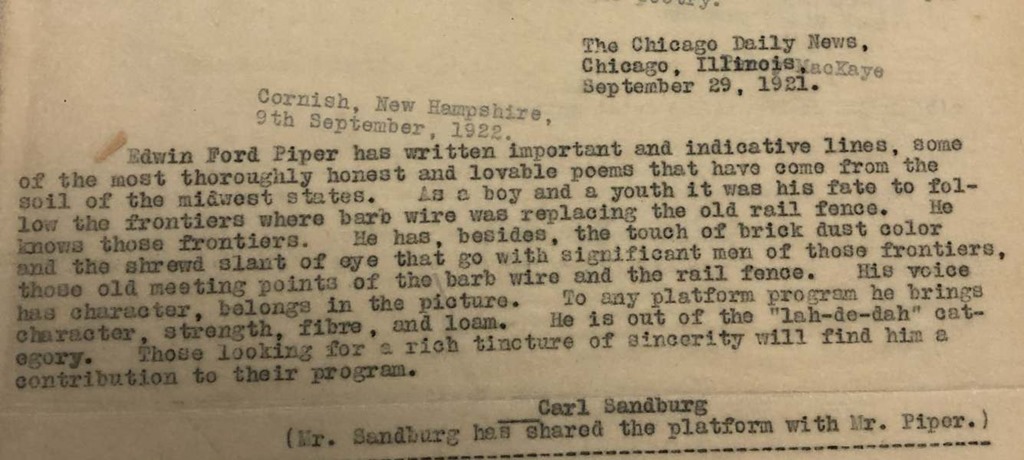
The finale of my June trip to Iowa City to see what I could find out about an even more under-considered Midwestern 20th century poet, Edwin Ford Piper, was planned to be a visit to Galesburg Illinois, a small city just east across the Mississippi river where Sandburg was born. Piper and Sandburg compare easily. Both born in the American Midwest a couple of decades after the Civil War, both part of early 20th Century literary movements we no longer take as much notice of. Both were attracted to a broad swath of memorized vernacular music that would be called “Folk Music.” They knew each other, even shared stage programs. Sandburg’s 1927 music collection The American Songbag  established what American folk music would be for my mid-century generation,* and from examining Piper’s papers I could see his definition paralleled Sandburg’s. Piper was one of the contributors to American Songbag.**

Sandburg's blurb of Piper 600

Poet Sandburg blurbing  poet Edwin Ford Piper. I also saw a note from Sandburg thanking Piper for songs used in Songbag, but don’t have a picture of that.

.

We arrived at Galesburg early for the 1 P.M.-opening of the Sandburg birthplace site. We wandered the wondering-what-it’ll-become-in-the-21st-century business district with its building facades still showing a variety of past decades abandoned styles left to fade, and browsed a charming small bookstore there. We were going to have an early lunch somewhere, and decided to just get sandwiches and go eat them in the small area behind the birthplace on benches by the Remembrance Rock there.

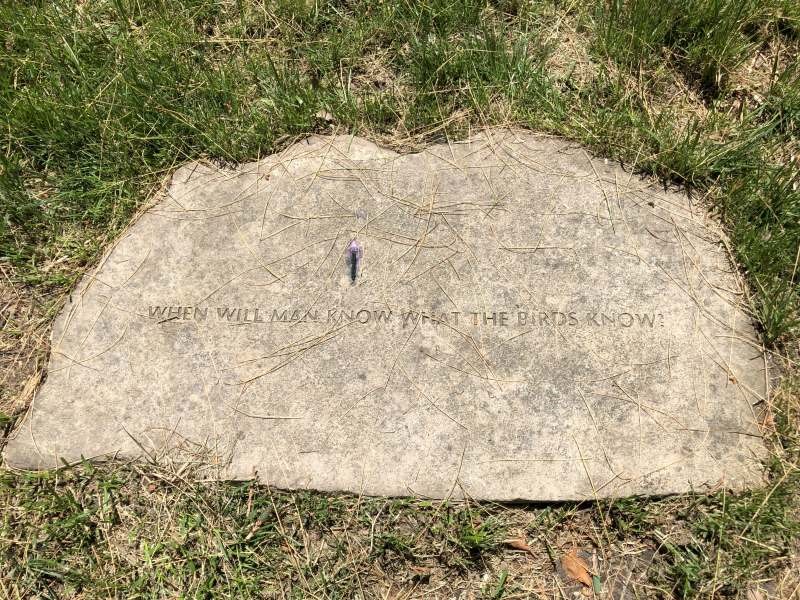
The rock is an unremarkable bolder, utterly plain and unshaped as a design choice.***  Sandburg and his beloved wife and partner’s ashes are buried under it. The lawn it sits on behind the house is circled by bushes and a few trees, and rather than any sense of a park, it reminded me of the backyard of the house where I grew up in Iowa. One thing the photos I have seen of the rock didn’t show: a ring of irregular, small, flat, stones that circle it, each engraved with a line from a Sandburg poem. If one wished, one could ceremoniously walk from flat grounded rock to rock stepping with your foot-soles on his words, which it seemed to me to be what one of Sandburg’s models Whitman has commanded — and so I did. There’s a nice bust of Sandburg on a stand there too, but to my sense of the place, walking his words was more meaningful. I’d told my wife that Sandburg’s father was a railroad blacksmith, and she figured that the neighborhood might have been handy for rail workers. After our lunch, she took a little stroll while I waited, and she came back to report that just over a rise a block away was the railroad line.

Sandburg When will man know Bird Poop 600

…but then all the birds know is to poop on poetry-engraved rocks, same as any other.

.

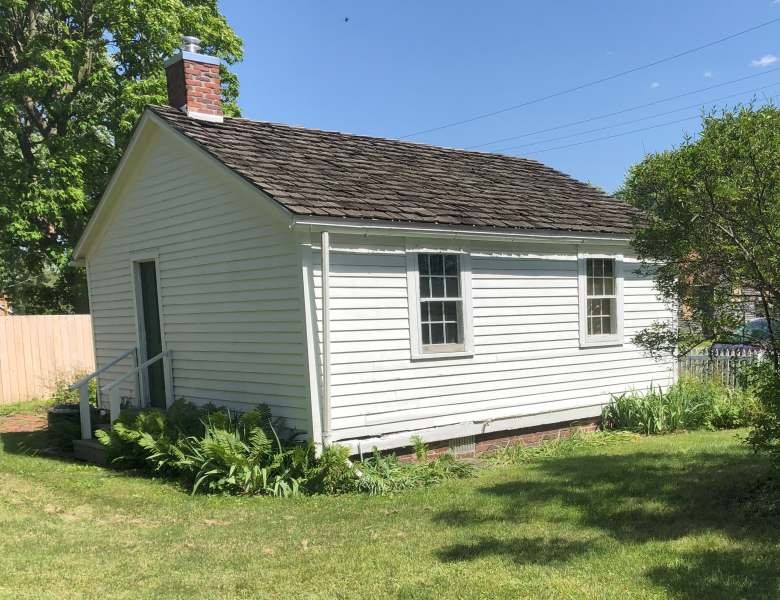
One of the site’s staff members arrived ahead of opening time to do a little yard work, and when that time arrived, he changed tasks to welcoming and serving as a guide for about 30 older folks in an adult learning program who arrived from Peoria in two small busses. Beside the birthplace (our host preferred to not call it a house, but a railroad worker’s hut) there was another small, somewhat rundown house next door that served as the site’s offices and a small room of memorabilia backed with an illustrated wall timeline of Sandburg’s life. Behind the two houses was a garage that has been turned into a cozy theater space where they host musical acts in homage to that part of Sandburg’s heritage.

My wife and I plus the 30 others overwhelmed the birthplace site’s capacity. Resourcefully the staff divided the group into two, and after watching a short video on Sandburg our half got to walk through the birthplace hut or house. If you are familiar with the modern tiny house movement, the floorplan and the maximal utilization of it would strike a resonance. Outhouse, no plumbing or running water, it’s decorated in late 19th century Swedish immigrant homey style, but a couple, a young child, and a baby would have been a tight fit, much less our troop of visitors. I recall visiting a reconstructed Lincoln birthplace cabin as a child, and though the Sandburg birthplace is wood-frame construction, not a log cabin, the square footage and amenities might have struck Lincoln biographer Sandburg as similar.

Sandburg birthplace 600

Sandburg’s birthplace: house, hut, cabin. This side shows the smallness best I think.

.

Perhaps because of the touring group’s visit, there was a special performance by a singer-guitarist whose name I didn’t catch, who did a short re-creation of Sandburg singing and talking about his life. I enjoyed that effort. Before leaving, I asked one of the leaders of the visiting group, an old professor, who had some years on your old guy reporter here, what Sandburg biography he’d recommend. He cited Penelope Niven’s bio, and I bought it at the site’s store.

No one hides the fact Carl Sandburg might not have much direct memory of the birthplace as his family moved to another Galesburg house while he was only a toddler****  But the link to his parents and the choice of it for a burial place (which was I believe his doing) speaks to the meaning to him. Unlike the larger house and goat farm where Sandburg spent his post-WWII life until he died that is a National Parks Service site, the birthplace is run by the State of Illinois and some local spirit and volunteerism. Sandburg retained throughout his life a fondness for Galesburg, never hid his roots there, and Galesburg was also the place where he attended college after his stint in the Army, though he never completed a degree.

Which brings me to today’s new musical piece, a setting of a Sandburg poem about someone who apparently left town wiping the dust off their shoes at the city limits. In his collections Sandburg called the poem “Gone,” but the main character’s name sticks in some memories, so it also gets called by the first line, or by the character’s name that appears in that line: “Everybody loved Chick Lorimer in our town.” Here’s a link to the text of the poem.

I promised mystery in this one. There are things left out, and various implications some of which complicate, some of which conflict, are left open. Can we even take that opening statement at face value? Not now, certainly not in 1916 could it be said that we all love “a wild girl” with a dream “she wants.” Some might, many would not. Wildness and dream-holding create envy, often a lot of it.

Is Chick Lorimer someone that everyone in town has marked as special, marked for greater things — someone so preeminent in their youth where that envy would be tamped down? If so, why the sudden leaving, with no one knowing where or why? Does a recognized prodigy, much loved, leave a place without saying goodbye? That would be a rare story.

Perhaps the “everyone” is a casual overstatement, referring only to a small group of friends who shared ideas? Later the poem seems to refer to larger numbers however.

Is she not actually loved by much of the town, and “loved” in a narrow, sexual, sense by many men? The “Dancer, singer, and laughing passionate lover” line could give testimony to that thought. That line is followed by two specific but puzzling lines, and their very specificity says we should pay attention to them. “Were there ten men or a hundred hunting Chick?” “Hunting” is a word choice, though we do say we hunt for the lost all the time without thinking of hunting as in wild game. Why the specific range, “ten or a hundred?” If this noteworthy young person is gone, no other info, that’s a missing person. Have they come to harm, are they being hunted for something they’re suspected of doing wrong? Why can’t they say, between 10 and 100 for the number of hunters? This hunt seems secretive from that wide range: 10 might be a small matter, 100 a greater one — but even 100 would be small if this is a universally beloved light of a town, unless it’s a very small town. It seems significant that the poem’s speaker can’t give a better estimate. And that’s followed by another stat: “five men or fifty with aching hearts.” The numbers are still widely separated, but they’re also halved from the number of hunters.

To perform this, I felt I had to have some plot in mind as I sang it. In my mind, Chick is a free-spirited libertine, and to a large degree that “loved” means no-strings sex. Chick likely left because she wanted something more, or because the disapproval of her “loving” everybody was getting intolerable. The maybe just five “aching heart” men thought they were, or could be, her significant partner.*****

How bohemian was poet Sandburg’s experience early in the 20th century? When he first moved to Chicago he lived in what was in effect a free-thinkers commune run by a strange guy, Parker Sercombe.  From my reading, “Free Love” was just as much a topic in bohemian culture in the early 1900s as it was in the 1960s.

But maybe I’m wrong, and maybe your reading is different. It could be that Chick is like “Chuck” Sandburg (the name he used then) wanting to see the world, wanting to follow their dream. Sandburg had bicycled around Illinois, rode trains legally and illegally to other parts of the US, and he’d already been to Puerto Rico in the Army by the time he wrote this. Chick could be his anima. Sandburg never felt entirely alienated from his hometown or family however. He came back through town, wrote letters to his family, and so on. And if you want to see his beginnings and his decided final place to remember him, one goes to Galesburg.

To hear my performance of “Gone” AKA “Chick Lorimer”  you can use the audio player below. Do you feel nobody knows where the audio player has gone?  This highlighted link will open a new tab with its own audio player.

.

*If you never cared about the post WWII folk revival for whatever reason, I will point out that Rock’n’Roll became self-aware artistic and literary-flavored “Rock Music” in the later 60s because folk revival musicians transferred their backgrounds into bands with electric instruments after The Beatles, electric Blues bands, and “Dylan goes electric” emerged to take over college and post-graduate audiences in the US. Over in the UK, the folk revival to Rock pipeline was supplied by “Skiffle” — an American jug-band folk revival style that swept UK youth in the 50s, merging with a peculiar British Trad Jazz revival that often featured the Blues element of pre-WWII Jazz.

**Piper’s wife, in her own papers collection at the University of Iowa library, claims that Piper’s contributions were greater than Sandburg credits in Songbag. Possible, I suppose, though the nature of Piper’s song collecting revealed by my examination of his papers shows a collaborative effort with collectors sharing with each other freely. Piper’s unpublished collection, like Sandburg’s published one, wasn’t done with a sense of ownership of songs.

****The family didn’t get sudden wealth, it supplemented the railroad wages by renting out rooms in the succeeding houses, and the children worked to add to the family income as they grew older.

*****For a fuller story fleshed out from the short poem’s details, there’s this 50 minute early 1960s TV episode from the Route 66 series which uses the poem idea as its central motif and title, with the leading man reciting Sandburg’s poem 2/3 of the way in. This linked version has hokey colorization of the series fine B&W photography, but it is easily viewable.

Reading Carl Sandburg’s American Songbag

I spent much of today reading through Carl Sandburg’s landmark 1927 folk song collection American Songbag,  all 500-plus-pages of it. It’s not the first time I’ve looked into the book, and indeed I’ve paged through it or jumped to songs I was interested in before. But next month I’m planning a trip to Sandburg’s boyhood home in Illinois and to Iowa City where I will be taking a look at some papers relating to early 20th century poet and professor Edwin Ford Piper who was one of the sources of folk song material used in Sanburg’s anthology.*  So, looking at the book in full seemed a good grounding for this trip.

I’ve made the case before here, such as this post from a year ago, that besides being a somewhat deemphasized Modernist poet these days, Sandburg is a primary model for the American Folk Music Revival, which eventually produced in the second half of the 20th century several genres of popular and semi-popular music.**  Here’s the matrix that Sandburg built in the 1920s, a hundred years ago:

  • American folk music can be appreciated like art music
  • It will be associated with literary poetry
  • It expresses, or can be adapted to express or accompany, progressive/left-wing causes
  • It’s multi-ethnic, and the contribution of Afro-Americans will be substantially acknowledged
  • Humor and funny stories will be part of its presentation

Sandburg was including segments of folk music performance as part of poetry readings before American Songbag.  AFAIK we don’t have any transcripts or recordings from that era, but all these things are demonstrated for the record in the 1927 book. Sandburg is not the only American doing any of these things a hundred years ago, but he’s doing all of them at once,  and he’s doing it with a degree of fame and cultural acclaim that was significant.

I was aided in my rapid march through American Songbag  by already knowing many of the songs it contains, and as I encountered them I remembered hearing them in my half of the 20th century performed by Woody Guthrie, Pete Seeger, Bob Dylan and many of those other “folk singers” that surrounded them.***  The Sing Out magazine and Jerry Silverman folk songbooks of the Sixties that are my foundation, are successors to Sandburg’s work, right down to the touch of  using vintage B&W line drawings as interspersed decorations.

Sandburg often includes little stories about the collector (Piper was one of a group who collected the songs “in the field” for Songbag)  and for those he collected himself he says a few words about how, where, and with whom he first heard the song. Here’s one of the most engaging of those stories I came upon today in the book:

Once when the night was wild without and the wintry winds piled snowdrifts around the traffic signals on Cottage Grove Avenue, Chicago, we sat with Robert Frost and Padraic Colum. The Gael had favored with Irish ballads of murder, robbery, passion. And Frost offered a sailorman song he learned as a boy on the wharves of San Francisco.

The song Frost sang for Colum and Sandburg? A subtle wry ballad of farming? A nuanced lyric of nature cooly observed? No, it was this one. Some will know it from its latter association with the Assassin’s Creed video game franchise:

.

*Besides the folks songs Piper contributes, Sandburg even quotes a part of a poem from his contemporary Piper’s Barb Wire  poetry collection in Songbag.

**Besides the Folk Scare of the 50s and 60s, the American “Rock Music” that extended Rock’n’Roll to FM radio, college campuses, and rock critics was generally formed from folks who had connections with the just preceding folk revival. Modern Americana and roots music links to the same strains and connections that Sandburg was personifying 100 years ago.

***Guthrie composed music for Sanburg poems later. Ruth Crawford Seeger (Pete’s step-mom, Mike and Peggy Seeger’s birth mother) was one of the composers who created harmonized music for the folk songs in Songbag,  and she also set Sandburg’s page poems to music. When the young Bob Dylan started to expand the poeticism of his song lyrics, he decided to pay a visit to Sandburg, briefly meeting him unannounced in North Carolina at Sandburg’s farm. Other folk luminaries connected? At least a couple songs collected from Leadbelly by John Lomax are included in Songbag.  Lomax is credited, but Leadbelly isn’t, though Leadbelly’s more general public career hadn’t yet started. Let me just say that Lomax’s relationship with Leadbelly is complicated. Just this month I was reading a recollection of a performance by Spider John Koerner (who first performed in the mid-century Minneapolis folk music scene along with Dylan) where he told a humorous story about a farmer who fed his pig by lifting him up to the branches of an apple tree. That’s a story Sandburg also told. I’ll also note that when I came upon several songs in Songbag,  the rendition I recalled from the Folk Scare of the mid-century was by Dave Van Ronk, a wonderful performer and a mentor to Dylan when he arrived in New York.

Happy May Day to the workers in song

It was quite the April for me, and I’m resting up today before getting on with a bunch of tasks I’ve put off while working on the accelerated posting schedule for National Poetry Month. Readership was up substantially, busiest month ever for visitors at this blog, and page views blew past the old record by over a thousand. I should be better at replying to your comments and encouragement, but besides being focused on the work I have a mental Catch 22 where I often can’t decide the best way to respond, and in that indecision put off responding.

Car Sandburg - The Sandburg Test

.

I didn’t put anything new for International Workers Day today, but I’ll repost this piece with Carl Sandburg’s words from his longer poem “The Windy City”  that I created for last autumn’s U. S. Labor Day. In posting it last year I suggested something I had bounced off my old compatriots in The Lake Street Writer’s Group, something I call “The Sandburg Test.”

Let me suggest a rough analog of the Bechtel Test.  Let me call it The Sandburg Test. To be clear, it’s not my suggestion that every poem has to be about work, about the things we do for our daily bread. But, if we are viewing an anthology or substantial poetry collection from a poet, to pass The Sandburg Test it has to have poems that deal with work in some substantial way. How does the speaker or characters in the poem relate to work? What are they doing that work for? What is it in presenting them that portrays something about life? What are the mysteries, sensations, and systems of that work?

Here’s that musical performance of Sandburg’s words from “The Windy City” accessible with the graphical audio player you should see below. No player to been seen?  This highlighted link is an alternative.

.

Cool Tombs

It’s been too long since I’ve presented a poem by Carl Sandburg here, and awhile since I had the time to make one of my “punk orchestral” pieces accompanying one of the poems.

Carl first.  Unlike Frost (birthday boy today, happy birthday Robert!) I appreciated Carl Sandburg as a young person. A poem like today’s “Cool Tombs”  doesn’t appear to truck with irony or express its perceptions subtly. It appears to say what it means to say. Those schoolchildren sure that poets and their literature teacher accomplices are seeking to make fools of us dense and under-lived students can rest easy with what this poem seems to be. Here’s a link to the full text of the poem, if you’d like to follow along.

I’ve made my point elsewhere in this Project that Sandburg, likely with intent, had other poetic modes. Like Frost (which Sandburg was once considered a peer to in literary merit) he’s always plain enough speaking that one can be fooled into thinking his thoughts are always straightforward. Read quickly enough, seeing only the plain-talking, “Cool Tombs”  has just one thing to establish: that our selves lose and are left-loose from our deaths. Great accomplishments, great enemies, great failures — eventually, nothing.

Where’s the ambiguity? Where’s the deep reading that great poems reward?

My answer, my reading of Sandburg here, is that is to be found in American history — that history a denser poem full of every Empsonian ambiguity — and Sandburg clearly is roping in American history here.   Are his choices incidental/accidental? Well, they do include things that disappear, even if like love they remain inescapable, returning things.

Other than American historians, few readers today will understand what a “copperhead” is referring to when Sandburg speaks of Lincoln, other than perhaps knowing it as a species of poisonous snake. That it was, and is — but in the American Civil War those in the North opposed to fighting the secessionist slave-holding rebels took to using an incised liberty head carved out of the mid-19th century American penny coin as an emblem of their sentiments. If you reach into your pocket now and note who’s on the current copper penny, you’ll see the head of Lincoln.*  Did history write some irony there?

Civil War hero and post-war President Grant suffered from corruption among businessmen in and surrounding his administration, details now lesser-known outside of historians today. The Sandburg that wrote this poem, ex-political operative and then still daily newspaperman, knew that government corruption hadn’t disappeared conceptually. Perhaps he also knew that Grant intended to — to some degree did — try to set up a fairer settlement to those newly emancipated from slavery. In the cool tombs of history, perhaps we remember Lincoln and Grant for those efforts, even if imperfect and eventually abandoned, they were.

Pocahontas’ story, as much as can be deduced from records and oral histories, is complex, and subject from the beginning to substantial romanticization by English settlers.**  An indigenous American, she married an early English-American settler, and legends of this marriage and other friendliness of Pocahontas to the English settlers are the prime reason she became a historical character to the eventual conquerors. From the First Nations standpoint, one can easily see this story rests on a vibrating matrix of love, coercion, or treason. As her story leads into Sandburg’s voice claiming for the lovers in the concluding section, perhaps Sandburg holds primarily for the first of that trio — but he and I were not there, we cannot really tell. I also don’t know Sandburg’s intent, but the previous two situations are suffused with crimes and evil: slavery, murder, corruption, and greed. Is Pocahontas’ story contrast or continuance? The poem’s text allows either reading. Perhaps the fairest reading, the one that was in my sense as I read it, is that Pocahontas’ love was tragic given how the conquest continued with so much killing and subjugation. Note too that Sandburg says a hail-the-conquering-hero parade (perhaps to the tomb?) should be examined as a vainglorious exercise.

Lincoln, Grant, Pocahontas cool tombs

Lincoln’s tomb in Illinois, Grant’s tomb in New York, and Pocahontas’ burial site in England.

.

Is all this external exegesis based on unintended things that I’m artificially assigning to a simple or at least single-minded poem? Most modern academic readers of Frost understand him to be a poet comfortable with intentionally invoking subtext. Certainly, if this were a set of incidents in a T. S. Eliot poem with reference to metaphysical poetry, with passages in Latin and Greek referencing classical history and legend, we’d know he wanted us to consider those connections.***

But Sandburg? I’d caricaturize my sense of how Sandburg’s viewed today like this: he’s written off as a superficial popularizer of unremarkable intellect and talents. He fooled some folks earlier in the 20th century into thinking there was something there, but now we have a better vantage point.

I obviously don’t see it that way. I could be mistaken — in which case it’ll be forgotten in the cool tombs.

Carl Sandburg's grave

Carl Sandburg’s grave in Illinois. Not so grand, but it also asks us to add history to the grave. There’s a little plaque on the footing bearing the legend “For it could be a place to come and remember.”

.

Alas, now again I spent more time spent writing on the words, leaving less time for the music. I recently had enough energy and assured time to try to do something with a larger group of orchestral instruments. Let me be brief. I wrote this originally as a non-harmonized melody, but transformed it into a harmonized piano part via some software that extracts harmonic ideas from a monophonic line, choosing the one that interested me the most, and tweaking it from there. The piano part then became the orchestration by another translational process of placing the piano’s range of notes with various other instruments.

If I had the focused energy or assured time, this could be a movement of a larger piece with other themes, variations, contrasts in color — but that doesn’t fit my life. I’ve come to call these short pieces, often expressing a simple musical idea by whatever means I can bring to hand “punk orchestral.” You can hear the recording of my performance of Sandburg’s words with this orchestral music using the audio player gadget you see below. No player?  This highlighted link will open a new tab with its own audio player.

..

*That liberty head cent had been replaced with a new design just as Lincoln was elected, though still in circulation. The new 1859 design replaced the classical liberty head profile with what? An American Indian in native feathered headdress. The current Lincoln profile penny was adopted in 1909, less than a decade before Sandburg wrote his poem.

**A couple of obscure horticultural details occur in the Pocahontas section. “red haw” is a tree that produces a crab-apple in Autumn. So too is the pawpaw, a fruit widely raised and eaten by native Americans. Sandburg oddly refers to the “pawpaw in May” which would not be a sweet, edible fruiting time for the plant in North America. Is there intentional metaphor there, or a mistake?

***I don’t know if Sandburg had this poem by Thomas Campion, which in turn was a loose translation of Catullus — but the lovers getting as much as they can while tomb-wise element was brought to mind as I newly considered Sandburg’s tomb poem.

From “The Windy City"

This Monday, Labor Day in the U. S., is a legal holiday which arose from the idea of a day to celebrate workers. Some see this holiday as being in conflict with May 1st, International Workers Day, but I myself have no beef with having two days to celebrate work and those that do it.

Poets and poetry are not, as a rule, oversaturated with attention to labor. Creative work such as writing is, in itself, labor — but the wages are so scant for poetry that it’s hard to see it as allied with such. Currently television and movie writers are on strike, but poets have little in the way of wages and rights to negotiate. If the weekend and the 8-hour workday were obtained through labor struggle, it’s hard to imagine poets picketing for a full honorarium for the 12-line sonnet, or chapbooks for sale on every bookstore shelf that stocks James Patterson books.

What I find less forgivable is that poets don’t write about labor as much as I think is due. Poetry’s Greatest Hits will tell us about mystery, death, love, war, dreams, desire, loneliness, family, friendships, every facet of our non-commercial relationship with nature, all the panoply of pain and joy. What poetry won’t speak of much is the third or so of our lives spent making or getting a paycheck.*  And I don’t think the situation for the subject of labor is getting better. Farm work, even if romanticized into shepherd tropes or the like, supplies many of the poems in the canon that speak of work. As the percentage of Americans engaged in, or even living among others engaged in that line of work decreases, we see fewer of those poems.

Around Labor Day or May Day, I often find myself dipping into the work of Carl Sandburg. Despite his less than illustrious education, not of the Ivy League but more a Row-Crop League college with hobo semesters, and attendance in The Front Page era of journalism, rather than sessions abroad and drawing room soirees. Sandburg was by intent a thoroughgoing Modernist artist, making it new as much as any of the early 20th century Americans, but his Modernist solutions and prosody get little respect currently. Maybe they’re right, though I find Sandburg can be effective for my purposes. Judge those things as you might, he does pay attention to labor and laborers as colleagues. He can portray all kinds of struggle in doing so, but also endurance, achievement, and harbored joy.

Before I get on to the piece I found in Sandburg to celebrate Labor Day, let me suggest a rough analog of the Bechtel Test.  Let me call it the Sandburg Test. To be clear, it’s not my suggestion that every poem has to be about work, about the things we do for our daily bread. But, if we are viewing an anthology or substantial poetry collection from a poet, to pass the Sandburg Test it has to have poems that deal with work in some substantial way. How does the speaker or characters in the poem relate to work? What are they doing that work for? What is it in presenting them that portrays something about life? What are the mysteries, sensations, and systems of that work?

What Sandburg poem did I choose? I picked a selection from the 6th part of a longer, multipart poem, “The Windy City.”   This one is sort of an extended revisiting of Sandburg’s Greatest Hit “Chicago,”  sometimes remembered as a boosterish paean to the great Midwestern American city, which it’s not — “Chicago”  is a poem about a city and a workforce in struggle. “The Windy City”  on the other hand is more mystic, and the section I chose is essentially a labor hymn. Physicists tell us that the things we see about us, solid things apparently, are in fact full of moving atoms and vibrating particles, their close motion making solidity. Sandburg’s windy city is such. The labor we celebrate on Monday, and do most every other Monday, is the gusty current that makes our world.

Carl Sandburg looks out on midcentury Chicago

Looks solid enough, but it’s made of something as transitory as work. Carl Sandburg looks out on mid-century Chicago.

.

My music for today’s piece is in my punk orchestral mode: simple musical structures making use of orchestra instruments and a few interlopers. You can hear it along with Sandburg’s words with a player gadget below. No gadget? Here’s a highlighted link, that’ll open even on Labor Day to present you with an alternative audio player. Want to read more of from the poem from which I selected today’s passage? Here’s a link to that.

Thank you for reading and listening. Thank you for the work you do when you’re not doing that. Yes, you may be paid for that, well or not, but our lives and communities are made out of that work. How can that not be mystical?

.

*My diagnosis of this avoidance is that poets may still feel an expectation that they should either be full-time poets earning a living from their poems, or if not that, rich enough to not need a “day job.” Their day jobs then are not poetic, and so don’t appear in their poems. Poets with academic jobs are a considerable middle case however. I suspect administrative policies and faculty politics still don’t seem poetic. Perhaps office-based work in bureaucracies is harder to press into non-humorous verse than the village smithy or a steel-drivin’ man?

Four people doing something like what the Parlando Project does

You might know this pedant’s complaint: something can’t be “more unique” — because the word unique means the only, singular. If so, what the Parlando Project does then is quasi-unique. I well know that setting literary poems to music isn’t unprecedented, but the way I do it is  a smaller grouping. For reasons (some practical) I’ve taken to using my rough and not always reliable singing voice more often,* and more pieces have simpler arrangements featuring acoustic guitar. In the past couple of months I’ve become aware of four other people, singers and guitarists not totally unlike myself, who have being doing things related to this presentation of music combined with literary poetry.

I ran into Evan Gordon on a guitar-related online forum this year where he introduced himself as working on combining poems with acoustic guitar-centered music, including his version of a passage from Jack Kerouac that I too admire, and which supplied the name to his collection “The Long Long Skies Over New Jersey,”  a short album released this year. Kerouac’s words are there along with Houseman and Yeats and a couple of covers of well-known songs. I rather like Gordon’s poetry settings, and though there’s only three songs taken from literature, the range of the poetic sources he chose to set echoes what this Project does. So, you might well like this too. My favorite in this collection is his setting of Yeats’ “When You Are Old,”  a poem which I too have done.  I (and some other listeners) like my expression of that poem, but Gordon’s is exquisite. You can find Evan Gordon’s “The Long Long Skies Over New Jersey”  on streaming services such as Spotify or Apple Music.

Andrew Merritt introduced himself to me via a comment here at this blog regarding my versions of the classical Chinese Tang Dynasty poets, telling us he’s looked to them for inspiration too. Merritt has a collection that he calls “Twang Dynasty”  where he combines influences from Tang poems with classic American country music. Does that seem far-fetched to you? Well, I can imagine a translated scroll stroked in traditional Chinese calligraphy of Hank Williams lyrics sitting beside those of the Tang classical masters, so I like Merritt’s imagination. His lead-off cut, “Drinking with the Moon”  is Merritt’s version of a Li Bai poem I performed here.  You can hear his work at this link.

In a recent post on Carl Sandburg I tried to make the case that this somewhat deemphasized Modernist poet’s footpaths can be seen all over music in folk and Americana genres. I wrote that Sandburg blazed a path and model for Woody Guthrie, Pete Seeger, and Bob Dylan; and as an early American folk music revivalist, he personally allowed a connection between folk songs presented in the raw (not as motifs in fuller orchestrations) with progressive/populist politics and high poetic culture. Sandburg did this not only by performing those songs publicly at his free-verse poetry readings (with a voice and level of guitar skills roughly like my own, not as a concert artiste) but by publishing a pioneering general anthology of American folk song purposely mashed together from around our whole immigrant country and its various sub-cultures with his 1927 The American Songbag.

One problem with The American Songbag  as published is that it appears to be aimed at the musically literate owners of parlor pianos more than guitarists, many of whom are allergic to sheet music.**  So it was with great joy that I heard just this month of a project undertaken during the heights of the Covid pandemic by Stephen Griffith. He sought to record the entire Songbag,  all 315 songs, and to present them, as Sandburg might have sung them himself with just simple voice and acoustic guitar. I eagerly went to his web site to thank him last week, only to find that it had fallen off the web. Given his apparent age in the videos, I hope Griffith is well and still with us, that he’s perhaps just engaged with other things. Luckily, his performances are still available on YouTube at this link — and their unadorned presentation is a treasure chest. Some of the songs in Sandburg’s Songbag  became folk music “standards,” but the versions Sandburg and his collaborators collected ending in 1927 sometimes differ, not just in the folk-process of a few floating or varied verses and lines, but occasionally in entire melodies. I’ve listened to a lot of folk revivalist music over the years, but even though I haven’t made it through all of Griffith’s Songbag  versions, some of the songs I’ve heard there, taken from Sanburg’s anthology, seem new to me. Anyone interested in The Old Weird America owes Stephen Griffith a debt of thanks (well, and Sandburg too).

There’s a fourth example I want to draw your attention to: Joseph Fasano, a man who is doing some other things while also being a poetry-aware person wielding an acoustic guitar. Because of that range of things he’s doing, I’m going to leave him for an additional post to follow.

Here’s one of Giffith’s Songbag performances, a variation of a song I discussed here that my great-grandfather liked in this post.

.

*Earlier in the Project I was more likely to use spoken or chanted vocals. I still do this sometimes, depending on the text and what I feel is most effective.

**There are piano lead-sheets for the songs in The American Songbag, but no guitar chords or parts. Many/most folk music associated guitarists and singers learned their repertoire “by ear” from hearing others sing the songs, and those who wanted to notate guitar parts beyond chord sheets were likely to use guitar tablature not treble staff notation. There’s an old joke regarding guitarists as musicians: “Q: How do you make an electric guitarist turn down? A: Put sheet music in front of them.”

While technically possible in a narrow sense, it would have been an impractical task to try to present all 315 American Songbag songs as recordings in 1927. Decades later, after WWII, record collectors created anthology record albums such as the Folkways, Library of Congress, or Harry Smith’s LPs which “taught” old folk songs to new, young players. Sandburg’s existing work helped make this later work interesting — but those recording anthologies relied on dubs from 78 RPM records made a decade or so later than the era Sandburg and his collaborators were working in collecting songs from unrecorded singers.

Two Houses on the Blue Ridge Mountains

While visiting western North Carolina this month I toured two houses built in the 19th century, each high on hilltops overlooking the mountains surrounding them. My mind likes to link things, I couldn’t help but look at them as a pair.

The first house was named Connemara by an owner that lived there in between the man who had it built and the man whose shade I’d come to visit. The man who had it built was Christopher Memminger who had enslaved workers to build it. Memminger eventually became the Confederacy’s Secretary of the Treasury, so he must have known something about money and the slavery that helped accumulate it.* The later owner was a poet and writer who somehow found his own words remunerative enough to afford it, Carl Sandburg. Sandburg was said to have found the place a bit baronial for a socialist poet, at least on first sight — but his beloved wife wanted temperate pastureland for her dairy goat herd, and this place had that. She’d helped and stood by Carl through his unlikely rise from hoboing between short-lived work, to being an aide to a mayor of Milwaukee, to daily journalism in Chicago, to becoming a prize-winning poet and multi-volume biographer of Lincoln.

The second house is Biltmore, built for George Vanderbilt II. If you know your Gilded Age, the Vanderbilts were likely the first great fortune family of enormous wealth in 19th century America. Brief accounts I’ve read of him don’t make him sound like someone all that interested in business or growing wealth. He was bookish, a bit shy — but also very rich and looking to use that wealth to put his mark on things, to enclose his life in the best as he saw it. If one wonders at the two socialist second-generation immigrants living in the large farmhouse of Connemara, Vanderbilt’s house makes that place look like an outbuilding. Biltmore’s not just bigger, it’s thought to be the biggest residence ever built in the United States, with around 4 acres of floor space beneath huge high-vaulted common rooms. The estate surrounding it was over 100,000 acres, and Vanderbilt had it landscaped by Frederick Law Olmsted, the man who had worked on a much smaller canvas with the 800 acres of New York City’s Central Park.

The mix of manicured and wild seeming landscape is beautiful in the Olmsted manner. We biked along a trail through 8 miles of it, past lagoons and along the banks of the French Broad river —and as we rolled over a wood-rimed rise down past a pasture I was delighted to see three hawks at tree-top level swooping over us, so low that the shadows of one passed over me rolling beneath them.

The two houses have similarities, if not in scale. Both Carl and George were packrats, though at the wealth level of a Vanderbilt, it’s called being an art collector. The Sandburg house was donated to the US government just after Carl’s death. His wife and two live-in adult children packed up as if going on vacation and left the house for residence in Asheville. The Park Service has maintained it ever since in Marie Celeste ghost-ship-shape. One of Carl’s cigar butts sits in an ashtray on the set-for-a-meal dinner table. Piles of books and magazines cover many surfaces as if they were just set down this week. Sandburg has thousands of books in bookcases everywhere around the house, and there are busts of Carl and his long-term subject Lincoln, art photographs by his wife’s brother Edward Steichen, and scattered knickknacks. Vanderbilt had even more thousands of books, all stored in a large floor-to-two-story-high ceiling library room, all arranged with leather and gilt bindings a-plenty. Life-size John Singer Sargent portraits abound and above giant elaborately surrounded fireplaces. Hallways are hung their entire length with framed etchings. Large Flemish tapestries showing Biblical virtues completely cover walls of a big room. Servants kept it all clean and ordered then, and that’s how it’s displayed now.

libraries

Sandburg Clutter

Vanderbilt Biltmore Library and a Sandburg bookshelf. Some Sandburg clutter.

.

The mood of the two places, as I sensed it, was very different however. Biltmore seemed dark, and though some of that was likely due to preservation of valued pieces from bright lights, both my wife and I had simultaneous Citizen Kane thoughts by the large tables and giant fireplaces. She nudged me and asked if I’d like to put together a jigsaw puzzle. In contrast, the Sandburg house seemed domestic in a familiar way to me. The metal handles on the hand-touch-patinaed Sandburg kitchen cabinets — chrome ones fluted like a Pontiac’s hood — were the same that were in my childhood’s kitchen. The clutter there, like my clutter.

kitchen_600

The Sandburg house kitchen

.

In the lengthy tour of the Vanderbilt house, the highlight was when we detoured outside onto a long stone veranda with splendid views of the Blue Ridge Mountains. We sat on deck chairs, as we might sit on our own home’s rickety screen-porch, and gazed not at a multicultural Midwestern neighborhood, but on the far hazy peaks as swallows darted to and fro just over the railing as they likely did when the Cherokee could not dream of steamboat millionaires or multi-volume biographies.

There’s a wicker chair out on a large flat granite rock, yards from the Sandburg house. It too offers a view of the tree-covered mountains, but with no roof over one’s head or seats for others. Carl Sandburg would go to that chair and sit to write first drafts. That unkempt shock of white hair of his would blow like leaves in the breeze, and the sun would remind him how blank the new page was.

Sandburg lived at his hilltop house bought with the proceeds from his own literary labors for two decades. Though George Vanderbilt was rich the day he was born, he had only about the same number of years to enjoy the extraordinary elaborate one he had built to his desires. Some of us still read Sandburg’s work in our homes — only tourists will now see Vanderbilt’s commissioned magnum opus.

I told you I like to connect things — and these two houses around Asheville are a natural pair — but I also look for the more tenuous connections. Last time I said that Sandburg’s most lasting influence, obscured by time and the others influenced by him, was being an original “roots” or “Americana” popularizer, the man with poems, a guitar, and songs from all corners and sub-cultures of America. What is perhaps the greatest lasting fruit of the extended Vanderbilt family tree? Not steamboats. Not gilded age mansions. Not art collections. Maybe not even philanthropic donations to long-lasting institutions. In 1910, Emily Vanderbilt Sloane, descended matrilineally from the Vanderbilts, gave birth to John H. Hammond. There’s no room to tell you all John Hammond gave us, so here his Wikipedia entry is linked. Why would you want to click that link? Here are names you’ll see linked to John Hammond there: Bob Dylan, Bruce Springsteen, Benny Goodman, Robert Johnson, Harry James, Charlie Christian, Billie Holiday, Count Basie, Teddy Wilson, Big Joe Turner, Pete Seeger, Babatunde Olatunji, Aretha Franklin, George Benson, Freddie Green, Leonard Cohen, Arthur Russell, Jim Copp, Asha Puthli, Stevie Ray Vaughan, Mike Bloomfield, and John H. Hammond’s own son John P. Hammond.

Today’s post is dedicated to my life partner of two decades today, Heidi. For a musical piece here’s one of Sandburg’s chief influences whose birthday also happens to fall today, Walt Whitman’s “I Hear America Singing.”   In his song Whitman reminds us of our labors, and as the son of a house carpenter, he knew directly who built the houses. Graphical audio player below for some, backup link here if you don’t see it.

..

*Carl Sandburg, Lincoln biographer, was not a Confederate, and was a proud “Civil Rights” supporter. When the tour guide noted the incongruence of this, I put on my village explainer hat and told the tour group that poet Longfellow, he of patriot poems like “The Ride of Paul Revere,”  lived in a house built by a Tory who fled the American Revolution.

Observations and Questions Concerning Carl Sandburg

I’m in Asheville North Carolina this weekend, and I visited the Carl Sandburg home national site not far from here. Longtime readers will know that Sandburg is a touchstone for me and this project, and so I thought it’d be worthwhile to put down a few observations and questions that have arisen from my visit in consideration of Sandburg.

I think Sandburg has suffered from succeeding in doing something we no longer expect poets to do. He achieved a certain level of fame during his lifetime — and that alone is problematic. If poetry has lost sufficient cultural interest, as some critics and some poets believe, then a poet too famous has presented a case that they aren’t really writing true poetry. It doesn’t help that Sandburg wasn’t known as a critic himself, and didn’t present an explicit theory of how poetry works. This led to an assumption that there’s no depth, originality, or vision in his work. From this perceived lack, his fame — and one might assume his influence — died off quickly with the celebrity poet character he became in his long lifetime.

Yet there’s one line of influence that I say is underappreciated, one that flows from his writings and public persona, a path of influence that mixed with others who had complementary urges. That line of influence runs through Sandburg’s work with American folk music. He seems to have been working roughly contemporaneously with John Lomax and Charles Seeger* in popularizing folk music at a time early enough that one couldn’t yet term their actions a revival. And he was mixing these folk tunes collected from various subcultures in America’s regions and mixing them within a project that included outreach of high culture poetry and a lefty political slant from the presenter, as if it was all one thing. There was no natural reason these things were required to be combined, and so a successful poet and author combining them, as Sandburg did, helped set the format for the progress of the folk music revival from the WWI era through to the eventual “folk scare” of the Fifties which launched Bob Dylan and many others who would be called song poets.

Sandburg-grandkids-guitar today

Sandburg singing with his grandkids. Note the classical guitar position, a way of holding acoustic guitars I adopted too. Guitar and piano currently in the Sandburg home. I couldn’t get an angle to read the headstock. Anyone got knowledge or a guess what make and model is is?

.

Critical intermediaries in this half-century progression were Pete Seeger and Woody Guthrie, and I’m often struck by how similar their presentations were to Sandburg’s. If you mix Sandburg and Will Rogers** into a cloning machine you wouldn’t get an exact Woody Guthrie, but you’d likely get something like him. Guthrie familiarly called Sandburg’s pioneering 1927 folk song collection The American Songbag  “Carl Songbird’s American Sandbag.” And like this project, Guthrie played and composed music to accompany Sandburg poems for public performance. Pete Seeger’s Chautauqua-ish concerts presented to and aligned with a Sandburgian “The People, Yes”  outlook. Seeger’s breakout group The Weavers made much of this blurb given them by Sandburg “When I hear America Singing, I hear the Weavers.” Before that, when he was beginning, Pete claimed he got ahold of American Songbag   when it came out. Again, like Woody, Pete was Pete. They added themselves.

I admire Langston Hughes, and while not single-handedly, he’s seminal in the development of Afro-American poetry. In reading his early work, some of which remains in the forefront of his legacy, I hear strong echoes of Sandburg’s word-music. Are they both hearing Walt Whitman in their ears? Likely, but the concision of many of Sandburg’s early poems is not Whitmanesque, and Hughes’ poetry likewise could be concise. Langston Hughes was too, himself, but a poet like Sandburg at least ran interference for his work.

Hughes was an early proponent of Jazz Poetry, yet Sandburg’s “Jazz Fantasia”  was there to serve as an example when Hughes’ first poems were published. Later on, I was often hearing elements of Langston Hughes in Gil Scott Heron, and if we continue that line, perhaps there are reflected elements of Sandburg is some down-tempo, socially conscious rap.

One of the things a tour of Sandburg’s home offers is the ability to peak at his many bookshelves and scattered magazines. They show a man with wide interests in politics and human rights alongside poetry. Here’s one little something I didn’t expect to find, wedged in between The Roots of American Communism  on its left and McCarthy: The Man, The Senator, The Ism  on the right: a copy of a science fiction magazine. Did Sandburg read or at least casually follow mid-century SF? Has anyone even asked this question? Is there any way to answer it? Was this one issue or are there many in the house?

Fantasy and Science Fiction

The magazine is right next to the McCarthy study. Hard to read the spine, but it may be this issue.

.

Here’s an oddity that I thought of while sitting in Asheville thinking also of the Black Mountain College that existed nearby. From 1945 when Sandburg moved to North Carolina until the college closed in 1957, it existed in the same part of the Blue Ridge mountains with Sandburg. In the 1950s it became the locus of a group of poets*** who eventually were called The Black Mountain Poets after the school. You might wonder (well, I did)  did any of them seek out Sandburg, or did Sandburg make any note of them? So far, I can find not a trace of an answer to that question. Was Sandburg either too busy or too retired to mix with them? Was he considered too mainstream and successful to be of interest to insurgent “post modernists?” Many Black Mountain Poets admired and communicated with William Carlos Williams, Sandburg’s contemporary — but Sandburg too had championed a more American and less European-culture-centric style of free verse continued by the Black Mountain Poets. There’s a dog not barking there.

In the end, I suspect Sandburg might be comfortable with his diminished reputation in the 21st century — even if I’m not. Sandburg often spoke of the work of the people as being continuous, of that factor being part of the peoples’ power. In that way he might be satisfied. Things he helped build, put in motion, continue to move forward, change, and develop.

For an audio piece today, here’s a short poem by one of the foundational Black Mountain Poets Charles Olson titled “These Days.”   I performed it acapella this morning, recording this very short piece on my phone in a less than quiet room I’m staying at. It speaks of something Olson and Sandburg might have agreed on. You can hear it with the audio player below, or if you don’t see that, with this backup link.

.

.

*Father of Pete, Mike, and Peggy Seeger. Husband of Ruth Crawford Seeger.

**Will Rogers arose in a very similar time-frame to Sandburg. The amateur guitar player/author/speaker Mark Twain had died just a few years previous. The clever yet folksy artist observing the entire range human behavior from a loving/skeptical non-East-coast/high-culture place was a needed character in American life, and while Sandburg isn’t a Twain clone, the role he played was somewhat successive.

***The list of other famous students and teachers of Black Mountain College included Buckminster Fuller, John Cage, Charles Olson, Walter Gropius, Joseph Albers, Robert Motherwell, Robert Rauschenberg, Merce Cunningham, John Cage, Paul Goodman, Franz Kline, Willem de Kooning, Robert Creeley and Robert Duncan.