The Temple of Summer

I spent Saturday riding my bicycle on the Mesabi Trail and visiting Hibbing, the Minnesota Iron Range hometown where Bob Dylan grew up non-ferrous.

To the visitor, the landscape there has a strangeness. Since the late 19th Century, open pit iron mining has been the industry of the region. An open pit mine is not the kind of underground tunneling and mole-dark pick-axe work you might visualize when you hear the word “mine.” Instead it is the removal of cubic miles of earth with explosives and huge shovels, work my wife describes as “making your own Grand Canyon.” The iron gives exposed rock and dirt a Martian red hue, and this colossal earthwork of generations of open pit mines has added extra hills, ridges, gorges, and small lakes. Though trees and brush eventually regrow and give these acts of men something of the appearance of nature, some hills retain the terraces where the trucks drove, giant Northern ziggurats or Mayan temples, now sprouted with pines—the Hanging Gardens of Bob Dylan.

postcard mesabi iron range

“Making your own Grand Canyon”


Since Bob Dylan grew up here, the strangeness of this landscape may not have impressed him in his youth, but an adulthood away might have eventually revealed its uniqueness. It is a singular place on a Labor Day weekend where one can see the mark of daily labor sculpted in a giant tableau.

How many of us can say the same for our labors? Children are raised, daily cares are met, that meeting makes a decision, a sick person is comforted and will live another couple of decades, the number of widgets on the planet increases infinitesimally, a project that will impact things for a few years is completed. In contrast, in the land around Hibbing, Virginia, and Mountain Iron, vistas are forever altered to mark a work life.

Virginia MN Bridge view

A view from the highest bridge in Minnesota spanning part of a no longer active open pit mine now filled with water outside the town of Virginia. The landscape you are viewing is man-made, not a natural feature.


An artist’s work, for all the literary pretentions to immortality, is at least as ephemeral as other work. The work is finished, and the earth has not changed its face. The work is read, seen, heard by its handful, and it melds at best into a memory in some part of those.

So, punch a clock or not, these are the same jobs, the same work. The poem, the performance, the painting, no less, no more, the product effort of applied human energy as any other work.

Occasionally, someone gets to be a Bob Dylan, and the vistas change. Leonard Cohen said that giving Bob Dylan a Nobel Prize is like pinning a medal on Mount Everest for being the highest mountain. I stood next to my bike on the state’s highest bridge spanning a man-made gorge and thought, maybe somehow, even subconsciously, this landscape gave Bob the idea.

Iron Range Truck

“Cruising down the highway in a Greyhound bus/All kinds of children they was hollerin’ at us…”


Today’s audio piece will not remind you of the Bard of Hibbing, as it is a fuzzy epitaph using Mellotron instead of giant earth-moving trucks to get its rocks off me. Here’s wishing all Parlando Project listeners a lanquid fall into the fluffiest possible snowbank. As you exit the Temple of Summer, listening to the music using the player below, I remind you that the Parlando Project appreciates your attention, but still needs listeners and readers. If you can, let others know what we’re doing here, and if you’re new to us, you may want to check out our archives with 250 other audio pieces combining various words with original music.

Visions of Cleopatra

“Jewels and binoculars hang from the head of the mule.” This famous line from T. S. Eliot’s modernist epic “The Waste Land” —oops! I’ve become confused here. As part of our celebration of National Poetry Month this April, I’ve been performing “The Waste Land”  and dropping the mixtape here as I complete a section. We’ve completed the first part “The Burial of the Dead,”  and this week I moved on to the start of the second section.

That section, sub-titled “A Game of Chess”  opens with an elaborate descriptive passage with lines quoted from older literature, with paraphrases and references of stories dating back to Classical Greek. It’s opening lines are cribbed from Shakespeare’s description of Cleopatra. The section’s sub-title itself is taken from an allegorical play first performed at Shakespeare’s Globe Theater.

Throughout “The Waste Land”  Eliot does this. He’s sampling. He thinks these bits will add flavor, perhaps even to those that aren’t as well-read and as he was in 16th and 17th Century literature. But this is also part of one of his tactics in his poem, to portray the specific malaise and suffering throughout Europe after the First World War and his own personal depression and chaotic marriage as something adrift in time, an infinity echoing inside the museum of Western Culture.

In this opening section he’s describing a woman in an over-decorated room full of upper-class bling and old-fashioned mannerist art that makes only sentimental reference to searing tales. As he describes this his syntax is convoluted, his sentences run-on, his poetic line breaks disassociating. And all this is in service of a segment when nothing, absolutely and intendedly nothing, happens.

As I re-encountered this section I had that flash of metaphor that I love. Metaphor is the powerful fusion that occurs when two things unite into one expression. Eliot’s room may be decorated differently, but the room seemed familiar, the language usage brought forth déjà vu, the air in the radiator pipes rumbled, the heat pipes just coughed.

How much did T. S. Eliot, “The Waste Land”,  or this section of “The Waste Land” enter into Bob Dylan’s toolbox? The two poets share some common influences from French poetry. Both love to mix highbrow and lowbrow references. Both quote and paraphrase other writers, though in Eliot this is usually considered scholarly, and with Dylan it’s too often taken as evidence of plagiarism. Sometimes Dylan is just Eliot without footnotes.

All I have to go on is a passing reference to reading and finding some value in Eliot in Dylan’s memoir “Chronicles,”  and the line in Dylan’s own waste land epic “Desolation Row”  where “The Waste Land’s”  editor and dedicatee Ezra Pound and Eliot are fighting in the (ivory?) captain’s tower. That’s plainly thin evidence. The flash of metaphor don’t care,  these two moments of decorated stasis feel similar enough to inform this performance.

Eliot on Blonde Crop

“These fragments I have shored against my ruins—and Shatzberg, I know it’s cold out here, but can you at least focus the camera…”


I got part way into this recording of the first part of the second part of “The Waste Land”  as illuminated by Bob Dylan’s “Visions of Johanna”  before I decided I’d go with more than memory and listen to the canonical recording from the “Blonde on Blonde”  record. I’ll have to say that my memory-track of “Visions of Johanna”  is mostly a mashup of the various live versions performed solo with acoustic guitar and harmonica in 1966, where Dylan’s “you’ll like it, or you won’t” singing makes every word tell. Dylan had a hard time getting an electric band version recorded that same year, perhaps because a Rock’n’Roll song about stasis is a hard thing to make. On reencountering the “Blonde on Blonde”  version, I took some inspiration from it: the organ player who gets lost partway in, the importance given to the bass part, and the drums that follow the ebb and flow of the singing. I’m not trying to duplicate the record, just tipping my hat to its effects.

This is the sort of thing we do here, even on months that aren’t National Poetry Month, bringing music to poetry and illuminating poetry with music, reencountering familiar poems to see something new in them, finding lesser known poems and presenting them. We do that a little different each time, as a visit to our archives on the right side of the page will demonstrate, but to hear this part of Eliot’s “The Waste Land” performed, use the player below.


London between snows

One more post where we slide the Parlando Project and “other people’s stories” to the side and become more like a conventional blog. Last night in London was a blustery snow squall, but as Minnesotans who know that the Theater of the Seasons plays in Repertory, we were up and around throughout the day. Our target was the area around the Strand and Trafalgar Square to hit the National Gallery. We really only struck Trafalgar Square a glancing blow, though it seems an impressive urban plaza. As we approached through the flakes and gusts, I pointed to the back of the column and asked my wife why they had a monument to Captain Crunch here.

Admiral or Captain

Nelson’s Column in Trafalgar Square, and close up of the statue at the top


Faux-naïve humor aside, some of the best parts of the day were the little things. As we passed a small library I saw a poster in the window about Sylvia Pankhurst, the most radical of that suffragette clan. Inside was a small exhibit detailing the middle of her career in anarcho-syndicalist circles which lead her to a steadfast effort to warn against the rise of Italian Fascism in the years between the wars. Some of the exhibit showed the efforts to extend Fascism to Britain through local London groups, which included the information that the library building itself had been formerly the headquarters hall of the Italian Fascist organization.

Shortly after entering the National Gallery we noticed these mock Roman mosaics on the floor leading into the central gallery. At first glance, one assumed they’d be the sort of stolid decoration museums are known for—but wait, is that Bertram Russell? Winston Churchill? Turns out they are a set of witty between-the-wars comments on the modern virtues. “Don’t tread on Gretta Garbo…” sings Ray Davies in my mind.

Lucidity with Bertram Russell

Lucidity on the ground in mosaics


We’d come for a Pre-Raphaelite exhibit which showed how much these original hipsters loved to put mirrors, particularly convex mirrors, in their paintings. At the exhibit I learned that the art Academy the PRB bros rebelled against had been in a wing of the National Gallery building, a museum then full of the lush late Renaissance paintings loved by the 19th Century. As young rebels are wont to do, they instead looked to the earlier painters with their sharp Colorforms palette.

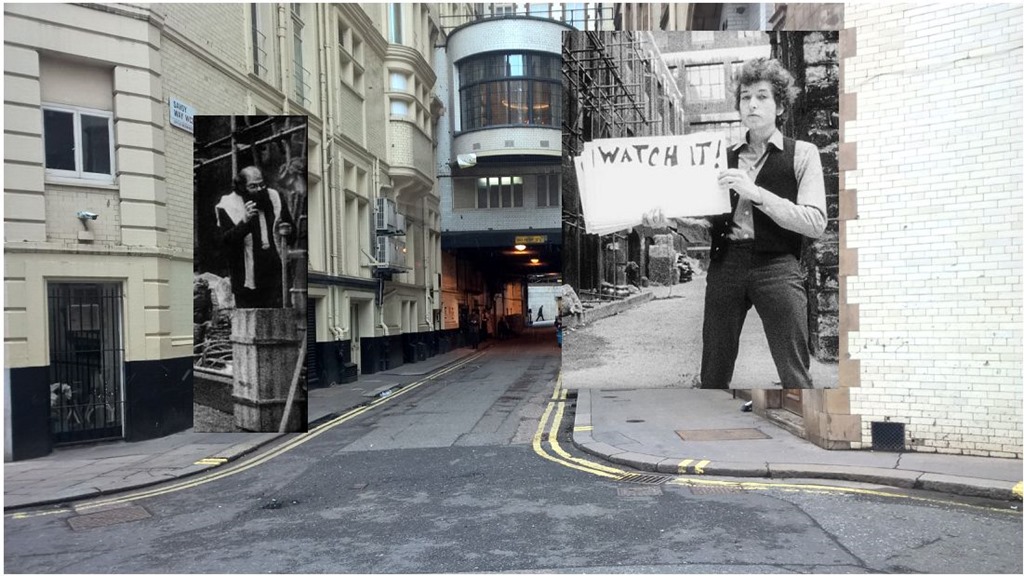
We took a side-trip down the Strand until we came upon the Savoy Theater and then the grand Savoy Hotel. Our bootheels had to do some wandering, but, sure enough, we found the alley where the “Don’t Look Back”-“Subterranean Homesick Blues” was filmed, and where more than a hundred years earlier William Blake had lived and worked on his Dante “Divine Comedy” etchings as he lay dying. We couldn’t see the Thames to confirm if flowed like gold, what with all the buildings the years put there between Blake’s place and the river, but you could still see Dylan and Allen Ginsberg standing in that alley.

The Savoy Alley yesterday and today

Click the link in this caption to learn more about Angels in the Alley by the Savoy Hotel


That evening we went to a mostly Mozart concert at Saint Martins in the Field, which was fine. Now that I actually try to write string parts and play them via virtual instruments, it was nice to see hands play the articulations from a front-row seat. But, before the concert, we ate at “The Crypt” beneath the church, which is not just a goth-sounding marketing name, but the actual crypt, complete with grave markers. My wife wandered about the area, reading the grave markers, noting one for a five-year-old child.

Everything in the past is beneath and beside us. Everything in the future is too, but we cannot see nor feel it yet.

London between rain showers

Last night I saw the London production of “The Girl from the North Country.”  The play’s production illustrates well how context can change a work of art.

I traveled 4,000 miles to see a play in London written by an Irishman integrating work by a Jewish iron-ranger with a British cast portraying a multi-racial rooming house in what was once Minnesota’s second largest city in the 1930s. The Irish playwright is Conor McPherson and the integrated work was 20-some songs by Bob Dylan.

How much went wrong in such an enterprise? I suppose plenty. I could see seams, but it seamed not to matter much. The core idea, of placing Dylan’s songs in the context of the 1930s worked well. Songs you believed needed to be set in the beatnik early 60s or the cultural turmoil of the around 10 years we don’t name as a decade after that, or  against the Reagan/Thatcher or Christian fundamentalist revival and so on, lived inside different lives anachronistically.

Is it a Dylan musical? Not really. Minutes taken out of context could look like that somewhat new form, the Jukebox Musical, but the dramatic material is darker and more substantial than the kind of utilitarian connective material in a Jukebox Musical’s book. This is play with music, not music connected by play. The songs are all sung by the actors, and the musicians are all on stage, sometimes mingling in tableau. In one brilliant little piece of business, a drum set placed upstage has various actors in the cast sitting at it and banging out simple but effective Basement Tapes backing.

In the best moments, the songs (or portions of songs, few are sung in anything close to their entirety) function like an ancient Greek chorus, or at least as I read those classic Greek plays in English translation. The play (or book if you must) reminded me of Eugene O’Neill, someone I have not read or seen in performance  in decades. Poetic dialog was uttered often, but character context kept this from being overly artificial (it’s a very unusual cast of  characters).

The parts are well sung, and the all-acoustic band with period-correct instruments does well. Same with the acting, which ranged from excellent to good, in a performance that demands a lot from it’s cast. As an evening of theater my wife and I thought it was transcendent, as theater should be. At the end of the performance, about a third of the audience jumped up in standing ovation, followed slowly by another portion, perhaps a third again. As we walked out we heard the reaction of some of that sitting third, disappointed at what has been a very well-reviewed production. I have no idea what the London-usual is for ovations, but in the Twin Cities, everyone stands almost all the time.

My wife doubts it will ever have a U.S. production. She thinks the material is too dark to appeal to audiences seeking uplift for their expensive theater tickets. I’d add that the play’s plot is very indirect with lots and lots of dead ends and shaggy dog story elements. If one is open to that (as I am) this doesn’t hurt anything, but some will miss the comfort of standard story through-lines. By chance I saw “Three Billboards Outside Ebbing Missouri”  on the plane trip over, and its Irish screenwriter, Martin McDonagh, also setting his story in America, has a similar shaggy storyline, and asks for similar emotional commitment for unexpected sharp plot turns. McDonagh’s screenplay however, treats  most of its characters, most of the time, as morons. This is not a metaphorical epithet. I found it puzzling and ultimately disrespectful for no good effect that so many in “Three Billboards”  were played as being so dumb.

By contrast, in “Girl from the North Country” McPherson has two characters who frankly have mental disabilities, and yet even they are offered more discernment and respect from their author creator in his play.

You do not have to be a Dylan fan to enjoy this play, but you do have to accept a tale that starts with all in trouble  and finishes with things worse for almost all, and with a singing of “Forever Young” that could cause you to never hear the song the same way again.

 Keats Pharmacy crop

Actual storefront in Hampstead. A sour joke:
vaccination against consumption was not available to apothecary/surgeon John Keats

Today we paired my wife’s love of nature with my love of Keats by visiting the Keats House near Hampstead Heath. Keats House is the duplex that was Keats last rental home, and the place where he wrote many of his best poems. There are few real Keats artifacts, but the house contains some of them and replicas of others. Seeing Keats marked-up Milton books, covered with underlined passages and marginalia in Keats own cramped hand was one highlight. I’m no expert on early 19th Century English living standards, but the  living quarters seemed surprisingly middle class adjusted for the time considering what I knew of Keats struggles with money.

My wife caught a break in the grey gloom and rain showers to spend some time roaming the heath while I nursed a cup of tea and started some blog posts and people watching. I have no Bob Dylan to share today, but here’s a version of John Keats “In the Drear-Nighted December” performed by the LYL Band.

Help grow the audience and alternative ways to get the Parlando Project

I enjoy making these pieces and talking about the process that leads to them. If you’ve ever come across a post here and pleasantly thought “I didn’t know that,” well, I likely had that same experience, sometimes just a few days before you did. Similarly, if you’ve ever listened to one of the audio pieces and enjoyed music and words illuminating each other; well, I’ve spent hours composing, playing, recording, and mixing it—heard parts of it up to a hundred times—and I enjoyed doing that. I’m not bragging there. As my own “producer” I’m well aware that I’m pushing my limits as a musician in making these pieces—but why go to the trouble if you aren’t making music that you, the musician, want to hear?

Well yes, I know one answer to that question, but we’re not a commercial enterprise. We don’t do sponsorships or ads. I do this to hear these poets and writers in a new way and because I’m attracted to the stories surrounding the words. But when I do those things, I’m often thinking about you too,  listeners and readers, the folks who pay us not with money, but with your attention.

I can’t say enough about how much I appreciate that.

As we near 200 audio pieces published, I’m looking for that audience to increase this year. I know we’re quirky, but so’s this modern world. Variety has been a goal from the start, so I expect that some episodes/posts/pieces will be more interesting than others to any individual reader/listener. I intentionally do that, because I find there’s often no delight without surprise.

So how can you help this audience grow?

Well, read and listen, though you’re already doing that, and you don’t need to do anything more.

Hit the like button if you like something. It’s a little thing, it’s become an Internet cliché, but it may help some for folks finding us, and it always gives me a good feeling when I see those icons at the bottom of the post.

Subscribe. There’s another term that’s become cliché, but there’s no cost or obligation to do it. I use the subscribe feature for blogs I’ve found interesting even for a portion of their posts, because it helps me find those posts of interest more easily.

Subscribe part 2. The Parlando Project started out as a podcast, where the audio pieces you see at the bottom of most posts can be automatically downloaded to your smartphone, tablet, or computer. Again, there’s no subscription cost. As a reader of this blog you’re “insiders,” and you get more information on the audio pieces, but we still have more listeners via the podcast than listener/readers here on the blog. The podcast audio is the same as what you get on the blog, but it comes to a subscriber automatically. You can find the Parlando Project on Apple Podcasts/Itunes, Stitcher, Google Play Music, player.fm, and many other podcast sources/apps.

Subscribe part 3. Since the beginning of 2018 we’re on Spotify, though with a footnote. The Parlando Project is in Spotify’s podcasts section, which is gradually being rolled out to the various Spotify apps. Only the most recent Parlando Project pieces are in Spotify’s listing, but it looks like you can add a Parlando Project audio piece to a Spotify playlist.

Yes, I’ve considered getting at least some of the audio pieces on “regular” Spotify or other popular streaming music services, but so far the costs and time to do that are stopping me.

Use the social media buttons. At the end of each post there are buttons to use a variety of social media platforms. The time producing the Parlando Project keeps me from all but minimal time on these platforms myself, but when someone does do this, it seems to help other people find us.

There. Now back to what we do regularly. Here’s one of the first audio pieces posted here back in 2016. “Angels in the Alley”  is a bit longer than what’s become our average, and I like to think our audio quality is getting better since then too;  but “Angels in the Alley”  is also more of a narrated spoken word story than others. What’s the  story? The death of English poet and artist William Blake, and how it connects with this famous rock’n’roll video clip. Ever wonder what Allen Ginsberg is gesturing about in the background at 1:35 into this?


And here’s the LYL Band with one theory:

A Song in the Garden of Love

Today we offer a respite from my voice and the return of alternate Parlando Project presenter Dave Moore. And since it’s been a few days since the last new audio piece, today’s piece combines a lyric written by William Blake with one by Christina Rossetti. Two great poets in one piece! Ladies and gentlemen, there is no greater value you can find today in the poetic words mixed with music marketplace!

Both pieces are stated by their authors to be songs, either in the name of Blake’s collection where “The Garden of Love”  first appeared, “Songs of Experience,”  or in the title itself for Rossetti’s piece, which she called just “Song.”

So of course, both pieces have been set to music and sung before this, but it was Dave Moore’s idea to combine the two pieces; and one can immediately see once he did this, how tightly they fit, with Blake sorrowfully reporting the graves in the garden, and Rossetti musing on the grave and its landscape.

Rossetti wrote her “Song”  while still a teenager. Unlike Blake who was born in a religious dissenter family and grew increasingly distrustful of the corruptions of organized religion, Rossetti would become one of the most graceful and modest of the poets of the Victorian Christian revival. Strange, isn’t it, that the two poems mesh together.

Christina Rossette on staircase

“If you listen very hard, the tune will come to you at last”
Christina Rossetti listens for inspiration, or puzzles over her holiday gift list


Speaking from my poet/musician duality, the version of “The Garden of Love”  that I most recall is the one recorded by Allen Ginsberg in December of 1969. Ginsberg’s recording is played, followed by a 20-minute discussion of the poem and performance here. The four speakers in this discussion mull on the country music waltz feel Ginsberg performed the Blake too. If I were in that room, I could have replied from the musician side of that duality, that in 1969 there was a bloomlet of counter-cultural figures essaying country-music tropes to the puzzlement from the hippie audience as to what level of irony was intended. Two musical figures close to Allen Ginsberg had taken part in that move earlier that same year: Bob Dylan with “Nashville Skyline”  and Ed Sanders with “Sanders’ Truckstop.”

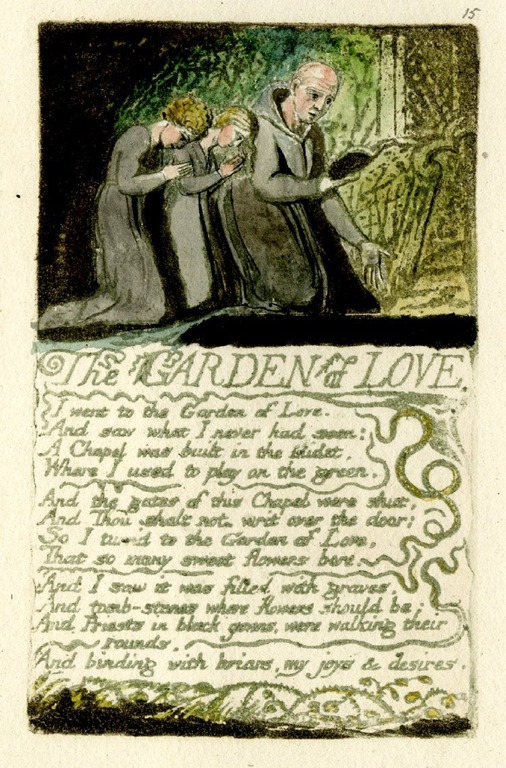
Wm Blake The Garden of Love

“A dominie in gray…led the flock away.” Blake’s self-illuminated song.


Our performance of this mixes Dave’s somewhat church-hymn organ (Ginsberg often used a hand-pumped harmonium organ in his live performances) with my country-ish Telecaster electric guitar, so perhaps Ginsberg’s country move was stuck in my memory as we performed this. Here’s what Dave Moore said about his performance:

“Wayback Machine time.

This song goes back to the early days of the Reagan years, which he ended up forgetting but we can’t.

Probably this is my first attempt to put music to classic poetry, I just thought they fit together so well & expressed both despair and hope so well. This one is my favorite vocal of all attempts at this piece. My introductory verses for each poet are new & I wish I’d separated them from the two little poems better, but that’s what you get with one-takes. Ah, sweet death, we can still sing.”

Dave points out a contrasting benefit of the pieces here performed as the LYL Band, which are not only “one-takes,” but are often pieces that only the composer-vocalist has any sense of the structure of, leaving the rest of us to follow and create parts on the fly. This leads to a certain roughness, and yes, at times, tentativeness too—but I believe there is a corresponding sense of the undiscovered and its discovery that may come across to the listener.

To listen to the LYL Band perform Dave Moore’s pairing of these two beautiful, yet sad, English lyrics, use the player below.


L’Amoureuse

I promise you, we will end up today very close to the love song of the last episode, though we will travel a ways before we get there.

I’ve not featured any French writers yet with the Parlando Project, but as this summer has used the words of many 20th Century English poets, we may be overdue for that, as the start of that century found some of them looking to the French for some new ways to write.

French poets started to go “modern” before the British poets, around the same time that Emily Dickinson and Walt Whitman were making their own breaks with past practice in America, so they had a head start, and their avant-garde was way past the supply lines of conventional narrative and sentiment by the time the 20th Century really got rolling.  The absurd casualties of WWI, largely fought in France and its neighboring countries, and so deadly to some of the generation of men doomed to fight in it, only accelerated the modernist direction away from the kind of meaning you might find in a political speech or battle plans.

This summer, 50 years ago, the Polish-French writer Guillaume Apollinaire coined a new word to describe a new way to approach the world in words: “Surrealism.” A few years later, his term was taken up by a group of artists who went about trying to practice a new idea, presented in 1924 as if it was a political manifesto, to write and create from:

“…The actual functioning of thought. Dictated by thought, in the absence of any control exercised by reason, exempt from any aesthetic or moral concern.”

  The Surrealists went on from there, going in various directions, becoming less an idea and more of a brand—but stop and think for a moment, that original idea, isn’t it powerful? The idea that there is a reality that we agree not to apprehend, not to speak of, that we constantly reframe our thoughts to, isn’t that idea political as well as aesthetic?
 
You take the idea of Surrealism, add music to it, and later that century you get Bob Dylan. You take the idea of Surrealism, apply it to the current reality, and you are woke, not from the dream, but to the dream that should not be denied.

Today’s piece uses the words of one of the French Surrealists, Paul Éluard. Éluard, like many of the British poets of this era, was another veteran of WWI. One story of his war service was that, since he was a writer, his military superiors assigned him to the office tasked with writing the official letters to the relatives of the casualties, and such was the efficiency of modern war that he sometimes needed to write 150 of them a day. After a year of this, he asked to be sent to the frontline trenches.

Alphaville Capital of Pain book

Jean-Luc Godard’s film “Alphaville.”  “I love you” could be the ending.

 
I have exposed you several times this month to pieces about the horrors of war and slavery, but I also told you we must travel a ways to get to today’s piece. After the war, as a founding Surrealist, Éluard produced verse with strange images and seemingly arbitrary combinations—Surrealist tactics to break the conventions—but his great subject, against the night, pain, and suffering, was love. Perhaps after those 150-letters-a-day forced march, he too wanted to look to war’s opposite.

Paul Eluard and Gala 2

Paul Éluard and the beloved, Gala. Eyelids not visible in this picture.

“L’Amoureuse”  (The  Beloved) is one of Éluard’s most famous early works, and uses my English translation of his words. The LYL Band performance of it was recorded live several years ago. To hear it, use the player below.

Wisconsin

One thing I like about the Parlando Project is how things we present end up reflecting on each other. Some of that I plan, but some of it just comes up.

Today’s piece “Wisconsin”  completes our series of pieces by songwriters who have won the Nobel Prize for literature, starting with Bengali Rabindranath Tagore who wrote thousands of songs, many of which are still sung today; then moving on to William Butler Yeats, who believed his poetry should be chanted to music and commissioned an instrument and a touring performer, Florence Farr, to realize his conception; and now today, Bob Dylan, the Midwestern American who has written hundreds of songs and whose birthday we’ll celebrate this month.

But “Wisconsin”  and Bob Dylan continues another topic, one from the last post, where I introduce the thoughts that enjoyment of a type of music is subjective, that the experience of the same music is subject to strange mutations of context in the passage of time, and that the judgement of merit and pleasure from music are two different things.

wagner opera costumes

A jam band looking to tune their banjo in the hills and feast on milk and cream


Like the lengthy operas of Richard Wagner or the exploratory playing of jam bands, Bob Dylan has never been universally appreciated. There’s evidence from his earliest years as a performer that this was intentional on Dylan’s part: to accept the freedom to perform in ways that caused part of an audience to reject his approach. Doing this in order to endear himself to another audience that would be attracted by this difference, this freedom, and yes—to a degree—to the power of the exclusion of that other audience.

This is not an unusual artistic stance. The artist who claims that audiences of Philistines cannot understand their work—and who may also aim steadfastly to make that claim true—is common enough to have been a comic stereotype from classical times. But Dylan distinguishes himself from that not only by becoming hugely influential, changing and expanding how songs will be written in English in a matter of a few years, but also because he was willing to change the nature of what audience he was repelling and attracting regularly, almost as if he had an over-arching artistic goal to say that this repel/attract response to art was a thing that we should examine with skepticism.

So one moment you are supposed to love or hate him because he’s an earnest politically-engaged folkie rejecting pop music and hedonism; and then you are supposed to love or hate him because he’s a loud rock’n’roll hip cynic deep into drugs and pop culture; and then you are supposed to love or hate him because he’s a Nashville country-music-factory family man embracing simple truths—but wait, now he’s not only that, he’s what, a Christian!? And then he’s someone adrift, trying to make records every wrong way in an era when everyone is making bales of money making records. Then he unplugs and makes two fine acoustic guitar records in his garage with not one self-written song, which only a handful notice; and then he makes five records in the last two decades that are either embraced or rejected as he writes songs full of richly imperfect characters and anti-heroes defiant and defeated. And now he has the nerve to ask us to listen to him singing songs Frank Sinatra would have sung. And all these twists and turns leave out three wonderful records that don’t fit these scenarios: “Blood on the Tracks”, “Desire”,  and “The Basement Tapes”— any one of which could be the masterpiece of most other songwriters’ careers.

Despite all this change, and more than 50 years as a notable performer, there are those who consistently don’t like his singing, don’t think much of his musicianship, who feel that the historic influence of his writing is somehow an embarrassing overachievement. Some of those people are musicians as well, some of them are smart and perceptive people, some of them hold to the duality of Bill Nye’s great sentence, who feel that like Richard Wagner’s, “Dylan’s music is better than it sounds.” How many of these people are sincere, how many are more at envious? How many are just smarter than I am, with better or different musical taste? How many can’t absorb Bob Dylan for the same mysterious reasons some can’t digest milk or gluten? Some of each.

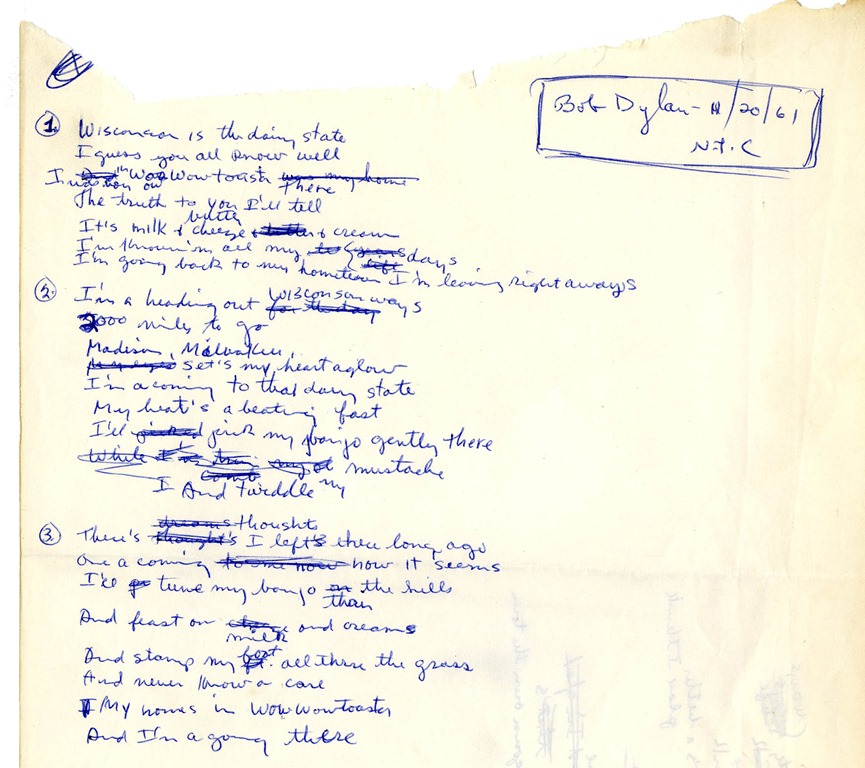
Now let’s take today’s Bob Dylan episode. “Wisconsin”  is a set of words, never used by Dylan, written when he was around 20. A handwritten manuscript was put up for auction last month with a minimum bid of $30,000, and I don’t think it made that minimum. Notices about the auction liked to poke fun at the unimportance and artlessness of the lyrics, particularly in the context of that songwriter getting a Nobel. Well, the Parlando Project is the place “Where Music and Words Meet,” and in this case the words are waiting for music and performance to animate them. On the scribbled page they are puppets without hands in them, so the LYL Band put their hands in.

dylan_wis_song

The Nobel is a long way off, but even the 20-year-old Dylan is revising what seems like off-the-cuff stuff

It turns out that the formula of nonsense and normality, commonplace and commotion, when animated with who-the-hell cares energy makes a fine rock’n’roll song. And you don’t need $30,000 to have that, you can get it here for nothing. Just click on the player below.

Maiden with a Lamp

When it was announced that Bob Dylan had been awarded the Nobel Prize for Literature there was a substantial reaction asking if songs could be literature—no, that’s not right, I’m mischaracterizing much of the reaction I read as if it was an honest inquiry into this question. No, the reaction I read was more of a conclusion that songs could not be literature, and so this Nobel award to Bob Dylan was a break with tradition, a loosening of standards.

This is complex subject, one I’ll probably return to, as I have much to say on this; but missed in the hoopla and questioning was this fact:  Bob Dylan was the second singer/songwriter to win the Nobel Prize for Literature.

In 1913 Rabindranath Tagore was awarded the Nobel Prize, the committee citing:

“Because of his profoundly sensitive, fresh and beautiful verse, by which, with consummate skill, he has made his poetic thought, expressed in his own English words, a part of the literature of the West”.

In 1913 when the prize was given, Tagore had only one such work they could be talking about: “Gitanjali,”  a 1912 collection of his song lyrics that Tagore had translated himself from Bengali into English prose poems.

Gitanjali title page 1912

The title page of the original English edition


Tagore is a fascinating man and artist, with achievements in so many fields that you might think I’m making him up. He wrote every kind of literature, started a university, seriously pursued modern painting, and gave Gandhi the title “Mahatma.” But he was no dabbler at songwriting, having written over 2000 songs. He’s even the only composer to score a hat trick for national anthems, having written the national anthems of India, Bangladesh and Siri Lanka.  His songs are so pervasive in Bengali culture that his thousands of songs have become their own genre.

tagore with Gandhi

“Let me lay it on you Mohandas: it means ‘Great Soul.”  Also, there’s this girl in Detroit who I’m going to call the Queen of Soul.”

Poet William Butler Yeats wrote enviously in his introduction to Tagore’s “Gitanjali”  of the power of songs:

“These verses will not lie in little well-printed books upon ladies’ tables, who turn the pages with indolent hands that they may sigh over a life without meaning, which is yet all they can know of life, or be carried by students at the university to be laid aside when the work of life begins, but, as the generations pass, travelers will hum them on the highway and men rowing upon the rivers.”

This spring as I read Tagore’s “Gitanjali,”  I hoped to find there on the page what is promised in Yeats’ introduction and what would normally be guaranteed by such acclaim. I failed at this. I couldn’t find it. The English of the prose translations seemed so archaic, the expression stilted, the voice vague. From accounts I’ve now read, this seems to be an acknowledged problem; and it appears that, for whatever reasons, Tagore purposely framed his translated work in an incomplete way. In the longer term, I will seek some of the newer translations. In the short term, I stood back and remembered something.

Song. These are songs.

Not only are they missing their music, but songs, like plays, are works for individual voices and talents to embody. Their creators are not claiming the real, complete thing exists on the page, that they are performing them mutely with ink on the white page. No, they expect, demand, that someone step in them, surmise their meaning, fill the blank white space with emotions, and speak them.

All art is like this really. Songs admit it. Songwriters generously say: I need you to fill these things, your humanity is better than any of my approximations.

So, today’s episode is the second of my attempts to bring something to a piece from Tagore’s “Gitanjali”  using his original prose translations, as that’s all I have for now.  With the last post here, “Light,”  I tried to meet Bengali music partway, but this time I’m staying firmly in the Western side, maybe even a bit on the Country and Western side. As I read this piece on the page I heard it as sounding like one of those weird Lee Hazelwood arrangements from a few decades ago, but since I was producing this myself, I had to sing the Nancy Sinatra part as well.
 
If you wonder about the floating light ceremony mentioned in the song I call “Maiden with a Lamp,”  it may be this one.

To hear me perform my vaguely C&W version of “Maiden with a Lamp,” use the player below.


On First Hearing Blonde On Blonde

Earlier here you’ve heard me proclaim that Bob Dylan changed how folks wrote songs. Before Bob Dylan circa 1964, no one wrote songs like Bob Dylan. Afterward, the things he did (portrayal of fragmented personal experience, florid and unlimited imagery, a questioning attitude toward accepted beliefs) were everywhere, until by today we may have forgotten (or for younger generations, never knew) that these things were once “Dylanesque.” And because songs with lyrics were the primary way late 20th century people experienced poetry, that revolution impacted the culture generally.

Of course, page-poets had already done those things. Some European poets worked with these concepts decades before Bob Dylan. American modernists of the first part of the 20th century did these things too, and in American English. And the Beats, Dylan’s slightly older siblings, knew those achievements and applied them to the post WWII American landscape.

So, take away the Nobel prize! Dylan had influences! And his revolution was maybe the fourth time around!

No. First off, the page-poets did not generally ally their words with music. Yes, I know there were exceptions to this “generally” statement—and I think those exceptions deserve more notice and listening—but that’s my point, those exceptions didn’t get much of an audience. As the Parlando project seeks to demonstrate, poetry gains resonance when paired with music. The inherent abstractness of music allows listeners to more easily accept abstractness and difficulty in words, so those producing the more difficult, abstract or hermetic writing needed music even more.  Add to that music’s ability to amplify and re-cast emotions, and Dylan’s linking of those page-poet concepts to music meant his was a new force.

So, I say the very thing that causes some to say Dylan should not be considered a literary hero: that he is a songwriter, is one very good reason he is just such an authentic hero.

And here’s another reason. We sometimes like to pride ourselves in finding what we believe are the first movers of things. In songwriting, Dylan is just such a first mover, but if we take his words or his music in separation, he is not the first mover. However, as to impact, it makes less difference who did something first compared to who got the experience to the audience, the listener, and/or the reader at the time and way they were primed to hear it. So, if we artificially separate Dylan’s words and music we can say they weren’t the first, we can even believe they were not the “best,” however we figure that out, but that combination of words and sound was a revolution that succeeded in ways that previous efforts didn’t. It’s romantic to mourn failed revolutionaries, but let’s not let our mourning obscure the power of successful ones.

While I wrote this post’s audio piece “On First Hearing Blonde on Blonde,” it is not the sort of work I usually put here. It’s a recounting of personal experience, something that is already over-represented in poetry and particularly in spoken word poetry. That can be a valid kind of poetic expression,  but there’s no lack of it elsewhere, and as a creator I’m instructed by my experience as a reader that most poems about the writer’s personal experience fail for several iatrogenic reasons, such as the writer’s inability to fully see and question their own assumptions, an approach to individualization that can cut the writer off from their connection to and balance with the rest of the world,  or even the simple ability to judge what another person will be interested in.

If I work out getting permissions for more current work by other authors, there will be more poems spoken in a personal voice here, but I believe they will gain from being selected by someone else, and spoken by someone else, not by the poet themselves. That’s one of my Parlando principles: “Other People’s Stories.”

“On First Hearing Blonde on Blonde” is published here, not because it’s a tale about myself, but because it tries to convey that listener experience that occurs when the listener is primed to hear something. Will someone who listens to Bob Dylan’s “Blonde on Blonde” record album, as suggested by the Nobel Secretary last week, hear a different album than I heard nearly 50 years ago? On one hand, surely they will. Every ear in every time is always its own. On the other hand, I could give you answers—I just typed and erased some now—but instead I leave you with wishes for more, and perhaps better, questions.

Next post we move on from Bob Dylan. Which is about right. After all, even Bob Dylan got tired of being Bob Dylan, several times in fact.

To hear the LYL Band and the audio spoken word piece “On First Hearing Blonde on Blonde,” click on the gadget that should appear below. We recorded the basic tracks the afternoon the Nobel Prize for Dylan was announced. Yes, the Dave Moore mentioned in the piece is the same Dave Moore whose voice and keyboard playing has been heard here.