If Emily Dickinson had no real models for the revolutionary poetry she developed, she did have other poets she could look to. We know from her letters that one of them was Emily Bronte.
English author Emily Bronte and her two sisters Charlotte and Anne all wrote poetry and then novels, but Emily seems to have been the most avid poet of the trio. Starting in childhood Emily Bronte created along with her sister Anne a fantasy world they named Gondal in which they spun tales of adventure. At least some of Emily’s poetry was connected to that world, and so it’s possible that today’s hopeless piece titled “Hope” is part of some fully imagined plot and isn’t autobiographical.
Emily Bronte. Plotting what to do to that useless hope when she’s uncaged?
One of America’s great contributions, an Afro-American contribution in large part, is The Blues. The Blues reaction to misfortune is almost inevitably to battle that misfortune in some way: to mock it, to hip others to it, to talk back to it and tell it that the speaker knows the score and may even settle that score with it some day. Most American Blues aren’t “woe is me, I’ve got it bad, and I’d rather be dead” it’s “I can tell you how much trouble I’ve encountered, but I’m still here.”
Emily Bronte is mocking too, but she’s mocking hope itself, not the unspecified troubles that have figuratively imprisoned the poem’s speaker. Hope is portrayed throughout as an external character, and that character is a pious creep, totally uninterested in easing the pain of the imprisoned speaker.
Still you have to hand it to Emily Bronte here. This is a rather impious poem from a preacher’s kid, even if it’s a character from her imagined world and this is only a momentary lament. Perhaps that’s part of what attracted Emily Dickinson to this fellow Emily. Dickinson is also a great mocker.
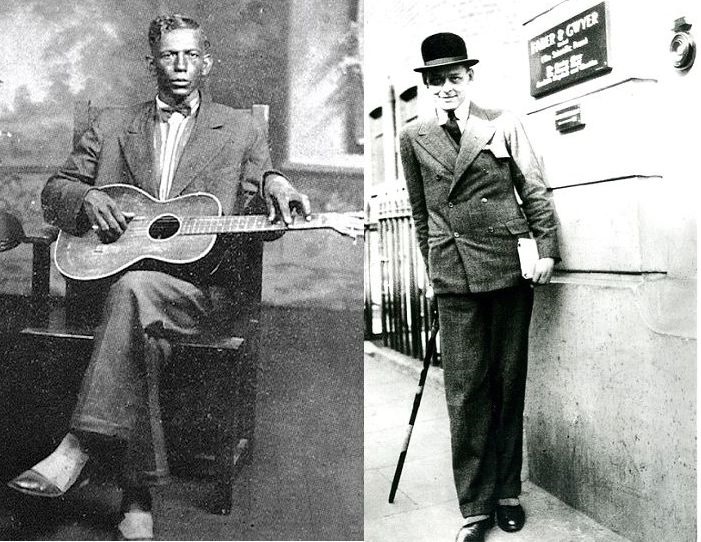
Was I being audacious when I compared Eliot’s “The Waste Land” to a modern hip hop/rap production sampling various parts and levels of the world’s culture? I don’t think so (though maybe I should be worried). I’m not going to get into a rap battle between T. S. Eliot vs. Missy Elliot, or a discussion about “Kendrick Lamar, is he a ‘real poet?” like my generation used to discuss Bob Dylan. My aging generational knowledge isn’t deep enough to discuss Lamar or Elliot as intelligently as I should. I’m more comfortable discussing folks who were born long before I was, but someone like Charley Patton is too O. G. to bring up here often. After all, T. S. Eliot and Charley Patton are my grandfather’s generation, born in the 19th century. People like me can be pretty good in figuring out what lessons our grandparent’s completed lives impart, not so good at what lessons our children should learn from us, and terrible at what lessons our children could teach us.
Charlie Patton and T. S. Eliot: two young swells put their best foot forward beside different rivers in the 1920s.
Eliot may have thought he was copying cubist paintings or cinema montage or some French poetry, but he chose this sampling tactic or he would have done something else. Who was Charlie Patton copying? I don’t know exactly. Maybe he made it up. Maybe some griot or indigenous shaman whispered it in his ear.
T. S. Eliot was his own kind of odd guy, odd to his contemporaries, even if he eventually became enormously influential in the Modernist literary movement that had taken over poetry education by the time I was a student. When I first introduced “The Waste Land” here I said there’s two things you need to know to approach it, and they aren’t esoteric at all: first that it’s musical and intended to be, and second that it’s written by a person suffering from depression, a common human malady that colors and filters perception profoundly. Now, following my grappling with it in the past few years, I’ll add two more things, neither of which require reading about Grail legends or From Ritual to Romance either: it’s written by a man writing for a culture coming out of a tremendous wartime trauma and it’s written by a man struggling to come to terms with human sexuality, it’s sins, pleasures, and disappointments.
On the war issues, Eliot is guiltily living, not dead, in a world where many others weren’t so lucky. Estimates vary, but somewhere between 15 and 19 million people were killed in WWI, the majority from the European theater that had become Eliot’s home. Given this level of death, it’s not surprising that Eliot personally knew people killed in the war. Most of his British literary contemporaries served in the war, he didn’t. Indeed, while WWI raged, he tried to disengage from the war, to continue to focus only on scholarly issues and his literary writing.*
Eliot’s an American from St. Louis in a foreign country and he’s gotta figure out how to trans-Atlantic code-switch. He goes in full-force, becoming so completely English that he eventually was able to style himself as an authority on what was appropriately British. After the conclusion of the war, as a literary critic he can write about “objective corelative” and all that, but he can no longer ignore the trauma his adopted country and the rest of Europe has suffered.
Last year’s segment “A Game of Chess” rolled-up into one audio file in our last post, portrays marriage darkly and introduces rape and sexual coercion as one of the underlying themes in “The Waste Land.” Here we know little about Eliot’s own experience, other than his marriage to an English woman was dysfunctional. As we move further into our section for this year, “The Fire Sermon,” sexuality is further brought forward in an unflattering light.
As the section begins in the segment I call “Sweet Thames” we’re back in a ruined landscape, the titular “Waste Land.” The scene seems post a debauched party season, missing even the messy vitality of that. Eliot, a man who grew up near the banks of the southern Mississippi is now on the banks of London’s Thames river.
And then he, or some incarnation of the poem’s speaker, the many voices in Eliot’s head, is fishing. Following the literary and critical references, this is the Fisher King, and we could look to a trail of ancient myths, but I chose to keep it immediate and funky in performance. This is a dirty, river-rat frequented urban river. He wants us to know that he’s fishing next to a gashouse, which I take to be one of those now obsolete processing furnaces that turned coal into coal gas, a smelly and polluting process usually relegated to the worst part of town. The anachronistic pendant in me found this amusing, as a decade after ex-St. Louis boy Eliot wrote “The Waste Land” his home-town Cardinals baseball team used to intimidate their opponents by wearing stinky unwashed uniforms and were given the nickname “The Gashouse Gang” for their smell and general lack of decorum. There’s no known connection for this coincidence, but it’s good that they didn’t wait until later in “The Fire Sermon” and to then become the World Series winners dubbed “The Young Men Carbuncular.”
As the section nears an end point another song-sample break is dropped,** the Mrs. Porter section. Eliot noted that it was an Australian army folk song, and further research indicates that the Mrs. Porter may have been a Cairo brothel keeper known to the ANZAC troops heading for the disastrous Gallipoli campaign, where a dear friend of Eliot, Jean Verdenal was killed in battle. Depending on how salty the soldier-singer may have felt, the body parts being reported as washed varied.
I like to think that Charley Patton, further down the Mississippi river, might have known that tune, but since neither he nor T. S. Eliot are here to sing this, you can hear my performance using the gadget below. If you’d like to look at the text of “The Waste Land” while you listen, the full text is here.
**And for all you carpe diem fans, did you note the sample from Marvell’s “To His Coy Mistress” here, when just before Mrs. Porter soda-washing-song he says “But at my back from time to time I hear…” and instead of a winged chariot, it’s motorcar horns. If given the choice of grave or sex, I think Eliot would have held out for a third choice.
Man Ray was sort of Man Ray’s real name. His family immigrated to the U. S. in the 19th Century and like many families they changed their name along with their country, and so Radnitzky became Ray. His birth first-name was Emmanuel, which would be conventionally shortened to Manny, and with just a bit more compression you arrive at Man.
I think I’ve mentioned in passing that in my 20s I developed an interest in Dada and Surrealism. I’d never pass myself off as a scholar of these subjects, it was more a matter of feeling that some of their ideas resonated with ones I had already been using. As evidence of my lack of scholarship, I’ll mention that I had always assumed Man Ray was French. Well, no. He grew up and began his career in Brooklyn and moved to Paris in his early 30s, before he could speak any French, That must have increased the Dada potential of the move!
Man Ray always felt free to range about in media and approaches. He was creating Dada assemblages and “ready-mades” by 1920 and Andre Breton called him one of the “pre-Surrealists” who had been creating art in harmony with that movement before it was officially a movement. Man Ray pioneered the idea that photography could be non-representational, made short experimental films, but also shot portrait photographs. And, luckily for this Project, he also wrote poetry. Ray once said that his artistic credo was seeking pleasure and liberty. “I simply try to be as free as possible, in my manner of working and in my choice of subject. No one can dictate to me or guide me.”
His short poem “Three Dimensions” was published in Alfred Kreymborg’s NYC-based Modernist magazine Others in 1915. As I understand Ray’s poem he’s looking at houses at night, not a city but outer borough or suburban scene. They’re lit up, representing the lives within. I suspect he’s punning when he says the luminous houses, walled off and oh so separate, should not be viewed “as masses.” They seem weightless, but in their separations the are as well not “The Masses.” The dark spaces between the houses, the hedges and walls, are then compared to shawl-covered heads as would’ve been worn by old women in his day. Ray concludes, still recognizing the separateness of the houses and the lives within, but perhaps with a hint of their potential. Mystery and curiosity are separated when we know that if they were to be combined they would combust!
So, what can I do with Man Ray’s poem?
Glover, Ray and Ray. Tony Glover on blues harp, Dave Ray on 12-string guitar, and a Man Ray self portrait
Dave Ray* was a singer and guitar player. In the early ‘60s he was part of Koerner Ray and Glover. I guess you could call Koerner Ray and Glover a group, though they themselves didn’t.** Dave Ray was 20 years old when KR&G released their first LP***, half-a-decade younger than when Robert Johnson first recorded a side, and much, much younger than Leadbelly was by the time John and Alan Lomax recorded him. Ray kept up playing his whole life until it ended while he was still too young in 2002.
KR&G formed in Minneapolis and were part of the early days of the West Bank and other folk music scenes here. I can’t say for sure (I’m a late arrival), but Dave Ray was probably one of the reasons that the Twin Cities area has a higher percentage of 12-string guitar players than anywhere else.**** Shortly after I moved to the Twin Cities in the ‘70s I bought a cheap 12-string at a record store on Hennepin Ave. It seemed mandatory, like learning the snow-emergency parking rules.
Why yes I can prove I’m a Twin Cities guitarist: here’s my 12-string.
Today I made a Dada assemblage. I’ve recast Man Ray’s “Three Dimensions” as “3D Blues” and I played it on that still surviving 12-string—not as well as Dave Ray could have done it, but then it wouldn’t exist if I hadn’t done it. The old 12-string has a soundhole pickup which I played through a little combo amp. KR&G started all acoustic, but Dave Ray often played plugged in later in his career. I rearranged some lines and phrases in Man Ray’s poem to fit it into a blues form. You can read Man Ray’s original here. You can hear my revision with the player gadget below.
*As far as I know, Man and Dave aren’t related. Dave Ray’s youngest brother, the equally well-named Max Ray, played the saxophone with the Wallets and still plays around town. If I was to Kevin-Bacon-game Man Ray and Dave Ray, Max Ray and the Wallets would be my move.
**Koerner Ray and Glover never broke up because they never joined up, performing solo or in various combinations from the first to the last. Dave Ray claimed they should have been truthfully billed as “Koerner and/or Ray and/or Glover.” Koerner made a record with Willie Murphy back in the 60s. Tony Glover wrote an important early instructional book on how to play blues harmonica as well as writing about the new Rock music that emerged later in the 60s.
***That first LP was called Blues, Rags and Hollers and just like it says on the cover, they played a wider-range of material than what was labeled “Blues” as time went on.
****Both Koerner and Ray played 12-string guitar, in the tradition of Leadbelly and Blind Willie McTell. As time passed, the blues 12-string tradition became forgotten in many places, and I’d encounter people online who thought acoustic-guitar blues must be played on small-bodied 6-strings or resonator guitars.
A couple of weeks back a local music legend Willie Murphy died. I’m going to ask indulgence from this blog’s overseas audience, because unless you were around Minnesota in the last 50 years or so, you’ll likely have no idea who Murphy was—no, it’s even more location specific than that—I believe you need to have memories pinned within a few blocks of the intersection of Cedar and Riverside avenues, in a Minneapolis neighborhood near the Mississippi river known as The West Bank.
Many years ago the West Bank was a Scandinavian immigrant enclave, and it is now the home to Minnesota’s largest Somali community. But my story today is in-between, in the second half of the 20th century, when it was home to a thriving bohemian culture, immigrants of a slightly different sort.
Shortly after I moved to Minnesota, I got work at a hospital there, and when I had enough money saved up, I took classes at the University of Minnesota which spans the two banks of the river. I came late to the West Bank scene, but I absorbed the stories of those nonconformist young immigrants who were homesteading something that was called “the counter-culture.” The counter-culture was Willie Murphy’s job, as much as musician: putting together bands, recording other musicians, inaugurating live music venues, working and networking the scene.*
Willie and the Bees getting down somewhere in the past
But he was a musician too. Sang, played bass, guitar, and piano. Interpreted a lot of great R&B and wrote some good songs himself.
He was never the businessman. He engendered some of the things that entrepreneurs like to claim they do, but he never got the cash rewards. It’s a complicated story and I don’t know all the details—but I do know that he was an artist making art on his own terms right up until his last months of his 75th year. In one trope of musician’s slang, musicians “make the gig” or “make the scene.” Murphy lived that literally: he made a lot of gigs, helped make a scene.
Angel headed hipster. Murphy in his later years, still keepin’ on.
Mine’s a complicated story too. I eventually fell in love at the same time with two people who lived on the West Bank. There was music most nights and every weekend at a couple of coffee houses, a short-lived jazz club, a music school, and several bars, all of them within four or five blocks. And for my literary side, besides the University, there was Savran’s bookstore, which was well stocked with small press publications and poetry in several languages. In one’s Twenties many are imprinted on the culture encountered then, but the West Bank in the ‘70s seems an especially strong tattoo—and nostalgia fades in reverse.
Most change happens slowly enough that you never see it happening. One day you look over your shoulder and you see everything behind you isn’t there anymore.
Or you pick up a paper and see that Willie Murphy has died.
Most change happens slowly enough that you never see it happening. One day you look over your shoulder and you see everything behind you isn’t there anymore.
Or you pick up a paper and see that Willie Murphy has died.
I felt I needed to write about this, regardless of how well I could do it. The song I wrote “Willie Murphy (Is Always Playing on the West Bank)” has in-jokes and puns that only West Bank habitués will understand. In the first verse I twisted a line from Ginsberg’s “Howl” that also supplied the name of Murphy’s last band. Punned-in the name of some West Bank bars in the second verse, gave a shout-out to Koerner Ray and Glover in the bridge, and got in a sideways nod to the West Bank’s Mixed Blood Theater before I finished.
A week ago, I sprung it on the LYL Band and we gave it a go, with Dave Moore supplying his piano part off-the-cuff. You can hear it with the player below.
*Murphy recorded an LP with “Spider” John Koerner back in the 60s, and produced Bonnie Raitt’s first LP in the early 70s. Willie and the Bees was an integrated R&B band that mixed funky jazz and danceable grooves for a decade or so from the mid-70s into the early ‘80s.
Here’s a short piece using a poem by a person who started out as a poet but who spent the greater part of her life working for her country, India’s, independence: Sarojini Naidu.
Sarojini Naidu, like Edna St. Vincent Millay around the same time in the U. S., impressed people as a capable poet while still a teenager. Her talents lead to her being sent abroad to England for college, and eventually she connected with the Rhymer’s Club, the turn of the century London organization that was the last stop in the 19th Century for some of the poets who would launch the poetry of the 20th century.
Today’s piece, “The Poet to Death” was first published in England as part of Naidu’s initial collection of poetry The Golden Threshold in 1905. Fluent in several languages, the pieces in The Golden Threshold are in Naidu’s own English. Some accounts say that the young Sarojini was modest about her poetry at the time, worried that her work was less-substantial because it is lyrical and song-like; and retroactively English-language Modernism did discount that sort of poetic gift. So, while her poetic work is still remembered in her homeland, where Wikipedia says she’s called the “Nightingale of India,” Sarojini Naidu will be a new name to most of our reader/listeners.
During the WWI years Naidu transferred her focus from poetry to working for Indian independence, a cause in which she became a principal, alongside Gandhi and the other independence leaders.
Did the world loose a poet for India to gain its independence? Perhaps. I do not know enough to say. In her English poetry, I can see the influence of the earlier 19th Century English romantics, but her language is less extravagant. She can remind me at times of Christina Rossetti (readers here will know I consider that a good thing), and “The Poet to Death” is a concise version of a trope Keats used as well.
India gave us chess. Chicago gave us Muddy Waters on Chess records.
Today’s music employs a polyrhythmic blues. Perhaps I was subconsciously moved by the “till I am satisfied” line in Naidu’s poem to think of Muddy Waters and his “I can’t be satisfied,” though what I ended up playing has some elements of Skip James’ guitar style too. At a conscious level, I was working on this while thinking of poet Donald Hall, having read a review of his new collection of essays coming out this month, and then hearing later in the same day that he had died at age 89. In his last couple of decades, Hall has often written of what continues until it ends in the course of aging.
Donald Hall. His book of essays “A Carnival of Losses: Notes Nearing Ninety” drops in July.
For some reason the version of the text I worked with did not have Naidu’s first stanza, which specifically speaks, as a younger poet, for death to stay his hand. In the remaining two stanzas, the age of the speaker is less determined, and so the situation is joined whether it is a young poet or old. The blossoms are always there a short time, at any age.
To hear my performance of Sarojini Naidu’s “The Poet to Death,” use the player below.
I’ve already mentioned in this count-down that I’m sometimes surprised at what Parlando Project pieces are the most listened to. It’s not just that it isn’t always the best-known poems, a surprise factor that I’ve already mentioned, but that it sometimes isn’t a performance that I think I pulled off well.
Such is the case with the repeat number one in this countdown covering activity this past spring: Fenton Johnson’s “The Banjo Player.” My personal discovery of Fenton Johnson goes back to reading James Weldon Johnson’s 1922 anthology The Book of American Negro Poetry. Fenton Johnson’s work included there immediately stood out for me in its range of expression, from the hymn-like “God Is In the All Time” through the startling confrontation of spirituality with reality in “A Dream,” to the frank and compressed expression of despair in “Tired.” I vowed to do my best to present Johnson’s range here.
Fenton Johnson
Which lead me to perform “The Banjo Player.” It’s frankly a humorous piece, though if one pauses after the laugh, there is a serious point being made. Explaining jokes always risks creating more comedy, but the serious point embedded in the joke here is that the banjo playing songster in the poem knows something of his value, but he still feels like he’s a failure because an otherwise uncharacterized woman called him a troubadour, and he’s not even sure if that’s a compliment.
That problematic name for the banjo player is the only way we can characterize that woman who spoke it. Is she, like Fenton Johnson himself, a member of the Talented Tenth, Afro-Americans who had gone to college and who had been charged in the early part of the 20th Century to “raise” the race with their achievements? Or is she a white Modernist admirer of para-literary poetry? We can’t say for sure, and since either is meaningful, the poem works either way; but I lean to the later if only for the word she used.
As so often with Modernism, you can trace something back to Ezra Pound. Just as the Pre-Raphaelites before him, or some hipsters today, Pound looked to the past to find models for a changed, modern future. One source he used was classical Chinese and Japanese poetry, but another was medieval European troubadour poetry.
So even at his lightest, Fenton Johnson makes a sophisticated point here, one that he reinforces by using a location, “The Last Chance Saloon,” in both “The Banjo Player” and his now most-anthologized poem, “Tired.” In the former it’s a place of some solace, in the later it’s the place were the absence of dignity is numbed.
Returning from those more important points to my issues with my performance of “The Banjo Player.” I tried to cop a little of that Afro-American banjo tradition. It just seemed the inescapable choice for this. I think I failed, if only because I’m not a banjo player. Such things may be inevitable with the production schedule I’ve practiced with the Parlando Project this past couple of years (something I’ll talk about soon), but to be honest, I’m slightly embarrassed that this piece is listened to so much.
Here’s Carl Sandburg again, this time from his 1920 collection Smoke and Steel. Today’s piece “Long Guns” is a protest poem of a kind. A few decades later, around midcentury, the folk-song revival in America (which Sandburg had helped to kick-off with his pioneering American Songbag collection of folk songs) grew a wing that wrote protest songs. Bob Dylan, a man who thought enough of Carl Sandburg to want to visit him as he was revolutionizing songwriting, wrote a few of them himself, even though Dylan once categorized the usual efforts of the protest song genre as “finger-pointing songs.”
So how does one go about writing a protest song or poem? There are probably lots of ways, and some work more often than others. Sandburg, the early Modernist, would sometimes write Imagist protest poems, which is quite a trick to pull off, though the classical Chinese poets that influenced Imagism had figured out how to do this centuries before. “Long Guns” however, is more in Sandburg’s Walt Whitman mode, what with its parallelism and lists.
Sandburg wants to call attention to the disorder of order established by armaments and guns, but rather than doing this as an essay would, or by leading off with some singular event that will arrest our attention, he starts by addressing an otherwise unidentified someone named “Oscar.”
This is a puzzling way to begin, and I have no idea why Sandburg did this. My guess is that most current readers will just figure Oscar is some random name, and stumble past this, but since I hate to leave specific things unexamined, I eventually had to try to figure out who Oscar was.
It’s likely you’ve never heard of him, but I think it’s Oscar Ameringer, a radical humorist who was styled “The Mark Twain of Socialism.” Ameringer was Sandburg’s contemporary, and both spent time working for Socialist candidates in Wisconsin, though their time in Milwaukee missed overlapping by only about a year. At least to fellow Midwestern Socialists, this call out to Oscar may well have been recognized when “Long Guns” was written.
After this mysterious opening, Sandburg lays out a condensed history of the world, a Genesis story of armed nationhood, a litany of the primacy of guns, speaking too of the long-range artillery that had been part of the new warfare of WWI.
And then, just past midway, Sandburg jumps somewhere else entirely—which is the freedom we allow poetry (as we allow it in music)—to a twisted fairy tale, the payoff. In the end, this is how Sandburg makes his protest point. We are like that child, and we are creating the child in that story.
How would Howlin’ Wolf comment on this Carl Sandburg poem?
In performing and presenting “Long Guns” I decided to throw a frame around it. A couple of posts back I mentioned some other Modernists, largely, but not entirely, separate from the recognized literary Modernists. In the same early decades of the 20th Century, some Afro-Americans were “making it new” with a different lyric language and music, which was labeled “The Blues,” and from which Jazz and Rock’n’Roll and modern popular music draw even to this day. There’s no Ezra Pound or T. E. Hulme to point to here, a name that we can say sparked things off. The Blues’ 19th Century Emily Dickinson or Walt Whitman-like predecessors are barely known as names. I still want to say more on this later, but as a frame for “Long Guns” I used a blues line I know from the singing of Chester Burnett who performed as “Howlin’ Wolf:”
I wore my 44 for so long, it made my shoulder sore.
What a striking and original line! If Li Po or Pound had written it, we might read it in a literary anthology. A man whose fear or anger he must carry, like a heavy revolver, painfully, always. As it happened, I know this poetic line from Burnett singing it, as the Wolf; where as part of his performance style his voice is unnaturally raspy, his delivery as if spoken by a spirit, perhaps not a normal man. A man who lives where the running of the world was all in guns. Is that a normal man?
To hear the LYL Band perform Sandburg’s “Long Guns” framed with music in the style of Howlin’ Wolf, use the player below.
Musician jokes have a cruel streak, though most musicians love them.
“How can you tell if there’s a drummer knocking at your door?”
“Because his knocking speeds up and slows down, and he doesn’t know when to come in”
“Did you hear about the banjo player who played in tune?”
“Neither did I.”
“How do you get an electric guitarist to turn down?”
“Put sheet music in front of him.”
Here’s my favorite. A doctor, a lawyer, and a musician each win 100 million dollars in the lottery. The doctor is all smiles and says, “Oh, this is great! I don’t have to worry any more about arcane billing codes and insurance bureaucracy. I can just treat my patients!”
And the lawyer claps his hands on hearing, and says, “I’m going to just take all my cases pro bono and never again have to represent someone just because they can hire me.”
The musician though is downcast, he says, “Well, I guess I can keep gigging until the money runs out.”
The most popular piece for the Parlando Project this past Winter was Fenton Johnson’s “The Banjo Player.” Johnson’s poem is essentially another musician joke, but one elaborated with some telling details observed from Johnson’s early 20th Century life.
The banjo is an African-American instrument, something often forgotten in my time until a few folklorists made efforts to set things straight. Fenton Johnson, born in 1888, just one year after Papa Charlie Jackson, knew that world before the guitar picker became the bluesman.
Hype-man ad copy circa 1924 for the first ever to record self-accompanied blues .
Yes, he’s poking a little fun at his banjo player, but Johnson’s real case is for his value. It was a cold 20 and icy this March morning, and Johnson says the banjo player’s music is welcome “as the violets in March.”
And the section where I do a bit of a sticks and harmonica breakdown is the heart of the poem: children, who won’t even be able to pay the banjo player dimes like the adults in the saloon, love him like Santa Claus.
Here’s an irony darker than the joke of the banjo player who doesn’t know what a troubadour is. Fenton Johnson, Chicago’s pioneering Afro-American modernist poet had a life a bit like those three in the lottery joke. There was no 100 million, but he was born into an Afro-American family that had somehow accumulated some wealth. He was able to attend college. He dressed well, drove his electric motor car around the city. Like our joke’s doctor and lawyer, he wanted to use his good fortune and talents for good, to raise the status of Black Americans, the present task then for the early 20th Century “Talented Tenth.” And so, he established literary magazines, hoping to start a Chicago variation of the Harlem Renaissance, to promote the arts. But he was also like the musician in the lottery joke. Slowly, as literary magazines often do, those enterprises drained his efforts and his finances. He spent the last half of his life living on diminished means, his pioneering verse forgotten by all but a handful in Chicago.
There’s probably a good novel, play, or movie in Fenton Johnson’s story, but here at the Parlando Project we ask only that you listen for a few minutes to the compressed expression of poetry and some music, best as I can make it. The player is below.
Well that’s it for our look back that most liked and listened to pieces this past Winter. I’ll return soon with some new audio pieces.
Here we go, continuing our Top Ten countdown for the most popular audio pieces from the past Fall as counted by your likes and streaming listens. In the past two posts we’ve done numbers 10 through 5, so let’s move on to number 4.
One thing I enjoy about this project is that I can’t predict which pieces will get the most response, and in 4th place this past Fall we have my rendition of a excerpt from Gertrude Stein’s arch-Modernist “Tender Buttons.” Not only was it popular last Fall, but it actually improved on its 8th place position from last Summer’s Top 10.
Stein’s experiments have to be seen as the forerunner of what came to be known decades later as “Language Poets”—poetry that reveled in the indeterminacy of our language, that exploited all the cracks and odd turns in our real everyday spoken syntax. This poetry can seem intimidating if one is pressed to extract a meaning immediately, but one value of the Parlando Project is that we’re free to perform the poetry with music and allow any straightforward meaning to take a back seat to the sound and flow of the words. And the poetry of “Language Poets” often gains some singular meanings when read aloud, because our everyday spoken syntax is nowhere near as clear as good written prose would be. We commonly understand meanings when words are spoken from inflection and our groupings of words that no diagramed sentence can measure.
Musically, I doubled down on the Modernist tilt of Stein’s words by speaking them to my interpretation of the style of Don VanVliet who performed as “Captain Beefheart.” VanVliet took the vernacular freedom of Delta Blues music and expanded on it even further. His own lyrics, like his own music, like Gertrude Stein’s words, don’t seem to make sense at first, until you open up and let them in for awhile, until the off-center is normalized, and you begin to see the facets of the brilliant corners. That journey starts—maybe only starts—when you listen to this piece the first time.
At Number 3, we have another returning piece from last Summer, “On the Troop Ship to Gallipoli,” based on my recasting of WWI poet Rupert Brooke’s late fragment, written down shortly before his death on the way to the front in Turkey. If the soldier’s death of Modernist instigator T. E. Hulme (whose “Trenches St. Eloi” was earlier in our Top 10) cost him the opportunity to solidify his position as a founder of British Modernism, Brooke’s death gave him no chance to outgrow or adapt his 19th Century poetics to the new realities of warfare that WWI revealed to many others. So, while maintaining my respect for Brooke’s experience as he wrote it down, I tightened and modernized his language and presentation to create the kind of poem Hulme, F. S. Flint, Ezra Pound, or Siegfried Sassoon would have written.
I tried to work the time-worn musical tactic of the slow build in my setting for this one. The final fuzzy musical strain in this is a conventional electric guitar played with an E-bow, a device that magnetically drives a string without plucking it, somewhat in imitation of what a real bow does on a bowed string instrument.
One of these two guys cut a crossroads deal at midnight that let him use Shakespeare’s lyrics
At number 2 in our Top 10, we’re back to a piece that hasn’t made a Top 10 before. It just so happens that it’s another adaptation or free translation, this time by Elizabethan physician, poet, musician Thomas Campion. With “Let Us Live and Love” Campion’s first stanza is a faithful enough translation of a poem by the Roman poet Catullus, but he then decided to develop his own path out of that beginning.
And so, by the second stanza Campion comes close to coining the Sixties’ slogan “Make Love not War” and he closes with a mighty invocation of love as the great illuminator of our darkness.
The Elizabethan age saw a flowering of lute player/composers. Many of them adapted the words of Elizabethan poets as well as writing and using their own poetry. One of Campion’s contemporaries was the great John Dowland, and another was a man named Robert Johnson. A perfectly common name, but a name that many people today associate with another singer/composer/stringed instrument player, the famous Delta bluesman.
So rather than using Campion’s own tune, I chose to set Campion’s words to my own Blues tune with slide guitar and harmonica.
That leaves only Number 1 to go. What piece was the most liked and listened to here last Fall? Check back tomorrow to find out.
A while back here there were several episodes where we discussed songwriters as literary figures, using the springboard of Bob Dylan getting the Nobel Prize for Literature. Dylan was the third songwriter to receive this award, preceded by William Butler Yeats and Rabindranath Tagore. But the Nobel prize is not really all that old, and the idea of the singer-songwriter is older. We know little about how the ancient Greeks performed their poetry, but accounts consistently say that it was accompanied by music, and in the case of at least Sappho of Lesbos, it’s specified that the lyricist played the lyre as well. Similarly in ancient Hebrew, David and his harp, or the west African griots and their Koras, and so on.
So, despite the idea that lyrics sung to music mark an inferior art, or that performing poetry to music is an affectation hardly to be endured, history says this was not always so. Of course, the way it’s done can please or not please, and it’s still possible that such performances are an obsolete form that we’ve now superseded with hugely popular and culturally significant poetry chapbooks and small press poetry collections—I kid! I kid!
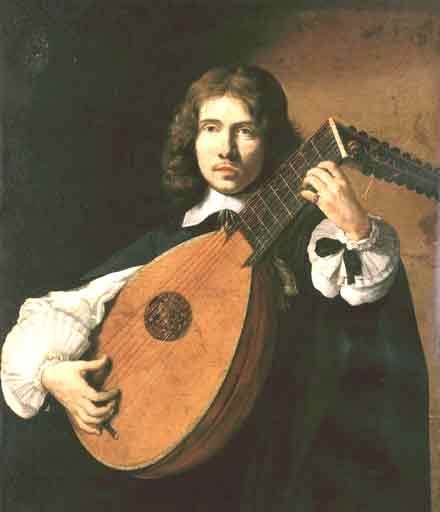
Today’s piece is by just such a singer-songwriter, an Englishman born in 1567, Thomas Campion. He wrote his lyrics, wrote music for them, and was an accomplished lutenist, so the chances are that he was discovered by John Hammond and played the authentic Elizabethan blues music he misheard from 78 r.p.m. discs of Catullus. Well no, doubting Thomas, once more I Kyd.
Poetic Campions compose. Thomas Campion with his lute.
If he looks glum it’s because it’s two centuries until Martin Guitars is established, and 350 years until the Telecaster.
He did write lovely songs, in a style I can’t come up with a way to present. “Let Us Live and Love” was one. You can hear it sung beautifully to his tune here. So instead of exploring my counter-tenor range, I’m going to go with a sort of loose skiffley blues in my performance.
I’m going to lean on my blues audacity hard here, because the poem is addressed to the singer’s lover, Lesbia. Beavis and Butthead style giggles are breaking out in the back, I can hear you. Turns out Campion took the lover’s name and the idea for his first verse of his lyric from a Latin poem by classic Roman poet Catullus, before taking off on his own thoughts on the matter. Classics scholars explain this by saying the Sappho of Lesbos’ association in classical times was more at a widely experienced lover, not necessarily a lesbian one.
OK, OK, forget the one about you might as well have sex with me.
How about this, we’re all going to die, just like that bird, and…
Another category “Let Me Live and Love” could be put in would be a “Carpe Diem” poem, which is not the Department of Natural Resources limit on the number of bullheads you can catch, but is more Latin meaning: “seize the day,” which in the case of poems usually doesn’t mean seize the day for fishing. Instead, Carpe Diem poems usually offer this proposition: “We’re all going to die, so you might as well have sex with me.” Seriously. Poets have actually made that seem like a smooth line.
The twist Campion puts on Carpe Diem is to bend it around a bit. His song has it that you already love me, and that makes the idea that we’re all going to die bearable. That’s at least a little more flattering.
To hear my performance of Campion’s “Let Us Live and Love” use the player below.




 Frank Hudson