I had to catch myself editing the last post – as I discussed my use of virtual instruments in place of the actual instruments and the new plausibility of thoroughly AI music, I was tempted to overuse the word “verisimilitude.” Is that really something essential to the art of music? I like the cranky not-quite-real sound of the Mellotron after all. If musical art should be imagination, music itself certainly doesn’t care if the instruments are real – though musicians might, from legitimate guild concerns. Then we moved to having the computer play the instrument, and that too asks about human-displacement – and now we have AI creating songs outright from very generalized prompts. If you’re a composer, a musician, or a listener, this raises questions.
Let’s start by being honest with ourselves as listeners in avid or casual modes: as we pass through life, music becomes a sort of sonic homeplace – a location where something sounds similar to what we’ve heard before, with just enough difference to stave off boredom, just enough new to add the spice of novelty. Some musical ears live in homogenous towns, others in more diverse ones, but we go to music for the effects we’ve learned to appreciate.
Current entirely-AI music exploits this: taking what we know of form and sounds, following its predictability in a way listeners have been known to appreciate, and serving our aural expectations back to us. When they do that, the robots are telling us something about ourselves. As I ended my last post, if we object to AI music, it may be from the romantic feelings we retain for human artists. We want fellow humans to make these sounds with and for us, and our response may rise to disgust when we are tricked. And here’s a problem: it’s getting harder to say you won’t be tricked.
If this is so, what hopes do we have? One: imperfection, at least of a kind. Let me interject here that I’m not talking about the imperfections of boredom, of which there are many. I’m talking about music that may be a bit more haphazard and unpolished. If machines can precision-target our musical comfort-center receptors, then let us distrust that response at least in part.
Commenting reader rmichaelroman has already guessed that might be part of it, mentioning the performance, rough in recording quality and musical finesse, from the LYL Band at an Alternative Prom in someone’s basement years ago. Even stored on honest recordings – live music, particularly live music that is truly live, with unplanned-out moments, with instruments reveling in their specific bodies, breaths, and vibrations – offers vivid imperfection.
Or too: voices with less talent than intent. I try to not over-burden my listeners with self-made excuses for my singing voice – but for all its limitations, it remains the one I have handy to realize the songs. Would AI be able to duplicate those imperfections? Perhaps, but it’s unlikely to want to.
When music practices and equipment reached points of greater mastery in the 20th century, reaction in the form of purposely avoiding those felicities arose. Midcentury pop music was opposed by the rising Folk revival and by early Rock’n’Roll. Then later, perfected Rock recording technology and improved musicianship found themselves met with Punk and Hip-Hop premised on the idea that a minimum of tech or muso-chops can still make an effective statement. By the way, I believe those technical hierarchies produced worthwhile music, but those that dispensed with them did so too.*
And when I wrote about voices with more intent than talent: for all the romantic imprecision of assigning internal motivation from a separated artistic product, what we believe we understand about why a piece of music was produced has importance. AI-music, however good it is at mimicking the technology and sound of music we like, presently offers only the weakest and least admirable answers to the question of why it was called into existence. To make some money? To make inoffensive sonic décor? To sell drinks to dancers? To show it can be done, as if that “verisimilitude” was the most significant thing about art? Some music I have liked was made for such mundane reasons, but in the future we may find intent more necessary to weigh.
I’ll leave with one more brief metaphor as AI-music reaches a level of musicological competence: we may have come to something analogous to painting’s role as photography entered the realm of visual representation. AI music in artistic hands may eventually seek out flagrantly subjective use of the technology – and music made by humans holding physical objects in real time will increasingly began to value qualities beyond sounding customary and “correct.”
If my energy holds out, there’s at least one more post in this AI series before I return to our regular combinations of literary poetry with original music, this one will address in more detail some of those music things I call “guild concerns.” If you miss the usual Parlando Project fare, there are over 800 examples of that here, so feel free to look around.
I wouldn’t want to call this performance imperfect, but there’s a human unexpectedness to it that satisfies me
.
*The 1950’s-early ‘60s folk music revival had elements that I found closely mimicked by the Punk/Indie movement of following years: the DIY convictions, the gumption to form or transform venues and record labels, the opportunities for out-of-the mainstream ideas and sounds to sneak in between the more polished and “professional” acts. Similarly, Hip Hop followed the folk process: use what instruments were at hand, assertion before sounding “correct,” recombining shared culture materials (floating verses and borrowed tunes for the banjo brigades; turntables, cheap drum machines, and samples for Hip-Hop, contemporary social comment for either). Musicologist Ethan Hein said in a BlueSky post that helped spur me to write this series, “You can get across the essential elements of hip-hop and house with buckets (Hein here is referring to overturned buckets used as drums –FH) and voices. Computers and sound systems are nice to have but inessential. Long after Spotify is gone, people rapping over beats will still be with us.”
My feature this February has been centered around an Afro-American scrapbook entrusted to me after it was found in a crawlspace at a former South Minneapolis rooming house in the middle 1970s. This series has taken me away from the usual Parlando focus, which is combining literary poetry with original music in differing styles. If you’ve been missing that, look to the bottom of today’s post — I’ll have something new for you today.
This exploration has taken a tremendous amount of time and effort, and I sometimes doubt how many readers will share my level of interest in looking back at what’s in and surrounding that scrapbook. It seems worthy of notice to me, and that supports my mind and heart work in this month’s effort. I did warn at the start of this series that what I’m writing here is coming fresh from an examination of the scrapbook, and some of my findings will be preliminary or subject to better evaluation — even little things in this larger than usual collection of writing. I just finished fixing a handful of typos on the previous episode that escaped my eye last night before I went to sleep, and now it’s time for the next one.
As a document the scrapbook spends a lot of time in the World War Two years. The book’s leading man, guitarist and singer Hank Hazlett, got his big show-business break then with the Jazz quartet The Cats and the Fiddle,* and the scrapbook evidences notice of the war in the things its maker chooses to include.
Here’s a Roy Wilkins column collected by the scrapbook maker rejecting racial prejudice in the US armed forces published during the war.
.
And here are a few more war related clippings in the scrapbook.
.
Another war-related story included in the scrapbook is a newspaper clipping that tells us of the Hank Hazlett era Cats opening for and then backing Lena Horne in a musical appearance in front of a hospital’s wounded soldiers. The Cat’s opening set was “Stomp, Stomp,” I Miss You So,” “Straighten Up and Fly Right,” with “Another Day” as their encore. With Horne at the mic, the combo supported her singing “Sometimes,” Stormy Weather,” and “Honeysuckle Rose.”
.
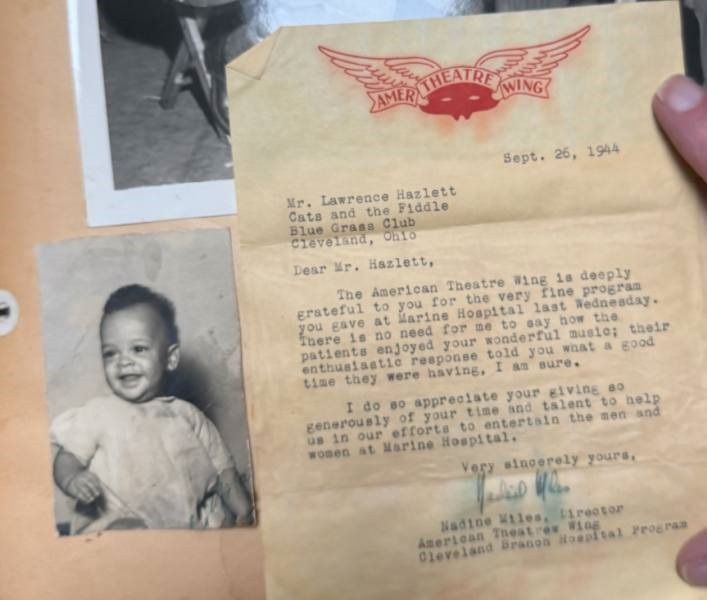
Having this dated letter from 1944 pasted next to the baby picture opens a theory regarding a possible child of Hank and Edith that I wrote about yesterday. A 1940s child could be part of Hank’s deferment, could be the right age to write Felicia’s letter to Daddy a few years later quoted in yesterday’s post, and later yet could also be a young, teenage woman, the subject of another picture in the scrapbook. That the thank you letter is addressed to Hank indicates to me that he might have been the de facto bandleader for the Cats and the Fiddle during his time with them. He was likely 6 or 7 years older than the other Cats in addition to taking the place of their regular lead singer — so, that role might have fallen to him.
A strong theme throughout the scrapbook is Afro-American pride and their struggle for equity in the arts. Many clippings demonstrate that the maker of the scrapbook was concerned with the stereotyping and constraints on Black entertainers and some clippings celebrate their achievements in overcoming that. Here are a few of those items from the scrapbook:
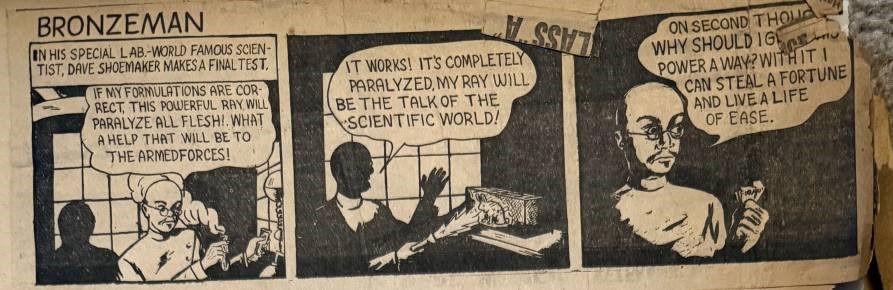
Did a bronze man create this? Yes. A.C. Hollingsworth created Bronze Man in Blue Beetle #42. As in Paul Laurence Dunbar’s famous poem, he was to “wear a mask.” Publishers changed things though. See this link.
.
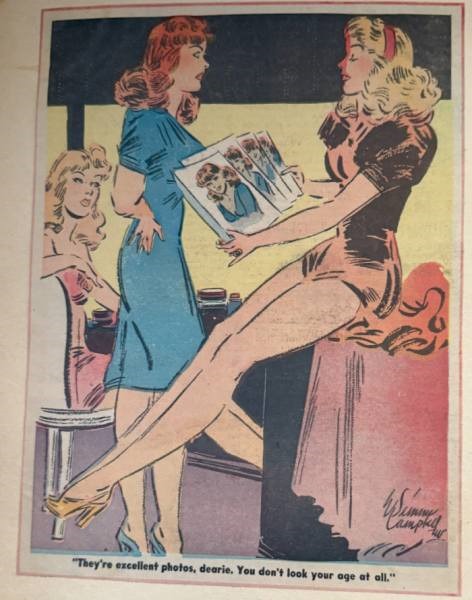
I wondered about a series of cartoons in the scrapbook. All white characters, nothing about music. What was the reason the scrapbook took note of them? The cartoonist E. Simms Campbell. was the first Afro-American cartoonist published in the big time U.S. “slick” magazines. His Wikipedia page says his work appeared in nearly every issue of Esquire magazine from 1933 to 1958, and in many other publications.
.
.
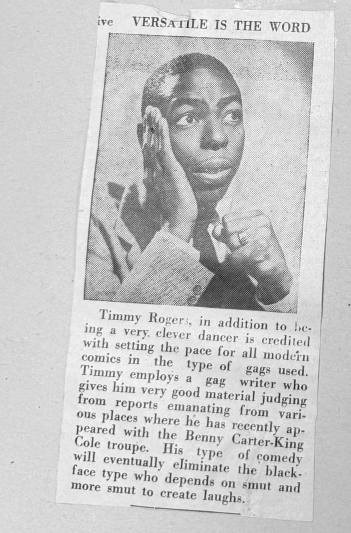
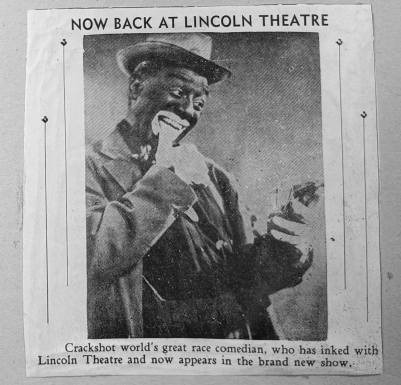
Dialectic, but make it funny: the clipping tells us Timmy Rogers was a Black comic who wanted to move beyond the blackface fool stereotypes. More info on Rogers. I can find nothing on Crackshot, though he’s given his clipping in the scrapbook too.
.
The entire multipage program for this landmark stage production starring the multi-talented Paul Robeson was pasted into the scrapbook.
.
Lena Horne, Dorothy Dandridge, and Butterfly McQueen. Three black women in entertainment who needed to struggle for non-stereotyped parts in the ‘40s. And keeping with our WWII subject, here are the Cats jamming with a white G.I. on bass. The armed forces may have been segregated, but music has established a beachhead. I note too, the scrapbook maker is paying considerable attention to women in the arts.
I knew about Lena Horne and Paul Robeson.
I knew about Robeson, Horne, Dandridge et al. I’d never heard of Pearl Primus before this month’s examination of the the scrapbook. Her Wikipedia entry tells what she did. This, Robeson’s Shakespeare, and the comics artists above are examples of how the scrapbook’s maker wasn’t just interested in music, but had a broad interest in the arts.
.
Our summary today: not all warriors carry a gun. We’ve had war today, and prejudice, and stereotypes — and me writing a bunch more words (with maybe fewer typos). So, let’s have a little music, and poetry — and love not war. Here’s a poem by Afro-American poet Alice Dunbar Nelson written in the last decade to be called The Twenties. This may be Black History Month, but all I read next to my breakfast each morning this month is telling me that the nonsensical denigration of Black American military and cultural contributions along with a side-helping of gay panic isn’t history, just as it wasn’t history to the maker or makers of the scrapbook. To hear Dunbar-Nelson’s poem “You! Inez!” as I sang it to music composed today in-between typing this, you can use the audio player gadget below. No player? Elon hasn’t fired it, it’s just that some ways of viewing this blog suppress it. This highlighted link will open a new tab with its own audio player.
.
*A founding member and most often featured singer of the Cats and the Fiddle was drafted. The scrapbook doesn’t deal with this, but I did wonder why Hank or other members of that quartet weren’t drafted. Hank Hazlett was born in 1911, and in 1940 he’d have been 29. The WWII draft was different than the Vietnam draft I’m most familiar with — in my day, most called up were younger than 27. In WWII draft men up to age 35 were commonly drafted. I only know the age of one of the original Cats quartet, but the bass player would have been 22 in 1940, and since the original quartet all knew each other from high school, I’m assuming they were near the same age — yet, as far as I know only Austin Powell was drafted. This is a complicated subject and we know so little about the men in the Cats. There were classes of deferments for various reasons, and even stories that some draft boards didn’t want to draft Afro-Americans for Jim Crowish reasons — this even though the Armed Forces were segregated throughout the war. There were also stipulations for physical condition that histories tell us bedeviled the system during WWII. One oft cited report had it that in the draft first year, 1940, “nearly half the men drafted were sent home” for not being fit enough for service.
Or course a great many Afro-Americans did work in war-industry, or were drafted or volunteered for the military, despite the Armed Forces still hewing to the Jim Crow segregation/white superiority regime of mid-century America.
I have a new audio piece today, combined with a continuation of my Parlando Project influences-as-episodic-memoir series. The audio piece uses text from Gertrude Stein’s Tender Buttons — worthy in itself — but what suggested it was a question that reading about Stein brought to my mind during The Seventies when I started to look into her life and work a bit.
Despite being nothing like an expert on Stein, I could fill this post with stuff about what she did and how she went about doing it. I’m going to make a summary of that a footnote, though that’s worth reading if you know even less about her than I do.* There’s one detail from Stein’s life that hooks into my story as I entered The Seventies. I’ll come back to that. Watch for it.
In the last post I’d left college in 1970, disconnected in the aftermath of the political activism post Kent State and my failure as a young editor of my college’s student newspaper. I wrote of some musical and poetry experiences in the early Seventies there. Another thing was both continuous and changed at this point: I needed to find a job. This was continuous because I’d most always worked from my middle teens. I’d had paper routes, did odd jobs for the local bank, and besides my work in my second year with the school paper, I’d been what was called a “work-study” student working most days in the college cafeteria. Although it didn’t occur to me then, I suspect the more well-off students may have noticed that I was doing kitchen work while they were only concerned with regular college life, but this continuousness of work was ever more complete from the time I was 20 until I was past the age of 65. Another way to say that was that I worked full-time hours all those year with no more of a break than a worker’s vacation. After leaving college I worked frying hamburgers at a fast-food restaurant and on a factory floor making vertical blinds, but in 1971 I was back in my small Iowa college town looking for work. I went to a nursing home in the town, thinking they might have kitchen work. Instead, they asked if I wanted to work as an orderly/nurses aide.** I took that job.
So, if work was continuous for me, what was changed? In some expectations one is supposed to find one’s career in their 20s. I had decided earlier that I wanted to write. In some other lifetimes perhaps I would have found an entry-level writing job, in another I might have wandered into something with politics. I’m not sure however if those alternative livelihoods would have suited me, for reasons I may discuss later in this series.
My job in the nursing home was in the Extended Care Facility, the wing for those patients who needed more-or-less complete bodily care for the rest of their lives. Many were completely bedridden, and many of that portion also unable to communicate. I worked the overnight 11-7 shift with one RN. I’m guessing we had around 20 patients in the unit. Our night work was turning the incapacitated every four hours to prevent bed sores, to clean up the incontinent and their bed linen, and to occasionally minister to those who awakened, often with some level of anxiety and agitation. It was hard physical work, and I will confess that I let the physical work deaden me somewhat at first to the Sisyphean nature of their lives and my tasks with them.
If one has a lot of triangles to move from Iowa to New York…
.
I moved to New York state to stay after a few months of that, carrying everything my wife and I owned in the bed of a rusty 1960 Chevy pickup truck that I’d purchased for $200 from my wages. The truck was so rusty that I could see the tires through holes in its floorboard, but other than a hydraulic clutch that would reengage itself if depressed too long, it ran OK in its rattly way. Back in New York I was living in a poor, mostly Black section of Westchester, renting a room from an elderly Mrs. Whitted who had a framed life-time membership certificate to the NAACP on her living room wall. I worked there first in another nursing home, a much fancier one in upscale Westchester, on the day shift this time. There were more staff there, but some elements of the care bothered me.*** Being low on the care system org chart I chose not to try to remedy that, and left for a job working on a med-surg floor at a Catholic hospital on the overnight shift again. The regular charge nurse on my floor was Miss Watson, a young highly competent Black Anglo-Jamaican with an impeccable English accent that would match a Sidney Poitier. We worked along with an LPN and at least one female aid (usually one of several Afro-Americans with a Great Migration southern-American accent) to complement my coverage of the male side of the patient census. I fully enjoyed working with Miss Watson. The most peculiar absurdity of her life that I got to observe was when patient relatives came in around the change to the morning shift after talking on the phone with Miss Watson. They’d assumed a starched-white Englishwoman, and so the recognition scenes when they arrived and saw her dark black skin always had me stifling a laugh. How much humor Miss Watson could consistently find in this might be another matter.
These orderly/nurse’s aide jobs paid a dime or so over minimum wage. The work was physically hard and even at its most basic levels it involved deep responsibilities all out of proportion to what it paid. Around this time, I came to embrace this necessary and underpaid work. It provided an inescapable, palpable, meaning to my life, something that struggling over a poem or prose draft could not demonstrate objectively. It allowed me access to all kinds of people in a wide range of economic classes and backgrounds. Occasionally, I thought of the members of my generation who served in the military, some drafted, and I told myself this was my service.
Eventually I moved up to Newburgh, New York, which will need to be another post. I worked my last overnight shift at the hospital and then I hitchhiked up to Newburgh at the end of my shift. I’d already gotten a job at St. Luke’s Hospital there in the Emergency Room. I’d work the 3-11 shift there the next day.
Are you waiting for Gertrude Stein to return? Here’s the connection. I can remember reading about the little Paris apartment she and her partner, edibles pioneer Alice B. Toklas, shared with Stein’s brother and a wall-smothering collection of Modernist art bought directly from artists that she knew, and the world would know later. It was there Stein lived from 1903 after leaving Johns Hopkins Medical School short of a medical degree.
As a time-travel destination that place is five-star. Artists, writers, critics, composers who once needed only to travel geographically to go there, wrote of it in their memoirs. A famous place.
Gertrude Stein in front of some of the Modernist paintings collected in her Paris apartment.
.
You know what I thought reading of that apartment? Yes, there was wonder. How did they figure which artists to collect? He, she, they, all of them were there, people before the pronouns. So and so met so and so there? Hemmingway finding part of his prose style in this small apartment — and from a woman? But my most nagging thought? Something else, another question: “Who paid the rent?”****
Many (most?) writers have the ability to be motivated by that experience, though in reading I can tell some are, and others are not. I myself am inconsistent. I have written and performed poems here that the richest and most comfortable person in my time might have written or could easily relate to. And then again, I may overselect poems whose speakers are in extremis.
Some take a commercial-first approach to their art, making sure it earns the rent money. My nursing work from age 20 to nearly 40 illustrated a variety of life to me, but it also allowed me (with worries) to pay the rent.***** Others take a cause-first approach, advocating with their art resolutely for remedies to what they see. Could my nursing work have reduced that aspect of my writing? That has just occurred to me. I’m not sure, though looking back I’m more at glad I didn’t have to point to my writing, and later my music, as what justified my life. And “Other People’s Stories?” Each day in the Emergency Room you’d meet up with other people’s stories. If your own were limited, or intractable, you could move their stories forward.
I had found a job that in those days allowed one to pay the rent. Inside that conceptual room, paid for by working with the sick and injured, I worked on the writing. And those years of unbroken work, of clock-in every working day, and rotating shifts? I suspect a habit retained as this Project approaches 700 pieces this year.
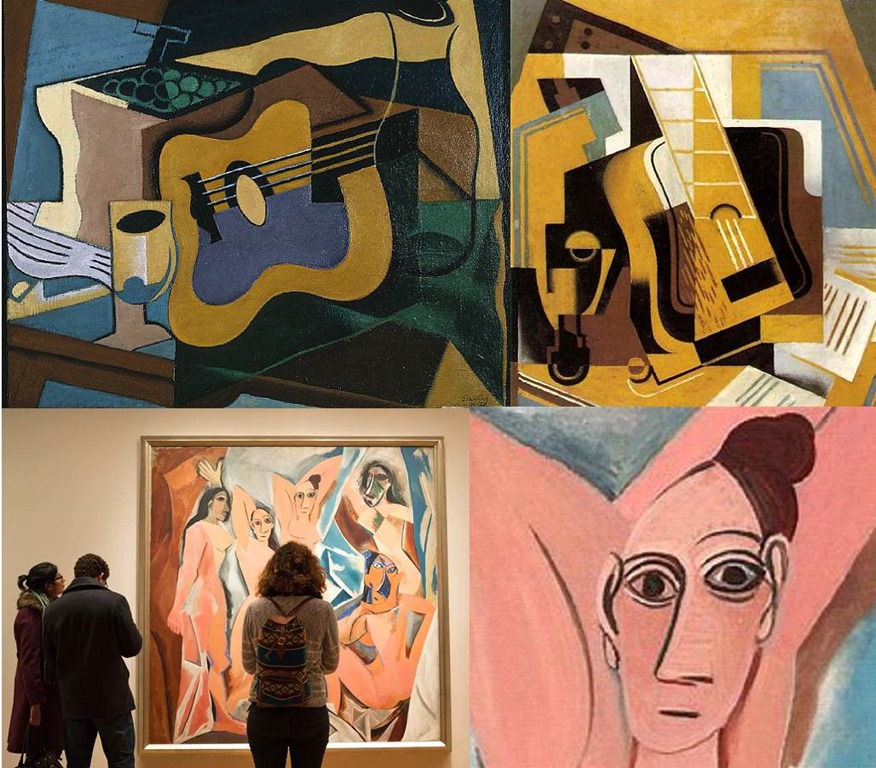
Today’s audio piece is from Gertrude Stein’s still controversial, still avant-garde, collection of “Cubist poems” Tender Buttons. That book is divided up into three sections: People, Objects, and Rooms. I performed the opening to the final section, Rooms today. Tender Buttons remains gnomic. Though the words themselves are plainspoken, a straightforward meaning is most often hard to make out. My performer’s working theory during the recording was that she’s making a statement about Modern Art and Cubism. Rather than a center and conventional panorama, Stein holds for more perspectives at once. She seems to be advocating for something not just decorative or the easy dessert of sentiment (“silver and sweet”). She sounds a “Life is real, Life is earnest” almost Longfellowean note when she says “A preparation is given to the ones preparing.” She perhaps compares a conventional painting with a center and a border to an empty dress, flat on a hanger. The final paragraph/stanza moves, synesthesia-wise, to music where the flowing facets of a Cubist painting may show a sequence of time.
.
Though printed as prose, the musical rhythm and rhyme of this poem arises with any earnest effort to read it aloud. If one was to modify it to conventional lineation, parts might almost pass as Emily Dickinson, albeit the more obscure and compressed Dickinson.
You can hear my performance with a drums, bass, piano, and electric guitar quartet with the player gadget below. No graphical gadget? This highlighted link is an alternative way to hear it.
.
*These footnotes are going to be long, and are for the more curious. They’re not necessary to enjoy the audio piece. Stein is easily classifiable as equal to Apollinaire and Ezra Pound (both of which she knew and interacted with) for influence on the emerging Modernist movement in the first quarter of the 20th century. Her influence on English language Modernist writing is not consistently admitted or admired, but her influence also extends to Modernist music — and along with her brother Leo, she’s absolutely central to the development and appreciation of Modern art.
The most amazing thing about her pre-Paris youth is that in a 19th century when women’s education and careers were constrained, she attended Radcliff (meeting, being mentored by, and admired by, William James) and then sought to become a medical doctor through graduate work at Johns Hopkins Medical School. Her center of interest was how the mind and its perceptions work, something she was studying at a time when Sigmund Freud had just started publishing. She dropped out of Johns Hopkins before graduating however.
**Job titles and even jobs listings were routinely gendered in 1970. Orderly was a male job, nurses’ aide the woman’s. Training for either was generally informal and on the job. Later in the Seventies I barely started an academic RN program, but affording the classes and especially the time and automotive costs of traveling to the nursing school put the brakes on that. Since I worked in teaching hospitals for over a decade after this as an aide hand-in-hand with nurses, interns, residents, and staff doctors, I learned a great deal of practical knowledge along the way. Administering medicine was not legally allowed, but I eventually did much of everything else the LPNs and RNs did. Afterwards, I always called what I did nursing, as it was a better description of my role for most of that decade-plus. In the middle 70s I helped in a small way to train early EMTs and given how much I liked the pace and variety of work in Emergency Rooms, I might have gotten into that line of work if I had come along a few years later.
The gendered job titles may have faded out as the Seventies progressed, but some of the work remained gendered. Despite having a poet’s level of athleticism and large muscle development, I was often called on to move or lift heavier patients, or to help restrain out-of-control people. Given how many stories there have been in recent years of people killed while being restrained (one in the news this month) I have wondered retrospectively if a different fate could have involved me in such a case. As things worked out, I never injured anyone while restraining them, though besides wear and tear I got a couple of minor injuries.
***I suspected a co-worker of patient abuse. I was new — they’d been there for some time. I had nothing concrete, and other longer-tenured coworkers thought they’d seen more, and that was part of my unease. A better person would have tried to organize a complaint and urge an investigation.
****Did you go to this footnote to find the answer? I’m not enough of a scholar to know all the details. Paris was dirt cheap then, there was some Stein family wealth, and the idea of artistically curious Americans of some means being gifted with broadening time abroad was common. Another Stein sibling, Michael, who also lived in Paris, has been cited as the man who handled the family finances there. The Stein bought-cheap-then paintings eventually became capital gains. At one later point someone noted a missing painting from the crowded apartment walls and Stein explained “We are eating the Cézanne.”
*****I’m no economist, but it’s my understanding that rent and housing costs have risen compared to the wages that of job earns now. It’s not my intent to engage in a walk-uphill-both-ways misery Olympics, just to explain some things that led to making this Project. Has any economist explained how jobs like the ones I held then, which are physically hard, unpleasant in some elements, demanding of all-shifts work, are at least mildly dangerous, have a chronic shortage of workers (much less good ones), and can have a life-and-death level of need and responsibility, yet pay less than much easier jobs for which there is a surplus of applicants? In my last few years of hospital work I moved to being a ward-clerk: typing, paperwork, general workflow organization and support (all of which I did as a nurses aide, as well as patient care) —and I then got a small raise.
It’s usually of little use for an artist to apologize for their work, and this is so even though most have self-doubts. Perhaps more so, women artists will speak about “imposter syndrome,” but I’d guess that many/most male artists have the same feelings, they just don’t talk about it. The plain fact is that we’re all pretending to be what we want to be, to go to the place we want to go to. We maybe get there, we maybe don’t — but we’re all traveling, and we all get lost sometimes.
I even have trouble with the word “pretentious.” I say that, though I know the problem that word is describing: the embarrassing failure where something doesn’t achieve what it clearly wants to achieve. It’s just that most good, and nearly all great art, starts out with exactly that urge: to make something better, to make it new, to stretch and extend the maker’s talents, to make something over the horizon from what the artist knows. Since the same urge produces success and failure, it’s not the urge or the hubris that’s the problem. Don’t beat yourself up over that urge, don’t beat your breast over the failures. Reflexive humble-brag is exceedingly boring. If you must, get through any of that quickly. One of my animating maxims is “All Artists Fail.” As I’ve written about that maxim extensively here, that paradoxically comforts me.
I’m not an expert on Kenneth Patchen, but the general impression I get from him is like a 20th century American William Blake, that he self-invented himself and his credentials, and that’s easy for me to admire. I spent much of this week looking for a poem, a text, that would inspire me, and shake me out of some creative doldrums; and after striking out both swinging and looking during several at bats inside several books, I came upon this one. Since the text of this Kenneth Patchen poem doesn’t appear to be available to link, here it is:
One can think on the statement that “death is something which poems must be about.” That’s sort of true, and I laugh at it.
.
It doesn’t appear to have a title in the early Selected Poems volume I found it in, but the first line was used as such when Patchen was recorded reading it. The poem is read unaccompanied, but Patchen predated the Beats in doing the mid-century poetry with music thing that’s an inspiration to me. He reads it slowly, precisely. I hear it silent on the page as more anguished in its effect, and in trying to record a performance of it this week I first tried almost shouting out parts of it. After trying that I decided that wasn’t working, and tried a more understated take — only to find that my voice was horse from the earlier takes. I did my best in the time I had, and that’s the performance you can hear today.
“She had concealed him” seems to be using something of a collage of voices. Not so directly as a Patchen favorite of mine “Do the Dead Know What Time It Is,”but the opening seems like the start of a fairy tale, then there are bits of realistic daily speech, and then the fantastic metaphor of the poems final lines. As so often in Patchen poems, there’s a sense not so much that God is love, but that Love is god.
The music today makes use of some concepts of mine that are, to convention and many listeners, wrong. I like the rub of outside notes and grotesque melodic contours.* Rather than having a straightforward harmonic foundation below a singular or a mathematically related set of melody notes, I’m fond of twined melodic lines that respond or contrast in turns with each other. And as an electric guitar player accompanying singers or poetic readers, I clearly don’t know when to shut up and not play my guitar. This last one I might change, perhaps should change, but in the immediacy of the playing moment I’m believing that strong words, read with force, are able to stand toe-to-toe with electric guitar.
Frankly, I worry that the resulting musical performance may have too much of all of the above. Is that from a failure of nerve, or a failure of execution? Am I reflexively using old habits, not stretching out to something else? Well, I meant what I played, meant my reading performance of Patchen** — but meaning and intent didn’t allay my doubts. Yesterday I made four completed attempts to mix this. With my self-expected release schedule and time conflicts, it’s rare to go beyond two alternate mixes. I still decided to let the music continue for a bit more than an extra minute past the reading, because I liked the echoing musical conversation in the deep dark cave.
And there’s this perspective: all that is just one musical mode here. I have other pieces that are less cluttered, more accessible, and less contrary to expectations.
Returning to the thoughts of the opening of this post: the middle parts of what I write today are parenthetical and not something I want to take more of your time with. Non-paralyzing self-analysis is likely uninteresting to readers or listeners, but it can be effective as part of the journey of making art. I’m done trying to make this piece any better. I think the best moments that I hear in it and what Patchen wrote may be worth your time. My job with this Project is to move onto the next piece, to see what I can find and do with that. Thank you for reading and listening. The player gadget to hear the musical performance of Kenneth Patchen’s “She had concealed him” is below for many, and this highlighted link is there for the others.
.
*More than once, what I play has been characterized as out of tune or dissonant. Some of that is timbral, and some of it is wide vibrato, but often it is note choice and sequence. I don’t always hear it that way. I think harmony has rules, that can be broken or bent, but there’s propriety there. But melody? Melody is free. Yes, I’ll acknowledge that certain melodic contours generally cause admirable effects, but I myself am easily bored with stock moves. Two bands I admire, Television and the Velvet Underground, were each said to have banned playing Blues riffs that were part of the expected electric guitar vocabulary. I on the other hand, and in today’s piece for example, am playing Blues expression (stinky, funky notes and wide vibrato) without the expected sequence.
I think the opening electric guitar chord today was likely a subconscious attempt to refer to the chord at the opening of Peter Green’s Fleetwood Mac version of his “Black Magic Woman,” and Green’s Fleetwood Mac was another band like the combo I constructed for today’s piece that tried to find room for an overplus three-electric-guitar frontline. That band’s Live at the Boston Tea Party set is foundational to me.
**I felt my earlier more histrionic reading was less effective and my more resigned reading better and more true to the poem, not a retreat.
I’ll admit I rushed to complete today’s audio piece because I wanted to make note of a birthday anniversary of an important contributor to the American wing of the Modernist movement of the early 20th century. I’m going to get to it in a roundabout way. Have patience, valued reader, I think this abbreviated story is worth your time if you care about the everyday accidents and personal connections that you might find scattered about behind what become large changes.
This story starts with two 19th century American immigrant families. I know a few details, and though I probably don’t know a lot more, but I think I know enough for a story. One family’s breadwinner was a laborer from Sweden. I read today he signed his name with an X, and he worked at various jobs including blacksmith’s assistant in Illinois after arriving. His wife was resourceful and was able to keep the underfunded household going. The other was described as a “peasant family” from the tiny country of Luxembourg. “Peasant” sounds so Bruegel, I don’t know if things were that feudal in Luxembourg in the middle of the 19th century, but that second family emigrated to the midwestern United States like the first one. The husband started out working in a mine until ill health forced him out. Luckily his wife found some income working as a milliner.
What’s important about these two families? Well, so far, nothing — though they raised families, that’s something. The second family already had kids when they arrived, the first one soon had seven kids. We’re going to concentrate on some of the kids. Our first family was the Sandburgs, the second the Steichens. One of the Sandburg children in Illinois called himself Charlie, and over at the Steichens in Wisconsin we had Edward and Lillian who were born in Luxembourg but were now growing up in the US. Charlie, the son of the man who signed his name with an X was passionate about writing. Edward, the son of the miner, was interested in art.
Charlie, our writer, had to leave school to help earn money for the struggling family at age 13. Eventually he volunteered for the army and served in the Spanish American War. Edward worked at the commercial end of art while having ambitions to move into the fine art world. Given those ambitions he took a wild chance by moving over to photography, which in the late 19th century wasn’t yet considered a fine art. How could that acceptance happen?
Edward started taking pictures and working on various ways the composition, lighting and film developing process could alter the images in artistic ways. One of his models for the photographs as he worked on his craft was his younger sister Lillian (see below).
Charlie got a break after the short-run war he was in. A local college gave him a scholarship* as a returning war veteran, and one of his sisters, Mary, was big on education and helped support him. Charlie rushed into doing everything writing he could do there — and while he didn’t graduate, when he left it was to pursue writing and to give talks on the midwestern Chautauqua circuit. Looking to network, he found himself in Wisconsin attending a Socialist party meeting.** It’s there that he met Lillian Steichen. Bam! Charlie fell hard and fast for Lillian. Lillian was perhaps a bit more careful. Charlie told her he was a poet, an artist, and he asked for her address (she was visiting her family, but was teaching in another state). She obliged. That was it, one accidental meeting.
For the next six months Charlie Sandburg wooed Lillian Steichen with letters. Lots of letters. Letters with poetry. Lillian’s letters easily showed her intelligence and wide interests, and she may have felt freer to discuss those things with native-born Charlie in writing because English was her second language and she may not have been as fluent in it speaking casually. And despite Charlie not being a good provider catch, the two fell deeply in sealed-with-a-kiss love. How much did Lillian rev Charlie Sandburg’s poetry engine? We’ll see at the end of this story today.
What about Lillian’s big brother Edward? His art photographs were getting some interest, and he had crossed paths with Alfred Stieglitz, another man who was interested in the Modernist movement to make photography into art. In 1905 the two go in to showing not just their fine art photographs but all kinds of Modernist art in New York City. Edward’s photographs filled Stieglitz’s journal Camera Work. A gallery they set up, the 291 Gallery, shows much new modern art work — not just photographs— and this work is often shown there publicly for the first time in America. How important and primary were Stieglitz and Edward Steichen in Modern art? Even a person who’s not primarily interested in visual arts like me has heard of the famous 1913 Armory Show in NYC, often considered the pioneering event in America’s exposure to Modernism. Well, Stieglitz and Steichen were showing that kind of work and laying the groundwork for that show for a decade before.
Back to Lillian Steichen and Charlie Sandburg. They married in 1908, job prospects for free-verse poets not overly concerning them. Charlie started to go by his birth name Carl, which he’d previously ditched because it seemed too ethnic. He worked for awhile as the PR/Press Secretary for the Socialist mayor of Milwaukee.*** And then he moves on to daily journalism as his day gig in Chicago. Carl, Lillian, and the brother-in-law exchange Modernisms. Carl’s poetry becomes more tightly visual, more show not tell. Later, if by extension photography can be an art, how about movies? Carl Sandburg’s daily journalism includes becoming an early movie critic.
Edward & Lillian Steichen. “My Younger Sister with a Rose Covered Hat.” Carl and Lillian Sandburg. “My Little Sister.” All photos by Edward Steichen. Check out the hats. Was it another happy accident that Steichen’s mom was a milliner?
On the anniversary of Edward Steichen’s birth, here’s one of Carl Sandburg’s poems wooing Lillian Steichen, “A Dream Girl,” performed as a song. You can think of it as Sandburg’s “Love Minus Zero/No Limit.” But knowing the art-photography Steichen side, consider the poems final line when you listen below, or read it here. I recorded the song quickly, with just my voice and an acoustic guitar, something that Carl Sandburg would have had handy to him, because Carl Sandburg was also a pioneering folksong revivalist, often dropping a set of acoustic guitar songs into his readings at a time when Pete Seeger wasn’t out of diapers. Oh, and Bob Dylan? Did you know that when Dylan’s poetic songwriting was just taking off that he took it upon himself to seek out Carl Sandburg? Oh, so many stories, let’s get onto the song. Graphical player below, and an alternative highlighted link for those that can’t see that player.
.
*Charlie, Mary, or someone must have talked Charlie up a bit. Colleges, even then, didn’t usually admit folks who hadn’t attended high school.
**By the turn of the century, democratic socialism was an emergent movement in the US. Despite its suppression in the WWI years there was some chance that it could have developed into a European style mass political party. Even with the Palmer raids and fears of a Soviet style revolution after WWI, US Socialists were able to win governorships, congressional seats, and mayoral races in places in the American Midwest in the first half of the 20th century.
****My own dedication: I found out about the 291 Gallery in a book Strange Bedfellows about the intertangled networks of American Modernism that was given to me by Dave Moore and Linnea Hadaway. Thanks!
I just spent a half-hour watching this video recommended to me by a stranger elsewhere online. I knew. and still know nothing, about the man who talks here, despite a documentary being made about him a few years back.
Why did it hold my attention, even though it’s partly about that documentary and a career I don’t know? Well, he’s an engaging talker, and the interviewer here too is excellent, but that wouldn’t be determinative. One of this project’s mottos is “Other People’s Stories,” but obviously in a world of current billions and more than a millennium of poetry to consider, I’m going to ignore or pass by most people’s stories. Maybe it’s his age and his obvious engagement with art, while being old enough to be my father? I’m old. I’m still engaged in this Project. Old people still facing that situation may be the link that connected me.
As someone who currently rarely performs live in a room of listeners, the subject of “stage fright” isn’t a pressing issue for me. The early parts of this interview do speak to that issue, reminding us that it is not a unique, shameful, issue — but one that is rather common among performers. No, it’s not so much stage fright that I myself am most interested in. Rather, I’ve been increasingly promotional with the more than 650 audio pieces and accompanying posts that have accumulated here over the past six years. I frankly feel a mix of unseemly self-interest and objective self-delusion as I do that. These acts of promotion are still novel enough for me that I can, for now, press on past those feelings. And since it’s been harder to create more pieces, or as complete a realization in them of what this Project tries to do, this task — which embarrasses me — allows me to think I’d doing something in place of that.
.
What I find is the deeper message then of this man’s account is that there is an element in art — subject, yes, to the clouding of our egos and neurotic urges — that is beyond ourselves. More than 20 minutes in, in what becomes the conclusion of the interview’s story arc — the thing everything before has been building to — Seymour Bernstein articulates that place.*
Can we visit that place consciously, acknowledge that we want to abide there at least a little while?
For an audio piece, here’s one of the early pieces of this project I’m most proud of, another older man of music speaking about that art. Weston Noble, spoke this about music at his retirement, and I wove his words into some original music. You can hear it with the player gadget below, or with this highlighted link.
.
*So, should I give it to you in pull quote form, a TL:DNR assistance to the harried reader who doesn’t have time for the half-hour interview? I debated this, but decided that no, it would lack impact without the build of the story telling itself by the method of it’s telling. I decided, you might be too likely to shrug, and the precept would roll off your consciousness. And earlier in the interview Bernstein makes another recommendation that may be valuable to writers and composers: that a balance of re-creation and creation is helpful.
Here’s a little story, about a one-eyed man named Leonidas, who you might think at first is not worthy of telling here at a place that talks about poetry and music. Was Leonidas an artist? Well, he started off an accountant. That’s important. Alas, the Great Depression happened, and even accountants were made redundant. Next, he opened a radio repair shop, since he’d been handy with electric circuits since he was a teenager. Better to repair a radio in those days, so he was able to make a go of that.
So, when does the art come in? Patience. Perhaps you know how revisions, pentimento, second drafts work in art? Then too, do you know the old saying about the one-eyed man in the kingdom of the blind.? That’ll apply too. There’s musical elements coming up, and we’ll end up in the Museum of Modern Art.
It wasn’t just families’ home entertainment radios that came into Leonidas’ shop. Musicians would come in and ask him to repair or construct public address systems. Leonidas’ region was bustling. First with agriculture, and soon with manufacturing. Workers wanted music at dancehalls, bars, and roadhouses, and the small affordable music combos with growing and sometimes rowdy audiences needed to be heard. Leonidas could make things loud.
Some of these musicians played electric guitars, a newish invention. The big hollow reverberant wooden boxes that had formerly needed only to be loud enough to provide a discreet chop of propulsion to large brass and saxophone led bands were now equipped with magnetic pickups which drove amplifiers so that one or two guitarists could replace that horn section. Simple accounting — the venues wouldn’t necessarily increase pay for larger, more elaborate groups. Slim down, but get louder.
One catch. The louder noise these big hollow guitars now made with pickups mounted on their surfaces reacted with a hellish howl from their resonate bodies’ underground cavities when the volume got loud enough. Leonidas’ amplifiers could make them loud, but the guitars couldn’t operate well in that loud environment.
Leonidas was the one-eyed man who knew nothing about guitars, but he’d been wiring electric pickups for a particular kind of electric guitar that was going through a bit of a fad: the “steel guitar.” A steel guitar wasn’t a guitar made out of steel, it was a simple flat piece of wood, like a small, narrow end table, with some strings and an electric guitar pickup that was played with a steel bar slid by one hand up and down the strings while the musician’s other hand plucks the notes the bar’s position has stopped on the length of the strings.
Leonidas got the notion to make a guitar that could be played in the regular way, with fingers fretting the notes, but still with a solid wooden body. He made a very practical instrument out of this idea. It was cheap to make, using inexpensive wood with an ingenious neck that could be removed in a minute with a screwdriver. Some musicians loved it, while guitar makers thought it crude. The simple plank of wood that made up a steel guitar wasn’t all that visible, being played flat like a table. This unadorned plank guitar was hardly more sophisticated, yet it would be hung around the musician’s neck for all to see. A musical end table is one thing, but hanging one around your neck while you sang or performed on stage? That’s just not right thought the existing guitar makers.*
Turns out musicians cared less about that incongruity, because Leonidas’ guitar was so practical, affordable, and it sounded great.
Soon other guitar makers responded to this success — but with fancier, less spartan iterations. The competitor’s responses might have golden paint or hardware and the same graceful arched tops the hollow guitars had, though now on top of solid bodies. Others had metalflake sparkle or fancy sunburst two-tone paint.
Leonidas may have been a non-guitar-playing accountant turned radio repairman, but he and his associates figured out how to fancy up his next design. The guitar he came up with next was curved and wrapped like a flowing scarf, shaped like an abstract painter’s asymmetric amoeba in the moment of forming itself into or away from the classical shape of a guitar. It would come in a variety of new-car-show colors. It had not just one, not just two, but three whole electric pickups. And it had a whammy bar, a spring-loaded vibrato device that let one easily swoop whole chords up and down in pitch. It was named like a Strategic Air Command bomber or the upper atmosphere verging on outer space: the Stratocaster.
Telecaster: like hanging an end-table around your neck and calling it a guitar vs. the colors and curves of the Stratocaster. A big Super 400 guitar forcing an arm akimbo.
.
Leonidas “Leo” Fender was born on this date in 1909. He never learned how to play the guitar — but he helped a whole lot of other people make music with one, by making his guitars affordable and durable like an accountant watching the logistical details. And as a repairman and tinkerer, he made his guitars easy to repair and modify. By choosing a modular design with interchangeable parts he made it possible for infinite variations of his original design to flourish. One could fill a store’s walls with a hundred variations of his Stratocaster — and eventually that is what happened. It’s the most popular electric guitar ever.
In 2015 while visiting New York I got to see them introduce a Stratocaster guitar into the Museum of Modern Art’s permanent collection. Thinking of the radio repairman’s art-shaped art-tool in the midst of MOMA’s paintings and sculptures I wrote this short ode to Leo’s Stratocaster in that context, and then I performed it with the LYL Band the same year. You can hear it below with the player gadget (where that’s seen) — or if you don’t see the gadget, with is highlighted link.
.
*Leonidas named this guitar that superseded his radio repairman line of work after the entertainment device that was obsoleting his radios, the Telecaster. I make the Telecaster sound crude because just like an Imagist poem that Modernists suggested could replace more elaborate and sufficiently “poetic” poetry, it did seem incomplete to many then. As an instrument however it’s surprisingly versatile to those who know their way around it. Despite the greater and continued popularity of the Stratocaster, there’s a solid cadre of players who give the secret handshake and declare “Leo got it right the first time.”
I have no new musical piece for today’s American celebration of freedom’s restoration, Juneteenth. I made moves toward one, but things didn’t move fast enough. In my wayward search I’ve been spending more time thinking about the Mid-20th century period 1940-65 that I wrote about a few posts back. During that period the Afro-American art form Jazz moved from being a predominant popular music style (though often performed by non-Afro-American musicians) to a multi-valent art music that intelligently reflected young Black artists, their concerns, and their adaptations.
That transformation is a complex thing, and this’ll be a short post. Early this century Ken Burns’ Jazz made the simplified case that this was a tragic arc. Art-music is something a smaller portion of people listen to, live with, care about. I don’t buy that singular tragic summary any more than I buy the companion theory held by others that the audience’s advancing stupidity is to be blamed instead. I suspect these theories are subject to the downhill-to-hell-in-a-handbasket generational syndrome that is ever repeated throughout time. Not that there aren’t things worth observing, worth reviving attention to, worth taking back out of the toolbox for reuse in these sorts of reverence for the past! After all, I’ve spent a good deal of time in this project drawing attention to and finding worth in early 20th century Modernist poetry. So, moldy figs, check.
I’ve spent a good deal of time this month listening to mid-century Black American Jazz, some of it from the end of that mid-century quarter when “free jazz” was the new thing. It’s not everyone’s cup of expresso-in-a-small-club. In Burns’ Jazz, several of the talking critics had it that these were the vandals that sacked Rome. Last night at dinner I tried to explain Albert Ayler to my spouse, who loves me enough to forgive that.* Want a simple blurb from me now on Ayler? Most people will be unable to listen to many of Ayler’s recordings with pleasure without significantly understanding something of its intent and context. There’s an argument to be made that art should never resort to that. My belief: sometimes one needs to be baffled, needs to ask questions on the parade from ear to heart. In the Jazz documentary, Stanley Crouch (the initial G is silent) would say of a player like Ayler “the emperor has no clothes.” I’d say he’s stripped naked.
Mid-Century was also an era when LP liner notes could be saying something. Here’s a bit written by Steve Young on 1965’s Black Arts/Free Jazz live album “The New Wave In Jazz.” I’m unable to find anything about what happened to this Steve Young.
.
So, it was Free Jazz in my ear as I approach this month’s American’s celebration of the restoration of freedom. Soon it’ll be American Independence Day. We Americans abundantly like the word freedom. Conceptually freedom is inherently a broad thing. People tore into the Capital crying freedom from votes they wished to disenfranchise. People were beaten on the Pettus bridge crying freedom to cast votes.
So, Freedom’s a broad thing. Freedom is like the meaning of life, self-evident and elusive. I think it’s to find your joy and to help others.
Here is today’s returning meeting of my original music and someone’s poetry, from one of the too-overlooked Afro-American artists of the last decade that was called The Twenties: Gwendolyn Bennett. She just called it “Song,” as broad a title as freedom for a complex thing that is Black American music. You can play it with the player below if you see that, or with this highlighted link.
.
*I told her I’d just spent the day reading LeRoi Jones/Amiri Baraka and listening to free jazz from 1965. Poetry and 50-plus-years-ago free-jazz combined will interest a few people, less perhaps than even the small crowd for either of those things by themselves — that’s you folks reading this far — and she’d just spent her day helping sick people. Sing heavenly muses: that I clearly have a higher calling.
Long time readers here will know that one of this Project’s ideas is “Other People’s Stories.” I’ve chosen to make that one of its principles for a couple of reasons. First, the Internet is full of folks telling their own stories, and this is fine (after all, to me those would all be “Other People’s Stories”). I wanted to do something different, to focus on how you and I experience a variety of words from a variety of writers with a variety of outlooks. The second is that I’m rather uncomfortable with promoting myself. That one’s complex.* Like most writers or composers or artists I think my own work has value at some percentage over half the time. Which then, mathematically, allows that I doubt its value, or my handling of its value, or the costs of declaiming its value to the universe a bunch of the time too.
No one creates without the first thought. It would be impossible. And no one who cares about what they create, about their audiences, or about how much craft and care can be devoted to any art; without seeing the faults, the missed communication, the needs for just one more revision or tomorrow for any work.
Many of us create instinctively, because we have to — but sharing that work is a choice. I’m nearing 600 Parlando Project audio pieces presented here. I could have presented at least half or two-thirds of that easily with things Dave or I wrote, but I made a different choice. It’s less conflicted for me to publicly look at, to be honestly surprised and delighted at Emily Dickinson, William Butler Yeats, Carl Sandburg, Langston Hughes, Sara Teasdale, or Du Fu; and then to share that with you.
But there’s a problem with “Other People’s Stories.” I’m likely not understanding everything those authors intended.** And they’re their stories, their visions. I’ve talked recently here about how when I translate a poet who wrote in another language how I want to honor their work and transfer accurately their particular powers, and yet then become tempted to break off into something their work makes me see through my own eyes.
A long prolog to presenting today’s piece, one I wrote and titled “Ethna’s Dream.” Ethna is Ethna McKiernan, a poet who I used to meet and talk about work with once a month or so, along with two to four others. Ethna cared and crafted her work over decades, and in her life did other useful work: running an Irish heritage book and art shop, working with the homeless. She’s currently in hospice, comforted by family, and the reports are that she’s now mostly in an out of what appears as sleep.
I couldn’t call Ethna a close friend. I always sensed a distance there. I think often of her none the less these days, and of every rudeness, awkwardness, or self-dealing on my part around her; and those or any number of things could have caused that. The very fact of writing a poem about her death, her dying, that mostest personal thing, seems problematic.
So, when you listen to my piece “Ethna’s Dream” you now know all that. This is not a poem about those things I’ve discussed in prolog, or at least I hope so. Instead, my intent is that it’s a poem about what we should treasure of that sharing of the unconscious that we have with artists (including those whose main art is just living). What I present in “Ethna’s Dream” is not a romantic, imaginary, sentimental metaphor in my own mind — though it may attract or repel you if you see it as such — it’s more at the essences of what we do, share, and take with art.
There’s references to Bottom’s speech in Shakespeare’s A Midsummer Night’s Dream. Am I prettifying myself up with pretentiousness, or comparing myself to the foolish play character? I wrote it, and yet I can’t tell.
*One problem, leading to one fear, is that when offered the chance to promote myself I see myself as overdoing it, and coming off as a self-absorbed narcissist that runs on too long about the arts I work in, prattling about the obvious and the obscure in equally embarrassing ways. If you’re still reading at the footnote stage, you may have forgiven me for that.
**Beside just plain embarrassment of ignorance, we now more often talk about cultural appropriation in regards to this. The travesties of cultural appropriation are real, but my belief is that they should, must, be risked.
This is the weekend that ends in American Labor Day, and I’m going to see if I can put up at least a couple of pieces celebrating that.
The relationship between poetry and labor is complicated. On one hand, unlike entertainers, popular prose writers, or some other fields in the arts, almost no poet earns enough solely from poetry to escape a complete lifetime of some other everyday work. This could lead to the world of work and the concerns of those that do it being widely incorporated into poetry, but in my observation that’s not so. Why should that be? Well, as much or more than any other art, poetry, in self-image or in public image, sets itself apart from ordinary work.
Poets are seen as dallying with the muses, observing unsullied nature, being drawn to erotic passion, explaining the godhead and the nearly unreal, or engaging in an endless spree of derangement of the senses. None of this seems related to the world of work. Things like that may be a way to spend the weekend or a holiday, and so poetry may be attractive to those seeking to temporarily escape their workdays — but then not an art used to understand them, or to interrogate them.
American Modernist poet Carl Sandburg conspicuously didn’t avoid work and workers as a subject. Some elements of Modernism liked to write about the products of early 20th Century industry — odes to locomotives and airplanes could stand in for birdsong or daffodils just fine for the make-it-new crowd — but the systems that built them and the human effort involved were largely not viewed as fit subjects. Satires of the management classes could be undertaken, and by damning their mundane concerns, the world of work could be dismissed as a fallen human state.
In variety and extent of opportunities to observe work the poet Sandburg may have had an advantage, and he didn’t squander it. Itinerant laborer, municipal government functionary, labor-union agitator, journalist, small-time farmer — Sandburg certainly had his perch to observe work. He wrote about all of those trades from inside and beside. Today’s piece is taken from the very last section of the long title poem in his 1920 poetry collection “Smoke and Steel.” In the poem Sandburg concentrates on that backbone of American industry in his time, the smelting of iron ore into steel, and he does so by focusing on the laborers in that system. While he’s in a long-winded Whitmanesque mode, he brings to this task the miniatures of Imagism, and in this final section, if separated out as I did here, he presents an Imagist poem. Earlier in his poem we meet a lot of people and their tasks involved in the manual labor of steel making; and now in this Imagist ending we’re left with three or four objects. Once he violates the unity of the charged moment, but otherwise it follows Imagism’s rules. Here’s a link to “Smoke and Steel”, and the section I adapted and used today is at the end of the opening poem.
We first meet cobwebs, called “pearly” to indicate a beauty in them, and they’ve caught and held raindrops. Just a “flicker” of wind tears them away from the scene. Moonshine, golden and so also portrayed as beautiful, perhaps in a pool of rainwater, is likewise shivered and dispersed by the wind. Finally, a bar of steel is presented, and there’s contrast. It’s not so transient. Violating the unity of the moment, the poem says it’ll last a million years, even if nature will coat it with a “coat of rust, a “vest of moths” and “a shirt” of earth, images that seem to me to connotate the grave when we are also told the steel bar will “sleep.”
I’ll admit that while I could visualize the cobwebs with pearly rain drops and the moonshine rippling in short-lived puddles, just exactly what the steel bar was as an image to be visualized was puzzling to me. A railroad track? We don’t usually call rail tracks bars. A fence, or even a jail cell (“steel bars” as shorthand for jail)? Nothing earlier in the poem prepares us for that reading in this section. Some steel ingot stockpiled and stored outside? But destined to be forgotten and left for a million years? Other than that “million years” permanence we’re told only one other thing about the steel bar: that it looks “slant-eyed” on the cobwebs and pools of moonshine. I understood this as “side-eye” and that reading seems pretty solid to me. The steel bar knows it’s going to be there longer than the cobwebs and moonshine, so it can dismiss them as ephemeral.
Then looking to confirm if a slant-eye look would have been understood to Sandburg as side-eye, I could only run into the use of, and disparagement toward “slant-eye” as an ethnic slur. Though that slur wasn’t news to me, it hadn’t occurred to me as I don’t think it’s what Sandburg intends.* Realizing this after I’d completed recording today’s performance, I considered that it might harm the ability of some listeners to receive the poem’s intention, and if I was to perform the poem again, I might take my privilege with a work in the Public Domain and sing it as “side-eye.”
Coming as it does at the conclusion of Sandburg’s longer poem “Smoke and Steel” what do I think the cobwebs, steel and moonshine mean as they are met by the wind of time and change? We may abide by the convention that poetry and work are separate things, but as Sandburg has just written a long poem about work, we know he wants these things to be combined. The things we do everyday for pay, the work we do in arts like poetry — are the later the cobwebs and moonshine, beautiful, transitory, little noticed; and the former the steel, the solid, useful things that will last? Or is the steel the “real” that is buried, and the cobwebs and moonshine it distains the eternal now that returns fresh?
And then, can either be both?
The player gadget to hear my performance of an excerpt from Sandburg’s longer poem that I’ve titled “Cobwebs, Steel, and Moonshine” will appear below for many of you. Don’t see a player? Then this highlighted hyperlink is another way to play it.
.
*Sandburg is too comfortable with ethnic slurs for many modern tastes in his poetry, and “Smoke and Steel” contains a handful of them earlier in the poem. The unabashed way he uses them in his way argues against this ethnic-Asian slur being a 1920’s dog-whistle.






 Frank Hudson