These Fought

The lives, outside of art, of artists bear only a mysterious resemblance to their work. The concentration of time that must be brought to creating work drains many a writer’s life of incident. And so, an artist like Emily Dickinson can lead an outwardly constrained life while creating an inward empire. Or the man who would eventually be charged with the establishment of the first modern democratic republic could be, as a teenage poet, a love-struck supplicant. Nor does general good character align with artistic success—saints can write bad poetry and flawed people may write good poetry.
 
Today’s post features the words from an American who as much as any single person launched Modernist poetry in English. His associates and admirers, added to his detractors and opponents, make up an encyclopedia of 20th Century English literature. In the first part of the 20th Century, some of them would be profoundly influenced by his artistic ideas, and some would even be directly edited or personally mentored by him. One hundred years ago, in 1917, Carl Sandburg would say of him:

“All talk on modern poetry, by people who know, ends up with dragging in Ezra Pound somewhere. He may be named only to be cursed as wanton and mocker, poseur, trifler and vagrant. Or he may be classed as filling a niche today like that of Keats in a preceding epoch. The point is, he will be mentioned.”

Pound would live more than another half a century after this, his literary revolution flowing outward until few could see back to its instigator. And there’d be reasons his influence would be discounted: by the end of WWII, when Modernism, no longer insurgent, was about to become the established artistic order, Ezra Pound was a 60-year-old man confined in an outdoor steel cage open to the elements, awaiting to be charged as a war traitor with a likely sentence of execution.

Ezra Pound Booked for Treason

This guy is most responsible for English literary modernism, but that’s not what got him arrested.


The customary quiet and inward life of a writer, even an unnoticed one, looks good in comparison.

Though this treatment was inhumane, and the charge not without controversy, it was not unsubstantiated. Pound had spent the years leading up to WWII making common cause with the European Fascists that the United States eventually fought in that war, and when that war was being fought, he broadcast eccentric propaganda in his native English in service of his adopted country of Italy and Mussolini. Furthermore, his attraction to the Fascist cause was not an accident, a casual side-effect of his adopted country of residence. Pound wholehearted seemed to believe in the crackpot and yet deadly racist theories bolstering Fascism.
 
Remember earlier this month when we talked about the popular folk song celebrating Jesse James, versus the reality of James’ life as a racist terrorist?  Pound lacked the actual bloody hands of a Jesse James, but not the thought behind them.

So much more could be said on this, but that would take more room that we have today, and besides your thoughts and judgements on matters like this, as I said when talking about Jesse James, are more important than mine. Not only are they more numerous, but you are likely younger than me, and will get to use those judgements on things like this to guide your life.

Today’s audio piece, “These Fought,”  was written by Pound at the height of his fame and good influence—not after WWII, after WWI. Unlike some younger Modernists, Pound did not actually fight in WWI, but situated in England during that war, he saw the patriotic recruitment and the creation of cases for the war, a war that soon became mechanized slaughter beyond all previous imaginings, and he lost friends in that staggering slaughter. So, in “These Fought”  Pound caustically calls out the cases for the slaughter, and leads us to note that bravery in fighting WWI, or fortitude in opposing it, were in some sense equal in valor and, alas, equal in success.

To hear the LYL Band perform this, use the player below.
Clark Street Bridge

Returning now to our discussion of Modernism, that early 20th Century artistic movement that gave the artistic environment we are still grappling with. While it was a world-wide movement, reacting to world-wide changes in technology and society—for the first time, Americans were at its forefront.

But not all the Americans were residing in America.

Back in 2014, when there was a brief 50-year anniversary flurry of coverage of the Beatles “British Invasion” of the US, I played one of favorite games. So, if we were to think in 2014 of the way things have changed since 1964, what would a person in 1964 be looking back at from the same 50 year interval from their time?

Turns out they could have been looking at not a “British Invasion” of musical groups, the Beatles et al—but an “American Invasion” as Ezra Pound, T.S. Eliot, H.D., Gertrude Stein, Robert Frost, and Ernest Hemmingway all were residing in England or Europe around this time. Pound in particular, was busy making alliances and promoting his vision of Modernism, which he called “Imagist.”

Imagists, at least at the start, put a high value on concision. Pound was just as concise in Imagism’s manifesto, reducing it to three rules:

Direct treatment of the “thing”, whether subjective or objective.

To use absolutely no word that does not contribute to the presentation.

As regarding rhythm: to compose in sequence of the musical phrase, not in sequence of the metronome.

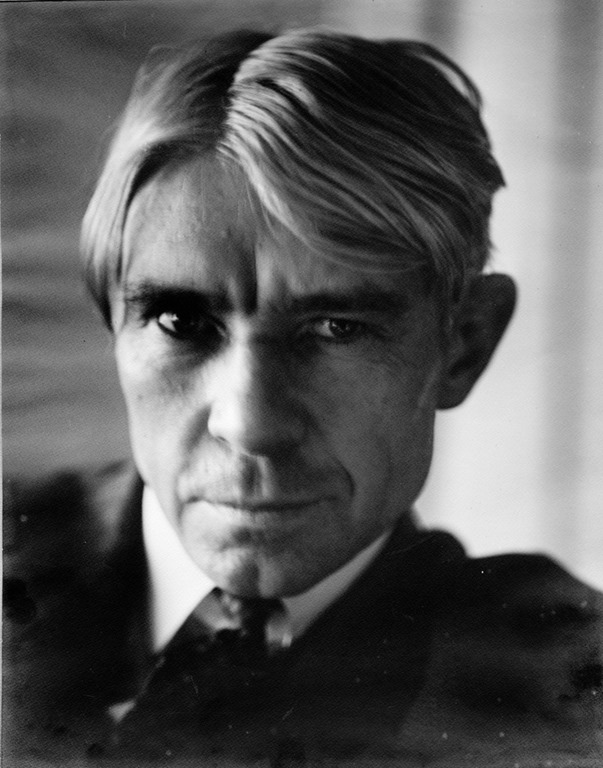
Youn SandburgEzra_Pound_by_EO_Hoppe_1920

Images of Imagists: Sandburg on the left, Pound on the right. You can say that again.

Not all the Imagists were residing overseas however. Back in the specifically American city of Chicago, Carl Sandburg was to combine these Modernist/Imagist precepts with Socialist politics and activist journalism. He worked so hard at this that he essentially split himself into different people. There was Carl Sandburg the Imagist poet who hung out at the then new Poetry Magazine offices, where the poetry discovered by their European Editor, Pound, was funneled into America. But he was also a journalist working for the legendary Chicago daily press portrayed in “The Front Page”.  At the same time, he was also associating with equally legendary American IWW radicals and anarchists, writing for their publications, sometimes under a pseudonym. Was he hiding his identity, or just saying that the agitator was a different personality?

Visualize that American comic-book secret-identify hero, say Superman. By day the “mild-mannered reporter for a great metropolitan newspaper…” by night fighting for “Truth, Justice, and the American Way…” as a crusading radical Socialist—but wait, there’s something more—he’s not just those two, he’s trying to create Modernist poetry as well. And pay the rent. Which is his true secret identity?

Clark Street BridgeClark Street Bridge Today

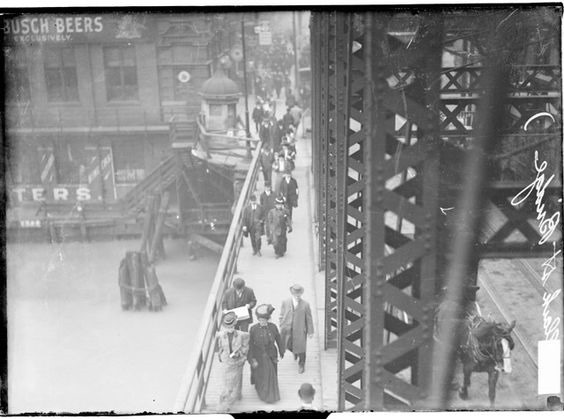
Chicago’s Clark Street Bridge, then and now: “No more dust and wagons.”  Are the voices still unheard?


Today’s audio piece, Carl Sandburg’s “Clark Street Bridge”  is an orthodox Imagist poem by this un-orthodox, tripartite man. The subject “thing” is definite as the downtown Chicago river bridge in its title. Its rhythm is as legato and singing as the absent voices singing at it’s end. It starts with its busy turn-of-the century black’n’white newsreel footage of crammed wagons and walkers, then takes us to the dog-watch night: only three scattered people interrupt the foggy mist and the brightest stars above the urban river. In this mist and shadows, reporter Sandburg takes off his double-breasted suit, but then, stay-at-home Imagist poet Sandburg takes off also his poets’ tights and doublet, and now, naked as a radical above the dark Chicago river he hears the “voices of dollars” in the city’s heartless commerce, the “drops of blood” from the men and women who animate it, and the gigantic chorus of the resulting “broken hearts,” as many as all the stars, as heavily present as the mist, and as unheard as either.

As I’ve often found with Sandburg, others have set his poetry to music, but no matter, I press on. My music for “Clark Street Bridge”  started with an un-relenting long-measure typewriter-like drum part which I hoped would stand for hoof and foot beats. I tried to pair the guitar part and the reading of the words, and finally, I laid a legato bass part underneath it all to stand for those voices softer than the stars and mist. To hear it, use the player below.

The Death of Col Bruce Hampton

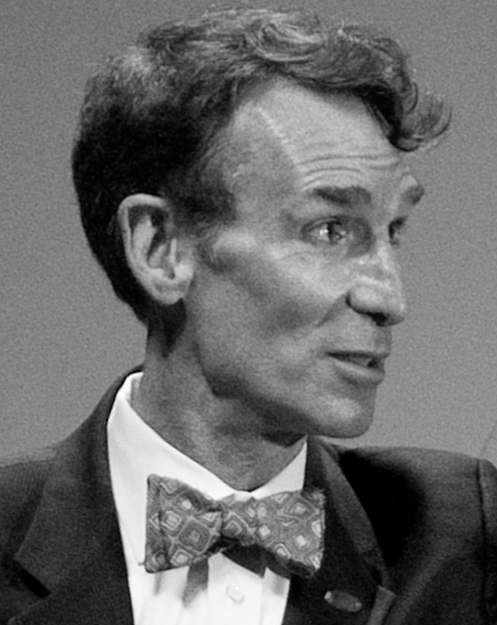
It’s probably one of the best quotes in the history of music criticism: “I’ve heard that Wagner’s music is better than it sounds.” The man who said it was a 19th Century American humorist Bill Nye. No, not the Science Guy, the other Bill Nye.

Bill Nye SG greyscaleEdgarwbillnye

The Nye on the right summed up challenging music in a sentence.


Nye’s great one-liner points out that unfamiliar music may gather approval of those who appreciate its novel approach while leaving a puzzlement as to what pleasure may be derived from it. In the late 19th Century, Richard Wagner’s music was radical. It was heard by many as having stretched the harmonic bonds of symphonic music past enjoyable boundaries. Nowadays Wagner is more in danger of seeming preposterously old-fashioned. He’s just the thing to let you know that Elmer Fudd is a fuddy-duddy when he breaks out into re-purposed Wagner and sings “I Shooot a Waaabittt!” in cartoons. Wagner’s music hasn’t changed, but fashions, expectations and experience have changed.
 
Back around 1970 a band from Atlanta Georgia called “Hampton’s Grease Band” released their only album. The story is told that it sold the second fewest copies ever in the history of their record label, who dropped them right after its release. There are reasons for that. Most cuts were over 10 minutes long. The music was eclectic and the beats eccentric—but what really unsold the record to many audiences were the vocals and lyrics by Bruce Hampton, who rasped like a southern Captain Beefheart with an outlook that mixed Dixie and Dada in quantities you didn’t want to get near enough to the caldron to measure.

This stuff still sounds avant-garde, but Hampton kept evolving after this band’s failure. He self-applied the conventional southern honorific “Col.” to his name, but he always kept a big streak of weird in his music, and by the 90’s another musical movement he helped form made odd music with obscure lyrics and long improvised instrumental passages commercially viable. The usual label for the groups who played this music was “jam bands.”

I could write more about jam bands, but since I need to move on, I’ll say that they were an attempt to invent jazz as if jazz had never existed before. By this I don’t mean to say they were wholly ignorant of jazz or prejudiced against it; what I mean to say is that they created as if they were starting the idea of jazz all over, more or less from scratch. Just as the Pre-Raphaelite Brotherhood thought they could start medieval religious paining all over again or William Morris’ Art and Crafts movement sought to start an artisan practical crafts industry out of nothing, they didn’t seek to learn from and extend the existing practices so much as to do a complete reboot.

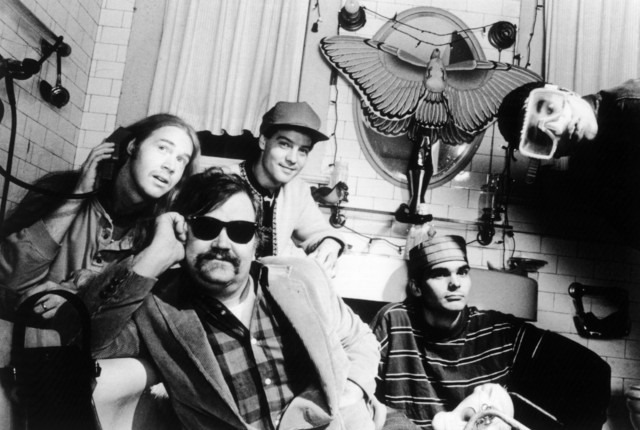
Bruce Hampton and band

Everything but the kitchen sink—ah, maybe we need to include that too.


Now we’re back in the hipster territory that I’ve been discussing in the last few posts. Depending on which generation and which sub-cultural alignment you have, jam bands can be an example of an ignorable genre of music that can only be endured for extra-musical reasons, or an organic expression of music that refuses to be contained and regimented by the formulas of other commercial music. It’s that double-edged nature of the hipster label people throw around as if a label was an analysis. Are they “hip” to something novel that has unconventional value, or are they bogus “-sters” consumed by useless difference for its own sake? And if you’ve read the other posts this month, you’ll realize I’m not just talking about one generation or one sub-culture here.

My guess is that’s it’s always some of both, and the exact proportions cannot be discovered while it’s happening.  Perhaps, like improvised music itself, it has to happen for sober judgements to be made later.

And how can one tell who’s the poser and who’s the sculptor of something new? Persistence is one test. Remember William Blake’s great proverb on persistence: “If a fool would persist in their folly, they would become wise?” Here’s Bruce Hampton on patience and persistence:

I’ve gotten everything I’ve ever wanted – 20 years after I wanted it. And that’s been perfect for me to not get things when I want them because I’m not ready for them when I want them.

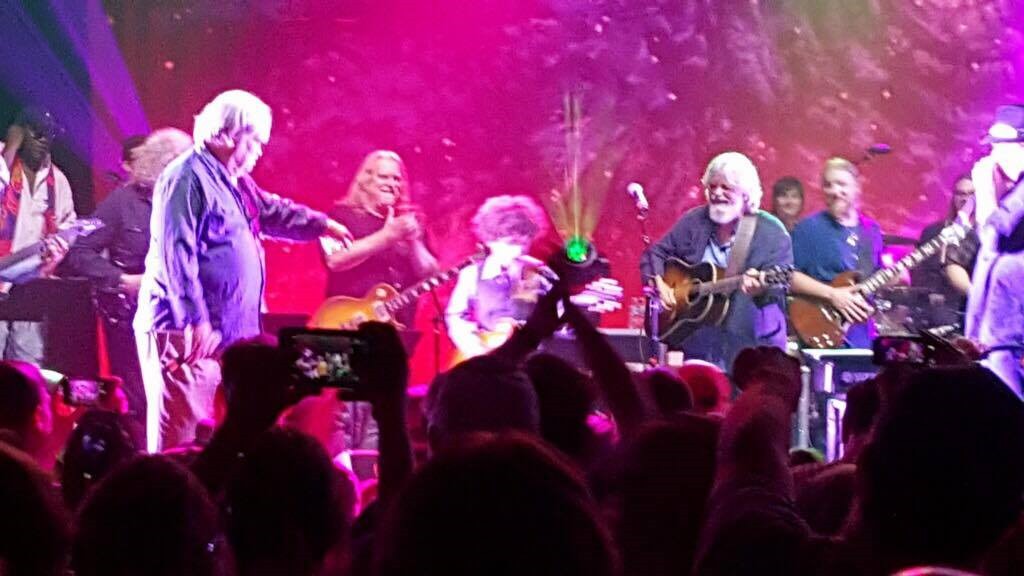
Today’s audio post, “The Death of Col. Bruce Hampton”  presents an sincere account of the unusual death of Bruce Hampton earlier this month: on stage, performing at a tribute to his 50 years of making adventurous music, surrounded by scores of other musicians who learned from him. You may still find his music better than it sounds. He played and sang a lot notes over a lot of time. Some of them were right, and some of them were wrong for the right reasons.

bruce-hampton last jam

Col. Bruce Hampton at his last concert says keep playing


To hear my audio piece “The Death of Col. Bruce Hampton”  use the player below.

Spring Grass

Did I just say it’s been awhile since I featured a piece with words by Carl Sandburg? I started this Sandburg piece early this month thinking it would appropriate for the onset of spring and National Poetry Month. It fairly short order, I came up with the general chord progression I wanted to use, one which is somewhat ambiguous as to key-center (D, A,  F# minor, E, with the cadence generally descending from D, but resolving either the A, the E, or the F# minor, and with a single B minor thrown in).

I liked this musically when I laid down the initial acoustic guitar track of the chords; but I intended to add additional parts to fill out the arrangement, and when I started that, I found I had given myself more of a challenge than I had anticipated. A better orchestrator than myself would have had less trouble I suspect, but I finally came up with something I felt I could accept yesterday.

Carl Sandburg Rocks Out

Carl Sandburg rocks out, no fancy arrangement needed.


If you search for other Carl Sandburg pieces that have been part of the Parlando project, you can see how fond I am of Sandburg as a writer of short poems. For someone who writes generally in free verse, Sandburg’s work has been set to music more often that one might expect. As I worked on “Spring Grass”  I assumed someone else had taken a crack at it, but I put off looking at that to concentrate on my own musical problems. This morning I did some searching and found that there are at least two other settings besides mine, one done by the young Phillip Glass, a composer I very much admire.

Phillip Glass Spring Grass

This guy probably had less trouble with his orchestration.

 
I find one word Sandburg used here intriguing: “spiffed,” which is obscure enough in his poem that I’m not sure what it means. At first I thought it was a nice onomatopoeic sound for the wind horse in the poem snorting gently near the poet’s face—and perhaps it is—but if I read Sandburg’s sentence right, it’s the spring grass smell riding on the wind that “spiffed” the author. Does he mean “spiffed up,” the only idiom I know that uses that word? I’ve never heard “spiffed” without the “up” myself.

Well, the word-mystery doesn’t stop the poem, there’s enough mystery in Spring itself.  Enjoy the rest of #npm17 and keep telling folks about the Parlando Project and our combining of various music and various words in various ways. To hear my version of “Spring Grass” use the player that appears at the end.

2ebruary

I decided on my own that Yeats’ piece in the last post was about February, but I have some other pieces that say, right out, in their own words, that they are about our current month. Here is one, “2ebruary.”

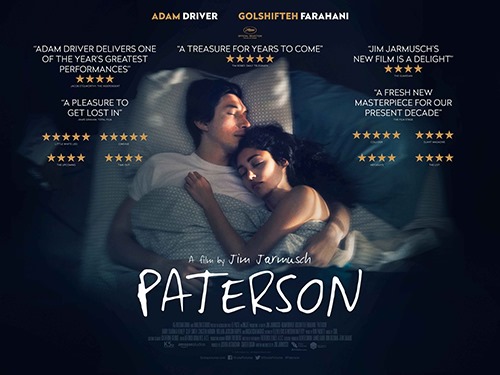
Earlier this month I saw Jim Jarmusch’s film, Paterson.”  This movie succeeds, in its modest and appropriate way, to do something impossible: to film poetry, or more exactly, the composition of literary work. It does this two ways: by having a writer, its central character, portrayed as a regimented, routinized person, grounded in a particularized working-class city and job; and then by having him compose “aloud in his head” his work against this background.

Paterson Poster

this movie has no light-sabers

This is a wonderful choice. The city, the routine clock of the days, the job, become the metrical, musical background for the flowerment of the writer’s consciousness that becomes the poems.

Though the movie is set in the New Jersey city of it’s title, the filmmaker refers often to the “New York School” of poetry, using the poems of Ron Padgett to stand-in for the work of the film’s main character.

The New York School uses a lot mid-20th Century Modern ideas, combining them into various combinations, depending on the individual writer associated with the movement. Some of it can be obscure and abstract, taking off from the same ideas that launched abstract expressionism in painting around the same time. But some also find a tenderness and wonder in the abstract patterns of urban existence, a Pop Art with a depth beneath its surface able to hold a beating heart.  At a point in the film, the main character opens his noon lunchbox to eat, and to write down the intermediate state of his morning’s writing aloud in his head, and there like a Thermos, nestled above an orange and a sandwich, is Frank O’Hara’s “Lunch Poems.” It has to be there.

Lunch Poems Cover

Don’t loose your Lunch Poems

O’Hara wrote in a great many styles, but this slim chapbook features several poems that someone once called his “I do this, I do that” poems. where O’Hara walks about, seemingly composing aloud in his head amidst daily tasks. These are my favorites, because, like “Paterson,” these poems seem to be about their own grounded creation in a city of routines, reflected inside the moist, encased, flowing mind of their writer.

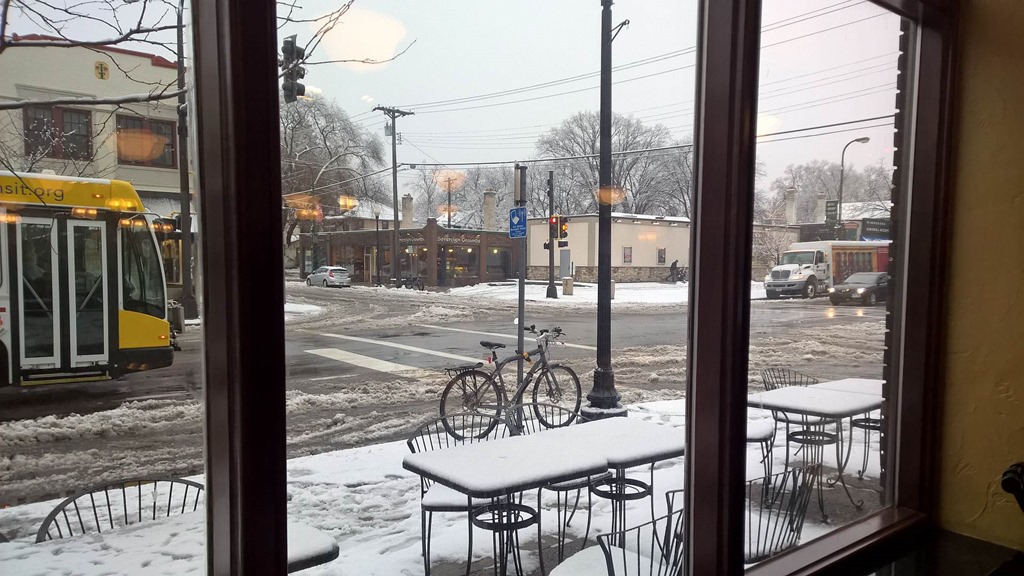
Today’s piece “2ebruary” takes off from that Frank O’Hara mode, as I often like to do, though I’m an old man, writing in another century, in the Midwest, not New York City, and my old joints creak best on a bicycle.

Schwinn IG5 outside Turtle Bread in Winter slush smaller

a scene from today’s piece, breakfast not included


“2ebruary” is a short bicycle journey thinking of history, and past the events that are turning into history that we can still change. I take a pause, as every American should, to note that American culture is made from those who came here carrying something from elsewhere. And Midwestern culture? For many, those packing trunks are hardly great-grandparent’s-age-old, at the eldest.

At one point in the journey, I note those that had no trunks when they came to America, they had only their chattel bodies and souls—and even of those two things, the former had been appropriated by others for handy profit. What could they unpack? Well for one thing: the largest and grandest part of our American music. Our history is short compared to many nations, but it contains mighty things like this. We who are joining that history, already in progress, can turn it one way or another. Which way do you choose to turn?

To hear the LYL Band perform “2ebruary” use the gadget below.