The Wood-Pile

Robert Frost is every bit the master of word music as Yeats and Millay. What makes Frost stand out is that he was every bit the thoroughgoing early 20th Century modernist as any of his free-verse contemporaries, while retaining an ease with accentual syllabic meter.

Here’s an example of Frost handling a subject just as a free-verse Imagist would. His aims, his presentation, hold to the Imagists’ principles. He deals with the thing directly (as we shall see, two things, but still…), and there are no tacked-on metaphors, no stock comparisons, no extraneous “poetic” language. Context is shown, but not explained. He loosens and varies his meter, so the poem sings and never seems to be a shackled march. At 40 lines, it’s a bit longer than Yeats’ poem considering “The Wild Swans at Coole,”  but Frost’s extra detail is even more specific and concrete than Yeats, though both begin their poem with the poet walking in a rural wetland. Yeats slough is a well-known place to him, conditioned with 19 previous visits. Frost is far enough into his swamp to not know exactly where he is, and so experiences what he sees with a first-time immediacy. Yeats’ slough then contains tradition, Frosts’ the more Modernist “Make it new!” place.

Though presented as one simple rural scene and story, “The Wood-Pile”  is more at two poems, though each part speaks to the other. As Frost’s tale starts, we are in the midst of one of his characteristic journeys, just as we are in other famous Frost poems. There’s a need for decision (“Turn back” or “go on farther”) and his choice, also made in other Frost poems, is to go on regardless of whatever doubts brought the question. If he’s lost in the dark by a wood on a snowy evening, keep going. If you come to a fork in the road, pick one and go on. If you’re walking in a swamp in winter and your foot is sometimes falling through the frozen crust, well, keep going “and we shall see.”

And so, here he sees his bird. No Keatsian nightingale, not Millay’s elusive flying swans with their awkward dangling legs and cries, nor Yeats’ majestic 59 swans, but a small bird. This bird becomes a mirror to the poet. Frost’s bird too must make choices in direction, and the poet, sensibly, thinks the bird’s guided by fear. “Keep something between little me and the big lummox trodding through the winter swamp,” he humansplains. And there’s a bit of humor at human’s expense as the poet muses that the bird, like humans with their self-importance, may think that the only reason for Frost to be out in the swamp is to go after the little bird.
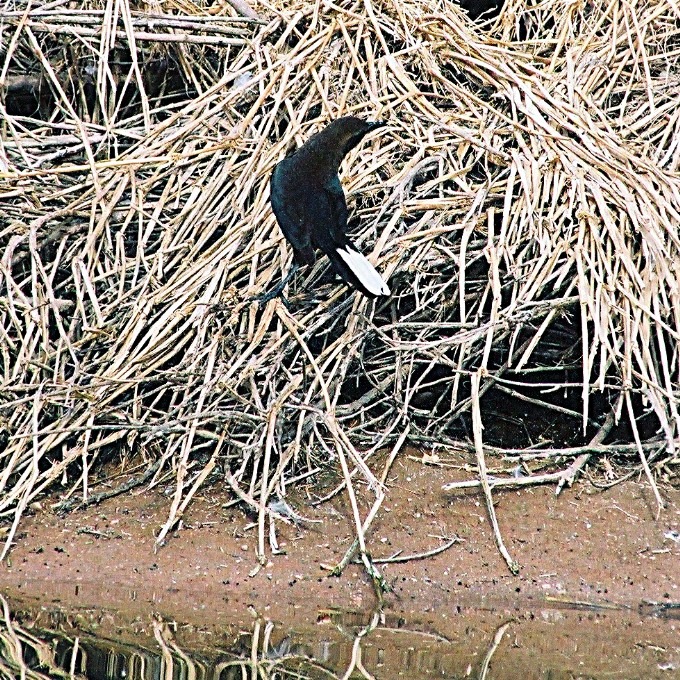
Gackle with white tail feather

“He thought I was after him for a feather—the white one in his tail”


But, we don’t know why Frost is out in the frozen swamp explicitly. The only reason he’s given, or will give, is the Imagist poets’ reason: “and we shall see.”

The bird leads Frost to the second thing the poem wants to present: an abandoned fire-wood cache. Here Frost zooms in close. Every detail of the cut wood and the once neatly stacked and propped wood-pile is stated. Frost turns forensic, like some New England Sherlock Holmes: this pile has been abandoned for years. Mature vines have grown through it.

wood-pile

“The slow smokeless burning of decay”


Here is another context left unsaid. Why would someone abandon a purposeful wood-pile in a swamp? Frost leaves it for us to be detective and to solve the mystery. This isn’t some lot of fire-wood left temporarily to be gathered later in the day, care has been taken to stack and prop it.

The only thing I can think: someone once built a shack (now completely disappeared) on the swamp land. Frost muses, sardonically, that only someone so busy with “fresh tasks” could abandon such effort in cutting and stacking. Does he mean to say, “only a fool would be so industrious to cut and stack this wood and yet not notice he was building his shack on a swamp that would not support a homestead?”

Now, the small bird with his “little fears” and oh-so-human misapprehensions of reality—and now, the steadfast Frost of miles to keep going, even if you may be lost, are set in contrast to this choice. Your fears may lie to you—but so will your optimism.

I once heard an astringent biological statement that the length of our lives can be reduced to a slow-burning chemical reaction. Frost’s last line here is a sad and beautiful analog to that truth.

Turn back or go farther? Go on, and we shall hear my performance of Robert Frost’s “The Wood-Pile”  with my original music. Just use the player below.

A Dust of Snow

Here’s another winter poem by Robert Frost to put to our uses. Writing about my last piece here, Frost’s “Stopping by Woods on a Snowy Evening,”  I wondered about the actualities of the scene the poet was describing: a New England winter road in a dark snowy evening before the coming of rural electrification. Frost would know, of course, that it would be quite dark in those conditions. But did he use that knowledge when he wrote the poem? Did he, the author—like I did as a reader once (despite knowing too the darkness of rural night)—visualize a well-lit snowfall on trees, an alluring and beautiful sight that might tempt him to stay and watch for a while?

I can’t say for sure.

Frost’s “A Dust of Snow” is even shorter, and the accepted meaning of its images has been a settled thing for some time. Last time I wondered if “Stopping by Woods”  was more a poem about a man who was lost in the dark in both levels of meaning rather than a man who was tempted by bright beauty. I could have been wrong, but I think it’s worth considering. With “A Dust of Snow”  certain images have been determined by most academic readers to be, well, symbolic. What if we consider them as real, natural objects and not as handy metaphors?

Robert Frost with axe

Let’s cut down on our use of overdetermined symbols with Robert Frost

We start right off with a crow. “A symbol of death” it is said. Perhaps it doesn’t hurt the poem to think that. I think it’s a crow. A dark bird, darker yet against the snow, and no crow would let the poet that near without a racket of loud caws. The poet doesn’t let us hear the caws though. Instead, like the uncanny sound of sifting snow in “Stopping by Woods,”  Frost wants us to feel just a dusting of snow falling from the branch as the bird flaps off. He wants the main action in the poem to be almost microscopic. He could have written that the bird’s takeoff “dumped a pound of cold slush down my collar”—but that wouldn’t be the poem he wrote. Is the dust a symbol of death too? Or is it an image of a tiny action of little weight? I hold to the later.

Oh, and symbol alert! The tree the bird left is a hemlock tree. Or as the movieReal Genius  reminds us in “the immortal words of Socrates, who said: ‘I drank what?”

How aware was Frost that the American Hemlock is a pine tree and the European poison is a completely different, smaller plant? If this were written by the avid amateur botanist Emily Dickinson, we’d know the poet would know this. Even William Carlos Williams M. D. might have need to know about the derivations of poison. Like the crow being “death” or a bird, “hemlock” could be a reference to death or suicide—but the evergreen is also a symbol of life in winter too, if it must be a symbol. Frankly I think either taken in a one-to-one direct simile way may overdetermine the poem. In the book of nature, having a black bird against white snow causing the small, light amount of snow to fall from an evergreen tree is sufficient.

And this snow falls on the narrator of the poem, and the small sprinkling of snow lifts the rueful mood. I think that’s the essence of the poem: the smallest action of nature, a flighting crystalline snow sprinkle that may not have weighed an ounce, can lift a human out of their dense internal fixations. I think that’s a more graceful poem than the leaden march of death-crows, grave-dust snow and poison trees. I could be wrong, but I like that poem better.

Musically, a much simpler arrangement than last time, just a bass and 12-string guitar. I’m trying to carve out time to prepare for some more recording with the LYL Band tomorrow. Even if we are successful, you won’t hear those pieces for some time, so use the player below to hear “A Dust of Snow.”

Thanks again for the likes, comments, and the sharing of these pieces on your blogs or on social media.

The Red Wheelbarrow

Obscurity in modernist poetry is a funny issue. What makes some writing hard to grasp, difficult to understand? Esoteric and little-known words like Wallace Stevens loved? Far-flung allusions to works in several languages like T. S. Eliot was prone to? Exploding normal written syntax and logical flow as Gertrude Stein did? Taking images into realms where direct one-to-one symbolic meaning is not only impossible, but more than likely, not the aim, as Tristan Tzara or Paul Éluard demonstrate? Presenting things “slant” in iconoclastic riddles as Emily Dickinson could? Writing works of epic length that few if any human minds can comprehend in their whole, like the Cantos of Ezra Pound?

And then there’s this poem, the basis of today’s piece, William Carlos Williams’ “The Red Wheelbarrow.”

The Red Wheelbarrow

The whole of it: 16 words, no punctuation, all lower-case

From empirical evidence you could say that it’s the very peak of the canon of modern American poetry. Remember that compiled count of the poems that appeared most often in poetry anthologies, most of which were explicitly focused on modern American poetry? “The Red Wheelbarrow”  is alone at the top of that list, included in over half of the anthologies counted.

Does that make it a “best loved poem”? Does it even assure that critics consider it great, much less the greatest? No, it does not. I think I first ran into it as a teenage student, in one of those anthologies used in some English literature class. Did my young teacher point it out as a poem of special merit? Did I view it as such? No. If I can trust my memory, if it was discussed at all, it was as if it was some kind of stunt, an intended provocation that so short and mundane a piece could be considered artful. “Now class, let’s get back to T. S. Eliot and Wallace Stevens.”

And how about critics? They largely part like the Red Sea on “The Red Wheelbarrow”.  If we look to one side, in among the mollusks and manta rays now behind the water curtain of the divided sea, we find those who care little for it. There’s nothing there demanding to be written about. No virtuosity is demonstrated to be noted and admired. And what important point is it making, other than, well, no point at all?

So, we turn to the other side, those swimming with bemused dolphins who wonder if they could leap across the band of Israelites walking on damp seabed, those critics hoping to demonstrate their microscopic perception of the hidden art in this terribly short and compressed poem. Carol Rumens is concise and representative of this when she says of Williams’ poem “This is his manifesto, surely–a poem quietly declaring how modern poetry works.” And she also warns “A naïve reading could take it as a comment about the great usefulness of wheelbarrows on small-holdings where chickens are kept.”

And then, here I am, now. No longer the teenage student who was sure someone had figured these things out, and I need only to find them. I can’t see far enough ahead where Moses and Aaron are, nor can I see far enough back how close Pharaoh and those charioteers are getting. I’ve got my hasty bread and a few grabbed things in my little cart, pushing it across the mud. I think I must be naïve. Yes, Williams is a modernist, as committed to the new way of writing as clearly as possible, a proclaimer of “No ideas except in things,” which means in retrograde, the things must be the ideas. If he had wanted to write a manifesto, he could, and did in the other poem that stated that dictum.

The obscurity in this poem is that there is no obscurity other than what we bring to it externally. There is no allusive, secret meaning, other than the secrets we’ve kept from ourselves, of our tools and our companion responsibilities.

Yes, there is art in these 16 words: the line breaks that ask us to hold our gaze, even in the middle of words, the “so much depends” warning that bids us look. The choice to look at just these simple common things, is a choice, is an idea. I think the dolphin side of the parted sea has smarter companions than the mollusks’ side; but I am looking down at my wheelbarrow, and Williams’ wheelbarrow, and saying naively, that it matters, even if I’m in the middle of the band, unable to see Pharaoh or Moses.

I’ve spent too long on the words again, but I feel I need to say a bit about the music I composed for my performance of “The Red Wheelbarrow.” I chose to use a twelve-tone row, a modernist musical idea from the same time as when Williams was writing the poem. It would be pretentious for me to say I got this from deep study of Schoenberg or Webern, though I’ve listened to a good deal of modernist music. However, “serialism” never stuck with me until I heard the prologue part of “This Town Is a Sealed Tuna Fish Sandwich” written by Frank Zappa. I’ve loved that piece from the first time I heard it.

Twelve-tone music subverts expectations of a tonal center or “important” scalar notes, so it can sound a little woozy or random, but, of course it has its pattern, by definition, which the mind’s ear can hear if you stop thinking in expectation of familiar patterns, which is the simple and profound thing it is asking you to do.

For those who’s blog readers can display it, you can click on the player to hear my performance of “The Red Wheelbarrow.”  No player visible? This highlighted hyperlink is another way to play it.

The Emperor of Ice Cream

I was reminded of this poem, and Wallace Stevens in general, while writing about the 20 most anthologized modern American poems recently. It’s odd that I needed to be reminded of Stevens. His poems were always present in the anthologies of my school years, back in the last century, along with Frost (who I disliked when I was young), William Carlos Williams (who I didn’t understand), and Eliot (who I liked for his verbal music without much understanding). There must have been something about Stevens that attracted me, as when I recall the poems I wrote in my youth, they more often looked and sounded like Stevens than those others. There’s a wit of a very contrarian kind that’s all over Stevens’ work, so I’m sure that was a big part of it, but I think it was also Stevens’ verbal music that pulled me in, and unlike Eliot’s, I (subconsciously) imitated Stevens.

I later read that Stevens walked to his famously conventional job as an insurance executive every day, and composed his poems in his head as he walked. This makes sense, as I did the same thing, with the two-footed meter of walking informing the rhythm from the soles of the feet up, rather than from the head down. Another thing about writing while walking: the music of that rhythm carries you into a more hypnotic and subconscious space were lines that sound good and fit to the beat are carried and held into memory more than carefully considered phrases that one would compose at the keyboard or with thoughtful pen in hand—and that same flow can knit together the unlike before thought can reject it.

If you take Stevens’ particular perverse wit, and meld it with composition of poems while walking, you have the recipe for a Wallace Stevens poem like this one.

The title of “The Emperor of Ice-Cream”  has that impish quality. It seems to be light-hearted. Who’s his consort, the Dairy Queen? Is his uncle the King of Burgers? Did he know Prince? Queen Be? Duke, Duke, Duke, Duke of Gelato. And the poem starts off as if we are in a variation of the nursery rhyme “Old King Cole, he was a merry old soul” by calling for the strongest man to crank the ice cream maker.

A digression: do 21st Century people even know what an ice-cream maker is? It’s a bucket, no larger than one used to mop the floor, filled with ice that surrounds a smaller metal canister with a hand-crank-driven paddle screwed into the top. Salt is poured onto the ice, melting it so that it can get the canister colder than zero centigrade, as the crank is turned to churn the mixture of sugar and cream. As the process continues, the contents of the canister thickens and the force needed to turn the paddle increases. Even with a strong man cranking, the resulting ice cream will be softer than the concrete brick of modern ice cream, as that is a creature of refrigeration unknown in Stevens’ youth; but the cool, rich, sweet taste would also be all the rarer then too.

Ice Cream Maker Ad

“Call the roller of big cigars, the muscular one” churning that 2 gallon one would take a mighty man


So back to the poem. We have the strong cigar-maker man churning, amidst young, common, unmarried women and boys bringing flowers. The resulting ice cream demonstrates Stevens comically expanded vocabulary, it’s “concupiscent,” lustfully good!  Freud may have famously insisted that “a cigar is sometimes just a cigar,” but a multitude of Blues metaphors contemporary to Stevens would agree, this is a lusty scene.

And the title reappears. Pleasure, broadly drawn, is the ruler of all!

So far Stevens has only been perverse in the weird “Old King Cole”  language of the revelry, capped off with a word that most of us can’t even pronounce, much less spell or define.

Bang! Into the next stanza. I had always thought “dresser of deal” was flowery poetic diction for “we need to deal with” the situation in this next scene, but it’s more of Stevens’ vocabulary quiz. “Deal” is an archaic term for cheap pine wood. The exquisite detail of the missing drawer pulls, so much like the shabby second-hand dressers of the bedrooms of my pre-IKEA youth, yields to the fullness of the scene: it’s a room with a dead body.

Digression again: my son bursts into the room where I am writing this. He has just heard a robocall barking “If you or your loved one is over 65, they have a 1 in 3 chance of falling. Don’t let that fall be their last. Press 1 to…” He’s laughing, and continues “…hear about our warning-thingy scam…”

I follow on with my additions “…and press 2 if you want him to die anyway since he’s not allowing you any screen time today….and 3 if you are hard-of-hearing and WOULD LIKE US TO REPEAT THIS MESSAGE LOUDER.”

Back to the solemn dead body, cold and dumb, being covered with a sheet from the dresser of deal that is poignantly too short to cover the feet. Stevens leaves the light on, we need to see this clearly. And the title returns, now a refrain, and in this new context, the ruler of all offers only fleeting pleasures that one strives for, passes through, and melts away. The poem ends.

Stevens arrives at the insurance company offices. He strolls in past the receptionist, arrives at his office. Warren G. Harding is President. He asks his secretary to take this dictation. Obedient to her accustomed role, she folds back the steno pad, pencil in hand. Did she care for his poetry that she transcribed? That would be immaterial, she has only to listen.

Wallace Stevens Walking

Strolling Wallace Stevens in the 1920s. Cane in one hand, thesaurus in the other?


Two scenes. Two passing stations on a walk perhaps, or a flight of memories as lines emerge along steps. Only one more perversity to note, a puzzling line that looks like a typo: “Let be be finale of seem.” Let the steps the author is taking when he wrote this be our guide. One stride: “Let be”, then a double-time step: “be finale,” another step: “of seem.” I had never figured this line out, but someone on the Internet named Daniel E. Burke pointed me to this letter Stevens wrote in 1939. If Stevens had caught a crack in the sidewalk causing a hitch in his step, the line might have been more clearly composed as “Let being  be the finale of seem,” but the Hartford sidewalks were too-well maintained, and Stevens never cared to be understood anyway, only listened to.


I had meant to write more about the music I composed for this one, but I’ve run way too long again. I wanted prominent drums to represent the flow of time, a cello to represent the melancholy death thread and a jaunty acoustic guitar part representing the swiving partiers of the first part. Assessing the performance I first thought I should redo or remix it to keep the cello and the guitar to their respective stanzas, but then I rethought that too. Shouldn’t they both be present in each scene to give the flavor of Stevens’ perverse combination? To hear my performance of “The Emperor of Ice-Cream”  use the player below.


The Death of Richard Wilbur, A Difficult Balance

It was only days ago here that I was remarking that Richard Wilbur was still alive while talking about the roughly half-portion of dead white men in a collated list of the most anthologized modern American poems. His poem “Love Calls Us to Things of This World”  written in the middle 1950s was one of that list, and one of the few I had no memory of having read.

Richard Wilbur 1950s

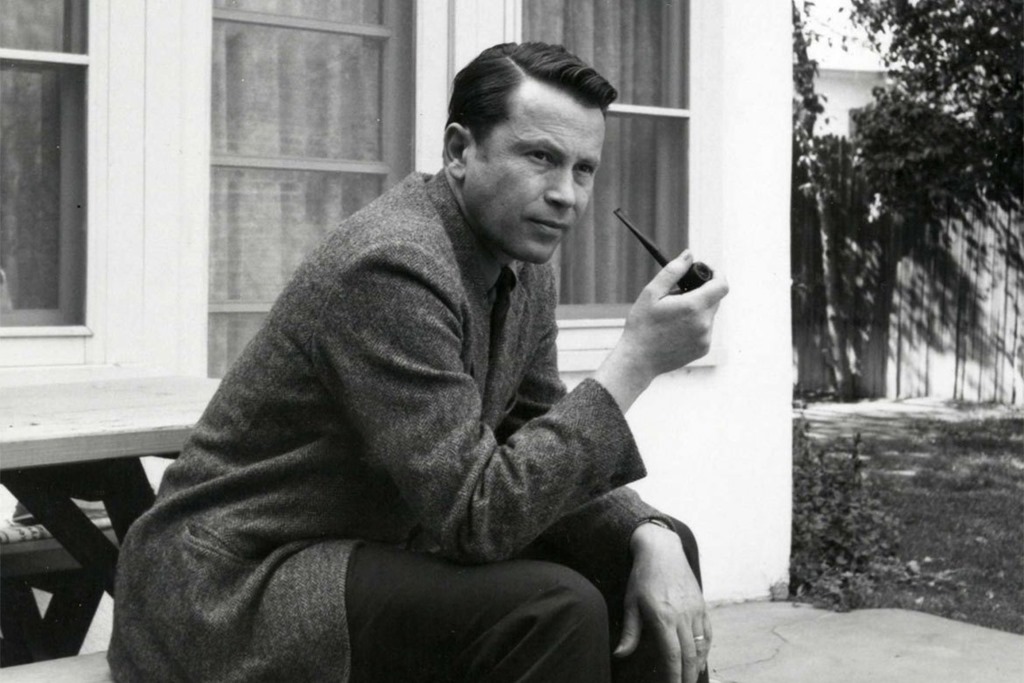
The modest house, the pipe, the tweed jacket, the Brylcreem hair with the straightest furrow—
Richard Wilbur impersonating the 1950s so that we don’t have to


So of course I read it, and rather enjoyed it. You could do the same via the hyperlink. There are a few things in it that one might quibble about, the heightened language (even if that is undercut by its over-riding conceit, a meditation on hanging laundry) including words that stop the modern colloquial speaker, such as “halcyon,” and the brief but passing use of rape for an image which causes me a concerned pause and objection now. There need be nothing censorious about such thoughts, as they are about the writer with his peculiarities, his time, and his blinders. They might remind me of my own limits in these regards.

The obituaries point out a controversy over Wilbur that, like his poetry, I was not much aware of. He was increasingly thought out of touch with the later 20th Century with his, on the face of it, impersonal outlook, his wit in place of rage and heated vision, and his devotion to a classic verbal music of accentual/syllabic meter.

All that may be so. Like I said, I’m generally unfamiliar with Wilbur’s poetry. But let me bring up some possible approaches from our current century, now nearly matured to voting age, to query those opinions from the 20th Century. The first is, how much do we need our poets to act as the shaman and feel for us?  Does such a need say that we ourselves cannot feel or imagine adequately, or that we cannot validate or understand our feelings and visions until demonstrated by the artist? I do not know a complete answer for this. I know that artists expressions seem to have helped me clarify and understand visionary and intense things, but I also think that the lens of wit makes clear the limits of our perceptions and emotions. Is the ecstatic visionary who can make real and palpable the dark shapes outside the fire-circle the wise one, or is the wise one the one who sees clearly that we cannot see far into the darkness and are apt to stub our toes on rocks if we think otherwise? Can only the former move us to action, can only the later keep us from recognizing foolish action?

I don’t think I know the answers, though I do think I see some of the questions. Just yesterday I wrote about how one of the  Parlando Project mottos “Other People’s Stories” shows a paradox. I feel it’s interesting—no, I’ll go farther—it’s important for us to experience other people’s subjective experience, to inhabit it to the degree we can. To do that, I’ve chosen to predominantly present other writers’ self-expression here—but to do that, I rely on others who interestingly express their own subjective experience. So, in a sense, I require others to not follow one of the principles that my artistic project goes by.

That brings up another Parlando Project principle: “Various Words with Various Music.”  Does not soft and consonant music not sound softer and more consonant when considered in the context of loud or discordant music (and vice versa)?  To fully have either, you must have both. Wilbur may have seen enough darkness to look for truth where the light is, to try to see, as his poem “Love Calls Us to the Things of This World” concludes, a “Difficult balance.”

The Most Anthologized American Poems of the Modern Era

Here’s a list of poets and poems, along with the year they were written:

Top 20 Poems List


OK, you probably already read the title of the post, so you know what they are.

This list comes from an article I bookmarked this summer that intrigued me, and today I returned to it because I’m thinking a bit about “The Canon”—those poems and poets that are judged by some generalized panel of experts as being worthy.

The whole The Canon thing is full of controversy, with complaints that it doesn’t include enough of what some favor in terms of poetic expression, or that it’s too-much a dead white man’s club; but part of what makes that discussion worthwhile is that The Canon is how almost all of us got introduced to poetry as an adult practice. Somewhere in our school years, we will be asked to open a textbook, and there on the pages will be some “great poems” that we will be asked to grapple with. Some of us will be puzzled that we can’t figure out how to do the sums of what these poems mean; and some of us will want to emulate them, to steal a little of their vision of existence, and some will hope to someday gain for ourselves something like that esteem in the eyes of others, to be, in our words, on a page in an anthology.

Sure, we may have already encountered nursery rhymes, Dr. Seuss, and perhaps some song lyrics, but these poems are the adults, writing the adult things. Poetry sections of literature classes can be as fraught with adolescent frisson as sex ed.

The article I was intrigued by was written by Emily Temple and posted on Lithub. It’s a painstakingly counted-up list, collated from twenty anthologies of poetry. The selection of anthologies has some problematic focus: half of them were specifically focused on American poetry, and nearly half (eight) were anthologies of modern or contemporary poetry. Still, the work to make this list must have been considerable, and I don’t know any similar, but better, efforts to use instead. For this post, I’ve decided to take even more shortcuts, over and above relying on Temple’s work, so bear that in mind.

I’m going to focus on the “Top 20,” the poems that appear in nine or more of the twenty anthologies. While this doesn’t eliminate the anthology-weighting to modern Americans, I think it means that these 20 poems and their authors are safely in “The Canon” as constituted in our current century. Here are a few scattered, short, observations about these most of the most anthologized modern American poems.

I had read and/or remembered reading all but three of the poems. (“Musee des Beau Arts,” “Skunk Hour,”  and “Love Calls us to the Things of This World”).  I suspect anyone who’s been interested in American poetry for a few decades would come in around that.

I sometimes worry that I’ve concentrated here too much on works from the first quarter of the 20th Century, and particularly those connected to the “Imagist” revolution in the center of that time. From this list, I shouldn’t. Nearly half the list (nine) is from this period, and if one was to play the “Kevin Bacon game” with Ezra Pound concerning these, your number is always zero to one, or you’re Wallace Stevens. I use so much from this era because I have trouble even finding the time to seek the rights to present a piece still in copyright, but also because I happen to find that era fascinating—and it turns out as far as modern American poetry is concerned, it’s still the core of The Canon.

However, even though the Parlando Project is closing in on 140 pieces, we’ve only done two of these top twenty poems (“The River Merchant’s Wife,”  and a small portion of “The Waste Land.”)

What era other than the Teens and Twenties of the 20th Century was over-represented? The Fifties, four selections, and you could consider Gwendolyn Brooks’ 1960 “We Real Cool”  sneaking in as a fifth.

Dead White Man’s Club? Not as bad as it was when I was in school. Not Dead White Males: 7 out of 15 authors if I count William Carlos Williams’ second-generation Puerto Rican heritage and don’t count that Richard Wilbur, though white and male, and still alive. The Canon is always historical, always trailing the contemporary. It’s not 7 out of 20 because five authors had two works in the Top 20. If someone does this article in 2117, or even 2067, I wager the pale dead males will be less than 50%. This is an easy bet (I won’t be around to collect from after all) but also because if we take the short-term acclaim of literary awards for new work in the past few years, I informally believe we’re already at that level. I know some will object to even mentioning these distinctions for various reasons. That’s a big topic, another time. If one wants to make an argument for tokenism from either side of that debate, that only the white males got double selections in the Top 20 would be your data point.

UPDATE:  not to belabor the White Males count, but as I pointed out when we presented “The River Merchant’s Wife” back in July, the authorship of that poem in a complex subject. It is  a translation of classical Chinese poet Li Bai. Pound’s Chinese translations are acknowledged to be of the looser variety however. If we split that one 50/50 we’re halfsies on White Males.

Here’s one that was interesting to me as I think about another issue: how old were the authors when the wrote their “Top 20 poem?” Go ahead, guess….

You didn’t look ahead, did you?

I guessed low. I was of the impression that poetry was a young person’s game, and many of the poems I’ve used here were written by authors below the age of 30. Turns out the average was a fraction over 40 years old, with Elizabeth Bishop at 65 and Wallace Stevens for his second selection at 75 making appearances for the Medicare set. The youngsters? Eliot at 27, Pound at 28 and 30, Auden and Moore at 32, Dickinson and Plath at 33. One oddity? Despite the average of a bit over 40, no one wrote a Top 20 poem in their 50s. If you’re under 30, don’t despair, as I did, thinking “John Keats died at 25, and what have I accomplished.” If you’re a poet in your 50s, consider a career in the insurance industry and plan on being Wallace Stevens.

This is another of the posts here that I’m tagging “About” that are not occasioned by a new Parlando Project audio piece. For those who can’t wait for the next piece mixing various words (mostly poetry) with original music, here’s that “included in 10 out of 20 anthologies” hit “The River Merchant’s Wife: A Letter”  done up Parlando Project style. Use the player below to hear it.

At a Window

I was ready to post this new piece, Carl Sandburg’s At A Window,”  early yesterday when I had one of those days that come to challenge artists. Artists less fortunate than I can perhaps point to a single thing that holds them back, but with myself it’s often several smaller things.

I’m a habitual early morning reader of the news, a rhythm that may have started in my earliest teens when I delivered newspapers before school and continued through night-shifts in hospitals where I’d read the papers as they came out in the predawn hours. Nowadays, it’s not the papers I turn to for news, but Internet newsfeeds, and the pre-dawn hour was filled with the reports of another mass shooting profaning music, this time in Las Vegas. These events hurt me because I often spend as spend as much of my day as I can carve out making the music here in combination with the words that I combine with it. One of art’s purposes in my mind is to allow us to set aside momentarily the real consequences and strictures of life. Not necessarily to escape them—in fact, many times art allows us to examine them so that we can treat them as the reality of what they really are, because those strictures, even things we fear most, have their limitations, just as we do. And art can be the “R&D Department” of the soul and the repair of the world.

Thus, the hurt when those borders are crossed. Thus, the feelings of one’s work in an inadequate field.

Of course, my feelings on this matter are a small and abstract hurt, compared to the suffering of those more directly impacted. Small things closer to my heart feel larger than great things farther away. This is one of the limitations of our perception. Then my day continued with another unrelated hurt, closer yet to my heart, and I was reminded again of my limitations and imperfections.

Real hurt seems so large, art seems so small, and I feel like a poor worker in a field of playful trivia.

Which may be so, the limits of my perception may not be able to tell. However, I believe this is a common feeling for artists to have, and so if you create art, you may also have felt this. We try to do so much, and all we can see is so little. This is part of why the Parlando Project principle: “Other People’s Stories” has value. Speaking the words of others helps me by adding what their eyes and hearts have seen.

SONY DSC

“He is an observer with sympathy but without fear”

This morning, it turns out that Carl Sandburg, in the very piece I was working on this previous weekend, “At a Window,”  was speaking to this experience, though in my down-heartedness, I couldn’t hear him for a while. This short poem, appearing first in 1914 in Poetry  magazine alongside his “Chicago, hog butcher for the world…” poem which will overshadow it, waited patiently to speak into my ear. What good could a more than a 100-year-old poem have for me?

Poetry Magazine March 1914

Eight poems of Sandburg’s Chicago Poems debuted in this issue.

“At a Window”  says that even in shame and failure you must hunger for even more of the same. In the context of the sampling of Sandburg’s Chicago poems, which spoke so frankly about the situation of poor and working-class Americans, I think that window in the title means so many things. Yes, it means there is an imperative to look outside oneself as an artist. The dusk and shadows out the window lets one see little, but one must still look.

Will there be any consolation? Sandburg apparently had such consolation in his spouse, who championed his work, who he speaks of in the “Leave me a little love…” section. Perhaps you have such a champion in your life, perhaps you don’t. We are called in “At a Window’s”  conclusion to look out the window anyway. Perhaps the one who comes walking out of the dusk is yourself, to champion someone else?

To hear the performance of Sandburg’s “At a Window”  use the player below, and thank you for listening.

It Is a Small Plant

September 17th is the birthday of the American Modernist poet and physician William Carlos Williams, and today’s piece uses the words from one of his poems “It Is a Small Plant,”  the best known selection from a sequence of poems Williams called “The Flowers of August.”

William_Carlos_Williams_passport_photograph_1921

Just because you have have a passport doesn’t mean you have to move overseas.


Unlike some other American Modernists—including two poets he met and befriended while a student at the University of Pennsylvania, H.D. and Ezra Pound—Williams spent most of his formative writing years in the United States, much of it in his native state of New Jersey where he practiced as a pediatrician. Like his fellow stay-at-home Modernist Carl Sandburg, Williams wrote poems the followed the new Imagist rules, at least at the start, finding them useful in breaking away from the old poetic styles.

One of those Imagist rules, the first one in fact, was “direct treatment of the ‘thing.” That doesn’t mean that you just directly state the message from your heart. Rather, it means that you honor and hone the image(s) that represent your meaning as palpable thing, not as mere poetic decoration for your words. “It Is a Small Plant” demonstrates that by spending nearly the entire poem presenting a description of a flowering plant.

In the series “The Flowers of August,”  each of Williams’ other poems are titled with the name of a particular meadow or pasture flower, but not this one. So, I suspect this is meaningful. The description of the flower here sounds a bit to me like the common bluebell, but it’s possible that he diverged from botany in service of one of the poem’s images, or that the omission of the flower name in the title for this poem made a point for him.

The other, more important, mystery is who the “her” that is inspecting the flower with the poet is, the her who regards the subject flower as “a little plant without leaves.” At first. I wondered if it was perhaps a young girl looking at the flowers, but I now believe that it’s the “her” featured at the poem’s close: summer. If that’s so, that is the reason the flower has no name, as the human name doesn’t exist for nature and for nature’s incarnation as summer. And in the course of the poem, summer then too cannot care about the anthropomorphic desires presented in Williams’ presentation of the image of the flower.

Violet

Unlike William Blake, William Carlos Williams didn’t see Heaven in a wildflower,
but he did see nature observing himself observing the flower.

I’m not a quick understander of poetry. In working on this piece, I read Williams’ poem, enjoying some lines in themselves. The ostensible subject seemed to fit with the season and coincidentally with some other pieces I’m working on—but I wasn’t sure what it meant. In the course of fitting it with music, recording the vocal, and then tweaking and mixing the music, I lived with this poem for a good part of the last couple of days, reading or hearing the words over and over.

If I had been too concerned with its meaning, I might have stuck with my initial supposition, that it was child apprehending the flower. I was pre-disposed to that on first reading, having briefly re-meeting Margot Kreil earlier this week, a poet who wrote an excellent poem called “Weeds”  which featured just such an image. But I was more concerned with getting the drums right, playing the bass, setting up delay divisions for the guitar lines, and marshalling my limited keyboard skills for the soft keyboard parts, and then making that all fit together.

Through you don’t have to go through those composition and production steps, this points out again one of the things that music can do to change the context for words when it’s combined with them. While music can emphasize some mood or presentation of the words, in the same way that suspense music makes a film clip of a character walking down an unremarkable hallway scary, it can also offer its art as a distraction from worrying about meaning too soon with a poem.

To hear my performance of William Carlos Williams’ “It Is a Small Plant,”  use the player below.


Sky

I describe the Parlando Project as various words (mostly poetry) combined with various music. The limits on the music portion are largely the limits of my own musical abilities and those of the LYL Band, but I try to stretch those limits as much as I can. The words we’ve used have been poetry more than 90% of the time, but I like to mix up eras and writing approaches there too. Today’s piece uses words that weren’t published as poetry, but they are instead taken from an interview with Laurie Anderson published in The Believer  magazine about 5 years ago. The interviewer (a couple of whose interjections I’ve included) was Amanda Stern.
 
Just before the small section I used from the interview, Anderson was relating that artists do not necessarily need to invent something new themselves, rather they can use art to just call attention to things that already exist. That’s an idea that we honor here with the Parlando Project. Instead of endless creating and featuring new sets of words that Dave or I write, we instead largely seek to pay attention to the work of others. That thought, attention versus creation, led Laurie Anderson to her meditation on the sky that I have now combined with my music for today’s piece, “Sky.”

Laurie Anderson and electric violin

American artist Laurie Anderson:  famous long ago for playing electric violin…

Part of what attracted me to this was her attribution of her sky meditation to growing up in the American Midwest, in a town without big mountains or large bodies of water. In such matters I could easily resonate with her feelings, having been similarly enraptured myself by the sky blue and clouds or the black with serious stars in my youth in Iowa. The book of nature has few words and a lot of blank spaces, but it reads deeply if you look at it.

The book of nature has few words and a lot of blank spaces, but it reads deeply if you look at it.

While I write this, I’m still reading more about the last episode’s author, pioneering English modernist T. E. Hulme, finding out that he felt the need to change his art after spending time on the Canadian Great Plains. Certainly, there was sky where he grew up in England, but the sky of great open places, with its null, yet present reflection on the earth, is the whole garment, after which having seen it, one can be reminded of it, even if all one currently has is a tattered swatch.

Laurie Anderson gives some advice to young artists—might work for old ones too.

 
I cannot describe Laurie Anderson fairly in the space I take for these things here. There are no other better-known artists like her, and so resorting to record store clerk shorthand such as: “She’s like Garrison Keillor combined with Yoko Ono and Andy Kaufman and…” is so strained it doesn’t really get the point across. I can see the lineage from Dada though the developments of 20th Century art in her work, but after all, everyone has influences and comes upon things they resonate with, just as Laurie Anderson’s way of combining spoken word with music is an influence on me.

Anderson’s spoken voice phrasing and speaking style is one of the distinctive things about her audio art. Some describe it as a monotone, but I’d say that’s incorrect. Yes, there’s a compression of affect, but that doesn’t mean there isn’t considerable impression of mood and attitude in it. Perhaps she’d ascribe that to Midwesterness as well. Even her non-pitched performance speaking has in intensely lulling cadence and music to it, not just hypnotic in metaphor, but very much in the mode of the spell-casting of a stage hypnotist.
 
That shouldn’t work—and as much as I love her work, in larger doses I sometimes find it hard to retain even sub-conscious attention throughout the whole work—but with the right amount of attention, it’s extraordinarily powerful stuff.

As she has developed her audio style over the years, she’s added singing and a strong use of electronic voice modifications. As far as I know, she’s one of the pioneers in the use of that electronic voice manipulation. I even considered using some of that in “Sky,”  but opted instead for a more straightforward presentation.

To hear my music accompanying words excerpted from this print interview with Laurie Anderson, use the player below. The whole interview, is also a great read for any artist.

Implications of Fireworks

Today in the United States is Independence Day, a day celebrated with summer cookouts and fireworks explosions. Like many obligatory holidays in our modern age, what we are celebrating becomes obscure. Yes, Americans know it’s Independence Day, but what we think of as we celebrate is a mélange of things.

What makes up this celebratory mixture? We celebrate the warmth of summer, particularly here in the northern parts of the US where eating outside is a special season. Our children are celebrating what still seems like an endless summer away from school. Stores have banners of firecrackers and flags luring shoppers who have the day off from work. And we celebrate a diffuse patriotism affordable because America is a preeminent, powerful nation. Our modern patriotism is not short of convictions—far from it, our country is prominently divided by convictions—but that too is possible by the relative wealth and power of today’s America.

signing the declaration

“Yes, treason against the crown and the divine right of kings, and we could all hang tomorrow,
but  can I add a part about dispensing with the noisemakers? I could use a little sleep tonight.”

But the event we are celebrating is a sharp and definite thing. 241 years ago a group of Americans started an anti-colonial movement, and in the furtherance of that, they soon were to found the first modern republic. Those who did this many years ago perhaps did not know, or even think of themselves as anti-colonialists. Some merely had issues with particular colonial authorities and decisions. Some were indeed bound up in an immense evil of colonialism, human slavery exploiting yet other peoples and nations. Still, we should seek to understand them as their idea became understood through the Declaration of Independence they signed today: that the rights of kings and empires were not heaven’s design—rather, human rights were.

And as their rebellion against kings and empires evolved, it strikingly lead—not to the setup of a new king, or a new, locally-sourced strongman—but to a new form of government, a republic. Once again, these were not perfect men—their government “Of the people, for the people” was at first for white male men of property—but they were men of such devotion to the republican idea that they would not let even the worthiest of their lot become king. That was unprecedented, and even in all the time since, not one in ten or one in a hundred rebellions immediately ends in such a way.

I know not all who read this are Americans, but those are the two remarkable things that we celebrate here in my country today. And of these two things, the second is the most rare, and the thing we must take care to carry within us: that winners are not rightfully kings.

That reminds me, there was another Independence Day tradition, one that has fallen by the wayside: the patriotic speech in the town square. I guess I’ve just revived that. Today’s audio piece is based on another text by Dave Moore, but it’s my music and performance of it. When I asked Dave about “Implications of Fireworks”  a few years back, he indicated it was more or less a diary of his impressions of a July 4th he had experienced. As filtered by Dave’s mind that day, those holiday explosions, cracks, and meat smoke brought different, less celebratory, feelings. If our independence was won with cannon and gun fire—if it’s maintained today by the same, and also with bombs made of seeds of sunfire—it is also must be maintained by, and be for, something more than that.

To hear my performance of Dave Moore’s “Implications of Fireworks” use the player below.