The Paris Review recently selected four guest editors, poets who will be asked to help select and present poems during a project in the upcoming year. To introduce their project and these editor/poets, they asked the poets for remarks on “Where is poetry now?” Each of the poets had interesting things to say, but I was struck particularly by part of what Vijay Seshadri said.
Seshadri is a contemporary poet of some accomplishments, awards and note, but I had not noted those things, nor could I recall any of hiswork before reading his remarks. That alone could be remarkable under the subject of “Where is poetry now?”—but let us ascribe that to my own focus and hit and miss reading habits. Seshadri addressed the question I’ve brought up here a number of times: how can or should poetry address political and social questions?
Words Vijay Seshadri did not say: “And so students, poetry lets you experience Other Peoples’ Stories intimately…but now the part you came for, my acclaimed one-man performance of the first season of ‘Stranger Things.”
Seshadri tells of a recent poetry workshop he taught. He describes his students as “young, sensitive, and deeply empathetic.” Looking to current events in the United States, he asked them “to consider the children in cages,” implying that he would like them to address that with their workshop poems, but he found that they could not do so in the work they presented, at least during the week-long workshop. Another writer could have used this observation as a springboard to that hardy perennial topic: “What’s wrong with the younger generation?” or its broader targeted version: “What’s wrong with our culture or society?” Seshadri didn’t.
What did he say instead about why this might be difficult for artists, and what they might do about that difficulty? This is what I present in today’s audio piece, using words of his that I extracted from his remarks. I use as an epigraph a line from one of Seshadri’s poems, and the title I use here, “Poetry vs. Children in Cages,” is my own concoction, but I hope I am being fair to his thoughts.
These are important questions. I know many of the readers here are poets or other artists. You may not agree with Seshadri’s thoughts on this, but you are still charged to think about this. Perhaps, like Seshadri’s students, you won’t have an answer in a week’s time, but that’s not a reason to stop thinking and trying to find a way to address our world.
To hear my attempt to convey Vijay Seshadri’s thought, use the player below. Musically this time, I’m back to using something like a traditional rock band instrumentation: electric guitars, bass, and drums, but I also made an attempt to use a virtual instrument rendition of a sarangi, which is a Indian sub-continent version of a bowed fiddle with resonating sympathetic strings, conceptionally similar to the Norwegian hardanger. Even in it’s VI guise, I found I had to be careful of those resonances.
You may have noticed fewer new pieces posted here over the past month. There are a variety of un-interesting reasons for that, but one cause is worth a post, even if it’s not representative of what you usually find here. Think of it as a “make up post” for the missing activity this July.
This month I traveled to Massachusetts with my family and some friends. My concerns with this project have lead me to cast some recent trips as literary pilgrimages. Since our expedition was a mixed-age group of five, that wasn’t all that we did of course, and many of my memories of this trip are more about fellowship with the rest of the travelers, and not just with the connections I sought with long-dead writers. But let me focus on the literary highlights of this trip today.
Boston/Cambridge
We stayed at the Parker House hotel, which was well situated and has a long history connected to the culture of the city. Operating since before the Civil War, it was the meeting site for the Saturday Club, where the region’s considerable 19th Century culture elite met. And for desert, the Boston Cream Pie was developed there too! The current hotel building doesn’t go back to those days, it dates to the 1920s, but since two of our party were 21st Century people, there was plenty of historic charm along with a good night’s sleep to be had there. Alas all that masonry or other infrastructure issues meant the WiFi service was at 1920s level too, so my blog activity was minimal during the trip.
My companion book for this trip was Matthew Pearl’s The Dante Club. I was delighted to find our hotel and the still-standing (though it’s a Chipotle now) Ticknor and Fields publisher and bookstore building just down the street were locations used in the book. The book is ostensibly a mystery novel, but what it actually does is attempt to recreate post-Civil War Boston and Cambridge as it would have been experienced by the prominent local poets of the time. Particularly in the opening chapters this requires the reader to struggle with their 21st Century sensibilities. Pearl uses excerpts from these authors’ books and letters repurposed as spoken dialog to convey that time’s sensibilities, and I found that slow going. Not only am I a 20th Century Modern in my own literary sensibilities, but I also believe that their ordinary conversational speech would not be the same as those fountain pen strokes. In the course of the book, Pearl violates every one of Elmore Leonard’s rules for good writing—though they were only the rules that worked for Leonard, and even he admits exceptions. The plot too is somewhat creaky, though that’s a common fault for mysteries.
Am I not tempting you to read this book? On the contrary, I eventually found it captivating. As we moved about Boston and Cambridge, and as I read more of the authors it references, the level of historical research Pearl put into this became apparent. I now want to try his current book, a sequel, that is apparently set among the Pre-Raphaelites, to see if his magic works when you aren’t walking around in the characters’ footsteps.
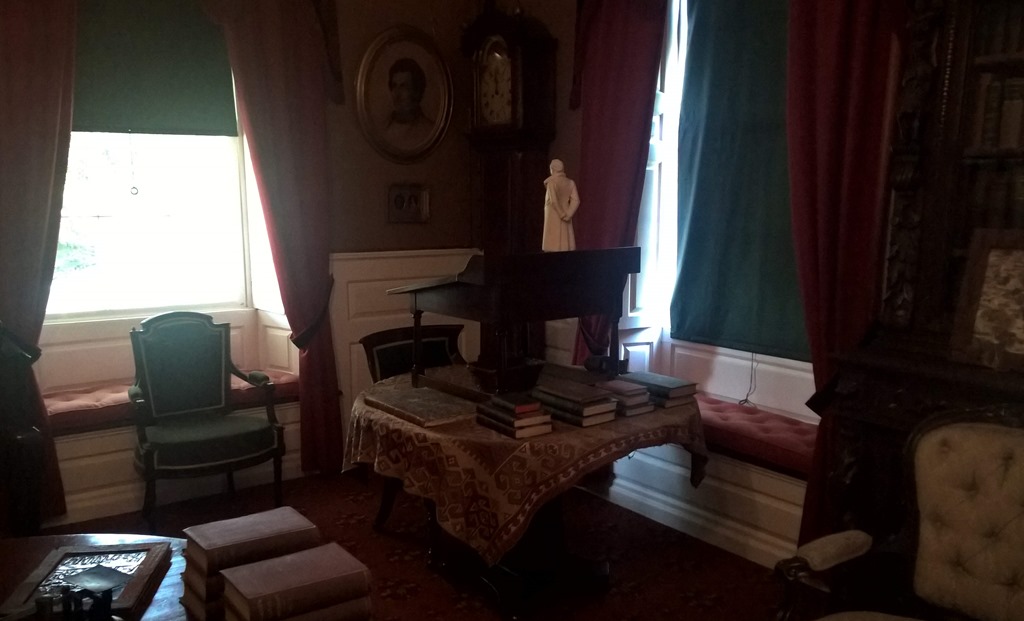
Henry Wadsworth Longfellow’s oh so modern standing desk. The small statue on top? Goethe.
Pearl’s book is largely responsible for our visit to Longfellow’s house in Cambridge, and for me taking the time to check out Longfellow’s now unfashionable work. We walked through the room there where Longfellow’s beloved wife was sealing envelopes containing locks of their children’s hair with help from her daughters one summer’s day when the sealing wax melting candle caught her dress on fire. The room where Longfellow rushed in and tried to smother the fire engulfing his wife with a rug and his body. He suffered burns from that fire, painful and life-scaring (that bushy beard wasn’t just a fashionable affectation), but not fatal as were the ones that took his wife’s life by the next day. The room he rushed from? His writing room, with it’s nowadays in-fashion standing desk (a tactic he shared with Hemmingway), a room decorated with carved Goethe, Dante, and Shakespeare, all looking at him, asking him to “Let us, then, be up and doing.” I now read his work and think of what it does not say in what it does say.
Provincetown
When told we planned to go to Provincetown, someone asked my wife “You know how wild it is don’t you?” Well, yes, it’s extraordinarily crowded on a summer day with people from other New England places looking for a change of scene, and gayer than a Pride parade. The main street is full of establishments that cater to the not-quite-needs of no-purpose-but-the-change visitors, and the milling throngs are deep in thought of how good a time they are having verses their expectations.
We got off the ferry and had a tasty early lunch of hip-casual fusion food in a place with a patio covered in sand that had a view of the beach, and past that to the ocean that which can’t be bothered with time, which is always visiting, and therefore isn’t a visitor.
We then picked up rental bicycles, and after reminding one brave member of our expedition that riding a bicycle is, well, like riding a bicycle, we took off on a five-mile jaunt up to the highest point on this area of the cape. There’s a widow’s-walk porch atop the visitor’s center at this high point, full of fresh breezes and a view of that ocean again, beside which lie grassy sand dunes that meet that wind with ardent curvatures. I’ve read that the higher water levels and fiercer storms of our human-heated climate have damaged these features, but to us, visitors, it still read as wild and timeless.
After a good long meditation with wind and outlooks, I was reminded of my reason for going to Provincetown, and we set back on bicycles for the town again too look for the house once owned by Susan Glaspell and her husband George Cram Cook. My paternal grandparents are from the same south-eastern Iowa location that Cook and Glaspell grew up in, and though as far as I know they had no direct participation in The Davenport Group, Glaspell was a cousin of my grandmother.
Back in 1915, Provincetown was what was called an artist’s colony. That term is now somewhat outdated I think, but the concept is timeless. Artists, writers, musicians, and the like look for somewhere unfashionable, perhaps a bit run-down, with cheap rents to reduce their overhead while they work on things that won’t bring in a steady cash-flow. These artists naturally knock into each other, igniting collaborations and idea sharing. Often those unfashionable areas gather value, and before you can invent the term gentrification, the upmarket consumers, who though they might bring disposable cash to spend on art, bid up the rents and crowd out all but the most financially successful creators of art.
But all that hadn’t happened yet. Cook and Glaspell settled in a house on the main street, the street we now find full of folks looking for a good day or weekend, walking and driving fender to footsteps so thickly that it was hard to even walk our bikes up to the address. Back in 1915 the couple had redecorated the house’s interior with bright colors and Charles Demuth had sculpted them a sundial for the yard held skyward by a nude statue of my cousin Susan.
Here’s where things get uniquely interesting back in 1915. What could this little group of artists do while waiting for the paint to dry, or while you waited to afford a replacement for the worn ribbon in your typewriter? They decided to put on plays. Whose plays? Well, they were writers, weren’t they? Let’s write them. A stage? Look, we have artists, they should at least be able to wrangle some lumber into a set. They were given the lower floor of a former fish house that was situated on the end of a dock out over the timeless ocean to use.
What did they know and didn’t know, and did that matter? Theater in the United States was a commercial enterprise, exclusively that. This was before broadcasting, and a huge enterprise existed, with theater chains from Broadway to the small cities across the country to supply those things that could make money by presenting live entertainment. In one way, theater was tremendously broad, but it was also predicated on presenting what was going to work for that big audience. In poetry, music, and art, the Modernists were experimenting, trying things that weren’t supposed to work to see if, in fact, they could. Driven by Cook and organized by Glaspell, this little cadre of artists began trying to do that with drama, but I doubt they had any idea of what would happen when they tried this, way out on the Cape, with at first only their friends in the audience.
A disheveled man who shared a rented room in the town, down on his heals and with an already well-established reputation for alcoholism claimed he had a bunch of plays in his trunk. “Trunk plays” is theatrical lingo for old work that might be revived if a need arises, but this was an actual sea trunk he was hauling around with him, stuffed with unproduced work. In an artists colony, many writers would claim they had good stuff already written, just waiting for the world to discover, but then as now, some of this would be an empty boast useful to get someone to pay for the next round.
It fell to Susan Glaspell to arrange an informal table reading of a play from that trunk. Worth a chance, since the new company was short of material and game for anything.
Remember it’s 1915. Europe had Ibsen and Strindberg, sure. The Abbey Theater in Dublin had started a few years before. Some around the table would be well-travelled and would even know their work. But this is America, and this was a hanger-on in a little beach town artists’ colony. The author with the trunk was too shy to read his own play, someone else was deputized, and the author sat in another room as the reading commenced. The guy’s name was Eugene O’Neill, and the play, Bound for Cardiff.
Glaspell wrote about this more than a decade later, but she recalls that right away they knew they had something. Bound for Cardiff, a play set on a tramp steamer, was performed in their makeshift playhouse at the end of a pier that year. The sound of waves, wind and gulls, the murk of fog and evening chill did not have to be added with theatrical tricks. The smell of the sea wafted up through the cracks in the dock floorboards.
The Provincetown Playhouse had its first star playwright, and Modernist American drama had its starting point. And in Glaspell and Cook, they had the organizers who could keep the artistic cats herded and pick up new strays. Within a year Glaspell, who had co-written the first play the Playhouse had produced, wrote Trifles, a seminal work of Feminist drama.
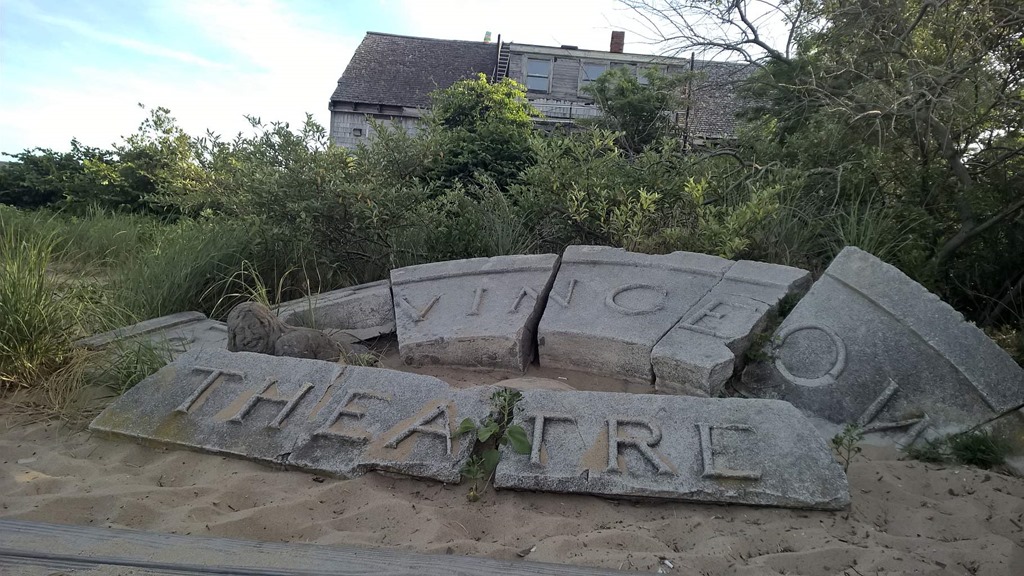
I believe this remaining sign is from a later theater, not the rustic fish-house. However when I was taking this picture a charming older lady walked up and asked if we knew what it meant, and was pleased and surprised that we knew about Susan Glaspell and the original Provincetown Playhouse.
That weathered makeshift theater building on the end of the dock could never have timelessness, though it apparently stood for some years after this. Cook and Glaspell took their organization to Greenwich Village and continued with seasons there as the Provincetown Playhouse for the next decade. There’s more to this story, but I bring the curtain down by noting that while scanning a book of plays the Provincetown Playhouse produced in the towns wonderful small library, I saw that two poets from this month, William Carlos Williams and Mina Loy, once performed on stage in a two character play there.
Amherst
This was my prime target for this trip, as the Parlando Project has lead me deeper into not understanding Emily Dickinson, which I’m still finding an interesting place to be. Emily Dickinson spent almost all of her life in Amherst, much of it living in her family’s house. Not being a Massachusetts native I had no idea where Amherst was, or any sense of what I’d find. My first surprise was how rural the region seems to be. We entered into the town on a winding two lane road that reminds me of those paved highways that followed what were once wagon rutted dirt roads and before that indigenous footprints.
The Dickinson Homestead. Emily’s front window is the one on top floor left.
The two neighboring houses that make up the Dickinson site are imposing as you pull up to them, reminding you of her family’s prominence in the town. Early on in our tour I learned that the present lot is actually smaller than the holdings in Emily’s time. Across the road running past the house’s front door and under the sight of Emily’s room’s window, the Dickinsons had a hayfield that they cultivated. And the garden that Emily tended, the accomplishment that she was most recognized for by her peers? It was much larger in size and scope than I had imagined, though only a conventional, more modern, grass lawn grows there now. There were flowers, though not in an organized English garden sense, but also a large vegetable garden used to feed the household and a remarkable orchard which the guide told us included fig trees—trees way outside the zone that should survive New England winters due to some ingenious horticultural tricks. Although they were Puritan stock who thought household servants would be a stain on a family’s industriousness, the Dickinsons did hire some garden and field help due to the size of the holdings. None-the-less it was the household’s women who managed the gardens, first Emily’s mother and then Emily herself.
Not only the grounds, but the house’s interior has been redone and revised since her lifetime, and our guide was scrupulous in describing what parts reflected the original arrangements. Emily’s bedroom, where she did much of her writing, and where she stored the hand-made booklets that became the prime source of her ground-breaking poetry, has been recreated in considerable detail however. It’s a bright room in the daytime, and the table by the window where she wrote and revised at night, has a whale-oil lamp that would have been a luxury in her time, but must have facilitated her incredible productivity during the 1860s.
The biggest surprise was the second house, built for Emily’s brother and his new wife next door at the behest of Dickinson’s father. That sister-in-law, Susan Gilbert Dickinson, should not be overlooked as a factor in Emily Dickinson’s genius. They had a close friendship from the time Emily’s brother started courting her, and like Emily, Susan was unusually well educated for a woman of her time and place. Besides emotional bonds deep enough to cause modern speculation about a sublimated or overt lesbian relationship, Emily seems to have used Susan as one of her trusted readers to give her feedback on her revolutionary poetry. For a woman so far out on her own avant garde as Emily Dickinson was in the middle of the 19th Century, Susan may have been indispensable.
This second house, “The Evergreens” remained more or less as it was in the late 19th century, and to a large part has not been restored. It’s spooky, you feel almost like you’ve broken into an abandoned house with wear and lack of maintenance left intact. That feeling is even stronger when the tour takes you to the floor where the bedroom of Gib, Susan Gilbert Dickinson’s youngest child was located. In 1883, at age 8, Gib died of typhoid. Afterward the room was locked and kept closed by his distraught mother. Decades later, when the house was finally turned over to the group that now conserves the site, the room still contained a small boy’s toys and his clothes still neatly tucked away in the dresser, some of which are now tenderly displayed as you walk past the door.
I could speak of more, but those were the literary high points of my trip. I hope to return with normal service in August, combining various kinds of original music with various words (mostly poetry). To tide you over here’s the most popular Emily Dickinson audio piece with listeners here so far, “We Become Accustomed to the Dark.” Use the player gadget below to hear it.
A couple of posts ago as I presented a piece using words by American poet Henry Wadsworth Longfellow, I mentioned that his prestige has fallen greatly.
Longfellow was minor and derivative in every way throughout his career…nothing more than a hack imitator of the English Romantics.”
“Who, except wretched schoolchildren, now reads Longfellow.”
And Lewis Mumford sums up his significance with a dagger by declaring that Longfellow could be completely removed from the history of literature without much effect.
Furthermore, while there’s no modern bon mot to extract from the Wiki, Longfellow’s didacticism, a huge defect if detected in modern poets, is noted. Even during his lifetime, that rankled the Transcendentalists, always looking for the more inexplicable sublime.
Akin to one our Parlando Project principles, Longfellow took the idea of “other people’s stories” to what are now considered ridiculous lengths. Instead of writing of intense internal experiences as Emily Dickinson did, or expanding the fleshy personal into a democratic universal as Whitman did, Longfellow wrote about many cultures and translated poetry from many languages. The term “cultural appropriation” didn’t exist as such then, but Longfellow could easily be charged with it. His best-known epic poem, Hiawatha, which has left its imprint all over my own region’s place names, is an earnest and non-hateful mishmash of the mid-19th century’s limited knowledge of indigenous Americans mixed with some contemporary to the time German romanticism. Longfellow would be a cultural criminal if he hadn’t already been reduced to a laughingstock.
OK, so what. All of these charges are true, but here’s what they leave out. To say Longfellow was “an American poet” is like saying Elvis Presley was a rock’n’roll singer. He proved that could be a thing, that an “American poet,” could connect successfully with a wide audience. He imitated Europeans and English romantics. Yes. Who the hell else was there to imitate? He wasn’t as original as Dickinson or Whitman. Yes, and neither is most any other poet you could name, now or then. And Mumford’s dagger? Alas, that can be said of most writers, because literature is a vast swarm of similar literary genetic ideas, but if there wasn’t a Longfellow, someone else would have to establish the idea of a popular American poet. That alternate-history someone else might have been good or bad, but it likely would have lead to some difference, even if the difference would be some other writer to rebel against.
I too wish Longfellow had tempered his didacticism, even if that is a large part of what made it possible for him to succeed. Most Victorian poets suffered from this as well, and it’s part of what the Modernists sought to break free from. To the degree that we are now Post-Modern, we can reassess this. Can poetry stand for something and still be art? If that is difficult to do, should it still be attempted?
Today’s piece is an example of Longfellow seeking to instruct, and the charge of cultural appropriation could be leveled at it too. In 1842, as opposition to slavery started to gather force in the United States, Longfellow wrote a short collection of poems on the “issue”—yes, human slavery, for and against, it was a debate. Longfellow explicitly released this collection for publication and distribution in support of the anti-slavery cause.
The obscenity of human jetsam. I learned about the Zong case only this year while traveling in Britain.
“The Witnesses” is from that collection. In it I think Longfellow transcends propaganda for this noble cause and demonstrates his effectiveness as a poet. He audaciously takes the notorious Middle Passage of over-sea slave shipment as his subject here. Though those travails were not his personal experience, the obscene losses at sea in the shipment of chained-up human beings is portrayed. I chose to further highlight Longfellow’s concluding phrase to all this. “We are the witnesses!” he writes, as the still shackled skeletons speak in his poem—but of course, un-romantically, their remains cannot speak. The poet, the reader, the performer, the listener, are the real witnesses here.
A short note. Wouldn’t you know it, after spending a good part of this year exploring the early 20th Century Modernists, I now have been using 18th and 19th Century sources more this summer. One of my favorite blogs, My Year in 1918 recently noted how I was tackling those WWI-era writers with my musical pieces for her readers who might want to sample that.
Well, I’ll return to those literary Modernists soon. After all, a principle here is to try to mix things up, to not be predictable or to always rely on my established favorites. But even today, I think I’ve been tipping my hat to another key early 20th Century American Modernist. As I was writing and performing the music for “The Witnesses,” with its variations on folk-style melodies that twisted between strains and finished with a louder cadence that didn’t resolve the multiplicity, I asked myself “Where’d that come from?” Early this morning it occurred to me: the composer Charles Ives, who was working at almost the same time as those literary figures. If he had access to an electric guitar he could have been Frank Zappa.
Once more I’ll break with my usual practice and apologize that I don’t feel I’ve fully realized this audio piece, mostly because it really should be performed with a number of featured voices and a chorus. While my computer and inexpensive collection of “virtual instruments” lets me reasonably realize a large number of instruments, it cannot represent vocal works very well. Go ahead and listen anyway, and if you can listen on speakers instead of earphones, crank the volume a bit.
I suspect no poet in the past couple of centuries has suffered a greater decline in esteem as Henry Wadsworth Longfellow. This is not due to some scandal in his biography, for as far as I can tell he lived an admirable life, but artistically he’s been indicted for a number of crimes and misdemeanors. Before I go over those, let me briefly summarize the heights from which Longfellow has fallen.
He was the first self-sustaining professional American poet, the first to reach a considerable level of national and international success. By the middle of the 19th Century he was roughly as famous as Tennyson and Dickens, known and generally admired by his contemporary poets, and avidly read by a broad non-academic readership. He sustained this fame for several decades and further, past his death in 1882. His general readership survived into my grandfather’s generation, and then through my father’s, and to a degree, into mine. Somewhere in the middle of the 20th Century, this engine of fame and readership broke down, and by now they’ve torn up the tracks of the Longfellow Line, and ragged grass grows over the railbed.
I grew up reading Longfellow as the next generations might read Dr. Suess or Sandra Boyton in childhood. As I reached the age of ridicule, I could revel in Bullwinkle the moose in his parody poetry corner reciting Longfellow poems that I knew. Now Longfellow is probably not well enough known to satirize.
So, what are Longfellow’s poetic crimes? Meter and rhyme and a certain amount of antique diction—though we are able to somewhat forgive the English romantics of the generation before Longfellow those afflictions. Earnestness and popularity, two things that no ironic 20th Century Modernist would wish to be accused of—but Robert Frost survived the later, while being seen (mistakenly) as expressing the former. Longfellow’s contemporary, Walt Whitman, explicitly sought to commit the earnestness and popularity crimes—though, as the old dis goes, for many years, Whitman couldn’t get arrested for it.
The good gray poet Whitman, and his doppelganger the forgotten famous writer Longfellow.
But Longfellow’s capital offense, the crime his reputation has been executed for, is simplicity and conventionality of thought. If I had to be Longfellow’s defense lawyer on this charge, perhaps I’d be reduced to throwing his case on the mercy of the court. Longfellow’s writing is often expressly didactic, and impersonal sentimental themes abound. Over and over again, he counsels perseverance and its seeming opposite, acceptance of impermanence. A more metaphysical poet would show his work and do more with incident to earn his conclusions. A more modern poet would make sure to make his life’s painful particulars his main subject.
Ironically, Longfellow’s life story is full of such material. Today we often think of poetry and art as an extension of memoir, and that writers earn their license to express things from their life stories. Longfellow would have had that license.
Some forms of Modernism believe that the best way to deal with complex emotion or great pain is to put it in the silences, in the blank spaces. These Modernists believed this would be more effective, because they are signaling with this constrained and minimalist expression that the thoughtful audience needs to seek for what is not said.
20th Century Modernists decorated their foreground with images, not antique forms of literary expression, and the complex message is encrypted in those images as if by steganography. Could Longfellow be doing something similar in the blank spaces between the lines of his hypnotic verse?
Today’s piece uses words from a late Longfellow poem “Morituri Salutamus,” a Latin title taken from the famous gladiator phrase “Those who are about to die salute you.” The bulk of this poem, written for the occasion of his 50th college class reunion when Longfellow was 68, is taken up with matter that might appear in a commencement speech or the granting of an honorary diploma. Its purported mode is lightly elegiac, advice to the young is given; but as it proceeds, Longfellow transitions to a not over-worn thought. He prepares for the poem’s final stanza by cataloging some swan-songsters of literary history: Simonides, Chaucer, Sophocles. For compression, and for my preference for briefer work, this last stanza is what I used for today’s piece.
In that final stanza, with supple verse, Longfellow concisely implores his aging generation (and himself) to continue to labor to create, to create better. That’s not a complex thought. Does it need to be? Is it easier or tougher to do because it’s a simple thought?
A few posts back I dropped a performance of Walt Whitman’s “Poets to Come,” a piece where Whitman precisely states his understanding that he’s shown a new mode for poetry and allied arts, but that this new mode of expression will only be fully exploited and explored by artists in the future.
And of course, as Americans we’re still living in his future. And Emily Dickinson’s future. And Ezra Pound’s future. And to a degree we have yet to acknowledge, we’re living in Charley Patton’s future as well (more on that last one later).
So, in “Poets to Come” Whitman foretold his legacy, but did Pound and the other founders of modern poetry in English fully acknowledge their American predecessors? I’m not sure, this is an area I haven’t studied yet. I’ve already mentioned in earlier episodes that Pound and his British allies seemed eager to point to modern French as well as ancient Greek, Chinese and Japanese influences in their Modernist verse.
Could Pound have been embarrassed by his American origins? Could could Englishmen T. E. Hulme and F. S. Flint have sought to emphasize the continental sources of their new aesthetic to compensate for their decidedly non-posh class status? That would be rash for me, who is not a scholar in this field, to claim on speculation. The strongest evidence in Pound’s case would be that as a man living outside the U. S., his cosmopolitan outlook was well-earned by his travels. Being drawn to the work of LI Bai or Sappho, or the French Symbolists requires no apologies.
Modernists who remained in America may have voted with their (metrical?) feet to more frankly explore the 19th Century American roots of modern poetry. A personal favorite of mine, Carl Sandburg certainly did this. That some of Sandburg’s longer poems sound too much like Whitman’s word-music has, I believe, disguised the degree that Sandburg was a committed Imagist, capable of writing spare, no-wasted word examinations of present objects in the Imagist manner. In his no-less than duality, Sandburg was the first successful poet to combine the innovations of Dickinson and Whitman.
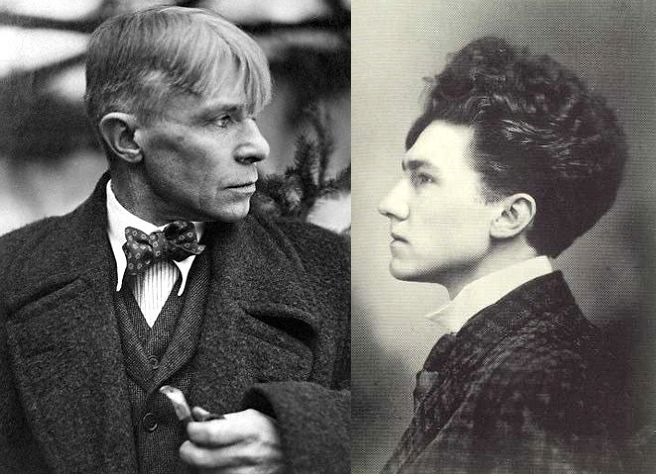
Young Modernists in suits: Carl Sandburg and Ezra Pound
Today’s piece combines two short poems, the first by Carl Sandburg and the second by the indispensable Modernist promoter Ezra Pound. Sandburg’s part “Letters to Dead Imagists” speaks fondly and perceptively about Dickinson and then moves on to tenderly remember Stephen Crane as a poet, who, like Sandburg, tried to combine Whitman with Dickinson. By calling them Imagists, the term Pound used to promote his “make it new” style of poetry, Sandburg is directly endorsing their claim to being pioneering Modernists.
In the second part “A Pact” we move on to Ezra Pound’s altogether more cranky voice, where he allows that Walt Whitman had broken “the new wood”, as if Whitman was some sawmill man who had roughly hewn some timber, which he contrasts to his, Pound’s, task and skill, which is to carve it artistically.
Know your Modernist family trivia: Ezra Pound’s grandfather started this bottled water company
I’m unsure how much Pound knew about Whitman’s background, so when Pound talks about the “pig-headed father” I at first assumed that famously stubborn Pound was only projecting his own considerable intransigence onto Whitman. But the poem’s closing image, an extended riff on wood and timber, indicates that he may have known of Whitman’s father’s trade as a carpenter. Pound’s own family had connections with the lumbering industry. So in the end, when Pound proclaims that he and Whitman share “one sap and one root” he’s allowing they share the American grain.
In my episodic way here, I’ve touched on the rise of Free Verse in Modernist poetry. Free Verse poetry may still be rhythmic and musical, but it follows no strict meter, nor does it use any rhyme scheme. Now an established tradition, it came to poetry written in English in a non-straightforward way.
I think we can largely assign this happening to Walt Whitman, the American who was writing verse with eccentric line lengths and no rhymes by the middle of the 19th Century. Whitman did not immediately gain imitators in English, but French poets like Jules Laforgue took up the cause of Vers Libre later in the century. In Laforgue we can see a direct link from Whitman through his pioneering French translations of the American’s work.
The main thread of the Free Verse revolution for poetry in English then jumps to England, where before WWI Britons F. S. Flint and T. E. Hulme made common cause with American ex-patriot Ezra Pound. Pound must have certainly been aware of Whitman (more on this later) and though I’m unsure if Flint or Hulme knew of the American poet, all three shared an interest in Modernist French poetry.
I can only surmise, but in starting their Free Verse revolution, it may have been advantageous for this small group to present this as a French idea rather than as an American one. At the beginning of the 20th Century, France was an established cultural force, a place from where new intellectual and artistic ideas were expected to emerge—and in painting and music Frenchmen were the leading edge of artistic Modernism then in a way that Americans were not yet.
This strange path, from America to Paris to London misses one poet, a too often forgotten writer of Free Verse before the 20th Century, Stephen Crane. As a young man in his early 20s he was introduced to the just-published first collection of Emily Dickinson (1890), and mixing his take on Dickinson’s compressed musings on the infinite with the just-died Whitman’s Biblical cadences and love of parallelism, Crane in 1895 published a collection of short Free Verse poetry “The Black Riders.” Today’s piece uses the words of one of those short, untitled poems from Crane’s book.
Stephen Crane:. He’d written Free Verse when Ezra Pound was still weighing in with sestinas
If, a couple decades later, one of the short poems in “The Black Riders” was to appear in an Imagist anthology, on a quick glance or reading it wouldn’t look or sound out of place, but the pieces in Crane’s collection are not really Imagist poems, not even in the same way that sections of Whitman or Dickinson are. Crane’s “Black Riders” pieces are too full of abstract concepts and romantic notions—and even though Crane is questioning or mocking these concepts, he’s not presenting the issues through concrete new images as the Imagists would.
It’s interesting to wonder how Crane might have developed if he’d lived a full life, rather than dying at age 28 at the end of the 19th Century. Still and all, here was an American, in America, writing Modernist verse with Modernist attitudes while still a young man and with the 20th Century still on the horizon.
Musically, today marks a return of new pieces recorded with the LYL Band and Dave Moore. The music I compose and play myself can be created over a varied length of time, and in whole or in part, reconsidered and redone. The LYL Band on the other hand, just goes. When we did some recording this week, Dave told me he was waiting for another instance of us starting off something with no more than my announcing “G Minor.” Today’s Crane piece “The Black Riders XXXIX” is not particularly complex or unpredictable musically, but we needed to knock off the rust. To hear it, use the player below.
A month ago I began our celebration of the U. S. National Poetry Month with an audio piece using the words of Walt Whitman. Today I bring our month of music meeting poetry to a close with another piece by Whitman: “Poets to Come.”
Which is appropriate, as modern American poetry begins with Whitman.
From time to time in his work, Whitman reminds us that he knows he hasn’t fully realized his poetic project. This isn’t just false modesty. He revised and added to Leaves of Grass throughout his lifetime, but it wasn’t because he thought perfection was one more edit away. Whitman seems to accept that it’s better to try to do what his ideals say to aim for, to make the effort to become the artist his art asks to exist. It’s better to be 80%, or even half or less, of that ideal Whitman he writes of, sounding his barbaric yawp over the roofs of the world, than for no Whitman to dare exist.
Note though that Whitman isn’t asking himself to do this for self -expression. His expression, even with the particularities of his own person being unavoidable, is cultural expression. He sought to sing into existence the culture he wanted America and the world to have.
Which is what makes this poem a great basis for the last post of this Poetry Month. He had faith for the poets who would follow his innovations and audacity. Many did come forth after him, many of which we’ve presented here. Whitman had, I might suppose, faith in the intentions of the Parlando Project—and I, if I pay attention to the spirit he wrote of, I should have faith too.
Good Gray Poet, Thin White Duke.. David Bowie sang “Ain’t there a pen that will write before they die?” Whitman’s caption says he was about 4 blocks from Sigma Sound studios were Bowie recorded that. TSOP!
During April I’ve created and presented 16 combinations of various words with my music, more than any other month in the year and a half of this project. I took a crack at preforming all of that “April is the cruelest month” modernist epic of T. S. Eliot’s “The Waste Land” —and only got near half-way done. I worked on the finding and understanding the words I’ve used, or composing, playing, and recording music for several hours every day this month.
And you’ve listened to these pieces, and if you’re here, you’ve even read my words about the process, for which I’m grateful. I’ll be back tomorrow with a piece by Dave Moore and the LYL Band for May Day and there may yet be more LYL Band recording before this Spring is over. I do expect to take a bit of a rest after the efforts of this April though. I have a pile of books I want and need to read, a whole lot of interesting blogs I’ve gotten behind reading too, and I’m looking forward to listening to music I didn’t have to think up first.
If you want more, I remind everyone that we have over 200 pieces here in the archives on the right. There’s lots of stuff that you may find better, worse, or at least additionally different there. If you, or someone you know would just like to hear the musical combinations we do, the Parlando Project music is available on all the major podcast services like Spotify, Google Play Music, or Apple podcasts.
Here’s Whitman’s “Poets to Come” performed with my music. Use the player below to hear it, and if you like it, please tell other folks about the Parlando Project.
We’re about to begin April’s National Poetry Month in the U. S., but I’m going to begin celebrating #NPM2018 today with a piece that’s a good way to start things off, the opening two sections of Walt Whitman’s “When Lilacs Last in the Dooryard Bloom’d.”
We’re aiming to present even more audio pieces than usual this April
Use the Follow button to make sure you get a notice as they drop
National Poetry Month isn’t just for American poems or for American poets, but if it was, Whitman would be all the more inescapable. In the middle of the 19th Century, he and Emily Dickinson forged two original styles whose sounds and tactics can still be found in contemporary verse—Dickinson, with small lines in small poems that bind-up with puzzles immensities; Whitman with long lines and epic poems that offer a catalog of exultation. One sees a single, small thing and says it represents the universe, the other beholds the diversity of the world and says it’s really one thing. Complementary opposites.
Both were working at a prodigious pace during the 1860s, during America’s great Civil War. On April 14th of 1865 Abraham Lincoln, the US President during that war, was shot. The next day he died. Within weeks Whitman had produced the first published version of this poem along with other poems about Lincoln and the ending of the Civil War which he published as “Drum Taps.” It would not be like Whitman to hold his thoughts on those great events inside. In contrast, Tennyson’s epic elegy on the death of a beloved friend, “In Memoriam” took him more than 15 years before he published it.
At over 200 lines in its entirety, “When Lilacs Last in the Dooryard Bloom’d,” taken as a whole, would exceed my usual mode here. I prefer my audio pieces more the length of the 45 RPM single records of my youth. So today, I present only the first two sections of Whitman’s poem. Whitman’s voice changes over the course of this long poem, but in these opening sections Whitman (albeit in free verse) is sounding somewhat like the poets his modernism would break from. Save for the absence of rhyme, his language here would not sound out of place in Tennyson (or even the earlier Romantics, like the Shelley of “Adonais.”)
Is this the dooryard? Whitman was visiting his mother’s house when he heard Lincoln had died.
He stepped outside and saw the spring lilacs in bloom.
I did the same thing, presenting only the intro section, last April for the poem I believe is most responsible for April being National Poetry Month, T. S. Eliot’s “The Wasteland,” which begins memorably “April is the cruelest month…” Those that can finish that first sentence may recall it continues “Breeding lilacs out of the dead land.” So, Whitman’s elegy and Eliot’s poetic apotheosis of High-Modernism written over 50 years later, both begin in April, and with lilacs.
We’ll be revisiting territories in “The Wasteland” later this April, but today you can start where Whitman started his poem, and from where Eliot got some of his inspiration for his. Musically, this one is fairly simple, but I hope effective: acoustic guitar and piano with a little low synthesizer groan eventually joining in. Use the player below to hear it.
It’s time for that quarterly exercise where we look back for the most popular audio pieces here at the Parlando Project over the past season. I’m going to follow the format we used last time, and break the countdown into four episodes. I base the popularity on the number of likes following their posting here, and the streams the audio pieces received directly from the blog, or on iTunes, Spotify, or other podcast sources. Let’s start the count from the 10th most popular as we move up the list to number 1:
10. Rosemary
Even though these pieces were listened to in the Winter for most of our listeners*, Edna St. Vincent Millay’s words have a kind of spring-cleaning of the heart vibe, and so may be apropos for opening the windows and letting the curtains blow around—or at least they will in a few weeks when it warms up here in the northern part of the northern hemisphere. I awoke to 10 degrees Fahrenheit and snow and polished ice myself today.
I rather liked the music I wrote and performed for this one, just as I have liked going back to Millay to reassess the strengths she brought to poetry. Millay’s popular reading audience, once substantial, hasn’t completely disappeared, and there’s a welcome re-assessment of her poetry starting in academic circles.
9. Stopping by a Woods On a Snowy Evening
I’ve featured Robert Frost’s words quite a bit here, perhaps to atone for my dismissal of him when I was a teenager as the kind of worthy poetry in our schoolbooks that we needed to move beyond. Two things were key to my learning to love Frost: his uncanny ability to write lyrical verse that sounds natural, and my finally noticing the dry wit and stoicism that underlies most of his work.
Frost, alone of his American generation, has retained a level of popular appeal and critical approval. He’s double-edged in maintaining that. Some are captured by the surface of his poetry, hearing and maintaining in their memory the catchy moral-of-the-story “big choruses” of Frost. In this poem, it’s the “I have promises to keep, and miles to go before I sleep” at the ending. Others listen carefully to the verses, the parts other than the lines we most remember, the parts we can come back to and find that we’ve forgotten were there. When I came to work musically with this poem, I’d forgotten those. There’s no lovely woods to see in this dark night. He may be lost. He’s so dark and alone that he can hear snowflakes sweeping across snowbanks between the jingle of his rig’s harness bells.
Musically, I was obligated to add shaker bells percussion to stand for those harness bells, but then, more obscurely, I decided to add a South-Asian tambura drone for the sweep of snow.
Modigliani’s portrait of Pierre Reverdy
8. Clear Winter
I was a terrible French student in my little Iowa high school and my little Iowa college. I seem to have no ability with languages, and less than no ability to handle those accents and the reforming of the mouth that makes speaking a foreign language possible. But I love poetry translation. I feel like a paleontologist removing the clods of sediment from a skeleton. Slowly, painstakingly, there it is, just as it was in its moment of sudden! But then my task shifts, and I must become the process of fossilization, to find the minerals of English that can fill in for the sinew and feathers of it’s original language.
I had a great time with the challenge of Pierre Reverdy’s “Clair Hiver.” I’m unsure of the accuracy of the “tea-kettle” section of my translation, but I fell in love with it, and could not abandon it, even if the light behind Pierre Reverdy’s eyes cannot reach the little anteroom behind mine.
*web stats I get for the streams tell me I have as many recent listeners in Australia as I have in Texas—and one listener in New Zealand. Bret, please tell Jemaine that there’s a lot of good stuff to read and listen to in the archives you’ll see listed by months on the right.
Tomorrow is celebrated in the United States as Abraham Lincoln’s Birthday—or rather, it was in the past. In 1971, a uniform Monday holiday, often called President’s Day, centralized what had been in the past dual, separate, celebrations of Washington’s Birthday and Lincoln’s.
Washington (as poet Phillis Wheatley’s motto for him said) was first in war and first in peace, and we owe him a great debt for being the rare revolutionary leader that did not try to crown his success with dictatorship. But Lincoln’s achievements are every bit Washington’s equal; though his central achievement, a US government that no longer enforced chattel slavery throughout the country has in recent decades been somewhat obscured for complex reasons.
But here at the Parlando Project, where we combine music with words, Lincoln gets extra props for being as great a wordsmith as any US Chief Executive. While taking the various roads that lead to this piece I read his famous Gettysburg Address, or rather refreshed myself with the words in manuscript form, for as a child I had memorized it.
At this site it’s possible to trace the slight revisions that Lincoln applied draft by draft to polish this concise statement of dedication. And the same site linked to another site that let me read (for the first time) Edward Everett’s main speech at the same Gettysburg dedication.
Perhaps you’ve heard the story of how the two speeches that day in 1863 contrasted. It’s no legend. Everett’s speech lasted over two hours. Lincoln’s could have fitted his into a linked series of five Tweets today, and it takes a couple of minutes to read. Go ahead, read as much of Everett’s speech as you can. It’s the kind of grand utterance that could have caused the 19th Century to invent TLDNR 140 years sooner.
So, Lincoln could fashion a memorable, resonant phrase and express complex things concisely. That’s the kind of literary talent that leads one to ask if he wrote poetry. He did, but as far as we know, there’s not very much of it. He wrote some occasional, short, light verse. His serious poetic works consist of an attributed poem with a narrator speaking of suicide, and a three-part poem recalling his hometown.
Abe Lincoln in his mid-30s, 1847, around the time he wrote today’s words.
It’s from the first part of that later Lincoln poem that I created today’s piece, “My Childhood Home I See Again.” It was published anonymously through the efforts of a friend of his in 1847. Lincoln was in his troubled 30s when his longer poems were written, and he seems to have been suffering from depression, the depth and length of which is subject of much discussion among historical scholars.
The parts I used from “My Childhood Home I See Again” tell much the same story as English poet Thomas Hardy’s “The Self Unseeing,” but Lincoln’s poem is more melancholy, even if he tries to make some pretense of it being only wistful. By the final couplet, Lincoln’s own words put in him the situation of George Saunders’ “Lincoln in the Bardo.” I suppose one could also compare Lincoln and Hardy’s poems to my own piece “Homeopathic Hometown.”
For today’s music I used an acoustic guitar and my semi-acoustic Jack Casady bass guitar for the main accompaniment. I try to stay away from instrument-geekery most of the time here, but that bass was actually designed by the musician, it’s not some “paint it a different color and slap on a decal” marketing gimmick. I love its sound, as you may be able to tell from the mix today. To hear too much (or just enough) bass guitar, and Lincoln’s sad words as I set them to music, use the player below.






 Frank Hudson