Tired

I’m going to close out our investigation into the little-known early 20th Century Chicago Modernist poet Fenton Johnson with one of his most emotionally moving poems. James Weldon Johnson first included “Tired”  in his “Book of American Negro Poetry”  in 1922, and it has been anthologized several times since. “Tired”  remains the poem of Fenton Johnson’s that one finds most often shared on the Internet today.

You can see why. Only a few beats in, that powerful line is spoken: “I am tired of building up somebody else’s civilization.” It may take no more than that line alone to have some tag Fenton Johnson as the first radical Afro-American poet.

I cannot categorically disagree there. I know little about Johnson’s political views, and though the two short-lived magazines he founded before 1920 are said to have included political philosophy, I know nothing of the particular stances he took or supported. At least at the time (the first two decades of the 20th Century) “Tired”  along with a few other of Johnson’s poems caused some Black cultural critics to remark that Johnson was too pessimistic, too given over to despair. You might find that strange, but in that moment, there was a feeling that educational and cultural uplift could soon raise the Afro-Americans along with the time’s large and wide immigrant demographics into a new, more accepting America. We know now that didn’t happen, that indeed 20th Century racism and poverty had some mighty blows to land on America and American Blacks with KKK branded racism, Great Depression poverty, and world-wide Fascism—but at the time, that uplift was what many Afro-American elites were pulling for.

However, just by going on what Fenton Johnson poetry I have available to me, I’m not entirely sure Johnson was, at this time, a political radical or a thorough pessimist.
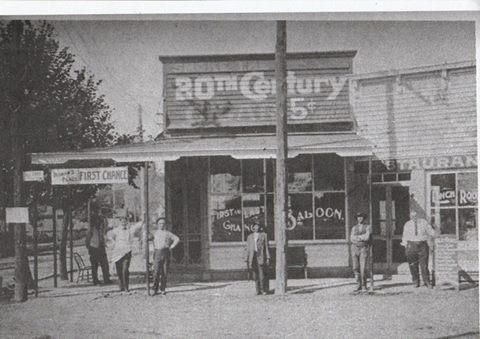
Last Chance Saloon

Somebody give me my gin.” Mike is out back serving warm gin to ladies.

After all, the speaker in “Tired”  is not Johnson himself, no more than the banjo player in our last post’s poem is Johnson, the middle-class raised, college educated man. Even the Last Chance Saloon, where the banjo player played for tips, returns in “Tired”.  Johnson didn’t live in a shanty, he wasn’t married to a laundress.

True, this is a character that Johnson wants us to hear, an important voice that maybe even the Black “Talented Tenth” wasn’t listening to then, much less White America. And though it’s free verse, this is a poem, not an incisive political analysis or program. It’s a dramatic speech with rhythm, repetition, and a rise in despair from gin-houses to the stars.

It’s not hard for me to see in “Tired”  the ancestor of August Wilson’s great play cycle, or the range of characters and voices in Walter Mosely’s detective fiction.

Musically I stepped at least as many decades into the future here, concluding this audio piece with a short burst of the kind of free jazz that allied itself with the Black Arts movement in the later part of the 20th Century. I’ll allow that this music is an acquired taste, but at its core is an ethic of allowing individual voices and modes of expression even in a group context. Free Jazz is not always as raucous as what I played for this, but it does not forbid it either. That’s consistent with what I try to do (within my limits as a musician) with the Parlando Project. When I say we combine words with various music, I mean it.

That does mean that you may not like all the writers’ words I present, or all the kinds of music I write and play to combine with those words, but it means that I’m also not going to stick with one thing and repeat it until we are both tired of it.

I’ve ordered these last four posts here on Fenton Johnson purposely, so to present the man more in full, and because, to be honest, I didn’t feel I could earn any license to speak these words without doing something more than just putting them in my mouth. To listen to Johnson’s “Tired”  as I performed it, you can use the player below where it appears, or this highlighted hyperlink.
The Banjo Player

“So, what are you going to do today?” my teenager asked me.

“Go and be of some use to the world.” I replied.

“How are you going to do that?”

“Write about Fenton Johnson.”

“No really, what are you going to do?”

“Write about Fenton Johnson.”

“Oh. I thought it was a joke or something when you said it.” They were mildly puzzled—but like most of us, most of the time, probably not interested in explanations. Fenton Johnson is not a figure of wide interest, even within the minority interest our culture finds in poetry. Perhaps at some later time they’ll read this, and it’s not an accident that I continue to write here aiming at someone just a bit older than they are.

Of course, I had meant that as something akin to a joke, because our lives and callings are all, taken whole, comic. The sport of fate and circumstance for good or ill should never be mistaken for judgement. Even the tragic is but darkly comic.

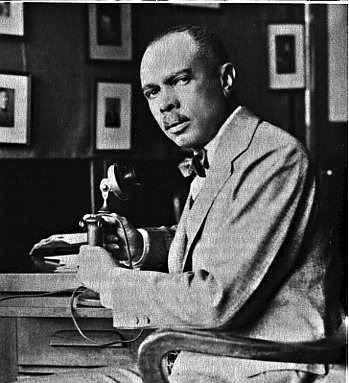
James Weldon Johnson on the phone

James Weldon Johnson: poetry anthologist and all-around American polymath, finds he can’t Tweet or post to Instagram  from his phone.

.

In 1922, when James Weldon Johnson (no relation to Fenton) sought to make up the first anthology of Afro-American poetry, he had similar hopes, though more grounded in his greater talent and effort. James Weldon Johnson, like Felton Johnson, was a rare college-educated man in the early 20th Century, and doubly-rare, both were Afro-American college graduates. Both Johnsons held to a responsibility their circumstance pressed upon them: to uplift their race and to heal and resist the ignorance of racial prejudice.

That second part, the resistance part, should feel familiar, as it’s an ongoing struggle many will feel a part of today. Prejudice of many kinds, injustice in so many cases, is still a pressing issue. The uplift part however may feel quaint.

In his preface to The Book of American Negro Poetry  James Weldon Johnson sets out the case that Black American poets should be able to rise to the highest levels of literary achievement, and while he’s not exactly apologetic about the poets his anthology will present, he’s also not a hype-man for what they have accomplished in 1922. Of Fenton Johnson, who he includes in his anthology, he says:

“Fenton Johnson is a young poet of the ultra-modern school who gives promise of greater work than he has yet done.”

Yet, as I look for the work of Fenton Johnson today, almost all the work I find are citations to the same pieces James Weldon Johnson included in 1922. What stunted Fenton’s career? A more extensive biography than may exist would seek to answer that question. The struggle for poetry’s place in national culture was hard enough throughout the 20th Century, add to that the challenges of racism. I do know that Fenton Johnson sought to ambitiously broaden his cultural impact by financing and editing magazines on Black arts and culture, and the failure of these publications to become sustaining was one setback.

James Weldon Johnson, surveying Black Arts in his 1922 preface for his pioneering Negro Poetry collection, speaks not at all of the visual arts (ironically, just as European Modernists were latching onto African art as an influence) and little of Black acting, despite his connections with the New York stage of the time, but he does speak prophetically about the impact of Afro-Americans on American music. Having only the evidence of the spirituals, cakewalk, ragtime, and the imperfect understanding in the cultured North in 1922 of what the newly discovered “Blues” might truly be about, JWJ professes that Afro-American music is already a predominant strain. Nearly a century since, we can only say that he was too modest in his view of the future, however audacious he might have seemed in 1922. American music, seen from outside our country, and in any honest assessment from inside our borders, is Afro-American music. I don’t want to slight the contributions in our country’s music from many cultures when I say that—they are significant—but all of them cannot help but reflect on, and reflect back, the impact of the descendants of those Africans brought here as cargo.

Which brings us to this Fenton Johnson poem included in James Weldon Johnson’s anthology. Here’s a link to the poem’s text. Its overall intent is humorous. You can hear the college man’s mix of condescension with an honest observer’s eye for detail. What makes its poetry an example of the “ultra-modern school?” Our last episode’s Johnson piece, “A Dream,”  was blank verse, even lines, even if the ironic asymmetry of its story is modern. The cadence of Johnson’s God Is in the All Time  is strong and regular. “The Banjo Player”  is free verse, conversational in rhythm. It jumps from the despair of the “Last Chance Saloon” mitigated by music, to the Kris Kringle promise of little children dancing and clapping to the banjo strum, finishing with a joke of the sophisticate.

Like the complex church music and rhetoric of “A Dream”  last time, I had trouble musically portraying the Gus Cannon/Papa Charlie Jackson vibe of the banjo playing bluesman. The banjo is just an instrument that I fight with, and no cheating of one-man-band multi-tracking could save me here I fear. Dom Flemons, Rhiannon Giddens, or someone better attuned to the banjo need to perform this.

I spent an afternoon yesterday depressed at my failure to fulfill the promise of Fenton Johnson’s piece. Could one more mix fix this? Nope.

I moped until I went to sleep.

And then my teenager asked me this question in the morning.

A Dream

Here’s a second poem by Afro-American Modernist poet Fenton Johnson. Like the first piece of Johnson’s that I presented earlier this week, there’s a religious element, but it’s handled this time with a remarkable framing device.

As published in 1921, “A Dream”  is the longer of two pieces which are grouped together as “Two Negro Spirituals.”  What strikes me about them is the extraordinary knife-edge irony held in them between spirituality and reality. If the Language Poets descended from the Modernists will not find in “A Dream”  the novel uses of language and syntax they look for, perhaps the Post-Modernists will appreciate Johnson’s conveying a vivid religious vision framed in a way that causes a reassessment of the foreground material.

That’s more critical theory and bin-labeling that I usually engage in, so let’s move away from that to the piece itself.

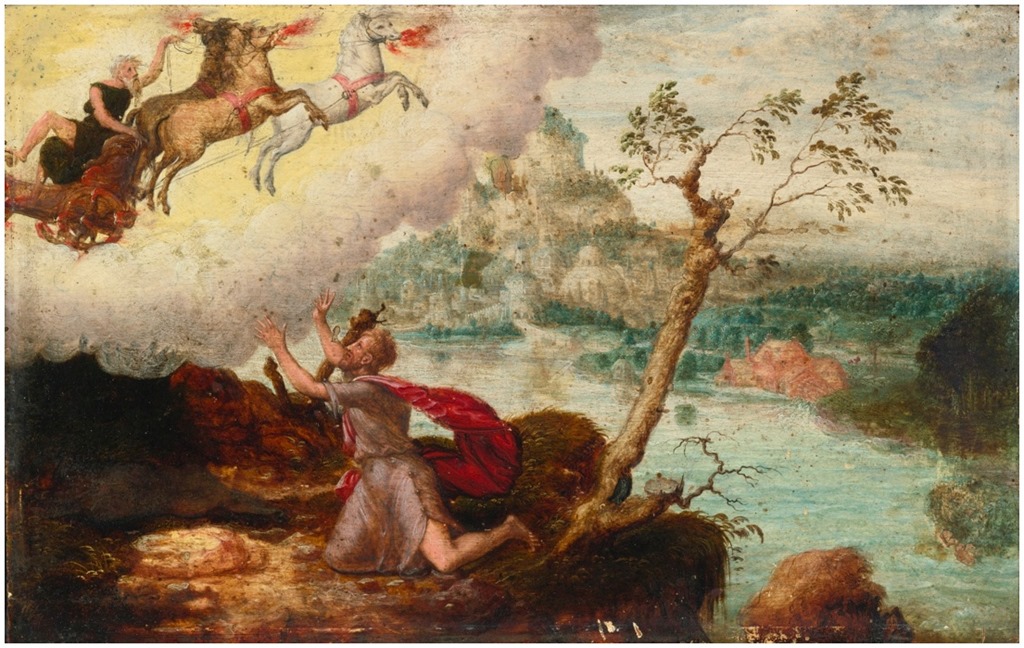
Elijah and the angel with a firey chariot

Elijah’s angel-fire chariot. Be sure your seatback is in the upright and locked position.

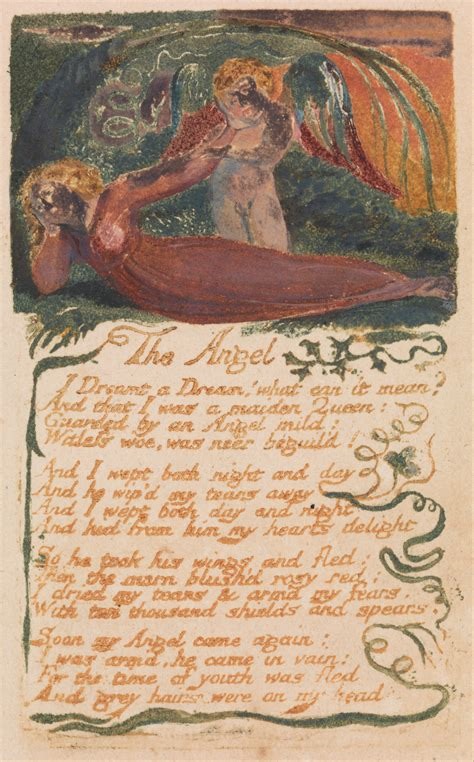
Is this texturally a “Negro spiritual?” Not really, though Johnson significantly chooses to call it that. The vision he presents, after a brief “Oh, my honey” aside, would not seem out of place in William Blake or any of a number of 18th to 20th Century Christian revivalists. The “spirituals” of the title were largely folk hymns, and the language here is more literary. Johnson wants us to know it’s an Afro-American who’s speaking, yes; but also, a man who could read and know these non-folklore sources. Yet, the recounting of the titular dream is not a scholastic catalog of mystical religious elements, it’s a deeply felt vision of a glorious reward. One does not need to be a Christian to feel the ecstasy of this vision, any more than one needs to fully understand all of Blake’s idiosyncratic religious precepts to sense their “thereness.”

William Blake The Angel

Like Fenton Johnson, William Blake frames an angelic vision

Johnson concludes the poem with a single line of a contrasting vision that recasts all that has come before it. Listen to the piece with the player below to hear it as it occurs.

Musically, this piece caused me all kinds of trouble, and, to be frank, I don’t think I got all the way to what I wanted to achieve. The difficulties of being my own composer, arranger, reader, ensemble of musicians and recording engineer should cause this kind of trouble more often than it does. However, I did so want to continue to present the things that this too-little-known poet Fenton Johnson did, that I have “called time” on this piece, and present it here now for you to listen to. Use the player below to hear it if you see that, or if not, this highlighted hyperlink will also play it.

God Is In the All Time

I’m continually a few days behind in the past month or so, what with Winter holidays and other appointments and responsibilities. Some of the audio pieces have been recorded especially expeditiously, and another part of this project has been neglected: the searches I take to find words (mostly poetry) I combine with original music.

Because publishers do not respond when I ask for permission to use works that may be in copyright, I am constrained to use written work outside of copyright, typically works published before 1923. Although I respond to, and use, poetry written in various eras, my desire to mix in more contemporary voices leads the Parlando Project to use a lot of poetry from the first two decades of the 20th Century. This is not altogether a bad thing. I happen to like a lot of what these pioneering Modernists did, and in some cases, what we find in the mouth of the “Post-Modern” poetry mainstream delta is worthy of reconsideration in the light of the Modernists. Have stagnant currents deposited silt and detritus at our end of Modernism, its own Mannerism that says that poetry must be written in a special poetic language and syntax, because that is the language that serious poems use? If popular poems are to be about recounting internal personal experience and serious poems are to be about hermetic personal language, what is missed?

Maybe we answer these questions by doing, as we answer other questions (even ones we never ask) by living. In my case, the doing may be by continuing this Parlando Project.

So earlier this month, returning to the research that goes on behind the scenes of this blog, I read two old anthologies of poems now in the public domain, looking for some new material. In one I was attracted to yet another piece by Carl Sandburg, a poet I believe should be reassessed in our time, but hardly an unknown, particularly to readers/listeners here. In the second one I came upon the work of Fenton Johnson for the first time. I’m willing to bet most of you haven’t heard of him.

Johnson, like Sandburg, like William Carlos Williams, wrote Modernist verse while remaining in America. Like William Butler Yeats, his career was long enough that he wrote poems that sounded like the 19th Century before transitioning to a 20th Century voice. Here’s a difference: Fenton Johnson was Afro-American.

OK, let me drop a term here: Identity Politics. I was recently reading a thoughtful blog post on Carl Sandburg compared to Post-Modernist poetry, when the author remarked that Sandburg was able to write in a time preceding Identity Politics. I don’t know enough about Left Write & Centaur’s full thought on Identity Politics, but the implication was that Identity Politics, characterized as the idea that we are silos of individual experience based on membership in social and ethnic groups, who then by implication need to be treated and considered primarily by that identity, is a bad thing.

I agree, that’s a bad thing for the most part. I also believe it’s often a real thing.

The first half: the separation, at least to some degree, of individual experience, is so self-evident I don’t feel I need to argue it. Poetry and literature is to a large part a demonstration of the things that we find unique in individual voices—yes, along with things we can find in common in our lived lives—but if our take on experience wasn’t varied, literature would soon become dull and repetitive (at least to me). Even for those things that we find in common as we read or listen, how would we know without literature or other arts letting us share this?

If we feel that separation is a bad thing, then art is where we go to heal that. The arts are simply a name we give to that sharing of experience.

The second part, that this separation can be handled and considered with bins of people labeled with ethnic origin, sexual orientation, gender, age, class, and so forth, this is where it gets real. We cannot wish away with imagination the ways the world labels and files its temporary inhabitants.

Should I care that Fenton Johnson is an Afro-American poet? Should I mention it? Does mentioning it imply some kind of special pleading? As I present a smattering of his development as a poet, will his work become “Well, it’s a Black thing”—a separation surrendered to?

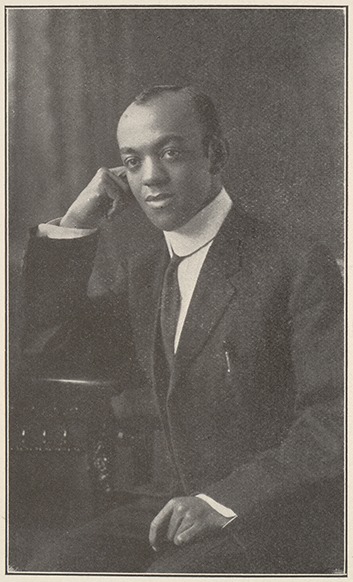
Fenton Johnson

The younger Fenton Johnson. I’m unable to find any later portraits of him.

However we dream our ideal world to come, I know that Fenton Johnson had to deal in the real world of 1918 Chicago, just as he would in 1968 or 2018 Chicago, with his ethnic skin color label on a daily basis. That label doesn’t peel off. No doubt, many he encountered imaginatively filled out that label with a long list of contents, but instead, let’s look from inside Fenton Johnson out at the world.

Will it be the same and different as Frost, Tzara, Sandburg, Rossetti, Tagore, Yeats, and Dickinson? Yes.

Early Fenton Johnson poems often start from a religious theme. This one, “God Is In the All Time”  portrays things from a universalist perspective. To hear my performance, use the player below.

Merry Autumn

Over the years I’ve developed a tough-enough way to be cheerful and productive, my own “grant heart” to myself. Though on the face of it, it sounds glum, I’ve learned it by reading about artists or from artists talking about their work, and it goes by this cheerful motto: “All artists fail.”

All artists fail more than they succeed. Every. One. No artist is so broadly popular that everyone likes their work. Even those that might gain a plurality of some kind, for some time, that likes their work, will find most of that group “ignoring” them most of their lives, because our attention is so precious and limited as audiences. One’s privilege as an artist is to get to fail again. If you don’t like how you’re failing, fail better, or fail differently, fail more often.

And even those artists we think of as succeeding sometimes, sometime find themselves succeeding in misunderstanding or misapprehension.

How can this knowledge help us, grant us heart, and not crush us? Anyone who makes things should carry in themselves the conviction that the world needs more of what they do, even if they or the world don’t know it yet. We are making more of what needs to exist, though that may fail when the world doesn’t know what to make of it. It may fail because we are wrong about its necessity. And it can fail because of how we choose to manifest our art.

Are we good enough to manifest our art so that it will not fail all the time? If our desire, our artistic conviction, is somewhere around helping heal the world and cleanse it’s perceptions, you may take that as beside the point. Decades ago, in the early days of the modern emergency medical system, I once helped receive a patient in cardiac arrest as they arrived at an ER, delivered by a volunteer ambulance corps. The man in the back of the rig, still in the human heat and confusion of the moment, said that he would have performed CPR, but that his certification for CPR had expired.

Well, you have to try, even though CPR then, as I suspect it does now, mostly fails. Art, even good art, usually changes our perceptions for only moments, leaving us nearly as deaf, blind and numb afterward. If art can heal the world, it’s a long course of treatment, and its healing is imperceptibly slow.

So, if you want to make art, want to write or make music, take heart and make sure your goal is to cleanse perception or heal the world. Add to your goals one more precept, to try to not bore the audience when it grants you it’s precious attention. If you want to create art because you want to succeed, consider a lottery ticket instead.

What a roundabout way to get to Paul Laurence Dunbar’s Thanksgiving poem “Merry Autumn.”  How did the poet Dunbar “fail?” The child of two enslaved African-Americans, raised by a mother who learned to read to help educate her son, Dunbar was able by the age of 21 to gather some appreciation for his poetry, which spoke in three voices. Voice one was that of an accomplished 19th century poet who spoke like the East Coast “Fireside Poets” such as Longfellow, using a middle-Atlantic diction that may sound slightly old fashioned to us, but was the established voice of poetry in America at the time. We in the 21st Century may hear the peculiarities of that voice from our vantage point in time, but it would probably have not seemed like a dialect at all to his contemporaries. He also wrote in two other American dialects, and dialects were a great American literary fad of the late 19th Century. We might rarely encounter the remnants of this fad in Mark Twain or some other regionalist writers nowadays, but the idea of using written English to represent the different pronunciation and syntax of a big country before broadcast media was an artistic and commercial success of the time. Dunbar’s poems, then, also “spoke” in an informal, less-educated Midwestern dialect, and in what was considered as the southern black dialect of the time.

Dunbar Live!

Ich bin nur einer meiner vielen Munde und jener, welcher sich am frühesten schliesst.”


It’s hard to say how accurate this black dialect was. Dunbar’s mother likely would have spoken in it. Even though we’re speaking about speaking of just a bit more than a century ago, it may come down to the same informed guessing that allows actors to perform Shakespeare in “original pronunciation” productions. And Dunbar’s transcribed accuracy aside, how it would be read by fellow African-Americans and how it would be read by Americans of European extraction would likely have differed greatly. On the page, his Afro-American dialect poems can look/sound like the black-face makeup minstrel-show dialect performed by successful white entertainers who perfected cultural appropriation for laughing audiences. The humble-brag of the Afro-American dialect poems may be abstractly similar to the tropes of the his Midwestern regionalist dialect language, but in the end, it was not “read” as similar by the predominate culture.

What did a young Dunbar think of all this as he wrote his poems in either of these languages? I do not know, but his dialect pieces were something he was praised for by the cultural critics of the time, and they no doubt aided his marketability. He eventually expressed despair at the concentration of the attention on the Afro-American dialect poems. Perhaps he had wanted to say that he’s all of these things: a black man, a Midwesterner, and a man who could sing a middle-Atlantic song as sweet as Longfellow or Whittier, and instead he was seen as the man to represent only the borough of his race in the eyes of those who did not share his experience. He had to try. He “failed.” Today we may be grateful for his failure.

Today’s piece “Merry Autumn,”  doesn’t show Dunbar’s later despair. It’s largely in the “Fireside Poets” mode, though he drops into informal Midwestern idiom once or twice. And following the precept to not bore the listener who lends their attention, he takes a contrarian stance toward the old poetic trope of Autumn symbolizing death and a fall to winter.

I sing it here with a folk-music type melody, an acoustic guitar, and some strings for accompaniment. Use the player below to hear it. Thanks for taking the time to listen!


For the American Hendrix

Today’s piece uses my own words to present some images regarding American musician and songwriter Jimi Hendrix. Just like William Carlos Williams meditation on a small plant last time, I pretty much follow the famous Imagist rules: direct treatment of the thing, no unnecessary words, and musical phrasing instead of mechanical metrical feet.

Each one of the images opens up what I hope is a rich question. It’s my hope that the resulting poem and audio piece assists you in remembering these questions that I see as posed in Hendrix’s life. Here is the poem I wrote and used with today’s music:


For the American Hendrix


And then he laid the guitar down, and set it afire

Which seems silly or sacred, depending on the art

He had only to keep himself alive, which would kill him.


He took every stop on the three 21 fret train tracks,

Slid between the rails, rode them underwater,

Understood the train-whistle called his ancestors


Living in the amplifiers, that he could not shake out,

That he could not know, that were here,

Before European words, that were here,


Brought in shackles, that were here,

Building in electricity, that were here

Now, for children who did not know they were children.


Voluntary orphans, immigrants discovering new worlds,

Walking on squatters’ land, not forgetting to bring their chains.


Jimi Hendrix

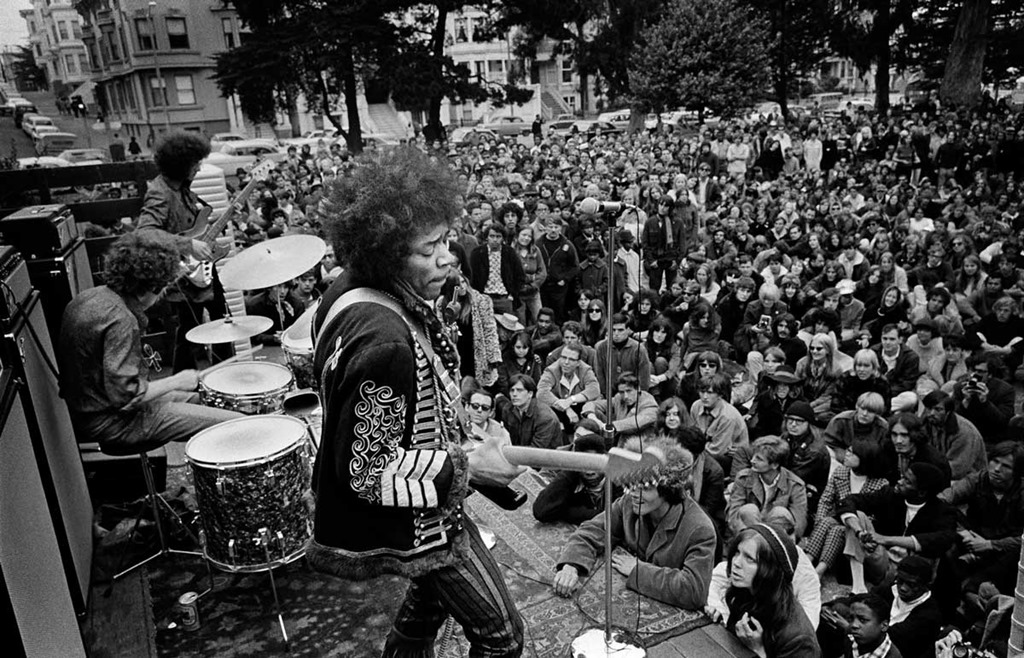
Jimi Hendrix plays for hippies in 1967. Do you envy them or feel superior to them?

In the first stanza, I remind us that Jimi Hendrix was a consummate showman, and that he used showmanship to wrest attention for his art, specifically when he appeared at his first significant concert as a bandleader at the famous Monterey Pop Festival and burned a guitar at the conclusion of a flamboyant act. I present this performance as being consistent to Hendrix’s commitment to his art, as a rock’n’roll musician, an itinerant life with associated dangers, which in his case lead to short life and career. Worth it? Necessary for success?


Hendrix ends his first American show as a bandleader with a sacrifice to his art.

The next stanza acclaims Hendrix for expanding the vocabulary of the electric guitar, using an image of the six-string guitar fretboard, which he transcended with notes beyond the temperament of the frets and though the use of feedback where the notes from the amplifier speaker reflect back to the guitar in the musician’s hands producing sustaining overtones that can be difficult to control but produce extraordinary effects. The question here: these sounds can be harsh, discordant, even painful, but do they too have a necessity?

Next stanza: this feedback is presented as Hendrix’s ancestry: part indigenous, native-American; part Afro-American, a descendent of slaves. This makes Hendrix the point where two arcs of American heritage cross: those that were brought to American against their will, like as to livestock; and those that that were already here and were supplanted by brutal or conniving invaders. The questions here should ask themselves, don’t you think?

The final lines move from Hendrix, to his audience while he was alive and performing: largely white, largely young, many taking a hippie bohemian voyage I liken to America’s famous immigrants, choosing to leave the world of their homes for some promised new world that cannot, and will not, be exactly as promised.

Whatever generation you reside in, you cannot get on a boat or plane to visit another generation’s time; but when you look at a picture or video of a crowd watching Hendrix play, consider those faces. They may be distracted by the day, transfixed or stunned, ignorant and seeking, intoxicated but intent, pleased and puzzled—they may not look like Hendrix, many will seem by their faces to not share his heritage, and none can know the depth of that heritage—and yet, they are dealing with the experience of his art. I ask you not to feel superior or inferior to them from the position of your age or the accident of your generation, but to instead to look to your own heart and ask if there you find some blindness or power, and then to ask, as the concluding words of “For the American Hendrix”  does: when coming to your new land, did you carry with you chains?

47 years ago today, Jimi Hendrix died, perhaps alone, perhaps ignored by his companion of itinerant convenience, trying to continue his art, ignorant of the strength of European sleeping pills.  To hear my performance of “For the American Hendrix,”  use the player below.

A Summers Night

A couple of posts back we had a piece with words by Roy G. Dandridge who got called the “Paul Laurence Dunbar of Cincinnati.” Today’s episode’s words are by the Paul Laurence Dunbar of Paul Laurence Dunbar.

paul-laurence-dunbar

Paul Laurence Dunbar. Young, Gifted, and Black.

Dunbar grew up in Dayton Ohio, the Afro-American son of former slaves. In his town’s high school class of 1890, he was friends with another guy, a white guy, one who had varied enthusiasms. This other guy was a snappy dresser for his time, wearing newfangled wing-tip shoes, bowler hats, and a sporting a dashing waxed handlebar moustache. When the mandolin had a popularity boom, Dunbar’s classmate dude had to learn to play it, and he apparently drove his family around the bend as he practiced. Then later, the dude became interested in printing, and so designed and built his own printing press. He got so attached to printing and publishing that he dropped out of high school to start his own print shop with his brother. Then a couple of years later, the modern bicycle was invented, and his mechanical ability branched out to building, selling, and repairing bikes.

Dayton HS class of 1880 labeled

Dunbar with his high school class. Dunbar is in the upper left, our mystery dude in the shadows in the back.
And what’s with the guy on the left in the front row, shouldn’t he be in a band or something?

But let’s step back to that printing business. Paul Laurence Dunbar was already writing poetry as a high school student. After graduation, his family’s lack of funds and racial discrimination kept him from going to college, but he hungered to get into print. Our dandy, mandolin playing, designed-and-made-his-own-press print shop guy went into business with Dunbar and printed a newspaper that Dunbar edited and wrote for, even while Dunbar was still in high school–and then he used his connections in the business to get his classmate’s poems collected and published two years after Dunbar graduated from high school.

Dunbar’s books gathered attention. James Witcomb Riley, Frederick Douglass and William Dean Howells reviewed him favorably. By the end of the 19th century he had toured England, gotten a job with the Library of Congress, and written the lyrics for a Broadway musical and collaborated on an operetta, becoming the first widely known modern Afro-American poet before he was 30 years old. The 20th Century awaited him.

Then he contracted tuberculosis. His health declined, and though he tried to continue to build on his career, he died in 1906 at the age of 33.

He should have been one the older generation of the Harlem Renaissance of the 1920s. He could have taken his mastery of the lyrical 19th century style, and like Yeats in Ireland, transitioned seamlessly into the forms and topics of modernist poetry.  Alas, none of that was to be.
 

Dunbar’s “A Summer’s Night”  is a lovely, sensuous lyric. If one goes beyond the Victorian-drenched term “maiden” used almost as a refrain in the opening lines, and the slightly precious “perfumed bosom” of the southern breeze that closes the first half of the poem, the flitting last half that closes with carousing fireflies staggering home in the dark is just gorgeous It’s my hope that using our Parlando Project tactic of performing these words with music lets one more easily accept the sentiment of the more archaic words.
 
So, what happened to our mechanical aptitude dude, the guy who’s printing press began printing Paul Laurence Dunbar while they were High School classmates, helping launch the career of America’s first widely known modern black poet?

Wright Bike

This bike looks pretty sweet even today. Dig the mono-tube rear stay, the tri-plane front fork, and the flipped moustache bars.

Turns out bicycles were one of the seed technologies of the 20th century. Our dude knew how fabricate his own stuff, and make it strong and light. The dude was named Orville Wright and he and his brother Wilbur took the modest profits from their printing and bike businesses, and three years before Dunbar died, they designed, built and flew the first airplane. There was a lot of disbelief that a high-school dropout from a hick town could do any such thing. Pioneers like Paul Laurence Dunbar and Orville Wright had to do it,  otherwise no one would believe it.

To hear my performance of Paul Laurence Dunbar’s “A Summer’s Night”  with music, use the player below. And thanks again for liking, following, and sharing.

Zalka Peetruza

Here’s a piece with words by a poet I knew nothing about until this year, and still  now know next to nothing about: Ray G. Dandridge. Born in 1882, Dandridge grew up and lived his life in Cincinnati Ohio, and I read that he was sometimes called “The Paul Laurence Dunbar of Cincinnati,” presumably because he shared the Afro-American ancestry of Dayton, Ohio’s Dunbar.

Dandridge was bit younger than Dunbar and he lived and wrote for twenty years after Dunbar’s death, but he remains less well-known and less read today than Dunbar, perhaps because he seems to have never traveled outside of Cincinnati. In his youth, he was partially paralyzed by polio, and he supplemented what he could earn writing by taking orders for the local coal company.

Perhaps Dunbar’s best-known poem is We Wear the Mask,”  a supple lyric that sings the—at the least—duality of needing to present a composed face while living with the realities of racism. Today’s episode, “Zalka Peetruza, Who Was Christened Lucy Jane”  is one of Dandridge’s best-known poems, and it also deals with this burden of duality, but Dandridge takes on another layer of intersectionality by making his subject a black woman. Dandridge’s Zalka has found herself, rechristened as a non-American exotic, dancing “near nude” yet wearing even more layers of Dunbar’s mask.

Josephine Baker1

Perhaps Josephine Baker made the exotic mask work for her?

For my performance of Ray G. Dandridge’s “Zalka Peetruza, Who Was Christened Lucy Jane”   I fired up a turgid synthesizer patch to carry much of the lead line over a swaggering beat, and you can hear  it by using the player that appears below. If you like this you can make use of the social media sharing buttons to let others know what we’re doing here at the Parlando Project.

Love and Money

Poetry turn-offs? There are lot of them. There’s the fatiguing stretching of language that can wear one out. There can be an air of paradoxical “Let me tell you what I think/you wouldn’t understand” attitude. While modernism has greatly reduced this, there remains an expectation of grand subjects treated solemnly—but then the modernism that gives us a wider choice of diction and subjects, also may hand us a confounding abstraction of words that refuse to work the way we’re accustomed to having words work.

Every one of these things has kept me from enjoying poems, and yet I’ve committed every one of these annoyances myself with my own writing. But what if we could relax, what if we could be told right at the outset that you won’t be tested on the meaning of the poem?

As it turns out, our culture has done that. We call this experience of poetry, without any need to immediately stand and deliver meaning, song lyrics.

With the Parlando Project we often test this theory by applying music to some well-known poetry meant for the page. This pulls the poetry off its silent ink and puts a human voice in it, letting you hear the sound and tenor of the words—but the music adds something else we’ve been culturally trained to do by decades of modern songwriting: it lets us experience the meaning of phrases within the song lyric in a subconscious, non-linear way. As listeners to songs, we sometimes grab the chorus or “the hook” first, and only later begin to appreciate how the verses are shading the experience of the refrain, and in-between times, the music lets us unselfconsciously tap our foot or shake a tail-feather.

Slave freedom paper2

Find the cost of freedom. In this case, a bit less than $172.

I hear alternative Parlando voice, Dave Moore’s “Love and Money”  less as a page poem and more as a song. Over various listens, I think I have drawn some tentative meaning from it. When I first heard the opening lines, I thought I was hearing part of an Afro-American slavery story, where freed slaves sometimes found themselves obligated to buy the rest of their family, because in that outrageous framework, property rights were the only rights that might be honored. As the song progresses, it’s jumps elsewhere, including a verse clearly set in this century. I hear the concluding verse as back in times of slavery, or some equivalent evil time, but the journey from beginning to end exists with a refrain that “our only chance comes down to love and money” and a wicked interlocking riff between Dave Moore’s electric clavinet part and my own Telecaster guitar.

So go ahead and listen to Dave Moore’s “Love and Money”  by using the player below. You won’t be asked to write an essay on it or anything.

Soul Selector Blues

Sometime around the end of the 19th Century, a century that had seen accelerating change in technology and social order, new artistic movements began to flower on either side of the Atlantic. In the UK the Arts and Crafts movement and the Pre-Raphaelite Brotherhood looked backwards at things that had disappeared or were nearly gone, and revived them within a the new context of their present day. Interest in neglected folk-cultural traditions of nations began to arise. Others looked to new orders: utopianism and socialism. The seeds of what would be called Futurism began to take shape, a worship of the inherent art in technology.

Here’s a funny thing: all these things mashed-up in the ferment of the times. Some of the artists held to several or even all of these beliefs, participating in more than one of these seemingly different or even opposed movements. Call this brew “Modernism,” for the one thing that united it was a desire for something new, or at least new for the times, to be produced.

As the 20th Century got underway, American artists forged ahead in these movements. The reasons for that are multifold, but one is that they had a head start: Walt Whitman and Emily Dickinson and the Emersonian Transcendentalists had already pioneered distinctly American ways to be modern.

Let’s leave the salons and literary magazines now for a moment. Here’s something else that was happening at the same time, with only spotty distribution beyond its creators. Some African-Americans, presented with nominal freedom, economic serfdom, social repression, and what must honestly be called a sub-human classification by many learned men, continued to come to terms with European instruments and tempered scales, combining them with the already juicy stew of American music and the remembered modes of Africa. They produced their own Modernism, something that eventually got called “The Blues.”

Lyrically, this was an inherently skeptical art. As it percolated through commerce, the Blues got re-defined as a sad song of loss, and loss certainly is part of its subject matter, but the outlook of the original Blues writers was not simply that. A lot of it was satiric comment, and when the Blues dealt with the desire and farce of love and lust, as it often did, it wasn’t just about loss.

I could go on and on about the Blues, but for the moment, I’ll ask you to just absorb this: when William Butler Yeats was having a harp built to chant his poems to, as he believed the Celtic griots of old had done; and when Ezra Pound, Robert Frost, HD, Amy Lowell, William Carlos Williams, Gertrude Stein or T.S. Eliot were inventing their strain of Modernist poetry, often abroad, some other Americans were back in the States retuning guitars and looking for the notes between the keys of the piano with their own poetry that sought to “make it new.”

Emily Dickinson is a special case in so many ways, but one of those ways is that although she wrote much of work during the Civil War in the middle of the 19th Century, she was only published much later in the century. Her poems, so stripped down, so skeptical of received notions, so vivid in fresh images that didn’t map easily to conventional meaning, fit right in with work being written 50 years later by the Modernists.

Emily Dickinson Uncrowned Queen of the Blues 2

Warning: time travel plots often are ridiculous.


Today’s episode “Soul Selector Blues”  takes this time travel one step further. What if Emily Dickinson was a serf on the Dockery Plantation in Mississippi early in the 20th Century? Maybe she’d tune a guitar to “Spanish” and grab a slide to get those in-between notes, and then what would have been “The Soul Selects Her Own Society”  would come out like this.

To hear the LYL Band cover “Delta Amherst” Emily D’s classic 78 r.p.m. side “Soul Selector Blues” use the player below.