I’m glad my face ID still recognized me today to write this, since I’m in an unhappy, grumpy mood, and I don’t much like the self I’m in. This mood may be because it’s winter and cold with dark early and late, or because I didn’t get a bike ride in, or because folks with guns and ones with governmental power are doing cruel things for the proximate reason that they’re cruel. Grumpy and unhappy? Perhaps a reasonable response for winter, but is that same mood commensurate to the mass shootings in the news or the treatment of our country and neighbors by the mad king and his gleeful courtiers? I don’t know. Whatever I do (little) or think (enough? too much?) about these things ties me up in this grumpy place. In addition, we have a world of similarly unsatisfied folks to me – but these folks are pointing out that we aren’t thinking or doing enough in various best ways to defeat these horrible acts.*
Since I put my efforts toward music and poetry, I’m not going to charge you with not doing the right things to counter those general evils here. It would feel hypocritical for me to do so. But this dissatisfaction with the world and myself is bleeding over to my work today as well.
Early this morning I posted something on BlueSky about Jazz that could be easily misunderstood. So, I’m taking my chance to get it off my chest here so that I can be misunderstood or make a fool of myself at a greater length. There’s a new documentary that you can rent-to-view for $3 on Amazon: The Best of the Best, Jazz from Detroit. This is a good film, made for the best reasons. My reaction is not their fault, and you shouldn’t hold it against them. The insightful Ethan Iverson has it right in summing up its value: “not just…a must-watch for fans, but also a superb introduction to jazz for the uninitiated.” But reading an interview with its creators and spending a rewarding 90 minutes watching it today also activated a problem I’m increasingly having with my musical work here. Let me summarize it as quickly as I can.
I feel embarrassingly limited as a musician. That I have a few tricks that I can pull off some of the time on a few different instruments must be balanced against the absence of some foundational skills that should be there. This is the reason that I’ve often taken to calling myself a composer, since my tactic is to create pieces I might play passably well rather than to show my lack of skill in doing musician’s work.** But “composer” sounds even more presumptuous. I call myself, I think accurately, a “naïve composer.” I know dribs and drabs of musical theory, but again I lack the musical foundation that most anyone who calls themselves a composer would have.
I feel this lack of foundational competence often among musicians, and I’d feel it even more if I was around folks who are composers often enough – and there’s no place I feel it more than when you put “Jazz” in front of musician or composer. Watching Jazz from Detroit, this fine film, reminds me of that; first because it makes the point that one of Detroit’s strengths as a “punches above its weight” center of Jazz music is that there were teachers in the school system and elsewhere in the city, mentors who helped young players understand and master the fundamentals of that art. These mentors guided folks who made Jazz and music their life and honors them. And it makes another point beside that one: they did this as part of a specific Afro-American urban culture that is not mine.***
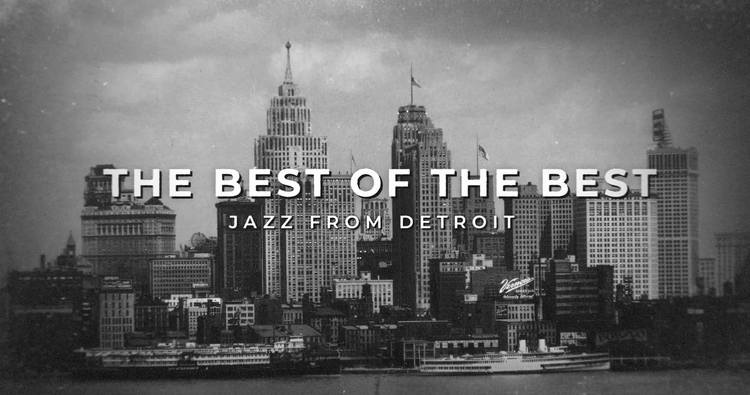
The film’s title screen.
.
OK, so where does that leave me, particularly at my advanced age? I somehow can’t stop at simply recognizing and honoring that, I’m drawn to dipping into that musical language at times here, even if I can’t speak it fluently, and I’m not sure that is a good thing. Are my efforts, which wouldn’t fool a skilled Jazz musician for a minute, profaning their art? Does even my small audience subtract from the possible audience for more dedicated and skilled musicians? Is this intentionally non-revenue Project undercutting folks who need recompense? Or even: is this self-flagellation boring, and something only someone with my level of privilege would undertake? Am I thinking about any of this too much, or thinking about it not enough? I don’t know.
But here’s what I do know: what I can observe I do. I keep doing this, even if it may be wrong – or guilty of a lesser sin, missing the point.
Here’s a piece of mine from a few years ago about the dedication of an actual Jazz musician, Sonny Rollins. Audio player gadget below, or alternatively, this highlighted link that will open a new tab with its own audio player.
.
*Some of them could be right on what we should be doing – but since they differ, some are likely wrong. All of these voices can’t be Martin Luther King writing from the Birmingham Jail, and there are/were folks then and now that didn’t think he was doing it right either. In our modern age I can’t help but suspect the “everybody to the left of Donald Trump is complicit in this mess” voices as bots.
**Put me in a room of not particularly skilled folk or rock players with my guitar, and on a good day I might fool them for a while at being a musician.
***This isn’t shouted outright in the film, but some of the elders speaking in it are, I believe, trying to make the point that the specifics of their 20th century Jazz-creating Afro-American culture require additional efforts to be valued and maintained.
I’m going to write about 20th century poet Langston Hughes’ pioneering Jazz poetry. I’m hoping to condense a lot, trying to make this short – but we’ll see. Like someone commencing a Jazz improvisation, I’ve got an idea – and maybe have some sight of where that idea goes – but what happens after that? That spirit, going there with maybe a first idea to see what you can develop from it, is what makes Jazz improvisation possible. Some skilled musicians, able to translate written scores into music straight off the page are terrified of that leap. Perhaps it’s because they know how to play those set-down compositions right that they’re frightened – if I must improvise, they may think, how will I know what’s right?
Langston Hughes published the words I’ll be using today in 1926 – but I must be in a hurry telling today’s story, because I’ll start in 1835, or thereabouts. Wikipedia puts “circa” next to that date, so there aren’t any attested records, but one Mary Sampson Patterson was born a free woman of color at about that date in North Carolina.
At around age 20 her Wikipedia entry says she fled for Ohio due to an attempted enslavement.* Records again are sketchy, but in Ohio she in some way studied at Oberlin College – as an Afro-American woman, this a double rarity in the first part of the 19th century. Her education trailed off in 1858 when she married Lewis Leary, a fugitive slave also from North Carolina. Leary was not just a fugitive slave, he became part of the Harper’s Ferry Raid, John Brown’s attempt to start a mass slave rebellion by attacking a military armory in Virginia. Brown attempted this with only 22 men, including Leary. Under the element of surprise, Brown’s men took over the lightly guarded armory, but a little over a day later a full military detachment under the command of Robert E. Lee easily defeated the small band. Nearly half of Brown’s raiders died in the subsequent battle – Leary being one of those – and seven more were executed afterward. Lee didn’t need to be any kind of military genius to win this battle, and whatever Brown’s beliefs, he wasn’t a great tactician either. Were they both improvising? I suppose they were.
The widow Mary married another abolitionist, Charles Langston, and they moved to Lawrence Kansas to raise a family. One of their children was Carolina “Carrie” Langston. That Carrie Langston married a James Hughes. The marriage was short-lived, though it produced a son given the first name from the mother’s family and the last name of the father’s: Langston Hughes. That was 1901 or maybe 1902 – accounts differ. Anyway, we’ve reached the 20th century.
Carrie needed to find work, and so the young Langston Hughes was largely raised by his grandmother Mary. So here you go: a Black woman, born around 1835, in the age of slavery, flees slavery’s grasp, gets at least a smattering of higher education, gives that up for a husband, then in turn gives up that husband in the fight against slavery, and in the end gets a chance to nurture a literary innovator. No one composes such a life and scores it out ahead of time.
I believe this is a photograph of the woman born Mary Sampson Patterson. The place I found it credits Yale’s Beinecke Library. Oddly enough I found two other photos claiming to be the Mary Patterson I write of above. Image search says one is another abolitionist woman from the same era. The other, of an older woman, may be Mary Jane Patterson, who was the first Afro-American woman to get a BA, coincidentally in more than the name, from Oberlin.
.
Hughes started writing poetry as a child. His first publication was as a teenage contributor to W.E.B. DuBois’s short-lived kids magazine. In the 1920’s he’s a young member of what gets called “The Harlem Renaissance.” Like his grandmother, he starts to get some higher education, but that effort is thwarted.** In 1923 he takes a job crewing on an Atlantic ocean merchant steamer.
How far is he planning ahead? Like many an improvisor, Hughes might have an idea in his head, he goes there, and he sees what happens to fit next. In 1924 he jumps ship while it’s in Rotterdam, and makes his way to Paris. One of the things he finds there: other Black folks, some of them playing Jazz, which in Paris has an added layer of exoticism. Here’s a link to a good short account of some of what Langston Hughes found there.
Hughes is an Afro-American. Jazz isn’t exotic to him, but furthermore he’s part of a smaller group (even among Afro-Americans) who are developing a deeper understanding and appreciation of that music.
Given what Jazz is in our current century – a largely select-audience concert art – I feel I have to go on another expository aside now, filled with what I have absorbed from history. In the early 1920s Jazz is viewed as fast-tempo music, suitable for dancing, drinking, and carousing. Intellectually, it’s considered thoughtless, or perhaps comic, a burlesque of real musical structure, timbres, and practice. It’s associated with criminality, intoxication, and sexual promiscuity to the degree that it isn’t just guilty of being an accomplice to vice but the cause of it: just taking in that hopped-up primitive music might drive its listeners to excess and ruin. Believing that I have a wide generational and geographic range within the readers of this Project, rough analogies to the initial cultural assessments of Rock’n’Roll and Hip Hop may be made – but I have no sure metaphor for those of you who grew up in our present century, for whom those later musical movements are history too.
Just like Rock’n’Roll and Hip Hop, Blues and Jazz are Afro-American musical forms, though both soon-enough have non-Black practitioners, and this points out something that the intelligent 1920s Afro-American young man in his 20s, Langston Hughes, is facing when he writes about his experience of Jazz. In a class or vocational level, is he going to be the college-degree middle-class artist or is he going to be a crewman on a steamer or a servant-job worker? Could he be something else beyond that dialectic? Hughes must have thought of all of this even before he took off from that freighter job, and every poem he writes may be notes and directions to himself in these matters.
I don’t know when Hughes first started to write poetry about Blues and Jazz, but some things I’ve read say that his poems about them go back to his high-school poetry – and I also don’t know when he first performed his poetry with Jazz accompaniment, though I think that music is present anyway in the word-music implied in much of his early poetry – but this was unsure ground to stand on in the 1920s.*** The novelty of a genteel high art like literary poetry speaking with appreciation about Jazz had some controversial power, but cultural gatekeepers, including some of the nascent Black critics, considered the music embarrassing and detrimental. Concert music, particularly Afro-American Spirituals, overtly concerned with the Abrahamic Godhead and Biblical stories (even if metaphor for temporal, earthly liberty and respect) were a competing, easily praiseworthy art that elevated the race. Meanwhile, Jazz, including the way it was adopted by some white listeners and practitioners in the 1920s, reeked of black-face minstrel shows, with white folks playing Black folks playing the fool.
So, once more I’ve taken the long way around, but here’s the 22-year-old Langston Hughes, an Afro-American poet and college dropout, so-recently raised by a Black woman who intimately knew the serious costs of seeking freedom and respect, with $9 in capital equity in pocket, who’s jumped ship from his job, and is in Paris, a capital of European Culture – and he finds, of all things, a Jazz band. Here’s a link to the text of his resulting “Jazz Band in a Parisian Cabaret” if you’d like to read along.
There’d be a temptation in this for a long poem of internal monolog, or some mighty external manifesto. A great poem might be written thusly, stuffed with much of what I’ve taken your time to discuss today. Instead, Hughes wrote this sly, shorter poem, one that assumes you know this history, assumes you know it in the same way that some other poet assumes you know Ovid or the Trojan War – and goddammit, if you are an American you should know it! Hughes little poem is made up of contrasting voices, a floating democracy of understandings and misunderstandings, breathing together as Jazz plays. The diverse audience calls out, wants this music. Hughes’ voice inside this colloquy, needs it – not just to remind him of home, but to let he see that home and his culture in perspective – and so he joins the chorus of “Play that thing, Jazz band!” European high culture and wealth enjoys it – and it’s a testimony, not a detriment, to its powers that the demi-monde likes it too. Are the American millionaires (perhaps as culturally stunted as modern techbros) slumming for idle amusement, or covert in foreign secrecy allowing a forbidden release? No matter, schoolteachers, the most modest keepers of culture, find it worthwhile. And oh, this statement, summing up something that Hughes can see in this moment: “You know that tune/That laughs and cries at the same time.” Hughes reports a little babel of European languages is going on around this recognition on his part that the Jazz band knows inherently what he knows. Then Hughes’ voice speaks again in his poem, another remarkable realization about Jazz music, “You’ve got seven languages to speak in/and then some.”
This epiphany then: Afro-American art: Jazz, Blues, Hughes’ own poetry, can go over the heads of the domestic gatekeepers or the reactions of racism.
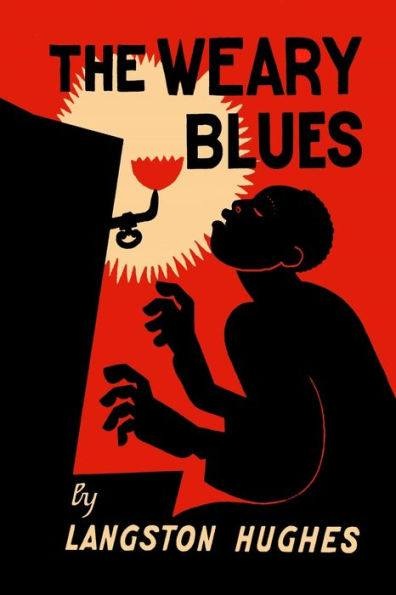
Hughes chooses to close his poem with a three-line final scene, one which a further dramatic program note might illuminate. Someone is picking up someone else for the night. No gender is lined out, and while it could be Hughes, it may also not be, or it may be Hughes constructing a metaphor.**** The person they’re attracted to is said to be from Georgia. I think that’s an important detail, because the poem’s dialog has it “Even if you do come from Georgia.” Hughes, Northern-raised, recipient of a white-privilege-level high school education and some Ivy League University is portraying this amour as an uneducated rural person. Metaphorically then, Hughes’ concludes that Jazz and Blues folk-music ancestry isn’t important compared to what it does – and by writing Jazz poetry, eventually performing Jazz poetry, that’s the choice the young Langston Hughes makes. When this poem appears in his first poetry collection, that book is going to be titled The Weary Blues – right on the cover he’s making a point of his decision on what’s worthwhile art.
.
Now that I’ve written all that, I’m left with handing off to my musical performance of Langston Hughes’ poem. I felt compelled to “make a Jazz noise here,” as one of my models once titled an album. As a composer I don’t have the theoretical training that most modern Jazz composers do, but I put something together using a characteristic Jazz harmonic cadence. Then the composer called on the inconsistent musician me to realize it and improvise the top line melody. I’ve been practicing my poor chord-comping skills a little bit lately, so I was able to portray the set of written chord changes passably. Spontaneously creating while playing the melodic guitar line was easier for me, as I’ve always been open to improvising that sort of thing. When I start something like that, when I don’t know how to play it exactly – I may have an idea, go there, and see what would fit next. You can hear the result with the audio player gadget below. Is there no visible audio player? No, your ship didn’t leave port without you, it’s just that some ways of reading this blog will suppress showing the gadget, so I offer this highlighted link that will open a new tab with its own audio player.
**Hughes and his mother were estranged from his father, who had become a company man with the Pullman Company working out of Mexico City. Langston’s father agreed to support his education as long as it was aimed at practical matters such as engineering, not the arts. Langston Hughes agreed to make a go of that, but found he couldn’t leave his literary interests. The train trip to work out this ultimately-to-fail detente produced one of the greatest poems ever written by a teenager.
***Unintendedly, I seem to have stumbled into a theme this fall: literary poetry which has absorbed folk-music forms. Folk revival acoustic-guitar-based music and electric Rock are in my page poetry just as they are more explicitly in my Parlando Project pieces using other people’s words.
****Hughes sexuality is, best as I can determine, hard to determine. Some say he was gay, others assume bi. Some who knew him well paint a somewhat asexual person, or they just say, as I do, that they don’t know.
Today is International Women’s Day, and I was fortunate to be able to complete this recording of a new musical piece setting a poem by Alice Dunbar-Nelson before the day ended.
“I Sit and Sew” is likely Dunbar-Nelson’s best-known poem — it’s certainly the first one I knew of. I’d encountered it as a poem written amid WWI during the years this Project was noting that conflict’s centenary. “I Sit and Sew” still comes up fairly often in regards to war and destruction, or because it mentions domestic, woman-associated work in the context of the greater world.
I noticed one other element in re-reading it this week: it seemed to me to relate to another line of woman-associated work: medical nursing. Having spent a couple of decades doing nursing work myself, the poem’s focusing-in on the trauma and injuries of warfare really made me think Dunbar-Nelson wasn’t just thinking generally, writing something that could be paraphrased as “War is terrible, and yet here I am peacefully making or mending something with needle and thread, as women have for millennia.” There’s nothing wrong with experiencing the poem that way, as a companion-piece perhaps to Hardy’s “In the Time of the Breaking of Nations” — but I’m a person who often asks questions while reading.
While the poem can stand on its own, I wondered if Dunbar-Nelson herself wanted to serve as a nurse.* Short answer: this issue has additional complications. Currently in the United States we’re suffering from numerous outlandish statements and acts snuffing out complexities of diversity, but historically women’s wartime work, including nursing, is tightly connected with increasing respect and civic equality for women.
Alice Dunbar-Nelson was an Afro-American woman. The U.S. armed forces were segregated during WWI, and the roles available to the non-White military were limited along with that, based proximally on rules about race-mixing no-doubt supported by a pervasive background of racial superiority. A few years back, while learning about another poem, I came upon the case of Col. Charles Young, a Black West Point educated officer with experience in two foreign deployments who couldn’t get himself utilized as America mobilized for WWI. The situation for Black Americans who wanted to work overseas as nurses was also exclusionary. I’ve found out Dunbar-Nelson was working as a national organizer, a member of something called the Women’s Committee of the Council of Defense, and her focus was on Afro-American support of the war effort. She published today’s poem in 1918, and after the war she wrote up a summary of Black women’s WWI efforts.
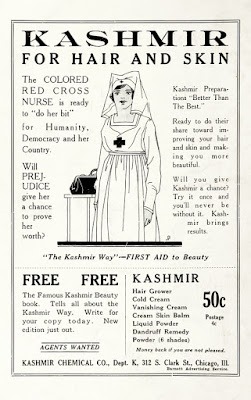
We Wear the Mask Dept. I found this ad here in another post mentioning this poem. In her article linked above, Dunbar-Nelson mentions, in passing, (pun intended) that some lighter-complexion Afro-Americans snuck through the overseas nursing service ban.
.
No long post today, that’s a start for anyone who wants to dig deeper.
The song I made out of her poem came together more efficiently than many, partly because it began before I knew I was making a song. This week I remodeled a nearly 30-year-old Squier Telecaster that I had put a Bigsby vibrato bridge on a decade or so ago. This guitar and that bridge just never worked out. I couldn’t get the neck angle and string height right, the saddles rattled, and the strings slipped sideways when I bent strings. After some looking, I unearthed the guitar’s original non-vibrato bridge and put it back on.** The guitar was transformed. Back when I put on the Bigsby I’d also installed a set of upgraded replacement pickups, and with the string-path mechanics sorted out, the guitar played and sounded great! While I was resetting the action/intonation etc., I quickly made a short musical piece on my recording computer that would let me play strummed chords, arpeggiated chords, and single-note lead lines over three separate sections — just so I could have fun while seeing if I’d eliminated all issues.
Funny how fast you can compose, if you’re not composing. I saved the drum pattern, the bass track, and the keyboard noodling after testing the guitar, thinking “Hey, I like that groove, might be useful.” This morning, I had about an hour when I could open a mic and record. I loaded the saved rhythm tracks, worked them into a longer song-form, recorded the guitar parts using the transformed guitar, and found that I could sing Dunbar-Nelson’s poem to this.
You can hear it with the audio player below. No player? It’s not hiding under a box, it’s just some ways of reading this blog suppress the player gadget. This highlighted link will open a tab with its own audio player.
.
*”Nursing” is a very broad word covering a wide range of caring work and levels of technical knowledge. Dunbar-Nelson’s write-up seems to indicate the women’s war work she was promoting covered a range of things, not just licensed medical nursing as we know it this century.
**One difficulty was that the original — like the Vibramate-brand vibrato bridge I took off — was a non-standard bridge. When I finally found the original bridge, it was sitting underneath a storage box in my studio space. Luckily, like most Telecaster parts, it’s not a fragile thing. By the way, I’m not knocking Vibramate’s hardware. I’ve used Vibramate products to add Bigsby vibrato bridges to other guitars with good results, and their “Spoiler” accessory for Bigsby bridges makes restringing or replacing a broken string a much calmer experience.
Early this morning, I was reading a blog of a modern avant garde poet who has lots of philosophic theories about prosody, and there this quote of Walter Benjamin’s is brought up: “To write history is to give dates their physiognomy.” Well, yes, I thought, that’s what I’ve been doing in this Black History Month series. This scrapbook, its photographs, ephemera, ads, and clippings from newspapers — all a picture of the history of an American Black man: Lawrence Kasuth “Hank” Hazlett, a musician and singer who lived from 1911 to 1990. That scrapbook that had come into my hands portrays his nation-touring time in the 1940s and a residence in South Minneapolis in the 1950s. When it comes to civil rights or diversity, we tend to see change, or the preceding things that needed to change, from a later vantage point. The scrapbook documents such a preceding time, and the sort of things that musician Frank Zappa liked to call “mutations” — the tiny breaking of norms. But, isn’t it just a scrapbook?
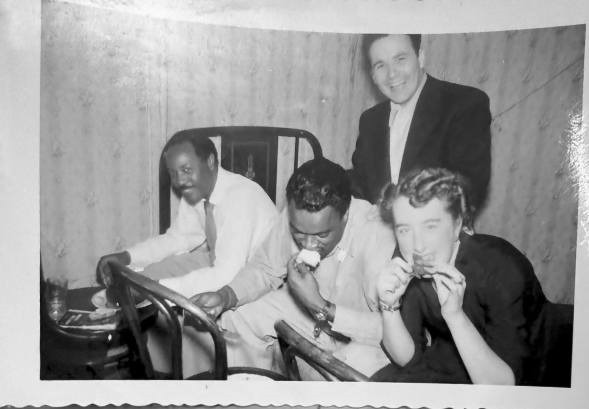
There are pieces in the scrapbook that may give us a glimpse into what its maker noted and selected to save. In the last post, we saw a picture of Hazlett playing on stage with a white bass player with the hippest of truncated neckwear — but overall, the performance photos show black musicians with him, playing (as far as I can see) to black audiences. Yet, here’s a photo from the scrapbook that stood out from that segregated norm:
.
In this photograph two black men (the one on the left appears to be Hazlett) are sitting on a cheap enameled-bedstead bed eating. Sitting on the same bed is a white woman and behind those three, a white man in a dark suit is standing. Black and white, men and the woman are smiling. It looks like an inexpensive hotel room, and maybe they’re all on tour.
On the back of the postcard they wrote: To Edith and Hank. So nice meeting you, it’s a pleasure to be an entertainer along with you. Jeannie Bill and Don
.
The scrapbook also collects this promotional picture postcard for an act called Jennie and her Boyfriends, who issued a single 45 RPM do-wop style record in 1959. Jeannie in the promo picture has a completely different hairstyle and hair-color, but it’s plausible this is her and one of the members of her trio in the bed-sitting photo.
Also in the last post in the series, we showed some clippings in the scrapbook of Black entertainers working to defeat limiting stereotypes, but one thing that struck me was that the scrapbook also contains clippings showing white entertainment figures. Ephemera in the book, like that MGM W2 form from ’44 and Los Angeles addresses for Hazlett make me think that he might have had at least tenuous connections with some of them during the 1940s. Here’s a page from the scrapbook showing a clipping featuring Lana Turner, which may have been included because its caption says Turner likes Duke Ellington records.**
Lana Turner isn’t into vinyl, she’s spinning shellac.
.
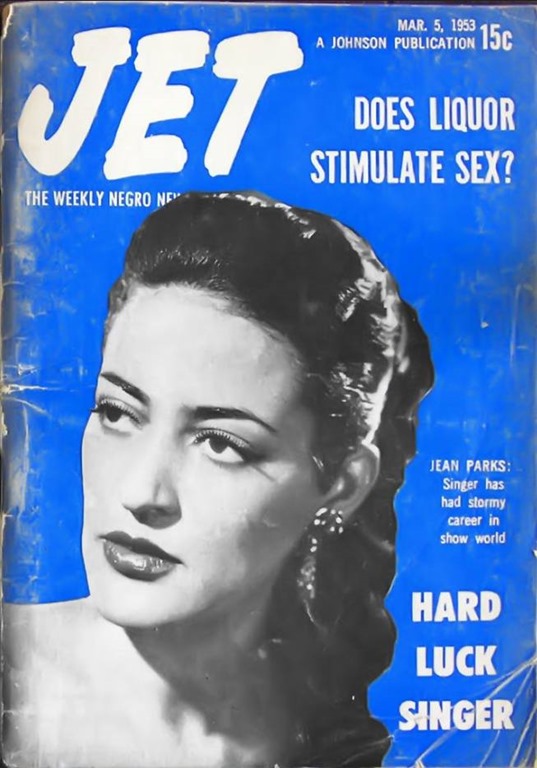
These are old clippings, sometimes from lower-res reproduction, and occasionally I’m misled by the ambiguities of race in the photographs. Take this one of Jean Parks found on this page with both white and Black entertainment figures. I figured she was white.
Find the second Afro-American woman on this page.
.
Those who’ve followed this blog will know that I was immediately saying to myself “Who’s Jean Parks?” The story outlined from asking that is as rich or richer than the story of Bruce Dybvig from earlier in this series. WWII military service put a crimp on the supply of male musicians — so just as with other occupations, there soon arose a number of female bands — Rosie the Riveter, only with saxophones. Popular pre-war bands often enough had female singers, and there were a smattering of woman pianists (and small-group guitarists) — but women playing horns, reeds, drums in big bands— important featured instruments in those ensembles — I can’t think of one. Then came the war and mobilization. All of a sudden there were groups entirely made up of Black or white lady musos sprung full borne from the brow as it were.
One of those was Eddie Durham’s All-Star Girl Orchestra. OK, now we’re studying history, so we have to do dates. It’s Victory over Japan Day, the war is over. In NYC a sailor grabs a nurse in a crowd without her consent, starts kissing her in front of a cameraman, and everything thinks this is splendid because the immense horrors of world war are over — and the, you know, sissy stuff of regular old living is to return. The All-Star Girl Orchestra are in the middle of an engagement on the opposite coast, in Oakland California. The link above says that manager Durham sees that the men are going to return — and just then, dissolves the act. Well, sort of. Some remainder is rebranded around singer Jean Parks. As it turns out, the post-WWII years will be tough for all big bands — and all-around, the all-girl band thing doesn’t survive the peace.
And here’s what happens when Parks meets the world of The Fifties. Just look at the bad-girl triple-double implied and indicted in this paragraph: Black, caught with a 6-foot-tall platinum blond “friend”/roommate, sex-work — and drugs? We got’em all: reefer, opium, cocaine. Other than a Communist Party membership card signed Mr. and Mrs. and documents linking her to a plot to cancel Howdy Doody, this is complete “All-Star” material.***
Seeing that other headline on the Jet cover, and suddenly I’m a teenager in the back row of the classroom muttering to a classmate “I must be drinking the wrong kind of booze.”
.
Two other pictures in the scrapbook seem to tell some kind of story about connections between the races, likely in Minneapolis in the ‘50s. There’s this snapshot, pasted on the same page as the similarly posed picture I speculated last time might be of a child of the Hazletts. I have no idea who Maxine is, or who’s Chuck. But as with the other pictures and accounts in today’s post, I’d reckon that mixed race connections like this had elements of risk beyond just social disapprobation. White school integration riots, Emmett Till, the beating and burning of the Freedom Riders buses, all were contemporary with the scrapbook.
.
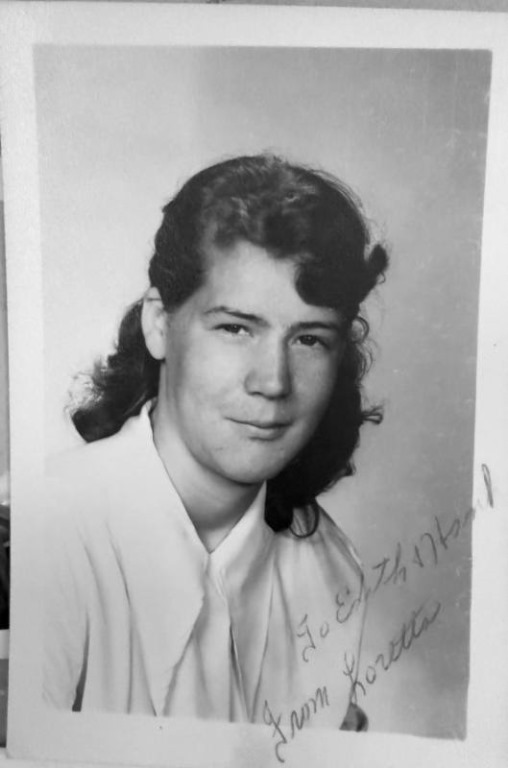
Then there’s this picture, inscribed to Hank’s wife Edith and so presumably from the early 1950s. So many of us have awkward school-picture-day photos, but I found this one more arresting than awkward. This is hard to detail, so I’m going to be more awkward than the picture, where after all Loretta is smiling and seems comfortable with themselves: Loretta looks quite masculine. Unattributed, it could easily be a 20-year-later photo of a mullet-head male guitar player in someone’s high school rock band. Burn-out the long-point blouse collar and retouch the long tresses in the back and it would be a 1950s boy who wants to grow up to play in Elvis’ band.
Loretta.
.
There’s no other context other than the inscription and being in the scrapbook. Looking at Loretta’s photo this month I immediately thought of “Get Back,” the Beatles lyric. Some of you may be singing the applicable verse in your head now that I’ve said that. My second thought: I’d love to know Loretta’s story, but there’s next to no chance I ever will.
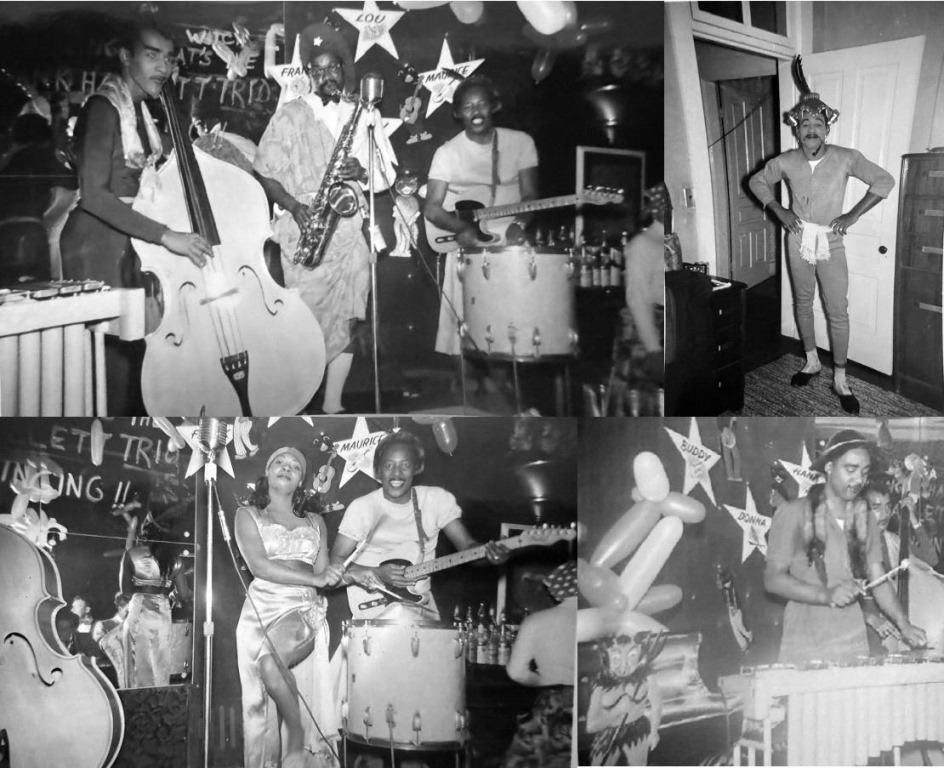
And now a transition that may or may not be apt. There are several pictures of Hank Hazlett, and Hazlett with his Trio, dressed in drag. I can’t place the club stage shown in most of the pictures. The Telecaster he’s playing says this is likely during the Fifties when he’s largely working out of Minneapolis, and it may be a Minneapolis club. Everyone looks like they’re having a good time, and dressing in drag is a multivalent act that can be meant to convey different things.
..
Everyone seems to be having a good time. Of course, right now we know it’s supposed to mean danger to children, and therefore we must let rich folks get richer so they can stop those goings on, because…religion. That’s a very serious opinion, mandate and all — you ought to pay attention to it instead of looking at this approaching 20,000 word series on — what? — a scrapbook about a Black musician who few have even heard of. And the scrapbook is mostly pictures, where’s the meaning in them? Of course, then there are these other Walter Benjamin quotes: “Those who do not learn how to decipher photographs will be the illiterate of the future” and “We collect books in the belief that we are preserving them, when in fact it is the books that preserve their collector.” Benjamin’s life, which we know more about than Hank, or Edith Hazlett’s, or Loretta’s life, could be called in to rebut those quotes. In a corporeal sense, he had little future, books didn’t extend his human, breathing, skin-coated living. But Benjamin did have his quotes, groups of words that might work like poems to let us see something new, and there are even some who will read philosophy at length.
There’s a new musical performance today, taken from a piece of folded and unfolded paper that was pasted into the Hazlett scrapbook. Did Edith carry it? Did Hank? On it, in faded pencil, are written 6 quotes, 6 maxims that someone wanted to carry in order to carry on. They are from a mixed-bag of writers, numbered 1-6 on the page, and in which order I read them in this performance: M. B. Whitman, H.D. Thoreau, Lloyd C. Douglas, Helen Keller, Herbert Kaufman, and Ambrose Bierce.
You can hear that performance with the audio player below. What? No player to be seen? Well, there’s injustice, carelessness, and cruelty we don’t see, and that’s a bigger deal than a couple of minutes of me dressing up in weird Jazz-band drag and reading some inspirational quotes — but you could use this highlighted link which will open a new tab with its own audio player.
.
*Marv Goldberg mentions that the Cats and the Fiddle might have had some involvement with the 1945 MGM Judy Garland film The Clock, which would have been several years and lineups past the original Cat’s quartet burst of Hollywood film appearances in 1938 — those all even before they had made their first appearance on recordings. A 1945-released film would have overlapped the time that Hazlett was in the Cats, could explain the 1944 W2. Mysteriously, I distinctly recall seeing a clipped advertisement for that movie when I first looked into the scrapbook years ago, thinking I should check the film out — but for some reason it isn’t in the scrapbook now.
***Like The Clock ad, I also distinctly remember seeing an article about someone in entertainment arrested for prostitution when I first looked through the scrapbook years ago. It too is missing now. The scrapbook was part of at least one move, and when I look at it now, I have to take care, as it’s falling apart. I now suspect that might have been more on the Parks case. The All-Star Girl Orchestra could have shared bills with the Cats in Hazlett’s time — they played the same theater circuit during WWII.
My feature this February has been centered around an Afro-American scrapbook entrusted to me after it was found in a crawlspace at a former South Minneapolis rooming house in the middle 1970s. This series has taken me away from the usual Parlando focus, which is combining literary poetry with original music in differing styles. If you’ve been missing that, look to the bottom of today’s post — I’ll have something new for you today.
This exploration has taken a tremendous amount of time and effort, and I sometimes doubt how many readers will share my level of interest in looking back at what’s in and surrounding that scrapbook. It seems worthy of notice to me, and that supports my mind and heart work in this month’s effort. I did warn at the start of this series that what I’m writing here is coming fresh from an examination of the scrapbook, and some of my findings will be preliminary or subject to better evaluation — even little things in this larger than usual collection of writing. I just finished fixing a handful of typos on the previous episode that escaped my eye last night before I went to sleep, and now it’s time for the next one.
As a document the scrapbook spends a lot of time in the World War Two years. The book’s leading man, guitarist and singer Hank Hazlett, got his big show-business break then with the Jazz quartet The Cats and the Fiddle,* and the scrapbook evidences notice of the war in the things its maker chooses to include.
Here’s a Roy Wilkins column collected by the scrapbook maker rejecting racial prejudice in the US armed forces published during the war.
.
And here are a few more war related clippings in the scrapbook.
.
Another war-related story included in the scrapbook is a newspaper clipping that tells us of the Hank Hazlett era Cats opening for and then backing Lena Horne in a musical appearance in front of a hospital’s wounded soldiers. The Cat’s opening set was “Stomp, Stomp,” I Miss You So,” “Straighten Up and Fly Right,” with “Another Day” as their encore. With Horne at the mic, the combo supported her singing “Sometimes,” Stormy Weather,” and “Honeysuckle Rose.”
.
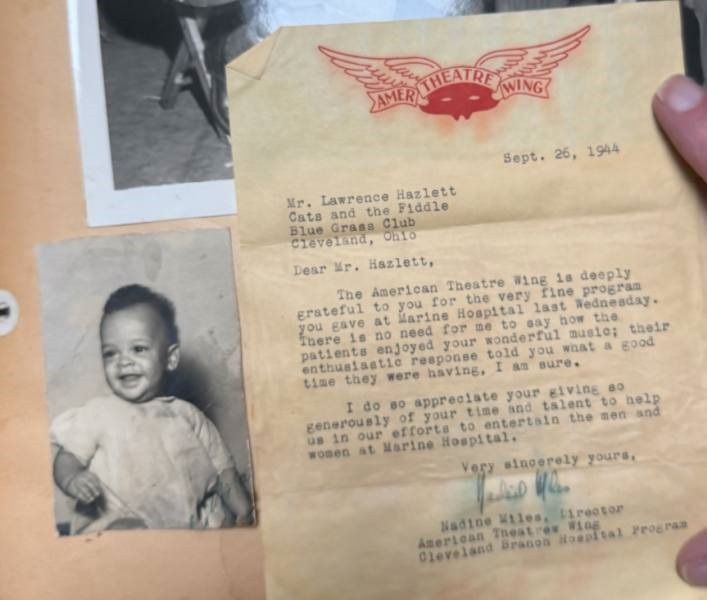
Having this dated letter from 1944 pasted next to the baby picture opens a theory regarding a possible child of Hank and Edith that I wrote about yesterday. A 1940s child could be part of Hank’s deferment, could be the right age to write Felicia’s letter to Daddy a few years later quoted in yesterday’s post, and later yet could also be a young, teenage woman, the subject of another picture in the scrapbook. That the thank you letter is addressed to Hank indicates to me that he might have been the de facto bandleader for the Cats and the Fiddle during his time with them. He was likely 6 or 7 years older than the other Cats in addition to taking the place of their regular lead singer — so, that role might have fallen to him.
A strong theme throughout the scrapbook is Afro-American pride and their struggle for equity in the arts. Many clippings demonstrate that the maker of the scrapbook was concerned with the stereotyping and constraints on Black entertainers and some clippings celebrate their achievements in overcoming that. Here are a few of those items from the scrapbook:
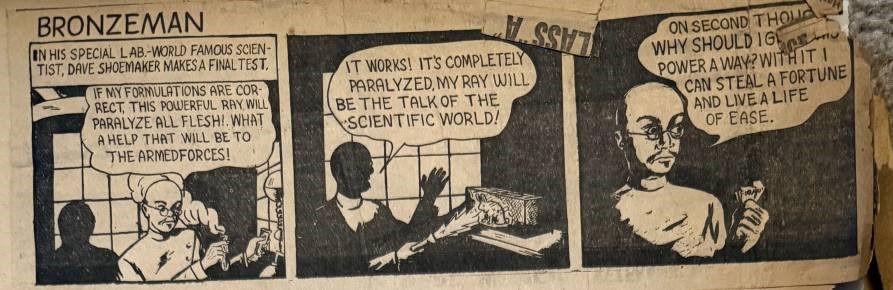
Did a bronze man create this? Yes. A.C. Hollingsworth created Bronze Man in Blue Beetle #42. As in Paul Laurence Dunbar’s famous poem, he was to “wear a mask.” Publishers changed things though. See this link.
.
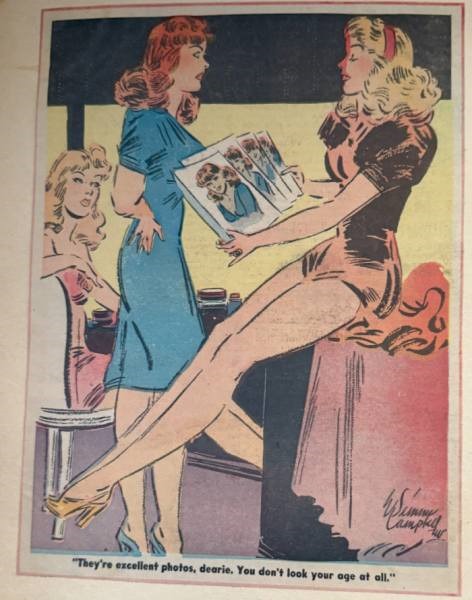
I wondered about a series of cartoons in the scrapbook. All white characters, nothing about music. What was the reason the scrapbook took note of them? The cartoonist E. Simms Campbell. was the first Afro-American cartoonist published in the big time U.S. “slick” magazines. His Wikipedia page says his work appeared in nearly every issue of Esquire magazine from 1933 to 1958, and in many other publications.
.
.
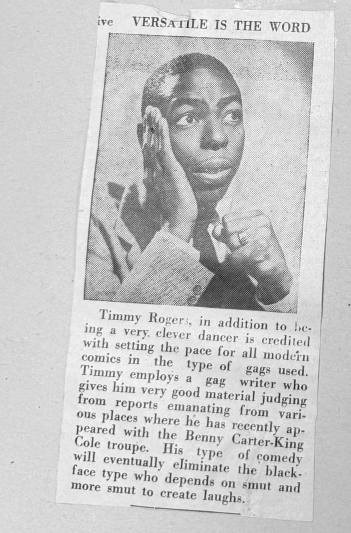
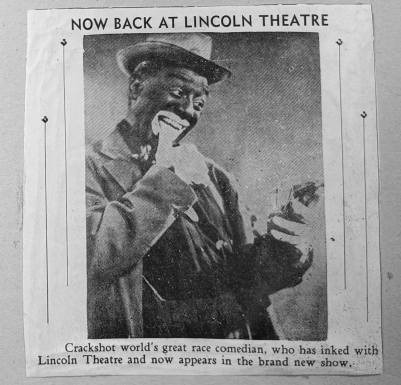
Dialectic, but make it funny: the clipping tells us Timmy Rogers was a Black comic who wanted to move beyond the blackface fool stereotypes. More info on Rogers. I can find nothing on Crackshot, though he’s given his clipping in the scrapbook too.
.
The entire multipage program for this landmark stage production starring the multi-talented Paul Robeson was pasted into the scrapbook.
.
Lena Horne, Dorothy Dandridge, and Butterfly McQueen. Three black women in entertainment who needed to struggle for non-stereotyped parts in the ‘40s. And keeping with our WWII subject, here are the Cats jamming with a white G.I. on bass. The armed forces may have been segregated, but music has established a beachhead. I note too, the scrapbook maker is paying considerable attention to women in the arts.
I knew about Lena Horne and Paul Robeson.
I knew about Robeson, Horne, Dandridge et al. I’d never heard of Pearl Primus before this month’s examination of the the scrapbook. Her Wikipedia entry tells what she did. This, Robeson’s Shakespeare, and the comics artists above are examples of how the scrapbook’s maker wasn’t just interested in music, but had a broad interest in the arts.
.
Our summary today: not all warriors carry a gun. We’ve had war today, and prejudice, and stereotypes — and me writing a bunch more words (with maybe fewer typos). So, let’s have a little music, and poetry — and love not war. Here’s a poem by Afro-American poet Alice Dunbar Nelson written in the last decade to be called The Twenties. This may be Black History Month, but all I read next to my breakfast each morning this month is telling me that the nonsensical denigration of Black American military and cultural contributions along with a side-helping of gay panic isn’t history, just as it wasn’t history to the maker or makers of the scrapbook. To hear Dunbar-Nelson’s poem “You! Inez!” as I sang it to music composed today in-between typing this, you can use the audio player gadget below. No player? Elon hasn’t fired it, it’s just that some ways of viewing this blog suppress it. This highlighted link will open a new tab with its own audio player.
.
*A founding member and most often featured singer of the Cats and the Fiddle was drafted. The scrapbook doesn’t deal with this, but I did wonder why Hank or other members of that quartet weren’t drafted. Hank Hazlett was born in 1911, and in 1940 he’d have been 29. The WWII draft was different than the Vietnam draft I’m most familiar with — in my day, most called up were younger than 27. In WWII draft men up to age 35 were commonly drafted. I only know the age of one of the original Cats quartet, but the bass player would have been 22 in 1940, and since the original quartet all knew each other from high school, I’m assuming they were near the same age — yet, as far as I know only Austin Powell was drafted. This is a complicated subject and we know so little about the men in the Cats. There were classes of deferments for various reasons, and even stories that some draft boards didn’t want to draft Afro-Americans for Jim Crowish reasons — this even though the Armed Forces were segregated throughout the war. There were also stipulations for physical condition that histories tell us bedeviled the system during WWII. One oft cited report had it that in the draft first year, 1940, “nearly half the men drafted were sent home” for not being fit enough for service.
Or course a great many Afro-Americans did work in war-industry, or were drafted or volunteered for the military, despite the Armed Forces still hewing to the Jim Crow segregation/white superiority regime of mid-century America.
Last time an Afro-American 35-year-old singer and skilled guitarist named Hank Hazlett had left The Cats and the Fiddle, a swing Jazz quartet made up of Chicagoans, when that group’s founding and featured singer returned after serving in the armed forces during WWII. Hazlett had been standing in for that man, and though he never recorded with the Cats* he got experience touring the best Black-oriented entertainment venues of the 1940s and interacting with other acts that the Cats shared bills with.
Hazlett must have decided he was comfortable fronting a band. In the scrapbook that is the centerpiece of this series, we can find two posed large-format glossy promo photos taken at a professional studio in Chicago of his next act: The Hank Hazlett Trio.
Interesting pairing visually. One with all black suits against a white background, the other all white against a black background. Could be simple use of contrast, but the poet in me sees metaphor.
.
That photo studio location indicates they were formed in Chicago. The trio was touring in 1947, as the scrapbook contains a letter from a San Antonio radio station thanking the group for an appearance there. I’ve also found this ad for a 1949 Trio appearance in Denver.
The Cats and the Fiddle had played Denver more than 10 years earlier in an early gig before Hazlett joined up. By now this venue says it’s in “The Heart of Denver’s Harlem.”
.
Unlike the scrapbook material from Hazlett’s Cats in the Fiddle stint, there are no clipped-out ads for appearances by the Hank Hazlett Trio pasted into the scrapbook. We don’t know who sang in the Trio, and I can’t be certain what kind of music they played either. The rapid, chopped chord-change swing Jazz of the Cats was morphing into what was renamed as Rhythm and Blues, a term invented by music journalist soon to be Atlantic records principal Jerry Wexler to replace the previous music business term “race records.” R&B could include former Jazz band vocalists who now fronted small combos, vocal harmony groups like the Cats or their more successful and smoother contemporaries the Mills Brothers and the Ink Spots, and the newly plugged-in Black rural and southern singers who had moved north to play a gruffer, harder-edged electric Blues. Basically R&B was rock’n’roll, just not named that yet, and with a much smaller white musician contribution when the term was coined.
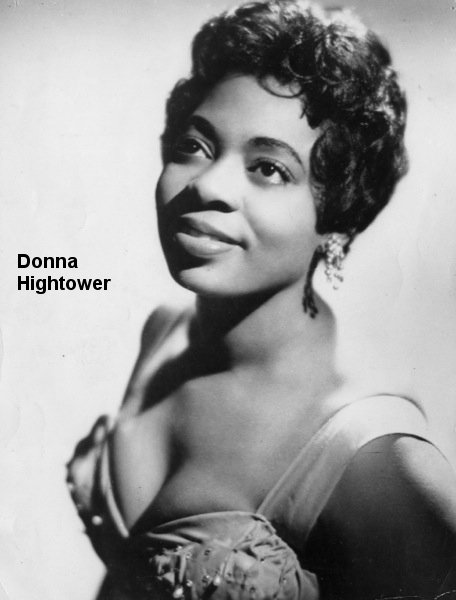
The first reports I can find of the Trio performing has them backing a Missouri-born by way of Chicago female R&B singer Donna Hightower which are collected on Marv Goldberg’s website.**
The Cats had played as a band for female singers, including backing Lena Horne with Hazlett on guitar.
August 1952 Minneapolis Spokesman (another Black newspaper) wrote this:
The musicians who are playing at the Key Club are Hank Hazlett, leader and Spanish guitar; Maurice Turner, bass fiddle; Buddy Davis, piano and vibraphone; Donna Hightower, Decca recording artist and vocalist. The musicians are all from Chicago and staying at the home of Mr. and Mrs. William E. Gray, 420 E. 37th St.”
That “staying-with” address is in the heart of Black South Minneapolis and would be two short blocks from a Portland Ave address we’ll meet just down the page. Goldberg has them playing at the Key Club in a long-term engagement until New Years Eve. Here’s what the St. Paul Recorder (the other Twin Cities Black newspaper) has to say (with Goldberg’s interjected corrections):
The Hank Hazlett Trio, composed of Buddy Davis, pianist and Maurice Turner, base [sic] drummer, along with the capable leader of the combo Hank Hazlett is now playing at the Key Club, 1229 Washington Ave So., every night and Sunday afternoon matinees.
The popular trio featuring Dinah [sorry Donna] Hightower, vocalist, got its start in Chicago in 1947 and has played successful engagements in many outstanding nightclubs.
Miss Hightower with her ultra modern version of popular music, seems to have a way with the patrons. The entertainers will be here through the holiday season.”
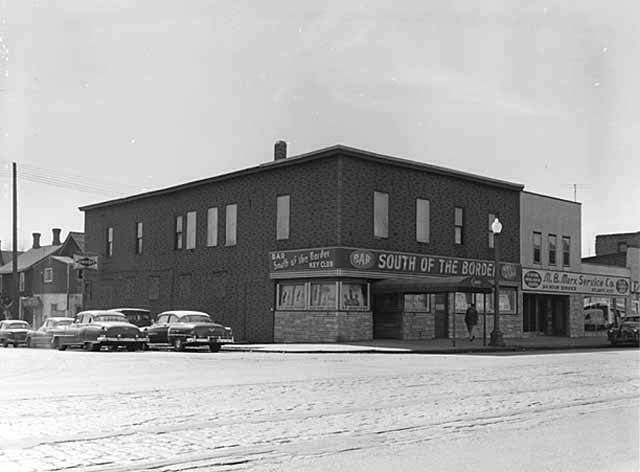
Don’t look for it now, this location was demolished for the I35 freeway.
.
If you want more details about The Key Club aka South of the Border, the Twin Cities Music Highlights website has much to read. Many national Jazz and R&B luminaries played at this establishment in the Seven Corners portion of Minneapolis’ West Bank neighborhood. Lots of seedy goings-on too, as this era of the Minneapolis Jazz and music scene often finds stripper acts, guns, and likely mob connections intermingling with the musicians.
This YouTube video dub of an acetate (demo or proof record) is the only audio artifact of the Hank Hazlett Trio I’ve found. Donna Hightower sings backing vocals. The guitar and likely the lead vocal is Hank.
.
Around the time of this extended engagement, it seems that Hazlett moved to the Twin Cities, setting up residency at 3648 Portland Ave in South Minneapolis, six blocks from where the scrapbook was found. Why there?
From what I can gather, Minneapolis has a strange and complex racial history, so please excuse these meager paragraphs that try to summarize the highlights of my incomplete understanding that follows. Minneapolis has long had some Black residents, and when it gathered more in the first waves of the Great Migration after WWI, there was white backlash. One instrument of that backlash were special clauses put into property deeds excluding transfer of those deeds to non-white or Jewish buyers. In theory government courts would need to be called in to enforce these racial covenants, but in practice these were often a silent exclusionary agreements, though they were sometimes enforced in breach by mobs of sullen whites who would surround an incursive Black occupied home with threats and vandalism against this blatant integration. This private customary segregation was later reinforced around mid-century by “red-lining,” a practice by home-loan issuers (including federal government loans) to exclude writing mortgages in Black areas. All of this, pretty rotten stuff — but perfectly “normal” and widespread in the United States, not just Minneapolis.***
In Minneapolis there were two sections of the city that became “Black:” one, on the north side of town (shared with a Jewish population that were often excluded by the same covenants and a higher than usual American level of local antisemitism), and the other, a vertical north-south strip in South Minneapolis. 3132 Park Ave was just on the borderline of these redline established sections. Even when I came to South Minneapolis in the ‘70s, you could see by the skin tones of the residents where those invisible lines sort of remained, to a fine resolution that could be almost block by block.****
Our 1953 musician Hank Hazlett lived in a house in the Black South Minneapolis area for several years, his only Minneapolis residence I can establish. I don’t know if he owned it, but the scrapbook maker was proud of it. There are a couple of photos clearly identifiable as his house, one with a new-looking or late-model 1953 Cadillac parked in front. I don’t know what his income was. The city directories continue to list him as musician, and at least in the mid-50s his local gigs were common. Even this late in the 20th century, when radio, television and recordings allowed music to be captured and transmitted on devices, live music was still a vital part of the experience of music. Perhaps for Hank the choice of Minneapolis went like this: I could tour from any city as my home base. The music scene in Minneapolis may be smaller than Chicago or LA, but on the other hand there are fewer Black bands competing for the club slots — and since it’s not a town to launch one’s new act to musical stardom, my middle-aged self may be able to settle down without having to directly compete with the most ambitious young acts.
One of the pictures of 3648 Portland Ave in the scrapbook. I’m assuming the car is Hazlett’s. The scrapbook has 1955 telegrams directing Hazlett and his trio to go from a gig at Williston ND to Sheboygan WI and that Scotts Bluff in Nebraska is cancelled. If they drove, that’d be a good car for this.
.
The city directory records tell us that he had a wife, Edith. It could be that the marriage predates 1953, and there’s certainly lots of 1940s material in the scrapbook if she collected any of it then. There’s a possibility they have a child. The scrapbook is oh so scant on this. There are three photos of young children on its pages. The oldest by background clues may be as early as the 1940s, and it shows a young toddler standing in a quiet road that is not Portland Ave, and in pen on the bottom it says “Earl P. Jr. 2 years old.” Lawrence/Hank Hazlett isn’t Earl, and “Jr.” traditionally means a father’s name given to an offspring. And then there’s a pair of what looks to me like two snapshots of one child. One shot of this kid shows a smiling sub-1-year-old in their onesie. To the right of that photo is pasted another one of a young Black couple sitting in front of moon and stars backdrop. That man doesn’t look like Hank Hazlett to me, but not only are the two photos near each other, I can sort of see the baby looking like the child of that couple. It’s possible that the man in the moon and stars photo is a much younger version of the performer Hazzlett, who I have only older-age pictures of. And finally there’s a somewhat serious looking, slightly older child in a push stroller-scooter. The back of that last photo has a date: 1952.
This is the second set of baby pictures that I think may be the same child. The one in the middle is dated 1952. Do you think the moon & stars picture that’s pasted on the same page as the left-hand baby is a younger Hank? There’s another picture below of a woman that may be an older Edith Hazlett.
.
There’s also a handwritten, child-like letter which I transcribe as:
Dear Daddy,
How are you? Fine I hope.
And all the others. We had a vary nice Christmas. Well today is the last day in the year and a new year is coming. Yvonne Dickie Gwen and myself are getting along fine in music. I love my fountain pen. We all like our fountains very much, our pens write fine.
Thanks for the money, Daddy. We were very glad to hear your voice. I have been over to whites ever since last Friday. White has a lot of Christmas cards. They are very pretty. Yvonne and Dickie White has a beautiful Christmas tree. I am glad you liked my present, and I know that picture is a good picture. White Chick and Marshall like there souvenirs very much. Well goodbye and good luck. With a lot of love
Felicia”
This could be an “on tour” letter to a traveling father from home — New Year’s Eve is always a prime gig opportunity. Or it could mean that the child doesn’t live with her father. Someone chose to put this letter in the scrapbook, and I believe the scrapbook was made by Hank, his wife Edith, or the two of them in collaboration. Knowing more would change the meaning of the letter.
Let me be clear: a musician’s life, particularly a touring musician, detracts from marital stability. Incomes change rapidly. Travel and late-night hours bring separation. Alcoholism and drug problems are endemic. Egos swell and are crushed and those changes can abrade a relationship.
The Minneapolis city directory tells us one more thing about Hank Hazlett’s home life. In 1958 the city directory records that Marian M. is now the wife at 3648 Portland. Marian is also listed as working for the Minneapolis Public Library. Hank is now 47, and the city directory doesn’t say “musician” next to his name — instead it says “banquet formn Dyckmann Hotel.” Same in ’59. In 1960 and ’61 Hank is shown at the 3648 Portland address, but he’s a musician and working at the Flame in Duluth, 150 miles north. In 1962 and ‘63 the musicians place of work is listed as the Manor House in St. Paul and the Downtowner Motel in ’63. Marian remains until the most recent city directory available listed as his wife.
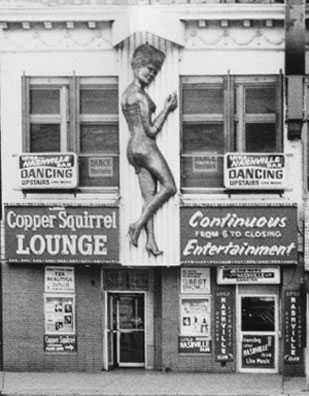
The last Hank Hazlett Trio gig I have found a record of was at a strip club/lounge on Hennepin Ave called “The Copper Squirrel” in September of 1963.
Site of the last known Hank Hazlett Trio gig.
.
I’ll admit, like someone looking at amorphous clouds in the sky I can picture these scenes: Marian isn’t necessarily up with the musician’s lifestyle. If Edith is the maker of the scrapbook or a collaborator in making of this document largely about her ex-husband’s life and music career she may have taken it with her. Out of spite or from fond memories of their days together? Maybe Marian didn’t want that scrapbook mostly about Hank’s earlier life around anyway? Who can say? Maybe it’s something else. There are no pictures in the scrapbook I can say for sure are post-1958. If Hank was the one making the scrapbook, maybe he had tired of documenting things.
Here are two picture which look like they could be the same woman found in different parts of the scrapbook. The man is Hank Hazlett, and I suspect that the woman would be Edith Hazlett prior to 1958. Edith may have been the person who made the scrapbook of her husband’s career, and may have been the one who put it in a crawlspace to be found in the mid-1970s.
Here’s a quartet of scrapbook photos of the Hank Hazlett Trio performing.
Hank with an Epiphone archtop in most of these photos, but a “blackguard” early ‘50s Telecaster in one. In the upper right there’s a woman holding down the pianist’s spot in the trio, and the white bass player there is crossing time and space with that tie he’s wearing to protest Donald Trump’s haberdashery sense and opinions about Black History Month.
In our next post we’ll track back a bit and talk about how the scrapbook includes the home-front World War II experience and what else it shows about American mid-century race relations and Afro-American cultural pride.
.
*The WWII years caused considerable interruption in recording activity. Shellac, the hardened resin that 78 RPM records were made from came from a residue produced by overseas insects located across a warfront Pacific Ocean, and there were strikes by musicians labor organizations as they tried to extract concessions from entertainment companies during this time too.
**I’ve mentioned Marv Golberg’s site multiple times in this series. It’s full of marvelous details about Jazz and R&B artists of this era. Thanks, thanks, thanks, Marv.
***Just after the end of WWII the practice of racial covenants was taken to court, and in an early post-war civil rights victory, they were struck down nationally, but redlining was not addressed, and “it goes without saying” agreements to hew to segregation continued. Yet at the same time in the late 1940s, a young Minneapolis mayor Hubert Humphrey saw to enactment of an early law against racial discrimination in hiring, giving promise that more job opportunities would open up for Black residents.
****By these 1970s properties in these parts of South Minneapolis were affordable, assuming you could swing the finances, because it was still considered a “bad part of town.” This led to some kinds of mostly young white people to move in: gay folks, and Boomer “hippies” and political radicals. Some of that generation are still alive, and still live there, and there’s a new influx: immigrants from Africa and Latin America.
If I hold to my current plan, there are going to be several more posts this February as I tie up this series dealing with an Afro-American scrapbook found at the house I stayed at when I came to Minneapolis in the 1970s. Those missing the Parlando Project focus on literary poetry combined with original music here should eventually get a return to usual service before the start of U.S. National Poetry Month.
So, that scrapbook, the thing in the middle of this series — I talked to Dave Moore who bought an old South Minneapolis house in 1975, about its discovery this week. As we learned last post, 3132 Park Avenue was originally built as the sort of house for an early 20th century businessman or upper-middle-class family: four large bedrooms on the second floor, spacious rooms on the first floor (two of which could be joined by opening a pair of large pocket doors) and a separate interior set of stairs to an attic third floor which may have been designed as quarters for live-in help. I summarized the house’s history last time, including that from the 1940s on, the house had a succession of tenants after its long-time grain-trader owner died in 1939, eventually becoming a rooming house catering to Black residents. Shortly after moving in, Dave was on that third floor, and he noted a small, about 3×3 foot, access door on one wall where the slope of the roof descended to less than full height. Opening the door, he crawled inside. It’s been decades, but Dave is pretty sure that the scrapbook was found there. “Anything else in there?” I asked him. “I remember an old carpet sweeper.”
The house still had furniture when Dave decided to buy it. By the time he took ownership the real-estate firm had taken all of that out, emptied the house — so for the scrapbook to have survived, it was lucky to have been secreted in a crawl space. Did its owner or creator hide it there? Who could that person have been? Today I’ll give you my best guess, and in following days you’ll get to look inside the scrapbook to see the clues that led me to that guess. In looking at what the scrapbook includes, you’ll get to look inside a particular document of what had the attention of a 1940s American Black person.
My initial guess, back when Dave gave me the scrapbook in the ‘70s: I figured it was made by a fan of Jazz music, then the popular music of the 1940s. Noting the movie and performing stars pictures clipped from entertainment magazines and newspapers — and that it was after all a scrapbook — I thought the greater probability was that it was a woman. Scrapbooking is not something that many grown men engage in, and so I imagined a young woman entranced by performers.
Later as I found out more about the Jazz-vocal-quartet The Cats and the Fiddle who figure prominently in what was chosen for inclusion in the scrapbook, I changed my theory. I learned that a man named Lawrence Hazlett (who professionally went by the name Hank Hazlett, and whose last name has been misspelled as Haslett and Hazelett) had been, during the 1940s, a member of the Cats and the Fiddle. I’d overlooked personal items pasted in the scrapbook connected to Lawrence Hazlett that a mere music fan wouldn’t have: his 1944 pay stub from MGM, a Department of Labor ID card. Hazlett was born in 1911 in St. Louis according to Marv Goldberg’s info. He may have lived at times in Indianapolis, Chicago, Minneapolis, and Los Angeles.* I changed my mind. This was a musician who was scrapbooking his career, and Hank Hazlett was that musician. At the start of the month, that’s what I thought I’d attribute the “authorship” of the compiled material in the scrapbook to.
I’ve now changed my mind again, due to this month’s research and closer re-examination of particular items included in the scrapbook, and my plan is that you’ll be looking over my shoulder at items in the scrapbook as I examine them in the next posts. These items engendered feelings, hunches — my attempts, however imperfectly but empathically, to think of why certain things were chosen to be saved and pasted on pages.
My current theory is that the scrapbook was made by a wife of Hank Hazlett, likely a woman named Edith I. Hazlett, with his collaboration.** If, instead, it’s my previous working theory that it was Hank himself documenting his life, the choices made in collating the material in the scrapbook would make him even more fascinating to me. The author (or collaborating authors) are more deeply and widely concerned with Black artistic expression than I would think most musicians were in the 1940s. There’s an undercurrent of feminist thought that can be extracted from some items in the scrapbook,*** though that may be a reflection of the decade of the 1940s when so many men were mobilized and out of the country. And dare I say it, at times there’s the slightest hint of gender non-conformity there too.****
It looks like the maker of the scrapbook altered the brand name of the now tattered scrapbook to Hazlett. The TV Troubleshooter booklet won’t tell you how to block annoying YouTube ads, nor offer fool-proof password sharing schemes. The torn photo may be a South Minneapolis snapshot of Hank Hazlett. Someone has to take snapshots (no selfies then) so it could be a clue that Hank isn’t the sole creator of the scrapbook.
.
Guitarist and singer Lawrence “Hank” Hazlett lived in the South Minneapolis neighborhood that the scrapbook was found in from 1953 to at least 1963. He worked steadily there as a musician, leading his own Hank Hazlett Trio for most of that time, and at least occasionally playing with other groups. Minneapolis city directories and some online histories of the Minnesota music scene document this information. But there’s a strikingly absent bit of data there: he’s never shown as living at 3132 Park Ave where the scrapbook was found. Instead, he was consistently recorded in city directories as living six blocks away at 3648 Portland Ave. Starting in 1953 and 1955 Lawrence Hazlett is listed as a musician at that address, and his wife is named as Edith. In the 1957 directory Lawrence Hazlett is missing from the directory listing, but a Mrs, Marian M. Hazlett is listed as living at that address. This continues in 1958 with Lawrence listed as the head of household and Marian as his wife onward to the last Minneapolis city directory in the Minnesota Historical Society collection, Marian is also identified in one directory of this era as working at the Minneapolis Public Library. So somewhere in the mid-‘50s, it appears that Lawrence has a different wife. There are no firmly dateable items in the scrapbook that can be fixed after the middle-50s. There are a couple photographs that could be estimated (from woman’s clothing styles) as early 1960s, so I can’t eliminate Marian the Librarian as the collaborating collator, but the masses of things from Los Angeles including current events clippings from the ‘40s indicate the book may have started before Hazlett or his wife were known to be in Minneapolis. In my ranking, Marian would be third on the list after Edith and then Lawrence/Hank himself. In this theory, Edith may have stopped using Hazlett as her last name and ended up at the 3132 Park address in its Black rooming house phase, carrying with her the scrapbook of her days in Hollywood and the following years in the musical scene in Minneapolis with Lawrence/Hank.
In the next few posts we’re going to take a ride through the crumbling pages of this scrapbook in detail. The details will go a lot of places. If you haven’t figured this out about me yet, I love that about details.
.
*The scrapbook has material listing addresses in LA and the Portland Ave. address in Minneapolis, and no other cities are explicitly listed as residences for Hazlett there.
**One surmise: Lawrence/Hank had off-handily collected stuff during his career, and his wife, seeing the value of what her husband did, decided to use a scrapbook to organize and present it, melding him in with other national entertainers. This might explain why things like publicity photos for line-ups of the Cats and the Fiddle dating from before Hank Hazlett was a member of the group are in there. That could be read as expressing symbolically “Here’s my husband, he’s good enough that they asked him to join this nationally-touring Jazz vocal group.
***There are also elements of laddish/Benny Hill-type sexual stereotypes in some cartoons — items that led my switch of maker-attribution to Lawrence/Hank — but the history of the cartoons broadened my understanding of them.
****Better scholars than this amateur, Afro-Americans who know by living things I’m ignorant of, or anyone who may have known the now dead people in the scrapbook may know better. I’m just an open-hearted person looking at this stuff and writing of my experience of it. I’m going to share an opportunity for you to do the same as the series next continues.
Some of you made it through my summarization of the musical career of the Cats and the Fiddle Jazz combo this week, but even though I was writing about music, we didn’t add much poetry there. One little thing I found out since I wrote that summary: that eBay matchbook collector item should have tipped me off about the site of one of those young Chicago kids’ gigs — a way stop on a trip to Hollywood to try breaking into the movies. It wasn’t at the “Airplane Café Club” as Marv Goldberg had it from his research, but the “Aeroplane Café. I’ve found a postcard. Looks pretty swanky. I wonder how the Cats act went down there in 1936 — did the Denver white swing kids dig their act? Four or five years later I’d give our band of audacious teenagers better odds on that.
Well, however they were received, they were young, they had dreams of a career ahead of them.
Looking at what musical acts were playing Denver at this club and elsewhere during the ‘30s, it was mostly white bands for dancing. Black bands started appearing on the bills in the ‘40s. My research said the Aeroplane Cafe lasted until the ‘80s, hosting in its last years rockabilly bands.
.
So, let’s combine some literary poetry with music, Parlando style today. The words are by Langston Hughes, one of the first poets to recognize that Blues and Jazz were poetic, suitable for praise in poems, suitable to combine with Jazz words he’d contribute. When the young Hughes wrote today’s words for publication, he called the short poem “Dreams.” I heard it as a kind of Blues, a Blues with a sorrowful side, but with an admonishment to endure. If some reading this are having a February of backlash and disappointment tempting despair, this is after all Black History Month. Afro-American poet Hughes knew that dreams may well be knocked down, ignored, belittled. Yes, I know the word “woke” is a word in present contention. I find it odd it is used by those who smirk and dismiss the word as they speak it, aiming it toward those who know very well the reasons that dreams are extinguished.
Hold fast to dreams
For if dreams die
Life is a broken-winged bird
That cannot fly.
Hold fast to dreams
For when dreams go
Life is a barren field
Frozen with snow.
I’m looking at a bare and snowy landscape out my window this evening. I rode to breakfast in 10 degrees with a cold wind this morning. I read the newspaper when I got to the cafe, because I’m a man who still spills eggs and hot sauce on the news in the morning. None of the news was good.
I spent my last couple of days making the musical piece work as well as I could make it, tickling an old guitar that I played when I was young, playing piano the way I can: a finger or two on the keys, tracking the left and right hand parts separately to disguise my ham-handedness — because music may find a way. I sang Langston Hughes’ words quietly, mouth up near the microphone. I had to, it was near midnight when I sang them, and my family was asleep and I want them to keep their dreams.
I want you too to keep the sweeter of your dreams. Waking right now can script all the nightmares and anxiety dreams that need no help. When the best mysteries come under the eyelids, ones almost too good to remember, I want you to keep them, even just the sense of them.
The audio player to hear my adaptation of Hughes’ poem I call “Langston’s Blues” can be heard with the audio player gadget below. No gadget? It’s off dreaming, but you can also use this highlighted link which will open a new tab with its own audio player.
I’m planning to return in a few days with more on why I wanted to work at figuring out all I could about that young Jazz combo of the 1930s and ‘40s.
Time for me to lay out all I know of the story of a 1930s and ‘40s Black American Jazz vocal quartet: The Cats and the Fiddle. Last time in this February series, I reminded moderns that so much in my parent’s and grandparent’s time revolved around neighborhoods. That’s going to continue today as I tell about some kids who shared a location. Previously we’ve seen the Cats and the Fiddle appearing in small-time Hollywood pictures in the Thirties, which might give you the idea that they were a well-established band with hit records and thriving career. That’s not the case. They were young, from out of town — and though they did have a few years of performing under their belts, they were likely around 20 years old. How’d they get there? Where did they go?
The Cats and the Fiddle didn’t start in Southern California. The original quartet were classmates at Wendell Phillips High School, an important school in Chicago’s Black South Side. Last February here we featured Fenton Johnson, an ambitious Black poet who graduated from Phillips decades before the Cats’ founders attended, but some other folks could have passed the band members in the hallways in their day: Nat King Cole and just possibly singer Dinah Washington. Cole was likely the same age — Washington 5-6 years younger but there was a Junior High section at the school.* Oh, let’s not totally leave off poetry — poet Gwendolyn Brooks was the same age as Cats members, and Phillips High School was one of three Chicago area high schools she attended. The thought that these teenagers, poets, singers, musicians, and songwriters, might have taken inspiration from each other, or some other, lesser known commonalties is intriguing.
While in High School the future Cats were in two different bands, the Harlem Harmony Hounds and another group which was — at least at times — performing as Four Dark Flashes. No, the first band had nothing to do with Harlem, these were Chicago kids. There’s a round-up of Cats and the Fiddle history available online put together by Marv Goldberg. He’s found a reference to the Harlem Harmony Hounds as early as summer of 1932, which says they were appearing on radio station WCFL in Chicago.**
The Four Dark Flashes appeared to have traveled some. In October 1936 they were listed as playing the Casino Theater in Toronto Canada, a 1,200-seater which would have just opened earlier that year. If they were all Barksdale’s age, they’d be 16 or so, and traveling out of the country during the school year. This would indicate that some of the Cats-to-be had dropped out of school early to pursue music. ‘36 was likely the year the Four Dark Flashes group lost a fourth, their lead singer. Harmony Hound Austin Powell singer and guitarist was the handy neighborhood replacement to join Ernie Price (tenor guitar), James Henderson (tipple), and Chuck Barksdale (bass). The whole group sang, and beside Barksdale holding down the upright bass, the fretted stringed instrument combinations of 6-string guitar, tipple, and 4-string tenor guitar might shift from song to song.
In October 1937 we get the first mention of Cats and the Fiddle as an act that Goldberg has found. The famous Chicago Black newspaper The Defender wrote that “Four Cats and a Fiddle” were booked to play the Dome Club in Bismarck, North Dakota along with a Bessie Mitchell.
OK, who’s asking “What are a bunch of teenage hep-cat Black musicians doing in Bismarck ND in 1937?” I don’t know. I can find nothing about the Dome Club there, but chances are slim that there were enough Afro-Americans in Bismarck in 1937 to support a Black entertainment establishment. Another Afro-American vocal act with guitar accompaniment, the four Mills Brothers from Ohio, had gotten on nationwide radio, and though their hit records are a smoother sweeter sound and have none of the jive talk found in the early Cats’ lyrics, it’s possible that our group of teenagers had a set-list of tunes tailored for white audiences. The Chicago Defender, when announcing the act’s road gig on its pages says the Cats had “one of the greatest floorshow acts in the game.” Promotional hype supplied by the Cats themselves? Or had they already done some show-stopping appearances in Chicago? Were upper Midwesterners plausibly ready for something like that “Killin’ Jive” hard-swinging Jazz aimed for Black audiences?
Then on November 20th the Pittsburg Courier (another Black newspaper) says The Cats and the Fiddle, consisting of the quartet of guys and a Bessie Sutton are playing at the Airplane Club Café in Denver this week. Not sure why anyone is concerned about this in Pittsburg, unless that Bessie is from there. What kind of venue was the Airplane Club Café? The only thing I can find is this picture of a matchbook once offered for sale on eBay.
The young Jazz guitar & vocal combo was going places. Lenny Kravitz’ grandma not pictured. (just checking to see if you get to the footnotes)
.
That pair of odd Fall ’37 notices bill a Bessie Mitchell and a Bessie Sutton as being with the Cats. It’s unclear if they are one or two different people, and if they are full-fledged members of the band or a separate act that might use the Cats as road show accompanists.*** If neither Bismarck or Denver seem like a common tour stop for a locally-known Chicago Afro-American combo in 1936, swing Jazz had a generalized popularity that was testing racial barriers. It’s also possible that clubs expected the Mills Brothers and got something a bit wilder, or that Bessie or Bessies were the headliners.
Where can we put our Cats on the map next? On January 13th, as 1938 has begun, Goldberg finds them in another Black newspaper, the Los Angeles California Eagle. The paper names the original four schoolmates and a Willis Rogers as members and they go on to say the group will “go far in pictures.” Once more I provisionally assign PR from the group to that prediction. I wondered if the late ‘36 Bismarck and then Denver gigs were just part of a “play your way to pay your way” tour to get to the American west coast. I’m just enough of a trainspotter type to wonder about passenger train service from Chicago to Bismarck to Denver to LA.
Want to figure their transit route with me? Chicago to Bismarck to the Pacific Northwest coast. Sure, the North Coast Limited. A lower Midwest route from Chicago to Denver with connections to LA? Yes, those are options on the Union Pacific Overland Route. But Bismark to Denver? Your faithful researcher looked. You’d likely have to go back to Minneapolis from Bismarck, and then from Minneapolis to Denver before going on to Southern California from Denver. But what’s the alternative? They could have driven, though I know nothing about their family’s financial resources to buy a car, and there’s the season of that traveling: modern indie band road dogs would dread a late Fall tour itinerary from Chicago to North Dakota then off to Denver before a jaunt to LA, when if LA is your goal from Chicago, a southernly “Route 66” highway beckoned. So, if the three dates Goldberg lists are accurate, I think of these four or five ambitious young Midwestern musicians zig-zagging like water bugs on train routes aiming for Hollywood. Yes, I’m grasping here at details, hoping that like a detective they lead to solutions to greater mysteries. The mysteries remain.
You’ve seen the high points of that movie career in the earlier installments of this series. For Afro-Americans in the mid-1930s that would be low-budget all-Black cast and audience pictures, novelty appearances in B movies, and possible work as extras or as a musician for soundtracks. Seems pretty meager when I list those opportunities, but to look at it another way it wasn’t that far from what bigger Black musicians were getting in the movie industry then. Racism and segregation were still unavoidable, overt issues, but Jazz as a rising popular music was softening some barriers in that decade. And it was the Great Depression. Black unemployment was even higher than the general unemployment rate. Appearing as “native” extras on a studio backlot might be demeaning, but even that level of employment meant a paycheck.
Still, they were all about 20-years-old, and they didn’t even have a record contract— yet. And our intrepid group still seems to be traveling back to Chicago from Hollywood.
Lawrence Cohn, who wrote liner notes for a 1976 reissue of the Cats and the Fiddle recordings, tells that Cats were visiting outstanding guitarist Tampa Red’s apartment in Chicago in the spring of 1939 after their spate of 1938 movie appearances, when Red introduced them to Lester Melrose. Melrose was A&R for Bluebird, RCA Victor’s “race records” label for artists of color. In the 1930’s and ‘40s, Bluebird was making good money on a variety of Blues related vocal records, often featuring small combo accompaniment, catchy rhythms, and double-entendre lyrics. Melrose worked out of Chicago where he collected a lot of Black talent for the label.****
How well did the Cats records do? Middling at best. Their closest approach to a hit was a ballad recorded on their first studio session in the summer of ’39, “I Miss You So” — but as WWII was about to break out in Europe, no one knew yet how big the young Cats could be. Cohn compares them to the Ink Spots, a vocal combo who started having big hits on Columbia Records around this time. He tells us the Cats and the Fiddle were repped by William Morris (the same talent agency as the Ink Spots) who started booking them all around the country to see what kind of career they could have. The subsequent gigs Goldberg tracks are mostly at Black audience theaters, but they include the big ones, the ones the most successful Black stars would play.
In America, WWII was still two years away. Victor records recorded more than two-dozen songs as they toured. That maybe-kinda hit “I Miss You So” wasn’t issued until 1940, and it wasn’t representative of their typical fast-tempo jive-slang songs.
Then the war came, and the previously stable, self-contained quartet group of high-school-pals started to churn. Henderson (who wrote “I Miss You So”) died shortly after the record came out. The bass-fiddle guy Barksdale died in ‘47, but was in and out of the lineup from ’41 on. Henderson and Barksdale were replaced by ex-Harmony Hound members Herbie Miles and George Steinback. In the midst of this ’40s churn Tiny Grimes was in the group for a couple of years, even wrote a tune or two for them. Grimes would leave the Cats to play with Art Tatum and Charlie Parker, and along with Charlie Christian, he would help popularize instrumental bebop styles for the guitar. Grimes left our vocal act because by then it wasn’t paying much, and he didn’t think it was going anywhere. A musician’s recording strike and a shellac shortage greatly reduced the issuance of records during the ’40s, and the audience mix for live shows must have changed some due to the overseas war. Amidst all this, Austin Powell, the most prominent singer and songwriter in the Cats was drafted. Hank Hazlett, a guitarist originally from St. Louis, was brought in when Powell went into the armed forces. Hazlett would play with the Cats from ’43 until late 1945. Powell was de-mobbed in Spring ’46, and the somewhat tattered group was still recording and playing, but to smaller and smaller returns. In 1950 the Cats and the Fiddle disintegrated, though surviving individual ex-members continued to be involved in music.
Lawrence Cohn was a highly knowledgeable man about this era, and he worked on a number of important late 20th century reissues of classic Blues and Jazz recordings. When in 1976 RCA collected most of the Cats and the Fiddle’s recordings in a double LP, Cohn wrote the liner notes, yet he only rises to faint praise there. He thinks the songs sound too samey. He says their musicianship was mediocre at best. In the end he’s left with the idea that their humor might be viewed as a corrective to the (in his opinion) too serious and artsy Jazz around when he wrote the notes. This sour summation ends Cohn’s notes:
In general this kind of happy jazz and pop combination disappeared, along with most of the melodic kind of jazz, during the Fifties and Sixties when rock and roll replaced the earlier style of music, and when jazz became politicized. A lot of people stopped going out when this kind of music was not being presented. Perhaps this release may in some small way facilitate its return.”
So besides knocking the Cats, Cohn seems to want to take some shots at the Spiritual and Black Arts Jazz musicians contemporary with his notes. I apparently like those musicians more than he did, and I like the Cats and a Fiddle more too. As to the Cats’ musicianship, I’m of the school that says the essential is that the players did a good job putting their own songs over, and that’s what counts more than an academic skills comparison. Barksdale was good enough for Coleman Hawkins when playing outside of the Cats. Tiny Grimes could trade riffs with Charlie Parker. Austin Powell was still gigging and recording with Louis Jordan and his Tympani 5 until the end of the 1950s, apparently playing not only guitar, but sax and piano.
Decades after Cohn, Australian critic Bruce Elder got the job to write up the Cats and the Fiddle for the current music streaming service Apple Music. Writing there Elder says
If anything, the Cats & the Fiddle were ahead of their time, producing a bolder form of R&B than critics were prepared to accept at the time, such as ‘That’s All I Mean to You,’ which likely would have slotted in perfectly a decade later, but in 1940 just seemed like style-less noise with a swing beat.”
Being slammed as “Style-less noise, with a…beat.” Does that sound like a description of something else that would come around after the Cats broke up post-WWII? Self-contained combos who play their own instruments with guitars mixed to the foreground, brisk tempos, uninhibited stage performances, energetic, youthful, close-harmony singing, witty lyrics that might wink with some “the squares won’t know what we’re talking about” slang?
I’m leading you to say “Rock’n’Roll.” I suspect older readers will be the first to follow that lead with that response, as I find many listeners in middle-age (and younger) think of the later evolution of what gets called Rock — or now, Classic Rock — as a more overdriven electric guitar thing, backbeat drums with less swing laying down the beat, with lead singers often singing alone only with occasional backing vocals. I used to shake my head (and type someone’s-wrong-on-the-Internet posts) in my 20th century Usenet days when the admittedly problematic Rock’n’Roll Hall of Fame would select some (usually Black) harmony vocal group for enshrinement and posters would object that’s Do Wop, or Soul, or something, but not real Rock. I’d try to remind them that Rock’n’Roll originated as a diverse mongrel genre, and that groups who approached music with an outlook, energy, and vocal blend like the Cats, were all over the first decade or so of Rock’n’Roll. These Black high-school students from the South Side of Chicago had an idea and put some audacious energy into propagating it.
About thirty years after the Cats and the Fiddle took their warning-track fly ball swing for the fences, this group of plaid suited white rubes — who looked exactly like you’d expect to find them at the Dome club in Bismarck North Dakota — got to have their moment in a low budget Hollywood movie. This is how they looked and sounded:
On discovering this band in a rural roadhouse, the film’s hero enthusiastically shouts “It isn’t boogie. It isn’t jive. And it isn’t swing. It’s kind of all of them.”
.
*I’m basing age estimates for the original Cats members on a military draft registration record Marv Goldberg indicates he’s seen for original member bassist Charles Barksdale, documenting that he was born January 11th, 1918. Nat King Cole and the Cats were seen again in Hollywood, as Black extras playing South American natives in the Myrna Loy/Clark Gable romcom Too Hot to Handle. Dinah Washington was playing in Chicago with the Cats and the Fiddle as her backing band for the gig when the club owner dragged Lionel Hampton to hear her and nationwide fame for that great singer ensued.
**This radio show was said to be weekly, and other references led Goldberg to think the show lasted until January 1935. WCFL’s history is interesting. Nathan Goldfried’s book WCFL, Chicago’s Voice of Labor has it that it’s “the first and longest surviving labor radio station in the nation, beginning in 1926 as a listener-supported station owned and operated by the Chicago Federation of Labor…” and that ““The station emphasized popular entertainment and labor and public affairs programing, seeking during its earlier decades to help organize workers, increase public awareness and support for the union movement, and enhance public awareness and culture.”
***Entering into wild/just plausible territory: Bessie Mitchell was the birth name of actor Roxie Roker’s mother, musician Lenny Kravitz’ grandmother, and actor Zoe Kravitz’ great-grandmother. She would have been in her mid-20s in 1937, but I have no info that she was ever in entertainment at all, or connected with the Chicago scene.
****Bluebird recording artists included Memphis Minnie, Big Bill Broonzy, Jazz Gillum, Memphis Slim, Victoria Spivey, Arthur Crudup, and LeRoy Carr. Melrose reportedly passed on Muddy Waters — Waters said Melrose was looking for a sweeter style of music than he and his post WWII generation played. One thing I wonder regarding Melrose likely having some responsibility for how big a promotional “push” might be given the Cats. Members of the Cats and the Fiddle from the start wrote most of their own material. Melrose often engaged in the pernicious practice of taking co-writer’s credit on records by acts he shepherded, cutting himself in on that element of royalty monies. At least on the Victor reissue LP I have, Melrose is never listed as having a songwriting contribution.
We left off last time in my Black History Month series this year, with a crumbling scrapbook filled with mid-20th century things someone had gathered. The scrapbook compiler was concerned with entertainment, particularly Afro-American’s in that role, and the largest number of items they’d pasted in focused on a somewhat obscure musical act: The Cats and the Fiddle. Was the compiler a fan or a musician themselves? Woah, we get ahead of ourselves. Let’s stay with the musical evidence we have for a little while longer.
Once I get out of bed in the morning, I grab a newspaper from somewhere in the vicinity of my front door and read it. This is antiquated behavior. I often linger in bed before or after sleeping reading near-instant news on a large tablet connected to the Internet before I later get to the morning paper’s headlines that were written yesterday, yet still I take comfort or distress from reading them printed on paper. This is memory/habit working. I’ve read a newspaper in the morning since shortly after I learned to read. I even delivered them door to door as a youth in my little Iowa town, a place where and when the newspaper might be the only way you’d find out about some things in any detail.
Though I compose music and operate various musical instruments constantly as part of this Project, I’m somewhat removed from the general life of a musician today though I read accounts, I observe. But all of us listen to music, experience it some way. I know of no culture anywhere that for any appreciable span of time has been without music.
In the 1940s and ‘50s world the scrapbook photos, magazine clippings, and ephemera collected would have overlapped my childhood, would have been my parent’s adulthood. I experienced music some from records, some from television or movies, and largely from radio.* Music face to face? Church music once a week, and the school’s student marching brass band a few times a year. I enjoyed rock’n’roll cover bands just twice, at the Junior and Senior proms in my high school. Concerts? I once got to travel to the large auditorium at the state capitol to hear Handel’s Messiah oratorio. But that’s a rural, small-town story within a family that had no special connection to music, played no instruments.
For other white folks in cities, and in other areas, music could have been more central, more direct. Step back a generation to my grandparents’ youth? Recordings, perhaps some, radio not yet broadcasting, movies silent. Non-commercially, there was the parlor and folk music of those whose neighbors or families played. Music at events meant musicians playing, making the entirety of the noise right there and then. Let me repeat: that era’s connection to music was almost entirely performer in the room or performance space — and so where you lived or traveled to impacted your music heavily, and overwhelmingly your connection to your music was as fully dimensional, occupying the same space at the same time with you.
Some who read this may be two full generations younger than me. Your connection to music will likely be more removed: streaming playlists, the soundtrack to video games, concerts that could be large TV screens over a distant stage of dancers and miming singers with microphones in their hands. Or it could be a sweaty basement or a club with a small stage at one side, or something you try to record on the ubiquitous computers surrounding us, to hopefully exist elsewhere momentarily on phones, like a brief, wrong-number phone call that each connected party, embarrassed, occupies briefly, and leaves. You may think: I decide how I experience music, or how I make music! Yes, you do have choice, even if you may, out the other side of your mouth, decry that most all others are dictated by culture and capital. The in-between truth is that you, musician or listener, and the musical audience and musicians in general, are still living inside a present culture that changes things. The older ones living now still remember past cultural contexts, a diversity of time.
Because Afro-American representation lagged in mainstream American culture, representation of their music in mass media was filtered out, shown behind a screen for much of America. A Black American circa 1930-1960 is going to make and experience music because of their contemporary cultural particulars, their landscape in time. How long this post would be for me to try to even outline or list those things I think I have a smidgen of understanding of: the divide of parochial cultural ignorance from non-Black folks can fill volumes, Black History Month a pitcher of a lakeful. Demeaning white superiority, colonial European cultural hierarchies, and minstrel show comic-fool stereotypes are the proscenium for Afro-American performers. Sometimes violence lurks at the meeting edges. A well-meaning paragraph in a blog post staggers to carry that weight.
So then, if a Black American was going to use music to relax, or as a balm against the absurdities of your life and times, how much easier is it going to be to find that in Black entertainers, in Black saturated places among fellow Black audience members. But also consider: your experience of music is going to be that fully-dimensional one most often. In the room. In the same time. You can smell the music, which you can’t on Spotify.
Think back to that short movie clip from the previous post in this series,“The Harlem Yodel.” The Cats and the Fiddle and the Dandridge Sisters are dressed up for the Alps in the roomful of mirrors that we’re to know to be an indoor ski meet. It’s 1938. I notice as the Cats enter our frame at one minute into the video clip, they drop a short series of sour, single string plucks. Is that a musical Dada expression saying: we know this is ridiculous, but we’re getting to be in the MGM movies, even if it’s a B minus, undercard short-subject? One of the producers of the short, Jack Chertok, would work on more than 30 shorts in 1938. By the early 60s he’d be the producer of My Favorite Martian, a half-hour TV sitcom about an undocumented extraterrestrial alien living incognito on a grey-scale Earth — not exactly Ralph Ellison, but some of the strangeness is intentional. In the movie, the audience is white.
White folks on the right: “What, we can’t even have segregation at an indoor ski jump competition?”
.
In the second music clip, “Killin’ Jive,” the audience is black in the film and in the producer’s movie-house intent. It’s from one of a series of Westerns made for Black audiences, and the picture’s star (unseen in the clip) is the “Sensational Singing Cowboy” who was variously billed as Herb or Herbert Jeffries or Jeffrey. Wikipedia decided on Herb Jeffries, but I don’t know if the last name varied for carelessness or branding tweaks. His Wikipedia article goes on to write about the unsettled ethnic background of the man born Umberto Valentino, but he was clearly marketed at the time as an Afro-American. The band’s performance there is intense and uninhibited — can’t-top-this showmanship. This clip, and publicity photos, would mean that the Cats would need to do this live on club stages at some point in their sets. This song (like many in the Cat’s recorded repertoire) is by a member of the band, and “Killin’ Jive” is, full of insider Jazz/Black slang. Here’s a link to the lyrics.
Clearly, it’s a song about marijuana intoxication, and it’s performed in a let’s-get-high-and-party manner. The lyrics, which as I said are written by one of the group’s founders, Austin Powell, can be read as adding an undercurrent to that performance. A line is refrained in the song “He’s a sad man, not a bad man,” and I expect “bad man” in Thirties Jazz argot could carry the same “formidable and unrestrained” (in this case, when high) Afro-American slang meaning as well as the mainstream cultural meaning of he’s not evil, he’s just depressed. There are lines too about “darkest days” and “got no rent” (not transcribed correctly in the link) If this were a Brecht and Wiell song from say The Rise and Fall of the City of Mahagonny, we’d read these lines and expect Modernist irony. What do I expect? That Powell had a brain and a viewpoint and meant what he wrote.
CORRECTION: The “Killin Jive” song was actually performed in another Black-audience-targeting picture called The Duke is Tops. They did appear in Two Gun Man from Harlem too, I just trusted my memory more than double-checking my notes,
“All Star Negro Cast” in the film from which “Killin’ Jive” appears
.
In real life and not in front of Hollywood backlot cameras? I can’t say for sure what kind of places the Cats and the Fiddle played in, but as working musicians the places they performed in would surely be physical contexts in a segregated society. Los Angeles had its own Black musical scene and audience around the Central Avenue neighborhood, and they could have played there. In a following post in the series we’ll get into what I can figure out regarding their musical career and travels from supposition, elements in the scrapbook, and some new information I was able to gather this month. More to come here soon in this series.
For a musical note, here’s a Langston Hughes poem remembering time on the other side of the tracks. There should be an audio player gadget below, but if it’s been red-lined out for you, this highlighted link will open a new tab with its own audio player.
.
*Radio was more-or-less the streaming of my era, but it had the extra dimensions that you knew that others were listening to the same music you were listening to at the same time. When “your record,” the one you made, or simply the one you cared about as a listener, was played on the radio, you may have been alone in your room or your car, but you knew also you were one of some many in a simultaneous nexus. Music on television or in the movie house was most often a generation behind. I’m nowhere near a Jazz musician in skills, but I owe it to TV and movies of my youth that when I hear a Jazz take on a “Standard” I usually know the tune.