Why bother with little-known poets of the early Modernist age? Well, it’s conceivable that we can better understand the context the better-known poets were operating in by looking at the field the greats stood out from. And frankly, I get a kick out of looking at the left-behinds and odd corners. Like a crate-picker at a used record store, I’m looking for those weird finds that you can’t quite believe exist or that reflect some transitory moment in the culture.
I’ve already mentioned Arthur Davison Ficke in an earlier post as one of the Davenport Group, a bunch of Iowans, who with their rural Illinois cross-river neighbors, made a bit of a splash in American culture in the first part of the 20th Century. Ficke is not as obscure a character as Muriel Strode from our last post, but the separating distances of fame and achievement shrink as time moves on, so you’re not going to run into either of them in any survey course or even specialist literary class in school.
Unlike Strode, I could find out about Ficke’s family background. He grew up in one of Davenport’s richest and most cultured families. His father was a prominent lawyer and had amassed a considerable oriental art collection. After education in Davenport, Ficke was sent to Harvard where he was a classmate of Franklin Roosevelt. After graduation he was granted one of those traditions of the well off, an overseas tour which included travel to Japan.
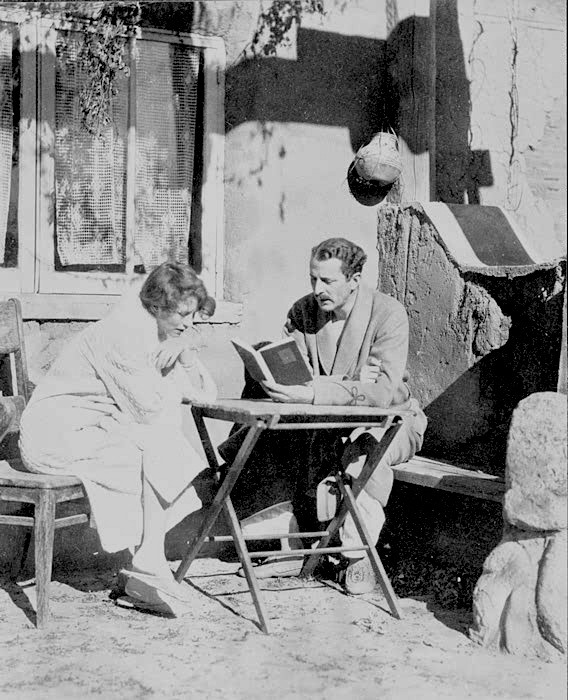
Throughout his school years, Ficke was drawn to the arts, and yet family expectation dictated that he was to practice law. A career as an art critic and poet therefore progressed alongside lawyering. During WWI, and while serving as a military Judge Advocate, he met Edna St. Vincent Millay and eventually a post-war love affair blossomed. You may see some similarity to Millay in today’s Ficke-written piece, a rhymed, metrical sonnet, a form Millay also worked in.
Arthur Davison Ficke with Edna St. Vincent Millay.
Like Millay, Ficke mixed with the Modernists socially while not consistently writing in the new Modernist style. This ambiguity of Ficke’s toward Modernism played out in an event we’ll cover in a future post.
I don’t find Ficke’s poetry as musical as Millay’s, but his“The Book of Lu T’ang Chu” still has its charms. The poem combines Ficke’s interest in the Orient with a subtle observation about art in the modern age. This poem’s ancient Chinese emperor and Ficke himself are now both dust in the wind, as we all will be—but we can still listen to his meditation, set to my new music and performed on acoustic guitar, piano, and an attempt at playing (via a MIDI controlled “virtual instrument”) the Chinese traditional zither that came to the fore during the Tang dynasty, the guzheng. Use the gadget below to hear this.
I was reminded of this poem, and Wallace Stevens in general, while writing about the 20 most anthologized modern American poems recently. It’s odd that I needed to be reminded of Stevens. His poems were always present in the anthologies of my school years, back in the last century, along with Frost (who I disliked when I was young), William Carlos Williams (who I didn’t understand), and Eliot (who I liked for his verbal music without much understanding). There must have been something about Stevens that attracted me, as when I recall the poems I wrote in my youth, they more often looked and sounded like Stevens than those others. There’s a wit of a very contrarian kind that’s all over Stevens’ work, so I’m sure that was a big part of it, but I think it was also Stevens’ verbal music that pulled me in, and unlike Eliot’s, I (subconsciously) imitated Stevens.
I later read that Stevens walked to his famously conventional job as an insurance executive every day, and composed his poems in his head as he walked. This makes sense, as I did the same thing, with the two-footed meter of walking informing the rhythm from the soles of the feet up, rather than from the head down. Another thing about writing while walking: the music of that rhythm carries you into a more hypnotic and subconscious space were lines that sound good and fit to the beat are carried and held into memory more than carefully considered phrases that one would compose at the keyboard or with thoughtful pen in hand—and that same flow can knit together the unlike before thought can reject it.
If you take Stevens’ particular perverse wit, and meld it with composition of poems while walking, you have the recipe for a Wallace Stevens poem like this one.
The title of “The Emperor of Ice-Cream” has that impish quality. It seems to be light-hearted. Who’s his consort, the Dairy Queen? Is his uncle the King of Burgers? Did he know Prince? Queen Be? Duke, Duke, Duke, Duke of Gelato. And the poem starts off as if we are in a variation of the nursery rhyme “Old King Cole, he was a merry old soul” by calling for the strongest man to crank the ice cream maker.
A digression: do 21st Century people even know what an ice-cream maker is? It’s a bucket, no larger than one used to mop the floor, filled with ice that surrounds a smaller metal canister with a hand-crank-driven paddle screwed into the top. Salt is poured onto the ice, melting it so that it can get the canister colder than zero centigrade, as the crank is turned to churn the mixture of sugar and cream. As the process continues, the contents of the canister thickens and the force needed to turn the paddle increases. Even with a strong man cranking, the resulting ice cream will be softer than the concrete brick of modern ice cream, as that is a creature of refrigeration unknown in Stevens’ youth; but the cool, rich, sweet taste would also be all the rarer then too.
“Call the roller of big cigars, the muscular one” churning that 2 gallon one would take a mighty man
So back to the poem. We have the strong cigar-maker man churning, amidst young, common, unmarried women and boys bringing flowers. The resulting ice cream demonstrates Stevens comically expanded vocabulary, it’s “concupiscent,” lustfully good! Freud may have famously insisted that “a cigar is sometimes just a cigar,” but a multitude of Blues metaphors contemporary to Stevens would agree, this is a lusty scene.
And the title reappears. Pleasure, broadly drawn, is the ruler of all!
So far Stevens has only been perverse in the weird “Old King Cole” language of the revelry, capped off with a word that most of us can’t even pronounce, much less spell or define.
Bang! Into the next stanza. I had always thought “dresser of deal” was flowery poetic diction for “we need to deal with” the situation in this next scene, but it’s more of Stevens’ vocabulary quiz. “Deal” is an archaic term for cheap pine wood. The exquisite detail of the missing drawer pulls, so much like the shabby second-hand dressers of the bedrooms of my pre-IKEA youth, yields to the fullness of the scene: it’s a room with a dead body.
Digression again: my son bursts into the room where I am writing this. He has just heard a robocall barking “If you or your loved one is over 65, they have a 1 in 3 chance of falling. Don’t let that fall be their last. Press 1 to…” He’s laughing, and continues “…hear about our warning-thingy scam…”
I follow on with my additions “…and press 2 if you want him to die anyway since he’s not allowing you any screen time today….and 3 if you are hard-of-hearing and WOULD LIKE US TO REPEAT THIS MESSAGE LOUDER.”
Back to the solemn dead body, cold and dumb, being covered with a sheet from the dresser of deal that is poignantly too short to cover the feet. Stevens leaves the light on, we need to see this clearly. And the title returns, now a refrain, and in this new context, the ruler of all offers only fleeting pleasures that one strives for, passes through, and melts away. The poem ends.
Stevens arrives at the insurance company offices. He strolls in past the receptionist, arrives at his office. Warren G. Harding is President. He asks his secretary to take this dictation. Obedient to her accustomed role, she folds back the steno pad, pencil in hand. Did she care for his poetry that she transcribed? That would be immaterial, she has only to listen.
Strolling Wallace Stevens in the 1920s. Cane in one hand, thesaurus in the other?
Two scenes. Two passing stations on a walk perhaps, or a flight of memories as lines emerge along steps. Only one more perversity to note, a puzzling line that looks like a typo: “Let be be finale of seem.” Let the steps the author is taking when he wrote this be our guide. One stride: “Let be”, then a double-time step: “be finale,” another step: “of seem.” I had never figured this line out, but someone on the Internet named Daniel E. Burke pointed me to this letter Stevens wrote in 1939. If Stevens had caught a crack in the sidewalk causing a hitch in his step, the line might have been more clearly composed as “Let being be the finale of seem,” but the Hartford sidewalks were too-well maintained, and Stevens never cared to be understood anyway, only listened to.
I had meant to write more about the music I composed for this one, but I’ve run way too long again. I wanted prominent drums to represent the flow of time, a cello to represent the melancholy death thread and a jaunty acoustic guitar part representing the swiving partiers of the first part. Assessing the performance I first thought I should redo or remix it to keep the cello and the guitar to their respective stanzas, but then I rethought that too. Shouldn’t they both be present in each scene to give the flavor of Stevens’ perverse combination? To hear my performance of “The Emperor of Ice-Cream” use the player below.
Today’s piece is our first proper piece by English poet Thomas Hardy. In America Hardy may be better known as a novelist, though he considered himself a poet first and last. When Hardy began writing poetry in the 19th Century, William Wordsworth was but a decade dead, and at the end of his career in 1928, T. S. Eliot’s “The Wasteland” was several years old. So, Hardy’s career starts at the tail-end of the English Romantic revolution, and proceeds through the Modernist Explosion of the early 20th Century.
In some particularities of locales and events, Hardy’s poetry can seem of the 19th Century; but his language, direct, colloquial, and unfusty, seems as modern as the 20th Century modernists. Indeed, modernists from Robert Frost to Phillip Larkin found much to admire in Hardy. Setting many of his poems in the rural areas of western England diffuses the placement of some Hardy poems on a timeline, as the more rapid pace of cosmopolitan change does not mark them as sharply.
“Strap yourself to a tree with roots”
Gravestones moved by Thomas Hardy when progress impinged on a country graveyard.
Today’s Thomas Hardy piece is “The Self-Unseeing,” published in 1901, right in the turning of those centuries that Hardy spans. This is another poem brought to my attention by the Interesting Literature blog, and I cannot improve on the excellent analysis of the poem there.
In “The Self-Unseeing” there’s a visit, in a mix of memory and reality, to a long-ago childhood house, a mental voyage many of us can do, assuming we can ride out the emotional waves. Given the fires, floods, earthquakes and winds of the past couple of months across our continent, some will be being taking this visit now wholly in memory.
Bury my heart in Stinsford.
So, that’s it for analysis of the poem this time, but we’ll offer some music to go along with it: strummed acoustic guitars and bass, and a vocal that’s a bit more to the “sing” side of our usual talk-singing. To hear it, use the player that should appear below. If you like the variety of what we’re doing here, combining various words with various music, please help us by sharing links to here, hitting the like button, or otherwise letting folks know. Thanks!
Today was the Autumn Equinox, which some use to mark the beginning Fall. Where I live it was very hot and muggy, hardly autumn-like at all, and even the reasonable breeze could not budge the heat. I went bicycling with my son, promising him ice-cream, which he accepted as adequate exchange, and picked up cold sandwiches for our supper, but in-between I worked on the setting for this piece, yet another by Christina Rossetti.
I wasn’t intending to return to Rossetti so soon, and I’m not sure how I ran into this poem, but it meshes so well with some others I featured here this month about summer and attitudes to love. I just couldn’t deny it.
Christina Rossetti: sadness that none-the-less sings in a lovely way
I know little of Christina Rossetti’s life, if she suffered from depression, or if this reflects a more temporary mood; but in whatever case, she fashioned a finely crafted lyric to present the experience. I find this sort of thing often in English poetry, sadness that none-the-less sings in a lovely way. Here is America we grew up some Blues, and we tend more to bargain with despair, or call it names and begin to insult its absurdity.
The title is a bit of puzzle to me, though. “From Sunset to Star Rise” has something of a “It’ll get better” connotation. Was she trying to remind herself of some wisdom that could come from this, or that there is some mystery yet to work out?
Musically I wrote this on acoustic guitar and the full arrangement retains the acoustic guitar part with some disconsolate drums and slowly building synth parts. To hear it, use the player gadget below.
Today’s post uses a very short poem about a famous doomed adventurer written by a too-little-known early modernist soldier-poet.
The words’ author, T. E. Hulme, is a name I kept running into as I read about the connections between modernist American and Irish writers in England at the beginning of the 20th Century. Many of those connections can be traced to a group of writers and artists, led by Hulme, who congregated in London beginning around 1908. It’s there that Ezra Pound, soon to be literary modernism’s greatest promoter, met Hulme, who many view as modernism’s originator. The argument for preeminence comes down to classic one: who thought of it first vs. who practically introduced it.
So far here I’ve concentrated on Pound’s role, but as I began to look at this circle, I must consider Hulme’s impact as well. And then a few weeks ago, through the wonderful blog “Interesting Literature,” and its founder Oliver Tearle, I finally read some of Hulme’s poetry, his own practical application of his ideas.
T. E. Hulme, the man whose brief poetic spark set off Imagism
If there’s a reason I hadn’t read Hulme yet, it may be that his poetry isn’t as well known, and there is very little of it—and what there is, is little twice: about 25 poems totaling about 260 lines. That’s right, as disciples of Bill James will quickly recognize, the average for a Hulme poem is shorter than a sonnet, just a bit more than 10 lines. His short poems, as much or more than other famous short Imagist poems like Pound’s “In A Station of the Metro”, Williams’ “The Red Wheelbarrow” or Sandburg’s “Fog” challenge the reader to find worth and significance in a few words and a putatively mundane subject. Today’s piece uses the words of Hulme’s “Raleigh In the Dark Tower,” and is something of an outlier in Hulme’s poems, as it’s subject is not so ordinary.
I used Sir Walter Raleigh’s “The Lie” earlier this month, and in writing about this extraordinary condemnation of human failings, I told you what every English schoolkid of certain generations would have learned or known about Raleigh: that he was an Elizabethan English hero, and yet he was executed by the English government.
Also to blame for Duke basketball fans
Once more I’m going to have compress Raleigh’s life into shortcuts, some of which are matters of dispute. He lived in a time of brutal Christian religious wars and is said to have witnessed both the St. Bartholomew’s Day Massacre and to be captain of the troops ordered to perform the execution of prisoners after the Siege of Smerwick. He was lifetime soldier of fortune and entrepreneur, a cross between James Bond and Richard Branson. He popularized the potato and smoking tobacco, and so can be blamed for lung cancer and my spreading waistline. His expeditions pioneered European settlement of North Carolina, which means he is partially responsible for both Michael Jordon and insufferable Duke basketball fans. He twice led English expeditions into Guyana in South America, without which we would not have Davey Graham and acoustic guitars tuned to DADGAD. Oh, and he was a writer.
Even during his three separate confinements to the prison in the Tower of London, Raleigh wrote. Or perhaps he wrote because of his confinements? He wrote the first volume of a monumental attempt at a history of the world during one prison stay, but his release ended the chance of the series continuing.
To present Raleigh, Hulme in his conciseness, give us just these few lines:
Raleigh in the dark tower prisoned
Dreamed of the blue sea and beyond
Where in strange tropic paradise
Grew musk
For my music for “Raleigh In the Dark Tower” I used acoustic guitar and a string quartet. To try to bring out the dream half of Raleigh’s prison I tried to perform a second, higher, vocal line. To represent the prison half of Raleigh’s experience, I repeated the words a second time, as a prisoned day would follow another prisoned day.
More depends on Raleigh’s life than depends on a Red Wheelbarrow, but Hulme lets that be only understood. And Hulme’s Imagist philosophy, a “dry hardness”, would urge fewer romantic dreams and more direct observation, but even in his few words, he allows this prisoner the immediacy of his dreams and voyages.
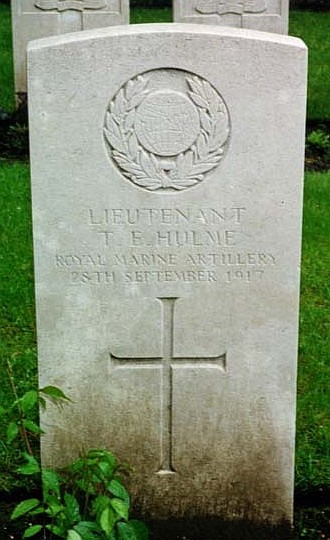
Raleigh would be executed for serving the amoral interests of his country too well, and Hulme would die a soldier on a WWI battlefield believing to the end in the causes of a war that was soon portrayed as absurd.
Another soldier-poet whose leaf WWI cut short
To hear my music and performance of T. E. Hulme’s “Raleigh In the Dark Tower,” use the player below.
Did I just say it’s been awhile since I featured a piece with words by Carl Sandburg? I started this Sandburg piece early this month thinking it would appropriate for the onset of spring and National Poetry Month. It fairly short order, I came up with the general chord progression I wanted to use, one which is somewhat ambiguous as to key-center (D, A, F# minor, E, with the cadence generally descending from D, but resolving either the A, the E, or the F# minor, and with a single B minor thrown in).
I liked this musically when I laid down the initial acoustic guitar track of the chords; but I intended to add additional parts to fill out the arrangement, and when I started that, I found I had given myself more of a challenge than I had anticipated. A better orchestrator than myself would have had less trouble I suspect, but I finally came up with something I felt I could accept yesterday.
Carl Sandburg rocks out, no fancy arrangement needed.
If you search for other Carl Sandburg pieces that have been part of the Parlando project, you can see how fond I am of Sandburg as a writer of short poems. For someone who writes generally in free verse, Sandburg’s work has been set to music more often that one might expect. As I worked on “Spring Grass” I assumed someone else had taken a crack at it, but I put off looking at that to concentrate on my own musical problems. This morning I did some searching and found that there are at least twoother settings besides mine, one done by the young Phillip Glass, a composer I very much admire.
This guy probably had less trouble with his orchestration.
I find one word Sandburg used here intriguing: “spiffed,” which is obscure enough in his poem that I’m not sure what it means. At first I thought it was a nice onomatopoeic sound for the wind horse in the poem snorting gently near the poet’s face—and perhaps it is—but if I read Sandburg’s sentence right, it’s the spring grass smell riding on the wind that “spiffed” the author. Does he mean “spiffed up,” the only idiom I know that uses that word? I’ve never heard “spiffed” without the “up” myself.
Well, the word-mystery doesn’t stop the poem, there’s enough mystery in Spring itself. Enjoy the rest of #npm17 and keep telling folks about the Parlando Project and our combining of various music and various words in various ways. To hear my version of “Spring Grass” use the player that appears at the end.




 Frank Hudson