The Labors of Hercules

I’ve largely put off considering the American Modernist poet Marianne Moore. Why? Largely a combination of difficulties in understanding her verse with an inability to appreciate her word-music. When I look at a Marianne Moore poem I’m usually struck by a combination of plain-spokenness with a knotted syntax that obscures the direction of her meaning.

Ordinarily I’m perfectly willing to put up with hard-to-understand-on-the-first-reading poetry—indeed I can like poetry that I can never quite grasp  as long as its language makes me gasp. But a Moore poem on the page, and in its first or even second reading often seems more like a set of notes for a poem or one of my own jumbled first drafts rather than an elusive song I’m driven to follow by the impetus of its structure.

But of course all of that is an impression based on limited exposure to her work. Late last year I put down a short list of works that would come into public domain in 2020, and one of those works from the last decade to be called “The Twenties” was Marianne Moore’s first book-length collection Observations.

This month I read Observations.  I was puzzled by many of the poems—that I expected—but what surprised me was how consistently the poems take a stance of protest, opposition and stubborn grievance. Don’t ask me to explicate each poem in Observations,  I’ll fail that test, and even if my understanding of the alliances of various Modernist has been refreshed and expanded by doing this Project, I can’t say completely who or whose poetic theories are being skewered, but Moore’s first collection can be read as a collection of dis tracks.

Marianne Moore 2

Marianne Moore has a few things to say about obstacles and those that put them up


Observations  contains Moore’s most famous poem Poetry,”  the one that begins “I too dislike it.” But as it sets out it’s ideas of proper poetry, it’s relatively gentle in chiding those that fail. Other poems in the collection are not so gentle.

Take the one I’m performing today: “The Labors of Hercules.”  The title helps us with a reference before we get to Moore’s discursive style. In Greek mythology these were a series of 12 tasks, each one next-to-impossible on its own, all of which the hero Hercules must complete as penance. Moore doesn’t seem to follow the scheme of these classical tasks.*  Instead she sets out the tasks that have been made next to impossible for her (or her like) to create their own variation of American Modernist art—and there’s a bunch of them.

Is the mule at the start of the poem then her own poetic muse, not conventionally beautiful and lyrical?  The rest of the obstacles/tasks seem more outer than inward. There’s a narrow-minded pianist too tied to the score** to improvise or compose in a new manner. A string of invective brings us some “Self-wrought Midasses of brains” with “Fourteen-carat ignorance” that she’ll disappoint. She sarcastically threatens to rebel and dress up as the specifically male and bearded representation of time and posterity.*** She disputes the theory (propounded by T. S. Eliot and some lions of New Criticism) that detachment from one’s particular personality is required for creative power. She runs into the “High priests of caste” and lashes them with some further, unmistakable invective. Next she says she’ll have to teach saints to atheists to succeed in her penance.

There’s a line I’m not sure of that follows: “Sick of the pig-sty, wild geese and wild men.” Moore might be saying she’s sick of reflexive poetic worship of a timeless nature, as she shared a Modernist interest in observing the man-made and mechanical as worthy of poetry. Myself, I like a poem that freshly opens the book of nature as much as the next person, but there are days when one more poem about majestic wild-geese or another Robert-Bly-has-helped-me-come-to-terms-with-my-masculinity**** wild man poem makes me gag.

The poem closes on a short litany negating a series of common prejudices and ethnic stereotypes. I will not tarry long here to note that several other Modernists of 100 years ago were not shy about displaying each of these bigotries. In the context of this poem, Moore is saying “and besides all of the other things I’ll need to overcome, I’m not going to score easy points with bigots.”

Andy Gill in action with the Gang of Four.


It’s my hope that my performance of “The Labors of Hercules”  helps as much as what I’ve written above to illuminate Moore’s poem. Musically I was thinking of Andy Gill, a guitarist who I admired greatly and who died this month. I didn’t mimic his distinctive sound or the can’t-not-dance groove of the group he founded, The Gang of Four—but a little of his attitude was informing me. The full text of Marianne Moore’s “The Labors of Hercules”  is linked here. The player to hear my performance should appear below, and all the Parlando Project audio pieces are also available on Spotify or Apple Podcasts. Just look there for (or on other podcast sources) for The Parlando Project.


*At a recorded reading given decades after she wrote this poem, Moore says the taming  of the opening mules was one of Hercules’ tasks. Maybe she’s referring to the capturing of the “Mares of Diomedes” task in the classical myth?

**”Tadpole notes” made me think of immature notes that haven’t grown into those real toads for one’s imaginary garden, but it appears that Moore’s quoted image is more likely a reference to the shapes of notes in conventional notation with their bodies and tails.

***Moore’s politics are not something I know a lot about. Socialism of the William Morris sort is said to be an early influence, but she was an ardent woman’s suffragist 100 years ago when she still couldn’t vote as a matter of law. At the time that the female “song-bird” poets (Teasdale, Millay, Wylie, and others) were starting to be denigrated by high-church Modernists, Moore was one woman who was going to fight back with her own distinctive Modernism.

Anyway, the whole image here of her clipping on a fake beard and confronting the “high priests” can only make this reader think of the stoning scene in Life of Brian.

****Bly fan and reading this? My opinion on his work is complicated, and your opinions are more important than mine anyway.

We Want to Believe That There Will Come a Moment When Everything Changes

Here’s another in our series presenting poems that address what a struggle for social change feels like. A couple of differences this time, but then this project likes differences.

First difference: the words I adapted for today’s piece weren’t intended as a poem. How’d I come upon them? I saw this post over on the Afro Punk blog which had a linked short video with long-time radical activist and thinker Angela Davis. Davis’ younger interviewer starts off with a philosophic observation about the nature of time and changes, and ends by asking Davis to “get us to a different place.”*

Davis’ reply did that: it included an insightful statement that may be useful across generations. Listening to it in her exact and measured speaking cadence I began to see a structure already implied in it that could be expressed poetically. My contribution to the text was simply to cut out and arrange some of her words in order to further compress and focus on an element that I heard and resonated with and that I’d like to emphasize. Though that’s audacious on my part, my intent was to respect and re-amplify this part of her message. Did I succeed or fail by changing the context of some of her words in this way? Listeners will judge.

You may not agree with every one of Davis’ ideas, but my point is that through poetry we can better understand the experience and soul that fires those ideas


Here a second difference. When I presented Yeats’ poem about his country’s civil war, I said most living Americans will likely have no knowledge of which sides and positions were involved in that struggle that Yeats wrote about in 1923, much less a position on them or their consequences. I certainly didn’t. Time and distance can do that. What might a civil war feel like so soon after Ireland had gotten its independence? We can still feel that element in Yeats’ poem regardless.

Similarly, the complex theological structure of William Blake’s 18th century “prophetic books” require footnotes for many of us, but his stance for human freedom and possibility despite our fallen nature may still come through.

Davis though is still a person of controversy. That’s a radical’s job after all, and she’s been at that for more than 50 years. Furthermore, actual questions of life and death of people—people that other still-living people know or knew—are connected to those positions and tactics over the decades. Arguments of necessity and priority are complex. As it is, no passage of time has made racism, sexism and homophobia mooted points, and no country I know is a safe refuge from these things. These are too important questions for me to be glib about them.

But what about what Davis said during this Black History Month about us who want social change? There is some wisdom to take in. You can listen to my performance of a few statements from this February 2020 talk by Angela Davis with the player gadget below, and you can see Davis herself make her points herself. Musically I believe I was thinking of Gil Scott-Heron when I tried to do my best playing a couple of electric pianos. Gil Scott-Heron is another one of those influences that helped form this project.


*For Black History Month, Afro Punk has taken a theme “How long ‘til Black future month?”

from The Book of Urizen, Chapter 9

Let’s return today to the English mystic and poet William Blake, but continue on a thought that is inherent with the last two pieces, one by Yeats and the other by a long-winded guy who writes this. Poetry, just like other writing can, within its levels, do any number of things. One can seek to teach, to reassure, to tell stories, to amuse, to make philosophical points, or to abstractly portray beauty in poetry. Some poets, some critics, some projects, believe some of these are more worthy aims than others. From one day to another I may favor one of these over another in my reading, my performances here, in my own writing.

There’s a certain “high church” of poetry that feels that which aim and which methods are used in reaching it is crucial—and that other choices harm the art. I’m not smart enough, or well enough read, to know if they’re right.

But there’s one thing impactful poetry shares with the other arts: that’s the texture of the immediacy of experience, of how its creation, its creator, its reader, its listener feels and shares of any of this.

So, it largely makes no difference to readers today what political side William Butler Yeats was on in the Irish Civil War. And if post-WWII “Westerns” dealt with certain horrors: racist terrorism, genocide, colonialism, and the responsibilities of citizenship in an uncertain and sometimes buffered way, well so be it. What remains is the emotional and perceptual core transferred now.

Today’s piece is a section from one of William Blake’s “prophetic books,” a series of very small editions he wrote, illustrated, colored and printed himself. As a young man I admired that. Blake bows to no other as far as “Indie Cred,” “get in the van,” and DIY spirit. Furthermore, he developed (or envisioned) his own mythology to explain his metaphysical outlook.

I can still remember first reading about Blake in a list of minor poets*  in some leftover textbook of one of my parents sometime in the mid-60s. The note said that while he wrote some charming short lyrics he later descended into longer works that were judged as borderline insane. To many a young person that’s not a tragic story so much as it’s intriguing.

A year or two later the rock’n’roll band The Doors dropped a Blake line into an album cut and I eventually was able to get a few paperbacks collecting Blake poetry. “Mad, bad, and dangerous to know,” youthful Byronic mythos was part of this no doubt.

I couldn’t make head nor tails out of Blake’s “prophetic books.” I could see the Milton and Books of Moses references, but that didn’t illuminate things much. In the decades since, there have arisen many Blake scholars who worked out his structure and epistemological themes to a great degree. That’s helped. But even then as a teenager, and now as an old man, I could and can still catch glimpses of how it felt to apprehend and sing these things Blake wrote. The poems are like their illustrations in Blake’s great plan for “illuminated books:” they are meaningful in their impact without necessarily telling you what they are meant to mean within some overall structure. And that’s probably how visionary works should be.

Blake's Ancient of Days on St. Paul dome

A recent special exhibition of Blake works in London was celebrated by projecting one of Blake’s most famous images on the dome of St. Paul’s cathedral. Not shown: the irony of nonconformist Blake’s image on a national religious landmark.


So today I’m going to perform part of the final chapter of Blake’s Book of Urizen  which comes after Blake has told something like a condensed tale of “Paradise Lost”  or the book of Genesis;  but with his own vision of the creation of the world and religion and the fall and fate of humankind. It doesn’t require that you understand or agree with Blake’s ideas if I can help illuminate Blake’s words so that you can understand the feeling of creating in a failed and fallen world.

In Blake’s mythos mankind is descended from fallen Eternals, blind to the infinity of the universe and their own souls. When we see his famous picture of a bearded Urizen with a compass at right angles measuring the world it’s not only a picture of visionary might—it’s the picture of a fallen, blind Eternal assiduously measuring a world with a puny device.

I didn’t go directly Doors rock’n’roll for today’s audio piece, instead the words led me somewhere else, to one of the things that influenced that band: the mythos of another visionary: Sun Ra, the Birmingham Alabama born Afro-American who recast himself as a prophet from the planet Saturn, and thereby encoded African and Afro-American culture as an infinite thing.

So Afro-Futurist saxophones today in gratitude to Sun Ra and to William Blake. The player to hear my performance is below, and the full text and illuminated plates of Blake’s Book of Urizen  is here if you‘d like to read along, The section I perform is near the bottom, Chapter 9, verses 3-6.


*Blake started gaining some reputational ground by the late 19th century in England, but American literary forces lagged in appreciation for him.

The Wild Roses

When I started thinking and planning this project, I thought I’d be producing audio pieces around five to eight minutes in length. That was the most common length of the preliminary combinations of various words with music I had experimented with before the Parlando Project was launched.

I made a course correction once the project took off. If you’ve been here recently you’ve seen that the typical audio piece is now between two and four minutes, roughly the length of the classic 45 RPM single record of my youth. How’d this happen?

I found that I am really drawn to the condensation and immediacy of lyric poetry, the kind of thing that lands its impact in 30 lines or less. Like those three-minute singles of my youth, those texts can often cram quite a bit of expressiveness into a similar length of time.

Then part of this is also counterprograming. About half of the listeners here consume these audio pieces as podcasts on Stitcher, Spotify, Apple Podcasts, Player.FM etc.  A great deal of podcasting on offer clusters around longer-form, loosely organized talkfests. I have no long commute, take few long trips, and much of my life is reading, writing, composing or recording and none of that opens opportunity for someone remotely talking at length (however engagingly) about something.*  My thought is that even if someone enjoys that, then mixing in a short dose of poetry or other condensed writing with music from this Project will be a pleasant contrast.

And there’s a more intimate reason. I’m a weak singer who cannot execute complex sung melodies or make simpler ones thrilling over a longer duration. Listeners will note that I don’t sing most pieces here, using instead variations of chant, talk-singing, or declaimed spoken word instead. This leads me to want to make my statement in a shorter format.

What’s all this leading up to? I told my wife that I’m hoping I’ve earned the right to potentially bore my audience today, because I’m going to present an eleven-and-a-half minute, 20-verse ballad. What’s more, I’m the author, so I can’t even cut the thing for length as the writer will complain.

“The Wild Roses”  has an odd inspiration: a TV episode that aired almost exactly sixty years ago on Feb. 6th 1960 as part of the western TV series Have Gun-Will Travel  titled “The Night the Town Died.”  Have Gun-Will Travel  strived to differentiate itself from other TV westerns of its era. It liked the odd-ball script a lot more than most, and the series’ star Richard Boone (who also directed that episode) seemed to favor bold acting performances. And though he rode a horse in the 19th century American west, Boone’s gun-for-hire character Paladin acted more like a noir private detective.

I’ve written here that the then common 25-minute stand-alone story format for dramatic TV shows developed poetic effects. Our modern, linked-episode, multiple-hour seasons develop characters over time in a way that emulates novels on the page. The much shorter format of the ‘50s  and early ‘60s had characters life stories sometimes told in a scene or two.

I’ve often wondered if the teenaged Bob Dylan watched these shows. There are elements of his story-telling in song that sometimes remind me of them. Dylan’s narratives are much more abstract, and Modernist language and tactics are deployed more often than the TV writers were allowed to do, but the sense of quickly sketched and absurd situations could be linked.

Gunfighter’s squint or age-related myopia? Richard Boone as Paladin, Robert Zimmerman as Bob Dylan.


The HG-WT episode “The Night the Town Died”  has some strong moments, but overall it leaves more an impression of its oddness and slightly over-done seriousness than coherence. I took very little from its script:** a single character name, a line of dialog—but largely I relied on a funhouse mirror reflection of its overall plot arc: a man comes to a town to revenge the lynching of his brother,*** but he wants to first determine, Hamlet-like, who his just target is.

I chose to tell my story using a young female Ophelia-like character as the narrator, and I gave the revengeful Hamlet-ish protagonist only a few lines. The former appears in “The Night the Town Died”  to speak about wild roses, the later bears the name I instead gave to the murdered brother. There’s no Deus Ex Machina Paladin gunfighter to serve as judge or referee as in the TV show. In my ballad, the narrator and the revenging traveler characters meet four other characters. If you think some of these encountered characters carry modern or out-of-time undercurrents, yes, that was my intent. And coming in right after a Yeats’ poem last time, I chose the town’s name in my ballad with intent too.

These choices were performance challenges. The writer (me) didn’t give the performer (me) much choice but to try to “play” the characters in voice to line out who was speaking in the immediacy of performance. If someone else was to perform this, having a number of vocalists to play the characters would be better I think. I sing the woman/narrator role, but then speak the lines from the men she meets in hope it helps set them apart. Likewise, my song might gain value from having a woman singing it.

The Wild Roses

There are still a few lines that I don’t think are as good as they need to be in this version. Maybe today’s performance is a bootleg/demo?


Performing this kind of narrative song takes special talents, and I have no more than a small amount of what should be deployed in that task. And as a writer my narrative for this ballad is also unusual. It’s intentions are more like Bobby Gentry’s “Ode to Billy Joe”  or Bob Dylan’s “Isis****”  than the straightforward narratives of “Matty Groves,”  “The Dowie Dens of Yarrow,” or Marty Robbins “El Paso.”*****   Does “The Wild Roses”  succeed or fail? The player is below.


*My wife, whose routine and preferences are different than mine, enjoys conventional podcasts, and audio books as well. I grow more and more impatient with age it seems. I can read and absorb more denotative information in the available time with my eyes than with my ears.

**There are two screenwriters credited. One (also credited with the story) had what seems an unremarkable career: Calvin Clements Sr. The other,  Frank Pierson, had a longer. more successful career.

***Yes, another post-WWII western based on a white-on-white lynching, which consciously or unconsciously may have been a way to deal with the horrors of terrorism directed at Afro-Americans and the responsibilities of citizenship and moral choices.

****More obscurely and perversely, some of the most laconic and least well-remembered Dylan songs like “The Ballad of Frankie Lee and Judas Priest”  and “Clothes Line Saga”  were also an influence here.

*****This Western gunfighter ballad was topping the charts at the same time “The Night the Town Died”  episode aired 60 years ago. Around the same time, Bobby Zimmerman started using the name Bob Dillon (Marshall Matt Dillon was another leading TV western character of the era, though there is a Dillon road in Dylan’s hometown of Hibbing, and there was a successful ‘50s football player that had the name of Bob Dillon)

The Stare’s Nest at My Window

I’ve done a number of William Butler Yeats poems here over the years as part of this project. We might agree that occurred because his words on the page just demand to be sounded. But there’s another side to Yeats that attracts too. He can write about political subjects with that same lyrical voice.*

One potential problem with political poetry is that a poet may not share the reader’s political stance, and while Yeats later dalliance with Fascism seems less ardent than Ezra Pound’s stronger convictions, the excellence of a poet’s lyrical gifts can’t save all examples.

Where Yeats succeeds in his political poetry, it’s often when he’s expressing complex moments of political disappointment or even disaster. This is properly the lyric poet’s area: the form where poetry isn’t about ideas but the experience of ideas.  When Yeats does this the details that led to these moments are sometimes sketched in, but the poem can succeed even if one knows nothing about them.**

After all, every person with a cause eventually knows days when the cause seems damaged, perverted or defeated.

Today’s Yeats poem is a case in point. In my parochial ignorance I knew nothing about the events of the Irish Civil War of 1922. Reading a bit about it could add some more resonance to the harrowing tale Yeats tells in this poem taken from a short sequence of poems he wrote that year about the conflict, but I don’t think the reader needs  to know those details for the poem to be powerful.

The poem has a central image, referred to in a refrain at the end of each stanza: honey bees and starlings*** are both nesting in the deteriorating brickwork of the place Yeats is staying in Ireland during this civil war, symbolizing those Irish factions fighting. Yeats seems to stand with the honey bees, which I read as the industrious, pragmatic, and fruitful symbol. The starlings are only raising their own brood in the same wall crevices, but from what I understand the starlings of the British Isles are somewhat of a nuisance bird, lacking in beauty and melodious song.****  Note too the detail that the starlings are being fed “grubs and flies.” Maybe the starlings aren’t evil, but what they’ve been given to subsist and grow on isn’t portrayed as lovely, a thought echoed in the final stanza.

Thoor Ballyee (Yeats Tower)

Not quite an ivory tower. Yeats had bought this old castle tower in disrepair. This page says they are still trying to repair it.

.

So, written in the sorrow of a civil war in his freshly independent country, Yeats’ plea is for a time when the chippering and tweeting loudmouths will eventually give way to those who may one day make his country prosper, though they will do so building in a country that has been emptied and hollowed out by the current disaster. That’s not a political platform, but it is an experience  that you and I may resonate with now.

Musically I didn’t stint on the discordant effects this time. Despite spending a few days with this one, it may take more time and listens for me to decide if I did right by Yeats with it. The full text of the poem is here if you’d like to read along, and the player gadget to hear my music and performance is just below. If you don’t see that gadget, here’s another way to hear my performance, this highlighted hyperlink will also play it.

.

*Although Yeats wrote about a variety of subjects, it’s easy to find him fitting into the same bag as other poets seeking to reform their culture out from under colonialism. In that effort he may be more of a cultural nationalist than a functioning politician (despite his eventual term in the Irish legislature), but this concern was central to his art.

**That said, one of the most popular posts here over the years has been this one about the exact issue and persons behind the Yeats poem “To a Friend Whose Work Has Come to Nothing.”

***Yeats chose to use an archaic name for the common starling: “stare.” Yeats claimed the name was still in use in Western Ireland, but it still seems to be a deliberate choice . Stare does give him more rhyming words, but I also wonder if Yeats was thinking of punning undercurrents of stare as in looking—looking as in out his Irish window at his vision for a new independent Ireland; and “stair” as in a climb toward a higher, more perfect purpose than centuries of colonial exploitation followed by civil war. Or even “state.”

****Despite the bird’s little-liked vocalizations, starlings can learn and repeat other sounds in their environment. The best story I came upon in looking for information on why Yeats might have chosen the starling for his poem was the tale of the composer Mozart’s pet starling who could sing Mozartian passages. The starling’s discontinuous song has also been posited as an inspiration for Mozart’s famously odd-ball A Musical Joke” (K. 522)

Rimbaud’s Eternity

I started out this January trying to translate Rimbaud, and it’s only as the month is ending that I’ve finally got something to present. Why was this such a struggle?

Well, some of it’s me. I’m having a harder time this winter keeping up this project, and by focusing recently on translation I’ve only made it harder on myself. Why do I do these translations on top of composing, recording, and playing most of the instruments in the pieces? That’s more than a rhetorical question, I’ve sincerely asked myself that this month. I’m not a speaker of any of the native languages of the poets I’ve translated, so I work with the highly welcome online dictionaries and computer translators available—but I’m not a literary scholar or expert on any of these poets, and I’ve never lived as part of their culture. I worry about getting it wrong, doubly so in that I present them publicly.

I think I have three reasons. First is that it expands what I can present here. As I’ve mentioned before, it’s difficult to get permission to do what I do for work that’s not in the public domain, and I don’t want to use other people’s translations that are in copyright without permission. Second, I think this is a great practice to improve one’s own poetry. Do any creative writing programs these days require or assign translation of poetry?*  I don’t know, but if not, I’d encourage that. The struggle to find the best English word, to not harm the strength of an image, and to shape the poem so that its word-music works are directly transferable to writing one’s own poems. And here’s the last reason: I think performing a poem illuminates it for the reader/performer, it makes it part of your breath. Translating it imbeds it even more so in one’s mind.

So why was Rimbaud a tougher task?

Unlike other poets, I’ve never been a Rimbaud fan, even though Modernist French poetry was an enthusiasm of my twenties. I think I bought a translation of Rimbaud’s A Season in Hell  at the same Savarns book store on the Minneapolis West Bank where I picked up poetry chap books by Patti Smith and collections of French language Surrealists. And Smith and Surrealists liked Rimbaud a lot.  Smith has spoken reverently about how her copy of Rimbaud helped her through her own early twenties, but Rimbaud didn’t perform that service for me.**

Arthur Rimbaud
Sentinel soul. Teenage poet Arthur Rimbaud

But even just as myth, Rimbaud has an inescapable pull. There’s no story like it: a bright teenager drops out of secondary school, flees to the Paris of the Paris Commune in 1871, takes up with celebrated poet Paul Verlaine. Disasters ensue, including taking the most famous non-fatal intra-author bullet from a disordered Verlaine. In the midst of this, he writes furious poetry, poetry capable of impressing the most avant garde writers of the 20th century to follow.

Bang Bang My Baby Shot Me Down

“Situations have ended sad/Relationships have all been bad…” Plaque marks were Verlaine shot Rimbaud.

All this as a teenager. As his teen years end, he stops writing and moves to Africa to work as a commercial trader, never returning to the writing life and by accounts actively distaining it. He dies of cancer at the age of 37.

As we’ve seen recently here, there are other teenaged poets who’ve produced work we still read today. But very few of them produced their greatest work at that age—and arguably none of their youthful work was as influential as Arthur Rimbaud’s.

I’ve dealt with the trouble that hard-to-grasp, obscure, and Surrealist poets present to translations. Rimbaud was as tough as Mallarmé in that regard. In one Rimbaud poem I finished a complete translation draft, but was left with an “is that all there is” feeling that the result wasn’t all that compelling. I started another and then another, but again the early results didn’t seem like I’d grasped them or that they’d work here.

Then it hit me, at least with his poem “Eternity,”  part of its power is incantatory, it’s in the metrical and rhyming effects in the original French! This shouldn’t have surprised me. While there are other ways to achieve similar effects: parallelism, repetition, old-English alliteration, even a certain kind of intellectual rhyme in imagery itself, rhyme is still used in most songs and hip-hop rap flows, not because there’s some kind of rule about it, but because the expectation of return to the rhyme gives a certain fatalistic drive to the verse. And “Eternity’s”  meter is also unusual, it’s a very short line, just five beats.

Do you remember me saying that I almost never try to bring over the sound of the original verse into my translations, that I’d rather focus on making the images vivid and for the poem to have whatever good word-music in English? That’s still a practical rule, which may go double when translating from a language like French which has the benefit of so many more rhyming words; but in this short poem I decided to move over to respecting the syllable count of the original line and to a ABCB rhyming scheme.

Eternity

For good or ill, this did cause me to play more fast-and-loose with some of the more difficult images and phrases in Rimbaud’s poem, ones where other translators had other readings. If it sounded good, if it kept to the scheme, if it seemed to advance some overall flow to the poem’s meaning from image to image, I judged it “close enough for rock’n’roll.”

In the end, my main diversion from other translations of “Eternity”  I’ve seen is that many other translations make this poem more of a brag that Rimbaud has absorbed the infinity of the titular eternity and is now it’s master. My version has a more elusive eternity and a sense that others are seeking to apprehend it, much like a search for an underground partisan. Because the other translators may be Rimbaud scholars with a greater mastery of French, there’s a good chance they’re more correct—but if there’s a possibility that the “I is another” in Rimbaud’s poem, there may be an element I’m bringing out that was always there. Here’s a link to the poem in the original French for those who’d like to check.

Musically, this is rock in the ragged sense that rock’n’roll is a loose and inclusive form. There’s no tight backbeat, the bass is a bowed contrabass with some filtering, and the guitar won’t really play the blues—but the overall guitar timbres are from the rock palette. For the chord cadence I made a nod to some of those who did help me get through my 20s. The line in Rimbaud’s poem that ended up being translated (loosely in this instance) as “I see no escape” brought to mind “All Along the Watchtower”  sideways to me, and the chord cadence I use is also somewhat similar to Patti Smith/Bruce Springsteen’s “Because the Night.”  The lines in my translation “Murmur our desire/Night that is nothing/A day that’s on fire” could well fit into that sort of expression. Some of you know the drill to hear it: the player gadget’s below, but what if you don’t see a player? Here’s an alternative, this highlighted hyperlink will also play my performance.

*I know in the past students were assigned translations from classical Greek and Latin poets as part of general studies. While this came from the idea that classical grammar and vocabulary were the basis for mastery of English (a suspect notion) I think it must have helped many a budding poet.

**It was poet/musicians did that for me: Leonard Cohen, Bob Dylan, Jimi Hendrix and Smith herself. All of these are controversial figures in purely literary circles. I can tell you that none of them helped my standing in those 1970s years when I should have been establishing the peripatetic poetry career that I didn’t have. It would have been better for me, influences-wise, if I could have said Rimbaud instead.

The Little Ghost

Tom Rapp is a singer-songwriter whose work I love, and whose 1972 joint setting of a Shakespeare and a Sara Teasdale poem is one of the inspirations for this project. Rapp had a favorite story about the earliest days of his overlooked career: while still a child he entered a talent contest in Minnesota. The story varies. He may have performed an Elvis Presley song. He finished second or third. Another Minnesota singer, a similarly young Bobby Zimmerman,* finished fifth. The Zimmerman kid eventually went on to have a career that outpaced Rapp’s.

But then, Rapp would always add, it was a baton twirler who finished first.

American poet Edna St. Vincent Millay is another poet who began writing and publishing early, sending poems to magazines when she was still a teenager. At age 20 she submitted one of her grander early poems to a literary magazine’s 1912 poetry contest, and that poem “Renascence”  oddly created considerable publicity when it didn’t win but finished fourth. She was a young, poor, rural kid and some said she should have won on the merits of her poem—even including the guy who won the contest, Orrick Johns. As with Tom Rapp, you may have to be a reader of blogs like this one to have some sense of who Orrick Johns was.

If you ever loose a talent or poetry contest, consider that baton twirler.

Millay suit and tie

Just kids. Whiten the background and Sinatra the jacket over one shoulder, and you’ve got that Robert Mapplethorpe/Patti Smith’s Horses cover a few decades early


After the contest and the brouhaha, a benefactor saw to it that Millay could attend college, and a few years later this other early poem of hers, “The Little Ghost,”  was included in her first poetry collection. “The Little Ghost”  isn’t the grandest or most incisive poem Millay would write, so even though I’ve done many Millay poems here, I had overlooked this one until I saw it this month over at the Fourteen Lines poetry blog.

My reaction is shared by most who encounter this poem: it’s charming and only a little bit chilling. Yes, there are a few mildly annoying inverted word order make-rhymes, but it’s the little details that make it work I think. That the ghost seems to enjoy the poet’s garden-work (gardening inherently partaking of the life-death-life cycle), that she enigmatically shows no sadness at being dead, that she (though immaterial) is gracefully careful of the poet’s favorite plant, that she walks away (though a ghost, and a ghost of a child) with the substantial while insubstantial bearing of a great lady.

There’s no redrum, no haunted charge to the living, no absolute-zero temperature of next to death. Millay doesn’t even make the revelation that the child is a ghost a held-off-for-the-big-surprise-reveal—that fact’s in the title and the first line. Still, in the moment the poem lets us experience, the poet doesn’t yet know what we know. That’s the little chill.

Some readers have said that Millay intentionally or otherwise put her own past childhood self in as an undercurrent of this little ghost, and that reading works too, though I don’t know that’s a secret meaning that one must get to fully enjoy the poem. What with the garden setting, and that annual reincarnation, I do get some sense of spiritual kinship between the poems living speaker and the ghost.

Did that inform the music choice? I am back in my South Asian mode today with hand percussion, tambura, and harmonium. The instrument in the right channel that sounds vaguely South Asian is an ordinary electric guitar, one with a vibrato arm that lets me get a bit of that characteristic pitch waver.

The player gadget to hear my performance of Edna St. Vincent Millay’s “The Little Ghost”  is right below.


*Zimmerman changed his last name to Dillon and then to Dylan. My late mother-in-law used to tell the story of meeting Betty Zimmerman at a function decades ago, and as mothers in those olden days were prone to do, they got to talking about each other’s children.

“You may have heard of one of my sons. He’s Bob Dylan.” Betty proudly said.

My future MIL Maxine came back with: “Who’s Bob Dielan?”

When she told me the story some years later, she explained “I didn’t know! I didn’t have much time for music back then.”

Poem 1 from Twenty Love Poems

Last post I said that Pablo Neruda’s departed lover was by definition absent by the time we got to the final love poem in his Twenty Love Poems and a Song of Despair.  I’ve now read the entire collection in an English translation, and I’d have to say that the lover is to a large degree absent throughout—not just in the sense that elements of a doomed romance are woven into the whole series, but in the sense that she isn’t really given a living presence.

Still, quiet, and dark are all attributes Neruda sees or applies to her.*  Erotic attention is  given, moments of apparent mutual intimacy are sketched, and most importantly to us as readers (as opposed to actual partners of Neruda) a range of striking imagery is used to represent her and the poem’s apprehension of his experience with her.

This last point may be crucial. Without it, this poetic series would be only another example of the syndrome of “The Male Gaze.” If that sort of thing, and the patriarchal power dynamics associated are a point of pain, this series of poems by the eventually Nobel Prize winning poet may not be for you.

Sexuality and its expressions, its inescapable intertwining with the rest of society’s hierarchies and prejudices, is not a simple thing. Twenty Love Poems’  popularity testifies that not everyone in the past 100 years sees it this way or is equally bothered by that element.

I’m willing to put Neruda on the stand, but only in our moot court, since he is now long dead, and no one now living likely had to try to negotiate an erotic relationship with him. He’s now become his writings, and his youthful lovers too have become the imagery that he preserved them as. Take that in the balance as we weigh the once living beings and their kindnesses, cravings and blindspots against the art that one of them has left.

“Poem 20”  in the series began by launching one last extravagant image about the love affair as it writes that there can be no more, but as I now turn to the opening of the series, the 19 year old Neruda is going to try numerous audacious images to describe his beloved and their relationship. They’re all going to be one-sided. She never speaks. Her emotions can be sometimes made out if one reads the poems in an Imagist manner (where emotional words are not used, but depicted with external description) but they are not the point of the series which is focused on the male speaker’s suffering, confusion, and dissatisfaction.

I’ve mentioned before that I fear that I may ere in my translations because my prime goal is to make vivid the images I discern in a poem. In Neruda’s “Poem 1,”  I differ from other translations I’ve read of it in that I see some images they have muted or made more abstract and “prettified.” I worried about my tendency here so much that I pulled back from some rawer translations I considered. This may be cowardice on my part—but the most noble explanation I can give is that to make a sure judgement on that level of tone I would need to be a fluent speaker of the source language and more familiar with the entirety of Neruda’s work.

Poem 1

Here’s the translation I mined from Neruda. “It’s much cheaper down in the South American towns where the miners work almost for nothing.”

.

Here are some brief notes on my experience of “Poem 1”  in making my fresh translation of it from the original Spanish.

The poem opens with an audacious image: the beloved is portrayed as an immense (if inhuman—not even animal, but mineral!) landscape. My reading is that Neruda is making an extended metaphor that erotically he’s engaged in mining his lover’s body. Are there subtexts here (I assume unintentional, but who knows) to foreign corporate exploitation of Chilean resources?

The first quatrain ends with what I read as a brag that lover-man Neruda is so potent that his lover could only conceive a son from his mining operation. See what I warned about? Either Neruda or I—or both of us—is risking risibility here.

In the second quatrain, Neruda recovers. This is flat-out marvelous and mysterious writing. Perhaps it benefits in that Neruda is no longer trying to describe his beloved, only himself here. In my translation task I worked a bit on what word to use for “túnel.” “Tunnel” is the obvious choice, but I never liked it as word-music when I tried it. I chose “cave” instead, preserving the anima subtext I sensed.

The third stanza, problematic again. It opens well, and as word-music compels. The “de leche ávida y firme” phrase is rendered by all the other translators in whatever their best Surrealistic/poetic manner finds. I’m more base it seems, and was struck by secondary Spanish meanings for “leche.” I could also have chosen the idiomatic meaning of smacking or bumping, even though other translators haven’t. Third line? If she was to speak: “Neruda, my absent eyes are up here!”   Fourth line. “Rosey pubis” is just bad, and I couldn’t justify linguistically my alternative.

OK, you in the back row. Stop snickering. Or otherwise we’ll stop with erotic poetry and go back to Longfellow right now!

Last stanza. How self-aware was Neruda when he wrote this?** As he refrains on woman and body, he goes and drops in the “my woman” formulation with it. Given that in the course of this series of poems or even the rest of this stanza, this isn’t going to be a long-term commitment, I’m not sure how he gets the deed and mineral rights on his beloved’s mortal corpus, but if you like you can just say that I’m 2020 anachronistically considering 1924. The final three lines make plain, even if it’s lovely verse, that, well: a man’s gotta ramble, I can’t be satisfied, and the problems of us little people don’t amount to a hill of beans in this crazy world.

Am I being unfair to Neruda? Even here as a 19-year-old he’s an accomplished poet who found an avid audience that bonded with what they received in his art. When reading his Twenty Love Poems and Song of Despair   I came across as many “wow!” lines as problematic ones, and I wasn’t bored. Not everyone looking for a lover, much less a love poet, is going to ask for the correct dialectic to get them through the night.

A possible defense is that this isn’t poetry as memoir (a common form today) and that the woman in the poem seems soul-less and silent because she is intentionally an abstracted metaphor. As I said when we started—whatever, she is now.

For my performance I chose not to go romantic for this as I did with “Poem 20”  last time. While there is a tender cello present, the main music is carried by pianos playing astringently. I performed it more as if it was a Browning-like dramatic monolog—for monolog it is. Feel free to hiss or sigh with the character of this very young dramatis personae.***  The text in Neruda’s original Spanish alongside another English translation is here. The player gadget to hear my performance is below. If you’re reading this in some blog reading software you may not see the player gadget, but this highlighted hyperlink should alternatively play the the performance.

.

*In “Poem 15”  the poet says to her “I like for you to be still: it is as though you were absent,/distant and full of sorrow as though you had died.” This may be taking a Goth stance a bit too far.

**In “Poem 14”  he shows a moment of sympathy, “How you must have suffered getting accustomed to me.”

***Former REM frontman Michael Stipe had one of those interviews via a standardized questionnaire recently. To the question “To whom would you most like to say sorry, and why?” he answered:

“Anyone I slept with before the age of 27…”

Poem 20 from Twenty Love Poems

This should be embarrassing to admit, but I’m not that familiar with Pablo Neruda’s poetry. This project is a great motivator to fill in such gaps. English translations from Chilean Neruda’s Spanish exist, but there may be no better way to become truly familiar with a poet than to translate them yourself.

As 2020 began, I saw a list of some works that came into public domain status on January 1st. Neruda’s Veinte poemas de amor y una canción desesperada (Twenty Love Poems and a Song of Despair)  was one of those 1924 books that are now free to perform and use.

Published when Neruda was 19, it has reached a large audience for a poetry collection: the Wikipedia article says it’s the “Best selling poetry book in the Spanish language ever” and gives overall sales as 20 million copies. These are poems of erotic love and desire, and that subject no doubt helps its popularity. I think it’s safe to assume that some of the sales would be love-token gifts.

Veinte Poemas Title Page

“If you see her, say hello. She might be in Tangier…” Pablo Neruda’s 1924 “Blood on the Tracks”


I’ve only translated one poem in the series completely: the final love poem. But on a cursory examination this collection of poems is an example of a genre that if presented as a sung recording would be called “a break-up album.” That is, it’s an expression of the author’s experience of a romantic relationship that has come to an end. It’s a common enough trope that many singer-songwriters have one in their catalog, and most of the rest could support a playlist to create one in effect.

A problematic element in the break-up album, sung or printed, is that the hard-end of a relationship tends to leave the writer who gets to document it a number of not always elevated states: self-pity, anger, hopelessness, revenge, grief, confusion, sorrow. By definition, the singer is “working through this.”

The former beloved likely appears, but they often don’t get a very well-rounded portrayal—the author’s pain is the side that gets sung. Sometimes you get Blood on the Tracks, and other times you get “Ballad in Plain D”  from Another Side of Bob Dylan. Where’s Neruda, who was a few months younger than the Dylan of Another Side when Twenty Love Poems was written, in this continuum? The poet’s beloved here is referred to mostly in the sense of her absence in this final poem. Not much is said about who did who wrong and in what ways, and by this it’s a universal poem.

Universal can risk banality. Against this danger Neruda arrays considerable musicality in his poem. It’s not a strict form like a villanelle, but repeating lines and phrases work like that form and remind us of the stuck-ness and the self-mantras at the end of a relationship. From my start at a couple of other poems in the series, the whole collection seems to be full of sensual imagery, but this last poem, so full of loss and lack, challenges this tactic.

Neruda wrestles with that right from the start, saying in one of the refrains that the dissolution has caused him to be able to write “the saddest lines” and he then immediately launches into some of the most elaborate images in this poem:

‘…The night is full of stars
And the dark stars on the horizon are shivering’
The night wind swirls the sky, singing.”


Yet the rest of the poem is not consistently in this voice. Alternating with the more striking images are lines you, I, or the next person might say at the end of a relationship. This may make the poem more inviting to those not ready for a full-on array of Surrealist images.

This also made it easier for me as a translator. I feel my task as a translator of surreal images is to make them vivid for speakers of contemporary English, and that leads me to feel I should understand even the most hermetic image to render it as well as I can. I’ll often spend a long time on just one phrase, one image. What is the poet’s mind, however disassociated from convention, sensing, seeing, in this?

As a performer, my other task was to invest this poem about the end of a passionate state with appropriate emotion. How much to understate? How much to state with extra conviction or extra doubt? What I lack in skills there I can try to shore up with music. The composition’s core is an acoustic guitar part that while it isn’t exactly based on a drone tone, doesn’t have the kind of progression that takes the listener on an irresistible linear route. I let my strings sing with the bass guitar part, an instrument that can portray a heart-sob better than most. Standing in for the stars, the night winds pushing clouds, the distant singer, and the lost beloved is a high melody part off in the right-channel distance.

The player gadget to hear this performance in English is below. If you’d like to hear the poem read in the original Spanish, you can find that here. Normally I’d provide the full text of the poem—in this case, my fresh English translation—but this one is rather long on the page. I’ll post it separately if I get some requests for it.


Thanks as always for reading and listening.

The Times Are Nightfall

There’s a musical theme in today’s audio piece: things that pretend to be another instrument, and while they don’t quite get there, are still something else.

That low bowed-string sound that opens today’s piece? It should be no surprise to long time followers here that it’s a Mellotron,* the primitive magnetic tape ancestor to today’s computer-based virtual instruments. It doesn’t really sound like a cello as it lacks any variation of articulation, but it does have a sound of its own.

There’s no bass guitar (the cello part is solidly in the bass register anyway), but to add a little punch I added an emulation of the Fender Rhodes Piano Bass most famously used by The Doors. Used as The Doors did, it can do a fair job of sounding like the plunk of an electric string bass, but I filtered it here so that it sounds less like a real bass. And yes, there’s an old-style electric piano in there too, an instrument that doesn’t really sound like a piano, having more of a bell-like timbre. I love the sound of a real piano, but there’s something else in the electric piano that I like too.

And finally, there’s the instrument I wrote the song on: electric guitar. I don’t know that we still think of the electric guitar as a “not quite” approximation of a “real” acoustic guitar, but one can define it so. There was more than the usual unamplified leakage of the electric guitar’s strings into the vocal microphone when I recorded the live take of the guitar and vocals for this. Normally I’d consider that a fault and record a clean pass of the vocal without that extraneous noise, but I kind of liked the accident and decided to keep it.

A little past half-way a pair of “real” violins doubling a new melody line come in, but since I don’t play real violin once more it’s a virtual instrument played on my MIDI guitar. Even in this simple section you can probably hear the difference in articulation from a modern VI instead of the Mellotron.**

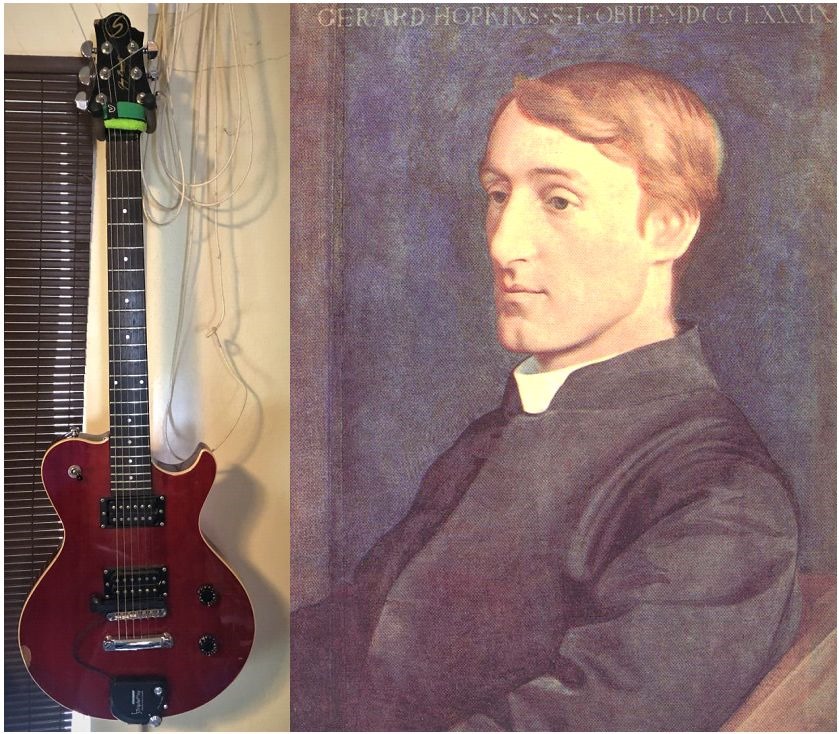
My Red MIDI Guitar and G M Hopkins

“I see only the basic material I may use…you may ask me why do I fail” I put a MIDI pickup on a cheap battered guitar that found in a used shop. David Sylvian lacks Hopkins fierce collision of images, but shares a sensibility with Hopkins in his song.


Well, all this is backward from the usual post here, were we talk about the encounter with the text used*** and then have only a line or two about the musical process, but the Parlando Project isn’t about consistency—it’s more about its opposite. Which is part of why you, the listeners and readers here are different. If you were someone who likes but one kind of music or one kind of poetry, we could disappoint you here. Our way is not the way to do it for maximum audience size, but if you’re a writer or musician—and even if wise council may be to find your style and consistently present it—an experience of alternatives can enrich that.

And then too, think of all those failed, not-quite instruments that don’t actually sound like the real thing. They sound like the exact and different failures they are.

To hear the performance of Hopkins’ poem, use the player gadget below. The full text of “The Times are Nightfall”  is here if you want to read along.


*It’s not actually a Mellotron: a rare, complicated and maintenance-requiring electro-mechanical instrument. The technology that greatly extended that concept, the modern “virtual instrument,” can more than handily represent it. Unlike the Mellotron’s single tape strips for each note, a virtual instrument can (all in software) represent different articulations and the various electrical subtleties of how the Mellotron was amplified and recorded back in the day. Even the peculiarity of the Mellotron’s notes being stored on strips of tape (not loops) that meant that after a few seconds the note would just end abruptly can be emulated or bypassed.

Music geek section: The Mellotron “VI” I used today is the M-Tron, who pioneered the idea of a software Mellotron. So far, I’m not quite grasping all its options, and I think I still prefer the Mellotron that’s part of MOTU’s Electric Keys collection.

**If you listen to “Endless Circle”  from late last month here you’ll hear how today’s piece might sound with more realistic instruments: cello, violin, piano, acoustic guitar, and vibraphone. It’s very much the same palette as today’s piece. My frank opinion today? I prefer the musical accompaniment of “Endless Circle”  and could never get a mix I was entirely happy with of “The Times are Nightfall.”  But I much prefer the vocal performance on “The Times are Nightfall”  and was unhappy with the vocals on “Endless Circle.”  In each case, I settled for the best I could do that week so that Genevieve Taggard and Hopkins’ poems could get presented.

***Hopkins’ most famous series of poems are called The Terrible Sonnets  not because they’re failed works, but because they are saturated with terror at failure and imperfection in human life. This poem has that too, but in its final section it seems to draft, in a New Year’s Resolution sort of way, a hope that personal discipline can lead one out of that state. The poem ends with ellipses, and I believe the poem may have been left unfinished by its author. My dictionary tells me that “ellipses” comes from the Greek for “falling short.” Even if unintentional, those things add meaning to the poem for me.

Though human discipline can do mighty things, it will  fall short. Whether divine or personal, some grace, some mercy, some beauty in imperfection is necessary. Thus that blessing I give: “All Artists Fail.”