March 2018 Parlando Top 10 Part 3

We return with the next three in the count-down of the most listened to and liked audio pieces of last Winter. Like last time, all poets who worked in the 19th Century, but in this group, all men.

Two out of the three today are from the British Isles. In may be no surprise, given its head start in English literature, that Britain is an outsized contributor both in words to be used and the Parlando Project’s reader/listenership.

I’ll be taking my second, short low-budget trip to London this month, and I’m frankly not sure what I will find this time, other than planning a side-trip to Margate to see the Turner art museum there and its small exhibition commemorating Eliot’s “The Wasteland” which was partially written in Margate. I’ll no doubt re-visit the Blake room at the V&A, and who knows, maybe I should try to find that alley beside the Savoy Hotel?

JMW Turner Waves Breaking on a Lee Shore at Margate

The London forecast calls for rain, hopefully not JMW Turner stormy though!

4. Ring out Wild Bells

When I posted this for New Year’s I noted Tennyson’s level of fame when alive, something that even the most popular Instagram poet cannot reach now. What I found out afterward was even more intriguing, that this section of his long poem “In Memoriam A.H. H.”  has become a tradition in Sweden to be read at the turn of the year, sort of how the Times Square ball-drop is ceremoniously repeated in New York, or how Guy Lombardo would once appear with his Royal Canadians near the top of the hour on TV to play a Scottish tune.

As evidence of Tennyson’s fame, I noted that my little Iowa hometown had a major street named for him when it was platted back in the 19th Century. Eventually the town and it surrounding farms were settled largely by Swedish immigrants. The Tennyson and bell-ringing tradition in Sweden started in 1927, long after the town was founded and settled, but wouldn’t it have been good in the town’s heyday if the farmers, shopkeepers, and schoolchildren had gathered on the sides of the street on New Years Eve to hear a poem?

Instagram poets get knocked for the shortness of their verse and it’s focus more on remediation than demonstrating literary skill. Tennyson built “In Memoriam”  into a book length series of poems, but his focus too was on remediation, in his case, of grief.


3. The Wild Swans at Coole

Yeats was Irish, and for decades I’ve met monthly with a group of poets the majority of whom were Irish-Americans. Yeats seems to have seamlessly transported himself between the 19th and 20th Centuries, changing so smoothly that he could not be observed changing. Somewhere around the turn of those centuries he decided that poetry should be chanted (not sung) to music, and yet we seem to know little about how exactly that sounded. Contemporary reports (and that’s what we have, there are no recordings I’m aware of) were decidedly mixed, even derisive, and Yeats eventually set that quest aside. The recordings of Yeats reading that we do have are from decades later, and in them there may still be traces of that concept audible in his, by then unaccompanied, reading style.

Yeats warns listeners that his chant may not necessarily enchant.

Reports also tell us that Yeats suffered from a difficulty carrying a tune, much as I do. His chanted, not sung, idea did not come from that he tells us, rather it came because conventional art song had too much ornament and melodic elaboration, deducting from the inherent music in the words.

In the course of the Parlando Project I take various stabs at what Yeats was trying to do, recreation in the literal sense, trying to create from the ancient and natural connection between music and poetry some combination that doesn’t privilege one over the other. Sometimes it’s spoken word, sometimes it’s “talk-singing,” and sometimes I think it necessary to sing.

I avoid apologizing for my musical shortcomings. It never mitigates anything anyway, and I’ve always found the humble-brag distasteful. I’ve hesitated at—and decided against—releasing performances most often because of failures of my singing voice. This performance came close to staying in the can. At times it works, not from my skills, but because there’s a certain match in the failings in the voice and the meaning of the poem.


2. My Childhood Home I See Again

One last 19th Century poet, an American. Long-time readers here will know that US President George Washington’s teenage love poem “Frances”  has been a surprisingly persistent “hit” with listeners here. It didn’t make the Top 10 this season, but we now have another Presidential/Poetical contender in Abraham Lincoln. If Washington was all youthful alt-rock persistence, Lincoln is more goth, with a downcast you-can’t-go-home-again tale of all he finds missing when he re-visits his hometown in his thirties.

Lincoln’s “My Childhood Home I See Again”  was very close to the popularity of the Number 1 this season. If didn’t count the substantial Spotify plays the Number 1 received, Lincoln would have topped this season’s list.

I posted this for what was once a common U.S. holiday, Lincoln’s Birthday. Also on this season’s Top 10 are the Tennyson New Year’s post and Rossetti’s Christmas song posted on Christmas Eve. Not sure if this is a trend, but listeners did like the holiday poems this winter.


Tomorrow, the most popular audio piece.

March 2018 Parlando Top 10 Part 2

An artist named Linnea Hadaway made a book earlier this year. It had no words in it. She said it had no words because it was about listening.

Today is International Women’s Day, an arbitrary thing like all special days, months and years. I can hear some grumbling off in the distance as some read this: “Another one of those special-interest things. I go to poetry and music to get away from that faddish nonsense.” There’s consistency in that opinion: if one is upset at “identity politics,” dividing the world in halves is just as deplorable as dividing it into tenths or smaller.

Are there dangers in division? There certainly are. But I don’t see these sorts of things as division, but as requesting attention—and attention is what art, and this Parlando Project is about. You see, life is incarcerated in the ultimate special interest group, the ultimate identity, political and otherwise: our own selves. Breaking the cellular barrier to spill our selves, or enticing us into opening a tiny pore to stare across at the skin holding another self inside another world, the still unexplored world we share, is the whole of art.

There is no apportionment so small as to be smaller than that. There is no way out but the way of art, to pay attention. Our ears cannot see, they can only listen.

No planning in this, but the next three audio pieces in our Top 10 count-down of the most liked and listened to pieces this past winter use words written by women.

Carrington 3

Surrealist Leonora Carrington captures the Parlando Project recording another audio piece


7. We Grow Accustomed to the Dark

I think I’ve used more Emily Dickinson pieces for words here than any other writer. I didn’t plan it that way. I’m not sure that Dickinson planned it that way either. Obviously, she meant what she did, assiduously creating and collating the more than a thousand short and engagingly enigmatic poems that we now see as a cornerstone of American poetry.

But as a careerist she’s a mess. She showed some of her work to friends and family, but like most friends and family they probably saw them as artifacts of the ordinary Emily, that stubborn particular. Perhaps they understood or didn’t understand her poems better than we do; but we, her current readers, believe it’s the later.

She had a lucky break with Thomas Wentworth Higginson, the critic and social activist who answered her letter and saw something there. Even in the intellectual ferment of Transcendentalist New England, how many would have? The posthumous publication he shepherded, made possible the Dickinson we have today. But did he understand her art? We, as posterity, think otherwise.

So, like the woman in “We Grow Accustomed to the Dark”  Dickinson pressed on, walking, almost straight, and like the bravest, aware that the comedy of striding face-first into a tree was possible.


The Emily DIckinson Internal Difference

I was there! What a concert! The music was good too.

6. A Certain Slant of Light

I didn’t think about this while writing the music for and performing “A Certain Slant of Light”  and “We Grow Accustomed to the Dark,”  but these two Emily Dickinson poems are companion pieces. The Dark poem is more clear, even comedic, the Light poem more mysterious.

In my original post I decided to not talk about what I think the poem means. In some ways, I think that’s true to the poem’s “Where the Meanings, are.” I had fun with the mock psychedelic rock poster I created to illustrate it, but I think the core experience of the poem is the same that some were seduced into having by ingesting drugs, the insight that the universe’s meaning may be unknowable and its substitute only available by fiat.

Cure the cod-sitar sounds, and stereotyped sparkle-eyed hippie whooshing “Oh, Wow!” Of course, we must laugh. This is an insight available even to the young that can apparently be induced by mere intoxication.

But it’s true. It may be easier to see the borders of truth if one comes upon it without chemical aids; but even true, it’s an insight that’s hard to integrate into an active life and compassion. Dickinson integrated it with these little packets of poems. “None may teach it,” she says, but I can let you see my experience of it.


5. In the Bleak Midwinter

And one slot higher in the countdown, a woman who isn’t Dickinson, but is roughly her contemporary, English poet Christina Rossetti. Her’s is a Christmas and Christian poem, faith is her fiat; and a shaped and received story is her poems plot.

As this post talks about division, opposites—and how, if one distrusts them, one must cross them, sometimes listening, rather than shouting at them to come down—“In the Bleak Midwinter”  is all about divisions and opposites, and where they fail to hold.

In the moment of Rossetti’s beautiful song, even if earth is iron and water stone, heaven cannot contain God, nor can the earth sustain winter or meagre poverty.

I remember someone asking one of the earnest folk-singers of my generation (alas, I can’t remember who) if a song could change the world. Their reply was something like, “Of course not, but during the time the song is being sung the world is changed.” Perhaps an argument for longer songs, better memories, or us slowly learning how to integrate the experience of art into the rest of our lives.


I plan to return tomorrow with the next three in our Top 10 count-down of the most popular pieces over the past Winter.

March 2018 Parlando Top 10 Part 1

It’s time for that quarterly exercise where we look back for the most popular audio pieces here at the Parlando Project over the past season. I’m going to follow the format we used last time, and break the countdown into four episodes. I base the popularity on the number of likes following their posting here, and the streams the audio pieces received directly from the blog, or on iTunes, Spotify, or other podcast sources. Let’s start the count from the 10th most popular as we move up the list to number 1:

10. Rosemary

Even though these pieces were listened to in the Winter for most of our listeners*, Edna St. Vincent Millay’s words have a kind of spring-cleaning of the heart vibe, and so may be apropos for opening the windows and letting the curtains blow around—or at least they will in a few weeks when it warms up here in the northern part of the northern hemisphere. I awoke to 10 degrees Fahrenheit and snow and polished ice myself today.

I rather liked the music I wrote and performed for this one, just as I have liked going back to Millay to reassess the strengths she brought to poetry. Millay’s popular reading audience, once substantial, hasn’t completely disappeared, and there’s a welcome re-assessment of her poetry starting in academic circles.


9. Stopping by a Woods On a Snowy Evening

I’ve featured Robert Frost’s words quite a bit here, perhaps to atone for my dismissal of him when I was a teenager as the kind of worthy poetry in our schoolbooks that we needed to move beyond. Two things were key to my learning to love Frost: his uncanny ability to write lyrical verse that sounds natural, and my finally noticing the dry wit and stoicism that underlies most of his work.

Frost, alone of his American generation, has retained a level of popular appeal and critical approval. He’s double-edged in maintaining that. Some are captured by the surface of his poetry, hearing and maintaining in their memory the catchy moral-of-the-story “big choruses” of Frost. In this poem, it’s the “I have promises to keep, and miles to go before I sleep” at the ending. Others listen carefully to the verses, the parts other than the lines we most remember, the parts we can come back to and find that we’ve forgotten were there. When I came to work musically with this poem, I’d forgotten those. There’s no lovely woods to see in this dark night. He may be lost. He’s so dark and alone that he can hear snowflakes sweeping across snowbanks between the jingle of his rig’s harness bells.

Musically, I was obligated to add shaker bells percussion to stand for those harness bells, but then, more obscurely, I decided to add a South-Asian tambura drone for the sweep of snow.


amedeo-modigliani-pierre-reverdy

Modigliani’s portrait of Pierre Reverdy


8. Clear Winter

I was a terrible French student in my little Iowa high school and my little Iowa college. I seem to have no ability with languages, and less than no ability to handle those accents and the reforming of the mouth that makes speaking a foreign language possible. But I love poetry translation. I feel like a paleontologist removing the clods of sediment from a skeleton. Slowly, painstakingly, there it is, just as it was in its moment of sudden! But then my task shifts, and I must become the process of fossilization, to find the minerals of English that can fill in for the sinew and feathers of it’s original language.

I had a great time with the challenge of Pierre Reverdy’s “Clair Hiver.” I’m unsure of the accuracy of the “tea-kettle” section of my translation, but I fell in love with it, and could not abandon it, even if the light behind Pierre Reverdy’s eyes cannot reach the little anteroom behind mine.


*web stats I get for the streams tell me I have as many recent listeners in Australia as I have in Texas—and one listener in New Zealand. Bret, please tell Jemaine that there’s a lot of good stuff to read and listen to in the archives you’ll see listed by months on the right.

Poets and Presidents Day

I don’t know if we’ll ever have a person who spent serious time as a writer as U.S. president. Yes, most write—or co-write to some degree—books leading up to their candidacy, and some kind of post-term memoir is now expected; but I’m speaking of a sustained and serious attempt at literary writing.

In my lifetime we had one prominent candidate (Eugene McCarthy) who did write poetry in the mid-century modernist style, and a substantial “leading up to their candidacy” book of political history from John Kennedy, though there is controversy about how much of “Profiles in Courage”  was ghost-written. Jimmy Carter has published books of poetry after leaving office, but at least so far as I’ve sampled his poetry, it hasn’t stuck with me.

Other democracies may have better examples. Vaclav Havel in the Czech Republic, and that winner of the Nobel Prize for Literature with a side job, Winston Churchill. Farther back there are more chief executives who could fill a shelf with their own books: Disraeli, Theodore Roosevelt.

Overall, I’m not sure that “men of letters” (a gender-neutral term doesn’t seem to jibe with that archaic phrase) are, as a class, good candidates for the Presidency. Writing is the perfect example of a one-person enterprise. To do it well takes a lot of effort, but most always it involves the writer setting themselves on that course by convincing themselves of it’s necessity and then carrying on with little assistance, at least until the publishable stage is reached. Leadership and coalition–building aren’t needed in those tasks. Vision is helpful in either field; but if we are to be honest with our selves, democracies only set much value in that in times of crisis.

washington.lincoln.apotheosis

“I extend this laurel, and hearty handshake…”


Though neither sought to publish, the two Presidents whose birthdays have been merged into Presidents Day do have poems to their credit. George Washington, as a love-struck teenager penned an incomplete acrostic poem that was to spell out the name of the subject of his affections. Last year the Parlando Project turned it into an angsty soft-loud expression of that youthful boldness-fear, one that, surprisingly, remains the most popular audio piece we’ve ever done.  Here’s the player for “Frances,”  Washington’s love poem:


Abraham Lincoln, the great American orator and leader, wrote a three-section poem in his 30s while recalling the hometown of his early youth. We set part of this to music for his birthday earlier this month. It’s quite sad, in a mode that was somewhat common in 19th Century literature, but there’s reason to think that Lincoln wasn’t just striking a pose. It’s now commonly believed that he suffered from some level of depression in his adulthood. To hear Lincoln’s “My Childhood Home I See Again,”  use the player below.

Ring Out Wild Bells

This guy was once famous. Not just writer-famous, but Beyoncé or Beatles famous. In England, and to a large degree in America, he was the face of, and the center of, Victorian poetry. And poetry in Victorian times, the written-down and printed in books kind, was still a force in mass culture.

tennyson

Once an empire’s most famous poet, now reduced to modeling a Slanket.

The town I grew up in was platted and settled around 1880, its success achieved by the industrious Swedish-American farmers around it and the railroad that went through it. The town was named Stratford, after Shakespeare’s birthplace, and so it was that the town’s main street, with it’s block of stores, was named Shakespeare Avenue. Shakespeare Avenue was met just north of the shops by the town’s central cross street, Tennyson Avenue.

That’s a remarkable piece of trivia isn’t it? Think of how many suburbs and housing developments were similarly planned and platted in the centuries since in the United States. How many of them had main streets named for contemporary poets? Milton and Byron had their streets along with Shakespeare in Strafford, but even Byron was 50 years dead; but here was Tennyson, a man still in his career across half a continent and one ocean away, and here this proud avenue in a farming town was written down to bear his name.

The problem with being a big-thing Victorian, as Tennyson was, is that our Modernists came after them. Came after them in time and eventually, opposition. Even though you can see the influences of the Victorians on the early work of some Modernists, you can also see the things they came to reject in search of an art for their own time. In those scattered small settlements where page poetry is still read or studied, we are now more likely to be reading Hopkins or Hardy for the English, or Dickinson or Whitman for Americans, or hinge figures like Yeats who spanned the eras, than Alfred Lord Tennyson, the once leading poet of his age.

Besides the street in my tiny town, Tennyson lives on in a handful of phrases from his poems that have become commonplace mottos such as “It’s better to have loved and lost, than never to have loved at all”words well-enough known even as their author’s fame and esteem has faded, that many people think they must be Shakespeare’s.

Today’s words come from another section in the same long poem or collection that premiered the “loved and lost” phrase, Tennyson’s broad meditation on loss and perseverance “In Memoriam A.H.H.”  If we’ve forgotten Tennyson, this makes it possible for him to be new again, and this is a piece, as I recast it, that seems very appropriate for our age—even for this year. The New Year’s bells ring in a new year, but they also chase away the devils of the old one.

So, enjoy the music I wrote and recorded for “Ring Out Wild Bells”,  but you may be surprised at how well Tennyson’s sentiments fit as you sing along with them while 2017 ends. The player for the audio piece is right below this for many of you. Don’t see a player? This highlighted hyper link will also play my performance of a new setting for Tennyson’s words.

.

Solstice Featuring Dave Moore

Yesterday’s post and audio piece had Dave Moore combining the poetry of William Blake and Christina Rossetti, but today we have him singing the work of yet another English mystic as well as his setting of a lyric by Emily Dickinson.

For those readers and listeners in the Northern Hemisphere, tomorrow is Winter Solstice. I write from Minnesota, fairly far upward and north in latitude. Winter Solstice is the darkest day of the year, with the sun not rising until almost 8 AM and the sunset clocking out of work early at 4:20 PM. Despite our colder climate, that’s about the same as London’s solstice daylight and a hour longer than Edinburgh. Minnesota’s famous Scandinavian immigrants, as one comic once put it, traveled across the whole wide ocean just to find the one place as cold, dark and miserable as the place they’d left—well I checked—they picked up 2 to 4 hours more midwinter light.

Of course the new year is less than two weeks off, and solstice is the shortest  day—not the entry into a dark season, but the beginning of a gradual expansion of daylight, cold daylight though it may be. For this reason it’s been a fairly widespread feast day across cultures.

However, for writers and musicians, the cold and the dark is no great hindrance. Sure it may blunt our moods, and stunt some mitigating outdoor activities, but our products are part of the festive in the darkness, and they can be like the shared quilt or blanket on the coldest night. Yes, before indoor lighting technology, scholarly reading was curtailed, but the poets of that dark time could recite from memory, needing no light bulb on their lectern. The sounds of strings, the dunest drum and the golden cymbal, travel without light.

And our partners and families don’t need light either to be known to us. They don’t even need poetry or music, their plainest word in the darkness is song enough, if we can hear that as one note in the slowest song that is our life together.

So, for today and the Midwinter Solstice, here is Dave Moore singing Robyn Hitchcock’s “Winter Love.”

The LYL Band tackles the darkest time of year


And for the short passage of the daylight, here’s Emily Dickinson’s sublime lyric about the transit of a day, “I’ll Tell You How the Sun Rose,”  also sung by Dave.

And don’t forget, we have over 160 audio pieces here, available in the archives on the right. Why not check out some from before the time you first heard of us?

Parlando Project Winter 2017–the Most Popular Piece of the Last Season

The last few days I’ve been looking back over the past three months at the audio pieces that received the most listens and likes from visitors here, and we’ve now counted up to the post revealing the most popular piece.

But before I get to that, let me let newer visitors here know what the Parlando Project is. For the past few years I’ve been experimenting with the ways that words can be used along with music. Most of the words are going to be poetry, if only because I like shorter pieces for this, and poetry accommodates that desire most easily. The music? My goal is: as varied as we can make it. The “we” here are largely myself and Dave Moore, who I’ve played with as the LYL Band since the late 1970s. Dave also is the alternative voice of the Parlando Project, one that’s read or sung several popular pieces during the history of this project.

Dave and I have also been writers (Dave’s also a cartoonist) since our youth, but this project is not, in it’s greater part, about presenting our written work. Rather it’s about looking at a variety of other people’s experiences and expressions, reacting to them, and seeking to embody them in a way we hope you’ll find interesting.

Do we turn the poems into songs? Sometimes. Sometimes they were, or were meant to be, songs anyway (Tagore and Campion for example). But often we aim for something that is cast between spoken word and chant. As best as I can figure out, this is akin to what William Butler Yeats once aimed to do with poetry and poetic drama, and he thought William Blake, Sappho and the Celtic bards did the same. And for myself, in addition to those Yeats pointed to, it’s my spin on what Jack Kerouac, John Lee Hooker, Allen Ginsberg, and Patti Smith (along with others) did.

Rap/Hip Hop does this too, but as varied as those artists’ approaches are, most of their tactics I can’t make work for me. No disrespect, it’s just my limitations.

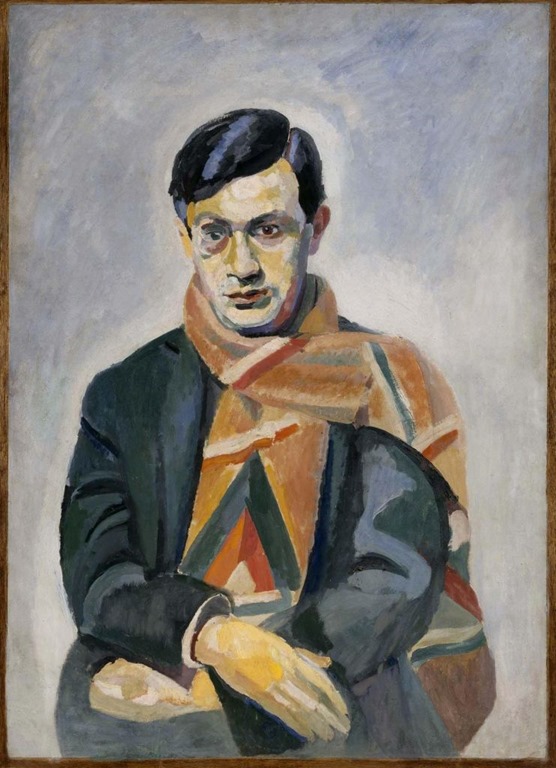
Well, here’s the Parlando Project’s most popular piece from the last three months: Tristan Tzara’s “The Death of Apollinaire.”  It was number 3 last September, so it’s been getting the listens since last summer, yet it’s not one I selected because it was well-known or sure to be popular.

Tristan Tzara by Robert Delaunay

Accessorizing with knitted wear was the most important artistic dictum of Dada

Tristan Tzara, one of the founders of Dada, is not that widely available in English, and even the subject of this elegy, the influential Polish-French writer and critic Guillaume Apollinaire, has a fame that doesn’t transfer with full brightness off the European continent. I did my own translation from Tzara’s French for this piece. And though I’ve attempted to do this, off and on, since my youth, translating Surrealist, much less Dada, poetry into English has it’s extra complications: to what degree is an image meant to be impenetrable and random, meaningless as a stance; and to what degree is it instead a shockingly fresh juxtaposition?

I have a prejudice for the later. When I am translating poetry I take it for a given that I will not be able to convey the auditory music of the original, though I try to retain the musical development of its statements, and above all, I try to find English words and idiom that will grab the English-speaking reader’s interest with vividness.  This approach has it’s dangers, as I’m not enough of a scholar of the lives of writers or of the their languages to make the most informed decisions, but in the case of “The Death of Apollinaire”  I feel this leads to a very effective and affecting statement about the death of an artist still suffering from his battle wounds just after the end of the WWI.

My limitations aside, I hope I was faithful to Tzara’s voice, and I hope you’ll find it moving too. You can listen to it with the player below.

New pieces will be coming soon, so come back and check, or hit that “Follow this Blog” button up near the top-right to get notices of new pieces.

The Parlando Project Winter 2017 Top 10 Part 3

Here we go, continuing our Top Ten countdown for the most popular audio pieces from the past Fall as counted by your likes and streaming listens. In the past two posts we’ve done numbers 10 through 5, so let’s move on to number 4.

One thing I enjoy about this project is that I can’t predict which pieces will get the most response, and in 4th place this past Fall we have my rendition of a excerpt from Gertrude Stein’s arch-Modernist “Tender Buttons.”  Not only was it popular last Fall, but it actually improved on its 8th place position from last Summer’s Top 10.

Stein’s experiments have to be seen as the forerunner of what came to be known decades later as “Language Poets”—poetry that reveled in the indeterminacy of our language, that exploited all the cracks and odd turns in our real everyday spoken syntax. This poetry can seem intimidating if one is pressed to extract a meaning immediately, but one value of the Parlando Project is that we’re free to perform the poetry with music and allow any straightforward meaning to take a back seat to the sound and flow of the words. And the poetry of “Language Poets” often gains some singular meanings when read aloud, because our everyday spoken syntax is nowhere near as clear as good written prose would be. We commonly understand meanings when words are  spoken from inflection and our groupings of words that no diagramed sentence can measure.

Musically, I doubled down on the Modernist tilt of Stein’s words by speaking them to my interpretation of the style of Don VanVliet who performed as “Captain Beefheart.” VanVliet took the vernacular freedom of Delta Blues music and expanded on it even further. His own lyrics, like his own music, like Gertrude Stein’s words, don’t seem to make sense at first, until you open up and let them in for awhile, until the off-center is normalized, and you begin to see the facets of the brilliant corners. That journey starts—maybe only starts—when you listen to this piece the first time.


At Number 3, we have another returning piece from last Summer, “On the Troop Ship to Gallipoli,”  based on my recasting of WWI poet Rupert Brooke’s late fragment, written down shortly before his death on the way to the front in Turkey. If the soldier’s death of Modernist instigator T. E. Hulme (whose “Trenches St. Eloi”  was earlier in our Top 10) cost him the opportunity to solidify his position as a founder of British Modernism, Brooke’s death gave him no chance to outgrow or adapt his 19th Century poetics to the new realities of warfare that WWI revealed to many others.  So, while maintaining my respect for Brooke’s experience as he wrote it down, I tightened and modernized his language and presentation to create the kind of poem Hulme, F. S. Flint, Ezra Pound, or Siegfried Sassoon would have written.

I tried to work the time-worn musical tactic of the slow build in my setting for this one. The final fuzzy musical strain in this is a conventional electric guitar played with an E-bow, a device that magnetically drives a string without plucking it, somewhat in imitation of what a real bow does on a bowed string instrument.


Robert Johnsons

One of these two guys cut a crossroads deal at midnight that let him use Shakespeare’s lyrics


At number 2 in our Top 10, we’re back to a piece that hasn’t made a Top 10 before. It just so happens that it’s another adaptation or free translation, this time by Elizabethan physician, poet, musician Thomas Campion. With “Let Us Live and Love”  Campion’s first stanza is a faithful enough translation of a poem by the Roman poet Catullus, but he then decided to develop his own path out of that beginning.

And so, by the second stanza Campion comes close to coining the Sixties’ slogan “Make Love not War” and he closes with a mighty invocation of love as the great illuminator of our darkness.

The Elizabethan age saw a flowering of lute player/composers. Many of them adapted the words of Elizabethan poets as well as writing and using their own poetry. One of Campion’s contemporaries was the great John Dowland, and another was a man named Robert Johnson. A perfectly common name, but a name that many people today associate with another singer/composer/stringed instrument player, the famous Delta bluesman.

So rather than using Campion’s own tune, I chose to set Campion’s words to my own Blues tune with slide guitar and harmonica.


That leaves only Number 1 to go. What piece was the most liked and listened to here last Fall? Check back tomorrow to find out.

The Parlando Project Winter 2017 Top 10 Part 2

Picking up from where we left off yesterday, here are the next three most popular audio pieces based on readers here hitting the like button along with the number of streams and downloads counted during this past fall.

Number 7 is Edna St. Vincent Millay’s “”Sonnet 43”.  I seem to be coming to a greater appreciation for Millay as I do this project. Like my long time favorite Carl Sandburg, Millay “suffered” from too much popularity in her heyday, and like Sandburg I believe that her popularity in non-academic circles at the least caused critics to feel that they need not bother to examine her work more closely.

I’ll admit, I was one of those that thought she sounded like someone trying to be a 19th Century poet when the 20th Century was well and truly underway. Now in the 21st Century, I find this less of a crime, and when I let go of that, I find I like this sonnet’s complex appreciation of love’s limits.

Musically I love that I was able to play a convincing arco bass using a MIDI-controlled virtual instrument for this one. Bowed string bass is like the snoring of the bear mother in a winter den to me, immense, and yet sweet and comforting.


Speaking of Carl Sandburg, his “Autumn Movement”  made it all the way to number 6, and that’s remarkable because it was only released on October 20th and thus had less than half of the Fall interval to pickup likes and listeners. I love the central autumn image in this one from Sandburg’s “Cornhuskers”  collection, and it reminds us that Sandburg, known also for his acutely observed Chicago poems and journalism, was from the very start of his career interested in conveying rural life as well.

Musically, this piece demonstrates how recently I had seen Bill Frisell in concert—and seeing him, and the musicians he plays with, is something I try to keep always recent in my experience. Of course, Bill Frisell has an immense amount of musical vocabulary under his fingers, and I don’t; but I tried to make the best of mine, which is all any musician can do.


Bill Frissell with books

Besides his music, I admire Bill Frisell’s interior decorating sense and, alas, his sartorial style.


Our number 5 piece in popularity this fall was T. E. Hulme’s report from “Trenches St. Eloi.”   Many of the Modernist soldier/poets who served in WWI grew not only to  hate war, but to distrust their country’s cause and justifications for their particular war. Hulme is something of a exception. As far as I can tell, he remained supportive of the British war effort in which he eventually lost his life. That doesn’t make “Trenches St. Eloi”  propaganda, for it’s far from blind to the horrors and difficulties of extended conflict. Hulme’s death shortened his career and helped mask his seminal contribution to modernizing British poetry.

Since starting this blog, I’ve been following the centenary of World War I off and on in the background, which meshes well with much of the material I can present here without running into rights issues, since modern public domain status cuts off at 1924. The material from the poets who served in the war or were otherwise touched by it, is, not unexpectedly, downbeat. Just as the Modernist revolution changed poetry, WWI changed how war was written about, breaking millenniums-long Homeric traditions of war heroes, that however flawed, were able to shape battles by their character, into stories of endurance like this one.

This is another one where the bass guitar gets to carry a lot of weight.


Thanks again for reading and listening. It’s been a huge amount of work this past year to bring you the Parlando Project pieces, hundreds of hours of reading, studying, translating, composing, playing, and recording these unique combinations of various words (mostly poetry) with various original music (as varied as Dave and I can make it). That wasn’t drudgery—far from it—it’s brought joy and amazement to me to see what’s out there that I haven’t heard or imagined before, and I hope some of that wonder and discovery comes through to the readers and listeners here, because it’s our goal to surprise and delight you, to show you new facets of poems or poets you thought you knew and to introduce you to some writers that didn’t get included in your textbooks.

Here’s what I ask you to do if we’ve succeeded in that, even if only for a piece or two out of the more than 160 pieces we’ve presented so far: let others know about it. Tap them on the shoulder, show them the URL, link us on your blog or on social media, stick an earbud in their ear. Every like, listen, link and comment helps me keep doing this. I know I should be a better promoter of this work, but frankly, I’m too engaged in the work itself to do as much as is needed.

And standby, the next three most popular pieces from the past fall will be posted soon.

The Parlando Project Winter 2017 Top 10 Part 1

I’m going to do the top 10 list a little differently for the past fall,  doing it in parts, so as to not overwhelm visitors here in one post with more audio pieces than you might have time to listen to. I’m also a bit pressed for time right now, and this fits with my schedule as well.

In traditional fashion, we’ll start with the 10th most popular audio piece from the past three months, and work our way up the list in popularity judged by your streams of the audio and likes on the blog.

Number 10, we have my looser translation of Rainier Maria Rilke’s “The Dark Interval,”  which is one of five pieces that are returning from our last Top 10 from September.  I translated this a few years back, making choices at the time (as translators must) as to what the author was getting at in the original German, and what English could most effectively reflect that. Knowing just a little bit more about Rilke, I think I’d make some different, better informed choices now, but the choices I made then do make for a particularly apt Winter poem with it’s opening skiing metaphor that was my most audacious choice. Rilke’s lines “I can speak in many voices/but this voice shuts up quick.” remain personally meaningful.

Musically, this is one of the short and pretty ones, so go ahead and listen.


Number 9 finds the piece that remains a perennial on the Top 10 lists, a little angsty ditty written by a love-lorn teenager infatuated with a neighbor girl. Although he didn’t actually complete the piece, with it’s acrostic scheme that was to spell out the young woman’s entire name left abandoned partway through the last name, and even though he apparently didn’t get the girl, you have to admit it’s an ambitious move by a young poet or suitor.

I titled it with the love object’s first name “Frances.”  The guy went on to military and political success, capping it off eventually with popular success as a wordsmith here. You may have heard of him: George Washington


Rose3

“When the last rose of summer pricks my finger…” photo by Renee Robbins


Well, is it all going to be repeats from last time? No. At number 8 we have a newer piece, making it’s first appearance on a Top 10 here, William Carlos Williams’ “It Is a Small Plant.”

My late wife often found pleasure in looking at things closely. How intent and intense could her focus become, and what would that reveal? If she found out, she could never tell me exactly, only that she was drawn to do that. Many years ago, after her death, I took to digitizing the photographic slide prints that she took, some of which were as close to buds and flowers as her lens could focus, and the feeling of being behind her eyes, looking with her intent, fell over me.

Williams does something like that in his poem, which also cannot tell you straightforwardly what it apprehends, while the power of the seeing is overwhelming. I like the music I played for this one quite a bit, particularly the fretless bass part, an instrument that I took up this year, and have felt greatly rewarded by.


That’s all for today, but three more of the Top 10 will be posted here soon. And remember, we now have over 160 pieces posted, so if you’d like to see what else we’ve performed and interpreted, the Archives (to the right on the web page) will let you listen to other pieces.