I wanted to get another musical piece up this week as I was somewhat dissatisfied with my performance in my last one here for Armistice Day/Veterans Day. I looked a pieces I had near ready, and selected this one, by Anglo-Welsh poet Edward Thomas. Thomas is lesser-known in the United States, but is more recognized in Britain where he often gets grouped as a “War Poet.” The main reason for that: he volunteered and was killed in WWI, and some of his poetry speaks about his thoughts as he considered volunteering for overseas front-line service.
Sitting in America, which hasn’t regarded Thomas enough, I’d like to expand him a bit from behind that label. First off, like Wilfred Owen (another British poet filed under war poets, and another WWI casualty) Thomas was something of a beginning poet,* but like Owen his poetic voice is so strong it doesn’t need to apologize for being early days. As powerful as Owen’s poems about trench warfare are, I’m just as impressed by his home-front poem “Shadwell Stair.”And Thomas, this other “war poet,” seems not to have finished any poetry about his short front-lines experience before his death in that service. As we celebrate Veterans Day it would be good to remember that each person who served is not just their service.
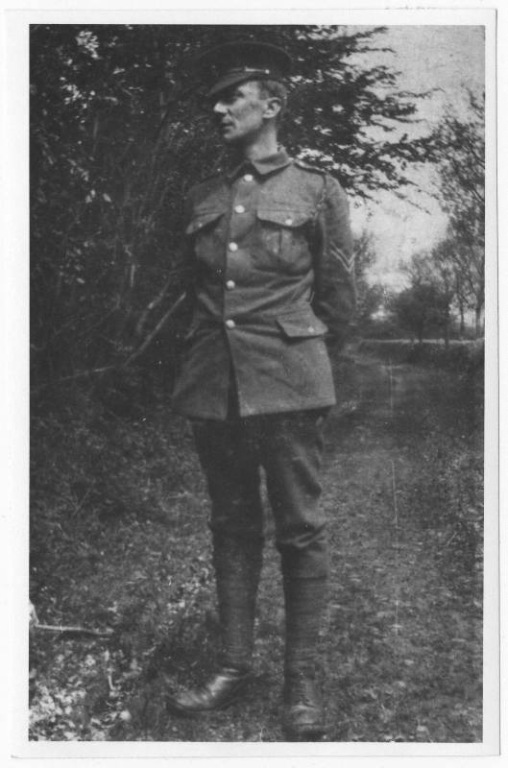
Edward Thomas in his uniform. He was married and past the age of most soldiers, but still volunteered.
.
So, here’s a poem that I think has nothing to do with the war directly – perhaps not indirectly either. “Like the Touch of Rain” seems to me to be a love (or rather a loss of love) poem, though the nature of the relationship is not spelled out.** It uses as its central symbol rainfall, and I suspect it’s speaking of erotic love because of the sensuous opening where the rain, however wild, is caressing the poem’s speaker and he sings and laughs here. The poem ends by telling us he’s now closed in, out of the rain, not by his choice but by some her’s “Go Now.” It’s a turn-about from the typical “Who’ll Stop the Rain” or “Shelter from the Storm” depiction of rain vs. shelter. Here’s a link to the text of the poem that I’ve now turned into a short song.
“Like a Touch of Rain” is not the most complex or virtuosic poem, but it also doesn’t detract from its depiction with any overreaching or stilted poetic diction. There’s a power in that. Reading Thomas’ contemporaries’ poetry in search of material for this Project I’ve read a great deal of published poetry that doesn’t escape those faults. My wife gave me a copy of Thomas’ collected poems a few years back – it’s not a thick volume, and I believe that most of the poems in it were first published in this collection posthumously through efforts of Thomas’ friends.***
After overreaching with my Padraic Colum poem setting earlier this week, and having to settle for an incomplete recording, it may behoove me to leave today’s piece as just voice and acoustic guitar accompaniment – and as rough-hewn as my voice is on this performance, I think it’s better too.
You can hear my performance of Edward Thomas’ “Like a Touch of Rain” with the audio player below. What, has the door to any such player gadget been shut? Well, this highlighted link will open a new tab with its own audio player.
**I have not read a full biography of Thomas, but before the war he seems to have had a complicated set of affections as well as bouts of depression and drug use. Those two things might cause one to suspect a ne’er-do-well life, but through-out that he wrote voluminous freelance reviews and essays to pay the bills for a young family.
Is Dorothy Parker a humorist or a poet? If choosing one, do we diminish the other? Wikipedia leads with the latter – which surprises me a little, because if you’d asked me in the midst of my literary engagements decades ago, I’d have replied the former. The poetic literary cannon doesn’t mind wit, but it downrates those suspected of making humor the main point of their work. And there’s the matter of how it was presented: Parker published in general periodicals (though at a time when they were still engaged more than now with literary poetry). Her collections are filled with short verses sharply focused on catching the busy glossy page-turner a century ago. Are they the poetry equivalent of a New Yorker cartoon – some insidery cultural memeability, yes – but not meant to be judged alongside fine art with substantial complexity?
What if we were to read her in translation, and she was a writer from a culture and times we were substantially distanced from? Imagine a poem like the one I’ll perform today not as a 1920’s American work by a writer whose lifetime overlapped my own, but as a fragment of Sappho or a poem taken from the pen-work of Li Po? Might we see something else?*
Here are some things I see looking at today’s poem this way as I worked to set it to music and perform it. The first is some awkward syntax, some of which could be “poetese,” that mangling of normal word order that is reaching for a sense that this is “special” speech cast in some archaic or fancified manner. In humorous verse this is often used as part of the joke: you were expecting some grand edifice of beauty and truth – dressed in this artificial, inflated manner – and instead you get a pratfall? Ha ha! This still works as a humor tactic, though its sharpness is dulled by the relative absence of literary poetry in our culture. Needing to reach the rhyme is part of the humorous charm of light verse – forced or outlandish rhymes are laugh points. Parker doesn’t go Ogden-Nash-hard on this here, but I smiled when the “rankles” and “ankles” chime goes off in the first verse.
An allied tactic is the use of some unusual words, another high-falutin stance that aims to make the pratfall funnier. I actually had to fix my recording of this. Having recently worked on Yeats famous apocalypse “The Second Coming,” I actually sang “And gyre my wrists and ankles.” “Gyve” is to bind or tie, “gyre” is to move in a circle or spiral. I don’t know, maybe I was visualizing RFK Jr’s falcons besetting the poem’s speaker with fetters in their beaks and claws.**
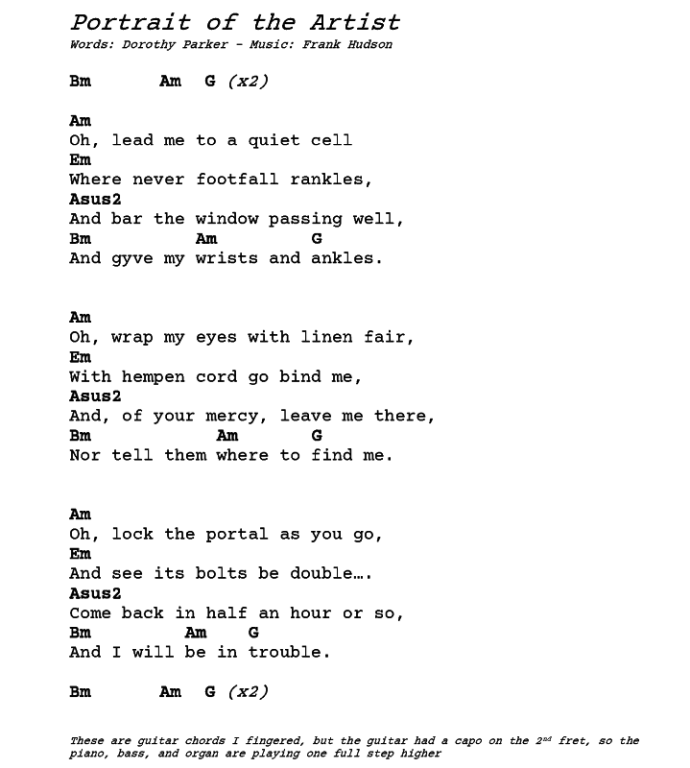
Here’s a chord sheet for the song I made of Parker’s poem
.
Also noted when dealing with this poem: the situation set out in the poem is extreme, and taken literally it’s a portrait of bondage, exile, or imprisonment. If parts of this survived as a Sappho fragment, I can see this being decoded erotically. Scholarship and kink cross-over more often these days – and the poem’s imagery is specifically sensual – but don’t put that in your scholarly paper until you do further research.
And here’s the last, most important thing I noticed: I’ve been living this poem recently. First off, a sidelight on the manner in which I found Parker’s poem: I have been going through books and disposing of most of them. My wife is distressed by the number of books and recordings I’ve accumulated over my life. Little difference most sit shelved at the edges of rooms, they are clutter, and she believes that the space could be used otherwise. At this point in my life, I can see this issue another way: I’m of an age that there’s no world enough and time to imagine going back and rereading or reading the majority of them. Books that I once treasured as reference materials are likely obsoleted by the Internet. For example, I’m torn about keeping my thick hardbound French to English dictionary which was a companion when I started translating French poetry years ago. I’m keeping most of my books of poetry, and some on music, as I intend to keep doing this Project. Novels and general non-fiction? To be carried away.*** Is it clutter? Among my small segment of humanity, I’m not alone in being comforted by books and music surrounding me, and the irrationality of there being more than I can consume in whatever time I have left as an aged person doesn’t change this, but having accumulated an overwhelming amount submerges some books. Going through my books I was surprised to find a 1930’s printing of Parker’s collected poems. I don’t remember buying it, though I did spend time and a dollar or two in any used bookstore that had a hardbound poetry section during my youth.
Last week I read through the first segment of Parker’s book, work that is now in the public domain, and it’s there I found “Portrait of the Artist.” I’ve mentioned recently that my opportunities to create new work here has become constrained. I’ll spare you the logistical details, but in the early years of this Project I had the five workdays of the workweek to research, compose, and record. The hundreds of pieces I produced in the first half of the Parlando Project’s run say I used that time productively – but if I was to be honest, I’d report that there were days I just blew off, knowing that the next day would be just as good to start or complete some Parlando work.
Now? I can’t tell for certain when I can record, I just know there will be fewer hours available. My energy level as I age is lower, and my old body no longer finds itself able to sit in an upright office chair for hours at a time. I do more of my research and reading on a tablet, which however marvelous, is a poorer environment for complex work with its constrained single smaller screen. I’m still able to play my instruments when I can use my studio space, though I need more time there practicing or simply blowing off the stress of life with a plugged-in electric guitar moving air around me. There are some mornings when my wife, being helpful, will tell me I’ll be able to work on recording for a few hours that day. I’ll think: I don’t have any new poem-texts selected, or the basis of a musical setting ready to be realized, and my energy is low. What can I do (anything?) with that time? And if I can’t do anything, when will the next chance come?
Whine. Whine. What else is the Internet for – complaint and its opposite, the carefully curated presentation of one’s perfectly actualized life to be envied. In Apollonian distance I can clearly see that to have the opportunity and the wonderous technology to do creative work, is a historical exception of the first order.
But then artists, many of whom are toward the introverted side, are often like the one in Parker’s poem: always swearing they wish they had the solitude and freedom from the distractions of life. And then the poet faces the blank page, the composer the silence in the room, their muse taunts them “What’ya got?” and the artist mumbles “That’s your job,” knowing that there’s really no one else in the room, just as they wanted.
There are lots of things in life that are temptations for self-pity or abuse. Sometimes the de profundis answer is “Ha ha.” That doesn’t mean it isn’t serious. The consequences for this troubled encounter with the chance to be creative, and perhaps to come up dry, have killed and crippled.
All this feeds into the choices I made in the musical performance of Parker’s poem. I treated it no differently than I would have a “serious” literary poem by Parker’s contemporaries Elinor Wylie or Sara Teasdale, though I believe there are a couple of times I’m subtly winking as the singer seeks the situation of a desert-steeple mendicant. The fool is funny – still is when the situation is serious. This is often the lonely place of business for creativity: weighted on commercial and logical scales, it’s absurd that we do it – even, or especially, alone in that room with silences and tabla rasa.
You can hear this performance of Dorothy Parker’s “Portrait of the Artist” with the audio player gadget below. What, is any such gadget gyved up somewhere? Well then, I provide this highlighted linkthat will open a new tab with its own audio player.
.
*We can prosecute mootings on more recent American authors too. I’ve recently written here on the difficulties in deciding how often Emily Dickinson means to make a humorous/satiric point in her poems vs. how often she’s an earnest transported romantic. A mixture? Likely, but what are the proportions? What are we missing if we miss the joke?
**Ah, the powers of overdubbing. I fixed that word-mistake ex-post-facto.
***I’m fond of the term “Death Cleaning” for this process. Time’s winged chariot is heading for Goodwill. While I’m blessed to be healthy for my age, I can no longer fool myself into thinking that someday I’ll get around to this, and that…and that, and that.
I hope the hardy, but smaller, summer readership here has enjoyed this diversion from our usual literary poetry combined with original music subjects. It’s been somewhat difficult to write. Why?
When I run across comments or longer-form writing about artificial intelligence – given my interests, mostly from folks in artistic fields – the feelings and cold convictions I read come in hot. AI gives me a lot of feels too: frustrations, fears, disgusts, distrusts, worries, even amusements at its fails. Yet, earlier in this series I’ve honestly talked about AI features I’ve tried. I wonder if I’m alone in these mixed feelings – if I’m just a wishy-washy old guy who won’t say it plain. For my final installment let me focus on those concerns.*
I’ve referred to some of those “guild concerns” earlier in this series. Let me expand on that. Let’s say you are a professional, semi-professional , or aspiring visual artist, voice talent, translator, editor, writer, composer, musician. AI claims it’s achieved parity with your field’s trades. “No!” you reply to any such suggestion, for you are informed of all the small things that a master in your field provides that AI, as yet, can’t. But along with that comes the fear that most customers and many consumers of your art may judge as inessential elements you’ve learned to provide and appreciate, that your professional value-add may be judged dispensable. Capital’s royal decision makers may not hear your objections, give them any bottom-line weight. There’s an unavoidable term for a resulting outcome: enshittifacation. Everything then may drop to just above the level that would drive commoners to revolution.
And there’s a tsunami of salt to be poured into artist’s wounds from the use of Large Language Models in current AI. LLMs digest realms of work by artists, almost entirely without compensation to them, and apply pattern and categorization processes to this hoard to make it into reusable parts that can be recombined into other work – work whose ownership has been severed from artists and transferred in part to oligarchical corporations. This injury isn’t speculative. It’s already occurred in titanic amounts to create current LLMs, and ex post facto attempts to get paid for this seizing of work or to prevent future accumulations of scraped up art are being resisted by the AI industry who is seeking government protection for this reuse.**
So, where organized as unions, workers in the arts have attempted to counter this, concerned both as keepers of artistic excellence and as counter-forces seeking to protect incomes for their members. Will this succeed? Who am I to predict, watching ignorant beach-sand techbro armies sweep across the darkling plains amid alarms. But I understand the anger/fear of the artists, endorse it.
But I, myself, am an odd case. Poetry has low capital needs, a loaf of bread, a jug of iced-tea, and a roof, and I’m good to go there – and the renumeration market for poetry is scant. I used to inconstantly chase after giving readings with a couple dozen attendees, or the small paper presses aspiring to three-digit sales. I still admire those things and support them, I just don’t see them as precious scraps to struggle over at this point in my life. With the Parlando Project I most often use other people’s poetry, using and promoting work from dead and/or public domain poets or small excerpts of words from the living. With this Project I can aim for my hundreds of readers or listeners for a piece – a tiny audience in Internet stats, but an appreciable reward by poetry standards. With my music production and distribution here (aided by affordable computer technology) I find that I’m part capitalist and part worker-in-song. And there’s a conflict there.
I’ve already confessed in the series that I sometimes use what is called AI to extend the long-standing feature of computer music arpeggiators, programs that suggest and play patterns of notes on command. Honestly, I don’t feel good about using these – there’s shame mixed in there with the approval I find with my producer’s hat on from the effective results they bring to the finished musical piece.*** It’s not just breast-beating when I confess it feels fraudulent to me to use some computer aided line or expression played with an accomplished verve. A human should do that, and I can’t do that, and yet that part of the ensemble is there – I’ve allowed it, and its level of success to some listener could be assigned to me. The alternate path I left some time ago was organizing bands of musicians to realize the music I create. I may wonder about that untaken path, but then I consider how dissatisfied those musicians might be at my non-commercial aims, how frustrated or dismayed they would be with my musical naivete, how stressful and ill-fitting it would be for the composer-hat-me to wear the bandleader-hat as well. Yet, those struggles, despite unfitness on my part, may be the necessary dues to engage in musical work. Guild concerns might hand down a harsh judgement on what I’ve done: “If you can’t do that, you shouldn’t do that – you’re taking away jobs from skilled tradesmen.”
In this I support the guild with one side of my heart, and yet I could be charged with working against its union shop.
A musical piece from a pair of DVDs issued decades ago that my child and I treasured when we both were younger. I don’t have details about how this music was produced, with what technology, but this is so much better than the trite AI slop illustrations I could have chosen to use instead. The Animusic web site is defunct, and I don’t know how you could still purchase this.
.
Full-fledged AI music? The examples I provided in my last post satisfied my curiosity in my quick attempts to see what the current state of the art can do. Even more so than with my frustrations with AI illustrations I discussed in the first part of this series, I’m not tempted to continue to use that level of AI music creation. I don’t have to test my ethics in this: AI generated songs can’t get close enough to what I want, what I intend to communicate. I like playing instruments, and despite my not uncommon artists ability to procrastinate on getting down to composition of new work, once I’m into the process, I find it absorbing. If what results isn’t always a perfect realization of intent, so to it is with AI, and typing a few words into a prompt has no visceral rewards.
As I wrap up this series today, I’ve honestly tried to report my contradictions. If I’ve done anything, it’s my hope that you, my widely curious readership, will use what I’ve written to spur your own considerations of the challenges AI brings to art. I’ve used music as the main example, but literature and many other arts – as well as work that isn’t viewed as artistic – have like dangers, allied concerns.
.
*Let me mention that I also share environmental concerns with the energy usage to provide AI. While earlier in this series I wrote that we likely don’t really know what those energy needs are with precision – and our existing general use of ubiquitous computers both saves and costs energy in some balance that’s hard to calculate.
An another issue: brevity keeps me from delving today into the important risk of extended capitalist and or authoritarian control of expression by ceding tools of production to oligarchs.
And lastly, there is a great deal of techbro hype around AI. In some ways it’s encouraging and scary how well it works, and in others it’s risible and scary how badly it works. I don’t mind so much laughing at its limitations in the world of musical art – like the satire in the last post where it created outrageous protest songs that can still sound sonically plausible – but the thought of non-analog safeguards in life-and-death contexts is concerning. It’s already hard enough to hold capital to account for grievous errors and oversights. Giving another level of kings-X granted to the passive voice of “computer error” worries me.
***If I was to play advocate in my defense, I could say that the uses I make of these tools are not the same as typing in a few generally descriptive words and having AI generate an entire song (or painting, or story, or essay) such as the song examples I supplied in the last post. I work iteratively with the specifications and adjustments for the patterns – though so do many who work on elaborate prompts for generating entire songs – but I’ve supplied them with the harmonic structure by playing or composing the chords or melodic centers of the resulting pattern to be generated. Those substantive contributions I supply make a case for these uses being collaborative extensions of the human.
I’ve so long used drum machines – and entire accepted genres of music are built around the expectations that they will be used – that using computers to play drumbeats in patterns seems more allowable to my inner ethicist. If I dig deeper, and acknowledge that I know and appreciate the musicianship and sound of a good percussionist, this is inconsistent, but this is my honest emotional report.
Summarizing and speaking here in guild specifics: the composer in myself may feel justified, while the internalized musician’s guild inside my soul still feels shame at my stooping to this.
For more than 50 years, I’ve often thought of this Bob Dylan song.
Today I was learning how to use a feature in my recording software, and I needed a vocal take to use as an example. I’ve been much concerned this winter with events that seem (as Thomas Hardy once wrote) to be “in the breaking of nations.” I guess I thought that busying myself with learning might let me take a break from that dread, and when I opened up a mic to sing, this was the song that came out of my mouth. I think it asked to be here today.
Songs and poems can do that. They aren’t necessarily mystic fortune-telling omens — they’re more at waves in the air or memory that come in to rattle your bones and vibrate your vocal cords or synapses.
The story in “All Along the Watchtower’s” lyric is a repeating loop, the last verse’s approaching riders are the two foreground characters arriving to speak and open the song. So, “All Along the Watchtower’s” story doesn’t unfold — it refolds — and I chose to point that out in my version today. To illustrate this song for the video I dealt out some tarot cards. I don’t believe those cards are omniscient omens either, but the pictures can flip and spread for a receiving eye and mind. Perhaps all symbols, songs, fables, poems, pictures — all foolishness and wisdom — rotate around themselves like that.
Is this short post a break from Black History Month, so soon in this February? Well, maybe, but the song “All Along the Watchtower”is best known from a monumental version performed by Jimi Hendrix.
A post today for a holiday with complications. In the UK, Canada, and the former Commonwealth, today is Remembrance Sunday and tomorrow is Remembrance Day. In my United States tomorrow is Veteran’s Day. Remembrance Sunday/Day is a bigger deal. Here in the U.S., it’s one of two holidays set aside to honor the armed forces,* and the Spring Memorial Day gets more observance. America moves it around as a Monday workday holiday, so it now rarely occurs on November 11th, the day it was originally meant to commemorate, Armistice Day, the day that WWI ended. In the American observance, the day and the moment being observed are no longer there as they happen to be this year.
But then, all the events of WWI have now passed out of the living’s remembrance, and WWII is entering the time of that leaving — while in England the wound and loss are still felt by a generation that themselves only recall the generations that personally experienced it.**
Historically, poets suffer, fight, and die in wars. Presently in the U.S. this may be less true than was traditionally so, our soldiering ranks now coming from a different cohort than those with MFA and workshop attendance. That too is complicated, and I’ll choose to honor your time today by not going into all of that. Yet I’ll maintain that the experiences of service to country, of organized protection and organized death, of comradeship and loneliness — these words of history aren’t so far away if we only open ourselves to listen to them.
Here are five poems for this complicated holiday that this Project has presented over the years. In honor of the UK preservation of the original reason for the holiday, four of them will be British to one American.
Gone, Gone Again (Blenheim Oranges)
British poet Edward Thomas is too little considered in the United States, but in the run-up to WWI this overworked and underpaid freelance writer started to expend his writing efforts to the least commercial of literary forms, poetry of individual honesty — urged in that endeavor by his expatriate American friend, Robert Frost. Frost left England for America as the war began and he asked his friend to follow him and emigrate to the United States.
Thomas didn’t accept his offer. In Britain Thomas is remembered as a War Poet, as one of the casualties of The Great War, but his poetry doesn’t speak of his trenchside times in the conflict — instead it sings with lovely precision and concision of the British countryside as he is making his decision to take the road well-traveled to enlist to the front. “Gone, Gone Again” is one of his masterful poetic verse-essays on this time of decision, as he observes an England depopulated of its workmen. Why did he go to the front? He explained it mostly as being unable to shake his patriotic connection to the very soil and experience of Britain that his poetry sings of, but I said today’s post would be about complications. Thomas was also a troubled soul, looking for meaning in his life not captured by certainty, and some have speculated that a soldier’s pay was a better economic offer for his family than his Grub Street freelancing. He packs every bit of that into this short poem.
.
Shadwell Stair
Wilfred Owen is another Brit who took up poetry in the context of serving in The Great War. He’s known for his scathing anti-war poems, which to Britain’s credit doesn’t keep him from being honored nationally as a War Poet. But here’s a lonely poem written on the banks of the river Thames, likely during the time he was back from the front being treated for what was then called “shell-shock.” Folks today can experience the poem in a context pointed out later, that the Shadwell Stair location was a gay cruising spot at that time. Historically, there’s a blindness in some eyes to see that not just that poets and artists serve, but that they aren’t all straight.
.
On the Troop Ship to Gallipoli
Rupert Brooke was a rising young poet before WWI started, and even at his young age, great things were predicted for him. Unlike Owen, his war poetry is conventionally heroic, conventionally patriotic. Unlike Thomas, he was under no economic pressure when he enlisted. Would that tone have continued, could he have written glorious battlefield odes, or would the war have turned him into a skeptical Modernist? In an irony that only the Fates could have woven, he was detailed to be part of the disastrous attempt to land at Gallipoli. While on the troop ship steaming there, he fell sick from what I’ve read was an infected insect bite, and died before reaching the deadly front.
I took a fragment Brooke composed on that fatal voyage, and audaciously decided to take a Modernist blue pencil to trim and rephrase it the way an Imagist might. That was a complicated act, one that I’m not sure I can justify, other than to say that I wanted Brooke’s moment on that troopship to stand out more vividly, riding roughshod over his verse to honor that.
.
The Cenotaph
I don’t believe there are any women on WWI War Poet plaques in Britain, but of course they were asked to and worked with the war effort, and were there to tend, mend, and mourn the casualties during and afterward. Here’s a complicated poem of mourning, written as the original Cenotaph*** was erected in London. Its author Charlotte Mew is another British poet little-known in America. From what I’ve read she was seen as eccentric by other artists of her time, and her poetry doesn’t fit easily into any movement or style. Every Remembrance observance in Britain to this day has a ceremony at the London Cenotaph where the current government pays solemn homage to the soldiers’ sacrifice. If I read Mew right, she’s the ghost-at-the-feast here, and has some particular wailing to do.
.
.
Grass
Lastly, for Remembrance Day, here’s the American — and non-more American than the child of immigrants Carl Sandburg. I would post his poem “Grass” every Memorial Day, every Veteran’s Day — and yes, even every Remembrance Day. Yet, this is a poem that sings about forgetting. Is forgetting wars, forgetting soldier’s service and sacrifice, a callous thing? Is forgetting the follies and cruelties of war dangerous ignorance? Is it better to forget wars than to suffer them forever in endless horror? Is forgetting just the way things are eventually, an erasing sigh that fades into new present days — as what humans do that humans can never fully comprehend?
Look, I said it was complicated.
.
*In the US, there’s fine print sometimes invoked to separate the two: Memorial Day for those who died in service, and Veteran’s Day to honor all that served. The UK Remembrance Day is more like American Memorial Day focused on wartime losses and sacrifice.
**Proportionate to population, the US casualties in WWI were much lower. And England’s cities suffered under bombs during WWII. I was going to write too about the World Wars and their effect on the British Empire and colonialism, and America sliding in as a replacement, but that subject is too big for any footnote.
***So great were the WWI deaths that logistics couldn’t see to repatriating all the bodies of British war dead back home, and unidentified dead and missing in action mysteries clouded the situation too. Regional cenotaph memorials, including a great one in the national capitol, would serve as a consolidated gravesite to lay flowers and visit in remembrance.
Today is Juneteenth, a holiday coming into greater recognition as a celebration of the ending of America’s race-based chattel slavery. Why this date? I repeatedly warned you that I can’t tell a story simply and briefly, but for this holiday I have an excuse.
Slavery began in the American British colonies somewhat haphazardly, but by the time we became an independent country we had lots of laws, customs, and beliefs to entrench it. As it often is with the mechanics of oppression, the structures to hold it up took work to maintain, and by the 1850s there was great worry between slaveholders that it would collapse. In the 1860 election, Lincoln won, and even though he’d stated a politician’s compromise middle ground on the slavery issue, his party included enough abolitionists that most powerful slave-holders were ready to press their states to rebel and set up their own government. Civil war ensued.
Which didn’t free the slaves — at least not yet.
Of course the enslaved had been freeing themselves, when they could, all along. Armed rebellions hadn’t worked for more than moments, but the brave, lucky, and skilled might successfully flee at least from the slave-holding states if not to Canada where US law couldn’t touch them.* But it wasn’t easy traveling all that far.
Once the war started in 1861, some enslaved people recognized they could try a shorter route: just make it to the Union troop’s camps, and a good many did just that, which created an awkward situation. You see: nothing had ended slavery’s legal framework, Lincoln still maintained he wasn’t doing that (if only because a few slave-holding states and slaveholders remained on the Union side). He just wanted to put down the rebellion.** Law still said the slaves were property.
Someone on the Union side came up with a peculiar idea. If the enslaved were legally property, they could be confiscated during wartime like a cannon, horse, ship or other enemy property could be. Dehumanizing language? Sure, but escaping past the Union lines meant an increasing chance that they wouldn’t be taken back.
Eventually, Lincoln supersized that freedom, by declaring that all the enslaved in the states in rebellion were free. This, the Emancipation Proclamation was issued at the beginning of 1863. American slaves elsewhere? Nope, not in the Proclamation. Slave owners in places under Confederate rebel control? Not gonna listen to Lincoln’s order. In April of 1865 Robert E. Lee surrendered the bulk of Confederate troops, but that still didn’t mean all enslaved were free, and the legal matter wasn’t consolidated until December of that year with the adaptation of the 13th Amendment.
A couple chapters back I talked about how slow by modern standards communication could be in the mid-19th and early 20th century. Well, it was slower yet when not everyone was on-board with the news. Juneteenth, with an absurdity that is so often a part of America’s racial history, celebrates when Union troops got over to Texas in June of 1865 to announce that the war had been over for over a month and the enslaved in Confederate Texas were no longer legally slaves.
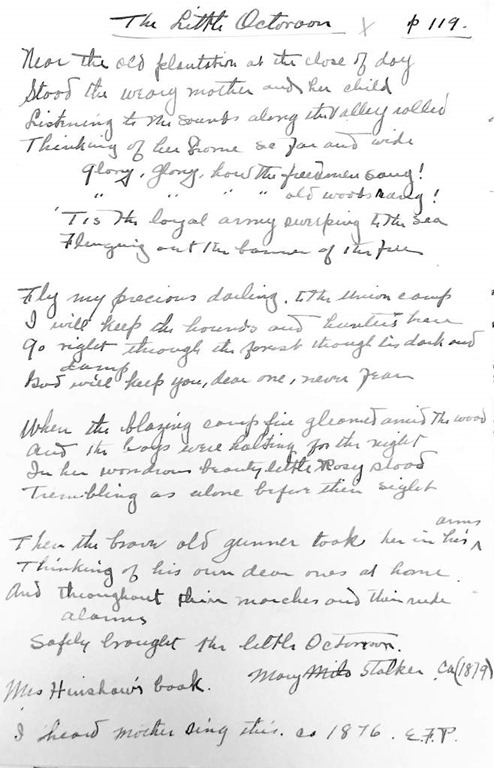
When I left off I was (more or less) talking about folk songs and the songs collected in the American Midwest before WWI by poet Edwin Ford Piper. I’ve also already mentioned that folk songs aren’t unchanging, and aren’t pure. While going through the yellowing paper in Piper’s archives, I came upon this song, handwritten in his own handwriting. He has the title as “The Little Octoroon.” Things aren’t going to get simple here readers. I can’t be simple.
The song as Edwin Ford Piper heard it from his mother
.
Octoroon is a largely obsolete word, derived from a lot of rigmarole regarding how Black someone was. It means 1/8th (octo=8) Afro-American. In general, the mumbo-jumbo legal biochemistry in American history regularly said it didn’t make much difference. Half, quarter, sixteenth — hell, for those who had trouble with fractions it was sometimes written down as: 1% Black, you’re legally Black.
An octoroon may not look Black. I can still recall when I was 14 or so, and having grown up in a tiny rural Iowa town. An Afro-American man who was a civil-rights activist was to visit my church camp. He arrives. Wait — that man’s Black? I remember in my naivete looking at his summer hands and forearms. The man had freckles people!
So why does this song, which is clearly a song from the Union and Abolitionist side make some point about the child being an octoroon? This will get weird: it was possible to be an abolitionist and a white supremacist thinking Afro-American’s inferior. Yes, you could be smart and ignorant at the same time! If you’re trying to end chattel slavery, and you’re counting votes or troops, you might not care to make a sticking point about this, ugly as it is. Those with pseudo-scientific beliefs such as an octoroon is “nearly a white person” might have stirrings of respect. (Ugh!) And then at the unconscious, illogical level, there’s the factor of that person looking much like me, so maybe they should have rights like me. Even if it’s a song (something with no visual element) those factors may have entered into its composition.***
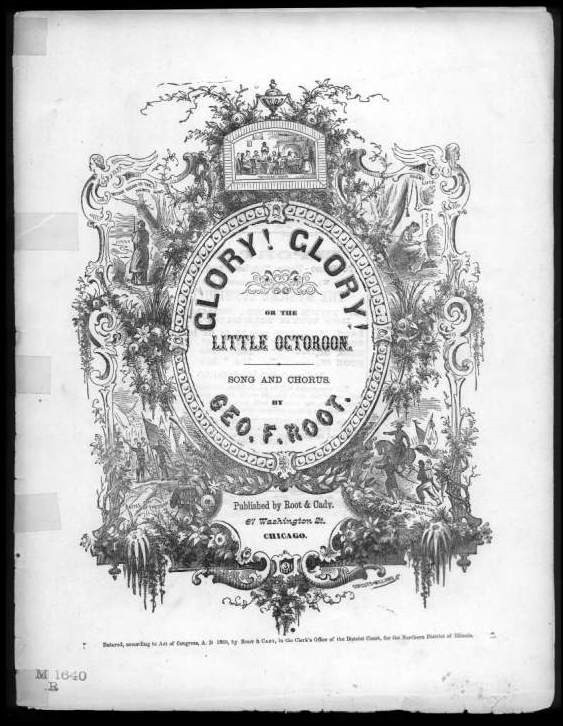
While there are no notes I saw in the archive that Piper knew this, this song does have a composer: George F. Root. Root didn’t quite reach Stephen Foster or Dan Emmett level of 19th century American songwriter fame, but he had his “hits” such as they were in the pre-recording era. During the Civil War period and based out of Chicago, he specialized in songs for the Union side.
The sheet music from George F. Root’s music publishing firm. When Piper remembers his mother singing this tune, it would have been only 10-years-old.
.
Did Piper’s mother learn this from someone else? Was there sheet music in a piano bench for this, unknown to the 5-year-old Piper? In the quiet library archive, I visualized two white people, a mother and child, in rural frontier Nebraska sharing this song. The differences in the printed song from the one Piper wrote down from his mother’s singing say this isn’t likely a handwritten copy from sheet music.****
Here’s my conclusion, which I hope I’ve demonstrated even though I’ve trimmed parts of this piece back: Juneteenth is the most complicated American legal holiday. The only simple thing about the holiday is that it stands for freedom and the lifting of oppression. Taken at its whole, though messy and with calculated delay, that makes it a favorite of a person like me, who still cries and wonders at how simple truths and rights take so long to be established. The song I’m performing today, its path and turning into a folk song, isn’t that complicated — but yes, the path of American freedom is.
You can hear my performance of Root’s “The Little Octoroon” with the audio player below. No player? This highlighted link is an alternate.
.
*In 1850 a Fugitive Slave Act was passed that required northern state governments, not just the federal government to return enslaved people who reached northern states. Some cities and states wouldn’t comply (there’s this Minnesota case for one example).
Piper’s mother was in Canada near the US border in this era. It’s possible that fugitive slaves might have crossed over into her region. I also note that Piper says she was singing it in 1876, perhaps because that’s the border of Edwin Ford Piper’s memory, but I read the date and think about it being the year Reconstruction largely ended and new de-jure laws and customs greatly restricted Afro-American citizenship.
**No, Nicki Haley, slavery was the cause of the Civil War, even though many liked to parse Lincoln’s compromise and coalition statements of this time to make it sound like it wasn’t. The flaw in that framing? Lincoln didn’t start the war, the South did, and they were explicit in proclaiming why they did it.
***There’s another song using this terminology that this Project has already presented: Longfellow’s scathing pre-Civil War poem “The Quadroon Girl.”In Longfellow’s poem the situation leading to that poem’s mixed-race child is laid out: feudal concubinage and/or rape by slaveholders. For making a speech implying the same, Longfellow’s friend, US Senator Charles Sumner was beaten to within an inch of his life on the floor of congress.
****The biggest difference: the printed song’s title calls out the chorus — it’s officially “Glory, Glory, The Little Octoroon.” I only sang the martial chorus twice in my performance because I was more drawn to the bravery and sacrifice told in the verses. We have two holidays that say soldiers made us free, but it’s not only soldiers.
I followed Piper’s transcription for the words, not the printed lyrics, honoring the chain of transmission to me rather than accuracy. I also modified Root’s tune and chords to suit my tastes and tendencies. I could not help but think of these things as I sang this: first, the mother, her family heritage caught in that sexual exploitation making the choice to stay and face the slave hunters and their dogs to assure her child’s escape. We never find out if she and the daughter will be reunited, or even if she survives. Then next I think of those pursuers who to the degree they are portrayed in the song would be gaslight villains — but in history they would be real people doing great evil, who could be thinking they were serving justice. And then lastly, the final-verse gunner who cares for the child, though he’s more the Horatio of the story, with the mother being the tragic hero. I ask you not to skip over the villain characters. It’s fine if you empathize with the gunner, but some great dangers in one’s life (and often to other lives) are those middle souls, like the slavecatcher pursuers, who have a system that tells them they are arduously, justly, doing right.
It’s been an eventful June so far for me, and I plan to be writing like a real blogger about what I’ve experienced in the last couple of weeks shortly. Then too, just this week I started working on a few further Parlando audio pieces. At least one may make the cut to appear here in the next few days.
This weekend is Father’s Day, and a new musical piece that I thought I’d present for that turned out too rough, even for my tastes. So, here’s a well-loved poem by Kevin FitzPatrick that alternate Parlando Project voice Dave Moore performed with The LYL Band a couple of years ago. It seems apropos. Kevin’s books of poetry are available from this website: kevinfitzpatrickpoetry.com Today’s poem appears in his 1987 collection Down on the Corner.
“Bicycle Spring” was first presented here in 2022, but for today’s post I remastered it and made this little video for it. Here it is:
.
Wishing my versatile readers and listeners a happy Summer.
I could, maybe should, write about a number of things this weekend. The end of May brings Memorial Day, one of the United States’ two holidays celebrating those who served in the armed forces, the spring version being more focused on those who died in wartime duty. It also brings to mind the anniversary of the drawn-out, agonizing death of George Floyd a few blocks from where I’m writing this. I think of that little group of South Minneapolis people, ordinary citizens of my neighborhood, who witnessed it, who pleaded with the police officers to cease their officiousness. I think of the new policemen in that squad, earnestly following the lead of their trainer who’d arrived, the man with his knee on Floyd’s neck. Duty.
Duty is a small word, but one that we have two holidays to honor. We generally respect it, and in small and large ways we carry duties through our days. My wife does in her workdays what I did for a couple of decades, taking on the duty of helping the sick. In between workdays she takes on the obligations to her mother suffering from increasing Alzheimer’s in a care home.
I’ve written about all those things here. I could write at length about them here tonight. In doing so I could say I am following my obligations to humanity, to those who suffer, to those who’ve lost. We use poetry often to decorate those tasks, more often perhaps than we use the more capricious song to do so. Thus I could write, and you might view it as your duty to read that.
Instead, I’ve been filled this month with the realization that this is my teenager’s last summer as a teenager. They’ve concluded an indifferent year of post-secondary education, and now have taken their first job. As to next Fall plans: they are thinking of stopping with school, saving money from the job, and moving out. Studying seems like a duty — their work-a-day job does too, but maybe it’s a more novel duty, or at least one that has a biweekly award of a paycheck.
Music is a key to memory, particularly emotional memory to me. During these feelings this May, I came upon a performance of a song by Jonathan Richman. Richman has an utterly strange career. He’s one of those you might see called a cult artist, which means those who “get” him sometimes puzzle those who don’t, but also it means that many who read this won’t know his work at all. As a teenager Richman became something of a Velvet Underground* superfan, and his early work shows direct influence of Lou Reed’s songwriting. In the early 70s he and his band The Modern Lovers recorded more than a dozen tunes that prefigured a lot of what was to come in Punk and Indie rock a few years later, but the recordings were not issued when they were made. Then in 1976, when the first stirrings of Punk were drawing attention, they came out along with newer recordings.
Here’s complexity to that odd: the old, early 70s songs and recordings were unvarnished, and they followed Reed’s model of being emotionally honest, but their timbres and approach would be in tune with some of the vanguard of what was called Punk at that time. The newer songs were even more childlike, though no longer being written by a teenager or recent teenage time-emigrant, and the sonics were quieter, even more stripped back. As his career continued, Richman generally proceeded down that path, writing ever more childlike songs focused on everyday wonderment. If his early singing called on some of Lou Reed’s snarl and assertion, the later work took on elements of 50s Do-Wop teenage innocent sweetness.** Richman in a sense started out before his time, had a recording career launch when his early work seemed of the moment, and then continued until the present day as a singer-songwriter presenting the impression of coming from a place that was younger and younger.
The song I heard while thinking of my teenager at the borderline, “That Summer Feeling,” was sung by a 40 something Richman a couple of decades into that career. On Richman’s record the Do-Wop influence is apparent, backing harmonies and call and response from additional voices. Compared to the version you can hear below, there are more verses, more detail of youthful specifics. Blind to the career history I’ve summed up above, you might easily think someone about 19 or 20 recorded it, fresh with passing through that borderland.
Here’s the intuitive choice I made when I decided to quickly work up a cover of “That Summer Feeling:” to record it more in the style of the early 70s The Modern Lovers recordings than the “mature” Jonathan Richman. If I had more time, I would have overdubbed a garage rock guitar solo at the end or maybe some combo rock’n’roll organ as those records sometimes had. Following my taste, I preferred the songs less specific but most summer-set verses.*** This musical change and the way I sang the lyrics also brings out more of the undercurrent in this song, a complexity that a casual listen to a more smoothly produced recording might let one overlook. The singer isn’t just doing a let’s remember our youth story here. He warns in slightly mutating refrains that that youth will haunt you, and then he pleads with the (presumably teenage) listener to not wait until they’re older to, what — it’s not entirely clear — somehow integrate that duty-free time’s outlook fully into oneself or it won’t just haunt you, it’ll taunt you, and finally it will hurt you “the rest of your life.”
Would any kid ever listen to that message? Doubtful. My fatherhood duty knows limits, even counterproductive effects, of advice. Still, I wanted to sing it anyway.
After the jumps of this Memorial Day post, I won’t make the proforma Memorial Day holiday wishes. Some will be decorating graves. Some will be thinking of how life was disregarded. Some are caring for the sick and infirm. Some will be having cookouts or taking a little vacation trip away from work. Black joy, worker’s rest, flopping down in the grass without any duty, playing or listening to music. We honor duty. Let us also honor some respite from it.
Here’s my performance of Richman’s song.
.
*As many writers do, I must reiterate the Eno quote about how only a few thousand bought the first Velvet Underground record — but that everyone who did went out and started a band. Historians have determined that the record actually had decent sales, but Richman is one of the early examples of direct VU influence. The early Modern Lovers band included folks who would go on to being in The Talking Heads and The Cars.
**The small vocal ensemble 1950 style of urban teenage music that got called Do-Wop was often written by teenagers or near teenagers — and like the Punk, Rap or Indie music that followed later, it was inexpensive and approachable to create for the kids who made it. Arch cultural critics and satirists-in-song Lou Reed and Frank Zappa both appreciated it, thought it honest in its innocence. Punk founders Patti Smith and Lenny Kaye met because Smith loved an appreciation of Do-Wop that Kaye had published. I on the other hand have vocal limitations that keep me from indulging in the style.
***I am struck by the specific the song takes in one verse where it goes from singing swimming ponds and cool lawns to a traffic stop. I don’t think Richman meant to make that an existential moment, even if our modern gun-soaked life might make it seem so now.
It was quite the April for me, and I’m resting up today before getting on with a bunch of tasks I’ve put off while working on the accelerated posting schedule for National Poetry Month. Readership was up substantially, busiest month ever for visitors at this blog, and page views blew past the old record by over a thousand. I should be better at replying to your comments and encouragement, but besides being focused on the work I have a mental Catch 22 where I often can’t decide the best way to respond, and in that indecision put off responding.
.
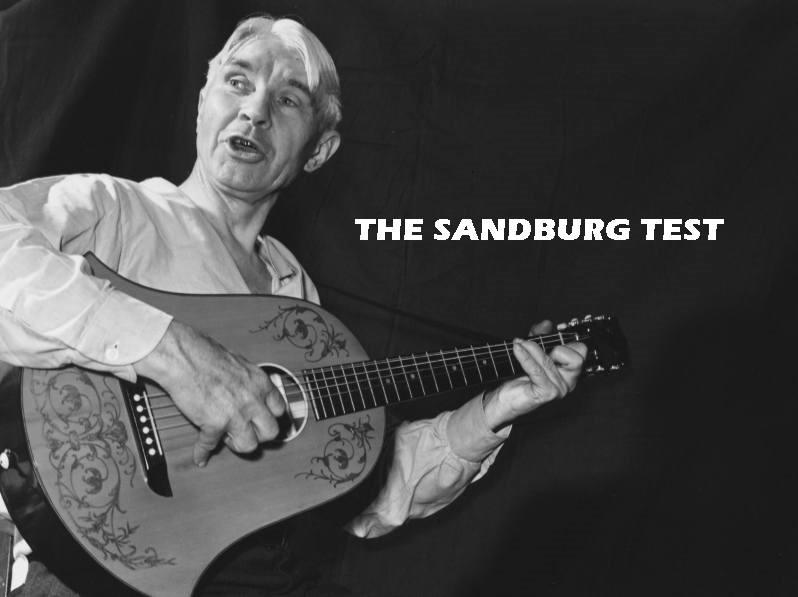
I didn’t put anything new for International Workers Day today, but I’ll repost this piece with Carl Sandburg’s words from his longer poem “The Windy City” that I created for last autumn’s U. S. Labor Day. In posting it last year I suggested something I had bounced off my old compatriots in The Lake Street Writer’s Group, something I call “The Sandburg Test.”
Let me suggest a rough analog of the Bechtel Test. Let me call it The Sandburg Test. To be clear, it’s not my suggestion that every poem has to be about work, about the things we do for our daily bread. But, if we are viewing an anthology or substantial poetry collection from a poet, to pass The Sandburg Test it has to have poems that deal with work in some substantial way. How does the speaker or characters in the poem relate to work? What are they doing that work for? What is it in presenting them that portrays something about life? What are the mysteries, sensations, and systems of that work?
Here’s that musical performance of Sandburg’s words from “The Windy City” accessible with the graphical audio player you should see below. No player to been seen? This highlighted link is an alternative.
A three-part post today — let’s see how short I can keep it, though we’re going to go far. Read on and we’ll leap from an important artistic movement whose poetry is forgotten, to the case of the odd filtering out of a woman artist from that movement, to some notes about translation and musical composition — and in the end to a remarkable trick, an April Fools’ joke of a sort I played on myself unconsciously.
Canons
It’s weird sometimes trying to figure out whose work gets remembered. It’s too much to ask for there to be some fair-minded, objective, and well-informed process of experts weighing the canon as our caissons go rolling along. Instead, quality and salience is supposed to just emerge. Emerge from what? Taken, via circular reasoning, from that memory. This sort of works, though how we know how well it’s working is hard to explain, as it may not consider those we aren’t as a culture considering. Canons have always changed — it’s ahistorical to say they haven’t, and when did we agree that history stops?
Dada poets are under-considered — or if they are, it’s as a conceptual statement more than a considered poetry. Visual arts will always include a Dada piece when discussing Modernism, literary arts are much less certain to. Dada’s evolution into Surrealism makes it almost easier to leave out Dada poetry. Dada poetry can be seen as the rough demonstration, the provocation that initiates a disruption.
My idea of presenting a Dada piece today comes out of an idea as question I had: “What can I do for April Fools’ Day?” Dada can be seen as an April Fools’ Joke. How so? Let me invent a manifesto of Dada that no Dadaist is likely to earnestly write as it violates the concept of Dada:
Much of what we’ve been given as meaningful can be seen in the human predicament as useless, maybe even harmful. Yet, we’re constantly being fooled with the trappings of power and precedent. Arbitrary examples of meaning, truth, and rules, dressed in the right costumes, framed in the expected way, keep us susceptible. So let us show how the trick is played and laugh at its absurdity.
Art Movement — and also the structure of an April Fools’ Joke.
Therefore, Dada presented poetry — a literary form we believe must be meaningful because it’s beautiful — that was random, perverse, taking the forms and frames of meaning while eschewing that meaning. Surrealism later posited meaning — or perhaps more exactly, the experience of art including poetry — as being above and beyond logical, conventional rationalizations, but the way was cleared by Dada’s withering can(n)on-fire that made merciless sport of the idea of hierarchical poetic meaning.
Still, we’re more comfortable with the idea of looking at the urinal/fountain or bicycle handlebars above a bike seat and seeing a worthwhile experience than we are looking at a series of chaotic words uttered incongruously as poetry. The first is a gentle poke in the ribs, it can easily elicit a pleasurable “See that?” The second worries us more, how should we take this? And the connection of denotative meaning (even an elusive one) that we rely on to carry us through an assemblage of words, is it indispensable? Is reader/listener boredom a legitimate artistic response, or one we’ll long endure?
The questions in some Dada poetry are valuable. The answers, not always so.
Emmy Hennings, forgotten because she was a Dadaist and because she wasn’t a Dadaist
Earlier this week I set myself a task to look at some Dada poetry to see what I could present here. I came upon a handful of poems by a name I believed I’d never seen: Emmy Hennings. I’ve retrospectively rechecked a couple of books I’ve read on Dada/Surrealism and I found my memory faulty. Hennings’ name was mentioned, but the context of those mentions didn’t make her seem anything like a key player. She was the partner and wife of Hugo Ball, a big macher in Dada, and consigned as a peripheral helper/muse/hanger-on. She did perform (from the very first Cabaret Voltaire performance!) but she was often characterized as a “music hall performer,” the kind of conventional entertainment that wasn’t what Dada was about. The supposition was put forward by the avant-garde that she was an interloper tempting Ball and the Cabaret away from real Dada into some kind of bourgeois, conventional performance career.
On further examination, there’s a case that she’s been underestimated.
Just kids. 1913, three years before the Cabaret Voltaire, but Emmy looks to me here like this could have been taken in 1975.
.
Looking over her poetry in a handful of human translations and quickie machine translations from her native German, I was immediately drawn in. It showed that essential Dada tactic as stated many years later by American Dada composer Frank Zappa: “Anything Anytime Anyplace For No Reason At All.” It also contained German Expressionist poverty-stricken darkness — and yes too, an element of erotic romanticism, though in the context that element was being set in place against the rest, implying criticism of it. Downrating her including music hall and folk song in her Cabaret Voltaire performances would seem to leave-out the case for Hennings consciously creating a Dada collage. If you put disparate things together as part of Zappa’s AAAFNRAA, those elements will talk to each other when viewed as one thing.
Here’s a secret factor most artists remain loath to admit: the random, or even the most carefully constructed miss-matches, can generate meaningful perception in the human mind. Yet Hennings didn’t write unalloyed gibberish, though outlandish collisions were allowed. She sometimes writes in a manner I recognize from later Surrealism — although from a woman’s mind and experience, a vantage point the Surrealists were loath to admit into their boy’s clubhouse.
Reading more about Hennings, I could see a rich collage of biographic and aesthetic components to her art.* I tried to sum that up to my wife by describing my emerging conception of Hennings as “A WWI sort-of Nick Cave: dark outlook, opiate addiction but hard working, catholic mysticism encrusted, mixed with elements of power-observing romantic eroticism.”
I already had a rough performance mix of the musical composition used for today’s piece before any of these Dada and April Fools’ ideas. I composed it using four new “virtual instruments”** that were newly available to me: a viola da gamba, a hardanger fiddle, a singing voice, and something that called itself a dulcimer.
I love bowed strings, and the somewhat rare and archaic viola da gamba is one that has long interested me, an interest that was sustained by once having a co-worker who played the instrument. The VI is a bit harsher sounding than hers (she used period correct gut strings and a softer bowing attack) but I used it to play the low-end lines in today’s piece.
The hardanger fiddle is a Norwegian folk-variation that uses sympathetic drone strings to add persistent, powerful overtones to the those actually fingered on the fretboard. A musical hero of mine, guitarist Steve Tibbetts once recorded an entire album featuring the instrument. My honest summary: I love drone, I love Tibbetts, my wife would testify I must love Norwegian-Americans, but I found it hard to take the sound of the hardanger for the length of an album — my reaction is similar to how some people experience bagpipe music. I also like sour tunings and harmony, but still that was my reaction. Dada being my goal, I went against sweetness however, and there’s a brief hardanger section in the middle of the piece.
By far the predominant sound in today’s music is from the VI that calls itself a dulcimer. I play the American mountain dulcimer a little bit. It’s a gentle diatonic scale instrument associated with American British Isles immigrants who settled in rural Appalachia, usually played by women as a quiet solo accompaniment for singing. This VI’s sound is nothing like anything I’ve played on mountain dulcimer. A demonstrator for the company that sells the VI says it sounds more like a lute. I’d expand that to say any of the oud variations or maybe even a mandolin family instrument. I treated its sound with a lot of reverb, so it’s more Coleridge’s opium dream Abyssinian maid dulcimer than some rustic American in a lone cabin.
The last thing I added to what was an otherwise vocal-less piece at this point: a high, keening VI voice. The human singing voice is something that VIs don’t yet allow easy access to. Perhaps eventually the ability for an easily available VI to sing all the components in human sung language will emerge, but for now what they do quickest is singing vowel-rich syllables. This VI went beyond the usual Oohs and Aahs with what sounded like nonsense words in no certain language. I hadn’t made the connection yet, but nonsense words are another part of Dada.***
So, on completion of the realized composition I surprised myself — I had what I then saw as a Dada piece without starting out with any such intent. That led me to seek out Dada poetry, and then to find and translate Emmy Hennings’ poetry to meld with my music.
“Singing at Dusk” is one of the few Hennings poems that has English translations I could find, but I made my own fresh translation. I followed a priority that guides my translations: determine what the images are in the original language and construct a contemporary English language way to convey those images. Since that is my primary goal, I will take liberties with the original’s sentence structure and wording. At times (and this happens here in this translation) I’ll even change the matter of the image in search of vividness. This latter choice is a historical fault, and I feel conflicted about it, but as I continue to translate, I catch other more renowned translators, resorting to it. Because I wanted a compelling sound to match up with the rather insistent music it was to mesh with, I also (uncharacteristically for my translations) decided to impose a rhyme scheme along with some other sound elements for this translation, which further caused me to depart from Hennings’ original. That kind of mutation to serve a form or rhyme scheme is another thing I catch other translators doing. Due to these choices, the result is partway between an earnest attempt a poetic translation and an “after a poem by” variation.
This version is a looser translation aimed for the needs of today’s performance
.
If it’s Dada, how much of this matters? It could, maybe should, be nonsense syllables, a random whatever. However, I didn’t find Hennings’ poem in the original German to be nonsense. Dedicated to her husband, Hugo Ball, it strikes me in German — and perhaps even more so in my looser translation — as a critical look at romance and marriage/partnership from a woman’s standpoint. Another element I bring out in my translation is the immigrant/exile experience. The originating Dadaists were from various countries, holed up in Switzerland, with a World War raging around them. They were writing work in German and French and a smattering of other languages, when those languages were being spoken in opposing trenches. National rootlessness was endemic in Dadaism, both as a choice and a fate.
Here’s the promised final observation: those keening nonsense words I generated from a VI played on my little plastic keyboard resolve at the end to something that I suddenly realized sounded very much like a woman singing “Jawohl.” What! They were just vocalese syllables, abstract sounds when I chose them — and they remained so for the dozens of times I’d listened to those passages, played even before I chose a German language poet to translate. Was that a trick of the ear? Here it was, the night-time, I was going to bed after a long day working on this piece. I was listening to this singing at dusk, and inside my earbuds I hear this voice loudly singing the German word for the certain and absolute “Yes.”
Will you have my experience with this musical piece? I can’t say, but you can hear it with the audio player below. No player? This highlighted link will open a new tab with its own audio player.
.
*Like some other Dadaists, she was a hyphenate: she wrote poetry, prose, sang, danced, made and performed with puppets, painted.
**A virtual instrument (VI) is a playable instrument made up of multiple samples (most often taken from a microphone in a recording studio placed on the “real thing”) of the various notes, ranges, and articulations of an actual instrument. One plays the VI by using a controller (a keyboard or perhaps a guitar with a MIDI pickup) that controls the notes played, or by scoring the music and selecting how that score should be played. This is a much more atomized use of sampling than the other kind of sampling that uses recorded snippets (often several bars long) of already recorded music afterward triggered to create musical beds and motifs in modern hip hop/rap music. The latter is another use of collage: thank Dada again.
Obviously, the tactile experience and idiosyncratic techniques of the real instrument cannot be brought over, but the results are increasingly convincing, at least to casual listeners. For composers without grant patronage or large exploitable friend networks, it’s a godsend. Even when the exact sound of a musician and acoustic instrument in the room isn’t produced, a musical something can be.
***The most famous Dada poem in any form known to modern English speakers is the Talking Heads song “I Zimbra.” When he presented it during his American Utopia theater piece, composer David Byrne explained that he adapted the vaguely foreign-sounding lyrics from a Dada nonsense-word poem by Hugo Ball, the partner of today’s poet Hennings.




 Frank Hudson