Are Song Lyrics Poetry? Part Two

Last post I rapidly traced poetry from the era of Homer and Sappho and the Confucian Odes,  jumped to English language poetry and finally ended with early 20th century Americans. I traveled fast, and simplified much, but it wouldn’t be out of line to say this is a progression from poetry that was expected to be performed with music to a poetry that wasn’t. Widespread literacy and the printing press, and by the Modernist era, a desire to include complex allusions and layers of ambiguity all helped this progression along.

Today let’s start in the 20th Century in America and follow the songwriter’s side of things. Popular songwriting had become industrialized. Composers and lyricists churned out uncountable numbers—and first by sheet music and then by recordings, film, and broadcasts, these productions could be distributed widely. Barriers to entry were low in this business, but rewards for popular success were high. Lyricists came from a wide range of backgrounds—some were middle class, even college educated, but many were immigrants or descendants of recent immigrants for whom English was a fresh language.

As with any mass art or market, much of what they produced was forgettable, a job of work, their ears may have sometimes bent to the muse, but their hands were looking for a paycheck.

Poets and literary critics occasionally paid a little bit of attention to that work in their time. Lively arts and all, some notice was taken.* With the music inspired by Jazz, the cultural force of the music could not be denied, even if the words that came along with it might be condescended to.

Then, in the mid-1930s, a decision was made, outside of music and poetry—a political decision—that eventually changed the course of popular music lyrics. For political reasons both international and U. S. national, the Soviet Union-dominated international Comintern and the U. S. Communist Party decided to switch tactics from a more purist “only the Communist Party is the solution” stance to a popular front position, where anyone to the left of the then rising Fascist forces were considered valid allies.**

In the U. S. this led to such slogans as “Communism is the Americanism of the 20th Century.” On a political level this meant that the Roosevelt New Deal wouldn’t be portrayed as capitalists pushing insufficient reforms to stave off the inevitable revolution, and that actual “card-carrying Communists” would be mixing more generally with socialists, liberals and centrists. But for our purposes, we need to look at how this played out in the cultural sector.

Popular arts, which could have been perceived as hopelessly compromised tools of the capitalist system, became more acceptable; but a more pure, folk expression that was seen as coming directly from and for the workers and the exploited, a music existing outside of the commercial infrastructure of entertainment, was even more ideal.

So here, twenty years before the “Great Folk Scare” of the 1950s were the roots of the folk revival.*** It’s in this pre-WWII period that Pete Seeger and Woody Guthrie came of age and shaped their songwriting. Seeger was a Harvard drop-out and son of two musicologists.**** Guthrie was none of those things. The Popular Front meant that the likes of those two, and many others with high to low culture backgrounds, would mix it up.


My apologies to my Christian readers for posting this example of extraordinary Popular Front songwriting on Easter when it’s more a Good Friday kind of thing. Billie Holiday sings the harrowing “Strange Fruit.”


As songwriters this could have meant dour issue-of-the-month songs cleared by some central committee. And to be honest, each of them sang and wrote some of those, but both of them had Emersonian Individualist streaks.*****

And they listened too, had big ears. Afro-American music and musicians, isolated southern U. S. musicians who songs and styles were time-capsules of old British Isles tunes. Blues and “Hillbilly” music benefited somewhat from being a source and occasional fellow-traveler with this movement.

The Afro-American Harlem Renaissance is shaped by the gravitational pull of this political decision too. Civil Rights before the ‘30s was often aspirational, and though the folk traditions were honored before, this new emphasis on embracing popular and folk arts increased the interest and respect for them among an emerging new Afro-American cultural consensus.

Now we jump ahead again, it’s that un-named but important straddle decade of the late ‘50s to early 60s. Communist connections are poison. Illness had made Guthrie bedridden. Seeger is persevering outside of any first-tier commercial structure as a road-dog performer. “Folk Music” is now a commercial genre with a still bohemian/left-wing underground. Into this we inject the man who will expand the idea of what song lyrics will be allowed to do: Bob Dylan.

You don’t have to like Bob Dylan as a person, performer or songwriter to accept this truth: there are song lyrics before Dylan’s 1963-66 period and there are song lyrics afterward, but song lyrics are a completely different field after the change he proved was possible. This is why an artist as strong in his own right as Leonard Cohen can say in one of his last public statements: “Giving a Nobel Prize to Bob Dylan is like pinning a medal on Mt. Everest for being the highest mountain.”

But a Bob Dylan has causes, has a context in which he can happen. That choice Communist bureaucrats made for pragmatic political reasons in the mid-1930s led to a folk music scene 20 years later in which Afro-American blues and weird old folk music mixes with poetic Modernism inside the mind of one songwriter, and what comes out is strange and compelling.

Song lyrics don’t have to be a piece of work aiming for an established commercial target. Song lyrics don’t have to make clear front-to-back sense the first or the fifteenth time you hear them, they can mystify you and still have listeners. Songs with narrative elements don’t have to progress in a linear manner. Song lyrics can be about anything, can use any kind of imagery. Love songs can be ambiguous. Political points can be made metaphorically. You can combine different kinds of diction, even sample and reference various existing sources, and it doesn’t have to seem out of place or from the lack of original things to say.

One can point to song lyrics that did one or two of these things before Dylan, but after Dylan used many of them together and repeated that demonstration often, many songwriters wanted to try using any and all of these things, and their attempts caused other songwriters to do the same. A chain-reaction occurred.

Modernist poetry had done all these things already, and often—but Modernist poets didn’t write songs, and for the most part they didn’t read and perform their poetry charismatically. Some Beat poets, that faction of the Modernist movement that had vowed to remain resolutely bohemian, who had read their poems in front of jazz combos, recognized this was a different level of music combined with words. Allen Ginsberg heard a copy of Bob Dylan’s second LP in 1963. As the first side of that record moved inward toward the ouroboros groove in its middle, as “A Hard Rain’s a-Gonna Fall”  played, he says he wept. Did he weep, feeling he was now displaced? Did he weep because this not yet 40-year-old poet might be replaced by this just over 20 singer-songwriter? No.

He wept, with an outlook of gratitude, because “There’s a saying among the Buddhists. If the student is not greater than the teacher, then the teacher is a failure.”


A long excerpt from “A Hard Rain Is a-Gonna Fall” with Ginsberg’s statement cut in.


Good story. But this was far from the end of the matter. A great many important poets and critics didn’t feel Ginsberg, or any of his Beat cohort, were very good poets. Therefore, Ginsberg’s say-so didn’t make Dylan a “real poet.”

You can’t say songwriting accepted or didn’t accept Bob Dylan, because acceptance is too meager a word for what happened—he changed how songwriting worked. The question of poetry “accepting” Bob Dylan, or songwriters in general, is still open.

Will I ever answer the question in the title? I beg your patience. This is by far the longest piece ever published here, even though I’m skimming over a lot of things. In Part Three I’ll finally get down to the answer that makes the most sense to me.

For an audio piece today I’ll suggest this one, one of the rare times here that I perform my own writing, a live version of “On First Hearing Blonde on Blonde”  by the LYL Band. The audio player is below. Thank you for reading and listening! Part Three, that should be the conclusion, comes soon.


*Decades after this era in 1990 literature professor Phillip Furia published his book The Poets of Tin Pan Alley  which helped convince this fan of more “authentic” songwriters that these commercial lyricists were not without considerable art.

**As in the case I’ll make later regarding Dylan, please don’t let any personal feelings or judgements you may have regarding Communism or the Comintern blind you to the historical connections here.

***I can’t not mention one poet and musician who jumped the gun on this, Carl Sandburg, who published his important folk song collection American Songbag  in 1927. And for length reasons, I’ve largely left out the 20th century development of Afro-American blues and jazz. Charlie Patton didn’t wait for the Comintern to get in touch with him to forge his new alloy of styles.

****One of his father’s prize students was Modernist composer Henry Cowell. His step-mother, Ruth Crawford Seeger was in some opinions the most significant female American Modernist composer of the first half of the 20th century.

*****We can think of songs like “Where Have All the Flowers Gone,” “Bells of Rhymey,” “Plane Wreck at Los Gatos,”  or “This Land is Your Land”  as exceeding requirements for that kind of song. Abel Meerpool’s “Strange Fruit”  is an excellent example of a lyric, written as a song, that would stand alongside poetry intended for the page.

Are Song Lyrics Poetry? Part One

Today, somewhere, someone probably asked this question for the first time, and yet I’ve been aware of this question for my entire adult life. So, before I try to address the question, let me ask first, how long have we been asking this?

The ancients didn’t ask it. It seems clear that if one goes far enough back in most cultures it was taken for granted that poetry would be sung or accompanied by music. It seemed to make little difference if it was an epic story or a condensed lyric expression, music was assumed as appropriate bordering on required.

Was there a progression away from music being expected with poetry in those times? I wish I could say I was scholar enough to answer that question here. As literacy became widespread, as the collecting of libraries increased, I assume more people may have read Homer or Sappho* on the page than heard their works performed. And similarly, when Confucius and his school collected The Book of Songs  they may not have assumed that each student would learn to sing and accompany each of them. Still it would have been absurd then for someone to judge that these works could not be poetry because musical accompaniment and performance had been associated with them.

Plectra and Sappho

Let’s see, one of these ought to work….And Sappho holding her plectrum in right hand


If we stay with English language and move on, we know that the Elizabethans recognized some poetry as destined for the printing press’s page, some for performance on the stage, and some for musical settings as songs. Poetry could be associated with music, but it wasn’t the default.

Continuing to sweep forward quickly, a few Romantics like Robert Burns wrote songs and Blake was reported to sing some of his work as well. Some of the prime British Isles romantics wrote literary ballads or the like, works that referred to song forms but without associated music, meant to be seen on the page.

Likewise, there seem to be only a scattered few in the late-Romantic/Victorian era and onto the early English language Modernists who were musical composers and poets or who assumed musical performance for their chief works. Long-time readers here will know that I like to point to Yeats as an exceptional example to this. For a time he pushed for poetry as performance with music and may even have composed or aided in the composition of some of the accompanying tunes. Little of his crusade survives, though it’s possible that one of the tunes to which his poem “The Song of the Wandering Aengus”  aka “The Golden Apples of the Sun”  is sometimes sung might be his, or personally approved by him.

That Yeats was closely associated with drama and theater may have something to do with this. Newly composed poetic drama is an uncommon form in the modern era, but drama normally presumes performance. Although readings by poets are common in the 20th and 21st century, the nature of the performances vary considerably, and it became common for poets to give dry readings that by the writer/reader’s nature or intent drained dramatic and performance elements from the reading.

Let’s stop for a moment and consider two unlike American poets who emerged in the early 20th century: Vachel Lindsay and T. S. Eliot. Lindsay, who came and went well before the first Beat poet stepped in front of a jazz combo can easily be seen as the original slam performance poet.

He wrote his poetry expecting to perform it. Associated with that expectation, his writing is designed to impact the back row of the auditorium immediately, and if he ever wrote a poem with layers of meaning or intentional ambiguity, I’ve never come upon it.

Eliot on the other hand, read somberly in public, but as much (or more) as Lindsay he seemed to inform his poetry with music. As I return to my serialized performance of his masterwork “The Waste Land”  this month I’m reminded of music’s considerable presence in it. He samples music in his great poem just as a modern hip hop composer might, dropping in scurrilous barracks ballads, pop songs, Wagner opera, and birdsong. He didn’t perform it as floridly as he wrote it, and so even if “The Waste Land”  bore an original working title of “He Do the Police in Different Voices”  Eliot does not do the voices when reading it, nor does he sing the music he’s decidedly referencing. It can  be performed however, and while the poem’s detailed layers and references won’t come through in one sitting, a performance like Fiona Shaw’s illuminates the emotional and character range in it better than anyone’s silent first (or probably tenth) reading of it will.

My performance of “The Waste Land,”  now about half complete, attempts to bring the abstracted music back to life in the poem, even if I reserve the right to select genres and modes of expression that Eliot might not expect.

When I perform a poem like Vachel Lindsay’s “Abraham Lincoln Walks at Midnight”  I expect you’ll get as much, or perhaps even more, from hearing it once as you would reading it on a page.

One of the knocks on poetry with music, or performing poetry in general, has been that it doesn’t help subtle and complex thoughts in poetry come through the way that slow reading on a page where one can look up and down the page at will does. I’ll agree there’s a non-linearity in reading poetry on the page that is difficult to translate into performance. But does musical performance of words prevent “re-reading”?

Music rejoices in repetition. Words used with music often take on refrains and repeated sections. I will sometimes create such refrains even if the original page poem doesn’t include them. Gospel and other ecstatic performance styles have been known to drill down to word or syllable level in repetition, again, somewhat compensating for that weakness of performed poetry vs. its non-linear presence on the page.

Particularly with recordings (although repeated performances have the same virtue) you can re-experience the poetic text for comprehension of different levels or different vectors of observation.

When I’m attending a poetry reading, I’m often worried that I will not be able to keep up the level of attention on the poet’s words as they read them throughout an entire night. This is irrespective of the value or quality of the poetry. A good poet is quite likely to cause my mind to explode with exploration engendered by a line, and I’ll find on my return that I have missed the rest of the poem! And a really good poem can blank out the next several poems.

On the other hand, a simple text like Otis Redding’s song “Respect”  as performed by Aretha Franklin and band can bear (for me) hundreds of listens. I will notice new things each time, or given the decades over which I’ve heard it, I may re-notice things I’ve forgotten I’ve noticed before. These revisits will also reach favorite moments where I wait for pleasures to return. A knottier text like Bob Dylan’s “Just Like A Woman”  once seemed like a way to vicariously experience a certain kind of demimonde I was only peripherally experienced in. Listening to it over my life tested it against theories that it was about gender fluidity, or that it was a patriarchal endorsement of the male gaze and privilege, and now I usually hear it more as an expression of two addicts negotiating their other relationship besides the one to the chemicals and the situation that obtains them. It may be none of those things, or it may not always be one of those things. It may be something different the next time I listen to it.

Why shouldn’t Emily Dickinson’s “Hope is a thing with feathers”  or Wallace Stevens’ “To the Roaring Wind”  get the same chance? Of course we can re-read a page poem, or read it and double back to check some connection, but particularly with short poems, might not music encourage repeat play?

In this first part we’ve talked more about poetry and the perception that it has become increasingly separate from music. In the second part we’ll come from the other direction, and talk about song lyrics and that old, but not ageless, question about if they are poetry. I’ll leave you with my performance of Yeats’ “Wandering Aengus.” We don’t know exactly how Yeats would have wanted it performed, but his writing on poetry with music indicates he didn’t want the performer to sing it in an art-song manner. Perhaps I’m complying with his wishes, but then I can’t really pull off full-voiced art song.


*My favorite Sappho legend—as a guitar player that must have the right flat pick to approach the instrument—is that she invented the plectrum.

Increased Posting Frequency for National Poetry Month

How is everyone finding the increased frequency of posts so far this April?

It’s been extra effort for me, but I’m enjoying what I’m finding out as I encounter these poems and poets. and I hope that comes across to you the listeners and readers.

I’ve got a lot more planned for National Poetry Month 2019. We’ll return to our serialized performance of T. S. Eliot’s “The Waste Land” soon, and I’ve got additional stuff in what’s turning out to be a “Roots of Emily Dickinson” series as we look at another poet who inspired this Founding Mother of modern American poetry.

Besides looking at Poetry’s Greatest Hits and poets like Eliot and Dickinson that are too large to ever get around, we’re also going to look at some more of the unusual, lesser-known, and should be better-known works again. If we have time, there may even be something new that Dave Moore or I wrote ourselves.

The Thing at the Window

Scenes of winter past: what is that thing bleeding some vital fluid outside my window?

What else? Some things I don’t know yet. This project is about exploration, and when you find one thing it often leads to another surprise. But you don’t have to wait, as there’s probably something to surprise you in the over 300 pieces available in our archives.

I’ll leave you today with the most listened too and liked audio piece of 2018, Emily Dickinson’s “We Grow Accustomed to the Dark.”  first released here last February.

Poetry in Gray, Part 2

As we continue our accelerated exploration of poetry for National Poetry Month, let’s look at another way that poetry, and in particular T. S. Eliot’s “The Waste Land,”  manifested itself in popular culture in the black & white TV era.

Yesterday’s post about a Twilight Zone  episode shouldn’t be all that shocking. Rod Serling made his bones as a screenwriter first, and many of his TZ episodes were adaptations of short-stories, albeit genre short-stories that might not pass muster in Western Lit classes. Burgess Meredith, who embodied the Prufrockian Harold Bemis had a long career in stage plays that were literary adaptions as well, including directing Ulysses in Nighttown  and a touring production titled James Joyce’s Women.

Still, in the unnamed straddle-decade of the late ‘50s and early ‘60s, science fiction and fantasy were rarer than televised literary adaptations. What was extraordinarily common was “Westerns.” A plethora of cowboys, gunfighters, sheriffs, horse-soldiers and ranchers rode the gray sage range. Watching them now I’m struck buy some things. They are often surprisingly violent. The small fuzzy low-contrast home screens wouldn’t have portrayed the later exploding blood-squib aesthetic of Peckinpaugh and Tarantino well then, but the Westerns of this era intensified the meanness, meaninglessness, and sadism to Jacobean revenge play levels.*

Paladin-Dylan 1

The moving pencil moustache writes, and fashion notices. Richard Boone as Paladin and Bob “Marshall” Dylan who’s taken to wearing dark western gear in his later years. Not pictured: Johnny “The Man in Black” Cash.

Taken in general they are also shockingly racially ignorant and ahistorical. The lead roles, the protagonists and antagonists, are nearly always white men, and then if the Western is a way to examine the historic violence of white men that could have its value, but it’s often white man against white man that is the central focus on the small screen. The issue of the conquest, displacement and decimation of First Nations people is rarely dealt with in any searching or complex way, and so that fault has become a commonplace in comments on the 20th century Western. What’s even more obtuse is the lack of any significant ethnicity beyond WASP-white. African-Americans, Asian-Americans, and first generation immigrants in general are all highly under-represented and when present, most always stereotyped.** Latin-American characters exist to a greater degree, given that much of the settings for these dramas would make it impossible to white-out them from history.

So, black & white television Westerns of this era are largely white & white.

I can’t hold it up as an exemplar in these matters, but my favorite of the era was Have Gun Will Travel.  It wasn’t consistent in mitigating these massive blind spots, but it had its moments.*** And as a half-hour drama, many episodes present almost poetic compression: striking unusual characters that exist for a scene only, tales told in only a few stanzas, epigrams dropped in as dialog. Watching a good episode is so unlike modern season-arcing prestige TV. You’re left to fill in the life before and after of most any character, and conflict doesn’t brew and simmer over hours, but often is “An intellectual and emotional complex in an instant of time.”

Will Travel LP collage

‘50s TV may have bleached the Old West, but that didn’t mean Afro-Americans and others had to go along with that.

So how am I going to stretch things to bring“The Waste Land”  into this six-gun waving post before I wind it up? Well, the Have Gun Will Travel  “Waste Land”  referencing episode “Everyman”  is so bold-faced that the writer certainly intended it, though I can’t say if anyone thought many viewers would catch the in-jokes in between the cigarette and laxative commercials.

You can see the entire episode here. It’ll take you about 25 minutes to view.

This attempt to incorporate elements of “The Waste Land”  fails to succeed overall, but some things about it are still striking. The mysterious Danceman character (a Summoning of Everyman/Seventh Seal  dance of death reference?) could appear in a Bob Dylan song and not be out of place. The strange and sketchy dynamics in the shopkeeper and his daughter might subtly be riffing off “The Waste Land’s”  sexual anxiety.

Once more, let me leave you with a Parlando audio piece featuring the LYL Band using the words of Carl Sandburg, this time his “Long Guns”   which I mix with a little Howlin’ Wolf. The player is below. The full text of Sandburg’s poem is here. And as to Howlin’ Wolf, well you just need to seek him out, but the man learned at the feet of rural mixed-race early-20th century Modernist Charley Patton.

*Alternate reader and keyboardist here, Dave Moore wrote a chapbook about he and his brother watching these shows as kids and making a game of totaling up the dead. It’s certainly math of higher numbers. Even in the half-hour dramas, one can be fairly certain there will be death along with threats of death—often multiple deaths, often murders, along with executions, duels, and battle deaths.

**Historically, the “Old West” was demographically diverse, just as most frontiers are.

***Two examples: “The Hanging of Aaron Gibbs”  featuring singer/guitarist Odetta, and a flawed episode with some strong elements written by Gene Roddenberry “The Yuma Treasure.”

Poetry in Gray, Part 1

Continuing our exploration of National Poetry Month, let’s open another door. You unlock this door with the key of imagination. Beyond it is another dimension—a dimension of sound, a dimension of sight, a dimension of mind. You’re moving into a land of both shadow and substance, of things and ideas…

Yes, I’m speaking of mid-20th century TV, and specifically The Twilight Zone.  Once more there is a revival of this series, helmed this time by the talented Jordon Peele. I think there’s something difficult in his task, one that may not matter in terms of audience or financial success, but one that I notice when I look at the old gray-screen stuff from 60 years ago. It’s two of those qualities I look for in poetry: compressed expression and memorability.

If older people remember some of those shows like poems, it’s because they were much more like poetry than prestigious television is today. For one thing the 30 minute drama was a thing. Isn’t this odd? We talk today about ever-shorter attention spans incessantly, as if we ourselves have forgotten that we’ve already talked about that subject—but the predominant television format today is the video equivalent of the serialized novel. Even the basest form of “reality TV’ shows are season-long arcs of hour-long episodes, and most of the prestige shows intelligent critics like to write about unwind over multi-season plots. That’s a valid concept, but it isn’t the only possible one. Those old 30 minute shows had to express the experience and clash of ideas fast, they weren’t about long-form character dynamics, they were about epiphanies.

Do folks feel they remember 21st century television episodes, in a sense they possess them completely as recollections of sensations and apprehensions; in the way that one possesses a poem, even one not completely memorized, where one may hold and carry a key stanza or final couplet in our mind?

There are several Twilight Zone  episodes that seem to have the quality of memorability shared with poetry. For the literary sort, the 1959 first season episode “Time Enough at Last”  starring Burgess Meredith as a man who so loves to read books would be one. The gist of the story is so memorable I’m not going to summarize the plot, because you’ll remember it if you saw it. If you haven’t seen it, it’s worth the 25 minutes of your time, and there will be no spoilers here. Only the final (spoilers!) scene is available on YouTube, so don’t go there, but I expect some streaming services will have it.

Instead I’m here to note two small things you may have forgotten, though I have no idea if Twilight Zone’s  creator, producer, and screenwriter of this episode Rod Serling intended these details.*

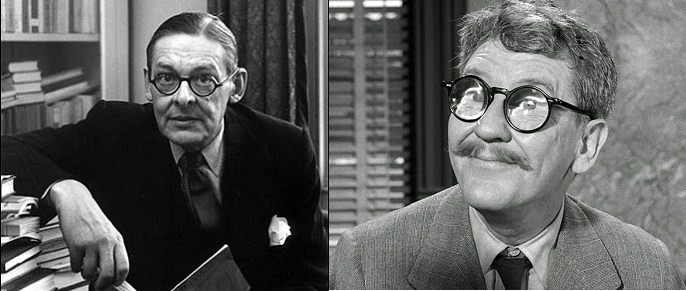
TS Eliot and Harold Bemis

T. S. Eliot and Harold Bemis played by Burgess Meredith. Two bank clerks who’d rather be reading.


First off, Burgess Meredith’s character, Harold Bemis, works in a bank and his marriage is spectacularly dysfunctional. I found it odd that I hadn’t remembered the key scene between the married couple, which is so intentionally cruel and specific as to equal or exceed the empty-hearted offhand cruelty between men and women in “The Waste Land.”  Even if the wife’s character is stereotypically shrewish, the ending of their scene is so heartbreaking that I can’t say why it isn’t more remembered. Of course, the whole sexual politics of this echt-’50s trope of the controlling female denying the freedom of the male should be bothersome, but did the TV show intend to reference the scholarly T. S. Eliot circa the writing of “The Waste Land”  then working in a bank, famously hamstrung by his own dysfunctional marriage?

Probable? I can’t go that far, but it’s more of an outside possibility than you might think. T. S. Eliot was never Tennyson or Longfellow famous, but in the 1950s he was as well-known as a poet could be then**, and poetry was still considered something of a co-equal branch of literature, a substantial part of culture.

And that was the other detail that stood out watching “Time Enough at Last”  again. The couple’s scene revolves around Harold Bemis wanting to sneak a read of a book. A classic novel? A bit of science fiction or fantasy? Hemingway on bullfights and fly fishing? The Second Sex  in French? A hard-boiled detective yarn? Philosophy? History? A collection of “Can This Marriage Be Saved”  columns?

No, it’s A Book of Modern Poetry.  Bemis’ character says of it “This has lovely things in it, really. There’s one or two from T. S Eliot. Edna St. Vincent Millay. Robert Frost. Carl Sandburg.” My ears perked up. That’s the kind of stuff you find here!

Now Harold Bemis is also a stereotype, the nebbish, maybe the idea that the thing his domestic bank clerk life most wants is modern poetry is meant to underline that caricature—that he’s too bookish. It’s not like he wants to anachronistically read The Art of the Deal.  Despite the sadness of the scene, it cheered me, it could also mean to say, even a little, that that is what he needs.  And in any case, Serling at least thought that an audience in 1960 would know these poets in some way, even superficially. If Jordon Peele or someone would rewrite that scene today and his modern Bemis was to speak of Frank Bidart, Tychimba Jess, Peter Balakian, and Gregory Pardlo*** as the lovely things he most wished to read, would the audience read anything in those names?

Well those four poets could well have as much or more to say to us. Why wouldn’t they? On the other hand, I can perform the older poems I use here freely as I encounter them, and it would be a chore to try to get unencumbered use of current poets for my small project. So, here’s my performance of Carl Sandburg’s “At A Window,”  available with the player below, and full text to read along here. All four of the poets he mentions in his scene would have difficult messages that still might console Bemis, all four could write a lovely line, even about harrowing things. But I’d choose this one from Sandburg for him to read aloud.


*Serling’s screenplay was based on a 1953 If magazine short story by Lynn Venable. Venable also has Harold Bemis as henpecked and working in a bank, but her story has Harold’s spouse so dead-set against him reading that it’s said he hasn’t ever been able to finish a book, and the only book author name-checked in the entire story is Spinoza. Her scene between Bemis and his wife is told in a much blander flashback.

**Before there was a national poetry month, on April 30th 1956 T. S. Eliot spoke in the Twin Cities, filling one of the largest capacity basketball arenas in the country (somewhere between 14,000 and 18,000 capacity)—not for a mythic men’s Final Four between Eliot, Robert Frost, Wallace Stevens and Carl Sandburg, but for a solo lecture sure to pack’em in today: “The Frontiers of Criticism.”

***Those are the last four winners of the Pulitzer Prize for poetry. Unfair! Bemis’ book was an anthology of modern poetry, those poets he longs for all had been publishing for 40 years. But just for contrast, here are the poets who won the Pulitzer in the ‘50s, “recent years” to the 1959 TV screenplay: Gwendolyn Brooks, Carl Sandburg, Marianne Moore, Archibald MacLeish, Theodore Roethke, Wallace Stevens, Elizabeth Bishop, Richard Wilbur, Robert Penn Warren, and Stanley Kunitz. Of course, poets in your rear-view mirror may appear larger/greater than they are to contemporaries, and it does look like the Pulitzer committee was more likely to give “lifetime achievement” awards in the ‘50s than they have been in our century.

The Most Popular Parlando Audio Piece This Past Winter 2018-19

Let’s just name the winner right off, and kill the suspense: Wallace Stevens’ “To the Roaring Wind.”

There was a time in my teens and twenties when Wallace Stevens grabbed ahold of me. I think back at that young man and try to wonder why. Well there was the accident of a very affordable collection of his best work that I mentioned when I first posted “To the Roaring Wind”  back in early January. I think that I also liked the way his poems looked. Free verse looked right on the page to me as well to my ear—I was not writing metrical, rhymed poetry when I started—but the poems also looked ordered, focused, a tightly built thing. E. E. Cummings or Marianne Moore with their ragged lines and strange fragmentation looked like that they were confused about how to put things into words, where Stevens looked sure. Other favorites that came to me later in life, like Frost and Dickinson, seemed to my younger self all too pat and superficial then, and there was Stevens, his poems with majestic numerabled sections that seemed to be laying out a lawyerish or legislative structure filled in with an exact poet’s eye.

wallace-stevens

Poet Wallace Stevens. Gromit not pictured.


That I didn’t understand all that he was getting at in his poems wasn’t a problem. No, that was a benefit. For my paperback edition $1.45 I got work that one could re-read without knowing already how it would come out! I recall writing poems that I didn’t know how they would come out either, something I will still do. There was one longer one from that era, the first one of mine ever to be published.  It had Stevens’ influence all over it,  copying his Blackbirds-numbered sections.

Frost, who I thought was entirely too conventional then, claimed that he never liked Stevens’ work “Because it purports to make me think.”  Isn’t that line so Frost-ian? First you might high-five Frost and shout “burn!” And then, if you pause and think about it, in decrying Stevens Frost makes a good argument for why you might want to read him—indeed, why I wanted to read him.

Oddly, this poet who was attractive to this teenager, published his first collection Harmonium when he was 44 years old. Lewis Untermeyer, one of the canon-gatekeepers of Stevens’ time, reviewed it then:

“…lacking the spell of any emotion, Harmonium  loses both itself and its audience. It has much for the eye, something for the ear, but nothing for that central hunger which is at the heart of all the senses.”

Untermeyer and Frost may have been right to some degree. I fell away from Stevens as I aged, not from any conscious choice, but because I had other poetic worlds to explore, ones that often had emotional and visionary aspects that weren’t overt in Stevens work.

Here is where the Parlando Project, which performs the poems with music, comes in. There is no inherent emotional content in any series of notes stronger than what the musician manifests when they perform it.

As I noted that Harmonium,  as a work published in 1923. was now in the public domain as of the first of January 2019, I looked for a piece from it that wasn’t one of its “greatest hits,” a deep cut to represent the collection itself rather than an often anthologized and well-known poem. My attention fell on the last piece in the book, this one. As I did this, a connection emerged with a local poet and poetry-reading organizer, David Shove who I learned had died at the turn of the year. “To the Roaring Wind”  is a call to two things: to the muse, that time-honored concept that what supplies us as artists isn’t from our individual merits, but from things outside us that we must serve, and then, to speaking poetry aloud.

David Shove Remembrance Event

“Papa John” Kolstad worked to arrange at least one more Midstream poetry reading event tonight, as a remembrance and continuance of the series run for the past six years by David Shove who died at the turn of this year.

I know this blog has  a good number of Twin Cities Minnesota readers, but even locally the Midstream series was a less-known-than-it-should-be thing. Best as I can tell, three things made it special: David Shove himself, who had a beautiful offhand way* of presenting a wide-ranging group of poets and writers; the space itself, a large second floor room full of clutter that says unpretentious and informal;**  and the upper-Midwest kind of poets, who have a tendency to community feeling, a sense that they, their poetry, and their readers/listeners are all in this together.

David Shove Rememberence Midstream Reading 1-21-19

Community Feeling. Some of the folks gathered to remember David Shove tonight in Minneapolis


Therefore, even though the event occurred with the palpable absence of David Shove, it still felt part of the series—and not just because absence is a kind of presence. As it sometimes does, the reading opened with some music—tonight, Kolstad on guitar and Richard Terrill on saxes performing some jazz as folks wandered into the room from the trench warfare of our most recent eight-inch snowfall. Then sixteen people with various connections to David and the Midstream series spoke of him, often concluding with a short poem.

I was one of those, perhaps the one who knew David less than any of the others. I only knew him from the reading series, but that was still a something. Yes it was.  I did an off-the-cuff reading of the Wallace Stevens’ poem “To the Roaring Wind”  that I had posted in a musical performance here last month when I first heard of Shore’s death.

Here’s a player gadget to allow you to easily hear that performance of “To the Roaring Wind”  from January.


*Shove as a presenter had a slow, dry way of speaking that the first time you saw him you might not think much of it. Then the next time you’d notice the method of it, and the third time, the art of it.

**The decor of the room I think is the unstoppable flotsam of past enterprises run out  of the room and Kolstad’s own intended collage sense. Part Marcel Duchamp and part Daniel Kramer’s “Bringing It All Back Home”  record cover.

Love’s Greatest Hits

“If music be the food of love, then play on…” So said Shakespeare and Peter Green’s Fleetwood Mac. Here at the Parlando Project we explore music and words (mostly poetry) crushing on each other, and some of our most listened-to audio pieces feature aspects of love. So, for Valentine’s Day here’s a countdown of our most popular pieces that feature love.

As it happens this “Top 10” also does a good job of showing the variety of music and ways we integrate the words with the music. I often think I spend the majority of the posts here talking about the words we use, but love, like music, often prefers “to speak without having anything to say,” the thing that music does.

10. Vegetable Swallow words by Tristan Tzara. When I translated this Dada poem I wasn’t expecting it to form the recognizable poem of desire that appeared. Musically I set this to something that is unorthodox rock. The keyboard parts don’t really work the way rock keyboards usually work, but the second half features an electric guitar solo that while it’s not rock, meets it at least half-way.


9. Love is Enough words by William Morris. More plainspoken than Tzara about the value of love in a world that doesn’t seem to want to contain it. Here the LYL Band is in garage band mode, with the usual keening combo organ of that Sixties’ genre along with two guitars, bass and drums.


8. The Heart of the Woman words by William Butler Yeats. One of the limitations I need to deal with in this project is that I’m not a very good singer, so it was particularly audacious here for me to perform Yeats’ poem of tender devotion acapella. One of the things I love about traditional folk music field recordings is that they often capture singers who are not perfect in pitch or in other qualities that make one say “what a singer!” That quality brings a different reflection on humanity and the words being sung.


7. Sonnet 130 My Mistresses Eyes Are Nothing Like the Sun words by William Shakespeare. I loved the episode of Upstart Crow  where everyone and Shakespeare’s wife takes the bard to task for this too honest love poem that deconstructs every phony and limiting idea of beauty in his era’s poetry. Bonus Black History Month points to the possibility that the poem’s famous “Dark Lady” might have African ancestors. Musically, we leave rock’n’roll behind for 12-string acoustic guitar, bass, recorder and a string quartet.


6. Rosemary words by Edna St. Vincent Millay. One of my personal favorite musical performances from the more than 300 I’ve presented here in the last three years. I was trying to recreate the sound of the acoustic band The Pentangle, and I’m still shocked and pleased at how close I could get. Millay’s poem has a new broom sweeping out the old, failed love to make ready for a new one.


5. Sonnet 43 What Lips My Lips Have Kissed words by Edna St. Vincent Millay. Our first repeat appearance by a poet in this list, and there’s a tinge of romantic regret in this one, but also there’s some satisfaction in a life of romantic independence. A massively underrated poem! Another small string group arrangement here with some spare piano, but also electric bass and drums.


Allegory of Music by Laurent de La Hyre

Actual photo of my anima recording another Parlando Project piece. “Yeah, it needs more theorbo.”


4. Let Us Live and Love words by Thomas Campion. Another variation on the carpe diem poem that starts as Campion’s Elizabethan English translation of Roman poet Catullus, and then branches off to his own take. The music here is blues: acoustic guitar and slide guitar with harmonica. I don’t play bottleneck slide guitar much with the Parlando Project, but listeners for some reason seem to like the pieces where I do.


3. Tender Buttons words by Gertrude Stein. Another one where I outright tried to cop the style of another band, this time Captain Beefheart and His Magic Band. I remain surprised at the number of listens this one has accumulated, and even when I posted this I wondered how many are out there that appreciate both Gertrude Stein and Captain Beefheart. More than I expected you brave souls!

Even more than the Tristan Tzara poem, this one abstracts desire and love; but particularly in its closing section, that’s what I read was there expressed in Stein’s cubist language. It’s possible that, though the language is different, Stein is making something of the same point as Shakespeare’s Sonnet 130 does, that desire starts at skin deep and cares little how it’s attired or to what it’s compared to. Beefheart did much the same thing lyrically as Stein—but also musically, reassembling shards of blues music and visual emotions.


2. Sonnet 18 Shall I Compare Thee to a Summer’s Day words by William Shakespeare. More rock band instrumentation used in a different way than usual. The tolling piano sure ain’t doing no boogie-woogie, for this poem is yet another carpe diem argument, presented only slightly differently. As always in carpe diem, “we’re all going to die” is the unlikely come-on, and Shakespeare isn’t making the “mistake” of his Sonnet 130, opening this one by saying his beloved is better than, rather than lesser than, a common poetic trope; but as the poem continues he makes the ego-drenched claim that he’s the better love partner because he’ll put you in a poem that’ll make you immortal.

How’d that work out for the love object? Lots of conjecture as to who might be the “fair youth” or the “dark lady” in those sonnets (or if Shakespeare is, well, capable of just making the whole thing up) but in fact, we’re more concerned with Shakespeare than his romantic partners. We treasure the valentines, not the fleshy and independent lovers that they may have been addressed to, and we hold them while their erstwhile subjects are dust without names.

Doesn’t seem fair does it? Maybe for Valentine’s today the best thing is to skip the questions of appropriate metaphor and honor that partner, and to return to poetry and song tomorrow?

I can’t be serious, can I? This project needs more listeners and readers!


1. Love and Money words by Dave Moore. Can this be? An original song by Dave, who has contributed words, music, vocals, inspiration and keyboards to this project from the start is more popular than Shakespeare? How could this be?

Could it be the elemental and essential nature of the pairing in the title and the rest of the lyrics? I was considering some slavery stories as I first considered Dave’s lyrics, that added some weight for me, but Dave’s words are free-floating as far as time and place. So, I’m not going to knock the words, but maybe it’s the funky way his electric clavinet and the rest of the LYL Band jells on this one.


Happy Valentine’s Day to every reader and listener here!

I listen to the Temptations last great record and think of Charles Stepney

Don’t worry, we’ll be back with more audio pieces soon. Ironically, some of the interval right now in new music is because I’m working on experimenting, organizing and recording a bit this month. There’s always plenty to hear in the archives here, if that’s what you came for. Listenership seems to go down on the weekends anyway, so let me dance about architecture and talk about music this time.

This week I was driving, and the radio station where I used to work played the Temptations “Papa Was a Rolling Stone.”  A driveway moment ensued. I probably hadn’t heard this record in years, perhaps decades, but I heard it plenty when it came out in 1972. That was back in a time before the death of the Top 40 radio format, a once popular but now oddball idea, where radio stations played a wide variety of music constrained by a tight playlist that repeated the same songs often enough that they imprinted on listeners. Radio formats still do the repetition, but such variety of genres would be considered commercial suicide now. Here’s a link to a list of the most popular songs of that year, the kind of songs you’d hear right before and after “Papa Was a Rolling Stone,”  but it may be meaningless now to those who don’t know them. Take my word for it, schlock and genius (sometimes in the same song) in a mix of genres that would never have anything to do with each other in later years.

“Papa Was a Rolling Stone”  doesn’t have to apologize for itself, it puts the needle-gauge over against the genius pin and keeps it stuck there for the entire piece. It’s a great performance. The Temptations, a vocal group, reportedly didn’t care for it because long portions of the record are instrumentally focused, but it’s a great group vocal performance none-the-less, with each singer getting to play a character not just a harmony singing register. As a listener though, what captured me then and now was the musical setting. The single was nearly 7 minutes. And it’s 7 minutes that never leaves the mono-chord minor groove and is through-composed featuring a prominent electric bass ostinato, spare trap drums and strings by moonlighting Detroit Symphony Orchestra players. Besides the voices, electric guitar and a heavily modified trumpet that sounds more like a modern synth patch than a real trumpet step forward and drop back.


Dancing on your grave: that slow, ominous groove confronts even the Soul Train dancers with a new problem


Listening to it again, enraptured by the instrumental arrangement, I thought, “This sounds remarkably like some of the stuff I do for the Parlando Project!” Please excuse that thought. I wasn’t thinking “I can play as good as those guys.” I try, but what I mean is that compositionally I’m often working the same concepts. “Papa Was a Rolling Stone”  was arranged by Paul Riser, whose name I had to look up. Listed composers Norman Whitfield and Barrett Strong may have had input, particularly on the vocal melodies and of course the memorable lyrics, but musically when you’ve got what is essentially a one-chord vamp, I’d look to the arranger for those tasty colors.

So, here’s this arrangement, this set of timbres, demonstrated in a highly popular single from more than 45 years ago, that I continue to exploit from time to time here—but that’s not where I first got the idea. For that I must step back to another man, even more obscure than Whitfield and Strong, as unknown as Paul Riser: Charles Stepney.

Charles Stepney was a genius of tonal and timbral color who worked extensively in pop music genres. One reason that you haven’t heard of him is that when you work in pop music genres and aren’t held responsible for hits you tend to disappear. Unlike “Papa Was a Rolling Stone”  I can’t point to a Charles Stepney record that many of a generation would remember instantly on mention. I knew Stepney most from his work with an equally obscure Chicago group of the Sixties and early Seventies: Rotary Connection.

If you were to listen to Rotary Connection albums today (they appear to be available on leading streaming services) your personal schlock/genius meter may waver from cut to cut. Particularly on the cuts from the Sixties, there are elements that sound like a soundtrack composer trying to portray “hippie-dippy sh*t.” In some instances, I’m not sure that Stepney wasn’t trying to signal just that, intentionally, as part of an extended collage of elements as Frank Zappa would do around the same time. Other times, what could be considered outré elements, “exotica” sounds of the quiet-village sort, need to be heard with an open mind and in the context of the whole presentation. Also in his Sixties work with Rotary Connection, there’s a fascination with extreme vocal effects, greatly aided by Rotary Connection singer Minnie Ripperton, who was asked to use her extraordinary vocalese techniques during those earlier records. You may find that strange, even off-putting, or a waste of a perfectly good voice that could be used in a more conventional soul-music style.


Problematic miming-to-an-early-record clip. Co-lead singer Sidney Barnes is hidden in the back, and the third lead singer Judy Hauff * had left the band. Worse yet, the TV host has a mansplaining moment with Minnie Ripperton.


Rotary Connection sometimes (like those Motown Whitfield/Strong productions) gets labeled “Psychedelic Soul.” Rotary Connection sometimes self-labeled itself as “Progressive Soul.” Interestingly, over in England the idea of combining 20th Century orchestral concepts and extended timbres with rock band instruments was a coming thing. It would get called, succeed as for a time, and then be filed on record shelves as “Progressive Rock.” Fashionable, then unfashionable, now something that one can experience without the danger of it taking over too much musical attention.

A contemporary arranger with some similarities, David Axlerod, has gathered a tiny bit of 21st century notice that has largely escaped Stepney. Even given Axlerod’s use of William Blake texts, I prefer Stepney. Perhaps that can be laid to my listening to Stepney’s work with Rotary Connection as well as Muddy Waters and Howlin’ Wolf** when these records were new, and I was young and ready to be imprinted. In this rare interview from 1970, Stepney sounds at times like Quincy Jones (although I wonder if the Downbeat interviewer may be an influence in that). If Stepney had relocated from Chicago to LA, closer to the heart of the post-1970 record business, could he have had a more Quincy Jones career?

His use of orchestra colors (like Riser, he used available symphony players, this time from the Chicago Symphony) combined with rock band instrumentation is what I admired, then and now. In the studio some of the rock band parts were played by Chicago jazz guys, both soul jazz types like Phil Upchurch and more outside cats like Pete Cosey. The combinations he composed aren’t really like anyone else’s—and different often makes demands on listeners to listen differently, and without preconceptions.

What happened to Stepney? He died young. He had just turned 45 in 1976, and—heart attack. He was starting to work with an upcoming group of jazz to soul players who also saw an opening in the Progressive Rock concept for longer pieces with more colors (yes, melanin pun intended). It might have been hippie-dippy to call themselves after their astrological signs: Earth Wind and Fire.


*although I focus today on Stepney’s instrumental arrangements, this unknown band had three outstanding vocalists: Ripperton is the best known; but Sidney Barnes was an arranger too, interested in expanding the soul-singer’s techniques, and Judy Hauff? She became a force in the shape-note hymn singing revival later in the 20th century, composing and arranging pieces for harmony choirs.

**although not orchestral, and I suspect less under Stepney’s direction, these two records(Electric Mud  and The Howlin’ Wolf Album)  by the Blues’ greats used some of the same jazz and rock musicians as were used on the Rotary Connection records. Reviews were almost entirely negative at the time. (TLDNR: sacrilege due to idiotic pandering to the hippies) Eventually, a handful of listeners heard the intent by younger Afro-American musicians to do something different with the tradition, as opposed to a mistake by crass marketers. The cover of the Wolf album was just this text: “This is Howlin’ Wolf’s new album. He doesn’t like it. He didn’t like his electric guitar at first either.” My opinion: like many experimental works, not everything works, but when it does, something new happens.

Summer 2018 Parlando Top Ten, Part Three

I’m going to move on up the countdown of the most liked and listened to pieces during the past summer, but first a short summary about what the Parlando Project does, and an even more compressed explanation of why we do it.

The Parlando Project combines various words, mostly written by others, most often poetry, with original music. I am Frank Hudson. I write, arrange, play, and record most the music here. I don’t do that because I’m a great composer, or even an average musician. I do this because it’s the most cost-effective and time-efficient way to create this much music this quickly.

Other musicians contribute parts, and another voice, Dave Moore, relieves you from hearing my voice every time. Ideally there’d be more pieces with more musicians, and more variety of voice; but such an ideal world would require a great deal of organization, maybe even funding and the organization it takes to seek that. The pieces could be better realized, but when I look at the history of such more professional and polished presentations, it seems likely that there would be many fewer pieces. Take a random walk through the archives on the right here: the Parlando Project is now marching toward 300 pieces combining those various words with music. I’m unaware of any not for profit group who’s made available anything like this many poetry plus original music encounters.

Why do I do this? Because I’m still excited by those encounters. Most often these words have been designated to pages, and in some cases, little-read pages. They are the condensed observations of many human beings, potentially vivified by silent music there in the inky words. How can I wake them up and dress them in those other musical sounds that don’t speak in words? You’re listening here, you know that can be intriguing, and so I will not say more now on this.

Why do I do this? Because I’m still excited by those encounters. Most often these words have been designated to pages, and in some cases, little-read pages. They are the condensed observations of many human beings, potentially vivified by silent music there in the inky words.

Now let’s resume our countdown as we get to some of the pieces you liked and listened to the most these past three months.

4. The Destruction of Sennacherib. For around 100 years students in the English-speaking world usually got a strong dose of the British Romantic poets as part of literature classes: Keats, Coleridge, Shelley, Blake and George Gordon, Lord Byron. Here’s the weird thing about that: not a one of these men seem to be good classroom examples for young scholars. Messy, often foreshortened lives; lots of sex, drugs, and what was rock’n’roll before there were Afro-Americans with electric guitars and re-voiced saxophones.

Take this little piece, sure it’s a Bible story, but a field strewn with corpses isn’t exactly happy Schoolhouse Rock fun-time, regardless of the unstoppable flow of Byron’s verse even without adding the instrumental music.


Shelley Shelley and Byron

Mary Goodwin Shelley thinks of doing something different with her hair.  Hit the riff harmonized in fourths: “We all came out to Cologny, on the Lake Geneva shoreline. To make stories with Lord Byron. We didn’t have much time…”


3. Fire and Sleet and Candlelight. Elinor Wylie was heavily influenced by those British Romantics and lived through events that echoed the scandals of Shelly and Byron in her own foreshortened life. Did this help her compose this tale of a life as a series of troubled trials and tests? One could easily suppose this to be so. Still, this piece’s title and something of the life as a trial by fire narrative strongly references an old and pious English Christian folk-hymn, the “Lyke Wake Dirge.”  Combining frightening with beautiful is not an easy thing to do, so it takes more than merely having the life-experience to create something like this.

This audio piece is an example of why I realize these pieces so often by playing all the parts myself. Actually collecting the equivalent of a chamber orchestra and a place to record them would take more than a full summer’s work alone.


2. Morituri Salutamus. There turned out to be a lot of daylight between the other pieces and the top two this past quarter. And this one is the greatest surprise, as its words are taken from a longer homecoming-speech-as-poem by that now most un-fashionable poet Henry Wadsworth Longfellow.

Still, I could relate to this section, which is the opposite of those romantic “live fast, die young, publish posthumously” proposals of the troubled romantics. “Morituri Salutamus”  is the cry of an aged artist refusing to quit, hampered by unavoidable age instead of youthful self-sought excess.

I have no idea of the age-demographics of listeners here, so I don’t know if that was the hook for “Morituri Salutamus”  this summer. Regardless of the pull of taking in experiences as wildly and widely as possible as a way to more intense artistic expression, I’ll admonish younger readers here that the primary duties of an artist are to survive and to actually do the work that survival allows. Like homecoming and graduation speeches in general, this matter is likely eye-rollingly obvious and simplistic to the bravest young listeners. That’s OK, I’ll be back tomorrow with the piece that was even more popular and modern than Longfellow.