The Most Popular Parlando Project Piece for Spring 2018

I’ve already mentioned in this count-down that I’m sometimes surprised at what Parlando Project pieces are the most listened to. It’s not just that it isn’t always the best-known poems, a surprise factor that I’ve already mentioned, but that it sometimes isn’t a performance that I think I pulled off well.

Such is the case with the repeat number one in this countdown covering activity this past spring: Fenton Johnson’s “The Banjo Player.”  My personal discovery of Fenton Johnson goes back to reading James Weldon Johnson’s 1922 anthology The Book of American Negro Poetry.  Fenton Johnson’s work included there immediately stood out for me in its range of expression, from the hymn-like “God Is In the All Time”  through the startling confrontation of spirituality with reality in “A Dream,” to the frank and compressed expression of despair in “Tired.” I vowed to do my best to present Johnson’s range here.

Fenton Johnson

Fenton Johnson

Which lead me to perform “The Banjo Player.”  It’s frankly a humorous piece, though if one pauses after the laugh, there is a serious point being made. Explaining jokes always risks creating more comedy, but the serious point embedded in the joke here is that the banjo playing songster in the poem knows something of his value, but he still feels like he’s a failure because an otherwise uncharacterized woman called him a troubadour, and he’s not even sure if that’s a compliment.

That problematic name for the banjo player is the only way we can characterize that woman who spoke it. Is she, like Fenton Johnson himself, a member of the Talented Tenth, Afro-Americans who had gone to college and who had been charged in the early part of the 20th Century to “raise” the race with their achievements? Or is she a white Modernist admirer of para-literary poetry? We can’t say for sure, and since either is meaningful, the poem works either way; but I lean to the later if only for the word she used.

As so often with Modernism, you can trace something back to Ezra Pound. Just as the Pre-Raphaelites before him, or some hipsters today, Pound looked to the past to find models for a changed, modern future. One source he used was classical Chinese and Japanese poetry, but another was medieval European troubadour poetry.

So even at his lightest, Fenton Johnson makes a sophisticated point here, one that he reinforces by using a location, “The Last Chance Saloon,” in both “The Banjo Player” and his now most-anthologized poem, “Tired.”  In the former it’s a place of some solace, in the later it’s the place were the absence of dignity is numbed.

Returning from those more important points to my issues with my performance of “The Banjo Player.”  I tried to cop a little of that Afro-American banjo tradition. It just seemed the inescapable choice for this. I think I failed, if only because I’m not a banjo player. Such things may be inevitable with the production schedule I’ve practiced with the Parlando Project this past couple of years (something I’ll talk about soon), but to be honest, I’m slightly embarrassed that this piece is listened to so much.

But that’s because of me, not Fenton Johnson. Below is the gadget for my performance of “The Banjo Player,”  but consider listening to some of the other pieces I’ve presented using the words of Fenton Johnson too.

Parlando Spring 2018 Top 10-Part Three

We now come to the top half of our count-down of the most listened to and liked pieces during the past three months. But what if you’re new here, and you wonder what this Parlando Project does?

In short, we take various words, mostly poetry, combine them with original music, and perform them. My intent at the start was not to do this the same way each time, to vary our approach as much as we could. We’ve been doing this for a couple of years, and there are now over 220 Parlando Project pieces available here if you search through our archives. From time to time, as I look at what we’ve done, I seem to notice a “style” developing, and while I have no objection to that arising organically from my predilections and limitations as a musician, performer or composer, when I hear that I usually ask myself “What can I try that’s different?”

The poems are not always the famous ones, I like to mix in some “deep cuts,” but it just so happens that these three recently popular ones are all pretty well-known, but maybe we can bring something new to them?

In position number four we have Emily Dickinson’s “We Grow Accustomed to the Dark.”  Last time I talked about how I’m finding that Modernist poetry in English moved from a recognizable natural landscape freshly observed in it’s early poems to a more interior landscape, another darker country where new dialects of language and syntax seemed the natural tongue of that region. It may well be that WWI, with its unstoppable socially-accepted murders, was a cause for this change. The rise of Freud contributed too. But more than half-a-century before WWI, and decades before Freud published, Emily Dickinson, spurred by American Transcendentalism and her own individual genius, was exploring some of those same places.

When Dickinson gets furthest inside her own head and tries to use her mutation of mid-19th century language to describe it there, she can be inscrutable; but when she’s half-way there like in this little masterpiece, she’s exploring poetic areas that won’t be visited again until the 20th Century.

This is another of the pieces where I think my music works particularly well. Perhaps you’ll agree. Player below:


Funny how these count-downs seem to form a sequence. From Dickinson’s dark we move to the  third place piece, by that little-known poet William Shakespeare, with one of his sonnets about The Dark Lady, “My Mistress’ Eyes are Nothing Like the Sun.”  When we wasn’t supplying titles for late 20th Century Sting CDs, or writing a play here and there, Shakespeare wrote a collection of sonnets that are full of ideas woven of memorable phrases.

Emilia Lanier Nothing Like the Sun

Emilia Lanier, musician, poet and possibly Shakespeare’s Dark Lady.


I’ve always loved the sonnet, even shared a few of mine here. It just seems the perfect length for a lyric poem, long enough to develop two or three ideas costumed as images, but not so long that one will find them frayed and soiled at the cuffs before it’s done.

Hear my performance of Shakespeare’s Sonnet 130, “My Mistress’ Eyes are Nothing Like the Sun”  with the player gadget below.


And now we’re up to the second-most popular piece this past quarter, Marianne Moore’s “Poetry.”  Shakespeare’s poem in slot number three declares his love by saying the things his beloved isn’t. Poet Moore’s poem about poetry starts off famously by saying she “too dislikes it,” and goes on to tell us what she feels works an doesn’t work as poetry, including the poem’s other famous line about poetry’s goal, to show “imaginary gardens with real toads in them.” I think here again of those early Imagist poems, with their unromantic and ordinary things made into central images: T. E. Hulme’s red-faced farmer standing for the moon or Aldington’s poplar tree as a young woman or F. S. Flint finding the moon taking on the terror of a WWI Zeppelin raid. Toads all, ordinary nature, not the battalions of classical gods or the obligations of sentiment.

This piece’s popularity on Spotify continues steadily, as with “Sky”  from earlier in the count-down, I wonder if it’s the short, somewhat generic title that brings in curious listeners there.

My initial idea of the Parlando Project did not have my voice as the only reader, and the first voice you hear in this version of “Poetry”  is Dave Moore who’s been the voice in a number of pieces over the past two years. The other voices in this performance are two fine poets who’ve spent a lifetime raising toads to see what works in their gardens: Kevin FitzPatrick and Ethna McKiernan. Hear them read Marianne Moore’s “Poetry”  with the gadget below.


That leaves us only the number one to count-down, the most popular piece this past spring. It’s not a well-known poem, and it’s not by a well-known poet. See you back here soon for that.

Parlando Spring 2018 Top 10-Part Two

Continuing on with our count-down of the most listened to and liked audio pieces from the Parlando Project during the past quarter, we’ve now come to numbers seven through five.

At number seven this time is an example of how the Spotify listeners differ from the blog listeners. This piece received only a handful of listens on the blog this past spring, which isn’t unusual, as “Sky”  was posted there last summer, and blog users tend to listen to the latest posts unless brought here by a search engine. On Spotify though, “Sky”  has seen steady action, and enough plays there to make it one of the most listened to this spring..

I like the idea and outcome of looking at the Midwestern sky that multimedia artist Laurie Anderson explained in an interview that I quoted to make the words for this piece, but I’m not sure what attracted all the action on Spotify for it. Is it the short, somewhat generic, title perhaps? As we’ll see later this month in the countdown, another of the Parlando pieces with a one word title was very popular on Spotify in the past few months.

Well, no matter blog readers, here’s “Sky” brought to your attention by the listeners on Spotify.


One of the Parlando Project principles is “Other People’s Stories.” There are a good number of Internet locations where people post their own poems, and blogging in particular is often autobiographical. I could do the same, but I have a contrarian streak, and I find responding to other people’s words and figuring out how to perform them interesting.

I don’t dislike autobiographical blogs, I subscribe and happily read a handful of them myself. If prodded, I can go on way too long about myself, just as I have a tendency to do on any subject, and having had my first poem published almost 50 years ago, I’m certainly not against revealing my own poetry. “Other people’s stories” is a choice I find helpful, that’s all.

I will use my own poetry/lyrics in the audio pieces here from time to time, though I like it when they are my words about other people, such as the number six most popular piece last spring, “Anglers.”  This is the story of my father and his youngest brother’s sport fishing, something they spent many pleasant days doing before my father became too old and frail for his beloved outdoors. Those days seemed timeless even as they were occurring decades ago, and those lakes have become mysteriously reflective in memory now. So, in writing of them I added notes about passing between dimensions.

I’m proud of how this came out, and glad so many have taken the time to listen.


These Top Ten lists often include well-known poems by well-remembered poets, but that contrarian streak in me likes to look at those less remembered and see what might be of interest there. Richard Aldington is one such case, a writer who was active in the pre-WW1 London circle that created Modernist poetry in English. Coming in at number five on this spring’s list is this charming poem of his “The Poplar.”

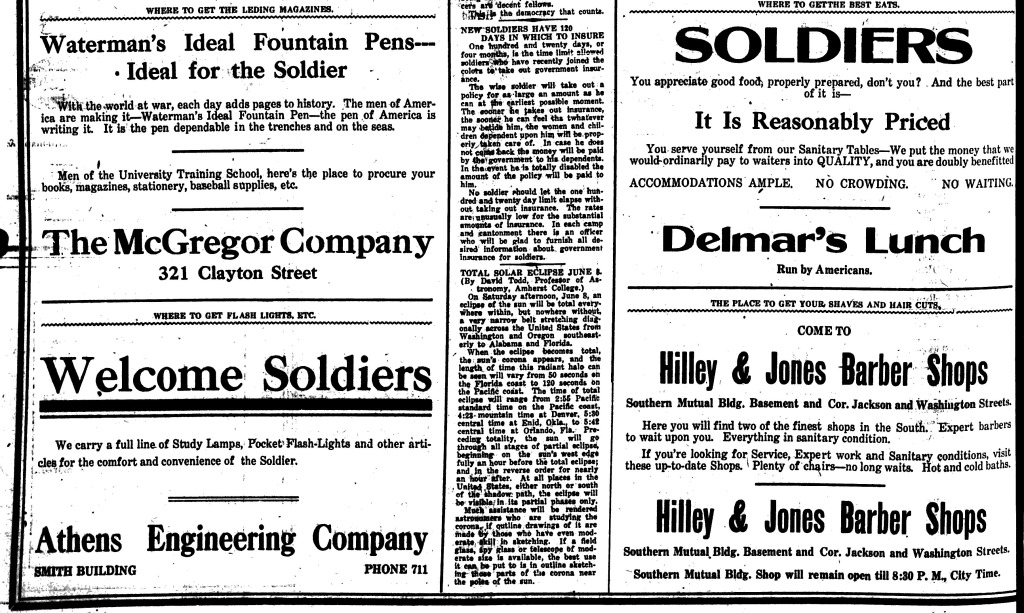
David Todd asks Athen GA artists to sketch eclipse

62 years before REM was formed in that town, astronomer David Todd asks artists in Athens Georgia to sketch the June 8th 1918 total solar eclipse. Note the ads pitching goods to WWI soldiers. “Delmer’s Lunch – Run by Americans”


Since it is easiest for me to use poems here that are in the public domain, the newest ones are often from that Modernist revolution that occurred in the first two decades or so of the 20th Century. There are weeks when I think I must be living 100 years ago more than in 2018, as I look for and read poetry from that era. Do I find this a refuge from 2018? No. The horrors of WWI (which impacted Aldington, who served, significantly), the realities of racial, class and gender attitudes then, mean this was no golden age. But what does surprise me reliving the genesis of English Modernist verse as I read their work now, is how they employed broadly accessible images in their Imagist poetry.

The post-1920 High Modernism that was largely used to represent the Modernist movement when I first encountered it is full of obscure references, exotic words and locations, events so far into the imagination and the special dialects the poet chose to reflect those inward locations, that a reader is confronted by a world they can’t comprehend the landscape of, much less the meaning of what occurs there. There can be beauty and insight in this, but it’s a world that assumes one will come prepared, well-equipped with poetry expedition gear and maps.

But before all this, as Modernism was forming itself, the poems are still in a world much like the one inhabited by the general reader, like this graceful and musical one. Give a listen to Richard Aldington’s “The Poplar”  below.


Other peoples stories. How can I connect sky-watcher and eclipse sketch promoter David Todd to poetry? Todd was a pioneer of “eclipse chasing” as well as a theorist of life on Mars. His wife, who documented his trips to view eclipses was Mabel Loomis Todd. Back in the 1880s Mabel had a scandalous long-running affair with Emily Dickinson’s brother, who lived next door to Emily. After Emily’s death, Mabel Loomis Todd was the person who saw to the publication of Emily Dickinson’s poetry. And when we return soon to continue our count-down, we’ll have a poem from Emily Dickinson.

Parlando Spring 2018 Top 10-Part One

As I’ve done most quarters, I like to look at the most played and liked pieces during the past season and report back here. Usually a few of the results surprise me, they aren’t always my favorite pieces or even the ones that I think came off best.

I do this in classic countdown fashion, so we start off with number ten and move in the next few days up to the number one. The audio pieces for the Parlando Project can be consumed a number of ways. Some listen to them here using the audio gadget on the blog, but others listen by subscribing to us through any of the leading podcast services. The audio pieces are the same, but the blog allows me to write about the pieces in a much richer manner than I can with any of the leading podcast services. However, if you, or someone you know might be interested in just the music and words, this is a handy way to get them on your phone or other handheld. So, if you just want the tuneage, search for Parlando – Where Music and Words Meet on iTunes, Spotify, Google Play Music, or any of the other podcast services. You should find our audio pieces in their podcast sections.

On to the countdown…

Coming in at number Ten is one of the two pieces from May that gathered enough likes and listens to make it, despite having a shorter time frame to do it in, “Letters to Dead Imagists and A Pact.”  I often like to look at who influences the writers we feature here, and this piece lets me do that with short poems from two poets: Carl Sandburg and Ezra Pound. Sandburg tips his hat first to Emily Dickinson and Stephen Crane, while Pound, rather grudgingly, acknowledges Walt Whitman. Despite being contemporaries with similar lifespans, despite both having connections to the American Midwest, despite Sandburg’s use of the early 20th Century Modernist/Imagist poetic practices as promoted by Pound; these are two very different men outside of their work with pen and typewriter. Interestingly, it’s Sandburg’s work that has an obvious Whitman influence though it’s Pound that points to him. Though Pound thought Whitman too careless in his craft, he’s the one that chose to give Whitman his due here.


Speaking of Imagists, at number Nine, we have the poet Hilda Doolittle and her “The Pool.”  Pound acted as a high-handed branding consultant would with  her, reading her poetry and then scrawling at the bottom of her manuscript her new brand: “H. D. Imagiste.” Doolittle writing henceforth as H. D. went on to a long career, and I’ve read that Hilda herself didn’t care much for the connotations of her family name anyway. Maybe that marketing advice helped, but early H. D. work like “The Pool” is  striking short poetry mixing concreteness and mystery, so maybe it was an inspired choice to use the short and less defined H. D. for a pen name.

Musically, I really like what I came up for this one too.


censor smelling woodcut

“Now is a time for carving…” Pound once decried “the exceedingly great stench” of Whitman’s poetry

At number Eight, let’s welcome to our stage the man who Pound said in our number-ten-holding poem “broke the new wood” in free verse poetry: Walt Whitman. What an odd image for Pound to use! In looking at why he might have chosen that image I found out that Pound’s family established itself in Wisconsin by building a thriving sawmill there, so it may be that Pound is liking Whitman to a pioneering lumberman, bold in seizing the ground and resources he found there, while Pound seems to say he pictures himself more as a William Morris style furniture craftsman or perhaps even as a skilled woodcarver.

Three Session men with Carolyn Hester

Straining at connections, because I love this photo so much: folksinger Carolyn Hester once recorded Whitman’s “O’ Captain,” but the 3 session men behind her appeared on many great folk records of the 60s: guitarist, Bruce Langhorne; bass player Bill Lee, father of filmmaker Spike Lee, and in the middle. the harmonica player with the shayna punim cheeks is known to trivia buffs as the father of Jakob Dylan, the leader of the 90’s band The Wallflowers.


Whitman’s “When Lilacs Last in the Dooryard Bloom’d”  is one of a pair of elegies Whitman wrote responding to the assassination of President Abraham Lincoln, and the one I prefer to the other: “O Captain! My Captain!”  regardless of the feelings some have for that other Whitman poem’s use in the movie Dead Poets Society.  Furthermore, Whitman’s lilacs here are one of the reasons that T. S. Eliot’s landmark of High Modernism “The Wasteland”  begins in spring with that very flower blooming “out of the dead land.”


We’ll have numbers Seven, Six and Five coming back here soon. So don’t touch that dial—wait, this is the Internet, you can touch the dial any time you want—but do check back, as we continue our countdown of the most listened to and liked audio pieces combining various words  with original music here over the past season.

The Destruction of Sennacherib

“The Assyrian came down like the wolf on the fold…” This, written by Byron, is one of the catchiest first lines in a 19th Century filled with catchy lines. It’s so good that I remember reading it in high school many, many years ago—and so good, that ironically I recalled nearly nothing else of the poem, not even its title.

I, like many others since, have informally used that image of a mighty force, that wolfpack, totally overwhelming a weaker force, cast as a fold of sheep. So, even though I did not remember the poem, when I read it again this month I thought that opening line summarized what the poem described. In that first re-reading I had trouble following the poem’s plot entirely, though the poem’s rhythm, rhyme scheme, and irresistible forward motion carried me through it with some appreciation. “OK, big bad Assyrians are going to sweep all before them, destroying everything in their path, including, I guess, that ‘Sennacherib’— must be the name of a city.” The poem’s flow moves relentlessly forward, like those Assyrian horse-drawn chariots I think; and there’s death and its all-quiet-afterward corpses—but no real battle, however one-sided, that the famous first line leads us to expect. Did Byron leave something out? And what’s exactly with that last stanza?

Lord Byron plays dress up

Lord Byron in an outfit that only Prince Rogers Nelson could pull off


Turns out, I was misreading the poem. It’s also been a long time since I’ve read the Second book of Kings in the Bible, where Byron borrowed his story. Sennacherib isn’t a city, he’s the king of the Assyrians. In the Bible story, the Israelite king, about to be swept away like his kingdom by Sennacherib’s Assyrian army, prays for God to intervene to save the kingdom, and God RSVPs with supernatural force, wiping out that supposedly unstoppable horde from the famous first line.

Sennacherib

Sennacherib goes out to get some more of that Stronginthearm’s Armour Polish for Gleaming Cohorts


Once I realized that, I could properly appreciate Byron’s middle section, with it’s spooky Angel of Death sensuously breathing in the faces of the Assyrian army as it flies through it faster than any charioteer. And the gloriously grisly image of the dead warhorse whose spume from its last furious race to escape is stretched between its stilled nostrils and the dirt it now lays in.

Yes, Byron races through this story because the mysterious “glance” of God defeating the Assyrian army might be diminished in a mortal’s attempt to describe it, and when Byron jumps to the aftermath, he keeps moving fast, but each detail he chooses to notice tells.

Unexpectedly to me, this wasn’t a story about how the smart money bets, how the unstoppable force is, as we’d better well realize, unstoppable. It’s instead, the story of a miracle.

Besides my initial misunderstanding, I found the poem has another problem in modern performance. Its poetic meter is anapestic, two unaccented beats followed by the strong beat. This is a jaunty rhythm, which whether for natural reasons or from association, sounds to me either like “A Visit from St. Nicolas”  or Dr. Seuss—and neither assists with the mood of this poem! So, I attempted to break up the metrical feet, and read “against” the meter a bit, while keeping the momentum going.

Musically, it’s some guitars mixed with warbling synths, and a keyboard electric-piano bass line this time. To hear the performance of “The Destruction of Sennacherib”  by George Gordon, Lord Byron, come down like a wolf on the fold onto the player gadget below.


Fire and Sleet and Candlelight

Today’s piece, like my recent setting of Margaret Widdemer’s “When I Was A Young Girl”  reframes a folk song from the British Isles. Widdemer took a song traditionally about a life cut down by youthful excess and reformed it into a poem about finding love outside the realm of adventurous, romantic fantasy. However, today’s words are from Elinor Wylie, whose poetry retains its allegiance to romantic excess, even if it’s frank about the cost of that.

“Fire and Sleet and Candlelight”  takes its title from a transcription of an old English song, collected in the 17th Century, but likely much older: the “Lyke Wake Dirge.”  The “Lyke Wake Dirge”  is a striking song, even though its antique dialect is nearly as hard to understand today as Summer Is Icumen In.”  As this blog post recalls, you’d be hard pressed to make out the lyrics to “Lyke Wake”  in present-day English from hearing it, but the simple yet stately melody grabs you anyway. That is an illustration of a Parlando Project idea: the presence of music allows one to defer decoding a text’s meaning, to appreciate something before you understand it. The line Wylie extracted for her title, in fact, is likely a common misunderstanding of the line in the old song. “Fire and Sleet and Candlelight” makes an easily available winter image, and so that’s what some heard. Scholars are now of the opinion that the middle item is actually “fleet,” not sleet; fleet being an old word meaning floor, and by extension, standing for home. The line’s word-music is beautiful with either word in it, and Wylie was very good at word-music.

To summarize “Lyke Wake,”  once you’ve died your soul will be tested on an arduous journey, which will be made easier if you’ve lived a life of charity. In the long-standing Christian debate between salvation from faith or works, “Lyke Wake”  favors the works side. The soul’s journey may still be strange and testing, but charitable goodness in life is rewarded as a way through.

This is not the poem that Wylie writes however. There’s a soul on a journey in her poem, yes, but salvation is nowhere achieved or even promised. “Lyke Wake”  is foreboding, but it may only recount two or three tests on the soul’s journey, and the refrain reminds us every verse the possibility that “Christe receive thy saule.” Christina Rossetti wrote a jauntier, more modern version of “Lyke Wake”  with her Up-Hill,”  to give one example of how this could  have been restated in modern English.

Wylie’s poem instead piles on the soul-struggles until you lose track of the number depicted. Nearly every pair of lines is a fresh torment or test, some of pain, some of discouragement.

Wylie’s images for the soul’s tests are in general straightforward, nothing too esoteric. The only one that caused me pause was “trysted swords.” Tryst derives from a Middle English word for agreed hunting place. Imagery-wise I was reminded of the Tarot deck’s three of swords. What would be hunted, and injured, would be one’s heart here, and trysted puns to twisted, as in the intertwined piercing blades of the three of swords.

Three of Swords

Tired of clattering swords making a racket at your castle?
Use this easy idea to store them securely.

So, Elinor Wylie’s “Fire and Sleet and Candlelight,”  presents a more arduous and unrewarded journey than even the spooky “Lyke Wake Dirge.”  As a 20th Century poet steeped in the Romanticism of Shelley, Byron and Keats, Wylie would hold that suffering is not to be avoided if it’s a cost for a passionate rush toward truth and beauty. I said at the start, Wylie was honest about the cost of such a journey—and in words she is—but in putting it into such singing word-music she makes the sufferings easier to bear while her word-music undercuts the real pain and danger.

Lonelysoul

Wikipedia uses this picture to illustrate “Lyke Wake Dirge,” calling it “Lonely Soul.” I can only think of it as the back cover of “Songs of Leonard Cohen.”


I therefore tried to emphasize the sorrowful experiences of the words somewhat when performing this. For music I went with a fairly full-fledged orchestral-folk setting this time. The vocal and acoustic guitar is actually a “scratch part,” a quick recording used to lay the blueprints for later finished tracks, but due to recent events my voice has been out of commission for a few days, so I had to leave those parts in. To hear my performance of Elinor Wylie’s “Fire and Sleet and Candlelight,”  use the player below.


Following up on In Pursuit of Spring

I completed reading Edward Thomas’s In Pursuit of Spring  yesterday, the book about a bicycle tour across southern England published just before his transition from a self-described hack writer to a much loved English poet. I’ve already noted some surprises in a reply to a comment earlier, but now that I’ve finished I have more to say.

I at first thought the journey was more than a month long, as I read a quote from the book mentioning finding May at the end of his journey—but that was poetic license on Thomas’ part, his bicycle trip from London to the Bristol Channel took only a few days, it was only the vicissitudes of English climate that he was expressing. So, my supposition that the time on his bicycle on a country trip helped break the cycle of hack writing is likely wrong. And more than the time-span says this. The book internally shows evidence of work for hire. Parts of it are uninspired writing—prolix and tangled  writing at that—which is doubly surprising given that Thomas’ poems are usually so sharp and short, where every word tells. The book contains digressions which may or may not have been conventional in English travel books of the time, but they vary in quality and subject. At one point he simply begins to tell a folk tale about two sisters for no reason I can discern. Some of the digressions geek-out on detail. There’s a monolog on clay pipes that I quite enjoyed, which might still pass today as a post on a hipster blog. His shorter discussion of “waterproofs” (rain gear) for bicycling would gather likes in a post today too.

Edward Thomas 2

“I have discovered that sellers of waterproofs are among the worst of liars, and they communicate their vices with their goods.” Even today, many all-weather bicyclists would agree with Thomas.


Thomas’ hack work included literary reviews, and there are mini-essays on several English poets thrown in amidst the travelogue. The only living poet this 1913 book dealt with at any length is Hardy (Thomas approves of him) but the strange case he recounts of the 18th Century rural poet Stephen Duck lead me to look for more about him. Thomas was reviewing the contemporary early 20th Century Modernists at this time, and no doubt absorbing some of their tactics, but he does not speak of them in the book.

Over the course of the book he spends an inordinate amount of time in village churches and their graveyards, often cataloging the ordinary names of those buried there—not just the plaques enshrining local now-forgotten notables—and he recounts many epitaphs he finds. This seemed padded and tiresome to me at first, but as the book continued I just grew to accept it. Was this a conventional part of travel book writing then? Are the family names or ordinary people particularly redolent of a region in England? I don’t know. But as this practice continued at every town, I recalled again, this is less than two years before WWI changed England and four years before Thomas met his own Eastertide death in that war. Prophetically intended or not, the book’s catalog of graves does begin to tell.

Another Thomas tic, carried over somewhat into the poetry, is his naturalists-level knowledge of plants and birdsong. At one point early in the book he’s riding off in the morning and identifies a great number of the birds calling by their song, and he never seems to pass a plant without knowing it’s common name.  When I think of his much beloved “Adlestrop,”  a poem I much admire, written only a bit more than a year later.  I wonder if he had to restrain himself from cataloging for several stanzas the species that make up “all the birds of Oxfordshire and Gloucestershire.”

When Robert Frost saw the poetry in In Pursuit of Spring,  he performed a task of greater perception than I expected, even though there are lovely phrases, a keen intellect that pops in and out, and an odd charm to the whole thing.  Have you run across the current craze for creating poetry by redacting the greater part of large blocks of text so that found poetry emerges? Frost must have mentally done something like that.

How much of Thomas’ mode of prose expression was warped by the pay-by-the-word and deadlines/assigned topics of hack work I can’t say, but the poet Edward Thomas is all the more remarkable to me after reading this.

No new music today, but since I mentioned “Adlestrop,”  it would be good to remind newcomers that they can hear it. The player is below.


In Memoriam Easter 1915

Here’s a story about a poem appropriate for this Memorial Day, though the story includes three Easter holidays.

First Easter: on Easter 1913 in March, a freelance writer, normally so pressed for a paycheck that he worked 15-hour days writing piece after piece, started off on a bike tour across Britain from his home near London to the south-western coast of England. Of course, there was a paycheck involved, a travel book was planned and resulted, which was called In Pursuit of Spring.

Edward Thomas Easter Bike Trip 1913 crop

Can’t tell the model, but from the front it’s clear that Thomas was riding a classic English “roadster” on his tour.


This trip started in overwork and near the ending of a glum winter, and finished in May with true spring; and this bicycle journey allowed the harried writer to expend a bit more focus on his writing. In the book, his trip ends in Somerset England, but a packet of photos he took during the trip indicates that he must have somehow crossed the Bristol Channel to Wales, the homeland of his ancestors. A tell-tale photo with his handwriting on the back was discovered recently, saying it was taken near Tinkiswood, the site of a Welsh Neolithic stone burial chamber. A year later the site was excavated, and 920 human bones were located. Welsh legend has it that staying the night in the chamber will cause any surviving visitor to go raving mad or become a poet. That wasn’t included in the book.

The overworked freelancer who took this journey was Edward Thomas. Shortly after the journey completed, he met a then little-known American poet who’s work Thomas had reviewed perceptively. The poet was Robert Frost. Frost read In Pursuit of Spring  and suggested that Thomas should write poetry.

“How so?” asked Thomas.

Frost told him that Thomas had already shown close readings of the book of nature and the rhythm of verse in passages in In Pursuit of Spring.

So, at this time Thomas began writing poetry, extraordinary poetry that is little known in the United States, but which is much loved by poets and readers in the U.K. Some of it so concise and so infused with deep attention to the natural world’s calligraphy that it rivals classical Chinese and Japanese forms.

And World War I breaks out.

I’ve already written about Thomas’ dilemma in deciding if he should enlist in the war, and Frost’s part in Thomas’ ambivalence, so here I’ll just say that Thomas did enlist. The records say it was in a company called “The Artists’ Rifles.”

Can Americans of our time imagine such a military organization? Of course, artists of all kinds have served in America’s military services, but I can’t envision that sort of name being used here in place of something like “The Screaming Eagles.”

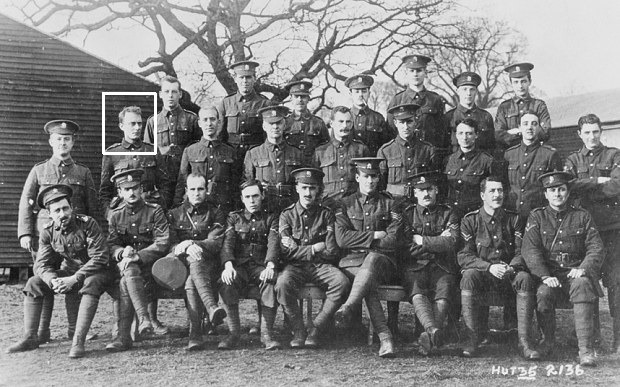
Edward Thomas' company in training with Thomas in rectangle

Thomas’ company in training camp


The second Easter: the somber name today’s poem was published under was not his. Thomas in his manuscript simply wrote down the Eastertide date in 1915 when he apparently wrote the first draft of this, two years after he’d started the trip that had indirectly formed him into a poet. That summer he was even stationed for a while on military training in one of the towns he’d passed through on the bicycle journey.

But never mind the name, what a poem. It’s four lines, a single quatrain. Nearly every word is telling, even ones you slide over in the first line. Decades later Pete Seeger wrote a song, “Where Have All the Flowers Gone,”  condensing an episode from a WWI novel expressing a similar idea to Thomas’ poem. Seeger’s song is not long as songs go, but it’s a good length for a room to sing along with. Thomas’ poem has only started when it comes to its fourth line. The previous line breaks abruptly, enjambed, with “should,” and its final line reveals itself as it unwinds in heartbreaking fashion.

And Thomas? A third Easter: another spring, 1917. His diary entry in France wonders if the enemy is unseen in the fields ahead of him, which he still must view with the precision of a nature poet. He pauses to light his pipe. A bullet pierces straight through his beating heart that, will, do, never, again.

To hear my performance of the poem eventually published as “In Memoriam (Easter 1915)”  use the player below.


Additional notes:  There’s a new paperback edition published a couple of years back of In Pursuit of Spring,  which includes for the first time the photographs Thomas took during his journey, and it’s available from booksellers. Yes, English people do take up the idea of trying to duplicate Thomas’ bicycle trip today, for example Kimberly Rew, the  guitarist alongside Robyn Hitchcock in The Soft Boys and songwriter and guitarist of Katrina and the Waves, and also the Nick Drake estate manager and vintage bike enthusiast  Cally Callomon, whose plans included riding the trip on a period-correct English roadster bike.

I recognize that Memorial Day is an American Holiday, directly derived from the post American Civil War Decoration Day. I know this blog has a large segment of U.K. readers, so to explain: in the U..S. we have two holidays celebrating the armed forces, Memorial Day, which retains some of it focus on honoring the dead who served, and Veterans Day, which is the U. S. holiday that coincides with Remembrance Day. For readers on either side of the Atlantic who’d like to hear the LYL Band present a performance of an American poet for Memorial Day, here’s Carl Sandburg’s “Grass.”


Full Moon

Our last poet, Margaret Widdemer seems to have done most of her adventuring in fantasy, but today’s poet, Elinor Wylie—well, she caused quite a scandal in the pre-WWI years. Widdemer may have dreamed of cavaliers and wearing leather in a traveling Romany wagon; but for Wylie, there’s biography!  Elinor Wylie grew up in Washington D. C. the daughter of Theodore Roosevelt’s Solicitor General and infatuated with the poetry of Percy Bysshe Shelley, which, as we’ll see, could be a bit of a leading indicator. Elinor Wylie started right off by eloping with another would-be poet, Phillip Hichborn, shortly after high school. They had a child, but the match was not good, and the brief accounts I’ve read report the husband as “unstable” and “abusive.” Next, her story gets weirder. An older millionaire lawyer Horace Wylie, also married, began to, as Wikipedia puts it, stalk her. Again, I lack details, but he apparently followed her about, taking care to show up often wherever she was. I’m not familiar with dating etiquette for married people in the pre-WWI era, but this sort of thing began to attract notice.

Bad marriage. Stalker. What to do, Elinor? She ditched her husband and fled to England with the stalker. Now we have full-fledged scandal. They hid out in jolly old for a while under assumed names. President Taft reportedly made efforts to bring her back. Eventually Horace Wiley got a divorce, Elinor’s first husband Phillip committed suicide, and WWI broke out in Europe. The run-away couple returned to the US, got married, and settled in New England where according to one biographer “Shopkeepers boycotted her, and she could buy no food. People began to turn away from her in the street. [The Wylies] were ignored in the worst way possible.”

Back in the US, the marriage to Horace Wylie soured too. She was to have one more marriage, this time to Stephen Vincent Benet’s brother William Rose Benet. They eventually separated, but Benet continued to promote her literary efforts, until in 1928 at the age of 43, the writer, still writing under the name of Elinor Wylie, died instantly of a stroke at Benet’s home while looking over pre-publication galleys of her last poetry collection with him.

Eilinor Wylie by Carl von Vechten

Elinor Wylie, clean bones crying in the flesh


All that folly of love in one short life! Did she manage to produce any poetry worth noting? From a look at her first collection, written largely while she was still married to Horace, I found her poetry more immediately attractive when read in the present day than Widdemer’s work. It’s very concise, and often considerably musical. You can see the influence of Shelley in the intense feelings and in some of the elaborate word choices. During her lifetime, the musicality of her verse (like Teasdale, like Millay) was noticed and admired, but like all three of these skilled singers on the page, High Modernism eventually discounted that element of poetry and looked for grander, more elaborately worked-out themes. And, to be frank, it also seemed to be looking for men. Mid-Century Modernism was a boys club.

Unlike Shelley, when time and death wore out the notoriety, the poet was more or less forgotten.

“Full Moon”  shows Wylie’s concise intensity well, and it shows a flair for visceral imagery too. In search of music or from love of obscure words, Wylie crafts lines that sound great even if one must keep a dictionary window open to grasp their gist. The poem as vocabulary test, a bit Wallace Stevens-like. Lines such as “My bands of silk and miniver momentarily grew heavier” and “Harlequin in lozenges” start the first two stanzas. Miniver? I think only of a Greer Garson movie. It’s a fur coat lining. Harlequin, a stock pantomime clown/fool character sure, but what’s with the lozenges, is the harlequin mute because of a sore throat? Nope, lozenges also means diamond shaped, the traditional harlequin costume has a diamond pattern.

nicoMarbleElinor Full Moon Album Cover

Harmoniums without Wallace Stevens: Nico and Elinor Wylie


What’s it all mean? It’s not hard for me to see Wylie’s biography in this, the experience of being seen as the bad woman, shunned and condemned. I made a mistake in performing this, singing “carnal mask” instead of the more perfect rhyme Wylie wrote: “carnal mesh.” I noted it right off and tried to sing the verse again, correctly, but I ended up liking the mistake and left it in. Musically, a Nico solo record from the mid-20th Century vibe came out, as I could hear Nico singing something like “harlequin in lozenges” and getting away with it a half-century after Wylie. To hear my performance of Elinor Wylie’s “New Moon”  use the player below.

When I Was a Young Girl

When I look at a more well-known poet or poem, I often find someone else less well-remembered connected with them. This sort of thing naturally intrigues me. Are we overlooking something of interest? Does this lesser-known person change our understanding of the more well-known poet?

I’ve noted earlier this month that Carl Sandburg won the Pulitzer Prize for his 1918 collection Cornhuskers—but that’s not the full story. For some reason, they decided to give out two awards for poetry that year, and another poet’s 1918 work was the co-recipient: Margaret Widdemer’s Old Road to Paradise.

Huh? Who?

I don’t aim this project to literary scholars, who likely know more than I do about the poets whose words I use, but there are indications that Widdemer’s name would stump them too, even those whose field includes the Modernist era. From a look through Widdemer’s Old Road to Paradise  this can be partly ascribed to Widdemer not writing in the Modernist style that triumphed as the century continued. Furthermore, Widdemer’s outlook, though feminist, is middle-class and lacks the bohemian allure of Millay or even Sara Teasdale (the poetry winner the previous year). As time passes, rebels and poètes maudite often retain their outsider excitement while losing their air of present danger, and Widdemer offers none of that. And while I’m hesitant to judge from a skim through one book, a further issue is that she may not be very good.

pre-war-lady-by-margaret-widdemer

Widdemer also had a successful career as a popular novelist between the wars.


Particularly for me, and for the Parlando Project, Millay and Teasdale’s words just want to sing off the page. Widdemer’s, though rhymed and following metrical schemes, generally don’t. There is a flatness to subject matter and a conventionality of imagery that fails to grab me as well. I would have loved to have picked up Old Road to Paradise  and found something as interesting as Fenton Johnson, Edward Thomas, or Anne Spencer; but not this time.

Margaret-Widdemer
Margaret Widdemer


That doesn’t mean there’s nothing there. Widdemer seems a level-headed person, and she is writing from a woman’s point of view that has fewer representations in the literary cannon of her era. What little I know of her biography says she worked to advance poetry and literary efforts. Could I find something to use? As I paged through Old Road to Paradise   I marked “When I Was a Young Girl”  as a possibility.

Why did this one stand out? It seems based on a folk song, but while it takes lines and tropes from folk songs, it presents an alternative viewpoint to the songs it borrows from. Since the post-WWII folk song revival, folk song has been even further associated with bohemianism and adventuresome living, even though the traditional texts used most often tell of sad ends.

From its title and often refrained first line, the folk song we can most easily connect with Widdemer’s poem is the female version of “The Unfortunate Rake”  a 17th Century song with dozens of popular folk song variations, including the American cowboy song “The Streets of Laredo.”  With the “When I Was a Young Girl”  title it’s been sung by Feist and Marlon Williams, and back in the 20th Century by Julie Driscoll and Nina Simone. The general plot of these variations is that a young person is dying after a short, intense life of drink and venereal disease. The too short life of pleasure is valorized even if the song’s singer often remarks that they know they are doomed to hell. No wonder this song has remained popular—both sinners and saints, and listeners on a journey from either pole to the other, can find something in the tale!

Widdemer starts as some of these folk songs do, by telling of the excitement of their youth before the song’s present moment, though in her more circumspect telling, the young girl’s adventures are in daydreams and fantasies, including (in another folk song reference), a longing to run off with the “raggle-taggle gypsies.”

I used a minor key melody for this, not unlike that used in the folk song. I won’t spoil the ending Widdemer puts on her version of this story by foretelling it here, but it’s not where that folk song and its variations take you. To hear it, use the player below.