Here is one more war poem from WWI, this one by another soldier poet, Wilfred Owen.
Beside living with the trauma of his war service, Owen was another poet caught in the revolution as English poetry moved from old modes to newer modernist verse. Like his friend Siegfried Sassoon, he was a decorated soldier who came to broadly distrust the case for war. Unlike Sassoon, Owen did not take the risky public stand against the war while it was being fought; but also unlike Sassoon, his fate was to die at the front of the war. Owen’s war poetry was largely published after his death, with Sassoon’s assistance and promotion.
Wilfred Owen: poet, soldier, witness to warfare
If WWI was billed as the war to end all wars, the anti-war poetry Owen and Sassoon wrote also spoke to universal themes. At least to what I’ve read, their poetry is not an argument against specific issues of their war, rather it’s an angry argument against war itself, and the associated patriotic justifications for sacrifice. Owen and Sassoon both wanted to rub their readers faces in the bloodied mud of the trenches.
It’s sometimes said that artists, if only they would happen to suffer the real struggles of non-artistic life, would see that art is only a trivial sideshow, inessential entertainment and decoration. Men like Owen are an example of how this is not necessarily so.
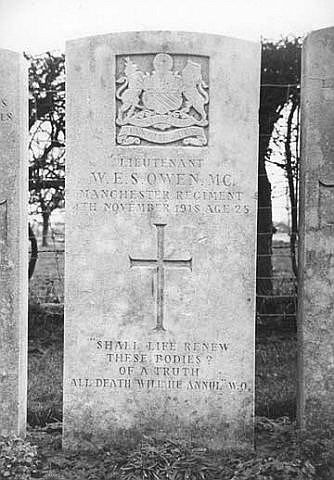
Wilfred Owen’s gravestone
Today’s episode, “Strange Meeting,” shows Owen’s anger, but because he’s a poet not yet fully in the 20th Century style, he expresses it sounding like a 19th Century poet, more like a Keats or early Yeats. As I came to grips with this piece, I felt the thought and subject matter was sometimes obscured by its march of rhymes and occasional poetic diction—and though a poem’s music is subjective, “Strange Meeting” doesn’t consistently sing to me like Yeats does, but then Yeats is a very high standard to meet, and Yeats never lived the brutal fighting the war poets like Owen went through.
Speaking of music, I’m finding myself repeating ideas (or finding a style?) with the settings lately. “Strange Meeting” starts with sustained piano chords, unsteady strings, and a plaintive wind instrument (in this case, an English horn). But I felt that carrying that all the way through would work against the grit and bitterness of the story here, just as Owen’s poetic diction does, so for much of the middle section I break it down to just drums and bass.
I hope I’m not overwhelming regular listeners with the war poetry from WWI this month. Perhaps I can find a change of pace soon, and some new variations in my musical arrangements too.
To hear my performance of Wilfred Owen’s WWI ghost story “Strange Meeting,” use the player below.
It’s now a commonplace to note how divided the United States is politically. The way the story is told, there are now two tribes, each sure the other side is largely wrong. We are said to know this, even if we are less than sure about everything “our side” may say, even if we are skeptical, even critical, of some in our faction. You may not believe that this is true about you, but this is what is widely said, and you may say something like this about others, even if you do not believe it about yourself.
I’m about to simplify a story, condensing its humanity so that you will only see moments in several people’s lives. That means you are going to need to pay attention, because the things it may lead you think about are only going to be there for moment.
On a summer day, 177 years ago, a sheriff bearing a writ from a judge knocked on the door of a house on the banks of Lake Harriet, which was then on the outskirts of Minneapolis Minnesota. If you live in Minneapolis, perhaps you know this lake. It just so happens that I’ve spent many mornings this summer reading poetry beside it, as panting joggers and conversing walkers surround it like clockwork.
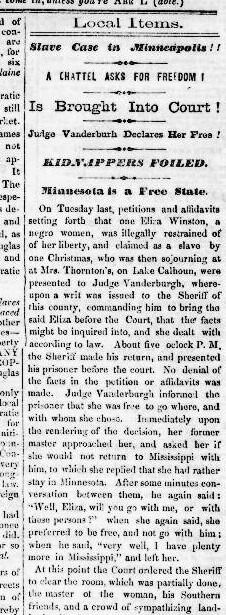
The judge’s writ commanded the appearance in court of a piece of evidence. As he knocked, that piece of evidence was being told by the people inside to run out the back door and hide. The evidence did not obey. The evidence’s name was Eliza Winston, a 30-year-old woman held as property by the family inside. By her home state of Mississippi’s laws, her mother would have been property too, and her children, if she would have any, would be property as well, the same as livestock on a farm.
How did she happen to be in Minnesota? The man that owned her had traveled up the Mississippi river with his family to escape the heat of the South’s summer, taking a steamboat as far north as the great river was navigable. For his and his family’s comfort, he had taken one of his slaves, Eliza Winston, with him. The laws of the state he traveled to explicitly forbade slavery, but three years earlier the national Supreme Court had ruled that a slave named Dred Scott remained property when he had been brought to Minnesota.
Living in Minnesota then were people allied with a faction that sought to end the practice of slavery. They were looking for people claimed as property to contest those claims. How did they view the slave owners? Of course, as evil you may think. Wouldn’t anybody? Somehow, Eliza Winston had made contact with these slavery opponents. One of them, William Babbitt, would swear out a complaint that her slavery on Minnesota soil violated Minnesota law.
Imagine if you could own something as useful as another human being as property, to have complete control over them. Wouldn’t that be useful; and as a business venture, potentially profitable? The faction that owned other people certainly felt that way. How did they view that other faction, the ones who sought to end that practice? They viewed them as wrong certainly, but they also saw them as annoying self-righteous busybodies that needed to be taught a lesson, a view that was sometimes shared even by those that weren’t sure that slavery was a good and necessary thing.
Since Eliza did not hide, she was taken to directly to a courtroom. Despite the rapidity of the actions, the courtroom was packed with those from both factions. Eliza’s owner was there with his lawyer, who pointed out Dred Scott. The lawyer for Babbitt had testimony from Eliza Winston that she was indeed a slave, that she’d been passed around like property between several owners, and the lawyer stipulated that Minnesota’s constitution clearly forbade slavery in the state.
The judge ruled, that based on Minnesota law, Eliza Winston was now free. As soon as he pronounced, a clergyman in the crowd jumped up and condemned the decision as “unrighteous,” pointing out that, regardless of the state or federal law, Christianity and its scriptures approved of slavery. I don’t know more of what he said, but he could have claimed that Babbitt and his faction were worse than thieves and rustlers, in that they not only stole, they were self-satisfied in their actions. The crowd stirred at this, and then there was moment of calm in the summer courtroom. Eliza Winston’s owner walked over to the woman that he had owned like a horse or a cow, and he calmly asked her if she wanted to come back with him and return to Mississippi. And Eliza, no longer property, answered that she wished to be free and remain in Minnesota. As Eliza Winston left the courtroom, the Minnesota clergyman was still orating on the wrong that had been done to the slave-owner.
“A chattel asks for freedom”
That night, those angry at the decision went out around the town looking for Eliza Winston. What would they have done if they had found her? One can only guess. They surrounded Babbitt’s house and battered down the door seeking Winston or Babbitt, and crying for blood. They similarly broke into another house seeking Winston. Winston, however had been moved somewhere else, and may have fled as far as Canada. A year later the Civil War broke out, and Winston, no longer property, became as if a ghost. There are no pictures of her, no tales of great or even small things that she may have done. Some even say she went back to the south after the war. In Minneapolis there is an inconspicuous historical marker about her case, placed along the Mississippi river that brought her here, and not much else.
An inconspicuous historical plaque about Winston in Minneapolis
William Green has the most complete telling of the story I’ve seen. For a PDF click here.
Then last year Dave Moore was told a version of Eliza Winston’s story by a friend. The friend, or perhaps Dave, got a couple of the details wrong, and I have left a lot of details out of the story as well—that may not matter. Dave was struck, mixing Eliza’s story and the tale of his friend choosing to tell him this story together, and then forming this lovely, vulnerable song.
Here’s what I ask you, now that you’ve heard my telling of Eliza Winston’s story. If you ever find yourself in a world of factions, and you find yourself in one of those factions, perhaps not sure of what you think, but sure that the other side is clearly more wrong. Ask yourself what Eliza’s story, and the story of slavery tells you.
To hear Dave sing his Eliza Winston song with the LYL Band, use the player below:
Anyone remember those sentry questions that would be used in to determine if some straggler in the soldier’s darkness was an American or foreign foe? “Who plays first base for the New York Yankees?” they’d ask.
Native Iowans have a similar method to catch those from out of state. They might start right off with asking about the state capital. “Dezz Moynens.” Wrong! Not an Iowan. “Day Moyne.” Native. Poweshiek, that fine county with a Brooklyn no one knows. “Poe’s He Eck.” Nope. “Powa Sheek.” How about that nice small town founded by lost Swedes in Boone County, Madrid. “Ma Drid?” Outsider, it’s “Mad Rid!”
While overseas in France in the early 1920’s Stephen Vincent Benet wrote his own catalog of place names that I have adapted for today’s piece “I Have Fallen in Love with American Names.” In it, Benet contrasts American place names with European ones, perhaps to staunch a little homesickness on his part, but also as part of his claim to something he and Carl Sandburg helped to define in the first half of the 20th Century, something that’s now used to label a musical genre: “Americana.”
To briefly define Americana, it’s the featuring of things that are distinctive to our country, most often things that are in the past tense, things that we are asked to pay attention to as our heritage. If these things seem a little odd, old-fashioned or provincial to us, that’s the tang the artist wants us to taste.
I came upon Benet’s poem after reading a Phillip Roth memoir in the New Yorker last month, where Roth takes off from Benet’s poem to discuss how a literary sense of a greater America he did not yet know expanded his horizons westward from his childhood neighborhood in Newark New Jersey. Roth remembered how, in the 1940s, even though one of the most cosmopolitan cities in the world was a river and a marsh away from his town, New York City was a world away, perhaps as far away as America seemed to Benet in Paris.
Roth doesn’t mention it, but as I read Roth’s piece, I thought of Benet’s story “By the Rivers of Babylon,” were a future neo-indigenous youth ventures across that same river into the ruins of New York on a vision quest.
This was “By the Waters of Babylon’s” original title
In the nearly 100 years since it was written, Benet’s “I Have Fallen in Love with American Names” has not fallen to ruins, but it has gained some tarnish or patina. I’ve cut a stanza because the notables referenced are now obscure, and I modified another line in it, not out gentility, but because it frankly stuck in my craw. By chance, one of the obscure and colorfully named towns in Benet’s catalog, French Lick, now is slightly better known as the hometown of basketball great Larry Bird—but that’s the not the greatest resonance the poem has picked up over the years.
As the poem builds to its ending, Benet uses something like the thought used by Rupert Brooke in his famous war poem “The Soldier”, the idea where even if Brooke was to die and his body was buried overseas, that his Englishness would remain. Benet sets up a series of places he might be interred in England or Europe, and ends with a line that later became the title of a landmark book about the cruel and unjust treatment of indigenous Americans. Did Benet choose to end his poem with the evocative place name of Wounded Knee because of the massacre that occurred there a bit more than 30 years before he wrote his poem, or because of legends that Crazy Horse was secretly buried there, or was it only something that caught his eye on the page of an atlas? I don’t know enough about Benet to say. His litany of American places does include “a Salem tree” which sounds to me like a reference to the Massachusetts witch trials and executions. If we are to remind ourselves of the greatness in our heritage, we are likewise obligated to remind ourselves of the sins there too.
Fall in love with a Salem tree? I have a tenuous connection to the story made into this film.
In my performance, I made the choice that, author’s intention or not, modern audiences will hear it as intentional, so I should perform it that way. The American name of my home state, Iowa, comes somehow from it’s indigenous people, but over 400 years passing, we no longer know what it’s meaning is. How strange to say that I come from a place of no meaning, knowing the pass-word to tell the magic ghosts of native sentries, but knowing not what I’m saying.
To hear “I Have Fallen in Love with American Names” use the player below.
I don’t plan on making a habit of this, but the next morning after I posted the audio piece where I perform an “Imagist” revision of Rupert Brooke’s late fragment written shortly before his death while serving in WWI, I wanted to change a few things about the mix.
Soldiers on a World War I troop ship in transit
What’d I change? I delayed the entry of my piano part to a few bars later. I remixed the concluding electric guitar part entirely, it’s now a bit more forward in the mix. And finally I added an E-Bow electric guitar top line over the final section. Why did I make those changes? Just trying to give the piece a bit more sense of “build” as the troop ship steamed along carrying Brooke and his fellow soldiers to the disaster that would be the Gallipoli campaign. The newly added E-Bow part is probably the biggest change. The E-Bow is a clever gadget that magnetically drives a single instrument string as if it was excited by a bow. As the name suggests, it’s sometimes used to give the effect of violin or viola sound coming from a guitar—which Jimmy Page and Eddie Phillips aside, is not designed to be bowed, however I think the part I played sounds less like a orchestral violin and more like an overblown free-reed instrument.
In composing the music for the Parlando Project pieces, I like using different sounds like a writer might use different images or connotative words in text. If you listen, low in the background of the mix I have a Mellotron flute part. Of course this late 20th Century instrument would not have been known to Brooke and his fellow troops, but for those late 20th Century people a low Mellotron flute part brings to mind (ear?) The Beatles “Strawberry Field Forever” or “Lucy in the Sky with Diamonds” or other English rock band recordings of the 1960s, so I was trying to bring in some sense, however anachronistically, of the soldiers thinking of home, and then at end I add that much louder, strident and free-reed sound from the E-bow guitar part. Similarly my fizzy guitar phosphorescent plankton bow-wave and electric bass thrumming ships engines. Hope it all works for you.
The new mix replaces the old one as of early this morning. To make it easy to hear the new mix, I’ve embedded the player to hear “On the Troop Ship to Gallipoli” below. The explanation of how I revised Brooke’s words, as if he’d been edited by Ezra Pound or had lived long enough to embrace the ideas of modernist poetry, is covered in the previous post here.
In the past few posts I’ve mentioned how Ezra Pound was more than an exemplary writer, theorist, and promoter for the early 20th Century modernist poetic movement that he called Imagism. He was also an excellent editor.
His most famous blue pencil job remains T. S. Eliot’s “The Wasteland,” but he also worked with H.D. and Ernest Hemingway, teaching with his editing how to pare away extra words, overused similes, and extraneous authorial sentiment. And once shown, those writers we able to use Pound’s insights to do the create their own pared down, modern styles.
In the last episode, I noted that Pound had been critical of some WWI poems written by Rupert Brooke. Here for example is the first part of Brooke’s most famous war poem “The Soldier:”
If I should die, think only this of me:
That there’s some corner of a foreign field
That is forever England. There shall be
In that rich earth a richer dust concealed;
A dust whom England bore, shaped, made aware,
Gave, once, her flowers to love, her ways to roam,
A body of England’s, breathing English air,
Washed by the rivers, blest by suns of home.
Written as England entered into WWI, and as Brooke himself rushed to enlist, this poem was embraced by a patriotic public almost immediately. If one shares it’s sentiments, the actual technique of the poetry probably admits no impediments to a reader, even today—but ask yourself, does it have a sense of actual immediacy? As you read, do you share with a fellow human, feeling, seeing, smelling, this experience? What I get as I read it is a thought, where a soldier thinks that if he dies in battle and his body rots overseas, that his body will homeopathically retain its English birth and experience, and that experience, it is inferred, is worth dying for. Why? Well because the poet says so, and he says it with rather polite poetical words. “Die” and “dust” are perfectly good, simple words, but as a description of death and decomposition, they are surrounded by forevers, flowers, air, rivers, and sun—all presumably sweet and genteel.
Rupert Brooke died at age 27 of an illness he contracted while on his way to the Gallipoli campaign in his war, but what if he, like Yeats, had continued to live and react to the developments of his young century? And what if Ezra Pound had gotten a hold of him and showed him how to punch up his verse?
Today’s piece shows what could have happened. One of the last things Brooke wrote was this fragment written on the troop ship in the month he died. Here’s the original:
I strayed about the deck, an hour, to-night
Under a cloudy moonless sky; and peeped
In at the windows, watched my friends at table,
Or playing cards, or standing in the doorway,
Or coming out into the darkness. Still
No one could see me.
I would have thought of them
–Heedless, within a week of battle–in pity,
Pride in their strength and in the weight and firmness
And link’d beauty of bodies, and pity that
This gay machine of splendour ‘ld soon be broken,
Thought little of, pashed, scattered. . . .
Only, always,
I could but see them—against the lamplight–pass
Like coloured shadows, thinner than filmy glass,
Slight bubbles, fainter than the wave’s faint light,
That broke to phosphorous out in the night,
Perishing things and strange ghosts–soon to die
To other ghosts–this one, or that, or I.
What can I, acting as Pound might have, do with this? Well first I can locate the charged images in it, hidden as they are inside Brooke’s extraneous comment. What are they? The soldier pacing at night on his troop ship. He’s staring back inside the ship, looking at his fellow recruits on the way to their first battle. If we have any empathy as readers, we don’t need to be told anything about what he’s feeling if it can be conveyed by what he’s seeing. What are our charged images? The troops are playing cards, games of soldier’s chances. They can’t see the poet, and he can see them only imperfectly, backlit by uneven lighting, “coloured shadows,” which is a great image obscured by all the muck about it. And he sees the faint light of a wave’s phosphorescence as bioluminescent plankton are sweep aside by the wake of the ship. The soldiers, and the poet himself, are already in the course of war, like ghosts, fleetingly seen, or only partially and incorporeally seen.
Have you tried the exercise where you make a poem by taking a marker and blacking out most of page of text, revealing a poem could be in what remains? That’s like what I did with Brooke’s fragment:
On the Troop Ship to Gallipoli
I strayed about the deck, an hour,
Under a cloudy moonless sky.
Peeped in at the windows,
Watched my friends
At table, playing cards,
Standing in the doorway,
Out into the darkness.
No one could see me.
I could but see them
Against the lamplight,
Coloured shadows,
Thinner than glass.
A wave’s faint light,
Broken to phosphorous.
Perishing things and strange ghosts
Steaming to other ghosts,
Only, always.
I removed over a hundred words that didn’t need to be there, which covered up what did need to be there. I don’t need to say that these things relate to each other, putting them in a short poem together makes that clear. I added only one word, choosing to add “steaming” instead of just “to other ghosts” because it’s an action word, and because “steam,” though active and industrious, is another thing that dissipates and disappears.
I have two unfair advantages over Rupert Brooke as I transformed his words. First, he died in service to his country shortly after writing this, so he didn’t have the chance to revise his fragment. Secondly, the place he was going, Gallipoli, and the outcome for so many British and Commonwealth soldiers who were deployed there is now infamous for poor tactics and horrendous casualties. I can simply use “Gallipoli” in the title and magnify the dread of soldiers on their way to battle.
Today’s episode is dedicated to Julie Shapiro, who introduced me to Eric Bogle’s “The Band Played Waltzing Matilda.” This is a song about Australian troops at Gallipoli, and though I can link to one of my favorite singers, June Tabor’s, version of it, there is nothing but my memory to testify to the devastating version Julie used to perform.
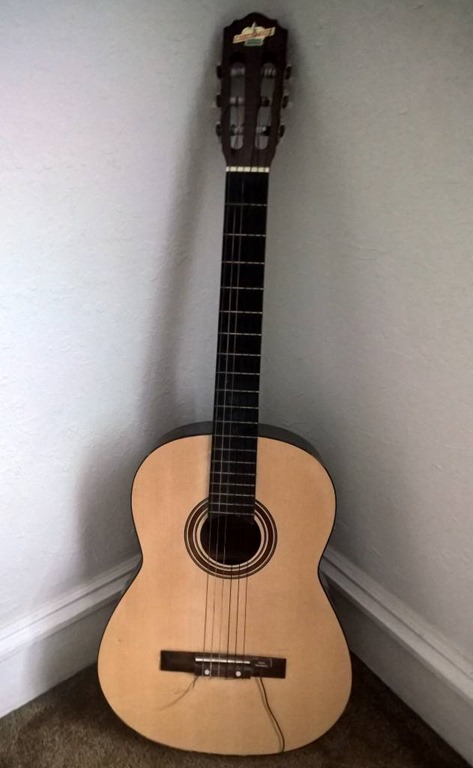
My first guitar, purchased for $40 in 1974, and played on today’s audio piece
Long post again, no time to talk much about the music for this performance. Perhaps I don’t need to tell, you just need to hear it. Use the player below then for my performance of a revised fragment by Rupert Brooke.
Here’s one more piece from Ezra Pound’s 1915 breakthrough collection “Cathay,” a war story he called “South Folk in Cold Country.”
At the time Pound was working from Ernest Fenollosa’s, and Fenollosa’s Japanese teachers,’ notes to translate classic Chinese poetry, World War I had broken out, and England, where Pound was living, had mobilized to fight this war. Like William Butler Yeats (with whom Pound was staying for part of this time) Pound did not want to take a side in the war. Not only skeptical of the war’s patriotic rationales, Pound also wanted to continue to focus on his modernist artistic revolution.
Earlier in the Parlando Project, we’ve seen how Yeats responded at the beginning of the war. His “On Being Asked For a War Poem”cloaked his disdain for statesmen’s’ rhetoric while seeming to take a aesthete’s stance of artistic superiority and inferiority.
Robert Frost needed to get to W. B. Yeats house,
so a helpful Ezra Pound drew him this map.
Pound felt similarly. He may not have been sure, at first, of the what he would eventually call lies by the politicians by the end of the war, but his poetic BS meter was immediately sure that the patriotic verse being produced to ennoble the war was false ethically and artistically. But Pound also recognized that any poetry he would write in such a charged environment would be inescapably seen in the context of the war.
Still, he was wary of writing about war as a civilian who had never fought in battle. At one point, he reported he had tried to enlist, but was turned down due to his (then neutral) American citizenship. At another point, he wrote a review critical of Rupert Brooke’s war poetry, only to have Brooke, who was serving in the British armed forces, die while in service, leading Pound to qualify that he was only criticizing the poetry, not the citizenship.
So as Pound created and promoted Imagism, his vision of new modernist poetry by recreating classical Chinese poetry in English, he came upon a solution. He would use the Chinese poets, both as the model for his new kind of verse and as a way to comment on the war.
Today’s audio piece is an example of how Pound went about those two things, once again translating and transforming the work of 9th Century Chinese poet Li Bai.
“South Folk in Cold Country” is an account by Li Bai of a military campaign in the north of China that had occurred almost a thousand years before he wrote. Pound, taking this for his modernism, has the soldiers who speak of their war experience say nothing of what they are feeling. There is not a word of them saying they are tired, confused, frustrated, or suffering, but their world is described by them as the image of all these things. While Li Bai/Pound’s “River Merchant’s Wife” reads musically off the page, despite being “free verse” in English, “South Folk in a Cold Country” has a more abrupt and doubtful music. Pound was trusting Li Bai and his own artistic sensibilities so that he might get some of the war experience right.
When I first read “South Folk in Cold Country” this year I thought: this sounds like a bag of fortune cookies mixed in with Ernest Hemingway. Either or both of those comparisons may sound dismissive to you, but I suspect the best fortune cookie aphorisms have some relationship, however strained, to the concision of classic Chinese poetry, and Hemingway, however familiar he may seem to us now, was using Pound’s ideas as part of what was to be Hemingway’s revolution in prose. Thanks to Hemingway, and in turn, to Pound who directly influenced and taught him, we now are not surprised by representations of war, violence, and death that assume concise description and charged observation can be truer than superfluous remarks by the author.
Hemingway, who did serve in WWI, sought out Ezra Pound to shape his writing about it
I did wonder about the General Rishogu mentioned at the end the piece. His Chinese name (remember, Pound was working from notes of Japanese scholars, not Chinese ones) was Li Guang, and his story is here. I like this as an ending. I’m not sure if Li Bai’s soldiers who speak in this piece are using Rishogu/Guang as an example of the hard fate of soldiers; or if they are saying, after what we’ve been through, making all those rapid marches to make Rishogu/Guang’s name, who among them will care about the general’s death. On the odds, I’ll take the later.
Musically I used some relentless vibes over electric piano and bass to stand for the rapid marches that the “swift moving” general kept ordering, and then some neighing winds from a synthesizer patch. To hear me perform “South Folk in Cold Country” with that music, use the player gadget below.
Just after the start of the 20th Century two teenagers met at the University of Pennsylvania. One was 16 years old, a smart and cocky boy without much in the way of money, who had somehow managed admission to the University at such a young age. The other was 15 and the only daughter of an astronomer and professor at the college. So devoted was the girl’s father to his astronomy, that it’s told that his wife needed to come by during the colder months with a kettle of hot water to unfreeze his eyelashes from the eyepiece of his telescope. This professor was the enlightened sort of early 20th century father who believed in women’s intellectual equality. He dreamed that his daughter would become another Marie Curie.
However, the two teenagers soon fell in with each other, and science was not in their bond. Poetry and the arts were. A year or so later, a new freshman arrived at the University to study medicine. That freshman was William Carlos Williams, and he would complete his studies and become a pediatrician and family doctor who practiced for decades in Patterson New Jersey while writing purely modern poetry. The boy and the girl fell in love, and were secretly engaged, knowing that the boy’s lack of money and established career would prevent the girl’s father from giving permission of them to marry.
The 1985 movie “Real Genius” is a documentary of this meeting between two teenagers in college.
The girl grew up and was sent to Bryn Mawr, a woman’s college that was known for having a tough “men’s curriculum,” following her father’s hope that she would become a scientist. There she met Marianne Moore, who also became a noted modernist American poet, but at Bryn Mawr she failed in her studies. The American oracle Barbie would later proclaim: “Math is hard!” and a career in science was out.
But wait. What of that cocky boy? Oh no, he’s gone to England! And double oh no, he now engaged to another woman there. After all this, we can now begin our story again.
This now young woman who had already met and befriended William Carlos Williams and Marianne Moore, went to England to meet back up with the young man she had fallen in love with as a teenager. The young man was Ezra Pound, and the young woman was Hilda Doolittle—but she wouldn’t be much longer.
Sorry, “Real Genius” its really about how Tears for Fears was uncool, but now is kinda cool.
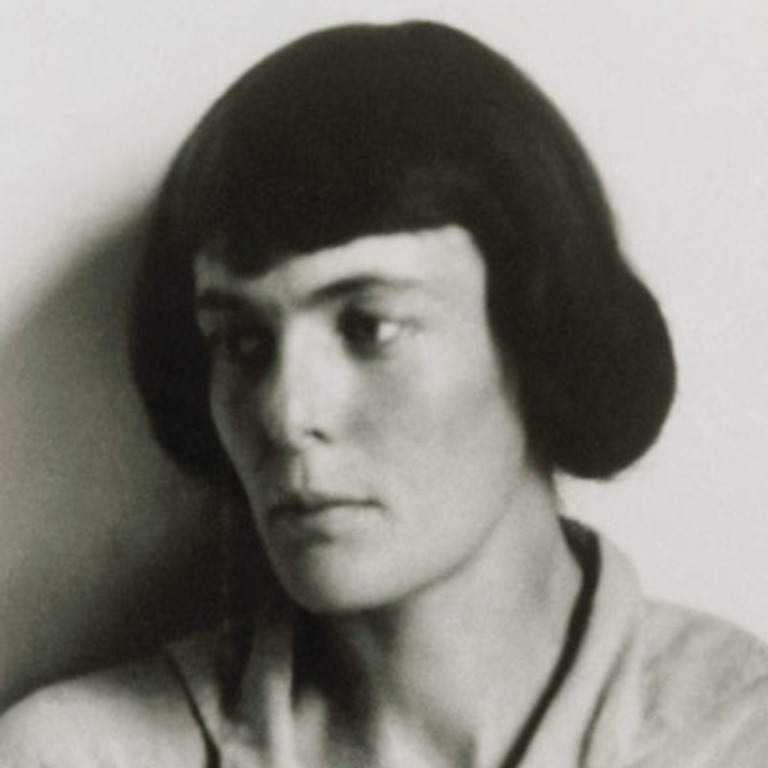
And here are the real and young Ezra and Hilda.
Pound was in England trying to stir up a poetic revolution, something that would forge past the reformation of William Morris and the Pre-Raphaelites and give poetry a fully modern cast. Hilda showed Ezra some of her new poems, and Ezra did three things that he would do repeatedly for other poets in the next couple of decades.
He immediately recognized that Hilda was writing the kind of fresh, spare, honest poetry that he thought necessary to break the grip of the past. He would see to it being published.
After admiring it, it took his pencil to it, and slashed out parts of the already concise poems. I can hear some of you drawing a breath on that, considering the sexual politics, ready to cry “Asshat!”—but that’s Pound, even with poets of genius: cut it, pare it down, make it new, not one extra word. A few years later he’d do the same thing to T.S. Eliot, and the surviving variorum manuscripts show why Eliot called Pound “The Better Maker” of “The Wasteland.” Pound’s editing pencil seemed to teach like the sensei’s stick, and once shown, poets like Hilda Doolittle and Eliot understood how to do the same thing themselves.
And then he took that editing pencil and signed Hilda’s poems “H.D. Imagisite.”
That last move was another part of Pound’s talents. He was probably more successful in launching other poet’s careers than he was his own. He had a shrewd promoter’s eye. “Imagiste” or “Imagist” was the name Pound would give to the modernist poetic movement that would during the years of WWI as radically reshape English poetry as the war would reshape the maps of the world, and here he was saying, rightly, that H.D.’s poems would be the ne plus ultra of that movement. As a name, H.D. was as pared down as the new poetry would be. If he’d lived long enough to see video screens with 1024 lines, he could have said calling them HD for “High Definition” was a tribute to his call for seeing things truly. And H.D. masked Hilda’s gender, still important in a world where women were widely thought to be incapable of great art. The former Hilda Doolittle didn’t object. She’d never liked the family name (“Do-Little” she thought it scanned) and besides, her sexual identity and friendship affinities were at least HD.
Let me admit that this post is unfair to H.D., the writer of the words of today’s piece. We’ve gone past my customary length limits and we’ve only barely touched on H.D.’s talents and extraordinary life. I’ll need to revisit her work soon and give H.D. her due.
What can I say about today’s piece “Heat?” Well it’s an appropriate July poem, and the titular heat, in true Imagist fashion is both a closely observed thing: actual summer heat, and an image that, without simile or extra framing, is imbued with complexity. Last episode we had Pound/Li Bai, two men, showing desire and longing in the “River Merchant’s Wife” with only a few actual named emotions or feelings. H.D., the better Imagist, shows female desire with not a single named emotion. The poem’s final phrase:
that presses up and blunts
the points of pears
and rounds the grapes.
is sensuous beyond words—it’s only 13 words to be beyond after all—and with four p and s sounds it holds four kisses.
To hear my performance of H.D.’s “Heat,” use the player below. And thanks again for the likes and the social media shares!
“The River Merchant’s Wife: A Letter” has a very complicated history. I can’t even say “Ezra Pound’s ‘The River Merchant’s Wife”— though he’s often listed as the author.
Let’s begin, as a river or a journey might, at the beginning. Back in the 9th Century in China there were two great poets. One of them we’ve already met there: Du Fu. He was known for his wisdom and level-headedness. The other was Li Bai (his name is also written in western letters as Li Po and Li Bo, and in Japan as Rihaku) who was known for his more excessive existence. In China both have been continually revered, but in early 20th Century Europe or America, they were nearly unknown. Only scholars interested in off-beat subjects knew of these men’s work.
One such scholar was an American, Ernest Fenollosa, who had traveled to Japan and become deeply immersed in Japanese culture, and as a sidelight to that, he also was exposed to Chinese culture. Early in the 20th Century, Fenollosa was one of a group of Americans living in England. We’ve met others here who were part of this “reverse British Invasion” of Americans: Ezra Pound, Robert Frost, T.S. Eliot—and you’ll soon get to meet another, H.D. Fenollosa then died in 1908, still in London.
Here’s were something fateful happened. Fenollosa’s widow, for some reason, gave Ezra Pound a bunch of her late husband’s papers. Pound was a young man who was trying his damnedest to start some kind of artistic movement in London. In the papers were scholarly prose translations of Li Bai’s poems done by Fenollosa and two of his Japanese associates, Mori and Ariga.
Ernest Fenollosa, deeply attracted to fur; and Li Bai, more into silk
Pound fell upon these scholar’s notes. He’d already sought out other old poetry for inspiration for his revolution (much as the Pre-Raphaelites had looked backwards for something fresh), but in this old Chinese poetry he found what he was looking for. It was concise. It was free of centuries of cruft that English poetry had accumulated. And Pound naïvely felt that the poems themselves grew out of the ideograms for their words, Chinese characters which had evolved from drawings of objects. He had found his poetic revolution. Poems should be constructed of little more than images. Not images in the sense of elaborate similes or strained allegories, images in the sense of a presentation of the direct observation of the poet, unadorned. Pound published what he created out of those scholars’ notes as a ground-breaking poetry collection “Cathay,” and he quickly began to compose his own modernist poems using his epiphany.
If Fenollosa hadn’t died in London, and if his widow hadn’t given this tranche of papers to an artistic provocateur such as Pound, it’s possible that Li Bai would be no better known in English today than he was in 1908, and it’s even more likely that poetry in English from that point on would have evolved differently.
If Fenollosa hadn’t died in London, and if his widow hadn’t given this tranche of papers to an artistic provocateur such as Pound, it’s possible that Li Bai would be no better known in English today than he was in 1908, and it’s even more likely that poetry in English from that point on would have evolved differently.
Seems like a miracle when such things line up, doesn’t it? Well, here’s something as miraculous: though “The River Merchant’s Wife’s” source was written over 1200 years ago in a culture so far removed from America that the childhood legend was that one would need to dig a hole through the center of the Earth to get there, even though it comes to us filtered through non-Chinese scholars, and even though the particular words I’ll use today to express it were written by an avant-garde poet whose work remains little-read and understood today, many people have an immediate deep emotional response to this poem the first time they hear it.
Isn’t that odd? All that strangeness in customs, place-names, time, provenance—and yet more: it’s a poem of female desire written in the voice of young woman by a man, and translated and transformed by men. And yet, woman and men, young and old, hear it, and they feel the pangs of desire and separation just as much as any 8th Century resident of China—even though the poem, following the tenants of what Pound would call “Imagism,” barely mentions the speaker’s emotions (“bashful,” “desired,” and the only present-tense one, “hurt.”)
I know I felt those things when I first heard it, aged perhaps 21 on a sad journey with a young woman. I hear it now as an old man too, and think once again of my friend John, and of China. The place, Cho-fu-Sa, that the river merchant’s wife says she will go out to meet her husband is, I’m told, hundreds of miles from her village in the poem. What is such distance to the heart?
To hear my performance of “The River Merchant’s Wife: A Letter” use the player gadget at the bottom here. Since this post is already long, I’m not going to talk much about the music today. The higher-pitched string instrument you’ll hear is my approximation of the pipa, a traditional Chinese lute. There are many moving recitations of this poem available online, but to see an entirely light-hearted modern translation of “The River Merchant’s Wife” after listening to mine, view this one.
The subtitle of the Parlando Project is “The Place Where Music and Words Meet”. As I mentioned last night, this project, which combines words sourced from a variety of sources with a variety of music, has now reached 100 available audio pieces since it’s official launch 11 months ago. Note that stress on variety. In terms of writers, I have my favorites, and the short format of our audio pieces strongly favors poetry, but the Parlando Project has featured words taken from other sources as well, and some of the poets featured were unknown to me until I ran across them looking for material, and I’m trying to vary the music as much as I can. Sometimes our pieces are as simple as acoustic guitar and voice, as in our most recent post The Oven Bird. Some pieces have full arrangements with multiple instruments, and some feature spontaneous performances by the LYL Band, a folk-rock band that’s been playing a rough and ready mix of electric instruments and literate lyrics since the early days of Minneapolis punk rock.
We’ve gotten thousands of downloads and streams so far, and though I don’t have the time to thank everyone personally for the likes and the shares, it’s been your passing on the existence of our audio pieces that has grown our audience from a few hundred downloads to thousands. I don’t have time for a social media presence myself. Researching, writing the majority of the music, as well as arranging, producing and recording these 100 pieces has taken an untold number of fascinating hours, but it leaves me little time to promote this work myself. So I’m very grateful for you, the readers/listeners who have done so.
Since we last did did a Top 10 in the spring, that growth in listenership has meant that there is only one returning piece since that list a few months ago. Which piece has the staying power? Lets start off the countdown in the traditional order, with #10.
10. Adlestrop – a late surge brought this piece with words by fateful British poet Edward Thomas into the top 10, just beating out Zalka Peetruza and Spring Grass as the final slot shifted back and forth this week. Adlestop’s download rate is noteworthy too in that its the newest post to make this list. Listening to this hazy slide guitar piece I still recall my own muggy summer unscheduled lay-over in Kingham a year ago, but that’s a private moment, though I feel somehow I’ve shared it with Thomas thanks to his words. In a more public way, this poem gains resonance from it’s connection to Robert Frost’s The Road Not Taken and to the Centenary of WWI.
9. Grass – speaking of WWI, here’s the first of two placings of a Carl Sandburg piece on this Summer’s Top 10. My private memory is performing this with the LYL Band, spontaneously as usual, with no rehearsal or warning as I read Sandburg’s words, and having us stop on a dime for line that starts “What place is this…” as Grass approaches Sandburg’s ending. For other listeners, particularly those with friends, families, and even ancestors lost to war, Sandburg’s piece asks a powerful question of forgetfulness.
8. Intro to The Waste Land – One could say this continues our WWI Centenary theme, as T.S. Eliot deals with his personal depression in the context of the aftermath of The Great War in this poem, but it was instead intended as part of our April “National Poetry Month” celebration, which I will always link to the poem’s famous opening line “April is the cruelest month.” This is one of my composed pieces musically, were I get to write and perform all the parts myself, which means I get to fully realize my personal “vision” of the music (something the listener needs to care not a bit about) and to therefore be responsible for all my own mistakes. My personal memories of The Waste Land are two-fold, one a memory of reading it for the first time in college, and though mystified, feeling an intense musical thrust in what Eliot wrote, and then to a time more than a decade ago when I felt just past my lowest ebb emotionally and then performed the last sections of The Waste Land spontaneously with the LYL Band, and found it as musical as I expected it would be, but also was surprised at how it expiational performing it was. Publically, the downloads of this have been steady, and have continued long past #NPM in April, so it’s either due to your sharing of it, or the poem’s continued fame.
7. To A Friend Whose Work Has Come To Nothing – Irish poet William Butler Yeats is another writer whose work we’ve mined for more than one piece here. One thing I learned while looking at material for this blog was that Yeats too believed that poetry performed with music was a necessary combination. Another investigation, brought on specifically by this piece, was to find out just who the friend was whose work had been thwarted, and what that work was. This has been another piece with a steady listening rate since posted. My guess is that the experience Yeats was telling us about is common to many, and whenever it is encountered it is not easily forgotten. Weeks after this was posted, I watched the former FBI director James Comey testify before Congress, and thought if Yeats was his friend, he would have said the same things in verse to him.
6. Clark Street Bridge – Carl Sandburg gets his second appearance on this Top 10 with this wistful story of day and night on this busy downtown Chicago river bridge. As a personal experience I got to see the Clark Street Bridge this spring on a visit to Chicago, and though the current bridge is almost 100 years old, it’s not the one Sandburg watched and wrote of. Another thing I learned during my trip: his night scene with silver singing stars equal in number to all the broken hearts in Chicago contained a larger number than I would have estimated from modern urban nights, as the poem was written before the widespread adoption of all-night electric lights. What are, or could, the listeners be attracted to? Well, broken hearts remain as numerous as the stars in a dark sky for sure, and Chicago has taken Sandburg to it’s heart; despite, or because, he says that that heart is broken.
5. The Death of Col. Bruce Hampton – I’ve written a number of direct tributes to musicians that I’ve featured here, but this is the most popular. Particularly now as the main lot of musicians fall back into the lower levels of the “gig economy” they gave their name to without additional payment, I see them as retaining the heroism of artists in general, who do what they do to general indifference, but now with a much lower chance of professional earnings. This is the only piece in this Top 10 where I wrote the words and the music, but that’s about the right amount, as the Parlando Project is about appreciating “Other People’s Stories” after all. The defensive shells and double-ended poison stingers that artists grow don’t always lead to happy lives, but those who knew Bruce Hampton have grateful things to say about him as a person and collaborator. And by chance, he got to come to the end his life with some of those folks thanking him, while he encouraged the creation of even more spontaneous art. I assume that’s the reason for so many people listening to this piece.
4. These Fought – Here’s one I’m a little surprised about. Ezra Pound may have done more than any other person to create modern poetry, but he’s less read today than many he influenced and championed. And though other modernists dabbled in between-the-wars nationalism and racial theories, Pound became America’s most notorious fascist apologist. And this piece, posted around Memorial Day is an uncompromising denial of the honor in the sacrifices of WWI. If you like your poetry feel-good and inspirational, if you like your poets cuddly and full of civic pride, this piece is not your choice. The LYL Band tries to equal Pound’s fierceness in this performance.
3. Love and Money – Unlike many other poetry and spoken word blogs, we feature other people’s words almost all the time in the Parlando Project. Of course, there’s nothing wrong with self-expression, but in following the Project’s dictum “Other People’s Stories,” we don’t do that often. Perhaps in consolidating that stated aim with the catalog of thought-provoking words that Dave has written over the years, many of the Dave Moore pieces I’ve posted so far have been performances where I perform Dave’s words–a mixed blessing that–because, to steal an old Columbia Records ad from the 1960s “No one sings Dave Moore like Dave Moore.” I was sold on this one the moment I heard Dave sing the first line of this piece as we spontaneously performed it, and there’s no way I could do it justice. The popularity of “Love and Money” probably has the same private and public reasons, it’s just a good song. Oh, and Dave’s pounding electric clavichord performance might have something to do with it too.
2. Up-Hill – Here’s an example of a poet I knew close to nothing about before looking for material in the public domain to adopt for Parlando performance. Having a long time love of the Pre-Raphaelite painters and knowing that poetry and poets were part of their artistic circle, I went looking for Pre-Raphaelite poems that I could relate to musically. I kept striking out. I really wanted to find something by Algernon Charles Swinburne, because, well, “Algernon Charles Swinburne”. Is there any name that says more clearly that you don’t give a damn about sounding cleanly modern and approachable? Only Ezra Pound’s invented persona “Hugh Selwyn Mauberley” comes close. Alas, I could find nothing I felt I could inhabit–and then I came upon some of Christina Rossetti’s shorter poems. Read this on the page just once, and you know it’s crying out to be sung. Perhaps Up-Hill draws listeners because it’s a Christian religious poem, but Rossetti’s writing personally connects with me because it’s imagery and expression is so non-abstract and modest.
1. Frances – Here’s the only repeat from last Spring, and it’s still on top, with almost double the total listens since released of the any of the others on this list. I released Frances on a lark to mark US President’s Day last February. I suspect it got picked up and linked somewhere more popular than other pieces that have been linked from here, but I haven’t been able to find out where. Here’s an example of how relatively popular it’s remained, long after it’s author’s, the first US President George Washington’s, birthday this winter: it was the 8th most listened to piece from the Parlando Project in May, still 19th in June, and currently it’s the 13th most listened to song in July, with a hundred alternatives competing with it. What accounts for this? Well it’s a love song for one thing. Maybe it’s the pared back Pixies soft/loud arrangement? It’s a mystery.
So that completes the Summer 2017 Top 10. I plan to do another one next Fall. If you’ve got a favorite you’ve found here, do what someone must have done with Frances, and go ahead a link to it to see if it can get more listeners.
With today’s post, we’ve reached the 100th official episode of the Parlando Project, where we mix words from many sources (mainly poetry) with various kinds of music. For the 100th piece I’ve decided to feature an older recording of mine, almost 10 years old, of my performance of Robert Frost’s “The Oven Bird,” because it marks some of the initial ideas that lead me to this ongoing Parlando Project.
the Parlando Project has posted 100 audio pieces combining music and words
Frost’s “The Oven Bird” is a devastatingly accomplished lyric poem written early in the 20th Century. The rhythm of the lines both grooves and varies itself, like the best music, and the rhyme scheme is elaborate, yet it never falls into forced rhyme. Frost’s language here is so plainspoken, ironically saving the fanciest and longest word for the poem’s last line. Frost is as rigorous a modernist as any of his contemporaries in the Imagist school. He’s as willing as any of them to hack away all the overused and overgrown 19th century “poetic language” and to use no word more than needed, but he does it here while writing a sonnet in rhymed metrical verse that sounds as natural as any free verse.
Allow me to indulge for minute my musical interests for a moment. What Frost does here (and elsewhere) is like what John Coltrane did shortly before changing his focus to what was to be called “free jazz,” where melodic freedom was stressed by radically simplifying the underlying harmonic structure. Coltrane wrote and recorded the most devilish difficult set of rapid chord changes constantly shifting the harmonic center, an obstacle-course of a composition called “Giant Steps”, and then proceeded to improvise over it as if it was no matter to him to make those changes. Like Coltrane, Frost could seem free, natural, and innovative, while writing inside a constraining form. This sort of kindred accomplishment speaks to what attracts me in the Parlando Project to equally privileging music and words.
“The Oven Bird” has a reputation as a downbeat poem, and while Frost will not sugar-coat the human condition, I did not, and still do not, find it so. In “The Oven Bird” Frost draws our attention to a bird that sings on, past the promising days of spring, and whose song is none-the-less, loud and insistent, even though he’s singing in a season where he might well feel out of place and out of time for song. Then in the closing section we’re first told that the future holds the fall season—and by extension, both the fallen state of man and the death cycle of nature—and “the highway dust is over all.” Some have read that line as Frost noting the coming of the 20th Century roads that will close out even more forest and bring some measure of end to the natural world. I think instead the “highway dust” is more at a statement of the death of all living things (dust implies in my reading “to dust”) and that dust is the dust of a set, laid out, road.
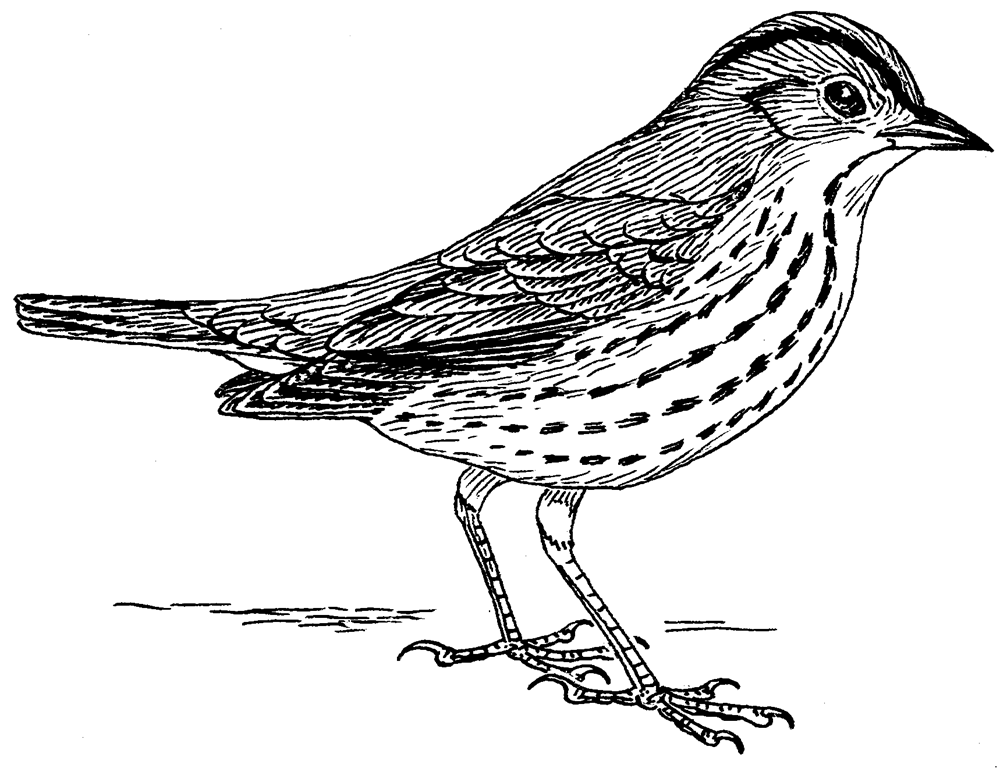
The oven bird: “He knows in singing not to sing”
Finally, Frost hits us, and me specifically near 10 years ago, with his conclusion—one that says much for this project that seeks to find “The place where music and words meet.” He says those of us, also mid-summer and mid-wood who listen knowing these things, sharing the bird’s predicament, should know that the bird has these teachings to pass on to us, “He knows in singing not to sing” (a zen koan of a line) and that the present question is “what to make of a diminished thing.” What a progression to this, from the plainest language with simple words never more than three syllables long, singing us the oldest cycle known to self-conscious humans—and then Frost gives us a line suitable for meditative thought and a question.
This is where I break from those who see this as a despairing poem about death, failure and decline. The poem asks what to make of that, offering the example to loudly sing.
To hear my performance of Robert Frost’s “The Oven Bird”, the 100th offical audio piece posted here as part of the Parlando Project, use the player below. “The Oven Bird” performance is voice and acoustic guitar, but if you listened to others, you know that the music and poetry we use varies. If you haven’t listened to other audio pieces in this project, check out the monthly archives for more. And if you like this, hit the like button or the follow button, and share this post or this blog address on your favorite social media channels. Those who’ve already done so help keep Dave and I encouraged to create new material, and you have helped grow the number of people listening to pieces from “Parlando – The Place Where Music and Words Meet.”









 Frank Hudson