What is Poetry and What Is It Good For?

People blog about these allied topics elsewhere, and there seems to be a bloomlet of books answering the same questions. I’ve lived a fairly good number of years, writing, reading, and listening to what I consider poetry, and I can’t say that I’ve thought of this for a long time.

There are inductive and deductive artists: ones who think of, or latch onto, a useful theory, and produce art from it; and those that, if they think of theory at all, derive it from what they have already created. I’m in that later, and I think larger, group.

The concentrated amount of work I’m doing with the Parlando Project means I am working a lot with poetry, and making constant choices. To give me focus in this process I did take on a few principles for Parlando, but  having handled this much poetry in the past year means that I can’t help but observe my choices and what those choices say about what I believe about poetry.

Poetry is musical speech.

Simply, poetry is musical speech. And good poetry not only sings with its words, it sings twice, as its thoughts flow like the logic of music. Do that and I think it’s poetry. Fail to do that (or rather, if I fail to hear that) and it may be a perfectly good something else, but it’s not poetry.

Hold it, some of you may be saying to your screen, what about free verse? What about those decidedly non-rhythmic pieces that are published as poetry, and are widely considered as such? Let’s take Ezra Pound’s famous short imagist poem “In a Station of the Metro” as an example of that:
 
“The apparition of these faces in the crowd;
Petals on a wet, black bough.”

No meter, no rhyme, is that musical speech? To me, yes, it is. I hear this music, as I hear the music in other poems, as a musician, but you could hear it too, even if you are only a listener of music. Music does not need to be a drill team march or four-square polka or sound the bass drum of some dance music that expects regular, repeating beats. The top melodic lines of much music vary in rhythm constantly, and musical speech should have the same freedom, as Pound himself declared in his famous short list of Imagist rules.
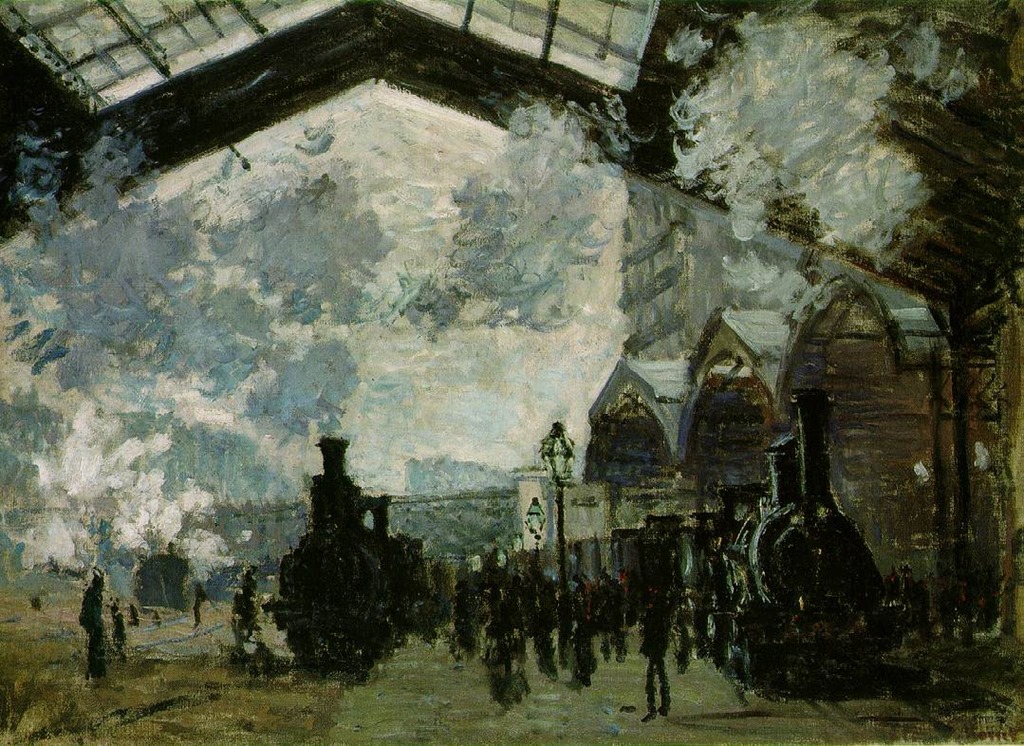
Monet St Lazare Station

They say the best things in life are free, but you can give them to the birds and bees!
I want Monet! Monet!  That’s what I want!

I could read other poems, ones that do follow conventional accentuated syllabic meters, and not hear much music in it. If I turn on a metronome or a simple drum machine pattern, I may hear rhythm, but I don’t necessarily hear music.

Yes, this sense of musical speech is subjective, particularly for a poem sitting mute on the page.

And what about the second music that good poetry will also sing, the musical logic of thought? I’m not even sure that “thought” is the right word, as it’s more at apprehension or experience, but as a listener or reader those subjective transferred experiences are felt as thoughts are and engender my own thoughts in response. When Emily Dickinson looks at a bird in her path, or Meng Haoran awakens after a stormy night, or when Ezra Pound comes to the subway stop and sees this throng of urban humanity as a transitory and eternal natural grouping I get to share my understanding of their understanding, if I have the patience and openness to seek to do so.

Music is not how to get from one note to the other as quickly and predictably as possible, rather it is how to pleasantly surprise, or even confound, you in those journeys between related notes.

Any of those experiences could alternatively be a chapter in a memoir, or a scientific observer’s log entry, or a character’s chapter in a novel. Some experience or apprehension of experience is transferred in those ways too—that’s what all art does—but in poetry, the transfer happens in the context of musical expression. This can work, like a meditation chant, a hypnotist’s spell, or any experience where the normal stops and starts of thought are interfered with. And the flow of the order of the data has an internal meaningful structure in good poetry, as a melody or a chord progression has in music, which is not necessarily the flow that works the most efficiently. Music is not how to get from one note to the other as quickly and predictably as possible, rather it is how to pleasantly surprise, or even confound, you in those journeys between related notes.

Consider an image, a set of relationships set out in a poem to be related at once to each other, as chord is in music.

Consider an image, a set of relationships set out in a poem to be related at once to each other, as chord is in music. And the relationship between one image and the next is like a cadence or sequence of chords in a musical composition.

When one thinks of poetry, as I now do, as a musical thing, and not a literary thing, then the presentation of it as we do in the Parlando Project, should make sense to you. Not that it must make sense first, it can simply be experienced.

All this implies some of what is the worth in poetry; and to be honest, some also of what is problematic in poetry, but I’ll leave a further discussion of those things to another post.
I Was Not Yet Awake

Here’s a piece with a short story written and read by Dave Moore.

Just as I have my bicycle ride poems, Dave has his morning dog walk poems and stories, and this one is one of my favorites. Dave tells me that he thinks he may have messed up the ending in this performance of “I Was Not Yet Awake ,”  but I think it works just fine.

I’ll let the story unfold as you listen to it without a lot of commentary from me this time. “I Was Not Yet Awake”  is a story about neighborhoods, neighbors, and trust, distrust and need.

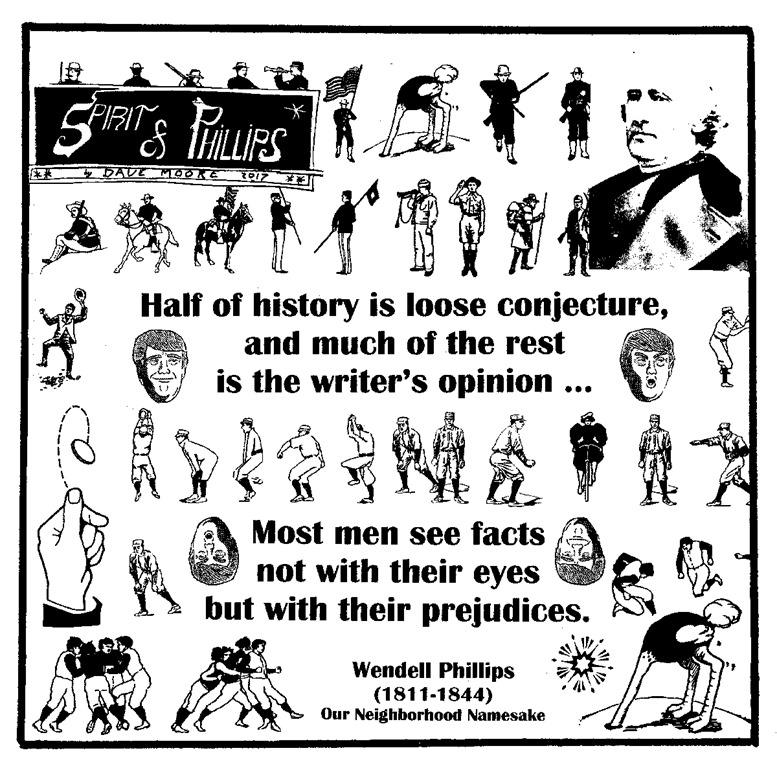
Spirit of Phillips Half of History

Dave Moore is also a cartoonist. His “Spirit of Phillips” reinvigorates the work of radical Abolitionist Wendell Phillips.

Dave is the alternative reader with the Parlando Project, and he also plays most of the keyboard parts you hear here on other pieces featuring the LYL Band. This story is much different from the last piece, where I tried to mash up Capt. Beefheart and Gertrude Stein, and it will also be different from the next episode. That variety in music and words is part of what we do. So go ahead and listen using the player you will find below.

Our audience growth in the past year has been largely as result of readers and listeners like you who have spread these audio pieces by sharing on social media or through their own blogs. Thanks to everyone who’s helped!


One Year of the Parlando Project

A couple of days back the Parlando Project passed its first birthday. It’s eating solid foods now, and is making efforts to walk. I thought it might be a good time for some posts to catch up a few things.

First off, some of you may be new to the Parlando Project and its presence here on this blog. What is the Parlando Project? We combine music (various kinds) with words (various kinds, but mostly poetry). I’m the Frank Hudson in this blog’s domain, and I’m the “editor” of this Project, but Dave Moore (whose voice you’ll be hearing again soon) is the alternative reader and vocalist here, and the project wouldn’t be the same without him.

I ask you to note the “various” used twice above. I’m one of those rare people, who when asked what their favorite type of music is, cannot answer. Yes, I have moods when I don’t want to hear one kind of musical expression, or when I strongly desire to hear or make another kind, but overall, I can’t say there is one type of music I want to be gone from forever, or another that I will never listen to or try to make.
 
So please do not take any single example of our music as representative of what you’ll hear next. I like noisy and chaotic music and sweet consonant sounds, I like solo acoustic guitar, I like modern day composers who refuse to die, I like artificial sounds created electronically, I like the natural sounds of strings vibrating in air, I like things simple and I like things complex.

The same somewhat applies to the words we use. I have a certain framework that we use at the Parlando Project. We favor shorter pieces for example. We both like a darkly comic touch. We generally don’t use our own words, even though Dave and I have written our own words since our youth, and we’ll use some of them here.

Rather than add another “I” speaking to the mesh of the Internet, I want to jointly experience with you some understanding of what others have written and spoken.

Why is that? The Internet is full of self-expression. I don’t want to put that down, but I feel the various mediums the Internet carries to your phone, tablet or computer are awash in it. Even our literature has become primarily memoir in one guise or another. Well, I consume some of that, you probably do to, but I’m currently not in the mood to create more of it. Rather than add another “I” speaking to the mesh of the Internet, I want to jointly experience with you some understanding of what others have written and spoken. That’s what I seek to do by performing the Parlando Project pieces, and writing about them here.

A poet who Dave and I have known for decades, Kevin FitzPatrick, was once reviewed as writing “poems that have other people in them.” Kevin’s other people are real characters, they have their own lives and wholeness, they are not hand puppets speaking only the words he mouths for them. They, like Kevin, are sometimes funny and sometimes subject to their own misconceptions and foibles.

Rush Hour cover

This is one of Kevin’s four published collections of poetry
You can find a copy here, here or here.

Stop and think for a moment now of how few poets do what Kevin does. Perhaps, if you write poetry, you too, fall into that larger grouping, writing from your innermost feelings, allowing other voices to speak only as you would have them. At the Parlando Project I use the idea, the rule, “Other People’s Voices” to remind me of this principle. I join with you, the listener and reader here, in trying to understand those other voices, by merging our performance of their words with the music we create as an audience to them.

Tender Buttons

Imagine this for the background and education for a poet. The poet is committed from a young age to see things exactly, so much so that they become fascinated with the very neurological functions that are the foundations of perception. In college, they study with the foremost psychologist in America, but they don’t stop there. They go on to study medicine at Johns Hopkins, stopping just short of a medical degree. The poet then decamps to the hottest art scene in the world where they discuss art with the painters who are revolutionizing how we depict reality in a frame, and this poet sees right away who are the great visual artists in this scene, with legendary precision. The poet’s next task was to use the ideas of this visual art revolution, along with ideas about how human thought and perception really work, to create a new kind of poetry.

You’d expect this poet would produce extraordinary work. She did. You might also expect this work to be revolutionary in its technique. It was, and still is. You might expect that you will want to seek out and hear this work, to experience what this background and conviction could bring to poetry. You might expect this writing to share with you exciting new ways of seeing. Well…

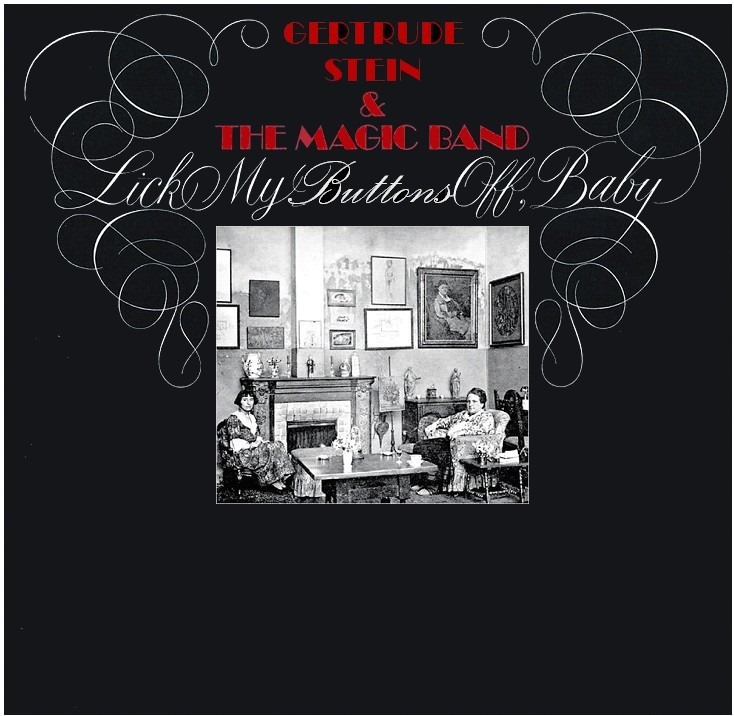
Gertrude Stein Lick My Buttons Off Baby cover

What percentage of my audience knows both who Capt. Beefheart and Gertrude Stein are?

 
Today’s piece uses the words of that poet, Gertrude Stein, from her 1914 collection “Tender Buttons.”  Even within the Modernists of her time, it was controversial, and it remains so today. Stein didn’t shock with her imagery like some of the provocative work of Dada and Surrealism. The radically condensed poems of the Imagists sometimes raised concerns that anything so seemingly simple and without the decorative rigmarole of 18th and 19th Century poetry couldn’t really be worthwhile art, but the Stein of “Tender Buttons”  was even more suspect. The imagists might withhold the complexity behind their shortest poems, but the words themselves were often plain-spoken, comprehendible on an immediate level—too quickly so, in some apprehensions, to be art. Here, the Imagists seemed to say, is the red wheelbarrow, the crowd at the Metro station, the stars above the Clark Street Bridge. I’m not giving you anything more, and you can take in these few words and shrug and say “so what?” for all I care.

Stein went further. In “Tender Buttons”  she wanted to project the messiness of real thought, real glancing perception, sticking to one thing only as repeated words that chorus and then disappear, only to appear a few poems later in the collection, but mostly moving from one atom of perception to another.
 
It’s as if, rather than speech recognition on a modern smartphone, that Stein turned herself into a human “thought recognition” device, registering in words not only the stream of consciousness but a stream of unconsciousness as well.

It’s as if, rather than speech recognition on a modern smartphone, that Stein turned herself into a human “thought recognition” device, registering in words not only the stream of consciousness but a stream of unconsciousness as well.

This is a brave idea, but what emerges from this sounds at first (and for many, at second, and then for as many times as they care to try) like nonsense. The words are plain, at the phrase or sentence level they can even seem to be intelligible, but as a whole, they seem to add up to nothing. Our brains are hard-wired to make patterns out of information, and so confronted with a chunk of “Tender Buttons”  this function may strive to make out coherence until one’s brain hurts, or it may just stop a few lines in and reject it as a failed experiment, perhaps even a fraud.

This is where I think that the Parlando Project’s secret weapon, music, can help. Music may have charms to soothe the savage beast of “I need to understand how these words fit together right now; and if I cannot, I will withhold my listening participation immediately.”

Musically I have put these two pieces from “Tender Buttons:” “Glazed Glitter”  and “Suppose an Eyes,”  against music from my memory of Capt. Beefheart, whose work helped me accept fractured non-narratives even while (perhaps because?) his were set against similarly fractured music. Alas, I lack the ability to emulate the timbre of Beefheart/Don Van Vliet’s voice as I declaim Stein’s words, but I assure you I’m hearing Don Van Vliet’s (or perhaps Kevin Coyne’s) voice in my mind as this piece nears it’s conclusion with the chant of “Little sales ladies, little sales ladies, little saddles of mutton, little sales of leather…”  The Parlando Project has always promised to surprise you with the variety of what we present, but we cannot promise you immediate delight all the time. If you like this piece combining two uncompromising artists, be sure to share us with the social media buttons you should see, and if you don’t like it, check out the other pieces already here or to come, as we use other types of music and other sets of words.

To hear “Two from Tender Buttons,”  use the player below.

The Dark Interval Version 2

The last post used my best effort at a faithful translation of Rainer Maria Rilke’s “The Dark Interval.”  Now, as promised, my alternative translation.

As I discussed, I first heard Rilke’s “The Dark Interval”  by hearing it. In the immediacy of that encounter, I heard it as a meditation on how our lives pass by while we do not speak up to them and use their singular moment, however imperfectly. Upon reflection, I now understand the poem was likely speaking of Rilke’s more impending death. The more literal translation I used for yesterday’s piece retains more of that focus.

Rilke and Tree

Rainer Maria Rilke. “A tree before my background”

.

dark interval

.

Today’s version uses the freer translation, reflecting my original understanding of the piece. The original poem includes three or four images, which I sought to vivify in modern English. The first image, that of the “steep hour” (diese steile stunde) we know is a downhill slope, not a slow, steep incline one is ascending, because the next line includes a sense of rushing or hurrying (eilen). I have no idea if Rilke ever skied or otherwise could be thinking of skiing or sledding down a hill, but that was the concrete image that presented itself to me, and this choice helped me deal with most enigmatic image in the piece, the “I am a tree before my background” (Ich bin ein Baum vor meinem Hintergrunde). My choice in this translation is a risky one. I made the vaguest image in the German into the most immediate image in English, that not only am I sliding rapidly, but there is dangerous obstacle, a tree, to deal with. I now think my translation of “hintergrunde” to “my past” may be inaccurate. Given the poems concluding images, I think Rilke may been thinking of background more in the sense of “musical background”—but it was the choice I made then, and it works well in my first understanding of the poem’s intent.

Charles Adams' skier and tree

Like the skier with the light jacket, I may be puzzled.

.

The next image is also a bit obscure. “I am only one of many mouths, and the one that closes the soonest.” (Ich bin nur einer meiner vielen Munde/und jener, welcher sich am frühesten schliesst.”) I’m still unsure of which meanings Rilke meant to convey there. Is he saying, “I am only one of the multitude, and I’ll be dead (and silent) sooner than most?” Or is he saying “I could speak up in many ways (I can’t quite decide what is the right way to speak up), so instead I clam-up and never express myself?” In this translation, I chose the latter. I now think Rilke likely meant the former.

The last image is the most developed one, and the most attractive to a poet and musician like myself, because it’s an image out of music itself. I read “the dark interval,” that I use as the title for this piece, as a reference to the tritone, a dissonant interval that was being exploited widely in musical works contemporary with Rilke. And of course, music based on blues and jazz forms makes use of the dissonant intervals too, so I chose to use the more modern “funky.” And in developing this musical image I chose to use another informal term to vivify the “death tone” (Ton Tod), translating it to “wolf-tone,” which is the howling feedback sound a string instrument makes when the sounded note is the same as the strongest natural resonant frequency of the instrument’s body.

Keeping with my initial understanding of “The Dark Interval”  I was trying to say that we keep silent, and do not act, out of fear of “dissonance,” of fear of not fitting in with the expectations; or because we fear a “wolf-tone,” an unwanted, strong response; but that when we do, if we do, as can be done within music, the dissonance can be resolved, that musical consonance sounds even sweeter when dissonance shows it in contrast.

So, there you go, that was once my understanding of Rilke’s “The Dark Interval”  that I used in this second translation. As a piece, in English, it stands up, it has coherence, and I think it’s livelier than yesterday’s more literal translation—but I also think I got Rilke’s meaning wrong. How much does this matter?

I often consider translations of poetry like a musician doing a cover song

To the listener, it may not matter. If they don’t know the original in German or from another translation, they experience this work as it is. To art also, it may not matter. A misunderstood work is still a work of art, another one of many mouths that isn’t shut. I often consider translations of poetry like a musician doing a cover song, where there is value in recreating the song differently, just as The New Standards did with their Clash cover that I linked to yesterday. Still, I can’t shake off the thought that I was unfair to Rilke.

So here’s the second version of Rilke’s “The Dark Interval.”   It’s a different performance, with acoustic and electric guitar and bass, but it uses the same music as yesterday’s. Use the player below to hear it.

The Dark Interval Version 1

How faithful should a translation be? I can hear your first answer even over the silence of the Internet: “As faithful as it can be, of course.”

And there are many times when I wish it could be so. One has to accept the translation loses when the devices of one language can’t make it over to the new one. Then, often there is the decay of time and the distances of cultures, and this can make meaning murky and less vibrant—but even between two people, of the same time and culture, native speakers of the same language, misunderstanding and misinterpretations of poetry occurs, as you can see with some pieces here where I perform words written by alternative reader and LYL Band keyboardist Dave Moore, which I didn’t fully grasp.

In the next two episodes of the Parlando Project, I’m going to demonstrate two different paths I’ve taken with the same poem, Rainer Maria Rilke’s “The Dark Interval.”  Today’s version is an attempt at a faithful translation.

rainer-maria-rilke

Looks like kind of the intense sort: Rainer Maria Rilke


Rilke, like Tristan Tzara or Apollinaire is another one of those WWI area European artists who exact nationality is hard to pin down. Is he Czech, Bohemian, Austrian, German, Swiss? It’s doesn’t help that the maps of Europe were being redrawn during his lifetime by the outcome of the WWI.

Nor does it help our translation task that he wrote “The Dark Interval”  in German, the language that one set of my grandparents spoke in their youth, and that even my mother was somewhat fluent in as a child, because I know even less German than French.

And Rilke is philosophically dense. His poems are full of compressed thoughts about the inexplicable, and he has a strong spiritualist bent. The former makes it hard for anyone to marshal his thoughts into another language while impressing on you the need to do so; the later makes it harder for me in particular, as I have come to believe that a philosophical spirituality is (at least for me) an impediment to approaching the mysteries.

It may help that I first encountered Rilke’s “The Dark Interval”  in a way deeply integrated into life. I, along with my friend John, was watching a band, The New Standards, perform in 2006, and during an interval in their show a man (who name I should remember, but can’t) read this poem. He did a good job of it, transmitting something of Rilke and himself in his reading. The translation he read was somewhat like the one I made later, and perform for today’s piece.

Just to give you a flavor of that concert, here’s the first piece they played. They did not pre-announce the song they were covering, leaving us in the audience to recognize it as their very different version unfolded:


I heard the Rilke poem immediately then as a meditation on the hurried mid-lives that John, I, and perhaps many of the audience were living at that time. Perhaps he—or the band performers, largely composed of veterans of locally famous indie rock bands of the 1980s and ‘90s—selected it for just that reason.

That’s not the version I perform here today. I did not change the words of this first translation, which sought to be faithful as I could understand it to be to the original German words, but circumstances changed how I hear it. John died, unexpectedly, way too young, a short time after we attended that concert. I learned later that Rilke composed it as he began to suffer from his final fatal illness. I can now see this not as a work about the busyness of middle age, but a work about the busyness of living nearer to dying. Different poem.

Here’s my performance of Rilke’s “The Dark Interval.” Just use the player that appears below to hear it. Tomorrow, my second translation of the same poem, with a different performance.


The Death of Apollinaire

This is an elegy, not a love poem, but then an elegy is a love poem that replaces the focus masking the complexity of love with the common mystery of death. Even the images and incidents can have an eerie similarity, as an absence may be at the center of either.

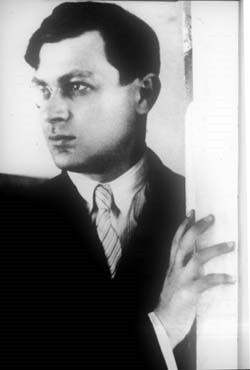
The author of today’s piece, Tristian Tzara, is as much as anyone the founder of Dada—if that absurdist movement can structurally support a founder. Like much of the early 20th Century modernist movement, the horrors and changes of WWI accelerated Dada’s development. Proudly anarchistic and rejecting the whole lot of social norms and artistic traditions, Dada was at turns playful and bitter about a European world order that that was itself disordering everything on the continent though modern warfare.

Tristan Tzaratzara_by_picabia

When I look inside the back of my guitar amp,  do I find? Picabia’s portrait of Leo Fender, or a tube socket schematic?

As we’ve learned in earlier posts here, a whole generation was mobilized as part of The Great War. The teenage Tzara, residing in neutral Switzerland, escaped this, but he apparently tried to gain funds from both sides’ propaganda arms to fund Dada activities—which would be just the kind of audacious prank that Dada loved.

The subject of today’s piece, Guillaume Apollinaire, was a slightly older member of that WWI generation who should have gone on to even greater things after the war. As I mentioned last time, he had invented the name for Surrealism, the modernist movement that was a post-war outgrowth of Dada. Before that, he had also invented the term Cubism. In France during this time, Apollinaire seemed to know, and was admired by, everyone: composers, writers, painters, theater artists, the whole lot of this vibrant cultural scene.

Swept up into the military by the war, Apollinaire was seriously wounded at the front and weakened by his wounds, he died during the great flu outbreak of 1918.

Apollinaire with WWI head wound

Apollinaire, his war-wound bandages “pendaient avec leur couronne”

His death then leads to Tzara’s elegy, today’s piece. Given Tzara and Dada’s reputation, I was worried as I started to translate this. Translation, particularly for someone like me who is not a fluent speaker of other languages, is already fraught with issues, but doubly so with writers who can use arbitrary absurdist phrases intentionally. When is something unclear, and when is it meant to be so? That’s a question you ask a lot with these writers. I have a prejudice for vibrancy, and if I feel there’s a good image or English phrase hidden in an unfamiliar language’s idiom, I will generally seek to bring it out, but I also realize that I’m fully capable of misunderstanding the writer’s intent.

With Tzara’s “The Death of Apollinaire”  I grew to believe that this was a sincere elegy for this much-loved artist among artists, and so, translated and performed it as such. Yes, it has its absurd images, but I chose to translate them with clarity in mind. Apollinaire died in November, and so I took the mourning images as a series of late autumn images, and presented them as such. I had the most puzzlement with the line “et les arbres pendaient avec leur couronne” which can be simply left as an unusual combination: a (presumably, shiny metal) crown hanging in a tree-top.  As I looked at “couronne” it appears that it’s used also for a laurel wreath crown, and for a funeral wreath too, and for a while thought “wreath” or “funeral wreath” would be the best translation. And then I considered the botanical meaning of “crown” applied to trees, and the follow-up line “unique pleur” made me think of the last leaves in autumn, a rather conventional image—but a great deal of what makes that conventional in English is the popular song “Autumn Leaves”  written originally in French by Surrealist Jacques Prévert!  My translation: “And the trees, those still with hanging leaves” takes liberties with Tzara’s words, in hopes that I might have divined his image. I’m more confident in how I translated the last line, “un beau long voyage et la vacance illimitée de la chair des structures des os” which I proudly think is superior to other English translations.

Musically, today’s performance is a mix of 12-string guitar in Steve Tibbett’s tuning, with electric guitar and bass. As always, there’s a handy player below so that you can hear it. If you like a piece you hear here, go ahead and hit the like button, but it’s even more important in bringing this work to others attention to share it on your favored social media platform. Thanks for reading and listening, and double thanks for sharing!

How to Make Speeches

I’m going to ask you to not read these notes yet. Listen to today’s audio piece first at least once. It’s short, two minutes long, it won’t take long. The audio player is at the bottom of this post.

OK, now you’re back and you’ve listened to the piece at least once. Do you think the words were written recently? Do think it’s a satire, some kind of sly Machiavellian comment on a particular modern politician?  Do you think it’s Donald Trump’s first draft of his recent speech to the Boy Scouts? Or perhaps is a secret litany of personal affirmations? It does at times seem like a twisted take on self-help.

So what is it?

It’s my quick and dirty attempt at a version of a section of the “Surrealist Manifesto”  written by André Breton in the early 1920s. The Manifesto  is sort of a grab bag, part a sincere plea for a deeper and broader application of imagination in art, part a catalog of examples of how unleashed imagination has already been applied, and part is indeed a parody of a certain genre of self-help, the kind published by occult gurus of the time.

Surrealist Manifesto cover

Not the Boy Scout manual

 
My piece is taken from that parody segment, and I’ve departed from conventional translations in two ways. First, to disguise it, I removed one phrase specifically mentioning Surrealism, and secondly, I’ve chosen my own idiosyncratic translation of the phrase “Peau de l’ours” in it. This is a condensed version an old and French saying, “Don’t sell the bear skin before you have it.” (a French version of “Don’t count your chickens before they hatch.”) Breton may have been using that cliché to contrast with the religious campaign-promise of heaven, but he also could have been refereeing to a hedge fund of his time which used that exact Peau de l’ours” name. And critically, what the investor group bought (and later sold for tremendous profit) was modern French art. “Hedge fund” gave me both ideas in a way that would be meaningful to a 21st Century English speaker.

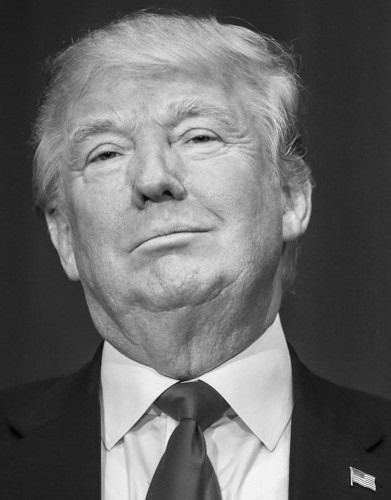
andre bretonDonald Trump

André Breton and perhaps the Surrealist Party’s first President, Donald Trump.

 
So Breton, as he often does in his pronouncements, is mixing the absurd, with recognizable satire, with sincere advice. But briefly, before I go, I ask you to think about a bigger question. What does it say that some modern artistic principles sound like they could be descriptions of Donald Trump’s (or other similar politicians) philosophy? Is it that Trump doesn’t have a philosophy, only that he finds excuses or rationalizations? For past politicians, we would say they lack a sense of irony, but Trump speaks ironically so often that one wonders if there’s a word for unconscious irony. Could it mean that the sincere iconoclastic individualism and commitment to their own personal freedom that 20th Century artists thought they needed as a corrective to disasters like WWI and a restrictive society and its expectations, is now leaching upward to more powerful men in conventional professions?

L’Amoureuse

I promise you, we will end up today very close to the love song of the last episode, though we will travel a ways before we get there.

I’ve not featured any French writers yet with the Parlando Project, but as this summer has used the words of many 20th Century English poets, we may be overdue for that, as the start of that century found some of them looking to the French for some new ways to write.

French poets started to go “modern” before the British poets, around the same time that Emily Dickinson and Walt Whitman were making their own breaks with past practice in America, so they had a head start, and their avant-garde was way past the supply lines of conventional narrative and sentiment by the time the 20th Century really got rolling.  The absurd casualties of WWI, largely fought in France and its neighboring countries, and so deadly to some of the generation of men doomed to fight in it, only accelerated the modernist direction away from the kind of meaning you might find in a political speech or battle plans.

This summer, 50 years ago, the Polish-French writer Guillaume Apollinaire coined a new word to describe a new way to approach the world in words: “Surrealism.” A few years later, his term was taken up by a group of artists who went about trying to practice a new idea, presented in 1924 as if it was a political manifesto, to write and create from:

“…The actual functioning of thought. Dictated by thought, in the absence of any control exercised by reason, exempt from any aesthetic or moral concern.”

  The Surrealists went on from there, going in various directions, becoming less an idea and more of a brand—but stop and think for a moment, that original idea, isn’t it powerful? The idea that there is a reality that we agree not to apprehend, not to speak of, that we constantly reframe our thoughts to, isn’t that idea political as well as aesthetic?
 
You take the idea of Surrealism, add music to it, and later that century you get Bob Dylan. You take the idea of Surrealism, apply it to the current reality, and you are woke, not from the dream, but to the dream that should not be denied.

Today’s piece uses the words of one of the French Surrealists, Paul Éluard. Éluard, like many of the British poets of this era, was another veteran of WWI. One story of his war service was that, since he was a writer, his military superiors assigned him to the office tasked with writing the official letters to the relatives of the casualties, and such was the efficiency of modern war that he sometimes needed to write 150 of them a day. After a year of this, he asked to be sent to the frontline trenches.

Alphaville Capital of Pain book

Jean-Luc Godard’s film “Alphaville.”  “I love you” could be the ending.

 
I have exposed you several times this month to pieces about the horrors of war and slavery, but I also told you we must travel a ways to get to today’s piece. After the war, as a founding Surrealist, Éluard produced verse with strange images and seemingly arbitrary combinations—Surrealist tactics to break the conventions—but his great subject, against the night, pain, and suffering, was love. Perhaps after those 150-letters-a-day forced march, he too wanted to look to war’s opposite.

Paul Eluard and Gala 2

Paul Éluard and the beloved, Gala. Eyelids not visible in this picture.

“L’Amoureuse”  (The  Beloved) is one of Éluard’s most famous early works, and uses my English translation of his words. The LYL Band performance of it was recorded live several years ago. To hear it, use the player below.

She is Sleeping on the Boundaries of the Night

I said I would change things up last time, and by stepping back a few years, today’s piece does that.

How much different is “She is Sleeping on the Boundaries of the Night”  from the last few posts? First off, we’ve left off from war. This is a love poem. Death appears in it only briefly passing—so fast it passes, as it can in a poem, you might not even notice it. And rather than being a piece by another poet, the words here are mine. We live here at the Parlando Project with the idea of presenting “other people’s stories,” but I also want variety, so I’ll make the exception this time, and present part of my story.
 
One of the modernist/Imagist ideas that Ernest Hemmingway liked to use in his early stories was to leave an essential detail out of story, and then to strive to write it so well that the power of that detail would become present subliminally.

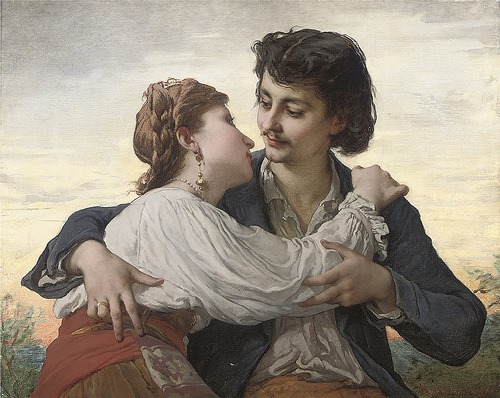
Lovers Tryst

In a classical aubade lovers are always awaking in a field and forgetting to check for contact dermatitis

“She is Sleeping on the Boundaries of the Night”  is an aubade, a traditional form of love poetry. An aubade features lovers awaking at dawn, and the poet lamenting that their night is over, so they must now part for their un-enchanted days. What do I think is different in my aubade?

Sixteen years ago, my wife died after a short and painful illness, not yet 44 years old. I cannot tell you all that means, but one thing I experienced in my grieving process was the question of where one goes from that stopped thing. After all, you are definitively stopped, you have no momentum in any direction, unlike in the normal flow of life. You can stay stopped, or move off in any direction.

I moved, and was moved, in the direction of falling in love again. There are some difficulties in that direction, knowing of love’s inescapable impermanence. Like the lover in an aubade, I knew now, deep in my soul and body, that love means that parting is intensified.

In the end, “She is Sleeping on the Boundaries of the Night”  is a love poem that hardly mentions death. I was trying to do that modernist/Imagist thing. Is death still there?

Alas, the other thing that I left out, is that other person, lying beside the speaker, stuffed with dreams no doubt with all the richness, sadness and choices of their life. My love poem fails, as some do, in that respect. Can it remain unsaid my partner chose to move, and move me, as well?

Today’s piece is musically a bit different as well—there’s an antique 20th Century beat box rhythm used for one thing. To hear the LYL Band perform “She is Sleeping on the Boundaries of the Night”  use the player gadget that should appear below.