Continuing my April National Poetry Month observance with another poem from Louis Untermeyer’s between-world-wars anthology Modern American Poetry. This one’s from a better-known poet than last time.
NPM starts with April Fools Day, an outdated holiday since we already had President’s Day in February, and can-you-believe-it outrages are somehow less funny this year. Yet, it’s also the day my late wife and I got married back in the 1980s. Not exactly a golden age back then either, and my wife would explain the decision to get married as a statement of the stubborn optimism of loving fools.
The poet who I’ll sing today published under the name H.D. – a nom de plume that still has a modern vibe for a pioneering Modernist. Maybe someone in our digital screen age will pay tribute by calling a project extending her work “QHD?” Something else that I’d expect might still sound modern is how she came to be a part of the Modernist vanguard that formed in England among a group including Americans living abroad. Hilda Doolittle was a young woman who had a college sweetheart. It appears they planned to get married. That other, a he in the pair, moved to England to meet up with the great Irish poet William Butler Yeats. His name was Ezra Pound. Young Hilda eventually traveled to London to reconnect with Pound.
Somewhere in the passages of boats and time the romance between the two died, for there’s no guarantee that optimistic fools will continue to share the foolish accords of love. Pound was a talker, a planner, a promoter of the kind of modern American poetry Untermeyer would start to collect a few years later in his anthology with that name. Meeting Hilda in London, Ezra hatches a plan for H.D. that’s not marriage.
Looking at a bunch of poems that Hilda had brought with her to England, Pound pronounced them delightful and perfectly modern, an unbidden expression of the new poetry movement he and his little group were promoting. Pound, ever sure of himself (a trait that is dangerous in politicians, but often advantageous in artists*) scribbled at the bottom of Hilda’s poems “H.D. Imagiste.” Later on the Frenchie “e” got dropped and the new English language poetry Modernists were Imagists.
Now, I wasn’t there – chronistically excluded – but if there was a function like social media then I can Imagist a whole lot of takes on this. Manipulating the poor girl! Way to change the subject EP. Patronizing, much?
Well, here’s the unexpected part: H.D.’s poetry was striking. Still is. She could write very compressed short poems, nothing wasted: no dallying narrative story-telling or clearly identified speakers, but the images inside these enigmas so clear and evocative.
In his introduction to H.D. Imagiste in his anthology Untermeyer wrote:
She was the only one who steadfastly held to the letter as well as the spirit of its credo. She was, in fact, the only true Imagist. Her poems are like a set of Tanagra figurines….The effect is chilling – beauty seems held in a frozen gesture. But it is in this very fixation of light, color and emotion that she achieves intensity. What at first seemed static becomes fluent; the arrested moment glows with a quivering tension…. A freely declared passion radiates from lines which are at once ecstatic and austere.
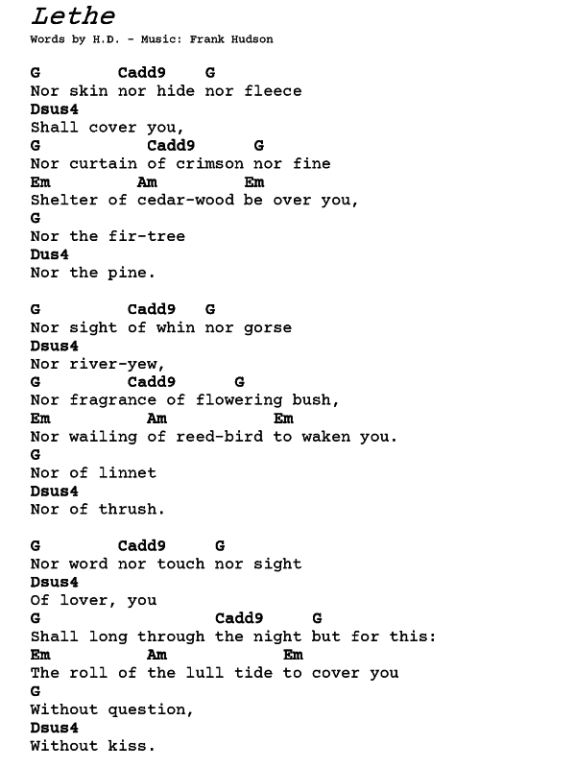
The poem I selected from Untermeyer’s selection is the one called “Lethe,” and it’s a good example of this effect. She leaves interpretive space in this poem: one could read it as a curse or an elegy. Is she decrying the separated lover, wishing upon them even more separation from nature, comforts, and others? Or is she with chilling remorse stating the plain facts of the dead: that they are separated – and we the living, separated too, but able to feel and sing that. Her poem is a sensuous litany of what the dead’s senses will not feel.
Today’s “thimbleberries.” I didn’t know what “whin” mentioned in the poem was. The Internet’s department of tautology department tells me its a variety of the gorse plant.
.
I chose the latter when I performed it – thinking on a day for fools, of marrying to share each other’s foolishness. You can hear that performance of H.D.’s “Lethe” with the audio player gadget below. What, you can’t hear the no wailing of reed-bird to waken you? Some ways of viewing this blog suppress showing the audio player, so I offer this highlighted link that will open a new tab with its own audio player.
.
*Ezra Pound’s confidence did extend to politics. Alas – to say the least.
 Frank Hudson