April is U.S. National Poetry Month, and this year I’m going to focus on poems found within an in-between-the-World-Wars anthology titled Modern American Poetry, edited by Louis Untermeyer. It’s a book that might have been assigned when my parents were in college, filled largely with poets that were born in the vicinity of the turn of the 20th century. I don’t know enough to comment on Untermeyer’s taste in selecting his early 20th century poets, but he seems to have interests in some areas that overlap my own: early Modernism,* humor, and poetry with proletarian and gothic themes. I assume there’s at least a trace of literary log-rolling in the selection of some of the less-well-known poets in the book, but in the short essays that he writes to introduce each poet Untermeyer often finds room for sharp critical comments – this to me is evidence of a fair-minded attempt to get his time’s consensus consideration of American poetry since Whitman and Dickinson.
My plan (to the degree that my life allows plans, which is arguable) is to present around 10 poems from the hundreds in Untermeyer’s thick book. I expect one or two will be “poetry’s greatest hits” that I haven’t otherwise gotten around to, and others will be unknown poems by little-known poets. Long time readers may recall a statement I’ve taken to calling Donald Hall’s Law. That poet, a prize-winner, once wrote: “Most poets, even prize-winning ones, will be forgotten 40 years after they die.” Modern American Poetry went through 6 editions between 1919 and 1942, and from a quick look, the last of the included authors died in the 1980s, and so are subject and evidence to that law. Will my efforts and your attention amend Donald Hall’s Law? Slim chance, but I enjoy sporting with its iron rule. Once some pressman ran these pages through their oily machinery, they pressed a democracy between the boards – and so, next to your Wallace Stevens and Robert Frosts, there’s the someone elses who led a life, observed it, did their best to craft some poem to convey that.
And here’s the first of those: George Dillon. Know the name? Know their poetry? This isn’t a test – I didn’t. Some reading this are likely living poets,** and you might have careerist moments in some early AM hours once the muse has worn off. Are you submitting enough, and to the right places? Did you do enough to promote your collection? Are you behind in your social media or correspondence? And while you never think this one yourself, you might still think someone else is thinking “Who do I have to sleep with to gain some traction?”
I’ve reached a age. I look at Donald Hall’s Law and am strangely comforted. I don’t need to be encouraged in dream-stoking stories about poets who achieved lasting fame. I seek out instead stories that say someone else was once here, wrote a little, and I can find them, find some pleasure in a poem or two, and say: that’s enough, or better than some other human clap trap we had no choice in hearing.
And so we have George Dillon. He made it into Untermeyer’s anthology, slotted between Robert Penn Warren and Kenneth Patchen. He was an editor at Poetry Magazine for over a decade! He won a Pulitzer Prize for his 1931 poetry collection! He and Edna St. Vincent Millay were lovers!
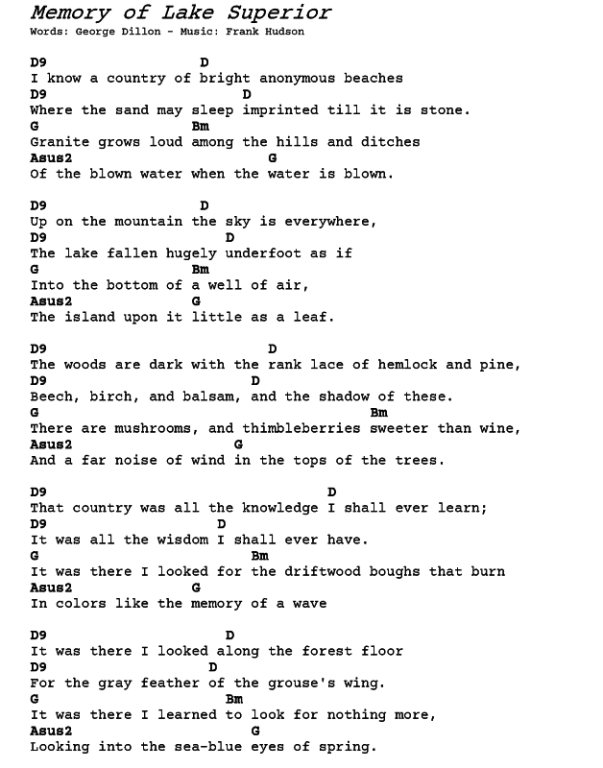
Chord sheets like this one might encourage you to sing this poem too.
.
I said Untermeyer could be toughly critical even of those he included. Here’s the end of his introduction to the selections of Dillon’s poetry in the anthology:
His defect is his fluency; he is sure of his craftsmanship, a little too sure. The subject-matter is conventional to the point of being stereotyped and the tone in the sonnets is a shade too pompous. Yet the verse is unusually flexible and few will question his gift of song.”
Fair enough. When I look through a collection seeking something to use here “gift of song” is going to attract me. And there’s another factor. The title of the poem I set to music is “Memory of Lake Superior.” My late wife lived in Duluth for a while; we both loved the north shore of that Greatest Lake. My living wife too hikes there even as I’ve become too old for long walks. Besides the “words that want to break into a song” effect, Dillon’s poem is well observed: the famous red-brown sandstone, the fungal debris on the forest floors. My wife tells me*** that the thimbleberries there that Dillon mentions “have larger flowers than razzberries.” It’s National Poetry Month, sure, but I thought leading off with a Spring poem with home field advantage would be appropriate.
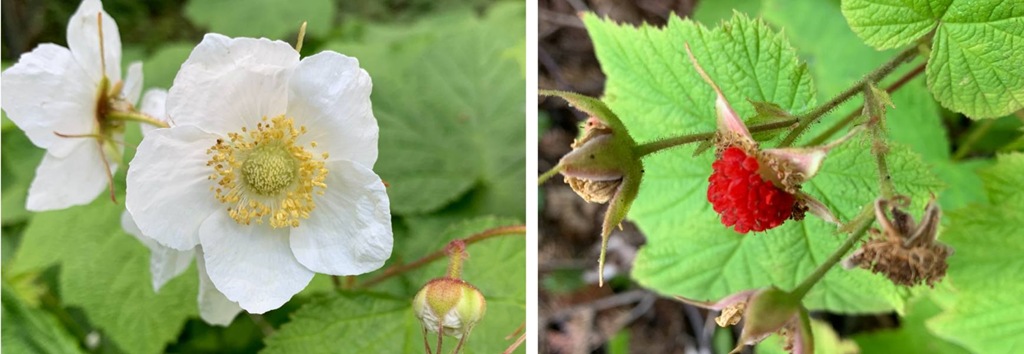
Thimbleberries, their flower, their berry.
.
You can hear Dillon’s “Memory of Lake Superior” with the audio player below. Are you asking, “Has Donald Hall hidden the player to enforce his law?” No, just some ways of viewing the blog won’t show the player gadget, and so I offer this highlighted link that will open a new tab with its own audio player.
.
.
*My initial interest in the early American Modernist era was fed by having a relative (Susan Glaspell) who was part of it, but the practical aspect of having work from 1930 back being in public domain and free for unrestrained reuse makes this era primary for poetic texts to combine with music here. Though the bulk of Untermeyer’s anthology republishes work from before 1930, I am using a later edition, and it’s possible a few of the works may be borderline: e.g. Dillon’s poem is obscure enough to not have an easily findable date of first publication.
**Dead poets reading here have damnably low engagement scores, and Ouija board planchettes never click links or hit “like.”
***Again, living wife – though a ghostly partner who whispers woodland lore to me from the undiscovered country would have a certain gothic charm.
 Frank Hudson