Did I promise an upcoming, complicated, love poem from Edna St. Vincent Millay last time? Well, let me deliver that.
This poem is one that taunted me to sing it as I read through several dozen Millay poems early this month. Millay chooses rich yet strange images in it, the poem’s erotic mood includes complex uncommon elements within its lyrical account of two consciousnesses which have met and are about to separate, and that makes me think of other songs I admire. Its splendor in an alienated nighttime moment makes me think of “Visions of Johanna,” while it’s notes of respect beside begone absence makes me think Dylan’s suite of songs within Blood On the Tracks. And Millay’s choice of images here verge toward the surreal enough to think of Robyn Hitchcock as I worked out the music and performance you can hear below.
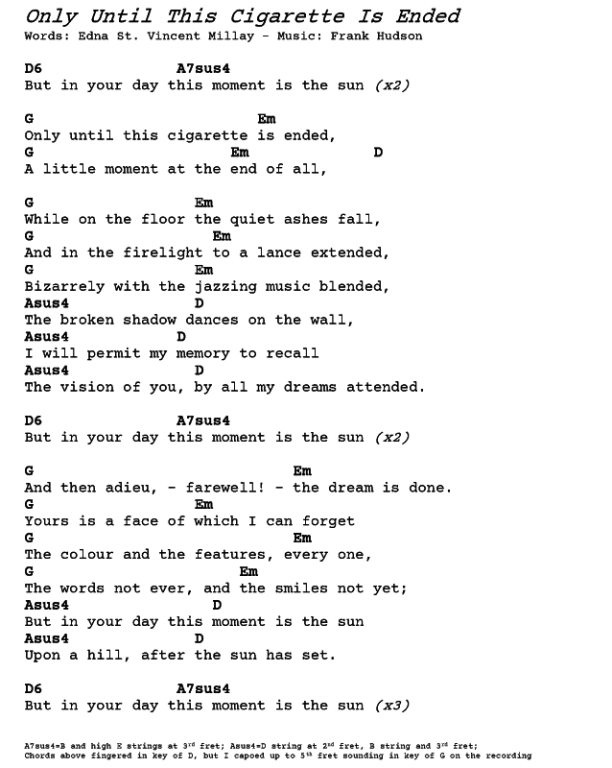
I chose to leave this chord sheet showing the chord forms I fretted on a standard-tuned guitar, even though the recording sounds in a different key due to my use of a capo. This is an easy song to play on guitar, even strummed rather than using my cross-picked arpeggio playing style, and I wish to encourage others to sing these Parlando Project songs.
.
I choose one lyrical change as I made the poem into a song: I decided to create a refrain out of one of its lines. I’m personally OK with songs that eschew choruses and refrains, and a great many poems taken down word-for-word as song lyrics will not have that element that’s increasingly prominent in popular songwriting. This choice brings forward that two-consciousnesses element. The poem has the poem’s voice (for simplicity, I’ll call that voice Millay’s) speaking what we’d call these days “her truth.” Though the poem is compressed into a lyric moment, that truth is that there’s been a pleasant enough erotic event between two people, but that Millay knew, or has decided, that that’s enough and this will not be an ongoing erotic bond. For a woman to publicly write this over a hundred years ago was striking – this poem’s honesty is precedent to those more contemporary expressions.
But the poem is more than precedent, let me linger on the images, starting with the titular cigarette, that quick and casual tube of tobacco. Rather than fade into Millay’s century ago, this reader (now singer) is drawn back half-that interval to when he, and most in his circle, were smokers. For Millay the cigarette would’ve been a somewhat modern signifier – and one without the more lingering girth of the cigar or the apparatus of pipe smoking – but for me, I was drawn back to what I tried to explain to my wife yesterday was my youthful erotic imprinting on cigarettes. My thoughts were not the trope of the post-prandial smoke after a buffet of lovemaking (something I never chose to do) but on the smell and taste of tobacco about the lover’s body. To younger moderns, disdainful of my evoking that, I’d try to explain that a common sharing of certain oils and ash on our skin and lips was kind of intimate comingled pyre. Millay doesn’t explicitly evoke that – I think the modern briefness and offhand casualness was her intent, but she portrays another image I think here that is specific to cigarettes in my memory” a well-packed, factory made, Modernist for Millay, cigarette can produce a lengthy ash as it’s smoked. I can still recall one college literature professor, one with a very John Berryman beard and manner, who would, while animated with some literary thought he was expressing, continue to puff on his cigarette as the distal ash grew to maybe half the length of the number in his mouth. This drooping ash would jiggle as his lips that held its cigarette continued to expound, and the suspense of its suspension would sometimes disconnect my attention to what he was saying with the other part of his mouth. All our thoughts, all our desires, all of us, will eventually fall to ash might be the image here, and I believe that’s the lance Millay evokes in her poem.*
There’s also fireplace, firelight in this shared post-lovemaking pyre, and Neanderthal meets Plato expressionist shadows make a visual Jazz noise with some off-screen radio or record player. For Millay a palpably Modernist mise-en-scène, but even for more modern moderns, there’s really nothing to turn off, it’s just lovers, so entwined, but these visions…
The final six lines make it so precise and so clear: something, a lasting erotic pairing, is not to be. Millay’s voice here is precise: this person momentarily beside her will not hence imprint with their body, hers – but that other’s words will stick with her? Something they said? Something they wrote? Since there’s no hint of rancor or lack of respect in the boundaries of this lyric poem, it may be the latter, a love of the poetry of the word not the poetry of the physical deed.
And in Millay’s final six lines comes that line I’ve chosen to refrain, a choice that brings her to an in passing but significant notice of that other consciousness inside this short poem’s fleeting embrace further to the fore: “But in your day this moment is the sun.”
What is that saying? That the other takes this as more overt than the covert firelight and briefly burning cigarette? Probably. That could easily be read as more than a bit egotistic, a trope in the more well-worn notched bedpost of the male “Babe, I gotta be moving on” road song. Or it could be, as I tried to make it my musical performance of Millay’s poem, a rueful acknowledgement that there’s a gulf between the two consciousnesses, even inside their closeness in the moment of the poem, now song.
So, complicated – a love song, or a song of something close to love.
That musical performance is available below with an audio player gadget. What? Is that side of the embed empty, the sheets now cold? Ah, the poem-now-song peddler now speaks, there’s jewels and binoculars – no, a link, a link, a highlighted link, that will open a new tab in your browser that will have its own audio player so you can hear it.
.
*Yes, yes, this obligates the sometimes “a cigar is just a cigar,” Freudian mention. That it’s a cigarette here – a genderless tobacco product rather than the male-coded cigar or pipe – is Millay’s choice.
 Frank Hudson
Excellent!
LikeLike