My winter has been impacted by things a regime of some coarsely-ground humans brewed up, but it’s been good this February to take a quick dive into the poetry of early 20th century Jamaican-American poet Claude McKay. Yesterday I was closing in on completing a new musical piece in my series combining McKay’s poems with original music in differing styles. I’d sung McKay’s “To Winter” accompanied this time by electric guitar instead of acoustic, and I had constructed some nice harmonic support from spare MIDI piano. I wanted a melodic top line though since my rough-hewn singing wasn’t doing enough to carry that role in the song. I decided to use a Mellotron virtual instrument.* Long-timers here may recall that I love some of the sounds that cranky mechanical 1960s tape-based sampler produces. Back then they were sold because it used actual recordings of real instruments – but the results? They didn’t sound all that convincing – and all that machinery was subject to glitches and breakdowns. However, once one stops aiming for verisimilitude, its sounds have a certain character. It probably doesn’t hurt that their very cheesiness brings back memories of crackling mid-century LPs and hazy concerts.
I was able to record those Mellotron parts, but my city was filling with heavy wet snow while I did that.
Authoritarianism of a meteorological kind as it accumulated, but I had another task for Wednesday. My newly inherited 12-year-old car had a worn drive shaft that needed replacing. I was to drop it off at a mechanic’s shop in a nearby suburb, and my wife had set a time to give me a ride back. She wanted to go right away, as the roads were getting worse from the snow. Long story short, what would have normally been a 45-minute round trip turned into over two hours of slow going.
It was later Wednesday evening when I returned to mix the resulting new and old tracks for the song in my home office, and I couldn’t get my home office Mac to light up my computer screen. First thought: a normal glitch, as the Mac sometimes just forgets that it should see the screen, but a restart or a re-plug did nothing. Connecting the monitor to another computer revealed the sad tale: my 15-year-old LCD screen had chosen that night to die.**
And this was a problem. All my mixing software is installed on the computer connected to that dead screen. So, no mixing Wednesday. It occurred to me: maybe the now dark computer monitor decided to go out because it was Ash Wednesday: remember, from silicon dust you came and to silicon dust you’ll return.
Thursday morning I pulled a smaller, lower resolution monitor from my studio space and hooked it up so I could finish this piece.
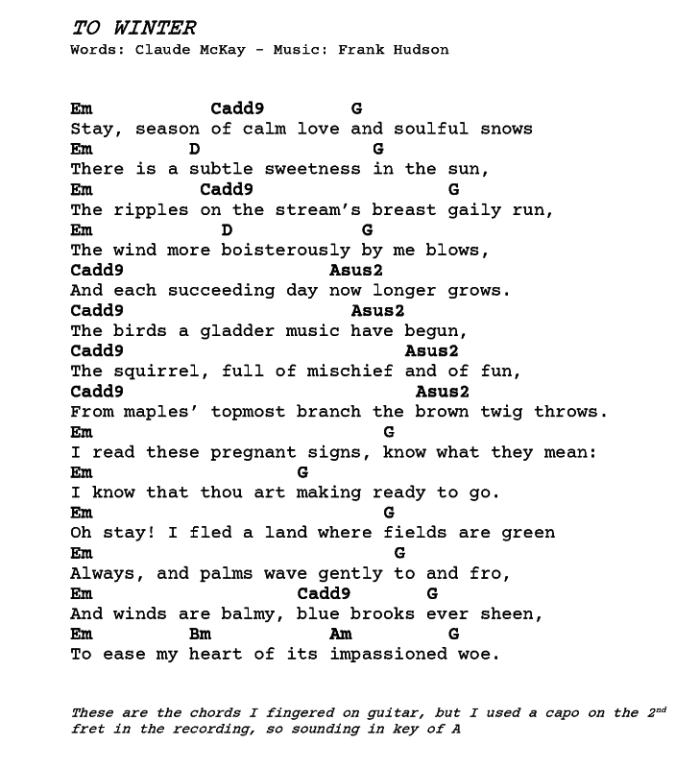
Just as I trust the mechanic to fix my drive shaft, I trust that someone out there can probably sing this song better than I can, so here’s a chord sheet.
.
“To Winter” is Claude McKay considering this very time of the year in the Northern U.S. Days are getting longer, there’s more animal activity, water, once ice, will break and flow. McKay’s poem has a complex reaction to this. He concludes he’s feeling winter inside within the moment of the poem, and finds winter outside permits that mood. Last time, with his “Tired Worker” I found some tension between McKay’s Keats-like language and prosody and the weariness of a 20th century blue-collar laborer. This poem’s my-time-is-like-Keats’-time-may-be-like-some-later-reader’s-21st-century-time choices cause less strain.***
What a wonderous range of coincidences wove into the past few hours. I chose the Mellotron, 19th century orchestral sounds as approximated by mid-20th century technology, mixed on a modern computer whose old LCD monitor left this mortal coil on a snow swirling night at the beginning of the Abrahamic religion’s overlapping spring holy days.
The mechanic has seen to my drive, shaft (“can you dig it”) so that it no longer makes disconsonant noises. I should have a replacement high-resolution computer screen by next week. February snows can be wet and heavy, but to water and mud-luscious they will soon enough go. Crude regimes? I can’t say just myself, but perhaps Carl Sandburg’s “The People, Yes” will increasingly say. So much to repair.
I hope to have a couple more Claude McKay pieces here soon, but to hear this one today, use the audio player below. No audio player to be seen? Mais où sont les neiges d’antan – but I offer this highlighted link as an alternative which will open a new tab with its own audio player.
.
*A virtual instrument contains the modern, much more sophisticated expression of the same idea (the various notes and timbres of a “real” instrument stored as digital recording data instead of one timbre and expression on a strip of magnetic tape for each note pulled along by clockwork springs and levers). My initial attraction to virtual instruments was reading that for only a handful of dollars one could rather precisely “fake the fakery” of the Mellotron without searching out and maintaining a finicky, costly, and increasingly antique instrument.
**The deceased was an HP Compaq LA2405wg model from back when that deleterious merger was fresh. It was a stretch for me to afford then, but in 2010 it was a rare 16:10 1920×1200 display, and I can’t even begin to calculate how many hours I’ve looked at characters and controls on that screen! Everything I’ve ever mixed, every video I’ve ever done, and a lot of writing and research for this Project were done on it.
***McKay’s poem reminds me a little of my favorite John Keats’ poem, “In the Drear-Nighted December.”
 Frank Hudson