My feature this February has been centered around an Afro-American scrapbook entrusted to me after it was found in a crawlspace at a former South Minneapolis rooming house in the middle 1970s. This series has taken me away from the usual Parlando focus, which is combining literary poetry with original music in differing styles. If you’ve been missing that, look to the bottom of today’s post — I’ll have something new for you today.
This exploration has taken a tremendous amount of time and effort, and I sometimes doubt how many readers will share my level of interest in looking back at what’s in and surrounding that scrapbook. It seems worthy of notice to me, and that supports my mind and heart work in this month’s effort. I did warn at the start of this series that what I’m writing here is coming fresh from an examination of the scrapbook, and some of my findings will be preliminary or subject to better evaluation — even little things in this larger than usual collection of writing. I just finished fixing a handful of typos on the previous episode that escaped my eye last night before I went to sleep, and now it’s time for the next one.
As a document the scrapbook spends a lot of time in the World War Two years. The book’s leading man, guitarist and singer Hank Hazlett, got his big show-business break then with the Jazz quartet The Cats and the Fiddle,* and the scrapbook evidences notice of the war in the things its maker chooses to include.
Here’s a Roy Wilkins column collected by the scrapbook maker rejecting racial prejudice in the US armed forces published during the war.

.
And here are a few more war related clippings in the scrapbook.

.
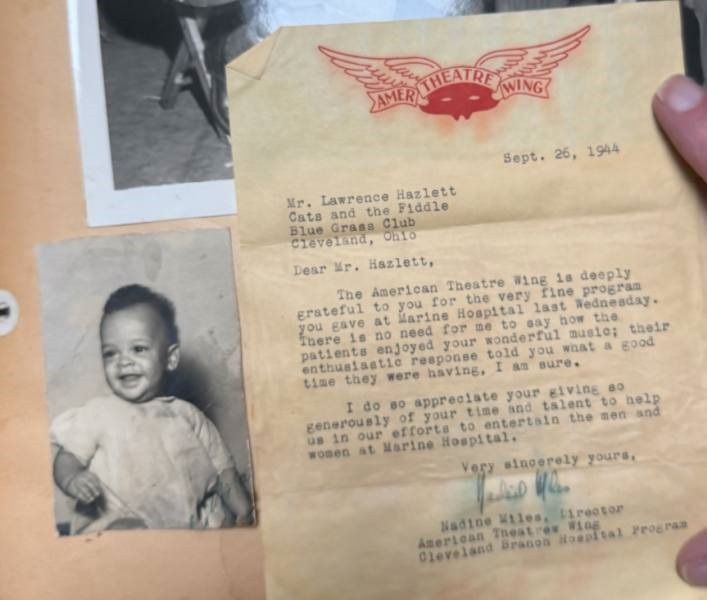
Another war-related story included in the scrapbook is a newspaper clipping that tells us of the Hank Hazlett era Cats opening for and then backing Lena Horne in a musical appearance in front of a hospital’s wounded soldiers. The Cat’s opening set was “Stomp, Stomp,” I Miss You So,” “Straighten Up and Fly Right,” with “Another Day” as their encore. With Horne at the mic, the combo supported her singing “Sometimes,” Stormy Weather,” and “Honeysuckle Rose.”

.
Having this dated letter from 1944 pasted next to the baby picture opens a theory regarding a possible child of Hank and Edith that I wrote about yesterday. A 1940s child could be part of Hank’s deferment, could be the right age to write Felicia’s letter to Daddy a few years later quoted in yesterday’s post, and later yet could also be a young, teenage woman, the subject of another picture in the scrapbook. That the thank you letter is addressed to Hank indicates to me that he might have been the de facto bandleader for the Cats and the Fiddle during his time with them. He was likely 6 or 7 years older than the other Cats in addition to taking the place of their regular lead singer — so, that role might have fallen to him.
A strong theme throughout the scrapbook is Afro-American pride and their struggle for equity in the arts. Many clippings demonstrate that the maker of the scrapbook was concerned with the stereotyping and constraints on Black entertainers and some clippings celebrate their achievements in overcoming that. Here are a few of those items from the scrapbook:
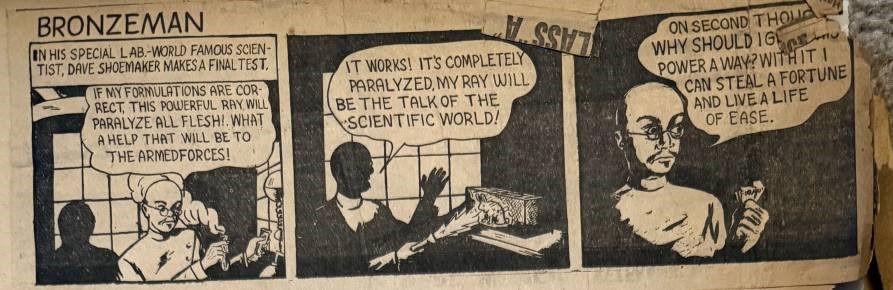
Did a bronze man create this? Yes. A.C. Hollingsworth created Bronze Man in Blue Beetle #42. As in Paul Laurence Dunbar’s famous poem, he was to “wear a mask.” Publishers changed things though. See this link.
.
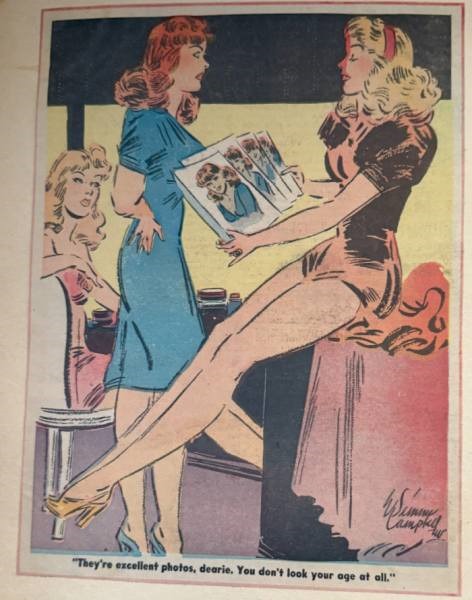
I wondered about a series of cartoons in the scrapbook. All white characters, nothing about music. What was the reason the scrapbook took note of them? The cartoonist E. Simms Campbell. was the first Afro-American cartoonist published in the big time U.S. “slick” magazines. His Wikipedia page says his work appeared in nearly every issue of Esquire magazine from 1933 to 1958, and in many other publications.
.
.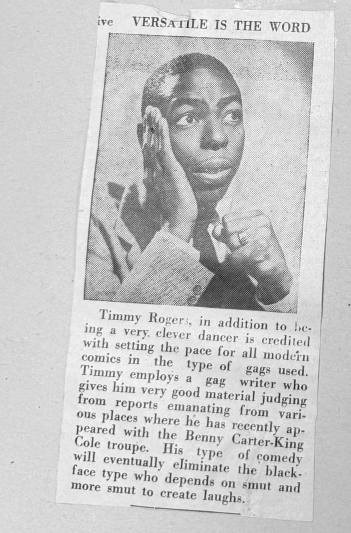
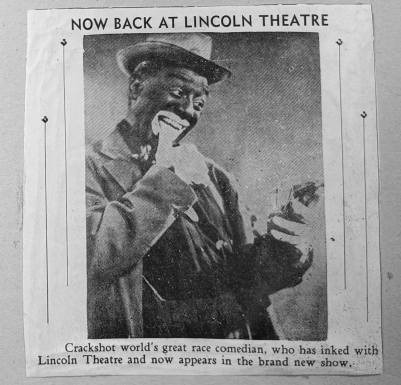
Dialectic, but make it funny: the clipping tells us Timmy Rogers was a Black comic who wanted to move beyond the blackface fool stereotypes. More info on Rogers. I can find nothing on Crackshot, though he’s given his clipping in the scrapbook too.
.

The entire multipage program for this landmark stage production starring the multi-talented Paul Robeson was pasted into the scrapbook.
.

Lena Horne, Dorothy Dandridge, and Butterfly McQueen. Three black women in entertainment who needed to struggle for non-stereotyped parts in the ‘40s. And keeping with our WWII subject, here are the Cats jamming with a white G.I. on bass. The armed forces may have been segregated, but music has established a beachhead. I note too, the scrapbook maker is paying considerable attention to women in the arts.
 I knew about Lena Horne and Paul Robeson.

I knew about Robeson, Horne, Dandridge et al. I’d never heard of Pearl Primus before this month’s examination of the the scrapbook. Her Wikipedia entry tells what she did. This, Robeson’s Shakespeare, and the comics artists above are examples of how the scrapbook’s maker wasn’t just interested in music, but had a broad interest in the arts.
.
Our summary today: not all warriors carry a gun. We’ve had war today, and prejudice, and stereotypes — and me writing a bunch more words (with maybe fewer typos). So, let’s have a little music, and poetry — and love not war. Here’s a poem by Afro-American poet Alice Dunbar Nelson written in the last decade to be called The Twenties. This may be Black History Month, but all I read next to my breakfast each morning this month is telling me that the nonsensical denigration of Black American military and cultural contributions along with a side-helping of gay panic isn’t history, just as it wasn’t history to the maker or makers of the scrapbook. To hear Dunbar-Nelson’s poem “You! Inez!” as I sang it to music composed today in-between typing this, you can use the audio player gadget below. No player? Elon hasn’t fired it, it’s just that some ways of viewing this blog suppress it. This highlighted link will open a new tab with its own audio player.
.
*A founding member and most often featured singer of the Cats and the Fiddle was drafted. The scrapbook doesn’t deal with this, but I did wonder why Hank or other members of that quartet weren’t drafted. Hank Hazlett was born in 1911, and in 1940 he’d have been 29. The WWII draft was different than the Vietnam draft I’m most familiar with — in my day, most called up were younger than 27. In WWII draft men up to age 35 were commonly drafted. I only know the age of one of the original Cats quartet, but the bass player would have been 22 in 1940, and since the original quartet all knew each other from high school, I’m assuming they were near the same age — yet, as far as I know only Austin Powell was drafted. This is a complicated subject and we know so little about the men in the Cats. There were classes of deferments for various reasons, and even stories that some draft boards didn’t want to draft Afro-Americans for Jim Crowish reasons — this even though the Armed Forces were segregated throughout the war. There were also stipulations for physical condition that histories tell us bedeviled the system during WWII. One oft cited report had it that in the draft first year, 1940, “nearly half the men drafted were sent home” for not being fit enough for service.
Or course a great many Afro-Americans did work in war-industry, or were drafted or volunteered for the military, despite the Armed Forces still hewing to the Jim Crow segregation/white superiority regime of mid-century America.
 Frank Hudson