I seem to have the kind of mind that, unbidden, sees connections. Probably drives some acquaintances around the bend, but regular readers here will have become accustomed to this. After all, this Project is about making a connection — likely unintended connection — between literary, page poetry and musical performance. Still, even though it relates to a mental reflex of mine, there’s “making,” work, involved in that combining.
So it was, that this month I went consciously looking for a connection, one I thought I might find between our American election results and the fear and despair around that event with the early 20th century era which I often look for to find free-to-reuse words to set and sing.
Where and what to look for in the era if trolling for such a connection? I wanted a short poem to leap out at me, one that I’d immediately flash on, in hopes it would attract even the casual listener here with a sense of recognition. I started paging through my Sandburg, who remains one of my personal models, but found no strong candidates I haven’t already performed.* I next moved on to a 1930’s volume A New Anthology of Modern Poetry edited by Selden Rodman. Rodman is one of those little-remembered figures I enjoy encountering in the Project, a litterateur and socialist activist who admired American Modernists — so connections right there.
The selections in Rodman’s volume look like an index of this Project’s authors, I counted 37 poets whose texts I’ve used in the nearly 800 published Parlando Project pieces.** His lively introduction promised what I was looking for, connecting the artistic discontent with old literary modes and tactics with social change and discontent.
Eagerly, I read on, looking for that flash of connection with the way folks I know are feeling this month. I read some fine poems, some I might even use someday here, but nothing came out of that quick skim and read that hit me with my sought property: “This sounds like it could have been written today.” Why not? When those poets wrote of their social injustices and feared outcomes the details of their times didn’t match closely enough to the details of our times.*** “It’s just details, what about the essence?” you might think. I thought that too, but I wanted listeners to feel it from the poem I was looking for. Details usually aren’t ephemeral in poetry, they are often the source of its emotional power.
If I’d left it there you wouldn’t have a musical piece to listen to today. But then I recalled Edwin Ford Piper, a man whose work I discovered earlier this year. Piper’s family settled in frontier Nebraska just after the American Civil War. He grew up there, knowing rural settlers, ranch-hands, and farmers at the turn of the century. To keep this a reasonable length, here’s a link to some of what I wrote about this deserving of more current attention poet earlier this year.
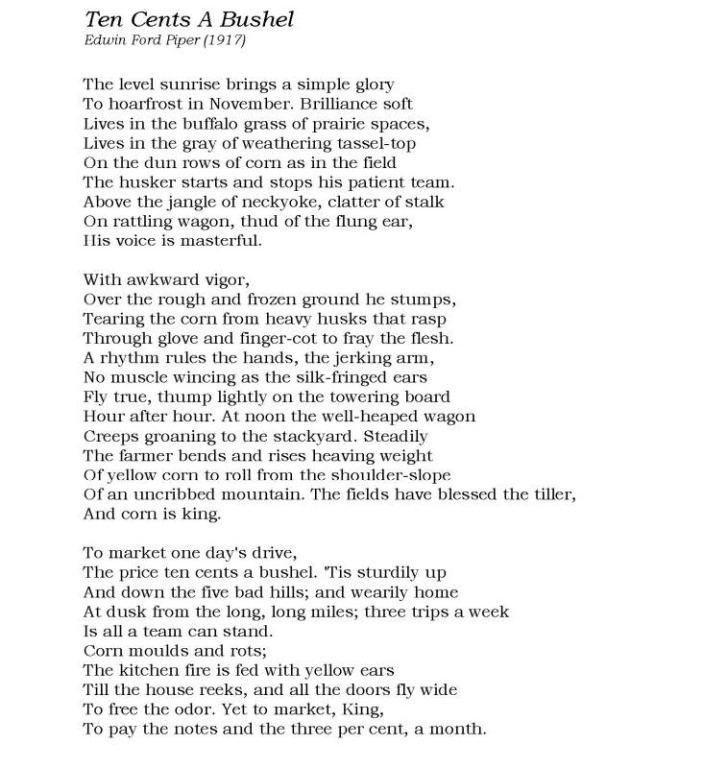
Here’s Piper’s poem I performed today as it was published in his collection Barb Wire
.
Piper’s poem “Ten Cents a Bushel” is about a small farmer. I doubt I have any readers who commercially harvest corn by hand, though some may have experienced something close enough. There are still agricultural workers, but modern field workers are usually employees, not caught in the exact resident small-farmer serfdom that is the center of Piper’s poem.**** I went with this poem anyway. In doing so, I accepted failure on my goal — at least so far — I didn’t find the brilliant connection between eras I was seeking. But if the poem’s details are off-target to today’s burdens, they are still powerful details. Piper’s poem lets us feel those details in our muscles and smell them with our noses, and the essence of the poem’s world, the repetitive stress of its rural Sisyphus’ burden, is something I expect some tired people can feel this month.
Today’s music? I prefer to call myself a composer, not a musician, even though I operate numerous real and virtual instruments in making these pieces. Modern digital recording allows me to maximize my inconsistent skills and to do with guile and planning what fingers and breath couldn’t accomplish. Be assured: “composer” sounds like a pompous title to me too, while “musician” retains the nobility of the worker. But there’s an element of my personality that sometimes tells the composer-me to back off with the theory and a build-the-musical-piece-with-ideas workflow, and barks “I just want to play!” Weeks like these, or times when I can plug into a loud amp and welcome that power vibrating in a room brings that energy forward. Today’s piece started with two inexpensive electric guitars and a bass playing loud in a room. The lead guitar I played is a Squier Jazzmaster, a model that wasn’t designed for loud, sustained-note playing, but can be forced to do it under volume by an elderly guitarist who can’t rip out rapid flurries of notes. You can hear that performance, my speaking Piper’s account of this November farmer’s harvest while playing more my mood than worked-out musical ideas by using the audio player below. No player? The bank hasn’t foreclosed, some ways of viewing this blog suppress the audio player gadget. This highlighted link is an alternative that will open a new tab with just an audio player of its own.
.
*I’m not disenchanted with Carl Sandburg. My results in this browse through his work may be because he doesn’t really do fear and despair as a predominant emotional frame. This may still be a good attitude to assay in these times, but not what I was specifically seeking. If you want Sandburg for this moment, perhaps this previous Parlando Project performance will serve you well.
**One blind spot: Rodman (who had considerable interest in Black Caribbean culture and history) didn’t include any of the Harlem Renaissance generation of Afro-Americans. I must resort to an academic meta-cultural term of art when I consider that: WTF.
***I did think this week about how to compare the injustice and fears which I naively thought I could measure between the 1930s and our time. I’m certain the levels of injustice were massively greater then. The fears? Even given their Great Depression, fascist governments, genocide factories, and a coming World War — I can’t say our fears are lesser.
****I started to write a conclusion here that would need to spin out more than a thousand words to do it justice. Such an epic would point out that those early 20th century rural farmers caught in an economic squeeze by powerful business forces up the supply chain from their crops, founded radical, effective, and practical political movements: The Farmer Labor Party, the Non-Partisan League. In the same parts of the land that today wave the red flag and the red hat, a very different rural political force was electorally successful. What’s with the same fields bearing different fruits in these two eras? That’s more than a blog post, something for someone with skills beyond mine. One naive half-formed theory: was there something about the largely immigrant-or-child-of-one, practical farmer or small-town-dweller of a century ago that saw through urban sharpies and charlatans, and focused on specific economic remedies?
 Frank Hudson
Great find. And yes, we academics rely heavily on the technical term “WTF.”
LikeLiked by 1 person