I indicated last time that I had another piece I wanted to present before Halloween by Walter de la Mare, that British master of the subtle supernatural. It took a bunch of concentrated effort to produce something of a realization of it, but it’s as ready as I can make it in time. How’d it come about, and why was I not sure I could promise it?
I use the Internet Archive often as part of this “not just non-profit — it’s non-revenue” Project. One of the things the IA has is a large library of scanned public domain literary works,* which affords me a handy way to look through “many a quaint and curious volume of forgotten lore.” In the run up to Halloween I made a note to see if there was some Walter de la Mare work I could use for my Parlando Project purposes.
This Project lets me not only explore the well-known writer’s and musical composer’s habit of procrastination, but also the reader’s and researcher’s branch of that foible too. I put that book search in my I’ll-do-that-tomorrow bin for about a week. “I’ll get around to it” I told myself.
And then in mid-October some numbskulls hacked the Internet Archive causing it to go largely offline for more than a week. When the scanned book section returned to availability, I was already into making other new work for this year’s Halloween series, but a few days ago I was finally able to access some additional collections of de la Mare’s work from the IA. In looking through those, I found that Walter de la Mare wasn’t only a poet. He also wrote short stories, which like his poetry, exhibit his dry sense of the strange. “The Three Friends” is one of his shortest published stories — short enough to work into one of my short-format audio pieces.
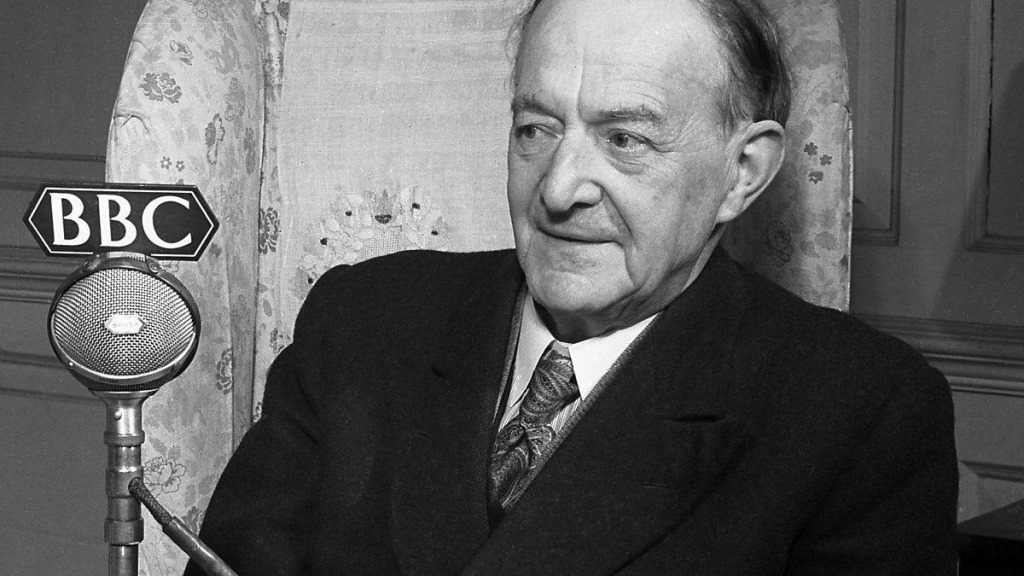
When Walter de la Mare worked the mic, he had a whole radio network to support him.
.
“The Three Friends” is dialog-centric, and in less than a day I was able to jury-rig up a three-person play out of it — but who’d be my voice-acting ensemble? It was less than 72 hours until Halloween. I’d have loved to have used Dave Moore’s voice, but my production schedule is catch-as-catch-can, and I didn’t know if I could corral him in time. My wife agreed to play the part of Lacey, the tavern keeper member of the three friends, assuming she wasn’t completely worn-out from her work and the rest of her life. Last night she stepped up to the mic and recorded that part in a quick pass. I made a logistical compromise and recorded the other two parts with my own voice, also working quickly.** By about 9 PM last night I had the dialog recorded.
Between then and about 3 PM this afternoon I worked on the audio production of the recordings, selecting a bit of instrumental music (from my last-weekend exploration of a new audio software feature) to serve as a plausible theme music for “The Parlando Project Theatre of the Air.” The 19 hours from first opening up the microphones to an audio play ready to upload weren’t all Project work: I did go to sleep after midnight, I got up at dawn and did a bicycle ride to breakfast, and early this afternoon I made another bike trip to the grocery store — but there was a lot of production work trying to meet the needs of this format that isn’t what the Project normally does. “Radio play” music production isn’t the same as recording and mixing a 3-minute song, and I had to learn how to apply my computer audio tools in a slightly different way. If you haven’t done audio production, it’s a heap of tasks even to get a half-way polished result: finding environmental sound effects, balancing levels, fixing the most egregious dialog glitches, deciding if any pauses are too long or too short, and so on. The result of this experiment is good enough to present, though I note things that I would have liked to do better.
So, what’s the story our actors are presenting for your ears today? Two friends are casually talking about a problem bedeviling one of them. That troubled man, Eaves, has been having reoccurring dreams or visions. His friend Sully tries to make light of it, but in the course of their evening they meet up with the third friend who works in a tavern, Miss Lacey. They talk over Eaves’ problem: you see Eaves thinks he has pierced the Samhain veil. Has Eaves seen, will he tell of, “the undiscovered country from whose bourn no traveler returns?”
Well, it’s de la Mare. Most writers would break out the purple pen to write such visions, de la Mare wants to make a more subtle (and human) observation. The orchestra (well, the piano trio) has started to sound. Take your seats and listen to the short, 10-minute world-premiere performance of the audio play “The Three Friends” by using the audio player below. What, has someone tall with a large hat sat in front of your audio player gadget? I provide this alternative, a highlighted link that will open a new tab with its own audio player.
.
*The Internet Archive has also taken an aggressive stance to works that are not clearly in the Public Domain. That activity is controversial and has had some legal judgements handed down for rights-holders. I won’t take your time to go into all that, but its scanned PD literary archive is a treasure for readers and researchers.
**Oh, if only I was one of those skilled voice actors who can call up entirely different vocal timbres to create distinctive sounding character voices! I tried to mitigate the lack of distinction between Eaves’ and Sully’s voices both being portrayed by mine by using stereo separation on today’s audio
 Frank Hudson
Enjoyed that very much.
LikeLiked by 1 person
Thanks. I got to crash into doing a different kind of audio production that I rarely do—out of nearly 800 Parlando audio pieces this is only the 3rd that not a musical piece.
LikeLike