The achievement of Emily Dickinson’s poetry is unusual, but the poem I set to music and perform today stands out even amid the rest of her work. This uniqueness has led to varied interpretations of what the poem is getting at: sometimes esoteric readings of the poem’s matter, written by folks plausibly smarter and more knowledgeable about Dickinson than I.
And so, if I was stopped before approaching this poem to make a song from it, I would have replied with a vague recall of what I’ve read: that it’s about something singularly, perhaps secretly, important about Dickinson herself — a striking, summary image of a rage or force she felt. Well, maybe it is. I’m not proposing that I have any authority to change any charge this poem has given you. I’ve often found myself ignorant or obtuse. Still, I found a rather different poem than I expected as I tried to arrange how I’d express the poem while singing it.
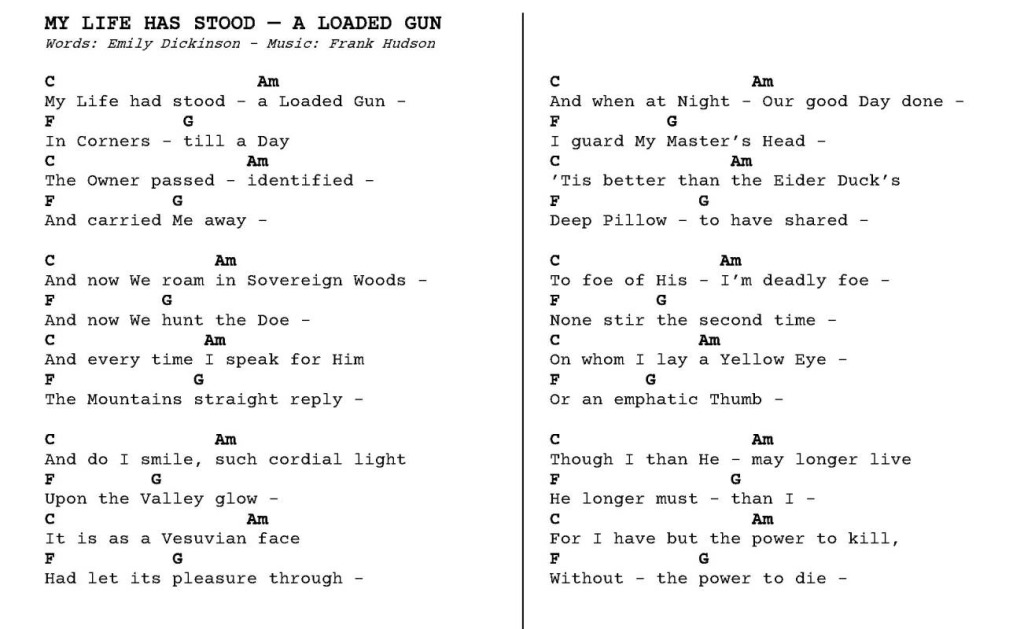
Here’s a chord sheet for today’s song. One intent in providing this is a hope others will sing it, perhaps better than I can.
.
The poem I read anew had Dickinson’s poetic voice playing a dramatic role, and the play is a tragedy whose protagonist is a sentient non-animal object, a gun. The gun’s relationship to humans, or particularly to its owner, is subservient and not rage-filled. It self-portrays itself as if it was a loyal dog: happy that it’s been selected like a pup from the pound, happy with a woodland walk in the company of its owner, proud of its sharp echoing bark. The stanza-scene where the gun is snozzled up to its owner’s pillow in bed, as if a sleeping pet, would make the most ardent gun-enthusiast contentedly smile.
Some readings have over-weighed the “stood” in the first line, as a Chekhovian gun frozen in the first act — all unrealized potential violence, a symbol of a quiet hurt or rage.
But then the turn, the volta. In the penultimate stanza the gun’s self-portrayal takes on another aspect: it’s like a gangland capo here, a deadly enforcer. Is it proud of its efficacy and efficiency in killing that it recounts? There’s no clear moralizing, but there is a contrast between that stanza and the sleeping master and gun. They will stir, and awake, while any foe the gun has shot will not “stir the second time.” The final stanza will tip our speaker-gun’s judgement on this.
Am I not diving deep enough into the wreck here? Am I stuck on the surface symbolism and not cognizant of the deeper meaning of what is being symbolized about Emily Dickinson, the middle-class, likely non-violent, non-weapon-toting woman? Could be, but as a singer of subjective quality, as a poor strutting player in this tragedy of the loyal gun, I might be able to convey that deeper stuff by playing the images well.
What was Dickinson’s self-knowledge of what she’s doing here? Was she the gun any more than Shakespeare was Macbeth or that Bob Dylan secretly sees himself as an Early Roman King? Deception and hidden meanings are a Dickinsonian trope, and the final verse clearly intends to be a hermetic riddle. I solve the riddle by thinking that the gun muses that as a non-living durable object it could outlive its human owner — but that in a better, wished-for world, the master would destroy it.
You can hear my performance of “My Life has stood — a Loaded Gun” with the graphical audio player below. No player seen? There’s one more bullet in your chamber — this highlighted link will open a new tab with its own audio player.
.
 Frank Hudson
The mood of your performance is so different from how the poem plays in my mind, but I like it a lot. I think this poem has maybe been too much of a monument for me to really connect with it, so it’s good to hear it slant.
LikeLike
The poem, at least as I tried to figure out how to perform it, quite surprised me. It’s reputation as ED’s sublimated rage was something I expected to find and present, and in my informal memory bank it was stored by its first line, so I recalled an unfired, silent, gun that merely “stands.” Instead, I saw an extended conceit on a personified loyal and oft-used killing weapon. While I is other and all that, and despite the 1st person monolog, I didn’t get a compelling sense the gun was ED. I thought the poem’s theme of loyalty was as strong or stronger as its theme of violent intent.
It was kind of interesting to pair it with her “Words like Blades” too. There the blade-wielder is “She,” but I could more easily think ED is presenting herself, or at least an aspect of a possible self there.
LikeLike