This week while attending the online reading of all 1789 Emily Dickinson poems as part of the yearly Tell It Slant Festival, I have been noticing how many Dickinson poems use music as a metaphor. I know she played the piano herself, but I know little about what her personal musical aesthetic was, or if there were other musical instruments played in her home. Piano could be then, as it still was in my mid-century lifetime, a home entertainment device — provided that the family could afford the space and the cost.
For whatever reason though, Dickinson chose to use guitar in this poem, and seeing my “home” instrument in it attracted me.
In Emily’s 19th century, guitar also played such a home entertainment role. I have a somewhat worn-out, very small bodied six-string that I sometimes play, and in today’s guitar marketplace such guitars are often called “parlor guitars.” The historic usage that name honors was that with less cost in space than a keyboard instrument, a home player could entertain themselves or their housemates with a guitar. These small guitars easily suited smaller-bodied women* and many of the players in the home were women.
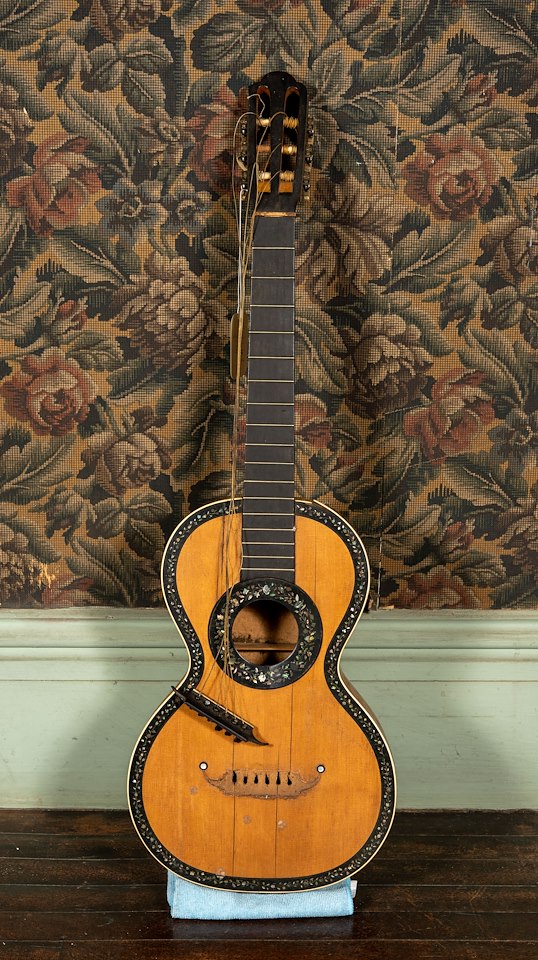
A parlor guitar from the Emily Dickinson Museum’s collection**
.
When it came to realize my music for this poem, I didn’t play my parlor guitar — I played an electric model — but as I continued to go over the words in the process of creating the audio piece I’m not sure that Dickinson had an actual guitar in mind either.
Touch lightly Nature’s sweet Guitar
Unless thou know’st the Tune
Or every Bird will point at thee
Because a Bard too soon —
The opening line, used in place of a title as we do with Dickinson’s untitled poems, has somewhat conventional words for playing a guitar: “touch” “lightly” and “sweet.” Indeed, a parlor guitar like mine responds sweetly to a lighter touch and isn’t designed for driving picking such as used in some later American guitar styles. But Dickinson is a master at choosing the unusual word, the one you or I might never come up with. Her opening line calls it “Nature’s…guitar.”
Given that she moves over to bird’s opinions by the poem’s third line, I think this guitar may be figurative. Its wood and strings might be tree branches, and the Bard too soon, a too early storm. Still, the final line might be speaking of prerequisites for musicianship or songcraft, seeming to warn that a player should be cautious until they know their “song well before I start singing” as another songwriter once stipulated.***
I left a middle section open for an additional top line when Dave and I recorded the basic tracks last week. Afterward I wasn’t sure what should go there, but I decided to score one of my simple orchestral instrument parts for this featuring a violin. You can hear the result with the audio player below. No player seen? Touch lightly this highlighted link and it will open a new tab with its own audio player.
.
*They weren’t made especially small, the petite size was normal for guitars in that time. The current standard size acoustic guitar in our era, often called a “dreadnaught” (because it was seen on arrival between the World Wars as big and formidable as a battleship) is much larger in dimensions: deeper, longer, and wider, and often with a longer-scaled neck.
Men played these small guitars too. In an earlier post I showed a picture of what purports to be Mark Twain’s own guitar, which is also that then standard parlor size, though Twain said he played it for the roughs in his California sojourn.
**The Museum has only recently been able to digitally document the artifacts in its collection. Perhaps due to the difficulties in provenance because the houses of Emily Dickinson and her brother and important friend and sister-in-law Susan Gilbert Dickinson did not pass immediately into museum curation, there is no online information as to who may have owned it, or even if it was played in Emily’s presence. I’m somewhat knowledgeable, though not a professional appraiser, and think this guitar could be a 19th century instrument. The collection’s picture of the back of the guitar shows a blacksmith-quality repair at the headstock joint. A common guitar injury, then as now, is for the neck to fracture at that place. My somewhat-informed-amateur’s opinion is that the headstock may be later than the rest of the guitar and was grafted onto it.
***A stipulation I disregarded, as the first song I learned to play was the Dylan song containing that line, “A Hard Rain’s A-Gonna Fall.” I did not touch it lightly.
 Frank Hudson