Gone, Gone Again

Let’s return to sing the poetry of a man who’s far better known in Great Britain than in the United States, Edward Thomas. Thomas had a remarkably short run as a poet, only writing verse for about two years after befriending and sharing thoughts about writing and the observation of the countryside with Robert Frost during the latter’s stay in England just before WWI.

Thomas was no longer young when he started writing poetry, and he had scratched out a living as a freelance writer for several years before he met Frost. None-the-less, two years is a very short time to develop as a poet, and today’s piece “Gone, Gone Again”  may show some rougher places commensurate with a poet who hasn’t fully developed his game.

As I worked with “Gone, Gone Again” as an audio piece with music, some of its odd poetic faults continued to jab at me, but as is sometimes the case with the Parlando Project, I grew to appreciate the poem and Thomas’ unique read on time and life more fully from the effort spent with it.

The poem’s meter is awkward and uneven, the rhyme unpredictable. A casual reader could hear it as doggerel. As the poem reaches its conclusion, with the only perfectly rhymed quatrain in the piece, the sentence seems twisted in order to make the rhymes.

How much of this is intended and how much of this is a beginner struggling with the verse? Who can say. From working with it, I think the rhyme scheme that refuses to be—well, a scheme—is likely intended. It does keep you off balance, but I think it’s effective. The meter with its odd steps, is likely just as intentional, though I’m still not sure it works as well for the performer or listener. Even in the performance you’ll hear today I didn’t reproduce Thomas’ text correctly, rounding off a few of the rough spots, and revising the last line of the fifth verse. Another musician who has worked with a great many poems, including a number by Thomas, gracefully manages to sing this poem unaltered, though I’m now somewhat attached to my “mistaken” changed line.

grass gowing inside 3

Thomas wrote “Grass growing instead” which would be consistent with a house abandoned an unknown time ago, but I sang “Grass growing inside,” which while a strong image determines it for long ago.


What then comes from repeated readings, or from the time I had to spend with this poem in order to turn it into a song? Thomas is playing with time. He starts off with a common trope: and end of summer poem. How many of us are having this same thought, “Where did the summer go?” Almost as if he’s leaving his own critical note, Thomas’ second stanza says right out, “Not memorable.”

And then he adds: “Save I saw them go.” Already, the poem starts its turn into a poem about survivor’s guilt.

In the next verse, we’ve gone from a ballad stanza style rhyme scheme, to a verse that starts with a rhymed couplet, followed by an unrhymed couplet. You really feel the lack of rhyme every time you sing or say “The Blenheim oranges/Fall grubby from the trees.” The curious pendant in me had to find out what a Blenheim orange is. It can’t be an orange, can it? As the sentry in Monty Python’s Holy Grail  reminds us: “Found them? In Mercia? The coconut (like the orange) is tropical! This is a temperate zone.”

The Blenheim orange is instead an English apple variety. Blenheim orange is a flavorful name though. It’s even an alternate title under which the poem is sometimes published. Assuming intention, Thomas may have chosen it not just because the apple is named the same as an imposing palace in Oxfordshire, but because the palace, and presumably the name of the apple as well, comes from a battle that was already 200 years ago when Thomas wrote his poem, a key engagement in the European War of Spanish Succession.

This may be too subtle by half, a College Bowl or Jeopardy-level question about history that almost everyone in the audience will miss.

Here’s where the play with time part returns. The poem next visits an abandoned house site, a trope that Thomas’ friend Robert Frost would go to more than once in his own rural poems.

Thomas is writing his poem in the context of WWI. During his entire poetic practice, he was grappling with the question if he, nearing 40 years old, should volunteer for battle service in WWI. He’s considering this well past any illusions of a grand battle adventure. He’s well aware that modern warfare has turned technology into an efficient killing machine, in his disconcertingly brutal phrase, turning “young men to dung.”

How long as this house been abandoned? Since the war of Spanish Succession? Since the outbreak of WWI (which might be the cause that river barge traffic is absent and those apples falling unpicked)?

Here the poem completes its turn: a compressed meditation on the losses of the cycle of life with or without the fortunes of war, four warm months started us off, May to August; now life is four as well “Youth, love, age, and pain.”

Thomas’ conclusion is stoic, fatalistic. The final verse’s schoolboys are a rich image, at once nihilistic vandals and the reduction of reason and textbook learning to emptiness. In Thomas’ time, WWI has broken the world, and he eventually decides that the call of duty, however irrational, is the only way to take part in the mending and solace of tradition.

I talk-sing this for the most part, but it’s a fairly full orchestration that I mixed in the background of the acoustic guitar/folk music song I wrote for this. The strings are quiet, but I let an oboe, trumpets and a fluegelhorn come a bit forward at times. The virtual instrument versions of brass instruments don’t sound as authentic as strings and keyboard virtual instruments do, but I wanted a bit of that flavor in there anyway. To listen to “Gone, Gone Again (The Blenheim Oranges)”  use the player below.
Parlando Spring 2018 Top 10-Part Two

Continuing on with our count-down of the most listened to and liked audio pieces from the Parlando Project during the past quarter, we’ve now come to numbers seven through five.

At number seven this time is an example of how the Spotify listeners differ from the blog listeners. This piece received only a handful of listens on the blog this past spring, which isn’t unusual, as “Sky”  was posted there last summer, and blog users tend to listen to the latest posts unless brought here by a search engine. On Spotify though, “Sky”  has seen steady action, and enough plays there to make it one of the most listened to this spring..

I like the idea and outcome of looking at the Midwestern sky that multimedia artist Laurie Anderson explained in an interview that I quoted to make the words for this piece, but I’m not sure what attracted all the action on Spotify for it. Is it the short, somewhat generic, title perhaps? As we’ll see later this month in the countdown, another of the Parlando pieces with a one word title was very popular on Spotify in the past few months.

Well, no matter blog readers, here’s “Sky” brought to your attention by the listeners on Spotify.


One of the Parlando Project principles is “Other People’s Stories.” There are a good number of Internet locations where people post their own poems, and blogging in particular is often autobiographical. I could do the same, but I have a contrarian streak, and I find responding to other people’s words and figuring out how to perform them interesting.

I don’t dislike autobiographical blogs, I subscribe and happily read a handful of them myself. If prodded, I can go on way too long about myself, just as I have a tendency to do on any subject, and having had my first poem published almost 50 years ago, I’m certainly not against revealing my own poetry. “Other people’s stories” is a choice I find helpful, that’s all.

I will use my own poetry/lyrics in the audio pieces here from time to time, though I like it when they are my words about other people, such as the number six most popular piece last spring, “Anglers.”  This is the story of my father and his youngest brother’s sport fishing, something they spent many pleasant days doing before my father became too old and frail for his beloved outdoors. Those days seemed timeless even as they were occurring decades ago, and those lakes have become mysteriously reflective in memory now. So, in writing of them I added notes about passing between dimensions.

I’m proud of how this came out, and glad so many have taken the time to listen.


These Top Ten lists often include well-known poems by well-remembered poets, but that contrarian streak in me likes to look at those less remembered and see what might be of interest there. Richard Aldington is one such case, a writer who was active in the pre-WW1 London circle that created Modernist poetry in English. Coming in at number five on this spring’s list is this charming poem of his “The Poplar.”

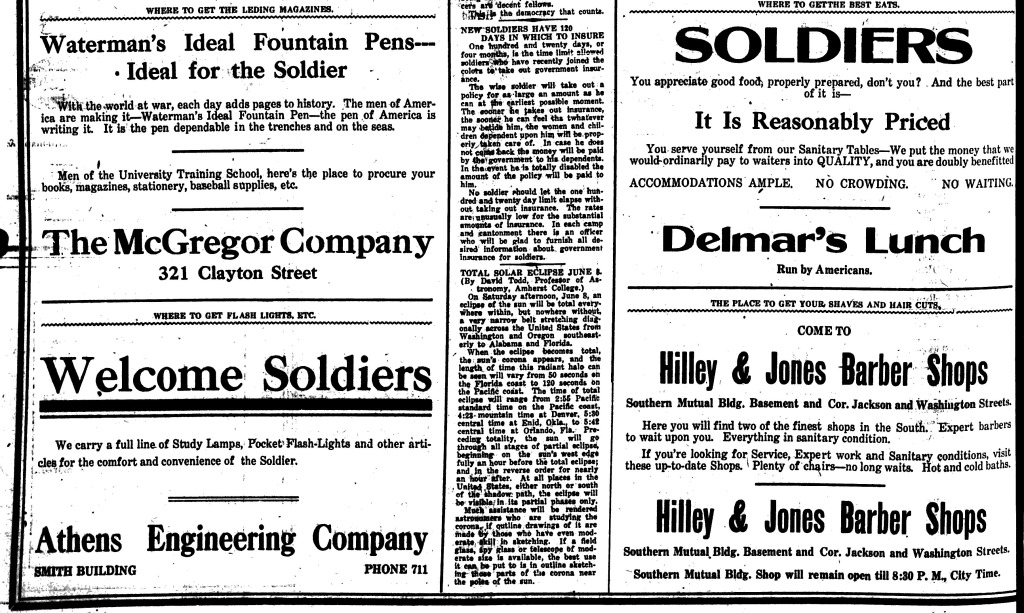
David Todd asks Athen GA artists to sketch eclipse

62 years before REM was formed in that town, astronomer David Todd asks artists in Athens Georgia to sketch the June 8th 1918 total solar eclipse. Note the ads pitching goods to WWI soldiers. “Delmer’s Lunch – Run by Americans”


Since it is easiest for me to use poems here that are in the public domain, the newest ones are often from that Modernist revolution that occurred in the first two decades or so of the 20th Century. There are weeks when I think I must be living 100 years ago more than in 2018, as I look for and read poetry from that era. Do I find this a refuge from 2018? No. The horrors of WWI (which impacted Aldington, who served, significantly), the realities of racial, class and gender attitudes then, mean this was no golden age. But what does surprise me reliving the genesis of English Modernist verse as I read their work now, is how they employed broadly accessible images in their Imagist poetry.

The post-1920 High Modernism that was largely used to represent the Modernist movement when I first encountered it is full of obscure references, exotic words and locations, events so far into the imagination and the special dialects the poet chose to reflect those inward locations, that a reader is confronted by a world they can’t comprehend the landscape of, much less the meaning of what occurs there. There can be beauty and insight in this, but it’s a world that assumes one will come prepared, well-equipped with poetry expedition gear and maps.

But before all this, as Modernism was forming itself, the poems are still in a world much like the one inhabited by the general reader, like this graceful and musical one. Give a listen to Richard Aldington’s “The Poplar”  below.


Other peoples stories. How can I connect sky-watcher and eclipse sketch promoter David Todd to poetry? Todd was a pioneer of “eclipse chasing” as well as a theorist of life on Mars. His wife, who documented his trips to view eclipses was Mabel Loomis Todd. Back in the 1880s Mabel had a scandalous long-running affair with Emily Dickinson’s brother, who lived next door to Emily. After Emily’s death, Mabel Loomis Todd was the person who saw to the publication of Emily Dickinson’s poetry. And when we return soon to continue our count-down, we’ll have a poem from Emily Dickinson.

In Memoriam Easter 1915

Here’s a story about a poem appropriate for this Memorial Day, though the story includes three Easter holidays.

First Easter: on Easter 1913 in March, a freelance writer, normally so pressed for a paycheck that he worked 15-hour days writing piece after piece, started off on a bike tour across Britain from his home near London to the south-western coast of England. Of course, there was a paycheck involved, a travel book was planned and resulted, which was called In Pursuit of Spring.

Edward Thomas Easter Bike Trip 1913 crop

Can’t tell the model, but from the front it’s clear that Thomas was riding a classic English “roadster” on his tour.


This trip started in overwork and near the ending of a glum winter, and finished in May with true spring; and this bicycle journey allowed the harried writer to expend a bit more focus on his writing. In the book, his trip ends in Somerset England, but a packet of photos he took during the trip indicates that he must have somehow crossed the Bristol Channel to Wales, the homeland of his ancestors. A tell-tale photo with his handwriting on the back was discovered recently, saying it was taken near Tinkiswood, the site of a Welsh Neolithic stone burial chamber. A year later the site was excavated, and 920 human bones were located. Welsh legend has it that staying the night in the chamber will cause any surviving visitor to go raving mad or become a poet. That wasn’t included in the book.

The overworked freelancer who took this journey was Edward Thomas. Shortly after the journey completed, he met a then little-known American poet who’s work Thomas had reviewed perceptively. The poet was Robert Frost. Frost read In Pursuit of Spring  and suggested that Thomas should write poetry.

“How so?” asked Thomas.

Frost told him that Thomas had already shown close readings of the book of nature and the rhythm of verse in passages in In Pursuit of Spring.

So, at this time Thomas began writing poetry, extraordinary poetry that is little known in the United States, but which is much loved by poets and readers in the U.K. Some of it so concise and so infused with deep attention to the natural world’s calligraphy that it rivals classical Chinese and Japanese forms.

And World War I breaks out.

I’ve already written about Thomas’ dilemma in deciding if he should enlist in the war, and Frost’s part in Thomas’ ambivalence, so here I’ll just say that Thomas did enlist. The records say it was in a company called “The Artists’ Rifles.”

Can Americans of our time imagine such a military organization? Of course, artists of all kinds have served in America’s military services, but I can’t envision that sort of name being used here in place of something like “The Screaming Eagles.”

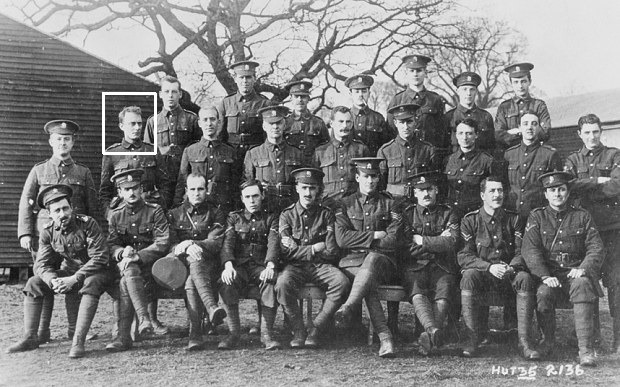
Edward Thomas' company in training with Thomas in rectangle

Thomas’ company in training camp


The second Easter: the somber name today’s poem was published under was not his. Thomas in his manuscript simply wrote down the Eastertide date in 1915 when he apparently wrote the first draft of this, two years after he’d started the trip that had indirectly formed him into a poet. That summer he was even stationed for a while on military training in one of the towns he’d passed through on the bicycle journey.

But never mind the name, what a poem. It’s four lines, a single quatrain. Nearly every word is telling, even ones you slide over in the first line. Decades later Pete Seeger wrote a song, “Where Have All the Flowers Gone,”  condensing an episode from a WWI novel expressing a similar idea to Thomas’ poem. Seeger’s song is not long as songs go, but it’s a good length for a room to sing along with. Thomas’ poem has only started when it comes to its fourth line. The previous line breaks abruptly, enjambed, with “should,” and its final line reveals itself as it unwinds in heartbreaking fashion.

And Thomas? A third Easter: another spring, 1917. His diary entry in France wonders if the enemy is unseen in the fields ahead of him, which he still must view with the precision of a nature poet. He pauses to light his pipe. A bullet pierces straight through his beating heart that, will, do, never, again.

To hear my performance of the poem eventually published as “In Memoriam (Easter 1915)”  use the player below.


Additional notes:  There’s a new paperback edition published a couple of years back of In Pursuit of Spring,  which includes for the first time the photographs Thomas took during his journey, and it’s available from booksellers. Yes, English people do take up the idea of trying to duplicate Thomas’ bicycle trip today, for example Kimberly Rew, the  guitarist alongside Robyn Hitchcock in The Soft Boys and songwriter and guitarist of Katrina and the Waves, and also the Nick Drake estate manager and vintage bike enthusiast  Cally Callomon, whose plans included riding the trip on a period-correct English roadster bike.

I recognize that Memorial Day is an American Holiday, directly derived from the post American Civil War Decoration Day. I know this blog has a large segment of U.K. readers, so to explain: in the U..S. we have two holidays celebrating the armed forces, Memorial Day, which retains some of it focus on honoring the dead who served, and Veterans Day, which is the U. S. holiday that coincides with Remembrance Day. For readers on either side of the Atlantic who’d like to hear the LYL Band present a performance of an American poet for Memorial Day, here’s Carl Sandburg’s “Grass.”


Good Night Ladies

While performing and posting about T. S. Eliot’s “The Waste Land”  bit by bit this month, have I mentioned enough how artistically revolutionary it was? For today’s section let me talk first about form and then about subject, and I’ll share a little-known episode in Eliot’s life that may have contributed.

I call today’s part of “The Waste Land” “Goodnight Ladies.”  Formally, even today, nearly a century later, a section of a major poem written like this would be provocative. First off, it’s not “poetic” in its language. While there’s a minimal irregular structure from the interjected closing-time refrain of the bartender’s call, there’s no striking images, meter, rhyme, melodic flow, and certainly no “poetic diction” in it. It’s part in the musical structure of this very musical poem is to present a section with no music in its words. While politically and culturally apart from the Dadaists working at the same time outside of England, Eliot’s structure for “The Waste Land”  is to throw in jarring and unannounced cuts in voice and setting. Even sophisticated, educated readers cannot agree how many voices and scenes are present in the “A Game of Chess,”  which this passage concludes. I made it three pieces, three scenes, others think differently. Eliot has already used plenty of high culture references in the “A Game of Chess”  section of “The Waste Land”  before today’s scene: Shakespeare, Ovid, and obscure Jacobean playwright Middleton—but he’s also thrown-in a pop song parody. Now he concludes “A Game of Chess”  with a bit of working-class pub dialog absent of any literary allusions (until the very end).

The speaker, an unreliable narrator, as well as her subject are working-class women. There is no sentimentality. This isn’t a “salt of the earth” bit of condescending or ennobling praise. The speaker is unkind and perhaps duplicitous (the implication is that she will, or has, put a move on the subject’s husband), and her subject, Lil, is a woman described uncharitably as looking “antique” at age 31, after multiple difficult pregnancies and an induced abortion.

The monolog, if not poetry, feels authentic. The depiction of class and sexual politics, is sharp and unstinting. A poet like Carl Sandburg, the radical and newspaperman, could have heard such dialog—but where the hell did T. S. Eliot, upper middle class raised, prep-schooled, Sorbonne and Harvard (legacy) educated, international banking officer, and furthermore, a man with a reputation as stand-offish and diffident toward women—even those of his class and cultural background—get informed enough to write this passage?

I couldn’t let that question go without some research, and I think I found an answer. It’s one of those “this would make a great movie” moments in literary biography. I knew Eliot had taken a crack at teaching school at a boys-only school in Highgate. That’s the start of the story, he taught French, Latin, math, history, drawing, beside duties coaching baseball (!) and swimming. One of his students: a 9-year-old John Betjeman.

Schoolteachers will know what kind of workload that entails. The bank officer job that followed was a relief to Eliot.

Here’s where it gets interesting. Through some connections, he was introduced to the Workers Educational Association. They were organizing college-level night school classes in Southall. Eliot applied to teach Modern English Literature there, and he continued to do this from 1916 through 1919. Since WWI was on, with many men overseas, the classes were ¾ women.

The weekly classes were a lecture followed by an hour of discussion. Regular papers and reading were required of the students.

What was the experience like for Eliot and his working-class students? Surprisingly rewarding for Eliot, and (as far as we know) for the students. In letters home to America, Eliot praised the minds of his best students, singling out several women. In an account he provided for the Association’s 50th Anniversary in 1959, he could still recall one in particular:

“There was one poor young woman who was one of my best students, but was an elementary schoolmistress with a very large class of little children in the daytime and (she)…died, I am sorry to say, of overwork.”

Was Eliot being polite in both his contemporary letters and his remembrance letter to the Association? Perhaps he did gloss over, or was unaware of, the difficulties one could imagine between himself and his students—but he did this for three years, as a second job that was presumably not his main source of income, and each year, he asked to do one more. Each year, he developed a new syllabus covering additional authors for his literature night-students, some of whom stayed with him for his entire run.

Students-inscription-to-T S Eliot 1919

Inscription on a gift copy of The Oxford Book of English Verse signed by his students on the day of Eliot’s last lecture. The longer article about this is a must read for those interested in this little-known period of Eliot’s life.


Was that worn-out school-teacher, or some other night-school student, a model for Lil in today’s portion of “The Waste Land?”  It seems possible. After reading this, my thoughts went to those students, hungry to learn and experience more about literature in the London night speculating of Zeppelin raids. How I wish we had accounts from the students as well! In “The Waste Land,”  Eliot wasn’t going to give us anything he learned about their joys, or any compensations they found for the travails of their lives, anymore than he gives anyone that. We’re left, in today’s piece, with this mean girl’s account of Lil, unsparing in scorn, revealing Lil’s burdens as more of the weight of the timeless waste land on post-WWI Europe. Eliot doesn’t even give her story, told so meagerly, any ennobling literary references, nor any poetry, does he? Just a story in a bar.

Wait. Her name’s Lil. Lillith? Possible, but I think not. How did this poem begin? “April…breeding lilacs  out of the dead land.” And the last line, the one I use for the title of this performance? It’s no longer the recounter of Lil’s life speaking (she who says it “goonight” not “good night”). The voice has shifted again, without warning in this unpredictable poem. It’s the voice of Ophelia exiting to her death by water in Hamlet.

Ophelia by John Millais

Ophelia by John Millais. Almost nothing to do with Eliot and “The Waste Land,” but it’s been too long since I’ve been able to put a Pre-Raphaelite painting in a post.


The reader in this performance is Heidi Randen, who does a great job with the words and keeps me from having to inflict my voice in too many pieces here. To hear it use the player below.

Rats Alley

Continuing in our April Poetry Month serialization of “The Waste Land”  by T. S. Eliot, it’s come time to perform the next section of the poem, which I call “Rats Alley.”

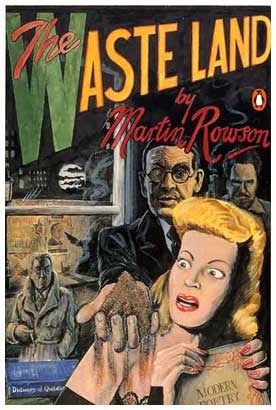
It just happens that this week I got a copy of Martin Rowson’s “The Wasteland,”  a 1990 comic-book riff on Eliot’s poem as if written by hardboiled-detective fiction writer Raymond Chandler and filmed like “The Big Sleep”  or “The Maltese Falcon.”  Rowson notes that in “The Long Goodbye”  Chandler had referenced Eliot’s “Prufrock”  with a character quoting “In the rooms the women come and go, talking of Michelangelo” and having the character ask his detective Marlowe “Does that suggest anything to you sir?”

Marlowe replies, “Yeah—it suggests that the guy didn’t know very much about women.”

Though that’s clever repartee, charges that Eliot was naïve about women or even misogynistic can be difficult to disentangle from his general misanthropy. A female Chandler character may be given more apparent agency than the women in Eliot’s “The Waste Land,”  but both the male and female voices of “The Waste Land”  are frankly damaged and the minor male characters, wraiths and zombies.

Rowson Wasteland1

Sometimes with a dame you gotta show’em some quotations in Greek or Latin.


In any case, Rowson’s comic-book/graphic novel is a lot of fun for fans of Film Noir and Chandler, or Eliot and Modernist lit. His drawings have more in-jokes than a season of “The Simpsons”  watched with a finger on the pause button. And from his notes Rowson supplies in my edition on dealing with Faber and Faber and the Eliot estate, it could have been even funnier if any of them had allowed the comedic-take to use any of the lines from the poem. I laughed often reading the Rowson, but never so much as when he recounts being refused the rights to use the ancient Greek and Latin quotes Eliot dropped into his poem, because Eliot’s rights now include them as part of a unique compilation. That may well be legally sound, but it’s also howlingly funny. Eliot as he wrote his “Waste Land”  was clearly borrowing widely from other authors’ work, because he thought it would show us something new when he put them in another context—the same thing that Rowson’s book sought to do.

Which is also what we try to do here as part of the Parlando Project, show you familiar and unfamiliar words in the context of different music and performance styles.

“We are in Rats Alley, where the dead men lost their bones”

“Rats Alley”  is a dialog, and the two speakers are clearly broken vessels. The woman dissatisfied, depressed, afraid, maybe even unstable. The man, numbed, haunted, unable to express even the short expressions of discontent the woman speaks. When he (once in the poem, three-times in my performance) breaks into the cryptic “We are in Rats Alley, where the dead men lost their bones” I decided to alter the voice, to make it a third voice. She’s asking him to speak, to tell her what’s going on, but she doesn’t seem to have heard him say anything, other than a litany, literally, of “nothing.” And so, I’m portraying the Rats Alley line as his inner torment, his monster, that is heard loudly, but only in his head.

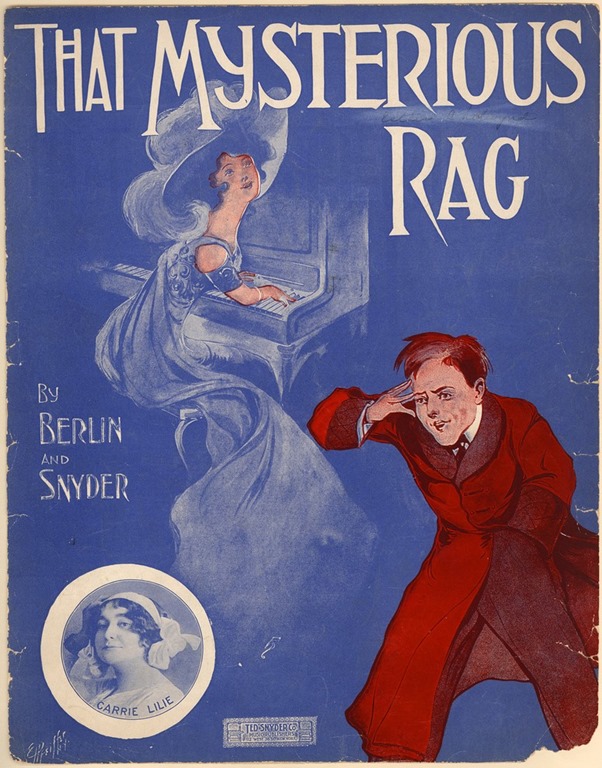
That_Mysterious_Rag_1

“In the rooms the women come and go, digging riffs from Ahmad Jamal”


Rats Alley sounds like yet another reference to some dark Jacobean revenge play, samples from which Eliot has already peppered his poem with. If it is, no one has found that work. Some speculate it sounds like the darkly humored street-signs WWI trench-soldiers hung on their subsurface battle lines. If so, then the last voice, the fourth voice of the piece, an imaginary, comic ear-worm song Eliot has made up, “That Shakespearean Rag,”  could also be an internal voice. It’s sometimes been considered to reference Irving Berlin and Ted Snyder’s “That Mysterious Rag,”  a giant pre-WWI hit with lyrics that say “Did you hear it? Were you near it? If you weren’t then you’ve yet to fear it.” In the hit parade context, the lyrics turn out to be just bragging that this rag is a killer hook “because you never will forget it.” Eliot substitutes Shakespeare in his parody, but is this male voice a soldier, haunted by the trenches and dead comrades to whom old tunes now take on a new context, a sinister edge? It’s a bit of a stretch, but could Eliot have planned to use “That Mysterious Rag’s”  mock-dangerous lyrics as a counterpoint to his scene—wouldn’t that have been a powerful sample!—but was enjoined by copyright issues?

To hear my performance of “Rats Alley,”  today’s segment of Eliot’s “The Waste Land,”  use the player below. You can hear the first section, “The Burial of the Dead”  or the first part of the “A Game of Chess”  section which I performed as “Visions of Cleopatra”  by looking in our previous posts this April as we celebrate #NPM2018.

Thaw

I like to mix up our musical encounters with poetry here, using both well-known and lesser-known poems. Here’s one you probably haven’t heard before, written by a poet who is less-known in the U.S. than in his native Britain, Edward Thomas.

In 1913, Thomas was 36 years old and was scratching out a living for his family as a freelance writer on whatever topics could generate a check, but his real passion seemed to be as an enthusiastic naturalist. He liked nothing better than to walk about the countryside reading the book of nature, jotting down notes about what he’d seen. Then he met a similar no longer young writer, a 40-year-old American who wanted a career as a poet.

The American had not found his own country in agreement with his vocational desire, and so he had flipped a coin to strike out somewhere else: Canada or England? He knew no one in either place, it was just a hunch that someplace different might change his lot. The coin came up England. He took a cottage in the Cotswolds, near to where Thomas was living. The 40-year-old American poet? Robert Frost.

Over the next couple of years, the two men developed what would be the most significant friendship in their lives. Now Thomas had a companion besides his notebook on those nature walks. Although Frost had published only a handful of poems in periodicals at this point, Thomas saw his talent, a man who could write metrical verse so supple that it didn’t seem like poetic diction. In turn, Frost saw another poet in this self-described “hack writer” with his avocational notebook.

Thomas and Frost

Nearing 40 years old and yet thinking about poetry. Edward Thomas and Robert Frost.


Frost published his first two books of poetry in England, “A Boy’s Will”  and “North of Boston,”  and Thomas reviewed them enthusiastically, helping launch Frost’s literary career. And with Frost’s encouragement, Thomas’ notebook jottings became poems.

In 1915 Frost moved back to the U. S. where publishers would now publish American editions of his poetry. Edward Thomas, and his family, were to follow. The two poets were to live near each other in America and continue their fruitful friendship.

These two men, these two friends, who each could write tremendously concise poems in which a natural drama could play out in but a few lines, had one constitutional difference. Frost was reconciled to chance and fate. He would jump oceans with a coin flip. If lost on a road by a snowy woods on the darkest night of the year—well keep on driving that buggy onward in the dark. Thomas, on the other hand, believed that introspection and judgement, an ever-closer reading of the book of nature could discern the right choice. If two roads diverge (as they would when he and Frost walked the Cotswolds) your honor derives from making the correct choice from the inconsistent evidence.

Back in the USA, Frost wrote his famous, misunderstood, poem about those two paths and sent it to his friend, still tarrying in England, and Thomas became the first person to misunderstand The Road Not Taken.”  No matter how much we honor the author’s intent, the poem exists after it’s creator. Thomas’ outlook saw the undercurrent in the poem, that choice could be important. Thomas thought: if Frost was making gentle fun of that, no matter, that was the point.

Here’s a small, four-line poem that Thomas wrote about spring, “Thaw.” As often with Thomas’ poems “Thaw”  is set on a nature’s large stage, but it’s a very short drama. Winter’s snow, as it is here in Minnesota today, is half-melted. Crows are cawing in tree tops, as the crows I saw today on my morning bike ride to breakfast were too, speaking the inscrutable language of crows. I saw one swoop down and frighten a foraging squirrel on a lawn, the black bird somewhat larger than the squirrel—and then, larger yet to it when the rook spread its wings and hammered out its hard-consonant caw.

The squirrel hopped like something had exploded underneath it and disappeared. These natural decisions could be read if one picks up the book of nature.

In Thomas’ “Thaw,”  the poet has come to understand that the crows know spring is coming, they are nesting already, and their treetop kingdom, unlike the ground beneath the poet’s feet, is snow free. They have read the book of nature more perceptively.

In Frost’s “The Road not Taken”  the comic narrator will sigh “ages and ages hence” about not having read nature right, of having lost the experience the road not taken would have given him. Edward Thomas decided not to move to New England to live next to Frost. Edward Thomas decided, though he was nearing 40 years old, and with a family to leave behind, that honor and his sense of correct decision required that he enlist in World War I, then half-way over. Within a few weeks of arriving at the front, a German artillery shell, following the arc of nature’s laws for men’s unnatural needs, killed him outright.

Thomas had continued writing his nature poems through his boot-camp training, and presumably at the front. He was still seeking to find what it knows that he doesn’t.

You can hear my performance of “Thaw”  using the player below. In the middle section I tried to give the impression with electric guitar of the sounds of a flock of crows.

If you like what we do here, particularly as we celebrate National Poetry Month (#npm2018), you may want to let others know about The Parlando Project on social media or elsewhere.


Unreal City

Today we continue our performance of T. S. Eliot’s “The Waste Land”  as part of our celebration of National Poetry Month this year (#npm2018). We’ve reached the end section of the first part, “The Burial of the Dead”  which started with it’s famous stance, opposite to April and Spring, before proceeding through some scattered bittersweet pre-war reminiscences and a satirically murky attempt to read the future. In the concluding “Unreal City”  we present today, we move on to an even darker scene.

In a dreary London day cast with brown fog, the poem recounts a hellish procession of desultory men walking to work over London Bridge. Compare this to Carl Sandburg’s Chicago-set treatment of a similar bridge scene written just a few years earlier. Sandburg, the working-class political radical, knows well the worldly bargain the workers face in addition to the human condition. Eliot, the conservative bank officer personally grappling with depression, will connect the weary enervation to a spiritual brokenness.

Readers differ on what level of reality we should ascribe to Eliot’s scene, which after all is labeled “unreal.” Is this a vision of the dead of World War I arising in a zombie walk? Or is this some level of Hell or Purgatory, in which urban London is only imaginary set-dressing for immortal torment? Or is it an actual observed moment in Eliot’s London living life which seems as trapped and without options as death? Imaginary gardens with real frogs in them, or real gardens with imaginary frogs?

Eliot develops this scene with the deepest gallows humor in the whole poem. One of the sighing walkers on his unvarying path is called out, greeted by the speaker in the poem as a fellow veteran of a naval battle between Rome and Carthage in 280 BC. I’m sure Eliot would have appreciated the anachronistic pun before its time, as by happenstance that Punic Wars battle at Mylae can now pun on the infamous 1968 My Lai massacre during the Vietnam war.

“The Waste Land,”  which had begun with lilacs bred by Spring, now speaks of a corpse planted in a garden as if it was the bulb of a prized perennial flower. Eliot’s writing this nearly a hundred years ago, but poetically his iconography has taken a step toward a late 20th Century Heavy Metal album cover. I’ve double-checked Eliot’s notes on this poem. No, he wasn’t listening to Iron Maiden when he wrote this poem.

Unreal City Cover2

Would Ezra Pound have said: Make it New! (Wave of British Heavy Metal)


The section closes with a French quote from Baudelaire that translates to “Hypocrite reader! My fellow, my brother.” Eliot is inviting us into his nightmare, asking us to come along with him. If you haven’t read “The Waste Land”  before, or recently, where do you think Eliot will go next, now that he’s put us in grisly post-World War unreal corpse garden land? Fulfilling his poem’s design, it will be somewhere completely different.

Musically, I didn’t attempt NWBHM to accompany this section of “The Waste Land.”  Instead, I combined a fat synth motif and Rhodes piano with some electric guitar stabs and burbling bass. Listen to my performance with the player gadget below.


The Parlando Project Winter 2017 Top 10 Part 3

Here we go, continuing our Top Ten countdown for the most popular audio pieces from the past Fall as counted by your likes and streaming listens. In the past two posts we’ve done numbers 10 through 5, so let’s move on to number 4.

One thing I enjoy about this project is that I can’t predict which pieces will get the most response, and in 4th place this past Fall we have my rendition of a excerpt from Gertrude Stein’s arch-Modernist “Tender Buttons.”  Not only was it popular last Fall, but it actually improved on its 8th place position from last Summer’s Top 10.

Stein’s experiments have to be seen as the forerunner of what came to be known decades later as “Language Poets”—poetry that reveled in the indeterminacy of our language, that exploited all the cracks and odd turns in our real everyday spoken syntax. This poetry can seem intimidating if one is pressed to extract a meaning immediately, but one value of the Parlando Project is that we’re free to perform the poetry with music and allow any straightforward meaning to take a back seat to the sound and flow of the words. And the poetry of “Language Poets” often gains some singular meanings when read aloud, because our everyday spoken syntax is nowhere near as clear as good written prose would be. We commonly understand meanings when words are  spoken from inflection and our groupings of words that no diagramed sentence can measure.

Musically, I doubled down on the Modernist tilt of Stein’s words by speaking them to my interpretation of the style of Don VanVliet who performed as “Captain Beefheart.” VanVliet took the vernacular freedom of Delta Blues music and expanded on it even further. His own lyrics, like his own music, like Gertrude Stein’s words, don’t seem to make sense at first, until you open up and let them in for awhile, until the off-center is normalized, and you begin to see the facets of the brilliant corners. That journey starts—maybe only starts—when you listen to this piece the first time.


At Number 3, we have another returning piece from last Summer, “On the Troop Ship to Gallipoli,”  based on my recasting of WWI poet Rupert Brooke’s late fragment, written down shortly before his death on the way to the front in Turkey. If the soldier’s death of Modernist instigator T. E. Hulme (whose “Trenches St. Eloi”  was earlier in our Top 10) cost him the opportunity to solidify his position as a founder of British Modernism, Brooke’s death gave him no chance to outgrow or adapt his 19th Century poetics to the new realities of warfare that WWI revealed to many others.  So, while maintaining my respect for Brooke’s experience as he wrote it down, I tightened and modernized his language and presentation to create the kind of poem Hulme, F. S. Flint, Ezra Pound, or Siegfried Sassoon would have written.

I tried to work the time-worn musical tactic of the slow build in my setting for this one. The final fuzzy musical strain in this is a conventional electric guitar played with an E-bow, a device that magnetically drives a string without plucking it, somewhat in imitation of what a real bow does on a bowed string instrument.


Robert Johnsons

One of these two guys cut a crossroads deal at midnight that let him use Shakespeare’s lyrics


At number 2 in our Top 10, we’re back to a piece that hasn’t made a Top 10 before. It just so happens that it’s another adaptation or free translation, this time by Elizabethan physician, poet, musician Thomas Campion. With “Let Us Live and Love”  Campion’s first stanza is a faithful enough translation of a poem by the Roman poet Catullus, but he then decided to develop his own path out of that beginning.

And so, by the second stanza Campion comes close to coining the Sixties’ slogan “Make Love not War” and he closes with a mighty invocation of love as the great illuminator of our darkness.

The Elizabethan age saw a flowering of lute player/composers. Many of them adapted the words of Elizabethan poets as well as writing and using their own poetry. One of Campion’s contemporaries was the great John Dowland, and another was a man named Robert Johnson. A perfectly common name, but a name that many people today associate with another singer/composer/stringed instrument player, the famous Delta bluesman.

So rather than using Campion’s own tune, I chose to set Campion’s words to my own Blues tune with slide guitar and harmonica.


That leaves only Number 1 to go. What piece was the most liked and listened to here last Fall? Check back tomorrow to find out.

The Parlando Project Winter 2017 Top 10 Part 2

Picking up from where we left off yesterday, here are the next three most popular audio pieces based on readers here hitting the like button along with the number of streams and downloads counted during this past fall.

Number 7 is Edna St. Vincent Millay’s “”Sonnet 43”.  I seem to be coming to a greater appreciation for Millay as I do this project. Like my long time favorite Carl Sandburg, Millay “suffered” from too much popularity in her heyday, and like Sandburg I believe that her popularity in non-academic circles at the least caused critics to feel that they need not bother to examine her work more closely.

I’ll admit, I was one of those that thought she sounded like someone trying to be a 19th Century poet when the 20th Century was well and truly underway. Now in the 21st Century, I find this less of a crime, and when I let go of that, I find I like this sonnet’s complex appreciation of love’s limits.

Musically I love that I was able to play a convincing arco bass using a MIDI-controlled virtual instrument for this one. Bowed string bass is like the snoring of the bear mother in a winter den to me, immense, and yet sweet and comforting.


Speaking of Carl Sandburg, his “Autumn Movement”  made it all the way to number 6, and that’s remarkable because it was only released on October 20th and thus had less than half of the Fall interval to pickup likes and listeners. I love the central autumn image in this one from Sandburg’s “Cornhuskers”  collection, and it reminds us that Sandburg, known also for his acutely observed Chicago poems and journalism, was from the very start of his career interested in conveying rural life as well.

Musically, this piece demonstrates how recently I had seen Bill Frisell in concert—and seeing him, and the musicians he plays with, is something I try to keep always recent in my experience. Of course, Bill Frisell has an immense amount of musical vocabulary under his fingers, and I don’t; but I tried to make the best of mine, which is all any musician can do.


Bill Frissell with books

Besides his music, I admire Bill Frisell’s interior decorating sense and, alas, his sartorial style.


Our number 5 piece in popularity this fall was T. E. Hulme’s report from “Trenches St. Eloi.”   Many of the Modernist soldier/poets who served in WWI grew not only to  hate war, but to distrust their country’s cause and justifications for their particular war. Hulme is something of a exception. As far as I can tell, he remained supportive of the British war effort in which he eventually lost his life. That doesn’t make “Trenches St. Eloi”  propaganda, for it’s far from blind to the horrors and difficulties of extended conflict. Hulme’s death shortened his career and helped mask his seminal contribution to modernizing British poetry.

Since starting this blog, I’ve been following the centenary of World War I off and on in the background, which meshes well with much of the material I can present here without running into rights issues, since modern public domain status cuts off at 1924. The material from the poets who served in the war or were otherwise touched by it, is, not unexpectedly, downbeat. Just as the Modernist revolution changed poetry, WWI changed how war was written about, breaking millenniums-long Homeric traditions of war heroes, that however flawed, were able to shape battles by their character, into stories of endurance like this one.

This is another one where the bass guitar gets to carry a lot of weight.


Thanks again for reading and listening. It’s been a huge amount of work this past year to bring you the Parlando Project pieces, hundreds of hours of reading, studying, translating, composing, playing, and recording these unique combinations of various words (mostly poetry) with various original music (as varied as Dave and I can make it). That wasn’t drudgery—far from it—it’s brought joy and amazement to me to see what’s out there that I haven’t heard or imagined before, and I hope some of that wonder and discovery comes through to the readers and listeners here, because it’s our goal to surprise and delight you, to show you new facets of poems or poets you thought you knew and to introduce you to some writers that didn’t get included in your textbooks.

Here’s what I ask you to do if we’ve succeeded in that, even if only for a piece or two out of the more than 160 pieces we’ve presented so far: let others know about it. Tap them on the shoulder, show them the URL, link us on your blog or on social media, stick an earbud in their ear. Every like, listen, link and comment helps me keep doing this. I know I should be a better promoter of this work, but frankly, I’m too engaged in the work itself to do as much as is needed.

And standby, the next three most popular pieces from the past fall will be posted soon.

Veteran’s Day, Remembrance Day, Armistice Day

November 11th was first celebrated as Armistice Day, the day that World War I ended 99 years ago. As wars—even World Wars—continued after that war, the day has been pressed into other service. In the United States it’s Veteran’s Day, a day to think of and thank those that served in the armed forces. In the UK and Commonwealth Countries I hear it’s celebrated as Remembrance Day, making it more akin to the US Memorial Day.

Because I like modern poetry, and the most recent poetry I can use freely here is from before 1924, and because we are marking the centennial of World War 1, I’ve performed a lot of things from the the WWI era here, including poems about that war. Since many of you are new to this blog (traffic has grown considerably since this summer) I’m going to take this day to point out a few poems about the experience of soldiering, many of which are written by the veterans themselves.

“On the Troop Ship to Gallipoli”  has turned out to be one of the most popular pieces here. It’s my adaptation of a fragment written by Rupert Brooke. Brooke was a believer in the British cause in WWI, and this piece comes out of words he wrote shortly before his death of an illness he contracted while on the ship taking him to the front in Turkey. It’s a testament to people willing to put their life on the line for an idea.


“The Trenches St. Eloi”  is nearly a dispatch from the front in poetic form. It was written by T. E. Hulme, one of the founders of Imagism and modernist British poetry, though his own poetry is less known than it should be. St. Eloi was a major front in the trench warfare that stagnated for much of WWI. Eventually elaborate tunnels were dug at St. Eloi by Welsh coal miners in hopes of gaining an underground advantage. Hulme was wounded there serving in the British Army, came back to England to heal, and then returned to the war where he was later killed in action.


“South Folk in Cold Country”  was published in this form during the time of WWI, but it’s a translation (by Ezra Pound) of a work by classical Chinese poet, Li Bai. In it, the lot of the soldier sounds eerily similar to that Hulme was experiencing a thousand years later. Li Bai is the same poet that Pound used as the source for the more commonly anthologized poem “The River Merchant’s Wife.” Anthologies, and perhaps readers,  seem to prefer love poems to poems about war.


“Christ and the Soldier”  is by Siegfried Sassoon, who was a decorated hero of Britain’s army in WWI. However, he was at least as courageous in publically taking a stance against the war while still in service. A compromise was reached that he would be treated as a casualty of “shell-shock” at a asylum in Scotland rather than charged with treason or some other serious crime. Sassoon published poetry about the war during the fighting, but this one was held back and was not published until later.


As a break from the gravity of these men’s experience, let’s remember that the experience of soldiering, even in wartime, is not without absurdity. After WWII, several artists had a hit with a spoken word record written and originally performed by T. Texas Tyler called “The Deck of Cards.”  And it’s been occasionally revived, slightly revised, for later wars—which is only right, as the original concept of the disreputable deck of cards that symbolizes what is holy goes back to at least the 18th century. The song’s performer usually follows Tyler’s model and says at the end of the piece that they know it’s a true story because “I was that soldier.” Well, Tyler wasn’t from Texas and I’m not even sure he served in the second great war, but its enduring popularity says that the story of a disrespected common man who shows the brass that he’s just as pious and knows a thing or two is just so satisfying. English songwriter Robyn Hitchcock performed a parody of Tyler’s song from a more Dadaist angle a few years back, and this is my version inspired by Hitchcock’s. I’m not a soldier, but the story is  true: B. B. King did  ride a bicycle out of the Mississippi Delta to Memphis.


Finally, a complete change of mood, and perhaps more in the Remembrance Day or Memorial Day spirit, but here’s Spanish American War veteran Carl Sandburg’s elusive elegy to the peace all wars fail to, “Grass.”