Today is World Poetry Day, and if I want to represent the United States poetically to the world, one of my first thoughts for a representative poet would be Emily Dickinson. Dickinson has many “Greatest Hits,” poems remembered, poems anthologized, poems that literary critics have generated essays from.
Today’s poem isn’t one of those, for whatever reasons. I suspect it seems too playful, even child-like. The Dickinson I was taught in my youth, when she was considered a less important poet than she is today, was at least eccentric, often gothic. But here there’s no death in a carriage, no fly-funerals — there seems no novel slant of light or truth being told. It’s just the wind, an ordinary thing — or that’s the first impression.
The other immediate impression the poem might give is from its sound. This is Dickinson’s prosody at its most exuberant. No stern march of iambs here, and the use of unpredictable rhyme, end and internal, near, imperfect, and perfect. I love the loosening of rhyme personally, though I know there are others for whom imperfect rhyme grates. But this poem is so rich with the rhyme and pararhyme: today, hay, hat, very; bur, door, fir, where, declare, ever, there; odors, clovers, ours, mowers, hours; pebble, stubble, steeple; hay, day, say, stay.
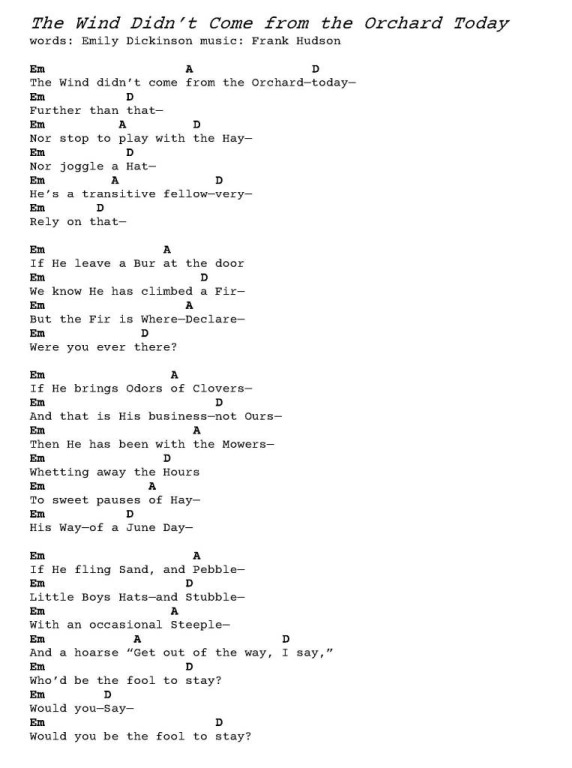
A chord sheet in case you want to celebrate World Poetry Day by singing it yourself. For performance I broke-apart Dickinson’s text, which is all one stanza — indeed, a single onrushing sentence!
.
America is a big country, a big culture. We certainly have our perfect formalists. But we have artists, like Dickinson, for whom form, and perfection in duplicating the form, is but an armature on which to improvise variations. While I’m one small ear compared to American Culture, I’ll take Dickinson’s side and place this poem in evidence.
Another thing to love in this one: the asides, set off with famous Dickinson dashes. “He’s a transitive fellow — very — rely on that” for example.
OK, so is this a musical slight-and-light poem about a playful wind we might meet in Spring?
Maybe.
Note that the poem starts off with a difference. The wind doesn’t come from the fruitful orchard.* It’s from somewhere distant. When I performed the poem, I began with the sense this must be an important fact to lead the poem off with it, but I didn’t know more. A playful breeze is mentioned, but again in the negative, this wind is too much in a hurry, that “transitive fellow — very,” and we can rely only on its capriciousness.
The sound of the “fir/where/declare” is so delightful, but what has happened here? Is the fir tree gone, uprooted, now out of place? Or is it just branches and seed-cones carried away from the location of the tree?
The sound of the mowers section is also delightful — and the work of hand mowing is so poetic one could create a whole suite of poems mentioning that kind of work — but it’s also the decapitation of anything above a height, and that’s always been part of the metaphor.
The final segment of the poem suggests a fiercer wind. An unremarkable wind might raise a little sand, but pebbles are being flung.** A playful March wind might dislodge a hat, but here it’s a steeple that has toppled off its head and the thing is like a run-away carriage.
In my Midwest, tornadoes are a common and feared storm with extraordinarily intense, though localized, winds. Dickinson’s New England has few of these. However, in the fall of 1861 during Dickinson’s most active years as a poet, two hurricanes, storms that can have high winds spread over a larger area, hit New England. Detailed contemporary meteorological measurements for that sort of thing don’t seem to exist, but sustained 60 mph winds are estimated. Ships were damaged, a ship was lost only a mile from the Boston harbor light, there were storm-driven high tides, and so forth. How far inland to Dickinson’s Amherst and at what force level it reached there I can’t say, but Dickinson could have been writing from regional news reports.***
In the many decades since Dickinson wrote her poem, we might not at first be able to hear the runaway roar of storm winds when we brush up against this poem — just the rush and song of Dickinson. So today, I will prod you to sense the mystery of the weather and the wind which we do not control.
For those of you who may have noticed a bit of a break in posts this month, it was not due to anything bad, more at a lot of effort toward new composing and recording. For the first time since last fall, The LYL Band reconvened last week, and you can hear their full folk-rock band performance of my song made from Dickinson’s poem with the audio player below. Has that audio player gadget seemingly blown away? Some ways of viewing this blog suppress showing it, so I provide this highlighted link as a backup.
.
*The Dickinson household was engaged in raising some of its own food, with Emily and her mother being known as experts in that field. The landscaping has changed at the Dickinson Homestead, but I understand that fruit trees were part of their domestic garden in Emily’s time.
**An incident from my own life. After a tornado at a branch radio network studio a few decades ago, I got a box containing the studio’s Macintosh tower audio computer to see what could be done for it. I took the computer out of its carton, and opened it to see what I could see, and the interior was packed with pea-sized landscaping gravel that had surrounded the building that housed our branch.
***I first read about the hurricane here. More about the pair of two Fall 1861 storms and how they impacted Civil War operations at this New York Times story.



 Frank Hudson