Today is May Day, the international labor day, so I spent it working, looking through poetry books for something about our lives of work. There’s less there than there should be I think, the world of work somehow not seeming as poetic as human love and desire or as sublime as the observation of nature and things of the spirit without any human sweat in it.
This lack leads me to admire poets who address this imbalance. And the first one that came to my mind turned out to be the one I ended up using today: Carl Sandburg. That Sandburg might come to mind for others too as a poet of labor probably didn’t help his reputation at the start of our current century. He doesn’t come by that classification lightly, having had a career as an itinerate worker and labor organizer before he began as a poet, and even while he was publishing groundbreaking works of early American Modernist poetry like his Chicago Poems in 1917, he had a second, less well-known life as a Socialist radical.
Carl clocking in in his later years when his day job was goat farmer
Somehow Sandburg survived both the post WWI and post WWII red scares without great harm to his reputation, but by late in the 20th century there was less interest in Modernists who wanted to write about work and labor issues. The bohemian fringe more or less looked at straight work as an unfortunate event*, and the academic establishment was more interested in aesthetic rigor and the ability to carry lightly evidence of a full-fledged college education for its poets.
Proletarian writing had been done already. Time to move on.
As I keep reminding you and myself, our current century is now old enough to vote, it’s approaching adulthood. It might want to re-evaluate those judgements the old century made about its youthful innovators.
So, for today, May Day, I took the opening to Sandburg’s longer poem that gave its name to his 1920 collection Smoke and Steel and turned it into a labor hymn. “By this sign all smokes know each other.”
Did I skip over Dave Moore the poet and writer to get to Dave Moore the words and music guy? Perhaps. Let’s step back away from the 1980s and recap a bit in word-print silence, without any musical noises at the beginning.
I met Dave almost exactly 50 years ago in 1968. And my first encounter found him reading his poetry in a church. He was also publishing what would have been called an “underground newspaper” in those days, an occasional Ditto-machine-printed* dozen pages or so of social, political and cultural comment, which I eventually contributed to. 1968 was a fabled year, like unto 1989 or perhaps some year coming soon in our current folly, full of momentous and contentious events. Odd as it may seem, it felt important to engage with them on paper, even for a small audience.
Dave left for Wisconsin to continue college, I ended up in New York to not. We didn’t see each other for over five years.
When I decided to cover Bob Dylan in reverse, and left New York for Minnesota in 1976, I ended up staying with Dave for a while and helping him work on rehabbing a run-down house he was living in. Dave had hooked up with a group of writers, the Lake Street Writers Group, all of whom lived a few blocks from that central east-west commercial/industrial strip in Minneapolis. As a group it was an unusual mix, including bartenders and low-paid workers, most with some college under their belts, but now in their mid-20s trying to figure out what to do with life that didn’t formally give college credits. These experiences gave the group something of a blue-collar, we’ll earn our cultural worth, not be awarded it, air that I liked. I too joined in the group.
The Revolution Will Not Be Duplicated…for less than 1/4 cent a copy! Just think, I could run off a few pages of this blog and have them in mailboxes by the morning!
Besides the usual get-together/critique/talk thing that writers’ groups have done forever, the Lake Street Writers Group ran a little magazine, The Lake Street Review. The first two bootstrap issues were printed on Dave’s Ditto machine, the magazine’s post office box was Dave’s too, and Dave was co-editor in the beginning along with the founding spirit of the enterprise, poet Kevin FitzPatrick.**
I asked Dave what poetry he remembered writing or publishing from this era today, and he reminded me that in the mid ‘70s he was concentrating more on stories. “Oh,” he recalled, “There was a song ‘Ballad of Mr. Lake Street vs. Mr. Id’ in the Lake Street Review.” That piece of Dada was attributed to John Lee Svenska in print, but it would have predated his work with Fine Art or the LYL Band by several years.
What would you get if you combined blue-collar with Dada? One answer would be some of the first songs Dave wrote for the LYL Band. Yesterday’s “Evil Man” would be one example, the man in the title morphing from childhood bully to sociopathic businessman to stickup man. You could see this as a new expression of the notable Woody Guthrie line about “Some will rob you with a six-gun, and some with a fountain pen,” but by having the evil man fade in and out of these equivalented roles from verse to verse, the Dada this-beside-this comparison is made. In today’s piece, Dave’s early ‘80s song “The Night Inspector,” the Ubu Roi rides a fork-lift in a factory. To give you some relief from the audio quality of the archival recordings from the early ‘80s, this performance is a later one where I sing Dave’s song with acoustic guitar. Go go Night Inspector (player) Gadget…
*I’m reminded that Fugs’ founder Ed Sanders was able to raise his ruckus in the ‘60s Greenwich Village scene at first by being the owner of a similar machine on which he printed his own little magazine and flyers. Ditto machines were better than Mimeograph machines. Mimeo machines printed in purple and their printed pages stank of that can’t-be-healthy-for-you volatile ink that is probably responsible for some of you getting lower mid-century grades than your parents expected on school tests. Ditto machines produced pages that looked more like “real” printed work with dark black text.
**Kevin FitzPatrick has continued to write poetry dealing with this milieu for his entire career, including a great number of poems, too rare in our culture, that deal with the complexity of day to day work as an employee. Here’s a link that will let you read part of his introduction to some selected poems of his, where Kevin talks about the life experience from this Lake Street Review era that helped inform his poems.
I spent Saturday riding my bicycle on the Mesabi Trail and visiting Hibbing, the Minnesota Iron Range hometown where Bob Dylan grew up non-ferrous.
To the visitor, the landscape there has a strangeness. Since the late 19th Century, open pit iron mining has been the industry of the region. An open pit mine is not the kind of underground tunneling and mole-dark pick-axe work you might visualize when you hear the word “mine.” Instead it is the removal of cubic miles of earth with explosives and huge shovels, work my wife describes as “making your own Grand Canyon.” The iron gives exposed rock and dirt a Martian red hue, and this colossal earthwork of generations of open pit mines has added extra hills, ridges, gorges, and small lakes. Though trees and brush eventually regrow and give these acts of men something of the appearance of nature, some hills retain the terraces where the trucks drove, giant Northern ziggurats or Mayan temples, now sprouted with pines—the Hanging Gardens of Bob Dylan.
“Making your own Grand Canyon”
Since Bob Dylan grew up here, the strangeness of this landscape may not have impressed him in his youth, but an adulthood away might have eventually revealed its uniqueness. It is a singular place on a Labor Day weekend where one can see the mark of daily labor sculpted in a giant tableau.
How many of us can say the same for our labors? Children are raised, daily cares are met, that meeting makes a decision, a sick person is comforted and will live another couple of decades, the number of widgets on the planet increases infinitesimally, a project that will impact things for a few years is completed. In contrast, in the land around Hibbing, Virginia, and Mountain Iron, vistas are forever altered to mark a work life.
A view from the highest bridge in Minnesota spanning part of a no longer active open pit mine now filled with water outside the town of Virginia. The landscape you are viewing is man-made, not a natural feature.
An artist’s work, for all the literary pretentions to immortality, is at least as ephemeral as other work. The work is finished, and the earth has not changed its face. The work is read, seen, heard by its handful, and it melds at best into a memory in some part of those.
So, punch a clock or not, these are the same jobs, the same work. The poem, the performance, the painting, no less, no more, the product effort of applied human energy as any other work.
Occasionally, someone gets to be a Bob Dylan, and the vistas change. Leonard Cohen said that giving Bob Dylan a Nobel Prize is like pinning a medal on Mount Everest for being the highest mountain. I stood next to my bike on the state’s highest bridge spanning a man-made gorge and thought, maybe somehow, even subconsciously, this landscape gave Bob the idea.
“Cruising down the highway in a Greyhound bus/All kinds of children they was hollerin’ at us…”
Today’s audio piece will not remind you of the Bard of Hibbing, as it is a fuzzy epitaph using Mellotron instead of giant earth-moving trucks to get its rocks off me. Here’s wishing all Parlando Project listeners a lanquid fall into the fluffiest possible snowbank. As you exit the Temple of Summer, listening to the music using the player below, I remind you that the Parlando Project appreciates your attention, but still needs listeners and readers. If you can, let others know what we’re doing here, and if you’re new to us, you may want to check out our archives with 250 other audio pieces combining various words with original music.
Have you ever noticed how little poetry deals with the world of everyday work, with the employments that occupy such a large portion of our lives? Some of this is due to the positioning of art as an escape from all that humdrum and haplessness. We go to poetry, or to music, partly to divert ourselves from it. It promises us the respite of beauty, or at the least a music to shake ourselves down from the defeats and stress of it.
On the poets’ part, some of that may be because poetry is almost never their “day gig”—and that other regular bills-paying job is, at some level, an embarrassment. After all, Lord Byron didn’t have that waitress job, Edna St. Vincent Millay didn’t have to sweat getting the reports done by EOD, and Homer didn’t have to stay awake wondering if he should raise a stink about how his co-workers are dumping too much of their work-load on him. Poets, if they are to make it to the level possible in our modern culture, can at best aspire to the level of college teaching with sabbaticals and a modicum of grants. That necessary rent-paying day gig is an admission that they are marginalized as artists.
Carl Sandburg seems unaffected by that embarrassment, one of the reasons to treasure him in his years as a pioneering Modernist. Since he was politically aligned as a socialist, some kind of workers-solidarity stance might be obligatory. Luckily, the early-20th Century Sandburg rarely reads that way, and his life demonstrates reasons why this is so. He was born of working-class immigrants, and all through his Imagist years, while he was focused on becoming a poet, he remained working class through and through.
You may not share Sandburg’s politics (any more than I share Ezra Pound’s), but even through the superficial changes in the decades since he wrote them, you can find in Sandburg poems a real, felt, understanding of day to day work for pay. His first three poetry volumes are filled with this understanding. Today’s piece, “Sunset from Omaha Hotel Window,” from his Pulitzer Prize winning collection “Cornhuskers” is suffused with this.
Much of Sandburg’s 1918 “Cornhuskers” seems to be reflections published some 20 years later of his experiences while still a teenager in the 1890s when he hoboed out west from his native Illinois, working day labor and various farm jobs. Some of its idiom is unclear to me. I am not sure what is simply obsolete vernacular and what is figurative language invented by the poet.
He: You know my boss says I’m in line to be a supervisor if I just keep at it.
She: It says here “An image is that which presents an intellectual and emotional complex in an instant of time.”
“Sunset from Omaha Hotel Window” tells you right off it’s allegiance to Imagism. It’s titled like a painting or an art photograph, and while Imagism wasn’t dogmatic about visual images, the visual arts were undergoing their own revolution influencing Modernist poetry; and as a practical matter, visual images have a directness that lend themselves to Imagism’s rejection of abstract and tired poetic tropes. And the poem’s first lines start, like many an Imagist poem, with colors and objects: a sunset over the Missouri river valley separating Omaha from Iowa. But then a line that’s a bit allusive: “The long sand changes.” My first thought was “like sands through the hourglass, so are the days of our lives.” That maybe what Sandburg was intending, but I don’t know if it’s some obsolete saying or something Sandburg invented. Sandbanks formed on a river channel are sometimes given this name, and that may be part of the meaning, and the wandering Missouri river has formed and erased many of them.
Later we meet up with two more lines like that: “Time knocks in another brass nail. Another yellow plunger shoots in the dark.” The first is partially clear, as the driving of a nail is a job of work with a sharply defined end. But why brass? It’s something akin to the still extant idiom “getting down to brass tacks” which is clearly understood to mean “getting down to the real, basic, concrete issues,” but the brass-tacks image that idiom presents, and its origin, is a mystery. The second part, the yellow plunger, I understand even less. I thought: meteor? Some meteors have discernable colors. The sun? He says in the dark, and his sunset is red from the first lines. As I sang it I just thought: shooting star, but I would welcome any ideas.
Still, the meaning of the poem is not hard to discern for any working person. As an Imagist, Sandburg doesn’t have to say what he’s feeling—weary, sad, cheated, worried, broke, lonely, unappreciated, angry—he just presents the scene. In my arrangement of this piece, I added repeats of Sandburg’s refrain “Today is a goner and today is not worth haggling over.” Time passes, work is done, and the issues of work, however numerous, enduring, undimmed, and uncontrolled by us are as stars—they are distant and present for a moment in Sandburg’s poem.
To hear the LYL Band’s performance of Sandburg’s “Sunset from Omaha Hotel Window” use the player below.
Obscurity in modernist poetry is a funny issue. What makes some writing hard to grasp, difficult to understand? Esoteric and little-known words like Wallace Stevens loved? Far-flung allusions to works in several languages like T. S. Eliot was prone to? Exploding normal written syntax and logical flow as Gertrude Stein did? Taking images into realms where direct one-to-one symbolic meaning is not only impossible, but more than likely, not the aim, as Tristan Tzara or Paul Éluard demonstrate? Presenting things “slant” in iconoclastic riddles as Emily Dickinson could? Writing works of epic length that few if any human minds can comprehend in their whole, like the Cantos of Ezra Pound?
And then there’s this poem, the basis of today’s piece, William Carlos Williams’ “The Red Wheelbarrow.”
The whole of it: 16 words, no punctuation, all lower-case
From empirical evidence you could say that it’s the very peak of the canon of modern American poetry. Remember that compiled count of the poems that appeared most often in poetry anthologies, most of which were explicitly focused on modern American poetry? “The Red Wheelbarrow” is alone at the top of that list, included in over half of the anthologies counted.
Does that make it a “best loved poem”? Does it even assure that critics consider it great, much less the greatest? No, it does not. I think I first ran into it as a teenage student, in one of those anthologies used in some English literature class. Did my young teacher point it out as a poem of special merit? Did I view it as such? No. If I can trust my memory, if it was discussed at all, it was as if it was some kind of stunt, an intended provocation that so short and mundane a piece could be considered artful. “Now class, let’s get back to T. S. Eliot and Wallace Stevens.”
And how about critics? They largely part like the Red Sea on “The Red Wheelbarrow”. If we look to one side, in among the mollusks and manta rays now behind the water curtain of the divided sea, we find those who care little for it. There’s nothing there demanding to be written about. No virtuosity is demonstrated to be noted and admired. And what important point is it making, other than, well, no point at all?
So, we turn to the other side, those swimming with bemused dolphins who wonder if they could leap across the band of Israelites walking on damp seabed, those critics hoping to demonstrate their microscopic perception of the hidden art in this terribly short and compressed poem. Carol Rumens is concise and representative of this when she says of Williams’ poem “This is his manifesto, surely–a poem quietly declaring how modern poetry works.” And she also warns “A naïve reading could take it as a comment about the great usefulness of wheelbarrows on small-holdings where chickens are kept.”
And then, here I am, now. No longer the teenage student who was sure someone had figured these things out, and I need only to find them. I can’t see far enough ahead where Moses and Aaron are, nor can I see far enough back how close Pharaoh and those charioteers are getting. I’ve got my hasty bread and a few grabbed things in my little cart, pushing it across the mud. I think I must be naïve. Yes, Williams is a modernist, as committed to the new way of writing as clearly as possible, a proclaimer of “No ideas except in things,” which means in retrograde, the things must be the ideas. If he had wanted to write a manifesto, he could, and did in the other poem that stated that dictum.
The obscurity in this poem is that there is no obscurity other than what we bring to it externally. There is no allusive, secret meaning, other than the secrets we’ve kept from ourselves, of our tools and our companion responsibilities.
Yes, there is art in these 16 words: the line breaks that ask us to hold our gaze, even in the middle of words, the “so much depends” warning that bids us look. The choice to look at just these simple common things, is a choice, is an idea. I think the dolphin side of the parted sea has smarter companions than the mollusks’ side; but I am looking down at my wheelbarrow, and Williams’ wheelbarrow, and saying naively, that it matters, even if I’m in the middle of the band, unable to see Pharaoh or Moses.
I’ve spent too long on the words again, but I feel I need to say a bit about the music I composed for my performance of “The Red Wheelbarrow.” I chose to use a twelve-tone row, a modernist musical idea from the same time as when Williams was writing the poem. It would be pretentious for me to say I got this from deep study of Schoenberg or Webern, though I’ve listened to a good deal of modernist music. However, “serialism” never stuck with me until I heard the prologue part of “This Town Is a Sealed Tuna Fish Sandwich” written by Frank Zappa. I’ve loved that piece from the first time I heard it.
Twelve-tone music subverts expectations of a tonal center or “important” scalar notes, so it can sound a little woozy or random, but, of course it has its pattern, by definition, which the mind’s ear can hear if you stop thinking in expectation of familiar patterns, which is the simple and profound thing it is asking you to do.
Back when I was kid there was something we were taught to be concerned about, our “vocation.” This was somewhat like the perennial question “What do you want to be when you grow up?” but with a religious and spiritual aspect.
As the word “vocation” suggests, we, while still children, were asked to consider our calling, what task God would ask us to do with our lives. Yes, there as an expectation inherent in that, that some of us would find that we had been called by God to become Christian clergy, but at least in my small town and church, this was not set out as the answer most of us were to find. It was assumed that each of us would obtain a distinct answer fitting to our talents and the universe’s needs.
Religious paintings depict a calling as a clear and vivid action,, like in a comic book
The folks who provided religious instruction in my town were practical people, and I couldn’t picture any of them expecting us children to be visited by spirit birds, or hear mystic voices to lead our country into battle. Rather they expected a small inner voice to whisper to us that we should be family farmers, or mechanics, or nurses and so forth. In my family, I could look to a grandfather who I never knew, who was called to the Christian ministry, or to an uncle who followed his father’s path, or to the more complex stories of my parents, whose vocational path I’ll defer talking about for reasons of space now. It never occurred to me, but I could have asked my teachers or myself about my great-grandfather and namesake, who would have had to have been called to be a common laborer by this scheme. Somehow this talk of calling and vocation seemed a bit grand a process for that.
I never knew what to answer that question with until my late teens when I decided that I would be a poet. That’s certainly a grandiose enough answer for this religiously-infused process, but even in my naïve youth I knew that meant I’d be doing something else beside that with my lifetime. So, a calling, but no answer to what I wanted to be when I grew up.
Most decisions to become an artist of any kind expose a person to things that will mess up one’s life. First off, you are going to do something that is likely unlikeable—you are going to privilege your own interpretations of our common life as somehow more valuable than modest silence or undecorated space. Even successful artists most often have a majority of people judging what they produce as not worthy of their time, or generically replaceable by something similar but different from what you do. And these odds of rejection, combined with the concentration of effort needed for much artistic work, make many artists defend their self/center with self-centeredness.
So there, as so often here in the Parlando Project, I’ve violated one of the principles that I set out to follow: I’ve spent time here with my story, talking about myself. Alternate Parlando Project presenter Dave Moore avoided this in today’s episode “Wally Wood” which Dave gave the longer title “Wally Wood’s Co(s)mic Philosophy.”
Here’s what Dave had to say about the piece:
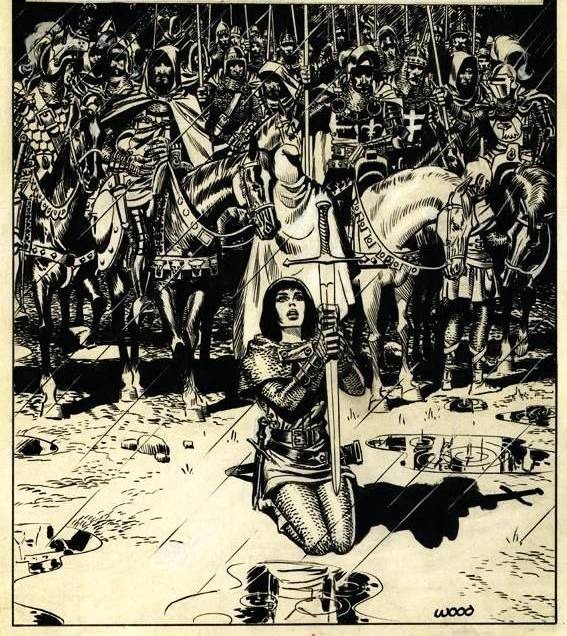
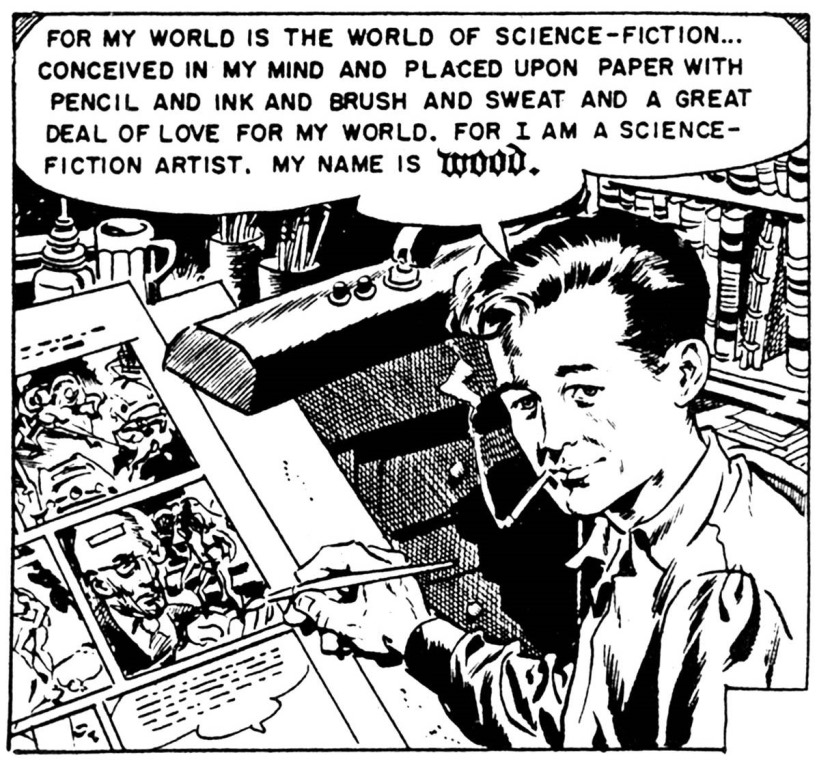
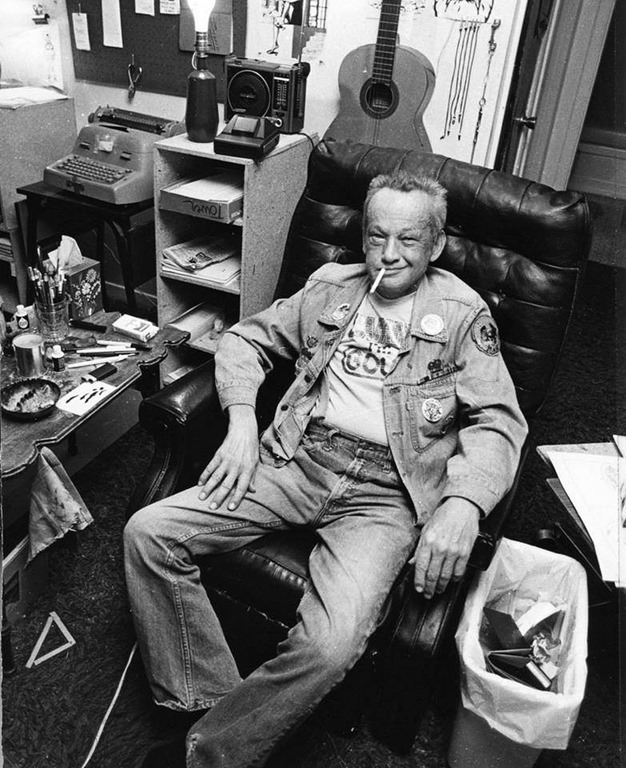
“Wallace Wood was one of the great comic book artists of the fifties and sixties. His detail work for EC Comics and Mad is still astounding to look at. Like many, he was also an alcoholic, and increasingly bitter as he aged. His words in the song are from a late interview in some fanzine.
I can’t draw, so far be it from me to draw conclusions about success or happiness. Or the scope of a talented artist’s frustrated Fifties ambitions. What strikes me most are the words ‘And yet’ after a pause. No matter what he says, no matter how things ‘work out,’ it was worth it for me and all the thousands of others who enjoyed his work. Go look him up, you won’t forget him.”
Wally Wood, combustible master of line
What did Wally Wood add the “And yet” to? Listen and find out, using the player below.
I feel like taking a break from the cosmic today. No mystic visions. No musing on transcendence. However, I’m going to go someplace different just the same.
For a little over twenty years I worked for a radio network that had a booth at the Minnesota State Fair. Midwestern US State Fairs are odd events. Tens of thousands of people attend each day for a ten-day run, yet what compels them is somewhat vague and mysterious. There’s a ton of food-truck style food, some of it comfort food—often sold in gallon buckets, which is more comfort than is comfortable—along with other fare that sometimes tries a little too hard for uniqueness. There are musical acts, but not anything that wouldn’t be on offer any weekend in Minnesota. There are exhibits, but in the Internet Age, one probably doesn’t need to go yearly to a few acres on the border of Saint Paul to find out anything.
In this piece I choose to highlight two other of the Fair’s most venerable traditions. The event serves as essentially the state championship round for livestock and animal breeding. Many of those animals are raised by rural kids. And the Fair is a prime stop for office holders and political candidates to speak, debate, discuss, and campaign.
Vague and mysterious compulsion: vegans and pubic cynics would be repelled at best by those two things. I am neither, but I also doubt that the average modern metropolitan resident gets up a month before or after now, and says to themselves: “I wonder what well-raised livestock looks like and I sure would like to hear a politician talk.”
The former is an understandable consequence of the modern age. The latter is more problematic, as the modern American republic expects the political business to be carried out by a largely disliked and disrespected crew. This modest little piece won’t change that.
Because I worked for a radio network, I was usually at our Fair booth on Judson Avenue before it opened. Judson is a reasonably wide but otherwise ordinary two lane city street. By the afternoon is will be filled shoulder to shoulder with people up and down its length, as far as one can see. But before 7 A.M. it’s just the folks who have Fair work to do. People compelled by very ordinary and understandable things, which is what this audio piece is about.
During most of the time I worked for the radio network, one of those folks with a job to do who’d arrive in the early morning would be Gary Eichten and his show’s producer. By midmorning, Eichten would interview office holders or office seekers, and take questions from the gathering crowd, fulfilling that second State Fair tradition. He was always the friendly professional, yet even working with him behind the scenes it wasn’t clear where his own political opinions were. One thing that did come though: he respected the job those office holders had or were seeking.
So this audio piece is my short Minnesota State Fair story: part that early Fair morning that few see, and part a tip of that hat to those folks who do their jobs every day. Musically we have the LYL Band in folk-rock guise again, with Dave Moore handling the organ. I played the bass line, and then the guitar part largely shadows the bass part an octave higher. My dad once asked me why lead guitarists always concentrate on the higher strings. Seemed like a good question then, and this time I didn’t.
Click the gadget below to hear the audio piece “Minnesota State Fair 7 A.M.”





 Frank Hudson