March 2018 Parlando Top 10 Part 2

An artist named Linnea Hadaway made a book earlier this year. It had no words in it. She said it had no words because it was about listening.

Today is International Women’s Day, an arbitrary thing like all special days, months and years. I can hear some grumbling off in the distance as some read this: “Another one of those special-interest things. I go to poetry and music to get away from that faddish nonsense.” There’s consistency in that opinion: if one is upset at “identity politics,” dividing the world in halves is just as deplorable as dividing it into tenths or smaller.

Are there dangers in division? There certainly are. But I don’t see these sorts of things as division, but as requesting attention—and attention is what art, and this Parlando Project is about. You see, life is incarcerated in the ultimate special interest group, the ultimate identity, political and otherwise: our own selves. Breaking the cellular barrier to spill our selves, or enticing us into opening a tiny pore to stare across at the skin holding another self inside another world, the still unexplored world we share, is the whole of art.

There is no apportionment so small as to be smaller than that. There is no way out but the way of art, to pay attention. Our ears cannot see, they can only listen.

No planning in this, but the next three audio pieces in our Top 10 count-down of the most liked and listened to pieces this past winter use words written by women.

Carrington 3

Surrealist Leonora Carrington captures the Parlando Project recording another audio piece


7. We Grow Accustomed to the Dark

I think I’ve used more Emily Dickinson pieces for words here than any other writer. I didn’t plan it that way. I’m not sure that Dickinson planned it that way either. Obviously, she meant what she did, assiduously creating and collating the more than a thousand short and engagingly enigmatic poems that we now see as a cornerstone of American poetry.

But as a careerist she’s a mess. She showed some of her work to friends and family, but like most friends and family they probably saw them as artifacts of the ordinary Emily, that stubborn particular. Perhaps they understood or didn’t understand her poems better than we do; but we, her current readers, believe it’s the later.

She had a lucky break with Thomas Wentworth Higginson, the critic and social activist who answered her letter and saw something there. Even in the intellectual ferment of Transcendentalist New England, how many would have? The posthumous publication he shepherded, made possible the Dickinson we have today. But did he understand her art? We, as posterity, think otherwise.

So, like the woman in “We Grow Accustomed to the Dark”  Dickinson pressed on, walking, almost straight, and like the bravest, aware that the comedy of striding face-first into a tree was possible.


The Emily DIckinson Internal Difference

I was there! What a concert! The music was good too.

6. A Certain Slant of Light

I didn’t think about this while writing the music for and performing “A Certain Slant of Light”  and “We Grow Accustomed to the Dark,”  but these two Emily Dickinson poems are companion pieces. The Dark poem is more clear, even comedic, the Light poem more mysterious.

In my original post I decided to not talk about what I think the poem means. In some ways, I think that’s true to the poem’s “Where the Meanings, are.” I had fun with the mock psychedelic rock poster I created to illustrate it, but I think the core experience of the poem is the same that some were seduced into having by ingesting drugs, the insight that the universe’s meaning may be unknowable and its substitute only available by fiat.

Cure the cod-sitar sounds, and stereotyped sparkle-eyed hippie whooshing “Oh, Wow!” Of course, we must laugh. This is an insight available even to the young that can apparently be induced by mere intoxication.

But it’s true. It may be easier to see the borders of truth if one comes upon it without chemical aids; but even true, it’s an insight that’s hard to integrate into an active life and compassion. Dickinson integrated it with these little packets of poems. “None may teach it,” she says, but I can let you see my experience of it.


5. In the Bleak Midwinter

And one slot higher in the countdown, a woman who isn’t Dickinson, but is roughly her contemporary, English poet Christina Rossetti. Her’s is a Christmas and Christian poem, faith is her fiat; and a shaped and received story is her poems plot.

As this post talks about division, opposites—and how, if one distrusts them, one must cross them, sometimes listening, rather than shouting at them to come down—“In the Bleak Midwinter”  is all about divisions and opposites, and where they fail to hold.

In the moment of Rossetti’s beautiful song, even if earth is iron and water stone, heaven cannot contain God, nor can the earth sustain winter or meagre poverty.

I remember someone asking one of the earnest folk-singers of my generation (alas, I can’t remember who) if a song could change the world. Their reply was something like, “Of course not, but during the time the song is being sung the world is changed.” Perhaps an argument for longer songs, better memories, or us slowly learning how to integrate the experience of art into the rest of our lives.


I plan to return tomorrow with the next three in our Top 10 count-down of the most popular pieces over the past Winter.
Lines to a Nasturtium

As I’ve all but promised, here’s a piece using another poem by the deserving-greater-notice early 20th Century poet Anne Spencer. It may even be appropriate for Valentine’s Day—though if so, it’s a somewhat complicated valentine. If we think of Spencer’s poem as a valentine, “Lines to a Nasturtium”  is a fancy one, but the doily lace on this valentine has strange knots in it.

I was going to present it first, before “Dunbar,”  but I felt I didn’t understand it well enough, and after living with it for a couple of weeks, I’m still not sure I’ve found its bottom. It’s beautiful and more than a bit mysterious. My son caught me laughing today as I read an account of James Weldon Johnson, who helped bring Spencer’s poems to publication in the 1920s, sharing a selection of them with the acerbic critic H. L. Mencken. Mencken’s reply? “Tell that woman to put beginnings and ends to her poems. I can’t make head or tails of them, but they’re good.” Yes, I had to laugh, but that’s sort of how I feel right now in regards to this set of words. It’s as gorgeous as the flowers it uses as images, but there’s a puzzling pair of lines “But I know one other to whom you are in beauty/Born in vain;” I feel I should be able to suss out who the “one other” and the “you” are, and I just can’t be sure.

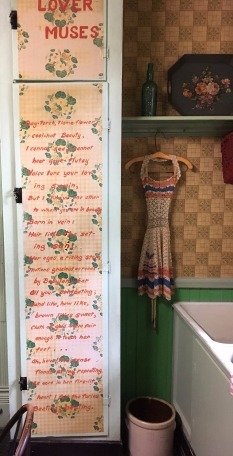
A sensual but philosophical ode to beauty? An early claim to the beauty of women of color against Euro-centric ideals? A Robert Browning-like soliloquy regarding a potential love rival? For awhile this morning, trying to follow the antecedents to that “one” and “you” in the text, I was leaning on that later, but then I was reminded that Spencer thought the entire last part of her poem, under it’s published sub-title “A Lover Muses,” was decorative enough to have it painted on a cabinet door in her kitchen.

A Lover Muses on her kitchen door

Come on, in my kitchen—Spencer’s poem on the door


I don’t want mysteries of meaning to get in the way of enjoying Spencer’s work any longer, so let’s just listen to it today. Use the player below.


Wild Nights Wild Nights

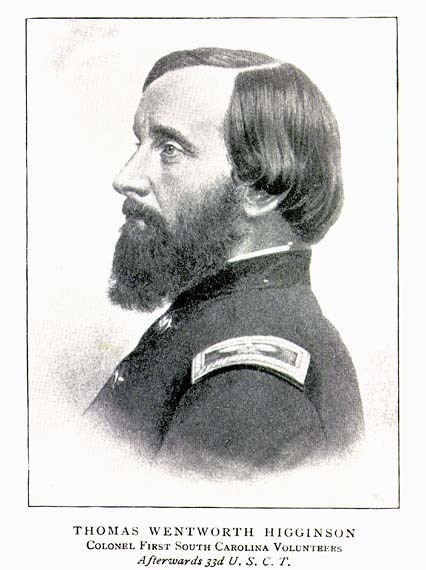
Thomas Wentworth Higginson may have exaggerated a bit, speaking then of “dread.” But it was 1891, and he had taken on editing the surprisingly vast literary legacy of Emily Dickinson for its first substantial publication. In this task, he was a lucky find, for though he had engaged in a lengthy correspondence with Dickinson when she was still alive—the real rarity was that he was a thoroughgoing radical, a Transcendentalist comfortable with heterodoxy, an uncompromising abolitionist who raised and lead a company of Afro-American soldiers in the Civil War; and rarer yet in his time, a stalwart feminist who knew and worked with pioneering American feminists Lucy Stone and Susan B. Anthony.

Thomas Wentworth Higginson in uniform

Abolition, Transcendentalism, Civil War, Women’s Suffrage and rights
Higginson wasn’t going to keep a little keep a poem about desire bottled up


So, fear of controversy was not in Higginson’s nature. Still “dread” was the word he used:

One poem only I dread a little to print—that wonderful ‘Wild Nights,’—lest the malignant read into it more than that virgin recluse ever dreamed of putting there. Has Miss Lavinia (Emily Dickinson’s surviving sister, and the one who found the large cache of poems at Emily’s death) any shrinking about it? You will understand & pardon my solicitude. Yet what a loss to omit it! Indeed it is not to be omitted.

What dread could a little 12-line poem cause? Dickinson’s “Wild Nights Wild Nights”  appears to be a poem about unembarrassed female desire. Even with suggested subtext supplied for for lines like “Rowing in Eden,” it probably seems less shocking today. Still, let’s give Higginson some credit. He not only didn’t want to censor it, he maintained it needed to be included for publication.

Even if we’re not shocked by an erotic element, let’s not forget: it is an Emily Dickinson poem. It’s terribly concise. It sings off the page, yet with such short lines, just three to five syllables long. It’s memorable. When I mentioned it to my wife as the next piece I was working on, she nearly knew it by heart.

But most strangely, though it starts like an ardent valentine, it finishes either in disconnected thoughts blurred by lust, or with something altogether less conventional. Setting humptastic subtext aside, why would one row in Eden? You’re in paradise! Where do you want to go? Do you need to stock your ship up with the fruit of knowledge against the scurvy of faith? And you’ve made it to port in the last stanza. Again, let’s leave the “made it past third base” metaphors behind for a moment. Why are you exclaiming the sea when you’re in port? I even wonder if Dickinson is slipping in a pun here: “Ah! the sea!” sounds like “Odyssey.” Is Emily’s wild-nighter an Odysseus looking to getting back on the boat and back to sea?

I don’t know exactly what Dickinson is getting at there. It’s her characteristic level of concision: pretty, but sharp pieces of glass, leaving lots of slant light to refract.

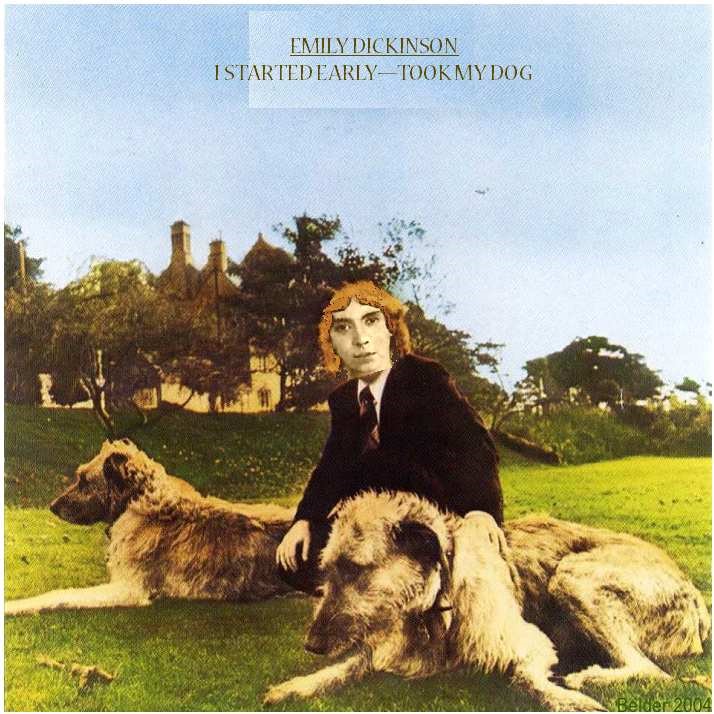
Veedon DIckinson

Poetic license. Yes, I know “Wild Night” is on Tupelo Honey


We’ve followed the Parlando Project goal of varying the music with Dickinson poems so far, even casting her as a classic blues singer. For “Wild Nights Wild Nights” I wrote a more rocking R&B thing this time. I relaxed a bit with the vocal this time too: tossing it off in one take while playing the acoustic rhythm guitar part. The opening lines of Dickinson’s poem reminded me of Van Morrison’s song, and so I slipped a few mutated lines near the end. Play the performance with the gadget below. You can dance if you want to…


Triad

I find it a wonderful “Parlando – Where Music and Words Meet” coincidence that one of Christina Rossetti’s sonnets and one of David Crosby’s songs share a title, “Triad.”

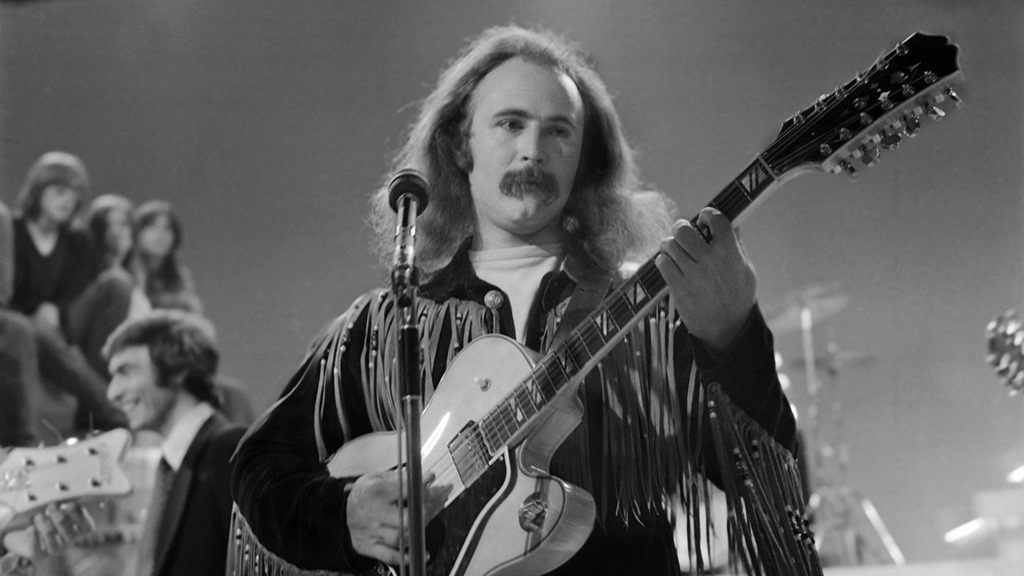
David Crosby is a musician and songwriter who first came to prominence in The Byrds and then as part of another triad, Crosby Stills and Nash. When I first came upon his songwriting many years ago, I was attracted to his distinctive abstract melodic and harmonic sense. Almost no one before, and few since, wrote music for songs that sound like his did then, with the exception of some Joni Mitchell tunes. Lyrically Crosby styled himself as unconventional as well. His “Triad”  is a blissful ode to free love—well at least free love as long as David Crosby is the one explaining how things will be.

David Crosby

David Crosby’s song starts by asking “You want to know how it will be?” and then he mansplains it


Christina Rossetti was a pioneering British 19th century female poet. Her biographical triad was that she had two brothers William Mitchell Rossetti and Dante Gabriel Rossetti, also writers, who went on to form the Pre-Raphaelite Brotherhood. Hmmm, “Brotherhood”—I wonder if girls get to join? Not officially, though she was used a model in some of their paintings.

Girlhood of Mary

Her brother Dante used Cristina Rossetti as the model for the Virgin Mary, far right.


Christina Rossetti’s “Triad”  is a not-so-happy look at romantic love, and the writer is none-so-sure how it should be either. Rossetti draws her portrait of three women who once sang together. One the stereotypical harlot, one the blue spinster, one the smooth compliant wife. Each of them finds the dead end of the limited paths available for passionate women. Conventionality decrees the hot harlot is shamed and the cold virgin dies for love, but Rossetti steps outside conventionality to tell us that the “temperate” spouse grew gross in her compromise until left with the devastating line droning “in sweetness like a fattened bee.” How much has changed since Rossetti’s Victorian England in this regard? Some things, not all things. New Rules are still rules, look at who makes them.

Musically here with our “Triad”,  the LYL Band somewhat refer to the psychedelic vibe of Crosby’s musical style to accompany Rossetti’s sad and lovely words. To hear it, use the player that appears below.