Absent Place — an April Day

Another poem for April Poetry Month. Another Emily Dickinson poem. Once more, wildflowers. Once more they’re that early spring flower, daffodils. Once more the poet is looking back because something’s missing.

Absent Place-April Day

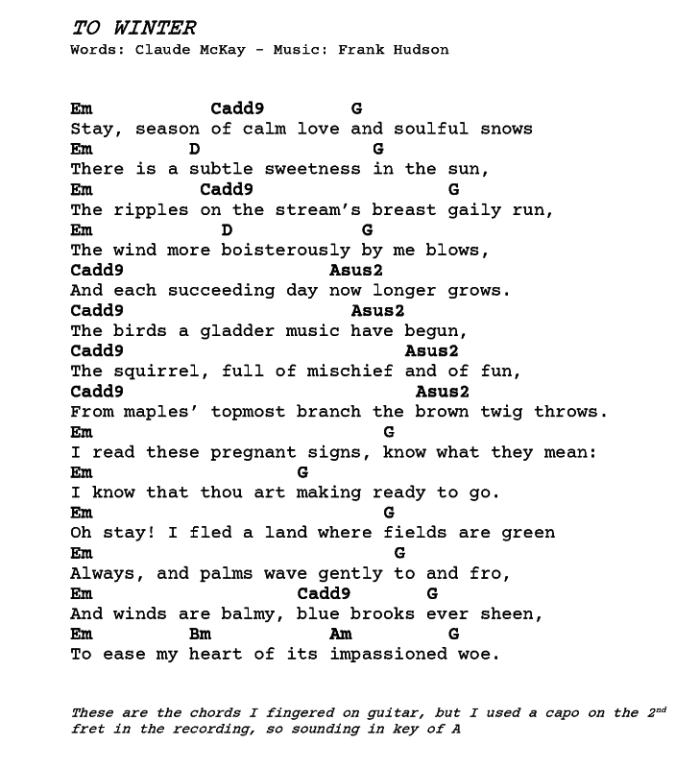
Chord sheet because someone else might sing this better than I can

.

Last time the voice in Dickinson’s poem was also alienated from Spring, but there was a taunting wit to that one. The mode in today’s Dickinson is more abstract, and the second, final, stanza is so gnomic here I can’t say I know fully what it’s conveying. Even the first stanza is tied in knots, tangled with those Dickinsonian dashes. Is “an April Day” the “Absent Place” — or is the April day, with present dancing-in-the-breeze daffodils, in contrast to the Absent Place? The stanza’s final line asking us to consider the viewpoint of “the Souls that snow” could be saying then the snow is more full of motion and drifting shapes than mere blossoms — or that April brings forth feelings that makes the Absent Place snow-Souls uncomfortable?

In intent or effect, it may be a shifting Tao — an all of the above in motion with each other?

But the final stanza? I assume “Drift” within is of the snow-Souls’, a self-impediment worse than snowed-in roads or walks, but the concluding two lines are harder to follow. Perhaps she’s saying that snow-Souls are the ”Him” in the last line, and their change and emotion is as strong as (“duplicate”) as the wind-moved daffodils? But “duplicate” is a strange word choice. Even within slant-rhyme it’s quite strained to rhyme with “without.” I even toyed with pronouncing the duplicate as the noun, not the verb, which would be a nice sound-pair with “but.”  However, that’s syntactically sour and doesn’t follow the first stanzas ABAB rhyme scheme.

For awhile I engaged in a little fantasy extension of this brief poem while asking why daffodils, rather than another Spring flower. Poet Dickinson famously knew her plants — not just as an avid gardener — but as a woman with more education than most in her time and place (which included science, considered a presentable ladylike field). She was the maker of an impressive book of pressed flowers labeled with their scientific names. Did she know her Greek myths as well as the scientific name for the daffodil, Narcissus? The essential piece of the Greek myths of Narcissus is that the youth of that name dies because he becomes entranced by his reflection, his duplicate. Is the last line’s “Him” Narcissus or something like him?

Or is she taking another route into the roots of the word narcissus, related to narcosis, a drugged numbing? Does the final stanza mean to say that springtime joy can be as numbing as wintertime sadness?

It may be wise to consider my thoughts about the final stanza over-thinking. They’re surely speculative, but it still seems likely that the poem means to link the emotions extracted from Winter and Spring landscapes.

As April National Poetry Month winds down, I’ve fallen into a theme without designing it. Many of us are feeling crabby, dismayed, disgusted, frightened, but Spring doesn’t know that. The cold of Northern April is now behind us, and May lays out ahead with greening and warmth. Is it taunting us by being pleasant and hopeful?

For the music in the performance you can hear below, I fell into it too, as certain and mindless as Spring. The recording started with the chordal guitar part, which I played on my jangling Squier Jazzmaster instead of an acoustic guitar because I was telling myself I’ve been stuck on acoustic playing too much lately, and I hate to be predictable. In timbre and volume it was hardy enough to easily accept the drums and electric bass that I matched with it. The final part was the lead guitar line played largely on the B string of the guitar up and down the neck, in that “I’ve just heard a Ravi Shankar LP” way that was popular in The Sixties — the 1960s, not Emily’s 1860s. You can hear it with the audio player gadget below. No such gadget to be seen? The authorities haven’t shut down the psychedelic ballroom, it’s just that some ways of reading this blog suppress showing the audio player.  This highlighted link is an alternative which will open its own tab with its own audio player inside.

.

Timothée Chalamet, A Complete Unknown, and a mid-winter song: Three Angels

I’m trying to decide between work on finishing a new Parlando piece combining literary poetry and original music, and seeing what I can do for a February Black History Month observance here. The first is mostly done, the latter is but ideas at this late date.

What to do? In my typical direct approach, I did something else today. This weekend I watched Timothée Chalamet appear on Saturday Night Live as the musical act on the long-lived sketch comedy television show. Chalamet is fresh off an acclaimed performance as the young Bob Dylan in the film A Complete Unknown.

I mostly liked that movie. Biopics are always dodgy things to do, as most people’s biographies when told straightforwardly do not have enough dramatic concision to make a compelling two-hour film. Which means they all have fibs in them, and they will perforce leave things and people out. It’s become an apparently unavoidable cliché to remark on this element by quoting a line from another film, The Man Who Shot Liberty Valance: ” When the legend becomes fact, print the legend.”*  This misses the point of John Ford’s great film. When that line is uttered near the very end of that movie, Ford has shown us a compelling tale of a man, played by Jimmy Stewart, who had many great things about him, a man who at the end of the film had risen to become an honored Senator, a plausible Vice President even — but Ford also told us of another man, played by John Wayne, who may have been less interesting as a biography, but whose acts are critical to the movie, and who gave up more than legendary fame when making his choices. Ford isn’t praising that “print the legend” eventuality. Ford’s film prints “the fact.” He thinks that’s more interesting.

A Complete Unknown  tries within conventional running time to tell a complex story: of a young man who’s forming himself — not so much finding himself — as he wants to be unfindable. Instead of doing a “great man” tale, it wants us to see the other folks around him, lovers attracted to and understandably frustrated by Dylan; and a pair of men: one a businessman, the other a saint of citizenship (Albert Grossman and Pete Seeger). In between these, Johnny Cash plays an imp of the perverse. That complex tale is told at a brisk pace. I was able to forgive that. Yes, there are characters undervalued, incidents re-arranged in the timeline — but in the movie’s defense I’d say it couldn’t be otherwise, there were just so many  talented and interesting people in that time and place.

And then we got to the final incident, the film’s climax. Here time is suddenly allowed to expand and we are given more detail about something that lasted maybe 48 hours in real time. Some of that detail is accurate, much of it is not. Most of the inaccuracies are aimed not to expand the complexities of the relationships and times, but to simplify them and underline a simplistic point. Finally, the movie has introduced all these characters, and this is the place where the earlier parts of the film are exposition, and you can get them to fully spark and rub with their differing viewpoints. Instead, that doesn’t happen, you get instead a rock’n’roll pantomime, with caricatures shouting and everything but a pie-in-the face fight.**

This is not the fault of the performers though. The cast does a fine job, and before his actual work could be seen, Chalamet’s ability to pull off his performance as Dylan was generally doubted in online forums of musicians and music fans. He did fine, and as the movie publicity has informed us, he “did his own stunts” by learning to play guitar and harmonica and to sing live, and this led to this past weekend’s choice for him to appear as a musical act.***

Again, Chalamet exceeded expectations. His opening Dylan song, “Outlaw Blues,”  (done as a rap-chant with Jack White/Black Keys-like elements in the ensemble) was fresh and effective, including that Minnesota call-out to being “9 below zero at 3 o’clock in the afternoon.”  Even more surprising was Chalamet immediately going down-tempo with a real rarity that would have stumped all but the deepest of the deep-cut Dylan fans: “Three Angels.”   It’s a brief song from a now little regarded Dylan album New Morning.  It seemed a throw-away even in that less-celebrated collection, an off-hand narration of an urban winter scene post-Christmas. From my Parlando focus, it attracts me though. It’s got some elements of one of poet Frank O’Hara’s “walking around poems,” that paying attention to what we are not usually paying attention to mixed with a casual surrealism. Everyone in the song seems a non-sequitur somehow, and why does the truck have no wheels, why is the cop skipping? Three fellas are “crawling back to work” under the same number of angels playing silent fanfares in snow, and we may not know if those three are wise men or not, as nobody stops to ask why they are going to work. Here a link to his set of performances.

So, I admire Chalamet’s taste in Dylan songs there. Perhaps if he lives to my age he’ll also be good enough looking to play me in my biopic. But watching his performance my ego remembered that decades ago I did a cover of “Three Angels”  myself, one done early in my ability to overdub parts creating a one-man-band on a recording. Today I found the recording and made this short video to present it.

I think I did this recording on a “portastudio” cassette, or on my first computer-based recording system.

.

*Here’s a good run-down of that “print the legend” trope, which takes care to get the details right.

**If you really want to know the complexities, I recommend the book which the movie bought the rights to: Elijah Wald’s Dylan Goes Electric.   I thought I knew all the details of the film’s famous climactic Newport Folk Festival scene, but I learned stuff from Wald’s reporting and extensive context on the “folk scare” American folk revival. Sure, 99.5% of the folks who watched the movie will not benefit from getting this book, but the .5% who would, need to read it.

***In the post WWII era, there were a lot of poets who in their dreams wanted to also be musical performers. Easy to see why too: poetry was a small cultural sideline, but for much of this era it was possible to become highly popular and well-paid as a “rock star.” It’s less acknowledged, but the same could be said of some actors — despite the fame, adoration, and income levels achievable in commercially successful acting being roughly equal to popular musicians. In 2025, I believe this is less often true — more and more professional musicians these days have meager incomes. But there may still be some desire to play Orpheus in real life among a sub-set of actors.

What do I think? I think poetry and music are kin, and if my thought-dreams could be seen they’d probably put my head in a guillotine. And despite the fame level of Bob Dylan, Chalamet is helping Dylan’s art by illuminating it. Good on him.

When the Year Grows Old

Here in Minnesota, the weather is turning, as it does at a time of its choosing in the Fall. Tomorrow morning the Fahrenheit temperature will be in the teens when I get up, and the forecast says single digits will greet me by Friday.

I began work on setting this poem by Edna St. Vincent Millay last week after seeing it at the Byron’s Muse blog. Two things grabbed me when I saw it: sitting there as silent words it begs to be sung, and it’s tantalizingly ambiguous.

This poem was from Millay’s first collection, published (1917) as Modernism was starting to find an audience in America. Americans in the last decade to be called The Twenties saw Millay as a Modern, though her prosody wasn’t like the free-versifiers, and her lyric’s narratives weren’t fragmented word-Cubism. So, a more comfortable Modernist to those whose expectations of poetry still flowed from the 19th century? Somewhat. Still, though not so much in her first book, but soon, Millay began to stand for The New Woman, a character that took up the prerogatives of independent thought, act, and agency in love and desire. A William Carlos Williams might have absorbed radical Modernist visions in Modern Art into prosody. A Carl Sandburg may have taken his Imagist eye and cast it toward workers and immigrants in his poems. But soon after this poem, Millay was using somewhat traditional verse to speak about female independence in life and desire. Cubism and Socialism were controversial, sure, but the kind of change Millay was covering in her poems was large in scope. Man Ray or Monet, Debs or Debussy, Pound or Reverdy — change was in the air — but as far as art such as poetry was concerned, the charge for change from women (and Afro-American artists) in the Last Twenties is a big deal, not something to shelve off as some sideline.

OK, so what does this early poem have to do with that? I’m not entirely certain. Yes, the overall scene of the poem is clear to any Northerner — but even as the poem starts the seemingly simple language has faceted surfaces. The poem is titled “When the Year Grows Old,”  but I’d suspect you might mistakenly remember it as “When the Year Grows Cold.”  It’s not just the rhyme, the poem is clearly about the weather getting colder, all the images intensify that. Intensities of anything old are not there directly at all. And then, I can’t say how idiomatic the opening statement (refrained at the end,) “I cannot but remember,” would be in 1917 — but it’s easy to read it (out loud, or in understanding) more than one way: “I will reflexively remember,” “I have only memory of this,” or even “I can’t do this, but I am forced to remember.”

And who’s the “she” in this poem? I had a thought in early-days with the poem it might be a pet, likely a housecat. Beside a generalized factor of love for warmth, cat owners might recognize the bird watching vocalizations — that, and a reference to “the warmth of fur” led me to that consideration. One reader’s reaction I read online this week thought “she” was a mother. I’m not sure of Millay’s mother’s (if that would be the mother here) characteristic feelings for tending a fire or even the specific kitchen task of making tea. My cursory non-scholarly thoughts are: not likely her happy place.*  Still, I could imagine that a general poetry reader in 1917 (like the Internet contemporary I came upon this week) could think that, or that the “she” is a friend of the poem’s speaker (which we might expect to be Millay), and so find this poem Millay’s predecessor to something like the young old Bob Dylan writing “Bob Dylan’s Dream”  about his remembering lost friends who’d once gather around a wood stove.

When the Year Grows Old

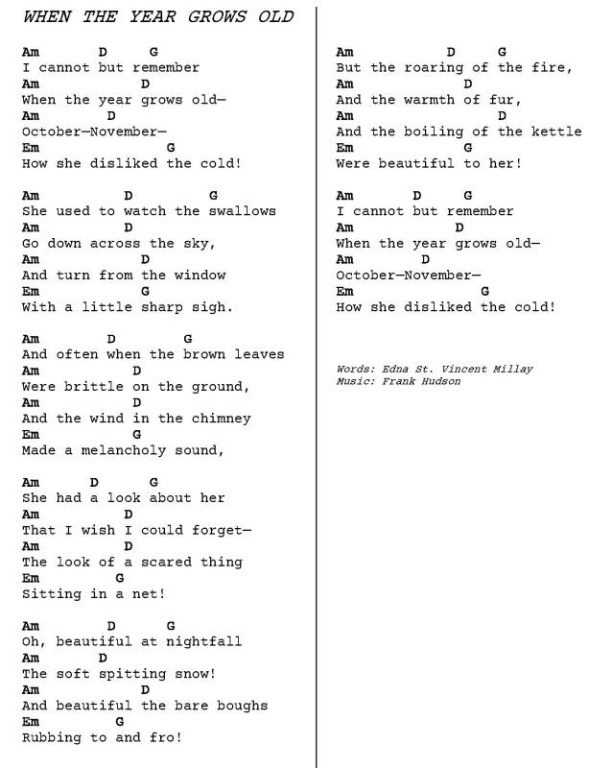
Simple chords for today’s piece, presented here as chord sheet  in case you’d like to sing it too.

.

Living with this poem as I set it to music and performed it, I came to think of it more at “Girl from the North Country” — a song about a lover who is longingly thought of lovingly, but who is now separated. By the time of the performance that you can hear below, that was how I was singing it. Why did I think that?

Partly from reading later Millay poetry, partly in biographic clues of Millay’s sexuality. There’s a definite undercurrent in the poem of the “she” feeling ambivalent: the sighing look at the flying birds, the melancholy chimney wind, and most directly in the abrupt “look of a scared thing/sitting in a net!” And what follows that line feels lustily sensual to me: those rubbing “bare boughs,” that fur by the fire verse.

That reading also answers the why the year being “old” is the title, not “cold,” other than just seeking variety. A once passionate attachment has been reconsidered by the other party, has grown old/cold.

Millay could have made other meanings (“cat lady,” “dear old mom.” etc,) clear with no commercial readership risks, but following my understanding, this presentation is coded so those who know will see that, and others will see a vaguer poem while recognizing late autumn weather. If I’ve misread it, or if Millay ever explained what she was intending — well, it wouldn’t be the first time — but it worked for me to find an experiential place to inhabit the poem.

You can hear my performance of Edna St. Vincent Millay’s “When the Year Grows Old”  with the audio player gadget below. No gadget? It’s nothing personal, just that some ways of viewing this blog suppress that. This highlighted link will open a new tab with its own audio player.

.

*As poetic testimony: tender as Robert Hayden’s well-loved poem “Those Winter Sundays”  is, it’s not a story of a parent finding happy beauty in loading up a household’s fire box.

To Waken an Old Lady

It’s National Election Day in the United States, and it’s seen as an extraordinary consequential election. Amid that great matter, I fielded a clutch of social media queries on poetry and music in the last 24 hours or so. I think I understand this seeming paradox. Though I myself will likely stay up late tonight listening to returns — as it is after voting early in the morning, I’m expecting to have only the maelstrom of worrying and hoping to spend over the rest of this national event tonight.

But since I last left my listeners at the end of October with an atypical audio piece, I thought it’d be a good day to release this performance by the LYL Band of a poem by the American early Modernist poet William Carlos Williams. That’s what we usually do here: take other folk’s literary poetry never meant to be sung and combine it with original music in differing styles.

What’s my personal history with Williams? Oddly,* my introduction to Williams was in the guise of his printed introduction of Allen Ginsburg to me (and many) in the thin City Lights paperback Howl and Other Poems.  Williams’ name was printed right on the cover of Howl,  and while in a smaller font than Ginsberg’s, it’s not fine print either. They must have thought it would help.

Howl Cover

Published November 1st, 1956. Did the choice between Eisenhower and Stevenson seem quite so existential?

.

As a young man I don’t think I absorbed much of what Williams said in his short introduction. I didn’t have the experience of life to fully grasp it, and about all I knew of Williams was that he was an established, a somehow certified, real poet — and the man he was introducing, Ginsberg, was not. At that point, the younger poet had not been elected to such a post by the cultural electoral college, but WCW was vouching for him beyond the matter of a questionable Beatnik fad. As a teenager at the time, what did I know about what made a real poet? I can’t fully remember. I had some romantic ideas about vision, seeing intensely what others couldn’t sense, and some idea that that would likely put the poet in opposition to elements of society. This was not some structured critical philosophy on my part, it was more a gut feeling, a wish for something more. I look back at that kid I was and think: well, maybe I’m still no better a philosopher than he was, though I now know complications — but yeah kid-of-the-past, there’s still something to that.

Williams’ name on the Beat landmark paperback did not lead me to read Williams then. Rereading that introduction today that may have been because while it had words that Ginsberg took as validation, it was somewhat between hands-off and off-hand about Ginsberg’s poetry. He called Ginsberg “disturbed,” recalled that he didn’t think the young man would develop into a poet (or even survive). He characterizes the title poem of the collection, “Howl,”  as a howl of defeat. I adamantly heard it as a howl of survival. So, thanks old man. Glad you at least said we should pay attention, be “arrested” Williams wrote, by Ginsberg’s poetry.

It’s only been in this century that I read Williams early 20th century work. I found a lot to like in his clean spare early poems written as Modernism sought to clear out the tired excesses of decoration. Now as I re-read Williams mid-century introduction to Howl  I’m arrested by things I, an old man, resonate with. He did  see the poem’s survival testimony. He wrote this there about Ginsberg’s poetry:

He proves to us, in spite of the most debasing experiences that life can offer a man,
the spirit of love survives to ennoble our lives if we have the wit and the courage and the faith — and the art! to persist.”

And he continues in the introduction to Howl:

Poets are damned but they are not blind, they see with the eyes of the angels. This poet sees through and all around the horrors he partakes of in the very intimate details of his poem. He avoids nothing but experiences it to the hilt. He contains it. Claims it as his own — and, we believe, laughs at it and has the time and effrontery to love a fellow of his choice and record that love in a well-made poem.”

It seems to me now, from my old age, that to “see with the eyes of angels” may be its own curse, and thus the angels may howl.

Is today’s small William Carlos Williams poem, one turned into a little song sung with the LYL Band, too slight to serve on a night where we look as nations move? I don’t know. I already told you, I’m not much of a philosopher. Williams’ “To Waken an Old Lady”  is a poem that yokes old age and the descent into winter. Here’s a link to the text of the poem if you’d like to follow along.

I now can often feel like the small birds he puts in this poem. In the course of life, I’m here past the days of career or work harvest. In the summer, the summer of this political campaign, I felt the cold dark winds plenty of times. The poem doesn’t say, but I suppose the poem knows spring comes. I suppose also the poem knows that death comes and preempts spring too.

“But what?” Williams interjects as the poem turns. Look: there are these broken seed husks, the ones that didn’t bloom. So what if they are not to bloom, they are sustenance for survival.

You can hear the LYL Band performance of “To Waken an Old Lady”  with the audio player below. Are the returns of an audio player yet to come in?  This highlighted link will open a new tab with its own audio player.

.

*Well maybe not odd for me. If you’ve read many of these posts, you may have recognized that I love the odd connection.

Stars: Robert Frost and The Book Of Nature

Robert Frost. Long-time readers/listeners here will know I love to sing Frost’s early poems as part of this Project. We’ll get back to Frost, but another thing long-timers here know: for me, roundabout is the best mental journey — and there will be a piece of music at the end as we rest from our walk.

Ok, let’s stroll.

It’s a famous midcentury half-hour black & white TV episode. So famous that you don’t have to have seen it to know the recognition scene near the end of its story that has become a modern myth that SF and Fantasy fans like to point out their stories aspire to. Given that, I’m going to assume no one will need a spoiler alert for this 1962 Twilight Zone episode called “To Serve Man.”

The format’s so brief, the story must be told rapidly. We’re told that a race of other-planetary beings have landed on Earth. With retrospectable irony, their leader is described as “Christopher Columbus from another galaxy.” They go about setting things here in benign order with advanced technology. They leave behind a book in their language that seems to be a guide to the extraterrestrials’ efforts. Partway in, Earth’s code-breakers have deciphered the book’s title: To Serve Man.  And they seem to be doing just that: ending hunger, gently enforcing world peace, taking selected humans on spaceship rides to their home planet.

Many of you are now speaking — telepathically or aloud — to a device’s screen what is urgently delivered to the story’s human hero once the humans can decrypt more of the book than just the title: “It’s a cookbook!”

I’ve written here often about something I call The Book of Nature. Though not an exclusive American idea, I connect it with the 19th century American “New Thought” movement called Transcendentalism. The Transcendentalists believed that a true scripture of the universe’s higher power was transcribed in nature. By contemplating nature big to small one could discern the highest truths. Our contemporaries who are “spiritual but not (sectarian) religious” may hold to this as a core belief, but it’s likely that every denomination of religious belief can incorporate this too — after all, if The Creator made this, their authorship means there is plausibly something there to be read.

Now we can get back to Robert Frost. Frost no doubt knew Transcendentalist thought, but unlike his fellow great American poet, Emily Dickinson, Frost didn’t hold with its doctrines.*  Yes, Frost wrote seemingly “En plein air” about nature often. His early poems, some of the ones I like best, are suffused with the landscape and particulars of New England nature. Did he see a supreme being’s handwriting there?

If so, Frost would be critical of The SB’s penmanship.

stars

Chord sheet so that you can sing this one yourself.

.

If we look at this example, “Stars”  from Frost’s first book of poems, A Boy’s Will,  what do we “read” from nature’s book? The stars come out at night. What is their nature?** “Countless(ly),” we can’t even get the basic stats correct. Oh wait, Frost can see a primary Roman goddess in there: Minerva, the goddess of wisdom and strategy. No, he reconsiders: it’s a statue of Minerva he sees in the stars, a human-made simulacrum — and her marble eyes are the form of sight organs without any such function. So should we look lower down at our earthly landscape?***  Snow covers it profoundly, drifting “as tall as trees” and so obscuring even the ground-level facts. Wind is blowing — the choreographer of this landscape — yet, this dance doesn’t tell a story, it obscures it, though here at last Frost reads a message. That wind, that obscuring snow, is “our fate.” In the most mysterious part of the poem, the second stanza, we cannot see where we’ve walked or where to guide our steps. The gothic part of my nature reads Frost’s “place of rest invisible at dawn” as death. I read the image in this stanza that in such deep and overblown snow, one cannot even see the walk fate will not reveal to a farmhouse graveyard.

Nature acts “with neither love nor hate.” Robert Frost has decrypted The Book of Nature — and all the pages are blank.

Here’s that song at the end of our mental walk where I set Frost’s poem to music with acoustic guitar. You can hear it with the audio player gadget below, or with this backup highlighted link if that gadget is not shown.

.

*Frost’s friend and fellow poet Edward Thomas was an exquisite nature poet of his British Isles countryside. In regards The Book of Nature, he’s between Frost and Dickinson for he has a horticulturalist’s specific eye like Dickinson — and his consistent naming of natural details and seeing them as readable symbols indicates he finds them plausibly capable of guidance.

** Astrologers, Biblical Magi, and classical constellation dots-connectors of course are reading that sky in clear text.

***In a changeup meant to fool this writer and singer, my specific winter this year has been oddly empty of any expected Northland winter symbolism. We’ve had next to no snow, only a week or so of bitter sub-zero cold, and I look out today on a sunny brown yard over which squirrels are carelessly playing tag and tree as we rise to our predicted afternoon high of (in Minnesota! In January!) of 55 degrees F.

I’ve been riding my summer bicycle with its summer tires most every day this “winter,” where that bike normally stays hung up high in the back of my shed. Spring in Minnesota is famously snowy, my winter bike with studded knobby tires cannot be put out of the way. Perhaps as long as I leave it by the door we may continue to have a mild winter.

To not be scared of death that doesn’t understand us

I’m going to start off the new year 2024 with something I do less often, presenting a new piece that uses my own words. I give myself permission in part because it was engendered by thoughts of another poet, Robert Okaji, who I’ve considered as something of a kindred spirit to my efforts here since this Project began 8 years ago. Like most every blogger I can’t help but talk about myself, but when I do that I fear I become a spendthrift of boredom, so one of this Project’s mottos has been “Other Peoples’ Stories.” Yet, for all that, this isn’t Robert Okaji’s story in any summary — he’s his own poet, his own writer. I’m presumptuous, but I won’t go there. I don’t know him, though I’ve read his blog, his poetry, seen him read online once. Is that like knowing him in some way?

Many of us poets could admit that we see ourselves in a timeless guild. Homer, Sappho, Shakespeare, Emily Dickinson, Du Fu, Yeats — they’re our co-workers. We flatter ourselves at times that we now occupy their offices. By the same conceit, I could think of Okaji as a compatriot. We live in the same country at the same time, we’ve exchanged the customary short notes over the Internet. At least once before today, something he wrote caused me to write something myself. I think I started writing translations/adaptations of classic Chinese poetry before reading his, but his approach (we both need to start from literal English glosses) ratified mine in effect.

So we poets, at the moments our heads swell up so that poetry can burst forth,* may think it’s as if we know each other, because we think we know each other in poetry. To say then that it’s like companionship, that it’s as if, is to do that thing that’s called in poetry a simile.

Every simile when examined harshly knows it’s pathetic. Every poem is not the thing it represents — even the great poems that change how we look at the thing they represent. Let all in the poetry guild admit this to each other within the walls of the guild hall.

I started writing today’s words on one of my more-or-less daily bicycle rides. In spring there may be many kinds of birdsong in my well-forested city, but in winter it may be only crows — which, as the poem describes, are quite vocal about a solitary early morning bicyclist in their midst.

Crows, ravens, big dark birds, are a death symbol of long repute. And it struck me that while we might chide ourselves for not having sufficient knowledge or understanding about death, we could just as well say that death doesn’t understand us. Living in our consciousness as if the present continues indefinitely, we don’t understand death, but death doesn’t understand that moment either. And then, we poets think we can capture the flow of consciousness and preserve it in poems. Today’s poem carries on in a series of similes and then makes a final summation of the series.

Okaji has written a group of poems over the years featuring the character of a scarecrow. Perhaps he too is riffing on crows as the death symbol, but his scarecrow is at times a comic figure too. A scarecrow is just another simile, a sort of, an as if symbol for us — and so I speak of Okaji’s scarecrow in my poem.

Scarecrow takes a winter bike ride

Scarecrow rides a bicycle in early winter mornings, and the crows object. (a note: I begat these AI illustrations with Adobe Firefly, which claims it doesn’t use uncompensated artists’ work to train itself)

.

I said my poem isn’t Okaji’s story — it’s more mine partway — but if you’re like me in some ways, particularly if you want to consider those of us aged to where a compatriot’s death seems next door, then it might be as if it’s partway yours too. The admonition in the poem’s title is therefore not addressed impertinently to Robert, but to myself and perhaps others who might read or listen to this.

Woody Allen wrote a great line: “I don’t want to be immortal from my work. I want to be immortal by not dying.” We write poems, we make those “like a” statements by writing poetry. As if: in our minds we walk into those poetic offices, write our metaphors, our similes. And some day, we must clean out our offices, leaving on our desks a few sheets of paper, maybe enough to stuff a scarecrow.

Today’s performance started with two electric guitar lines I recorded early on New Year’s Day, following the tradition of trying to do things on that day that one would like to continue to do regularly the rest of the year. The two somewhat irregular riffs were spontaneous,** thinking that promise to myself required doing  as much as planning. The bass line was laid down almost a day later to try to hold things together, and the decoration of the keyboard parts arpeggiating the spontaneous chord changes which had started things off, were the final tracks. Those things done, I had my rock band to declaim my sonnet “To not be scared of death that doesn’t understand us” over.

You can hear that with the audio player you should see below. No player?  This highlighted link is a back-up method, as it will open a new tab with its own audio player.

.

*A metaphor that sounds more like a sneeze than Athena’s birth when I re-read this.

**I fancy the right channel line played on my Telecaster has some crow-call-like moments.

Storm Fear

Of all the English language poets who have achieved a general readership, it’s likely that Robert Frost is the most misunderstood. I don’t say that to shame that broad audience — after all, in my youth, when asked to read Frost, he seemed too full of tired maxims and quaint commonplace situations. Sure he comforts folks I ignorantly thought, and maybe I undervalued comfort, but that wasn’t what I was looking for.*

I won’t blame that youth I was then too much. I was onto other things — but as far as Frost goes, I was carelessly understanding his best work too quickly. Decades later, partly as a result of this Project, I came to his short lyrical poems, beginning to appreciate their supple word-music — and then once beguiled, I began to see what he’d put in these concise pieces.

“Stopping by the Woods” isn’t about lollygagging when there’s duties to do“The Road Not Taken”  isn’t about the so-consequential road taken. This poem, “Storm Fear”  from Frost’s first collection, A Boy’s Will, isn’t about settling down to a little hygge-time in a winter snowstorm. Here’s a link to that poem’s text if you want to follow along.

Maybe it’s its concision, or the careful way Frost uses incremental details, but this poem was first published in 1915 and yet the horror it contains seems to have passed most readers by. As I read it this month, now more attuned to how Frost can work, my first thought was this is as harrowing as Bob Dylan’s “Hollis Brown”  or as stark as Bruce Springsteen’s Nebraska  album.

My first reminder as you read this poem is that it’s set in a circa 1900 rural America that was more isolated than you might imagine today. Farm families didn’t always have daily connections with others, and those institutions that offered connections: churches, shopping towns, exchanged labor, and rural schools were episodic. Long winter nights and snowstorms restricted what travel there was. Frost himself went through a brief attempt at living that farm life in this era. Perhaps he had a writer’s lighthouse-keeper fantasy of splendid, thoughtful isolation. His poetry testifies that he learned the reality.

Frost’s poem opens with a snowstorm in progress in the nighttime. How many poems, stories, blog posts, other accounts portray such a scene? Frost wants to let us know this isn’t a greeting card picture. The wind is a “beast” and it’s curiously imploring “Come out!” How many readers will miss this odd inclusion and take it as so much filler merely indicating that there’s a wind?**

The poem’s speaker, who we’ll find out is a young husband in the house with a wife and child, responds that it doesn’t take much interior debate to not obey what the beast outside is requesting. He’s thinking: there’s a storm, I’m staying in.

Then we get a different calculation. He tells us about the wife and child. They’re asleep, there’s no awake partner to bounce ideas off of. Suddenly he’s worried about the isolated farmhouse’s sole source of heat, a wooden fire. I think the implication here is that at the very least he thinks he needs to visit an outside woodpile. Or perhaps the winter has been hard enough that he’s short on fuel.

In the poem’s concluding scene, he’s now set on going outside. In the snowhills and blowing snow, even the barn looks “far away.” Is he even considering trying to make it to a neighbors for fuel? Is he making a difficult but sane decision, or is his isolation and “cabin fever” such that he’s thinking of making a risky trip for less than necessity?

Storm Fear 1

I thought too of the deadly rural winter isolation of Susan Glaspell’s “Trifles” reading today’s Frost poem.

.

Let me note one other thing about the poem. For Frost, the famous formalist, this poem’s form is very irregular. Poetic feet, meter, rhyme scheme? It’s all over the place, though periodic iambs are there in the confusion. Formalists who teach Frost would likely skip over this example for lessons. Workshopping this poem with a formalist? I can imagine the markup.

In setting “Storm Fear”  for performance I was able to deal with the irregularities in Frost’s design, but then I’ve worked in this Project with a lot of outright free verse and have found it not as difficult to sing or mesh with music as some might guess. But when you’re performing (rather than writing a page poem) there are a couple of things you might want to add stress to: a sense of repetitive or choral structure and some additional guidance to the listener to intrigue understanding on one listening.

My choice here was to make the poem’s 7th and 8th lines into a refrain that repeats twice more, the last with a variation. The first time we hear “It costs no inward struggle not to go,/Ah no!” we hear it as the easy rejection of the beast-storm’s call. The second time, as the singer thinks of his wife and child, it seems more as a statement of the imperative for him to take action and leave into the storm. And in the final statement at the end of the song, he’s about to enter the storm thinking he must seek aid.

Would Frost have approved of my changes? Who knows. He was a man of strong opinions and an often brusque manner. Many poets or their rights-holders would forbid changing even a word. But this old poem is in the public domain now, I need no permission, and I hope my setting honors the intent of Robert Frost.***

You can hear my musical performance of “Storm Fear”  with the audio player gadget you may see below. Is that player snowed out?  This highlighted link will open a new tab with its own audio player in those cases.

.

*So yes, I was a dolt about Frost, but not singular in that ignorance. Frost’s first two poetry collections were published in England after he left America for there. One reason for that hejira: American publishers were not in the least interested in his poetry. Frost was nearing 40 when A Boy’s Will  was published. So at least in 1915, the experts were also misreading Frost.

**Some Faustian readings of this poem take that beast as The Beast — that the poem’s speaker is a sinner being stalked by his sins’ debt collector. Frost may have been aware of that implication, though it doesn’t strike me as consistent with what I understand of Frost’s own theology. Making the wind “howl” or “growl” is a commonplace, and calling it outright a beast may be stronger — but if enough readers miss the eminent dread in this poem, maybe it wasn’t strong enough.

***Generalizing, poets who feel they’ve worked their words with a fine touch are often resistant to editing by collaborative outsiders. Since Faust has entered the chat, I think of the collaboration between Bob Dylan and Archibald MacLeish who were slated to do an adaptation of Steven Vincent Benét’s “The Devil and Daniel Webster”  for Broadway. MacLeish knew Benét, and likely thought he could do right by his late friend’s work. Dylan has his ways, and MacLeish had his — so the two fell out, and Dylan’s songs in progress for the play were not used. The eventual Broadway production bombed. Dylan used some of the songs later on his own. His “Father of Night”  is often attributed as one of those rejected songs.

Anna Akhmatova’s “Love”

It wasn’t a conscious plan, but I’ve been pretty tough on love within recent presentations here. Today’s piece from Russian poet Anna Akhmatova continues that, but it wasn’t something I just started to work on either. My efforts on this 1912 love poem “Liubov”  began when I did a fresh English translation of it last June. Perhaps because of its striking winter imagery, I decided not to publish it until later in the year. I stuck with this decision even though I’d also completed writing the music eventually used for the performance you can hear below.

It was only this week when I decided it was winter enough to complete my work on this, and oh does Akhmatova’s “Love”  fit in with the Australian poet Kenneth Slessor’s “Wild Grapes”  and Margaret Widdemer’s “The Dark Cavalier.”   Her poem wastes no time making its sinister case for distrusting love: it opens with a cold-blooded snake shape-shifting itself into a frosty heart, persistent, and pretending to be as harmless as a dove. It ends with the poet warning others that desire “Knows how to cry so sweetly/with prayers of an aching violin” and its final statement that the hint of interest shown by any man’s smile now sends fears, warning, to the poem’s speaker.

It’s such an arresting statement that it sounds like the judgement of a woman’s hard-won experience. One never knows with poets and their conjured personas, but this is a poem of a young woman, written when Akhmatova was in her early 20s, and the poet herself later rejected her early work off-hand as “naïve poems by a frivolous girl.”*  Yet, even by that age she was already participating in avant-garde circles within an adventurous life of shifting romantic alliances.**

Akhmatova by Modigliani

Portrait of the young Akhmatova reclining on a couch by Modigliani

Anna Akhmatova on couch

Later photo of Akhmatova on a couch. “Is that a smiling winter snake-heart-dove at my frosty window? I’m in no mood to get up to answer.”

.

In my translation (which relied on English literal glosses as I don’t speak Russian) I followed my usual practice: to try to determine what images the poet is presenting, and then to vividly portray them in a way in contemporary English language word-music, even if that’s not closely tied to the original “tune” of the poem’s native language. I thought the solutions I came up with for this poem worked well, and I hoped my instrumental music would add to that. I had recorded the basic tracks of energetically strummed acoustic guitar and my vocal first, and then found it somewhat difficult this month to work out a keyboard part to flesh out some additional melodic interest. I tried to follow myself with the added keyboard arpeggiation, but the eccentricities of the rhythm was challenging. My final judgement was the tension of my attempts might be a feature not a bug, and perhaps you’ll find it so too. You can hear the musical performance of my translation of Anna Akhmatova’s poem “Love”  with the audio player below. If you see no player, this alternate method is offered: you can use this highlighted link which will open a new tab with its own audio player.

*Akmatova’s life was complicated by more than love affairs, as she lived through two world wars, a revolution, and shifting and threatening political currents in the USSR. It’s not impossible for older writers to see their work as a progression and to discount the fondness readers have for their previous work, but living through such history suggests that shifting cultural expectations could have made expressing such doubts an external expectation.

**From choice, chance, and restriction, she lived her life within the bounds of the old USSR. However, before this poem was published, she’d traveled to Paris where she met artists and writers there. If Gertrude Stein had her Picasso portrait to display in her famous French apartment, Akhmatova had a portrait by Modigliani which she carried with her and displayed in her living spaces throughout her life.

A Winter’s Tale: A cold mystery for Halloween

Having done over 700 audio pieces in the more than 7 years of the Parlando Project, I take pride in the variety of the original musical settings I’ve supplied for them. Oh, there are more than a few of the performances over the years that embarrass me: stuff were my problematic vocals don’t deserve parole, or arrangements where I can’t now tell how I ever thought they worked, or those where it would have been better if I’d had access to better musicians than my overdubbing, but many of them still sound good to me.

None sounds better than this one as we near the end of my Halloween Series presenting some of the listener favorites from those 700-plus pieces. “A Winter’s Tale”  sets a should-be-better known poem by D. H. Lawrence. For some of you that poem’s climate is going to seem premature — and you may even wonder why it fits a Halloween theme. I assure you in Minnesota, in the northern parts of North America, this poem is not out of season. We’ve had no snow yet, but my morning bike ride was –5 Celsius. And tomorrow? Those thin polyester costumes sold at stores for trick or treating are not right for many a Minnesota Halloween. And any creativity in making one’s own costume is suppressed by the eventual need for an overcoat which will cover it. And what of Lawrence’s poem — here’s a link to the text of the poem — what’s Halloween about it?

Winters Tale 1080

A long way between houses just for some candy.

.

Well, it’s quite mysterious. This is the third time I’ve presented it, and I’m still not sure what the specifics of the described wintery mystery are. At times it seems like a breakup or strained love poem. Other times it seems like a hunting poem, metaphorical or not. It may have some connection I’ve not fathomed to Shakespeare’s play concerned with virulent mistrust. If it’s a hunt, I can’t even say who the speaker/singer and the hunted are. One or the other may even be Winter itself. That mystery and the air of danger are enough to make it a Halloween poem, and after my musical work, a Halloween song.

You can hear it with the audio player gadget you should see below. No player to be seen? This highlighted link is a backup that will open a new window with its own audio player.

.

Emily Bronte’s Cold Halloween Spell

Continuing our Halloween Series featuring some of our listener’s favorite fantasy and supernatural pieces from the seven years of the Parlando Project we get to today’s short Emily Brontë poem “Spellbound.”   Once more we have an eerie situation with withheld information that adds to the mystery while paradoxically compelling our attention.

Before beginning the Parlando Project I was only aware that Emily Brontë had written poetry, holding that fact as having no other consequence. I’m not even sure what drew me into her poetry — memory fades — but it may have been finding out that another Emily, Emily Dickinson, read it. Brontë’s poetry, which preceded her famous novel Wuthering Heights,  was at least partially extracted from a series of writings she and her young siblings created within a set of fantasy worlds — and though this short discussion of Emily and Anne Brontë’s imagined world of Gondal doesn’t list this poem as being part of that universe, “Spellbound’s”  setting doesn’t sound out of place from the northern, winter island in their Gondal.

Nor out of place in the northern U.S. where I live, where the wind and weather is casting us to cold with predictions of snow and ice within the next 24 hours. When I first presented this poem three years ago,* I was intrigued by the prepositional position that the poem’s speaker seems to be in. In the poem they say that clouds are above them and the wintery wastes are below. It could be that Brontë was only envisioning a highlands or hillside perspective, but my mind’s eye had the spellbound speaker suspended, frozen in mid-air. Perhaps again, my imagination overtook me in that detail, but then I’m glad for Brontë’s imagination which created this chilling and enchanting poem that let me picture that.

Bronte's Spellbound 1080

Another illustration created by enchanting Adobe’s Firefly with an incantation. Firefly claims that it doesn’t use uncompensated artists work in its AI model.

.

I rather like the music I came up with for this one. Maybe you will too. An audio player is below for many of you so you can hear the performance of it, but some ways of reading this blog will suppress that page element, and so I also offer this alternative: a highlighted link that will open its own audio player gadget.

.

*If you follow this link to my original presentation of “Spellbound”  you can see the lyrics as part of a chord sheet in case you would like to perform this song yourself.