Libertad! Igualdad! Fraternidad!

We’re going to have some William Carlos Williams poetry turned into a song below. If you’ve missed that sort of thing from me, I’ve returned with time to focus on what we do here.*

I think I’ve already mentioned that I’m disappointed in my country and its follies this past year after the national election. I could take your time and patience with some personal punditry on where to apportion blame for this. The electorate? The winning vassal party and it’s red duchies? The oligarchs and emperors ever-richer and more protective of prerogatives? And then too, the losing party, who gets apportioned blame for everything else on the list as well as bearing the sting of defeat?

I’m not going to do that. A complete list opens up the vulnerability of adding one’s own self to the blame. While many personalities have strong defenses against that self-indictment, I’m not sure if that’s a good or bad thing. By now, if you wanted any variety of that, you’ve already had your fill. Rather, if you’re on the side that lost, you might feel left alone. As we approach the new regency in a matter of hours, let me repeat something I said after the election: we can, we should, forgive ourselves for hope. It is a right-sure prediction that we’re going to need more not less hope in the next few years.

As we approach the new regency in a matter of hours, let me also repeat something I said after the election: we can, we should, forgive ourselves for hope. It is a right-sure prediction that we’re going to need more not less hope in the next few years.

Further in that feeling alone — except for the exchange of blame and shame — I’m not thinking this group are presently at risk of being visited by reporters seeking to understand their sorrow, fear, disappointment, despair. They’ve had over 60 days to file those “I must understand them” stories, but there’s a general silence on that front. Perhaps there will be some stories of the manifestations to come of what some of us fear — though if the worst fears come, those could be harder to find, and stories after injury may be less efficacious than the now-impossible to file stories that could have come beforehand.

Libertad!

I urge folks to sing these Parlando songs themselves, so here’s a chord sheet for today’s piece. Some will likely do a better job than I do, and additional voices strengthen a song.

.

So, I was happy to find, write music for, and sing this short William Carlos Williams poem this winter, even though it was written back in the last decade called The Twenties. I too feel forced into the mud, and so much now depends on the stink of the ash-cart rolling toward us. You can hear it with the graphical audio player gadget that should appear below. No player? No editor looking over his shoulder at their owner-baron has spiked it. No algorithm has ruled against it in court. The audio gadget has always been impartially suppressed by some ways to view this blog — but you can use this highlighted link to open a new tab with its own audio player.

.

*This isn’t the first holiday season that has caused a drop in new pieces or posts, but I’ve spent a good deal of time in this cold bilaterally looking January shopping for a replacement for my 20-year-old car. I had previously figured I’d wait until that car had reached its full majority this upcoming fall to shop for a replacement, but like some others I played the odds that new tariff taxes and repercussions would raise prices.

To Waken an Old Lady

It’s National Election Day in the United States, and it’s seen as an extraordinary consequential election. Amid that great matter, I fielded a clutch of social media queries on poetry and music in the last 24 hours or so. I think I understand this seeming paradox. Though I myself will likely stay up late tonight listening to returns — as it is after voting early in the morning, I’m expecting to have only the maelstrom of worrying and hoping to spend over the rest of this national event tonight.

But since I last left my listeners at the end of October with an atypical audio piece, I thought it’d be a good day to release this performance by the LYL Band of a poem by the American early Modernist poet William Carlos Williams. That’s what we usually do here: take other folk’s literary poetry never meant to be sung and combine it with original music in differing styles.

What’s my personal history with Williams? Oddly,* my introduction to Williams was in the guise of his printed introduction of Allen Ginsburg to me (and many) in the thin City Lights paperback Howl and Other Poems.  Williams’ name was printed right on the cover of Howl,  and while in a smaller font than Ginsberg’s, it’s not fine print either. They must have thought it would help.

Howl Cover

Published November 1st, 1956. Did the choice between Eisenhower and Stevenson seem quite so existential?

.

As a young man I don’t think I absorbed much of what Williams said in his short introduction. I didn’t have the experience of life to fully grasp it, and about all I knew of Williams was that he was an established, a somehow certified, real poet — and the man he was introducing, Ginsberg, was not. At that point, the younger poet had not been elected to such a post by the cultural electoral college, but WCW was vouching for him beyond the matter of a questionable Beatnik fad. As a teenager at the time, what did I know about what made a real poet? I can’t fully remember. I had some romantic ideas about vision, seeing intensely what others couldn’t sense, and some idea that that would likely put the poet in opposition to elements of society. This was not some structured critical philosophy on my part, it was more a gut feeling, a wish for something more. I look back at that kid I was and think: well, maybe I’m still no better a philosopher than he was, though I now know complications — but yeah kid-of-the-past, there’s still something to that.

Williams’ name on the Beat landmark paperback did not lead me to read Williams then. Rereading that introduction today that may have been because while it had words that Ginsberg took as validation, it was somewhat between hands-off and off-hand about Ginsberg’s poetry. He called Ginsberg “disturbed,” recalled that he didn’t think the young man would develop into a poet (or even survive). He characterizes the title poem of the collection, “Howl,”  as a howl of defeat. I adamantly heard it as a howl of survival. So, thanks old man. Glad you at least said we should pay attention, be “arrested” Williams wrote, by Ginsberg’s poetry.

It’s only been in this century that I read Williams early 20th century work. I found a lot to like in his clean spare early poems written as Modernism sought to clear out the tired excesses of decoration. Now as I re-read Williams mid-century introduction to Howl  I’m arrested by things I, an old man, resonate with. He did  see the poem’s survival testimony. He wrote this there about Ginsberg’s poetry:

He proves to us, in spite of the most debasing experiences that life can offer a man,
the spirit of love survives to ennoble our lives if we have the wit and the courage and the faith — and the art! to persist.”

And he continues in the introduction to Howl:

Poets are damned but they are not blind, they see with the eyes of the angels. This poet sees through and all around the horrors he partakes of in the very intimate details of his poem. He avoids nothing but experiences it to the hilt. He contains it. Claims it as his own — and, we believe, laughs at it and has the time and effrontery to love a fellow of his choice and record that love in a well-made poem.”

It seems to me now, from my old age, that to “see with the eyes of angels” may be its own curse, and thus the angels may howl.

Is today’s small William Carlos Williams poem, one turned into a little song sung with the LYL Band, too slight to serve on a night where we look as nations move? I don’t know. I already told you, I’m not much of a philosopher. Williams’ “To Waken an Old Lady”  is a poem that yokes old age and the descent into winter. Here’s a link to the text of the poem if you’d like to follow along.

I now can often feel like the small birds he puts in this poem. In the course of life, I’m here past the days of career or work harvest. In the summer, the summer of this political campaign, I felt the cold dark winds plenty of times. The poem doesn’t say, but I suppose the poem knows spring comes. I suppose also the poem knows that death comes and preempts spring too.

“But what?” Williams interjects as the poem turns. Look: there are these broken seed husks, the ones that didn’t bloom. So what if they are not to bloom, they are sustenance for survival.

You can hear the LYL Band performance of “To Waken an Old Lady”  with the audio player below. Are the returns of an audio player yet to come in?  This highlighted link will open a new tab with its own audio player.

.

*Well maybe not odd for me. If you’ve read many of these posts, you may have recognized that I love the odd connection.

William Carlos Williams “The Birds” and what nature sounds

Something about the Spring I noticed this year — oddly, this year as an old man who has had a full lifetime of Springs — is the intensity of natural sounds in my city. There’s a tendency, demonstrated in many poetic tropes, to make nature a portrait or a silent movie, putting nature in contrast to the noise of our civilization’s hum and bark.

I ride my bicycle nearly every day off to a café to have a breakfast, sometimes early enough to feel like the single soul on the street, but by the return trip certainly part of the city waking and doing: kids on their school bus stops, sometimes with a parent, sometimes waiting with their own cohort only, folks holding coffee flasks unlocking their car doors to go to work, a few other bicyclists, including those on big front basket bakfiets or long-tail rear-seat-shelf bikes holding small kids, this observant cargo watching whatever in the morning beneath their pastel helmets. The human noise is slight and clicking. In such mornings we are more like crickets rubbing their wings.

But the birds! When most of those humans are making only accidental noise this early, and the kids waiting for the yellow bus aren’t always talking, perhaps practicing quiet for the ordered schoolroom, the birds are singing at the tops of their voices in the morning. Like miniature feathered fiddles, their song cuts through larger sounds, it insists on being heard. “Ladies, I got your genetic material here!” “This is my and my kind’s tree!” “Whatever this is, this Spring, I am here, and I’ll use my breath to say it!”

Like us bipeds lacking much fur, other mammals aren’t sounding much. Yard bunnies are suspicious and quiet. The squirrels don’t chirp, and their little feet make quiet footfalls. The dogs on leashes: all nose-leading in an alternate sensory dimension. But the frogs and toads are singing out too — whole amazing choirs of them, all wanting to contest Emily Dickinson’s Nobody with a harrumph and high whistle of who they are.

So, it is this Project’s nature to add sound to page poetry. Today’s audio piece is just me alone with a Telecaster electric guitar during a hurried session early this Spring to put down some musical ideas. In the poem that I’m combining with my music, “The Birds,”  William Carlos Williams follows Imagist principles, melding a moment into concrete images. Given that we’ve just had a set of rainy days throughout the long holiday weekend in my city, I resonate as Williams poetically paints the bird-morning wet as undried paint.

Is the world not “wholly insufflated” as he says at the start? The bird song is breathing into our world — nature is not silence, but poetry aloud.

Strange Powers Magnetic Fields photo by Heidi Randen 600

My wife found these* stapled to poles around our neighborhood on Sunday.

.

You can hear my performance of Williams’ “The Birds”  with the player gadget below. No gadget to be seen? This highlighted link is an alternative that will open a new tab with its own audio player. Want to follow along with the text of the poem? Here’s a link to that.

.

*This bird couple’s heads are superimposed over a human pair of heads from the cover of The Magnetic Fields Holiday  album. The quatrain quoted below is from a song found there “Strange Powers.”   Despite being a substantial Magnetic Fields admirer myself, I had never seen this album cover.

William Carlos Williams’ Summer Song

One of my favorite Indie rock band names is Yo La Tengo. The name comes from a convention that was formulated decades ago as talented non-English speaking players began appearing in North American baseball teams. “Yo la tengo!” means “I’ve got it!” – a useful term as two or more fielders with their eyes fixed skyward tracking a fly ball might otherwise collide. In such a situation, the most confident player needs to call off the others who also think they might have a chance at making the play.

Today’s piece is by William Carlos Williams, who grew up speaking Spanish. It was published in Williams’ 1917 collection Al Que Quiere!   Wikipedia quotes from a later memoir by Williams where he translates that phrase as “to him that wants it,” a cry that he associates with playing football (AKA soccer). I don’t have access to that memoir, but he expands on that definition to make it sound like it’s an in-game cry meaning “I’m open, I’m confident, I have advantage on the defenders, get the ball to me!”*

Odd to think of WCW as a young athlete. I always picture him in his later years, the time that overlapped my lifetime, as an older man.**  But there is another element of his nature in that cry: if not exactly a poetry ball-hog, he seems to have been a poet who was not ashamed to make claims for his artistic validity. He got the Modernism bug early, and went right on to the business of “Making it new” even before this collection was published. Confidence. Or stubbornness.

William Carlos Williams’ poem “Summer Song”  starts out straightforward, with the Moon still visible just after dawn. If you’d like to follow along, here’s a link to the text.***  WCW is right-off attributing personhood to the Moon. If self-aware, the Moon must know it will soon be washed out by the rising sunlight, but Williams says the Moon is indifferent to that, it goes on smiling, for even if it’s a “wanderer” it also seems to understand that it will come to a new place, a new town, a new day, soon enough.

In the final section I’m a bit less clear at how surreal WCW is going. Let’s presume he’s the poem’s speaker, the man observing this moon in the summer morning. I try to picture the image he portrays. He says he might buy a shirt the color of the Moon (white? gray? silver? ruddy?) and accessorize it with a sky-blue tie. I’m puzzled. Wouldn’t the blue of the sky be the field (the shirt) on which the moon would (whatever color) be the tie in the foreground? Is he purposefully reversing foreground object and background field? Perhaps his intent is to say that the wanderer moon is really bigger than the present blue morning sky?

decalcomania by rene magritte

Painter Rene Magritte reversing field.

.

I’m unsure, but his final line is clear — if he too may be overshadowed — he may wander too, even if fading into invisibility, until his time might come. And here we are, some 106 years later, and I’m singing his words in front of a rock quartet today. You can hear that performance with an audio player you’ll see against the field of this web page. Or not? Well, then this highlighted link will tie you to a new tab which will supply its own audio player.

.

*I’m unable to find any confirmation in a quick search that this is some kind of standard on-field player cry. The Wikipedia excerpt from WCW explaining it also goes on to have him say that “I was there willing to pass the ball if anyone did want it.” So, is “al que queire” the cry of the player who wants the ball — or the cry of someone putting up a long kick in hopes one of their teammates will be there to receive it, a soccer equivalent of an American football “Hail Mary pass?
Again, Willians was like that. He was willing to write and to publish, put himself out there, without the level of attention and praise that some of his Modernist contemporaries received during their lifetimes. Anyone know anything more about this Spanish phrase?

**Also like the band Yo La Tengo, Williams was based in New Jersey.

***Here’s a link to an earlier version of this poem as published in 1916 in Poetry  magazine. As I improvised while singing, unaware of the this alternate version, WCW extended and refrained his ending there.

Danse Russe — While William Carlos Williams dances naked

I’m taking a break today from telling some stories of discovering my own influences, and through them the possibility of this project combining words (mostly poetry) with original music. Instead, let’s return to one of this Project’s themes “Other People’s Stories.”  Today’s piece is by William Carlos Williams, and it tells a story of a morning for a 30-something young father. The mood this poem is coming from is ambiguous on the page: it could be read as joyful, even if gently self-mocking, or it could be seen as an earnest Whitmanesque celebration. Since the poems here are performed — and more so, performed in the emotional environment of music — I had to make a choice of mood. I think it’s wistful, and I took that choice largely from the short song the poem tells us the poem’s speaker sings in the midst of it.

Parenthood, particularly first parenthood, is often a very significant life event. The urge to have a child, to reproduce in the emotionless language of biology, can be partly an expression of the parents seeking to extend and duplicate themselves. The reality of the child and child-rearing, conversely, is to reign in one’s autonomous self. Depending on one’s personality and role in the household, it may mean to act as a caretaker to the helpless and needy infant, or to find much of the home’s attention is now on the newcomer. The romance of the ideal baby can be immanently real some moments, and the endless labor and new roles just as real other times.

If the mood is ambiguous, the story Williams’ “Danse Russe”  tells is told directly. It’s morning, the rest of the household is still asleep. Three others are mentioned as the sleepers: “my” wife, “the” baby, and someone named Kathleen, who has been identified biographically as a nanny the Williams’ family employed. Let’s be honest about the slight tells of the “my” and “the.” My is possessive, the isn’t. Kathleen’s named presence means there’s one other caretaker here. However privileged* we may view what was, in biographic fact, the presence of child-care, I’ll note that the speaker, the father, is plausibly then even more separated from the child. He is obligated and estranged in mixed degrees.

As the poem opens, he’s inside, physically in the household, but not with the others, and the house in his image has a sense of the outside world in morning mists and a cosmic sun. What does he do in this quiet early-morning time?

Danse Russe as AI generated 2

“To dance beneath the diamond sky, with one hand waving free.” Yes Bob ‘n’ Bill, but then the baby wakes up.**

.

He dances and sings, though one hopes it is a large house and he’s sotto voice and light on his feet. We’re told he’s naked and before a mirror. He indulges in a short Whitman’s sampler catalog of his unencumbered body,*** fully himself, able to bask in himself. Is he having a full-on Robert Bly drum circle moment here? Maybe. Let’s give Bly the poet his due here, he was often able to see a layer below the simple image — and Williams has chosen to show us this, even if we don’t know for sure why he makes this choice, and he doesn’t direct us to all his feelings, save for one, the one the dancer sings: loneliness. He concludes from the song that it’s best to be lonely, it’s his fate from birth (for being male?) From Williams’ own life I can assay he was certainly willing to be lonely, proudly stubborn in his self, but his story here, his image, is not without wistfulness mixed with self-justification. He, the poet, can help us see this. Who knows how much he, or we, can do with that knowledge? I tried to emphasize in performance that there’s a small refrained phrase in this short poem. Do you notice it when you read the text, linked here, or listen to the performance below? Three times the poem begins “If I….” What do we know of the I? What shall the I be?

Williams ends with his own “who knows?” Is he self-evidently, or by his own claim, “The happy genius of my household?” “Genius” here I think is meant in the mode of creator and progenitor, not in the IQ test sense.

I choose to think this is not a rhetorical question, that it’s truly at issue. He’s asking to cheer himself on: I’ve made the purchase of this house, I am the father of this child, I’m half the choice of its life — even if I’m also separated from this household and baby, and I feel that separation as loneliness. So many first-time parents feel in thought, bound and estranged, in all their variety of roles, partners, resources, and situations: “Am I happy?” And their best answers are “Halfway.” And then, “Shouldn’t it be all the way?” Who shall say? Well, William Carlos Williams dances and sings, and he says the distance from halfway is loneliness.

Today’s musical portion to go with Williams’ words I jokingly told my wife this morning is “shoegaze,” the genre named not just for the lack of audience eye-contact but for the number of floor-stationed effects pedals to be employed. You can hear that performance of “Danse Russe”  while waving your shirt in the air with the graphical audio player below. What, there’s no player to be seen? Now you’ve got to rebutton that shirt? No, you can use this highlighted alternative link that will open a new tab with an audio player.

.

*Live-in childcare was more common at unexceptional levels of income in the early 20th century. A substantial number of young immigrant women worked in this role.

**I slightly modified this image generated from  a text prompt using the test version of a new Adobe product, Firefly. Adobe promises that it uses only licensed art from it’s stock library to “train” the algorithm. Much controversy these days about AI, but of course poets have been using words to invoke images for some time.

***The contrast here between childbirth and breastfeeding roles and their intimate demonstration of bodily connectiveness strikes me. Did Williams intend this? I don’t know, but it’s there for me to sense. As a family physician, Williams would have certainly known intellectually of those differences.

The Red Wheelbarrow for National Poetry Month

Besides being the first day of National Poetry Month, it’s April Fools day, so maybe it’s a good day to present a poem that caused many readers to wonder if it’s a joke: William Carlos Williams “The Red Wheelbarrow.”

I’m not against a poem causing wonderment, are you? It’s fine to look at it and respond “You can’t be serious — is that really a poem?” but I urge you to follow that question with other ones, such as “What use is it?” “Is this just an artsy provocation?” or “What should poetry be then?”

I think Williams’ poem is a late but effective representation of the movement that launched Modernist poetry in English: Imagism. Fairly quickly, a great deal of English language Modernism soon moved on to more complex poetry, a poetry that was often hard to grasp due to intense but hermetic personal material or elaborate references to other works of art, but “The Red Wheelbarrow”  is none of that. Instead it expresses, like a sub-two-minute punk song from the mid-1970s, a rejection and clarification of overly elaborate poetry.

2022 NATIONAL POETRY MONTH POSTER 1024

and this place has chickens. Also a short 12 tone-row composition.

.

I think Williams genuinely thinks the rain-water makes the wheelbarrow beautiful, and he doesn’t even think he needs to say that word “beauty” or make some elaborate metaphor to seal the deal. To say that, and just that,* is a provocation against poetry that asks more, and to readers that expect the poet to give them more. But it’s not just the momentary rain-water glaze that makes it poetic: it’s useful, something to depend on. Now that’s a goal for poetry (or any art) to meet at least some of the time, don’t you think? Self-impressive poetry, trickster poetry, poetry that gathers and unites widespread allusions — all have their place as well, but sometimes it’s good to see what there is seen naked in the rain. When the cave dwellers put their hand or the hand of their child up against the wall of the cave and blew red ochre dust around it, that’s art — not of the artists showing us skills, but the art of our shared and transient experiences made fixed.

Musically here I decided to use another contemporary early Modernist tactic: the tone-row. If one knocks “The Red Wheelbarrow”  for not having poetry’s elaborate or fanciful imagery, or some tight connection with the artist’s personal biography, perhaps this performance will show something traditional it retains: a lovely, largely iambic, word music. Yes, it’s music in miniature, but still that poetic element was there for me to express.

To hear my audio performance of William Carlos Williams’ “The Red Wheelbarrow”  set to my own music, you can use this highlighted link, or (if visible) a player gadget below. And as I’ve been doing with our National Poetry Month re-releases, there’s a simple, low-budget, lyric video at this link.

.

*Well, he also admires the contrasting chickens.

Winter ‘20-‘21 Parlando Project Top Ten, numbers 7-5

Let’s pickup the countdown of the pieces that drew the most listens and likes over this past winter. Each bold-faced listing is a link to the original post on the piece in case you’d like to read what I wrote back then, and those original posts will also contain links to the full text of the poems used.

7 Thursday  by William Carlos Williams.  Quite often when reading through early 20th century Modernist poetry, I repeat my surprise of how plainspoken and outwardly simple some of it seems. This poem by Williams is one of those. There’s not a single word in it that would be unfamiliar to a grade-schooler. One need know no complex allusions to anything other than ordinary life. Not all his contemporaries wrote like this. Wallace Stevens will pleasingly stump us with his love of obscure words, T. S. Eliot will ask us to consider how history rhymes its myths, and William Butler Yeats will make English sing with beautiful and metrical word-music. Against that sort of thing, this poem by Williams may seem ordinary. As ordinary as a Thursday.

There’s only one bit of word-trickery in it — and having no other in this short poem should invite us to ponder it: that unusual use of the common word “carelessly” in the context of “I remain now carelessly/with feet planted on the ground….” Carelessly? Huh? How many quick readers would slide over that and not notice anything out of place! In the opening of his poem Williams has told us his dream has come to nothing. Is this dream one of our ordinary nighttime hallucinations or a strong and potentially life-changing imagination for the course of things? He doesn’t say and may perhaps mean either. His stance on this? Back to observing the world standing simply and unmoved with both feet on the ground, “carelessly” in the sense of “without a care” regarding that; with the sense also that the overlords of guilt and ambition or the lure of more surreal and spectacular verse are saying he should  care and he’s going to ignore them.

In place of that care, of that “tyranny of the shoulds,”* Williams offers us ordinary life, ordinary words, the meditation of breath. That resilience and carelessness, those two steady feet able to stand up to the sky, is this song. You can hear it with a player gadget that may appear below, or with this highlighted hyperlink that will also play it.

.

6 I wake and feel the fell of dark  by Gerard Manley Hopkins.  What a combination this makes with Williams’ poem that it happens to sit next to in our countdown! Hopkins’ poem has its speaker also awakening from a non-productive dream “Hours I mean years, mean life” — this dream is clearly both a nightly and a life’s dream. And he’s in the opposite of careless: roiled with distress and self-disgusted guilt over it.

What a combination this makes with Williams’ poem…

The language here is extra-ordinarily charged. Some of us have had such a self-castigating night, but few of us could express it in such a tight compressed form as a sonnet that moves musically and emotionally. Hopkins’ feet are not firmly on the ground at all — he’s rolling and tumbling as the great American floating Blues verse has it — and that’s the nature of Hopkins’ song.

This is the distress half of the engine of the Tao. We may more easily recognize it quickly as great poetry, and should, though without some balancing aspect it cannot long whirl.

My performance of this greatest of his  “Terrible Sonnets” can be heard with this hyperlink, or in cases where it appears, the player gadget that may be below.

.

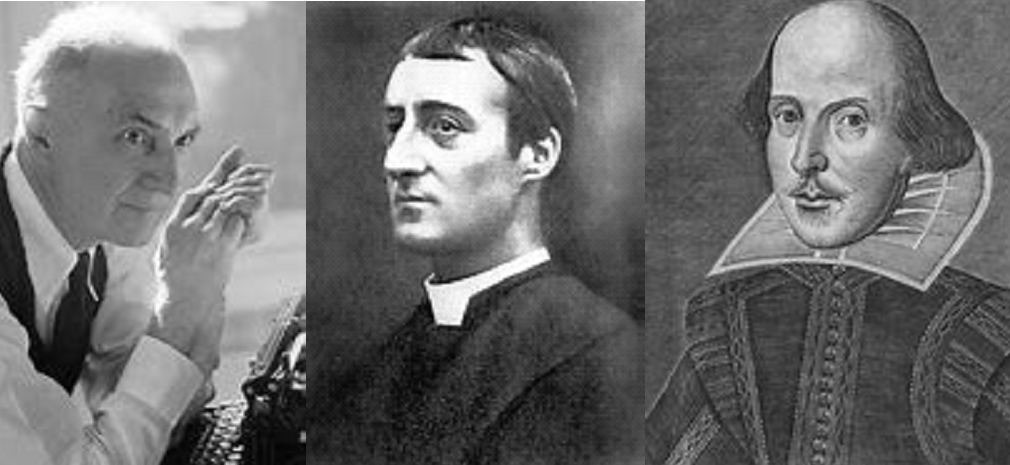
Williams-Hopkins-Shakespear 3 collars

Collar styles of poetry, a retrospective. William Carlos Williams, Gerard Manley Hopkins, and William Shakespeare

.

5 Sonnet 97  by William Shakespeare.  I understand there’s this guy, Shakespeare, who wrote some poetry. Is it any good?

Well, the jury’s still out on that one. It is always so with art, as art happens in the present when we look, read, listen, hear. That’s a large part of what this blog is about: encountering stuff written in various ways and times and seeing what we can make of it in the immediacy of a musical performance.

“Sonnet 97: How like a Winter hath my absence been”  is  neither the calm meditation after a dream’s failure nor the roiling disgust our first pair of poems had. Instead, this sonnet is all about the ambiguity. What kind of ambiguity? Shakespeare will pick several. One of the basest tests of mental state is “oriented to time and place.” This poem certainly isn’t — that’s its most pressing point. Is it winter, summer, fall, or spring? Can’t say for sure. The purportedly male authorial voice dons rhetorical drag and speaks of his sonnets as if they are birthed from a poetic womb as if the addressed “fair youth” is the only begetter in a very patriarchal metaphor for these sonnets. And what’s the true nature of the relationship between that authorial voice and the fair youth being addressed? Complicated. Author as vassal of the ruling class?**  Lover? High-minded patronage? Some of all? Well, that’s Shakespeare’s song for us. This hyperlink will play my performance of it, or if you see it, you can use a player gadget that may appear below.

.

*The phrase is psychotherapist and author Karen Horney’s, whose mid-20th century work may still have something useful to say about us today.

**It was while dealing with this sonnet that this aspect of the “Fair Youth Sonnets” first occurred to me. I assume it’s occurred to others, but not being a Shakespeare scholar I can’t say who or where.

William Carlos Williams’ Thursday

How many poems celebrate the poet’s dream, or dreams? This one doesn’t.

It’s fair to say that American poet William Carlos Williams had a curmudgeonly streak. In this poem from his 1921 collection Sour Grapes  he holds the line for the style that early Modernists had championed to break free from the poetic fancies that preceded them. By the 1920s the Modernists were moving on to new things, and it’s safe to say that many of them had developed new fancies. Indeed, in three-years-time the first Surrealist Manifesto would be published. The Surrealists went further than our usual sentiments about the value of an individual’s personal dream presented in the context of following one’s dream with the idea that it would integrate into our plans for work or a place in society. The Surrealists didn’t want to domesticate one’s dreams to society, they wanted to bring the full wildness of dreams to the fore and let society make whatever of it.

But, here’s Williams’ poem “Thursday,”  which you can find by following this link. First off, I see that he uses very plain language here, and there’s little trickery or poetic obscurity in his manner of speech either. There are no references to ancient myths, no quotes from Latin or Greek, or even Elizabethan English. He starts by noting the ubiquity of dreams, and at least for the purposes of this poem, he doubts their worth. I like the choice of words he uses here for why he’s going to skip the value of his dreams aspirational or Surrealist: “carelessly.” In other words: I don’t care about that all,  at least in this poem’s now. Instead, he spends the body of the poem inhabiting the body of the poet — as we the reader may too if we come along with Williams.

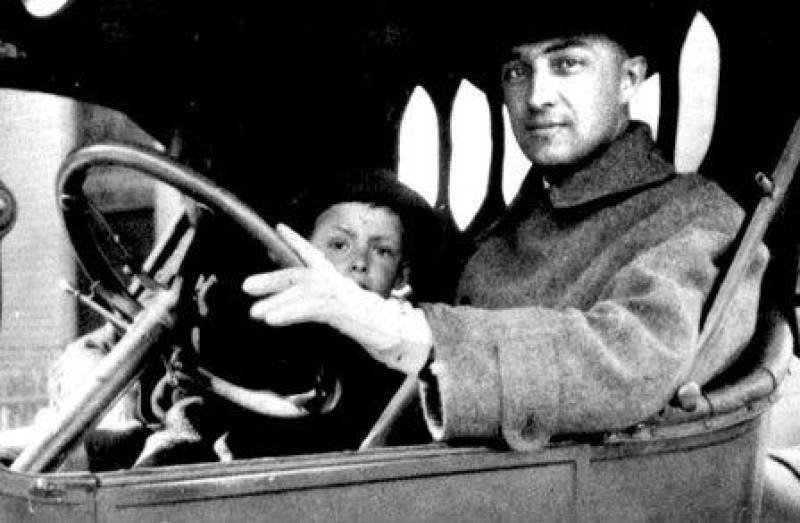
WCW at the Wheel

WCW at the wheel. “Yeah, but I’m driving and we’ll have some good ol’Imagism and none of that pretentious stuff.”

.

This is part of what I found intriguing when, as part of this project, I revisited the original English-language Modernists early work. I loved Surrealism as a young poet. I liked Dada referencing nothing and T. S. Eliot referencing whole libraries. But before those evolutions existed, what Modernism first used in English to break free and “make it new” was very concrete and radically simple: the presentation of the experience of brief charged moments that could include the revolutionary act of taking notice of the mundane and unexalted.

Like just a “Thursday”  in Williams’ life, in your life, in mine.

The player gadget to hear my performance of Williams’ “Thursday”  should be below, but if your blog reading software doesn’t show it, this highlighted hyperlink will do the job too. More work with piano this time and a return of an orchestra section. I keep hoping to return to more fierce electric guitar soon here. We’ll see.

William Carlos Williams’ January

Recently I mentioned I might return to the Modernists of 100 years ago who inspired a lot of the material I’ve used here over the years. And indeed, I read two early William Carlos Williams collections early this new year looking for material as I prepared to do that.

And then, as a novel from 1925 warned: “Somewhere back in the vast obscurity beyond the city, where the dark fields of the republic rolled on under the night….” and we’re borne ceaselessly into Make the Confederacy Great Again. Doomscrolling overcame me, and my concentration scattered without need for pepper spray. Unlike some others this week, I don’t want to play-act armed revolution — and despite the abundant wrongs and injustices of my government, I’m not even enthusiastic about the real thing. If I can’t bear up under the tedium of actual politics and its incremental proposed solutions, why then must it follow I would want the excitement of the barricades?

I had to sidestep new pieces for a while. Yesterday I was granted a few hours in which I might work on them, and so I felt compelled to return to what I had thought of using for the new year, and this poem from American Modernist poet William Carlos Williams was on the top of the stack. It’s called “January,”  and it was published 100 years ago this year.

Young Wiliam Carlos Williams

As to doomscrolling vs. poetry, Williams said: “It is difficult to get the news from poems, yet men die miserably every day for lack of what is found there.”

.

By some caprice of the muses, this century-old “January”  seems to address my situation in this one. Williams speaks of the distractions outside himself as he continues to write, and to winter’s “derisive music” he replies he’s still “bound to my sentences.” I can’t be sure what specifically inspired this poem. Williams could simply be sick of winter, that season that litters itself all over the landscape and then freezes itself in place. Or it could be speaking of his place in the Modernist movement, which was gaining traction culturally while (in Williams’ judgement) it wasn’t recognizing his part in it sufficiently.*

For our own arts, that’s an indispensable act for us: to stay committed to our work. Beside the world’s events that tell me that what art does is not quick acting enough to serve as a vaccine for our society, beside doubts that I should be better at what I do before presenting it, beside my own particular guilts that I should spend less time doing these things and more at promoting it, there’s no work to fail or be ignored unless one does one’s work.

I had to work quickly on the music, relying on some things that have become stylistic standbys for me in this Project: bowed strings (contra-bass this time), electric piano, electric guitar, and drums. In his poem, Williams develops the idea that the distracting winter wind is playing music to interrupt his own word-music. He describes this music as featuring the chromatic scale interval of the fifth. Reading the silent poem, you might think he’s talking about a dissonant interval since he also says twice the winds’ music is “derisive.” But the fifth is instead a sweet interval, even if one plays minors or major scales against it or piles on fuzzy overtone-rich distortion. From a musical perspective, I’m thinking Williams is saying that even the winter winds are not as cutting, honest, and to-the-bone as he wants to write. They’re derisive because they are merely sweet.

The player gadget to hear my performance of Williams’ “January”  should be below, but if you don’t see it, this highlighted hyperlink is another way to play the musical piece. If you’d like to read the full text of the 1921 poem, this is a link to that.

.

*The collection this poem appeared in was titled Sour Grapes.  Williams thought — and some later critics began to agree with him — that American cultural critics were more enamored of WASP writers and overly eager to establish their own Ivy League version of the Oxford-Cambridge hierarchy for poets and poetry. Williams’ father was raised in the Dominican Republic and his mother was from Puerto Rico. Now of course, both Williams and some guy named Trump both went to the University of Pennsylvania, which is officially in the Ivy League. While Williams did post-graduate travel and work in Europe too, unlike some other American Modernists he was committed to making his poetry speak in, and to, an American way.

More on that exchange published in the prologue to Kora in Hell

Did you find yourself agreeing more with H.D. or William Carlos Williams in Thursday’s audio piece taken from Williams’ Kora in Hell?  If I was to survey listeners, I’d be surprised if Williams wouldn’t win far more applause. Being that it’s his  book, and he controls what H.D. presents before he responds, it wasn’t really a neutral-site debate.

That sort of exchange could remind you of our modern political ads, where candidate A is quoted or shown in some excerpt that appears outlandish, and then candidate B is cut to saying that they think that’s just as outlandish as you think it is, and I’d never take that position, so vote for me. Except, it’s in reverse. It’s Williams, candidate B, who’s taking the more extreme position. Still I think Williams will largely win the audience.

It’s also easy to see this as a male/female dynamic. H.D. makes a suggestion, plausibly insightful, asking only for self-reflection on W.C.W’s part. Williams responds to her, in much more forceful rhetoric, defending his freedom, saying in effect when you say “sacred” I hear “heretic.” I think a great many observers of gender roles would see this as a stereotypical exchange. I agree*, but I could imagine this same exchange with the genders switched—less common, but possible. And it certainly occurs in a same gender situation too.

Something else that came to mind as I read this was a division that was made in an influential essay at mid-century, something that was still current when I was in school. This month I re-read that essay after Kora in Hell  and the telling exchange I took from its prologue. It’s by critic Philip Rahv, published in 1939, and its title “Paleface and Redskin”**  sets out the framework of its thesis, something that professors still thought relevant when I was being taught. The title is a distinctive dichotomy Rahv had observed in American literature. This paragraph from Rahv’s essay summarized the two types:

…the redskin glories in his Americanism, to the paleface it is a source of endless ambiguities. Sociologically they can be distinguished as patrician vs. plebeian, and in their aesthetic ideals one is drawn to allegory and to the distillations of symbolism, whereas the other inclines to a gross, riotous naturalism. The paleface is a ‘highbrow,’ though his mentality…is often of the kind that excludes and repels general ideas; he is at the same time both something more and something less than an intellectual in the European sense. And the redskin deserves the epithet ‘lowbrow’ not because he is badly educated—which he might or might not be—but because his reactions are primarily emotional, spontaneous, and lacking in personal culture. The paleface continually hankers after religious norms and tends toward a refined estrangement from reality. The redskin, on the other hand, accepts his environment, at times to the degree of fusion with it, even when rebelling against one or another of its manifestations. At his highest level the paleface moves in an exquisite moral atmosphere; at his lowest he is genteel, snobbish, and pedantic. In giving expression to the vitality and to the aspirations of the people, the redskin is at his best; but at his worst he is a vulgar anti-intellectual, combining aggression with conformity and reverting to the crudest forms of frontier psychology.”

Rahv ostensibly doesn’t favor either side. His observation, made by a man who could claim to be an immigrant, outside observer, was that American Lit was binary and divided with authors on one side or the other and no synthesis, and that this was a bad thing. ***

Palefaces and Redskin Potatoes

Pale faces and redskins, or 3 artists and some spuds.


It’s easy to see that divide in the H.D. and William Carlos Williams exchange. H.D. in the moment captured in her letter to W.C.W. is paleface, and Williams is redskin. Rahv expends most of his examples on novelists, and Modernist novelists like Hemmingway and Faulkner and Sherwood Anderson he feels all fail to a significant degree due to redman tendencies. But Modernist poets weren’t really in either camp as Rahv defines them. Ezra Pound could be claimed as either, and even in the two early pre-Modernist poems I’ve just presented here he tries on each personae: in “Grace Before Song”  a pious poet in service of art who will be personally forgotten and in “In Thus in Nineveh”  as an unheralded poet who will be remembered because the people value the lively if imperfect vitality of his verse.

Feel free to consider Rahv’s classification system as silly, outdated, or even distasteful. I myself consider it an amusing parlor game kind of thing, more subjective than Rahv thinks it is, and as subject to superficial oversimplifications as taking a “Which Disney Princess are you” quiz. ****

I wasn’t going to include any audio with today’s post, but after spending a day avoiding completing this post so that I could play with orchestra scoring, I figured I could read a couple more sentences also from Rahv’s 1939 essay backed by a short example of what I was coming up with. The player’s below.


*Even though Williams and English language Modernism in general coincided with the rise of women’s independence and citizenship, and even if women were participants in this cultural revolution, that doesn’t mean that Modernist men were invariably feminist—far from it. There are things to admire about W.C.W. for sure, but even in my limited reading of his work I keep getting this weird vibe from him where women are concerned.

**Yup, Rahv went there with the casual use of the racial slur. As literary culture goes in this era, totally non-remarkable and non-controversial. The first college I attended, where I heard of Rahv’s essay, had named its sports teams The Redmen, a just  more polite term. I had a tiny part in asking this name be changed. In Rahv’s defense I’ll say that he was a Jewish heritage immigrant from the Pale of Settlement. If life experience is knowledge, he likely “understood” ethnic slurs as deeply as any of us.

The kind of dichotomy Rahv lays out has analogues in modern discussions on just how street a rapper is, or debates on if performance poetry can be “real poetry.”

***From the luxurious wisdom of history, I found it fun reading the essay to see who of his contemporaries he thought was fatally damaged by this inability to join the strengths of both groups. He seems to give obvious paleface T. S. Eliot a passing grade, though noting that he had to leave America. Rahv says “Faulkner’s horror stories have long ago ceased to have any recognizable value.” History disputes Rahv there. Hemmingway is just a retread Natty Bumppo he says, an arguable case still today (even though I’ll take the other side on that one). Emily Dickinson gets an atta girl notice as a more or less successful paleface. No, additional reflection since 1939 has discovered that Dickinson is a redskin with paleface trappings.

****I’m Jasmine.