Meru

Poet William Butler Yeats had interests and a life that spanned times and poetic styles. His earliest poems whole-heartedly exhibit 19th century romanticism and prosody, but like the English Pre-Raphaelites he sought to vividly revive elements of the deeper past while doing so. His interests beyond poetry ranged as well. Last time I performed Yeats, I mentioned he had deep interests in esoteric magic, and yet the same man had a firm grounding in civic poetry while supporting an Irish cultural revival and independence from England. A poet with an already established style, he crossed paths with the American and British Modernists early in their revolution, and his later poetry shows that rather than getting his back up about their changes, he adapted some of their make-it-new approaches. Yeats employed influential American Modernist critic Ezra Pound during Modernism’s rise, and while he dipped his toes into fascist movements,* unlike Pound he seems to have drawn back from that.

Today’s piece, “Meru,”  is a late poem in Yeats’ career. I find it balancing the worldly and spiritual, and on no more authority than my own necessary to come to grips to perform it, I see it as commenting on the rise of rapacious authoritarians contemporary with its composition in the 1930s.**   Here’s a link to the poem as Yeats published it.

“Meru”  is a sonnet, a rather regular one structurally. Though the word we use for this lyric poetry form literally means “little song,” many sonnets are hard for me to perform with music. Their length is good, and lyric poetry in this context means that they focus on a compressed scope of time and experience — but the form rarely uses refrains, a powerful, almost indispensable, tactic for song attractiveness. Seeking a good musical structure, I divided Yeats one-stanza poem into four verses, with refrains after verses two and four.

Meru

The song form I reformed Yeats’ sonnet into. Note the chords shown are what I fretted on guitar, but I used a capo on fret 3, so the piano, bass, and the song song sound in Eb.

.

What do I think, as I chose to perform this, the poem conveys?

I like Yeats opening here, with its circular word-choice of “hooped,” for describing civilization’s shared beliefs. I’m unaware that this is any kind of established British Isles idiom, and the choice of this scene-setting word seems to invoke something like a key-ring or perhaps a wooden barrel or cask — and in the last image, that’s a construction that can fall apart. The opening statement continues to say civilization’s order is only an illusion, but the first three lines end by reminding us that such creations of the human mind are none-the-less great movers of reality and life. I’ll come back to that at the end today.

The second, four-line, group is remarkable in its ferocity, and I think it’s a description of mankind’s often perverse desire to gather more power, more wealth, and perhaps something they vaingloriously ascribe as rough justice while doing so. The ending line of this section serves as my first refrain: “The desolation of reality” that results from this.

Third segment, as I read it, brings in a distinct element of Yeats’ occult beliefs, starting by reminding us that the “desolation of reality” is a repeating motif of history and the fall of empires. But what’s with the two mountains introduced? Everest is Earth’s highest mountain, but it’s remoteness and location in Tibet links it with a late 19th century form of occultism: Theosophy. Theosophy is too large a subject to go into here,*** but its founder posited that certain Ascended Masters located in Tibet held onto ancient secret wisdom becoming super-human in the process. Mount Meru is more obscure to most readers I suspect: it’s a symbolic mountain, and like other symbols such as Mount Ararat, the Garden of Eden, or the entrance to the underworld, it is not an actual fixed map point, but is often referred to as being in some part of the Himalayan region. Some read the poem’s plural hermits as two hermits, one-per-mountain, and Theosophy holds to two current Ascended Masters.

I suspect these Theosophical details were in Yeats’ mind as he wrote his poem, but I don’t know if he ever wrote about the genesis of this sonnet. And luckily for most readers (and listeners today) you don’t need to know any of that. After a description of desolation of nations, I think the image of two or more hermits, ascetics living naked in snow and ice shelters in famously remote places stands as an image of the other-worldly mystic surviving with nothing but belief and the knowledge that the world’s disasters are part of some reoccurring process driven by human greed for power and wealth. Is this removed survival our fall-back in today’s world of raging authoritarians, blinded in their ravening?

And once more, I suspect the aged Yeats was thinking of his own age, of the rising of fascist authoritarians then, not just specifics of Theosophy — as a poet, one uses the images in one’s cupboard. This aged singer certainly thinks of those men and the desolation they cause as I sing Yeats poem this month. The poem ends — and I refrain on this — with a twist on the old saw: “it’s always darkest before the dawn.” Chillingly, naked in the snow, Yeats has as his dawn consolations that all tyrants (and alas, all mankind’s) glory and monuments are gone.****

Is this fate? Is this prophecy? Is this inevitable? I’m no Ascended Master — if you are, you tell me. I’m just a composer drafted by words and asked to sing them. But I promised I’d come back to the “manifold illusion” of peace, of some sustainable rule without unleashed tyranny. “Man’s life is thought” the poem said. A diverted American poet turned President once spoke of a conception, a particular manifold illusion, imagined on: “Liberty, and dedicated to the proposition that all men are created equal.” If enough believe, the mage’s trick works. I’d rather it be a kind trick.

You can hear my musical performance of Yeats’ “Meru”  with the audio player gadget below. Has the audio player become subject to the desolation of reality? No, just some ways of reading this blog suppress it. This highlighted link will conjure up a new tab with it’s own audio player so you can hear it.

.

*I’m not a Yeats scholar, and there are surely many who know more about the man and these political matters. While disappointing, I was not surprised to see he found some connections in fascistic groups, as trappings of cultural nationalism and nostalgia for some mythic past were widespread then, just as they remain in the fascistic nationalists now crowding under the aged wings of my country’s self-fancied mad king.

**Because of the later date of publication, this poem may not be in the Public Domain in the US, and this entirely non-commercial project almost always uses work in that class out of respect for author’s rights. I’m making an exception here out of a renewed commitment to civic poetry in the current world.

***Here’s more info on Theosophy if you want to wade in deeper. Having had some interest in esoteric beliefs as a young person, I carried some knowledge of it as I encountered this poem. As the Wiki article points out, Theosophy continues to influence various “New Age” ideas, but I’m not a believer.

****Some readers of the poem hold the “His” in the last line to be a godhead. I’m not sure why that would be. Could it be the then traditional capitol letter at the beginning of the poetic line leads to that reading? Or is it some element of Theosophical mythology? There’s another, non-cap, “his” in the poem, and I read that pronoun, along with its partner, to refer to elements of mankind.

Yeats’ The Second Coming

I will not write much about the Yeats poem I present today. Unlike some others I’ve performed here, it’s quite well-known. Phrases in the poem like “things fall apart; the centre cannot hold,” “the ceremony of innocence,” “the best lack all conviction, while the worst are full of passionate intensity,” and “what rough beast…slouches towards Bethlehem to be born” have been quoted, reused, and brought out as touchstones and summaries alongside distressing events. Still, if you’d like to see the entire poem “The Second Coming”  as it appears on the page, here’s a link.

Where folks do explainers for this 1919 poem, it’s usually pointed out that the Irish poet William Butler Yeats studied mysticism and magic, and alongside this short poem, he wrote other texts explaining his esoteric theories of the rise and fall of epochs. This was more than colorful stuff for poetry for him, he believed it, and believed that the 20th Century was some kind of end-times. Now that we’re a quarter of the way into the 21st Century, we seem to be running a little late — but Yeats was writing of millennia, so being off a hundred years or so might be a rounding error. And as he starts off writing of the cycles, the widening gyres of history, his sonorous phrases of dread keep coming back to us.

W B Yeats Magical Weapons

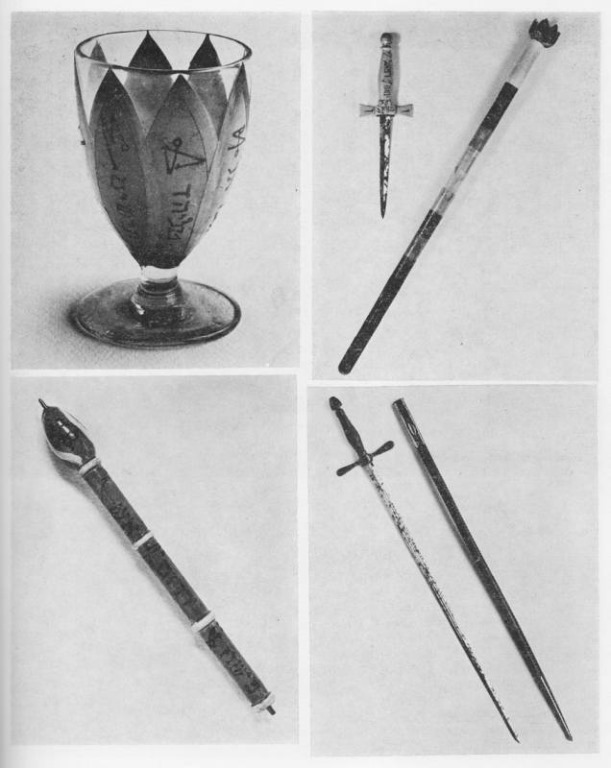
Yeats as wizard. Here are some of Yeats magical weapons. Photos from “Yeats, The Tarot and the Golden Dawn by Kathleen Raine” which I found at this web page.

.

Even ignoring all the mystical back-story, this is a poem about the breaking of nations. Therefore,“The Second Coming”  fits with the theme of civic poetry, and I put this poem down on a short list of poems to consider combining with music for this April’s National Poetry Month, but we’re nearly half-way into the month before I could complete a version that I felt was presentable.*  Given its grand scope it called for some big music, and my orchestral scoring skills have atrophied from where they had developed earlier in this project. Another way to make a large noise is to perform it with a full rock band, and I have been trying to recover my skills in that kind of ensemble playing this Spring. But there was another obstacle: I found that, unlike other Yeats’ poems, this one isn’t easy to fall into singing. The blank verse here tends stentorian, and I’m not a big-voiced powerful singer. For one stubborn section of the poem, I felt I needed to break into chant rather than try to keep the lyrical lift of singing. This sort of thing is a consequence of a composer needing to rely on a limited singer to realize the work.

The raw tracks I recorded for today’s song were somewhat messy due to the number of instruments: three guitars, organ, piano, bass, and drums, It was quite the operation to mix them even to my “good enough” level. You can hear that musical performance of W. B. Yeats’ “The Second Coming”  with the audio player you should see below. What, has that rough beast not slouched onto your screen? It’s not the end of the world — some ways of reading this blog suppress showing the player gadget. Here’s an alternative, a highlighted link that will open a new tab with its own audio player.

.

*As I write this sentence, I take stock and consider that since this Project began 9 years ago, I’ve been composing and recording the more than 800 pieces presented here at a rapid pace. To create a single album’s worth of music in a month is considered a challenge — since 2006 there has been an “RPM challenge” to write and record an album of songs during the month of February. I’ve been doing something like that, nearly every month, for nearly 9 years!

Has that been good for the quality of the work? I don’t think the answer is a straightforward “Of course not.” While there are times when I wonder about some months-long work focused on a single composition, at my age I figure anything I want to explore or express needs to be a matter of getting down to it and getting it done as well as my current skills allow.

Two Children’s Poetry Anthologies in the 1920s: Still a Colony

I keep meaning to write some things in general about the two anthologies aimed at children I’m featuring during this U.S. National Poetry Month: “A Girls Book of Verse”  (1922) and “A Boys Book of Verse”  (1923). NPM implies an American focus in its name — and these 1920s anthologies were published by an American publisher (Frederick A Stokes) with American editors (Mary Gould Davis & Helen Dean Fish) and they remained in print until at least the WWII years.

Long-time readers here will know that I have an affinity for the first quarter of the 20th century as a literary era. It’s the time of Modernism’s emergence and triumph in the arts, and English language literary poetry was transformed largely by a group of Americans: Ezra Pound, Carl Sandburg, Langston Hughes, T. S. Eliot, Robert Frost, H. D., William Carlos Williams, Amy Lowell et al.

How much of this is reflected in our two 1920’s anthologies?

Close to zero, zilch, nada, nothing,

There’s a single poem by Amy Lowell, “A Little Garden,”  a metered and rhymed poem that barely reflects her influence on a branch of Imagism, that indispensable early Modernist poetic movement. There is one Modernist with several poems included in the two anthologies — an American not in the above list, one that I’ll reveal later this month — but most of you won’t know that poet’s name.

This is not because the anthologists wanted to include only older poems from before America was in the game. Most of those published postdate America’s Whitman/Dickinson/Longfellow and the “Fireside poets” poetic emergence. Many of the poems are from the young 20th century or the final years of the old century. OK, let’s quantify how many poems by U. S. poets are in this set of English language poetry from just about a century ago.*

I did a quick and dirty count of American’s poems in these two anthologies’ tables of contents. Remember, Americans are making these two books, and while they might have been sold overseas, I suspect American parents, libraries, and children were the intended audience. Are they going to be flying the red, white and blue from the library ramparts? Cheering the home team?

Apologies for the cursory numbers to follow. Even if I’m reasonably knowledgeable about poets of this era, there are a lot of unknown authors in these two books 237 poems. Stopping to search Pamela Tennant, Jean Ingelow, Cecil Roberts, Alice Meynell, and Young E. Allison, and the like would have delayed this post.**

Here’s the rough count: 42 poems with known U.S. authors. 150 written by known non-U. S. authors (almost all British Isles residents). The poems by unknowns (which still included those in the footnote below when I did the tally) counted as 42. Given the over 3-1 breakdown in the knowns, and the revealed makeup of the short sample of the unknowns, I expect the unknowns would break similar to the knowns.

So, there you have it: about a hundred years ago — within our parents’ and grandparents’ childhoods for many readers of this post — they easily could have gotten the idea that poetry was still largely a British thing. I was surprised at this lopsidedness. I’d also say that before reading through the anthologies this year I expected at least a smattering of the Modernists, though I’m not surprised by the overwhelming rhymed/syllabic metric poetry .

And then I remembered how poetry was taught to me as an American student. Modernism was acknowledged, though things seemed to stop at Frost and Yeats. The art started with Chaucer and Beowulf, quickly moved to the Tudor poets, and spend a fair amount of time on the 19th century worthies that were included in these 1920s books.

However de-emphasized poetry may be in today’s America, I doubt we’d see such a disproportionate mix now. But before I end off today, I’ll reiterate what I wrote last time: I’m not that much of a literary nationalist, and so I’ll leave you with two non-American authors from this gendered pair of books of verse for children, two poems that speak of longing for their home nations. Both were written when the poets were no longer living in their birth countries, intensifying their poetic expressions. As I’m doing throughout this series, I’m asking you to guess if the poems appeared in the girls or boys book of verse.

The first is one of the most famous and best-loved poems to appear in the pair of books: William Butler Yeats “The Lake Isle of Innisfree.”   I was at a poetry reading here in America this past Thursday night, and not just one, but two of the reading poets said that one of their own poems was inspired by this poem of Yeats. It’s such an Irish poem that it’s printed on the Irish passport. Yet the poem was written in London, by a man whose father had moved his family to England when the poet was only two. I performed this as part of this Project in 2019, and you can hear it here with this audio player — or if you don’t see the player, with this link.

Can you guess if it’s in the girls or boys book?

The second one, is by Robert Browning, who’d eloped off to Italy with his poetic life-partner Elizabeth Barrett Browning. He called his poem “Home Thoughts from Abroad”  and I recast it for singing and call my version “In England Now.”  My aim in my recasting was to make the dislocation from an ideal England seem less a matter of geography and more a matter of time and change. You can hear that version with the next audio player gadget, or with this link.

Was this floral longing poem in the girls or boys book?***

.

It ain't cricket 600

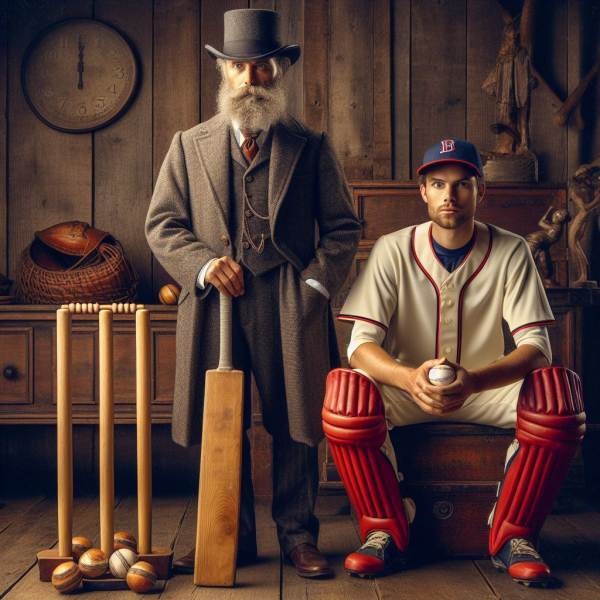
Here at NPM2024 Field the British side has shown up to face the Modernist American 9. The Brits advantages: fine woolens, bats that could also be used in a pizza oven. Americans? Plenty of sharp Latin-American players, closer, more aerodynamic beard trims. Read the post for the score.

.

*In case you’re wondering, I think the only translations from a non-English poet are a pair of William Cullen Bryant translations of Homer, and a KJV Song of Songs  excerpt.

**Anyone who knows me, knows that just typing this excuse makes me want to indeed do a web search for at least this quintet. I did. Results: only Allison is an American.

***Yeats’ poem of his bee-loud Mojo Dojo Casa Dream House was the leadoff poem in the “Girls Book of Verse.”  Browning’s poem of an April unaware for those who simply live in it was in both the boys and the girls volumes. So, if you’re keeping score, you guessed this second one correctly.

Four people doing something like what the Parlando Project does

You might know this pedant’s complaint: something can’t be “more unique” — because the word unique means the only, singular. If so, what the Parlando Project does then is quasi-unique. I well know that setting literary poems to music isn’t unprecedented, but the way I do it is  a smaller grouping. For reasons (some practical) I’ve taken to using my rough and not always reliable singing voice more often,* and more pieces have simpler arrangements featuring acoustic guitar. In the past couple of months I’ve become aware of four other people, singers and guitarists not totally unlike myself, who have being doing things related to this presentation of music combined with literary poetry.

I ran into Evan Gordon on a guitar-related online forum this year where he introduced himself as working on combining poems with acoustic guitar-centered music, including his version of a passage from Jack Kerouac that I too admire, and which supplied the name to his collection “The Long Long Skies Over New Jersey,”  a short album released this year. Kerouac’s words are there along with Houseman and Yeats and a couple of covers of well-known songs. I rather like Gordon’s poetry settings, and though there’s only three songs taken from literature, the range of the poetic sources he chose to set echoes what this Project does. So, you might well like this too. My favorite in this collection is his setting of Yeats’ “When You Are Old,”  a poem which I too have done.  I (and some other listeners) like my expression of that poem, but Gordon’s is exquisite. You can find Evan Gordon’s “The Long Long Skies Over New Jersey”  on streaming services such as Spotify or Apple Music.

Andrew Merritt introduced himself to me via a comment here at this blog regarding my versions of the classical Chinese Tang Dynasty poets, telling us he’s looked to them for inspiration too. Merritt has a collection that he calls “Twang Dynasty”  where he combines influences from Tang poems with classic American country music. Does that seem far-fetched to you? Well, I can imagine a translated scroll stroked in traditional Chinese calligraphy of Hank Williams lyrics sitting beside those of the Tang classical masters, so I like Merritt’s imagination. His lead-off cut, “Drinking with the Moon”  is Merritt’s version of a Li Bai poem I performed here.  You can hear his work at this link.

In a recent post on Carl Sandburg I tried to make the case that this somewhat deemphasized Modernist poet’s footpaths can be seen all over music in folk and Americana genres. I wrote that Sandburg blazed a path and model for Woody Guthrie, Pete Seeger, and Bob Dylan; and as an early American folk music revivalist, he personally allowed a connection between folk songs presented in the raw (not as motifs in fuller orchestrations) with progressive/populist politics and high poetic culture. Sandburg did this not only by performing those songs publicly at his free-verse poetry readings (with a voice and level of guitar skills roughly like my own, not as a concert artiste) but by publishing a pioneering general anthology of American folk song purposely mashed together from around our whole immigrant country and its various sub-cultures with his 1927 The American Songbag.

One problem with The American Songbag  as published is that it appears to be aimed at the musically literate owners of parlor pianos more than guitarists, many of whom are allergic to sheet music.**  So it was with great joy that I heard just this month of a project undertaken during the heights of the Covid pandemic by Stephen Griffith. He sought to record the entire Songbag,  all 315 songs, and to present them, as Sandburg might have sung them himself with just simple voice and acoustic guitar. I eagerly went to his web site to thank him last week, only to find that it had fallen off the web. Given his apparent age in the videos, I hope Griffith is well and still with us, that he’s perhaps just engaged with other things. Luckily, his performances are still available on YouTube at this link — and their unadorned presentation is a treasure chest. Some of the songs in Sandburg’s Songbag  became folk music “standards,” but the versions Sandburg and his collaborators collected ending in 1927 sometimes differ, not just in the folk-process of a few floating or varied verses and lines, but occasionally in entire melodies. I’ve listened to a lot of folk revivalist music over the years, but even though I haven’t made it through all of Griffith’s Songbag  versions, some of the songs I’ve heard there, taken from Sanburg’s anthology, seem new to me. Anyone interested in The Old Weird America owes Stephen Griffith a debt of thanks (well, and Sandburg too).

There’s a fourth example I want to draw your attention to: Joseph Fasano, a man who is doing some other things while also being a poetry-aware person wielding an acoustic guitar. Because of that range of things he’s doing, I’m going to leave him for an additional post to follow.

Here’s one of Giffith’s Songbag performances, a variation of a song I discussed here that my great-grandfather liked in this post.

.

*Earlier in the Project I was more likely to use spoken or chanted vocals. I still do this sometimes, depending on the text and what I feel is most effective.

**There are piano lead-sheets for the songs in The American Songbag, but no guitar chords or parts. Many/most folk music associated guitarists and singers learned their repertoire “by ear” from hearing others sing the songs, and those who wanted to notate guitar parts beyond chord sheets were likely to use guitar tablature not treble staff notation. There’s an old joke regarding guitarists as musicians: “Q: How do you make an electric guitarist turn down? A: Put sheet music in front of them.”

While technically possible in a narrow sense, it would have been an impractical task to try to present all 315 American Songbag songs as recordings in 1927. Decades later, after WWII, record collectors created anthology record albums such as the Folkways, Library of Congress, or Harry Smith’s LPs which “taught” old folk songs to new, young players. Sandburg’s existing work helped make this later work interesting — but those recording anthologies relied on dubs from 78 RPM records made a decade or so later than the era Sandburg and his collaborators were working in collecting songs from unrecorded singers.

Love and a Question

While looking for material to combine with music and perform for the Project this week I came upon a specific but little-known connection between two great early 20th century poets. I’ll go into the details of that in a bit, but before I write about that, let me set the scene by mentioning something about one of those poets, Robert Frost.

In the past mid-century, when I was growing up, Robert Frost was a poetic institution. He’d won four Pulitzer prizes, his work was as well known as any living American poet, ordinary readers might have familiarity with some of his best-known poems, and a few phrases from those poems had entered general usage. It was not uncommon for the schoolbook poetry anthologies that I’d encounter back then to end with Robert Frost. If he wasn’t the end of poetry, he was as good a symbol as any of the end of poetry as it was consumed up until that mid-century time, where literary poets wrote verse that was assumed to have a chance at general readership and could have evident value to them. He wasn’t Tennyson or Longfellow exactly (Frost’s sound was more like common American speech) but you could see him as a proprietor in the same trade as the 19th century giants.

He was enough of an institution that schoolboy-me was having as little to do with him as I could. Sure, he was living, but that was no help, because he was old.  Many dead poets left young corpses, paintings, engravings, or photographs of dashing writers, heads cocked with their thumbs and index fingers up against their visionary brains. Keats or William Blake, now there  were my comrades, not Frost. I plead youthful ignorance and concerns, and Frost’s poetry stuck around to eventually inform me in my foolishness.

So, it surprised me to eventually learn that for nearly half his life Robert Frost couldn’t get arrested as a poet in America, and he wasn’t doing all that well in finishing college or finding a steady day gig. Frost may have been trying, but he wasn’t trying very long in any one place — inevitably either they or he wasn’t for having him stick around. Nearing 40 years old, Robert Frost did something next in his unstable life: he went to England. What was this guy, that by my time was the quintessential American-scene poet, thinking?

I’m not enough of a scholar to know for sure, though reading a few Frost bios would probably inform me. One good theory: nature poetry and poetry about rural subjects was having something of a bloomlet in England. If England had led the way in industrialization and empire building, an in-reaction interest for literature about the countryside and country living was arising.

Within a couple of years of arrival Frost connected in England as he’d never been able to do in New  England. He published his first two collections of poetry. He formed a close friendship with British critic Edward Thomas (and in return convinced Thomas to write poetry). He ran into another American ex-pat, Ezra Pound, and the younger Pound trumpeted the now 40-year-old Frost’s poetry back to America as part of the coming new thing.

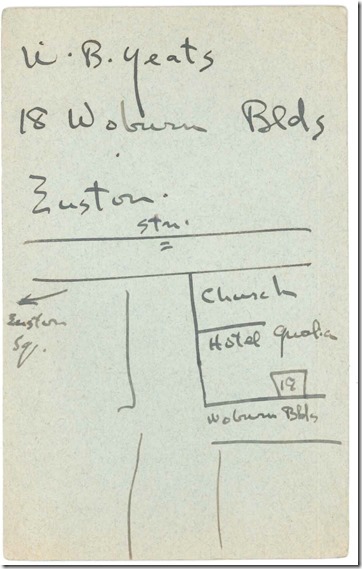
Imagism in action Ezra Pound, acting as a Georgian-era GPS, drew this map to show Frost how to get to Yeats place in London.

.

And there may have been another factor, a hoped-for connection with another poet: William Butler Yeats. Yeats wrote of the rural Irish  countryside of course, and I had never associated Frost with the Celtic revival at all. Just in preparing for this post today, I took note for the first time that Frost’s mother was a Scottish immigrant. Why did I start to look into that kind of connection?

I started re-reading Frosts first English-published collection, A Boy’s Will,  where I came upon this poem with a generalized title: “Love and a Question.”   That poem stood out at first glance because I could easily see how it could be fit to a folk-ballad style musical accompaniment. It even included a close variation of a floating verse line used in several folk songs “Her heart in a case of gold/and pinned with a silver pin.” But then there’s a second line too: the woman by a country hearth with thoughts of “the heart’s desire.” Here’s a link to the full text of Frost’s poem.

That second line would have been unremarkable except for the accident of performing a Yeats poem from an early verse play of his The Land of Heart’s Desire  this past winter. I link to my post on this if you are new or have forgotten, but this play sets up a nearly identical situation to Frost’s “Love and a Question.” A newly married couple are in a remote cottage on a stormy night. A knock at the door, and we are introduced to a stranger who asks for some comfort — but who is, it’s inferred, a fairy who wishes to enchant the new bride.

How well did Frost know this piece by Yeats? In research this week I found out that while in one of his short-lived teaching jobs before leaving for England he’d directed Yeats play with a company of his students. Cites I can find online mention him putting on this play,*  but nothing I found mentions that he also wrote this poem rather directly dealing with the play’s same story.

What does Frost bring to Yeats’ material? While his poem is understandably more condensed than even a one-act play, Frost obscured the situation considerably over Yeats well-told fantasy tale. The few attempts to write about Frost’s poem I found online catch nothing of the fantasy element because Frost makes that so unclear. Yeats’ stranger at the door is portrayed as odd and troubling soon after the character’s arrival, yet other than the continued borrowings from Yeats plot, the only thing in Frost’s text that suggests that the stranger is not a mortal is the peculiar detail of the stranger carrying a ”green-white stick” which if read in the context of Yeats’ tale may be interpreted as a wand or wizard’s staff. The stranger in Yeats is an active character, throwing themselves into the newlyweds’ relationship rapidly. Frost’s stranger is but spoken to and doesn’t act or speak other than the knocking entrance. The bride in Yeats has some action and agency in her own thoughts. The bride in Frost is a single tableau by the fire. The fears of the bridegroom are expressed in both the verse play and the poem, but in Frost’s poem he seems to be talking almost to himself. Endings? Spoiler alert: in Yeats’ play the bride dies, and it may be guessed that her soul-spirit has been taken by the fairy-stranger. Frost’s ending is vaguer. The bridegroom seems to say he understands the protocols of regular alms-seeking, but he can’t understand why someone would be so rude as to interrupt a new wedded couple on their honeymoon. Yeats’ bridegroom is anxious, but wary as he tries to win the occult battle, even though he fails. Frost’s bridegroom seems, well, puzzled.**  Is Frost satirizing Yeats tragic Irish tale, suggesting that a real rural bridegroom wouldn’t figure out what was going on? I might be missing something, but does the poem feel like a satire? For the bridegroom to be a fool wouldn’t surprise a Frost reader. Many kinds of human foolishness, misunderstandings and limitations are portrayed in Frost poems.

This brings up another factor. This early Frost poem isn’t very Frostian. The story, such as it is, isn’t clearly laid out, and the language and prosody — this seems impolite to say about this master — is awkward. I thought this poem would be easy to sing. It wasn’t, and I think that goes beyond my limitations and the brief time I could obtain to work on recording this. The poem strains natural, clear syntax and order at times to make the rhyme, and it doesn’t show well Frost’s famed use of metered verse that sounds like natural 20th century American speech. I don’t know if being so confusing adds to the weird tale, though as an aficionado of handed-down folk music there are times when the stuff that falls out through worm-holes or is forgotten in the folk process does add power by mystery. No one really knows for sure what “Smokestack lightning” is, or what it has to do with the rest of what Howlin’ Wolf sang about, and most don’t know what the hell a cambric shirt is either. We know only that something strange is going on. The listener here may be like Frost’s bridegroom: with some passion though puzzled.

So now you know that Robert Frost wrote a poem after a verse-play by Yeats, and you can hear me work to bring that Frost poem to music with the graphic player below. If that player doesn’t show up at your door, wave your magic pointer and strike this highlighted link to open an alternative audio player.

.

*Introduction to a Frost anthology The Road Not Taken by L. U. (I’m thinking, Louis Untermeyer), Yeats and American Poetry  by Terence Diggory, and Robert Frost: A Life  by Jay Parini. The latter quotes Frost writing that Yeats was able to “make the sense of beauty ache.”

**The ballad tradition includes tales of ordinary folks who by luck, pluck, or guile beat the occult challenger. I don’t know how well Frost knew his Child ballads, but he did know the golden heart box with a silver pin. Still, I can’t think of one offhand where the mortal wins just by being a bit dense about what is going on.

Winter 2022-2023 Parlando Top Ten

It occurs to me that it may have been a while since I’ve reminded new readers what the Parlando Project is, has done, and tries to do. It started as an idea around 2015 to focus on something I’d done off and on for decades: to combine other people’s words, usually literary poetry designed to be seen on silent pages, with a variety of original music.

I did this not only because I think it’s fun, but because the process allows me to more deeply absorb some sense of what the poets are trying to convey. At least for me, I can read a poem with my eyes and sense that there’s something wonderful there — but then to read it aloud, perhaps even to sing it, allows me to inhabit it, to visit the environment inside it, as if one is deep inside some forest, awash at a water-brink, or walking down its street or inside some meaningful building.

Reading a poem silently is like looking at a picture. Performing it aloud is painting the picture with the words still wet.

Early in the Project many of these performances were with others, most often my long-time musical partner Dave Moore. For a number of reasons those opportunities have decreased. These days the typical musical setting here is composed, and all the parts played or scored, by myself. I’ve done a handful of pieces in the Project without instruments, but that’s unusual. I think that even though they are played by a one-man-band I want the words to have companions. Even the loneliest poems can have these here.

I do these pieces myself, not because I have great confidence or a high appraisal of my musicianship. Far from it. I compose and play the parts because I’m available. I’m an amiable contractor to myself, I enjoy playing different instruments, and I’m unafraid to dive into a variety of musical environments. My estimate is that most musicians who hear what I produce for the Parlando Project are unimpressed by this work, in that I almost never get responses from them when they are exposed to it.*  My guess is that is because I use simple ideas, and my realization of even these basic conceptions via my own playing has imperfections. My musical “thing” is more at participatory folk music or the punk/indie ethos — and though I try to produce good work here, and I’ve put effort into that, I don’t consider many of the Parlando Project pieces the best realization they could have. When I’ve taken to putting up chord sheets of some of the simpler acoustic guitar pieces here in the past year, I’m thinking that a better singer or player might take them to a better musical place.

Hepcats of Venus

Imaginary band gets down in beatnik cellar. Illustration shows my younger self & spouse in the center. W. H. Auden taps his cig on the ashtray in the foreground. Behind the drummer, Gertrude Stein considers Virgil Thomson.

.

Now let’s get on to a brief rundown of the Parlando pieces that were most liked and listened to this past winter. I do this countdown style, from 10 to the most popular. The highlighted titles are links in case you’d like to see what I wrote about the pieces when I first presented it.

10. All Souls Night by Hortense Flexner.  Long-time readers here will know I like to go beyond “Poetry’s Greatest Hits” here, and this spooky piece by a little-remembered author from the time of WWI continued to be listened to long after Halloween.

.

9. “Uncle Sam Says” by Waring Cuney.  This one, jumping forward to the WWII era, is almost cheating, as Cuney, a friend of Langston Hughes, engaged here in straight-out songwriting with bluesman Josh White. I’ve been playing a bit more bottleneck slide guitar this winter, and that’s what I used to accompany this message song about a segregated military.

.

8. “Now Winter Nights Enlarge” by Thomas Campion.  Speaking of songwriters: poet, musician, and Elizabethan-age physician Campion also intended this to be sung — although, as with “Uncle Sam Says,”  I didn’t use the original music for my performance.

.

7. “The House of Hospitalities” by Thomas Hardy.  A poet who spanned significant chunks of the 19th and 20th centuries, Hardy was well-versed in poems of rich remembrances, as in this Christmas season memory of holiday celebrations past and gone.

.

6. “I’m Sorry for the Dead Today” by Emily Dickinson.  One of three appearances by this crucial American genius, this one a jolly remembrance of a cooperative harvest time in Amherst.

.

5. “I’m Afraid to Own a Body” by Emily Dickinson.  An opening line or two in a poem can grab even the most inattentive reader sometimes, and this poem’s opening pair of lines certainly did so for me this winter.

.

4. “Fairy Song” by William Butler Yeats.  Like many a Yeats poem, this one beguiles you and me with its lovely word music. Then I read the play whereupon the poem appears and discovered that its context is exactly that for the song’s singing fairy: a beguiling away of a distressed person from their heart, hearth, and home. That wind that opens this poem is chilling once you know.

.

3. “I felt my life with both my hands” by Emily Dickinson.  I cannot say authoritatively what Dickinson intended the context of this poem to be, but I read it as an examination of body dysphoria, though I’m unsure if anyone else has “read” her poem that way. As I have sometimes done, I’ve performed this with what I call an “Inline Epigraph,” quoting a line from a Lou Reed’s song “Candy Says”  before the concluding section of Dickinson’s text in my performance. I often think of poems as being in conversation with each other.

.

2. Railroad Avenue by Langston Hughes.  I spent an enjoyable but inconclusive time searching for the “real” Railroad Avenue, thinking it could be like Van Morrison’s Cyprus Avenue or a NYC address in a Frank O’Hara poem. Couldn’t find it. May be it’s only mapped in Hughes’ imagination, a construction for the purposes of the poem. Long-time reader rmichaelroman reminded us in comments that America’s separations often are lined by being right in one’s memories from the “wrong side of the tracks.”

.

1. “I’m Gonna Make Love to my Widow ‘fore I’m Gone” by Frank Hudson.  Another bottleneck guitar piece that readers and listeners liked a lot this winter. Well — a self-penned piece about good old-fashioned winter randiness made it to the top of the Top Ten. Go figure. They’re talking single digit wind-chills and a March snowstorm as this week ends up here in Minnesota. Codger cuddling is carbon-free heating people!

.

.

*I ascribe this to politeness on their part. I tell myself that I overvalue the audacity and aims of what I do, when simple competence with simple ideas might be preferable.

Yeats’ “A Fairy Song”

A person I know as a poet told me at a reading that he was playing with his Jazz combo on Sunday, assuming (rightly) that there would be some interest on my part. I told him I wasn’t sure if I could attend, since I live in a household with two distressed persons. They nodded as if they understood.

If you’ve noticed that this Project has been more intermittent, that’s much of the reason. The typical post here starts with looking for interesting texts, researching a bit about their context, composing, playing and recording the music, and then finally these blog entries about my encounters with the poems and the process of presenting them. The order of these events isn’t set in stone, occasionally there are gaps between steps, but it’s also common for each step to take an open-ended block of concentration. My desires to support those I love, their needs for quiet, and frankly, my unease held in common with theirs, has made that kind of focus rare for several months, wearing down what storehouse of steps I have for new pieces of work.

In place of that, I’ve taken up two things that more easily fill the odd-lots moments of time that come to me. I’ve increased Twitter promotion of the over 650 pieces in our Parlando Project archives found here.*  I’m doing that enough that I’m probably seen by some as an ignorable nag by now, and the results so far in drawing traffic are only slightly better than my attempts on Twitter made during last National Poetry Month. Still this substitute effort to promote the various ways that music and words can combine makes me feel like I’m not abandoning this Project’s goals.

The other activity is reading, which of course has always been part of the Project, but I speak of reading that isn’t directly tied to finding a new piece or understanding its contexts. I’m mostly reading books about musicians, music, or poets for pleasure and as a reset from life stress.

But enough about me and troubles that aren’t yours. This post is getting tardy in getting to today’s work by William Butler Yeats. His “A Fairy Song”  comes from a fairy story told in a verse play from early in Yeats career. Most recently we’ve presented a later Yeats poem “A Coat”   in which Yeats is looking askance at this sort of earlier work and at those who chose to copy his early style. “A Fairy Song” is  very pretty, and you could enjoy it just as fantasy word-music — decoration not declaration or anything much. I enjoyed the poem from first reading on that basis. In times of trouble, why not some dancing fantasy?

A Fairy Song

Easy chords & simple arrangement, and like many of my Parlando Project pieces, offered here in case other singers want to sing it.

.

However, after waking in the middle of the night last night I read the play The Land of Hearts Desire  that this poem appears in twice, introduced inside the play by a fairy child. Let me quickly summarize the plot: a young bride is beguiled to take in a beautiful child who comes upon their rural poor Irish cottage at night. She gives the child food and warmth, and in return the child reminds her that her loving marriage means bondage to grinding tasks of life and family duties that will have no release until death — but if the young bride comes away with the beautiful child to the otherland of the faery, they will have nothing but carefree joy.

It’s a commonplace that fairy stories have psychological depth, and so to my mind in the middle of my night, I was ready to take this one in beyond idle fantasy. I hold for the loving marriage. I hold for duty. Ever the freedom and fate for breakage, ever the poverty or wealth of what we can give and bring — beside and knowing that — I’m for that above music and magic. And readers, I love music and poetry a great deal.

That poet who plays saxophone in his jazz combo? I waited until an hour before the show started, things were clear, I went off and saw them play. I was worried: jazz plus poetry is a formula that might each reduce the additive audience, but an appreciative 50 or so showed up scattered about the theater. A stranger a couple of seats over thought the keyboard player sang like Chet Baker — and yes he did. The playing was fine, and at my age I might have danced, but the fixed theater seat aisles would have kept a dancing ring from forming.

The next day I had what turned out to be a bit over an hour to find music from “The wind that blows out the gates of the day.”** I did so and quickly recorded this simple setting with acoustic guitar of Yeats’ “A Fairy Song.”   You can hear it with the player gadget below. No gadget seen? This highlighted link will play it too.

.

*If you’re following the Elon-Musk-takes-Twitter farce of Internet doors opening and closing amid much bumbling, you may be curious about my take on this. No time today. There are some interesting people there, including a small poetry community — that size like all poetry communities. Twitter’s design, which long predates Musk, is conducive to folks like me with unknown blocks of time from a few minutes to sleepless doomscrolling hours. I personally find it impossible to keep up with WordPress on my phone, even though I treasure the blogs I follow when I can find time at a larger computer screen.

**If you’re interested in a deep dive into the Irish faery mythology that Yeats was using in his play and poem, this web page will give you quite a bit to go on.

Yeats’ Coat

Let me briefly slip, Wordsworth-like, into reverie, and note that “Oft, when on my couch I lie in vacant or in pensive mood…” I turn to the vast daffodilian array of scanned material available from a brief Internet search. I’d been thinking about Irish poets after reading this exchange between poets Ann Grá and Sean Thomas Dougherty.  Grá asked “What’s the best way to improve one’s active writing vocabulary?” Dougherty’s answer? “Read Irish poets. Everything will improve. Including life.” Irish poets mentioned — and William Butler Yeats enters the chat. You may have noticed that I led-off last time by remembering a Yeats poem about a friend whose work has come to nothing. This all entered into seeking another Yeats poem to perform this week. I came upon this one. Poetry workshop devotees, note that I read it even though it has just about the most generic title imaginable: “A Coat.”

But here’s the neat thing: I was able to read it in its first American publication, situated exactly with added meaning and context in a scanned copy of a 1914 number of Harriet Monroe’s Chicago-based Poetry  magazine. Poetry,  the magazine, was fairly new. Yeats reputation was well-established — so publishing a tranche of new Yeats poems was likely “a get” for Monroe rather than a breakthrough for an emerging poet. With rhyming coincidence, the selection of 11 Yeats’ poems begins with that one from last time “To a Friend Whose Work Has Come to Nothing,”  and ends with today’s: “A Coat.”   These poems are followed by a short editor’s note from Monroe who writes of the resistance from cultured readers to the Modernist verse her less than two-year-old magazine had received, singling out the objections to Carl Sandburg’s Chicago poems* she’d published. Then as I read the scanned magazine, and without even a page-break, the indispensable English-language Imagist Mephistopheles, Ezra Pound, pops up from the hellmouth trap-door with a review of Yeats new verse.

Then, as often now, what sits on the page as if it’s an objective bit of selected poetic criticism is really an insider comment from those who already know each other in some way.** Pound reviews “A Coat”  specifically in his piece, just a few pages past the poem’s American unveiling. “Is Mr. Yeats an Imagiste?” Pound is rhetorically asked. “No,” Pound answers himself, “but he has written des Images as have many good poets before him.” In writing here about Yeats then current poetry Pound praises the directness of style and unfussy language and syntax the Irish poet is now using. He mentions that Yeats’ earlier poetry with a more 19th century music and setting has attracted followers and imitators in their now 20th century, but perhaps the imitators miss some of its vitality — so much so that Pound wonders if the reader would “Rather read Yeats in the original” than these bad copies. Pound’s conclusion? “I’ve not a word against the glamour as it appears in Yeats’ early poems, but we have had so many other pseudo-glamours and glamourlets and mists and fogs since the nineties that one is about ready for a hard light.”

So, why do Irish writers have something to teach us other English speakers about using our language. First off, as a colonized and exploited country, they may look at the language from a critical parallax. If it’s the language of your colonizer, your oppressor, you may want to ask what English words should  do, and you have reasons to be warry of what they can  do.***  And I have a second idea, less fully-formed, that the whole mists and fogs of Celtic folklore, to which Yeats added his own caldrons of turn-of-the-20th-century magic and occult stuff, offer a conscientious poetic distiller a chance to speak the shades of the ineffable vividly in their poetry because their folkloric traditions and magikal folderol have already saturated their personal needs for glamorous elaboration. Other poets embroidered robes, either traditional or ceremonial, will get caught in such, but if one can escape, you have the contrast of a new clarity. This clarity is different — you have the experience of having worn the long robe, and now the new Eden.

Adam-Eve

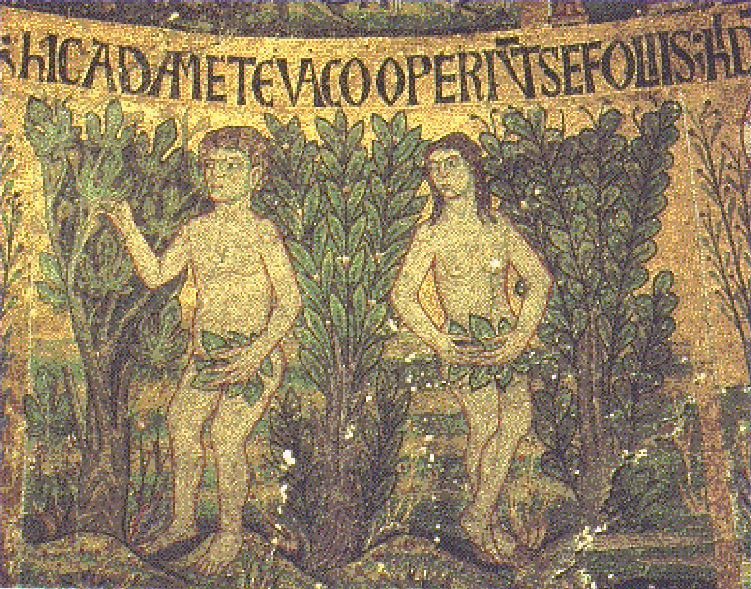
Eve ate from the tree of knowledge, then Adam explained plant-based couture  Eve wonders why she suddenly knows the Latin genus Toxicodendron.

.

Today’s performance of Yeats’ “A Coat”  has music for solo acoustic guitar, something that I’ve fallen back to often this past summer. The final guitar performance turned out to be an exercise in the various timbres I could pull from the guitar. The tuning and chord voicings used had several two and even three-string unisons which resonate and sustain, and then some contrasting pizzicato muted notes. You can hear it with a player gadget below — or if you don’t see that, with this backup highlighted link.

.

*Reading Monroe’s 1914 account reminds me of just how alien Sandburg’s poetry must have seemed to an early 20th century ear. To my 21st century ear and mind, I can more easily find the music in it, and I treasure now his Imagist “direct treatment of the thing” being applied to ordinary life, workers, immigrants, and the cultural powers that obfuscated that with elaborate English language.

**The American Pound and the Irish Yeats were both in London at this time. It’s likely that Pound himself was the conduit by which the new Yeats poems found their way into Monroe’s magazine. London then was the locus of the new Imagist ideals which stressed simplicity. Poets who wrote primarily in metrical and rhymed forms then, such as Yeats, Frost, Hardy, and Edward Thomas absorbed or resonated with this new, fresh, directness as a poetic effect.

***Though for various reasons this project has limitations on using modern English-language poetry, it strikes me that contemporary American poetry benefits from similar parallaxes. I was going to supply a catalog of those groups who know English as having been used as the language of an oppression, but it occurs that anyone who’d go with this thought can already supply their own catalog.

Yeats’ “He Wishes for the Cloths of Heaven” for National Poetry Month

Continuing our National Poetry Month celebration, here’s another poet’s love poem, loved by other poets, William Butler Yeats’ “He Wishes for the Cloths of Heaven.”   If Millay’s “Rosemary”  portrays a relationship turned cold, “He Wishes for the Cloths of Heaven”  is more at the wooing stage.

The speaker in Yeats poem begins by saying that they’d offer their beloved heaven or the heavens — well, to be exact, a luxurious simulation as some kind of cloth — and then not care that the beloved might just use it like a rug and walk all over it. And then they say they don’t have those cloths of heaven, only a dream. Still, the beloved can walk on that, the poet’s dreams; but the poem finishes with a plea that they should walk softly on that treasure, the wooer’s dreams.

In this short eight-line poem, Yeats does some fine things. First — no surprise if it’s Yeats — it sounds beautifully, and he does this almost entirely with meter, supplely alternating two and three foot beats in my scansion of it, though you can force an iambic feel.*  Unlike many poets and poems that pour on the consonance seeking musical sounds, he avoids this here other than “dim and dark.” Nor is end rhyme a factor, though there are 2.9 internal rhymes in the entire poem (“night” – “light,” “spread” – “tread,” and “cloths” – “enwrought.) Instead, Yeats leans on repetition of words, even though one can read or hear this poem without noticing just how heavily repetition is used. These words are repeated at least once: “cloths,” “light,” “feet,” “I,” “dreams,” “spread,” “under,” “my,” and “your” along with generally-repeatable articles like “and” and “the,” and with only 61 words in the entire poem, almost half the poem has another half echoing it.

It’s also subtle in it’s meaning. Yes, it has been used in “real life” as a wooing poem by others, but being subtle in a valentine is a risky business. Yeats himself originally published this as a persona poem in the voice of a character as “Adah Wishes for the Cloths of Heaven,”  even though many identify this as an expression of his in-real-life love for Maude Gonne. But notice this: the poem’s speaker would be extravagant with something he doesn’t own (and maybe no one could own fabric as rich as heaven) — but he’s asking for some mercy with the actuality of his immaterial dreams.

So, there’s a lot here for other poets to admire, but there’s more: this poem restates the situation of most poets when they are writing too. We plan to create the closest we can with words and their weave to the heavens — and those plans, those wishes, are our dreams. And then — like Maude Gonne, the plausible love interest this poem may have been directed to — people walk, not on them, but around them.   Don’t be dismayed, such is life. All Artists Fail.  We are the wooers, and then when we read or perform poetry such as this one by Yeats, we become the lovers, the beloved.

Watch here for views of a statue depicting this poem created by Jackie McKenna that I much admire. One thing I just noticed when doing this video: the crouching figure of the wooer looks quietly satisfied viewed straight on, and then in the final profile shot, a little sad or resigned. Intended or trick of the light?

.

Three ways to hear my music and performance of Yeats’ “He Wishes for the Cloths of Heaven:”   there’s a player gadget for some, this highlighted link for others to use, and, at least for now, I’m continuing to create new lyric videos for this National Poetry Month series, and that is available above.

.

*That sort of repetition with variations, trod gently, gives a better musical effect in most cases.

The Folly of Being Comforted

Readers often hear different poems when reading the same text. It’s unavoidable, even though it causes some authors to despair at how they are misread. So, it should be no surprise that it is possible in performance to recast poetry considerably without changing a word.

Around 1902 Irish poet William Butler Yeats wrote a poem taking exception to a too-easy consolation meant to comfort. He cared for the poem enough that around 20 years later he revised it slightly, to emphasize his response to this well-meaning gesture, explicitly writing out the one word concise enough to underline his feelings at the offer of comfort: “No.”

Those who study Yeats’ life are pretty sure this poem is biographical and is based on his unrequited courtship of Maude Gonne. That’s a long story, and to say that these were two complicated individuals is to understate the matter. If one reads today’s text, that poem “The Folly of Being Comforted,”  in that biographical way, it makes sense. Here’s a link to that text.  That reading, coldly condensed, would have it that someone told Yeats, “Hey, that hottie that you are so enamored with — I’ve heard she’s getting older, grey hair, older skin around her eyes. Sure, they say with age comes wisdom, but never mind any of that, she’s no longer so attractive that others will be chasing her. So now, maybe your chance will come around.” And to this Yeats gives his “No,” explaining that as he sees it, she’s not lost a step beauty and attractiveness-wise.

There’s a perfectly good romantic love sonnet there, and that’s not what I performed today.

I’m mentioned this year that I have family and others I know going through infirmities and transitions. It’s not my nature to talk about them, or even to directly write of my own experience of those situations. Even though one of the principles of this project has been to seek out and to present “Other People’s Stories,” I’m hesitant to speak over their own voices*  in the same way that I’m comfortable talking about those long dead and in some cases too little remembered.

As I was working today on finishing the mix of the audio performance you can hear below, Dave called me to tell me that our friend and poet Kevin FitzPatrick had died last night. We were planning to visit him in hospice tomorrow. Now we’ll visit him when we think of him. Visiting hours are now unlimited.

Kevin FitzPatrick and Ethna McKiernan

For many years Kevin and Ethna would celebrate poetry in a public reading on St. Patrick’s Day in Minnesota.

.

Another poet we both know, Ethna McKiernan, is also facing a serious illness this year. When I read and then performed Yeats’ poem, I was thinking of these things. I recognized it was a romantic love poem, yes, but I read all sorts of undertones in it. We are meant to pass over them in the “correct” reading. Maude Gonne was all of 35 when Yeats first published his poem, the grey hair and “shadows…about her eyes” were likely subtle things. We’re all more than double that. Age is not subtle at that volume. When I read Yeats’ simple elaborating line “I have not a crumb of comfort, not a grain.” I felt my own lack of useful care or comfort I’ve offered Kevin or Ethna, partly because I fear I’d be rather bad at it, and partly because I’m less close to either of them than even Dave is. That said I’ve been acquainted with Ethna for about 40 years. I may have not been close to her in her “wild summer,” but I knew her when. Yes, the fire “burns more clearly” with her even now as Yeats says.  After all, when you get our age, there’s more fuel.

Yeats called his poem, “The Folly of Being Comforted”  and he ended the poem with that title. He likely had real feelings in this matter, long ago when he was alive. When I think of these mortal matters, now, here, my feelings are different than a witty sonnet about someone’s crude mistake regarding his estimate of Maude Gonne. And so I performed my feelings, using Yeats words.

The player to hear that performance is below for many of you, but some ways of reading this won’t display that. So, I also offer this highlighted hyperlink that will open a new tab window and play it.

.

*I feel I must guard myself in that partly because I’d easily fall into it if I didn’t.